Call Us
+86 136 6007 9809
Call Us
+86 136 6007 9809

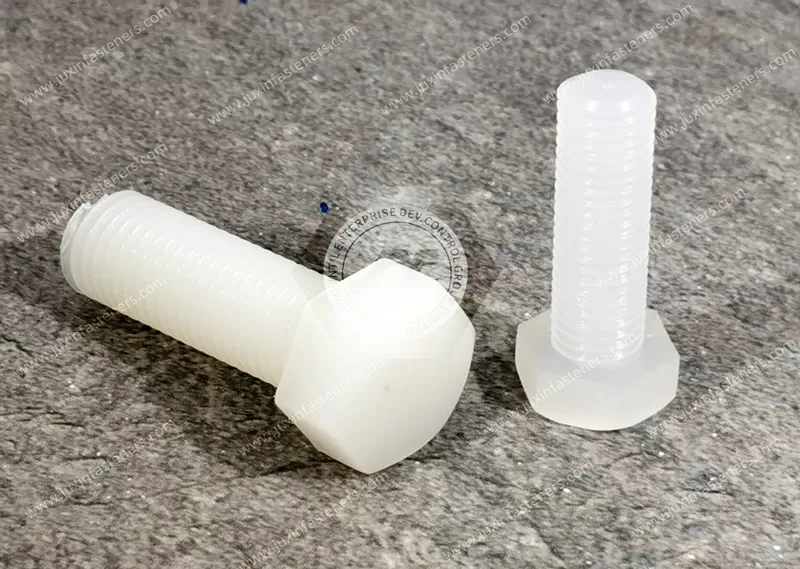
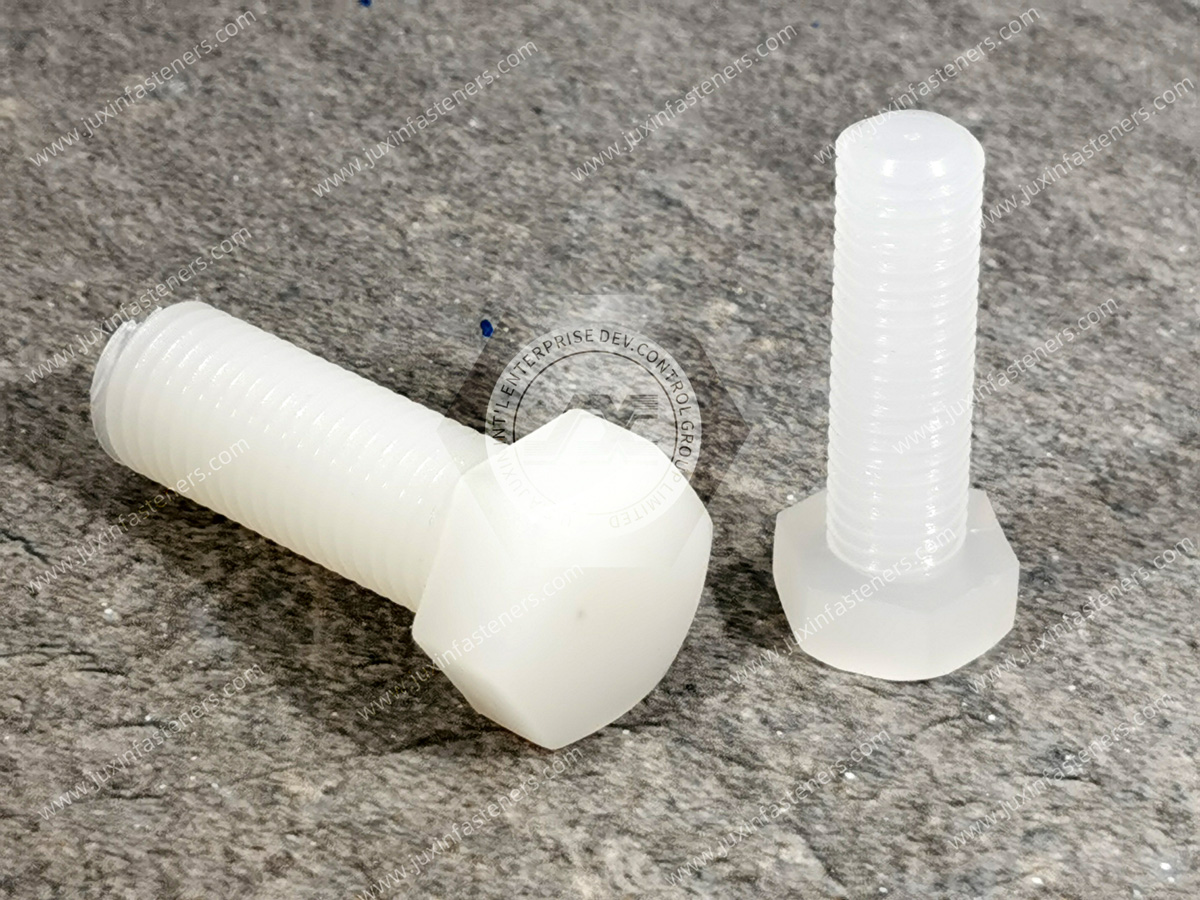
Name: PP Hexagon Head Screws
Material: PA66, PA+50%GF, PA+50%GF, PEEK, PVDF, PPS, PTFE, PP, PVC, PC
Size:M3,M4,M5,M6,M8,M10,M12,M16
Standard: GB/T5783, DIN933,ANSI/ASME B18.2.1,JIS B1180-94,ISO 4017
pp material is polypropylene; polypropylene is a non-toxic, odorless, tasteless, milky white, highly crystalline polymer with a density of only 0. 90-0. 91g/cm3 is one of the lightest varieties of all plastics. It is particularly stable to water, water absorption in water is only 0.01%, molecular weight of about 80,000-15,000. Good molding properties, but due to large shrinkage (1% to 2.5%). Thick-walled products are easy to concave. For some parts with high dimensional accuracy, it isn't easy to meet the requirements, and the surface gloss of the products is good.
1, physical properties: PP (polypropylene) is a non-toxic, odorless, tasteless milky white highly crystalline polymer a density of 0.90-0.91g/cm3, especially stable to water, 24 hours in water absorption rate of 0.01%, molecular weight of 8-15 million between. The molecular weight is between 8-15 million. It has good molding properties, but the shrinkage rate is significant, and it is easy to make thick-walled products with depression. The product's surface gloss is good and easy to color.
2, mechanical properties: PP (polypropylene) of high crystallinity structural regularity, has good mechanical properties, its strength and hardness, elasticity are relatively good, but at room temperature and low temperature impact strength is poor, the molecular weight increases, the impact strength increases, but the molding performance deteriorates.PP (polypropylene) is the most prominent performance is the bending fatigue resistance. The dry friction coefficient is similar to nylon's but not as good as that under lubricating oil.
3, thermal properties: PP (polypropylene) has good heat resistance, a melting point of 164-170 ℃, and is made of products that can be sterilized at a temperature of 100 ℃ or higher; in the absence of external forces, 150 ℃ does not deform. It has an embrittlement temperature of -35 ℃.
4, chemical stability: PP (polypropylene) has good chemical stability. In addition to concentrated sulfuric acid and concentrated nitric acid erosion, various other chemical reagents are relatively stable. Still, low molecular weight aliphatic hydrocarbons, chlorinated hydrocarbons, etc., can make the PP (polypropylene) soften and dissolve.
5, electrical properties: PP (polypropylene) of high-frequency insulation is excellent because it almost does not absorb water, so humidity does not affect insulation properties. PP (polypropylene) has a high dielectric coefficient, and with the rise in temperature, it can be used to make heated electrical insulation products; it also has a very high breakdown voltage. PP (polypropylene) voltage and arc resistance are good, but the degree of static electricity is high, and it is easy to age in contact with copper.
6, weather resistance: PP (polypropylene) is very sensitive to ultraviolet light. Adding zinc oxide, di-monthly laurel thiopropionate, carbon black, or a similar opalescent filler can improve its aging resistance.
Product Specification
PP plastic industry applications
1. Mechanical and automotive parts: Polypropylene has good mechanical properties and can be directly or modified to manufacture various mechanical equipment parts, such as industrial piping, agricultural water pipes, motor fans, and infrastructure templates. Modified polypropylene can be molded into bumpers, anti-scratch strips, automobile steering wheels, instrument panels, interior decorative parts, etc., significantly reducing the body's weight to save energy.
2. Electronic and electrical industrial devices: modified polypropylene can produce household appliance insulation shells and washing machine liners, commonly used in wire, cable, and other electrical insulation materials. It uses the weight of homopolymer polypropylene 60 ~ 80 parts, ethylene - vinyl alcohol copolymer 20 ~ 40 parts, compatibilizer (polypropylene maleic anhydride graft and ethylene - vinyl alcohol copolymer reactants) 1 ~ 10 parts, at 170 ℃ ~ 190 ℃ under the conditions of the polypropylene composite materials made of mixing with high toughness, its impact strength of up to 210J / m, with a high gas barrier properties, water vapor rate of close to 2000g - m, the water vapor rate of close to 2000g - m, the water vapor rate of close to 2000g - m. The water vapor rate was close to 2000g-μm/(m2-24h). In the preparation of barrier films, the traditional film-making process can be used for production; the process is relatively simple and produces at a low cost.
3. Construction: polypropylene fiber is the lightest of all chemical fibers. Its density is (0.90 ~ 0.92) g / cm3, with high strength, good toughness, chemical resistance and anti-microbial properties and low prices, etc., reinforced with glass fibers modified or rubber, SBS modified polypropylene is used in large quantities in the production of construction templates foamed polypropylene can be used to make decorative materials. In the event of an earthquake, polypropylene fiber ceramic concrete damage pattern for plastic damage, no fragment spalling. The selection of polypropylene fiber granulated concrete is safer than vegetal granulated concrete.
4. Agriculture, fisheries, and food industry: polypropylene can be used to make greenhouse canopies, mulch, culture bottles, agricultural tools, fish nets, etc., the production of food crates, food bags, beverage bottles, and so on. Reactive blending with waste PET (polyethylene terephthalate) to make multi-functional waste PET, multi-functional waste PET, and polypropylene in-situ fiber composite materials made of in-situ fiber composite. The composite material has waste PET to form shaped microfibers, waste PET microfibers, and PP matrix resin to form a moderately flexible potent combination of interfaces and other structural features. Waste PET, and PP composite fiber materials prepared in situ toughness and rigidity are significantly higher than the PP's, and the mechanical properties are relatively good reproducibility. China's annual production of PET waste resources has significant economic and social benefits.
5. Textile and printing industry: polypropylene is the raw material of synthetic fibers; polypropylene fibers are widely used in producing lightweight and beautiful durable textile products; the application of polypropylene materials printed on the screen is exceptionally bright, bright, and attractive.
6. Other industries: in the chemical industry, polypropylene can be used in the preparation of a variety of corrosion-resistant conveying pipes, tanks, valves, packing towers in the shaped filler, filter cloth, corrosion-resistant pumps, and corrosion-resistant containers of the lining; in medicine can be used for the production of medical devices; polypropylene can also be grafted, composite and blending process, to achieve the development of the energy sector applications.
Product Pictures
Contact Us
Tel.:
+86 020 8621 0320
+86 020 3121 6067
E-mail:
Technical Support:
Navigation
SEND INQUIREY