Call Us
+86 136 6007 9809
Call Us
+86 136 6007 9809

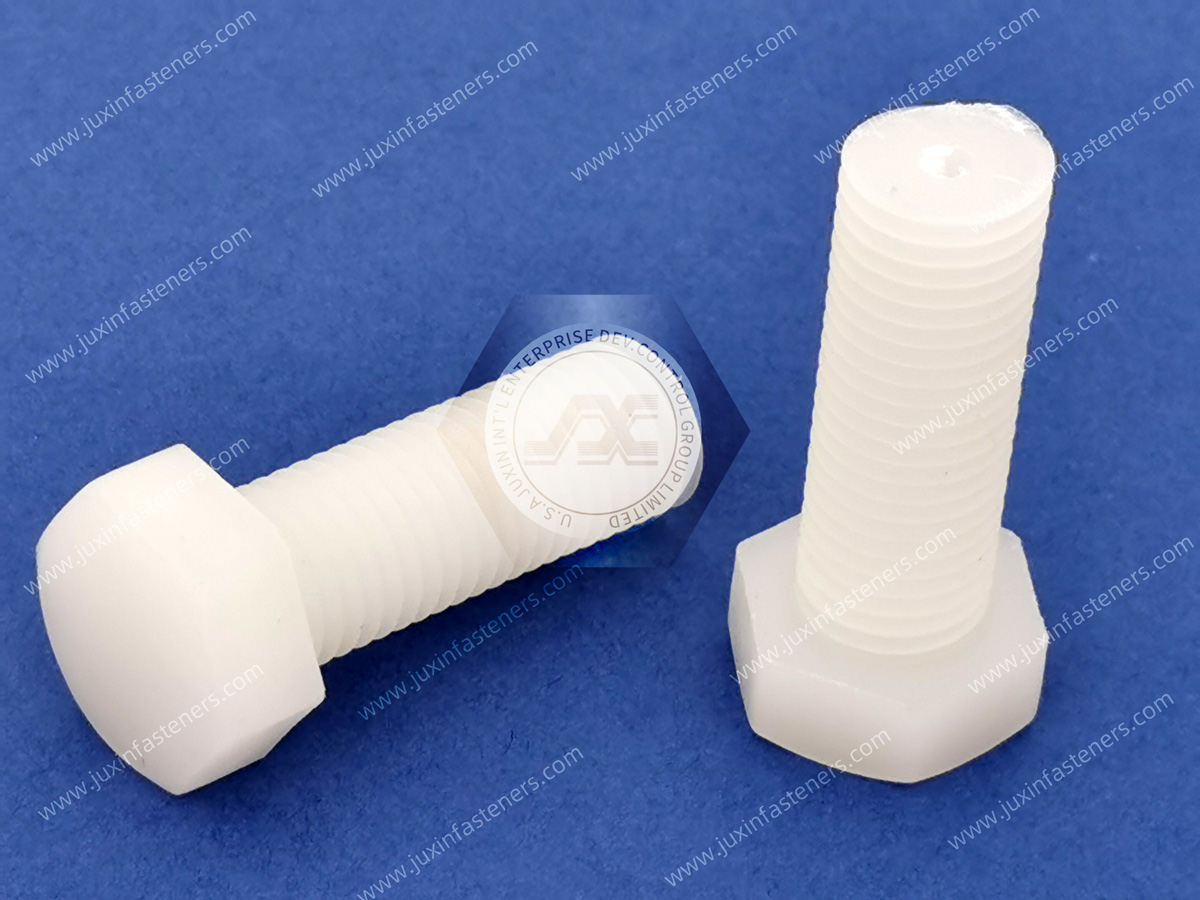
Name: PTFE Hexagon Head Screws
Material: PA66, PA+50%GF, PA+50%GF, PEEK, PVDF, PPS, PTFE, PP, PVC, PC
Size:M3,M4,M5,M6,M8,M10,M12,M16
Standard: GB/T5783, DIN933,ANSI/ASME B18.2.1,JIS B1180-94,ISO 4017
Polytetrafluoroethylene (Teflon or PTFE), commonly known as "Plastic King," tetrafluoroethylene, also known as perfluoro ethylene, is an organic compound, chemical formula C2F4, a colorless gas at room temperature and pressure, insoluble in water, mainly used as a raw material for the manufacture of new types of heat-resistant plastics, engineering plastics, new types of extinguishing agents and fog suppressants. It is a polymerized polymer compound of tetrafluoroethylene. Used as engineering plastics, they can be made into PTFE pipes, rods, strips, plates, films, etc. It is generally used for corrosion-resistant pipes, containers, pumps, valves, etc., as well as corrosion-resistant pipes, containers, pumps, valves, radar, high-frequency communication equipment, radio equipment, etc.
1. High-temperature resistance: the working temperature can reach 250℃.
2. Low-temperature resistance: good mechanical toughness; even if the temperature drops to -196℃, it can maintain 5% elongation.
3. Corrosion resistance: inert to most chemicals and solvents, resistant to strong acids and alkalis, water, and various organic solvents.
4. Weathering resistance: It has the best aging life among plastics.
5. High lubrication: It has the lowest coefficient of friction among solid materials.
6. Non-adhesion: It has the lowest surface tension among solid materials and does not adhere to any substance.
7. Non-toxic and harmful: physiologically inert, as artificial blood vessels and organs implanted in the body for a long time without adverse reactions. The surface of the medical catheter is smooth, non-toxic, odorless, and resistant to sterilization. Medical catheters for internal use do not contain harmful soluble substances and have excellent organism replaceability, biocompatibility, and blood compatibility.
PTFE has been widely used in aviation, aerospace, atomic energy, electronics, electrical appliances, chemical industry, machinery, construction, textiles, medicine, and other industrial sectors, and increasingly deep into people's daily lives. The industrial application of PTFE materials in anti-corrosion has incredibly extensively promoted the development of the chemical industry.
Product Specification
Polytetrafluoroethylene (PTFE) is a very useful polymer with excellent mechanical and chemical properties. This material is used in many different chemical, pharmaceutical, medical, electronic, aerospace, and automotive applications.
In the chemical, pharmaceutical, and medical industries, PTFE is commonly used to manufacture pipes, valves, seals, and other industrial equipment. Its high corrosion resistance and chemical stability make it ideal for handling acids, alkalis, and other chemicals. In addition, its low coefficient of friction makes it suitable for use in fluid handling and transfer applications.
PTFE is commonly used in the electronics and aerospace industries to manufacture cable insulation and other electronic components. This is because of its excellent electrical insulation properties, which prevent current leakage and other circuit problems. In addition, PTFE can remain stable under extreme temperatures and pressures, which makes it ideal for manufacturing aerospace components.
In the automotive industry, PTFE is commonly used to make seals, tires, and other parts. Its low coefficient of friction and abrasion resistance make it ideal for manufacturing high-performance tires and other automotive components. In addition, its chemical and heat resistance make it an essential material in automotive manufacturing.
PTFE is a very useful polymer with excellent mechanical and chemical properties. It is used in various chemical, pharmaceutical, medical, electronics, aerospace, and automotive applications. PTFE is an attractive option for industries that require a material with excellent corrosion resistance, electrical insulation properties, and a low coefficient of friction for manufacturing equipment and components.
1. Tensile Properties:
Tensile Strength: PTFE has a tensile strength of 3,900 psi.
Tensile Modulus: PTFE has a tensile modulus of 80,000 psi.
Tensile Elongation at Break: PTFE has an elongation at a break of 300%.
2. Flexural Properties:
Flexural Strength: PTFE will not break during bending.
Flexural Modulus: PTFE has a flexural modulus of 72,000 psi.
3. Compressive Strength:
Compressive Strength: PTFE has a compressive strength of 3,500 psi.
Compressive Modulus: PTFE has a compressive modulus of 70,000 psi.
4. Hardness:
Shore D hardness: PTFE has a Shore D hardness of D50.
5. Impact Properties:
IZOD Notched Impact Strength (IZOD Notched Impact): PTFE's IZOD Notched Impact Strength is 3.5 ft-lb/in.
PTFE has good mechanical properties. It has high tensile and flexural strengths and can maintain stability under stress. At the same time, PTFE has high compression strength. It has good compressive properties. In addition, PTFE has moderate hardness and is not easily deformed. In terms of impact, PTFE shows better impact resistance.
It has better compressive properties. In addition, PTFE has moderate hardness and is not easily deformed. In terms of impact, PTFE shows better impact resistance.
Product Pictures
Contact Us
Tel.:
+86 020 8621 0320
+86 020 3121 6067
E-mail:
Technical Support:
Navigation
SEND INQUIREY