Call Us
+86 136 6007 9809
Call Us
+86 136 6007 9809

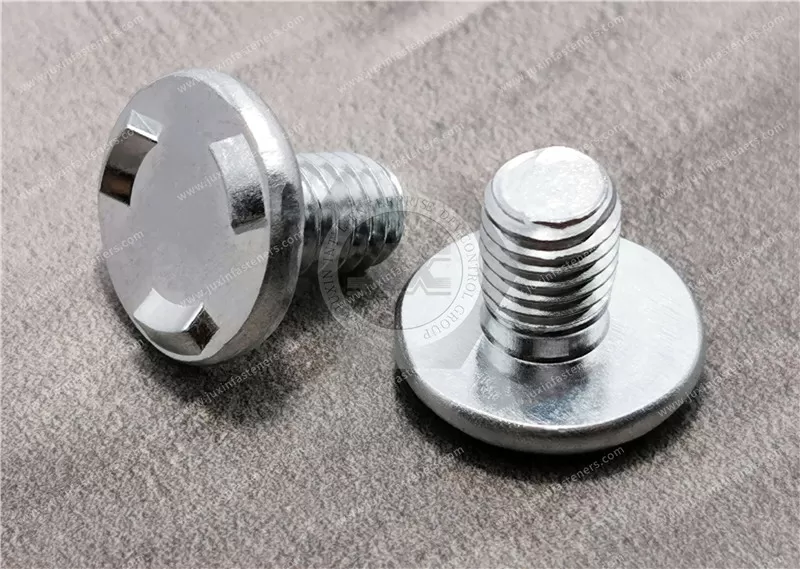
Name:Weld Stud with 3 Projections On Top of Head,Overhead Projection Weld Studs
Material: Stainless steel, Carbon steel, Brass
Standard: Q199B&QC /T 599 (B) - 2013
This Projection Weld Screw features three precision weld projections on the top of the head, allowing welding directly to (rather than through) the surface of the sheet material. The three projections are of equal height and mass and are positioned on the head to allow a robust weld connection while eliminating the need for drilled holes.
Product Specification
Projection weld bolts have three pips on the thread side of the head. The stud is inserted through a hole in the base material and welded on the reverse side, resulting in a stud with excellent pull-out and torque-out performance.
Advantages of Carbon Steel Weld Studs
Low-carbon steel weld studs are suitable for use with HRB-80 or less materials. Benefits of carbon steel weld nuts include:
Cost-effective when compared to S.S.
Ideal for high-volume machine parts
Ideal for light and medium applications
Name:Overhead Projection Weld Bolts
Material: Carbon Steel, Stainless Steel
Carbon steel Grade:5.8,6.8,8.8,10.9
Projection Weld Studs & Screws
Proj Weld Studs
Stud welding refers to joining circular-shaped parts with flat workpieces using a welding arc and applying a pressing force. Projection weld studs and screws are particular types of fasteners that are specifically designed to be welded to another object. There is a wide range of spot weld stud, and tab weld stud options, depending on the specific application.
1. The working principle of projection welding:
Projection welding is an evolution of spot welding. Generally speaking, a mountain point is punched out on one of the two plates, and then welded. Due to the concentration of current, it overcomes the defect of nugget offset during spot welding. One or more nuggets form at the joint.
2. Features of the projection welding process:
During projection welding, the electrode must drop rapidly as the bump is sub-collapsed, otherwise spatter will occur due to pressure loss, so a projection welding machine with good electrode followability should be used.
The electrode pressure should ensure that the bumps are completely sub-collapsed when they reach the welding temperature so that the workpieces can fit closely. If the pressure is too high, the bumps will be crushed prematurely, and the function of projection welding will be lost.
The reduced flow density will reduce the strength of the joint, and the pressure will be too small to cause sub-heavy splashing.
Usually, the welding time of projection welding is longer than that of spot welding, and the flow is smaller than that of spot welding. Multi-point projection welding is a slightly longer welding time than single-point projection welding to reduce the difference in heating at each point caused by inconsistent bump heights.
The current required for each spot of projection welding is smaller than that of spot welding the same spot, but the current must be able to melt the bump before the bump is completely crushed. The welding current is approximately the current required for each bump multiplied by the number of bumps.
Size Can also be According to the Customer's requirement for manufacturing, please check the detailed specification sheet details PDF, CAD, 149-150 Page See more product details.
Overhead Projection Weld Studs in Automotive Manufacturing
High-Strength Structural Fastening for Body, Chassis, and Electrical Systems
Overhead Projection Weld Studs play a critical role in modern automotive manufacturing. As vehicle platforms evolve toward lightweight structures, electrification, and high-speed automated assembly, projection stud welding has become a preferred fastening method for achieving structural integrity, production efficiency, and long-term durability.
Stud welding technology is widely applied across body structures, chassis systems, and vehicle electrical architectures. It provides permanent threaded anchor points without compromising sheet metal integrity.
What Are Overhead Projection Weld Studs?
Overhead Projection Weld Studs are specially designed fasteners with defined projection points that concentrate welding current and heat during the projection welding process.
During welding:
Controlled current flows through the projection points
Localized heat is generated at the contact interface
The projections collapse under pressure
A solid-state metallurgical bond is formed
This method ensures consistent weld quality, especially in automated robotic production lines and overhead welding positions commonly found in automotive body assembly.
Key Automotive Applications
1. Body Structure (Body-in-White)
Overhead Projection Weld Studs are extensively used in:
Frame assemblies
Body shells
Reinforcement brackets
Door, hood, and trunk support structures
By welding studs directly to structural panels, manufacturers create stable fastening points for subsequent assembly operations.
Engineering Benefits:
Improved torsional rigidity
Reduced deformation risk
Minimal heat-affected zone
Consistent positioning accuracy
Enhanced crash performance reliability
Because projection welding concentrates heat precisely at the projection interface, metal fatigue and distortion are effectively minimized.
2. Chassis and Suspension Systems
In chassis production, structural consistency and fatigue resistance are critical.
Projection weld studs are used to secure:
Suspension brackets
Steering assemblies
Cross members
Underbody protection components
Compared to multiple threaded connections, projection weld studs:
Reduce part count
Increase assembly speed
Lower total vehicle weight
Improve structural load distribution
This contributes to better vehicle handling stability and long-term durability.
3. Automotive Electrical and EV Systems
In both traditional and electric vehicles, stud welding is widely applied to secure:
Control modules
Sensor brackets
Grounding points
Battery enclosure components
For EV applications, projection weld studs provide reliable conductive attachment points while maintaining compatibility with lightweight substrates.
The strong metallurgical bond prevents loosening caused by vibration, shock loads, or long-term fatigue — ensuring electrical reliability and system safety.
Advantages of Overhead Projection Weld Studs Over Conventional Fastening
1. Automation Compatibility
Projection stud welding is fully adaptable to robotic production lines.
Benefits include:
High repeatability
Short weld cycles
Reduced manual labor
Stable quality control
Unlike traditional bolted assemblies, no tapping or secondary operations are required.
2. Structural Consistency
Because the stud is permanently fused to the substrate:
Connection integrity is uniform
Torque variation issues are eliminated
Risk of installation errors is reduced
Long-term fatigue performance improves
Projection weld studs ensure consistent structural behavior across high-volume automotive production.
3. Lightweight & Efficient Design
Projection welding eliminates the need for:
Through-holes
Additional reinforcement plates
Excess hardware
This supports lightweight vehicle design strategies and reduces overall manufacturing complexity.
Considerations in Design and Maintenance
While projection weld studs provide superior structural performance, they are permanent fastening solutions.
Design engineers must evaluate:
Service life requirements
Accessibility for maintenance
Replacement strategy in case of component failure
With proper design planning, these considerations can be effectively managed without compromising performance.
Why Overhead Projection Weld Studs Remain Essential in Modern Vehicle Production
As automotive platforms shift toward:
Electrification
Lightweight materials
Modular architecture
High-speed automation
Overhead Projection Weld Studs continue to deliver:
High connection stability
Enhanced vehicle rigidity
Improved crash safety
Efficient automated production
Long-term durability under vibration and fatigue
From body structural assemblies to chassis systems and EV electrical platforms, projection weld studs remain an indispensable fastening technology in modern automotive manufacturing.
Overhead Projection Weld Studs Manufacturer for Automotive Applications
Engineered Structural Fastening Solutions for High-Volume Vehicle Production
Overhead Projection Weld Studs are essential fastening components in modern automotive manufacturing. Designed for high-strength structural attachment and robotic automation compatibility, these studs provide permanent threaded anchor points across body-in-white (BIW), chassis, and EV systems.
As vehicle platforms demand greater rigidity, lightweighting, and intelligent production, projection weld studs have become a preferred fastening solution for OEMs and Tier suppliers worldwide.
With 23 years of experience in industrial fastener manufacturing, JUXIN delivers automotive-grade Overhead Projection Weld Studs engineered for reliability, consistency, and scalable production.
What Makes Overhead Projection Weld Studs Different?
Projection weld studs feature precisely formed projection points that:
Concentrate welding current
Control heat distribution
Ensure uniform weld collapse
Minimize spatter
Improve weld repeatability
This makes them especially suitable for overhead welding positions and automated body assembly lines where precision and consistency are critical.
Unlike conventional bolt assemblies, projection weld studs eliminate secondary threading operations and reduce assembly variability.
Automotive Applications of Overhead Projection Weld Studs
Body-in-White (BIW) Structural Assemblies
Used in:
Reinforcement plates
Cross members
Door and hinge brackets
Seat structure mounting points
Projection weld studs improve torsional rigidity and structural load transfer while maintaining panel integrity.
Because no through-holes are required, body sealing and corrosion resistance performance are enhanced.
Chassis and Suspension Mounting Systems
In chassis production, projection weld studs secure:
Suspension brackets
Steering system components
Brake line supports
Underbody modules
High-strength weld performance ensures fatigue resistance under dynamic loads and long-term vibration exposure.
EV Battery and Electrical Systems
For electric vehicles, projection weld studs are widely used in:
Battery pack enclosures
High-voltage grounding connections
Power distribution mounting structures
Low heat input and controlled welding parameters support the use of lightweight materials, such as aluminum substrates.
Engineering Advantages for Automotive Production
1. High-Speed Robotic Automation
Projection weld studs support:
Short welding cycles
Fully programmable welding parameters
Consistent weld penetration
Reduced labor cost
Production efficiency can be significantly higher than with traditional threaded fastening methods.
2. Improved Structural Integrity
Because the stud is metallurgically bonded to the substrate:
Load transfer is more direct
Joint consistency is improved
Torque variability is eliminated
Long-term fatigue performance is enhanced
This is critical for safety-related automotive structures.
3. Lightweight and Cost Optimization
Projection weld studs reduce:
Part count
Assembly steps
Secondary machining operations
This contributes to the overall vehicle lightweight strategy and optimized production cost control.
Quality Control and Manufacturing Capabilities
At JUXIN, Overhead Projection Weld Studs are manufactured under strict process control standards.
We provide:
Carbon steel and stainless steel materials
Strength grades such as 8.8 and 10.9
Custom head geometries and projection designs
Surface treatments (Zn plating, Geomet®, Dacromet®, etc.)
Dimensional and mechanical property inspection
Welding performance validation
Our 23 years of experience in industrial and automotive fastening solutions allow us to support customers from design consultation to mass production.
Consistency in weld quality is not optional in automotive manufacturing — it is mandatory.
Why Choose JUXIN as Your Automotive Weld Stud Supplier?
23 Years of Manufacturing Experience
Automotive Application Expertise
Stable High-Volume Production Capacity
Engineering Support for Welding Parameters
Customization for Special Structural Requirements
Reliable Global Supply Chain
We understand the demands of modern automotive platforms — structural safety, electrification, lightweighting, and the integration of automation.
Request Technical Support for Your Automotive Project
If you are sourcing Overhead Projection Weld Studs for body structures, chassis systems, or EV applications, our engineering team is ready to support your project requirements.
Contact us today to discuss technical specifications, customization options, and production capabilities.
Overhead Projection Weld Studs for EV Battery Pack
High-Reliability Fastening Solutions for Electric Vehicle Battery Enclosures
As electric vehicle platforms continue to evolve, battery pack structures require fastening systems that deliver structural strength, electrical reliability, lightweight compatibility, and automation efficiency.
Overhead Projection Weld Studs for EV Battery Pack applications provide a permanent, high-integrity threaded anchor solution specifically engineered for battery enclosures, module supports, and high-voltage grounding systems.
With increasing safety regulations and performance standards in the EV industry, projection weld studs have become a critical component in modern battery architecture.
Why EV Battery Packs Require Specialized Weld Stud Solutions
Electric vehicle battery packs operate under demanding conditions:
High vibration loads
Thermal cycling
Crash impact requirements
Moisture and corrosion exposure
High-voltage electrical conductivity requirements
Traditional fastening methods such as bolting or riveting often introduce additional holes, increase the number of assembly steps, or compromise sealing performance.
Overhead Projection Weld Studs eliminate these challenges by providing:
Permanent metallurgical bonding
Hole-free structural integration
Improved sealing integrity
Reduced assembly complexity
Key Applications in EV Battery Pack Systems
1. Battery Enclosure and Housing Structures
Projection weld studs are widely used in:
Aluminum or steel battery trays
Upper and lower enclosure covers
Cross-member reinforcements
Side impact protection frames
Because projection welding concentrates heat at defined projection points, it minimizes thermal distortion — especially critical for thin aluminum battery housings.
2. Module and Component Mounting
Inside the battery pack, studs secure:
Battery module brackets
Cooling plate supports
BMS (Battery Management System) brackets
Cable routing structures
The permanent threaded base ensures precise alignment and long-term resistance to vibration-induced loosening.
3. High-Voltage Grounding and Conductive Connections
Electrical grounding reliability is essential in EV battery packs.
Projection weld studs provide:
Stable conductive grounding points
Low-resistance electrical paths
Strong pull-out resistance
Consistent torque performance
This supports overall battery safety and system stability.
Engineering Advantages of Overhead Projection Weld Studs for EV Platforms
Lightweight Material Compatibility
EV battery enclosures are increasingly used:
Aluminum alloys
High-strength thin steel
Mixed-material structures
Projection welding offers controlled heat input and precise collapse behavior, making it suitable for lightweight substrates while maintaining joint strength.
High-Speed Robotic Integration
EV battery packs are produced in highly automated environments.
Projection weld studs support:
Fully robotic welding
Short cycle times
High repeatability
Reduced manual labor
This ensures consistent weld quality in high-volume production.
Enhanced Structural and Crash Performance
Battery packs must meet strict impact and safety regulations.
Projection weld studs:
Improve load transfer distribution
Increase structural rigidity
Maintain sealing integrity
Support crash energy management
Their permanent metallurgical bond enhances overall pack durability.
Quality and Performance Considerations
For EV battery pack applications, weld studs must meet strict requirements:
High tensile and shear strength
Corrosion resistance (Zn, Geomet®, Dacromet®, etc.)
Salt spray resistance
Fatigue durability
Welding parameter consistency
Precision control of projection geometry and material composition is critical to ensure uniform weld penetration and long-term reliability.
Juxin Fasteners Overhead Projection Weld Stud Solutions for EV Battery Systems
With 23 years of fastener manufacturing experience, JUXIN supplies Overhead Projection Weld Studs engineered specifically for EV battery pack structures.
We provide:
Carbon steel and stainless steel options
Customized projection designs
Strength grades such as 8.8 and 10.9
Surface treatment solutions for corrosion resistance
Welding compatibility consultation
Stable mass production capability
Our engineering team supports customers from initial design validation to full-scale EV production programs.
In electric vehicle manufacturing, fastening reliability directly impacts battery safety. Consistency, precision, and structural performance are non-negotiable.
Request Technical Support for Your EV Battery Project
If you are developing or sourcing Overhead Projection Weld Studs for EV battery enclosures, module mounting systems, or grounding applications, our team can provide tailored technical solutions.
Contact us today to discuss your battery pack fastening requirements.
Product Packaging
Packaging: The inner packaging is a plastic bag, and the outer packaging is a carton. Then the tray. Carton size: 29*19*19.5cm and 23.5*17.5*8, cm and pallet size: 215*100*90cm, or as your request
Product Pictures
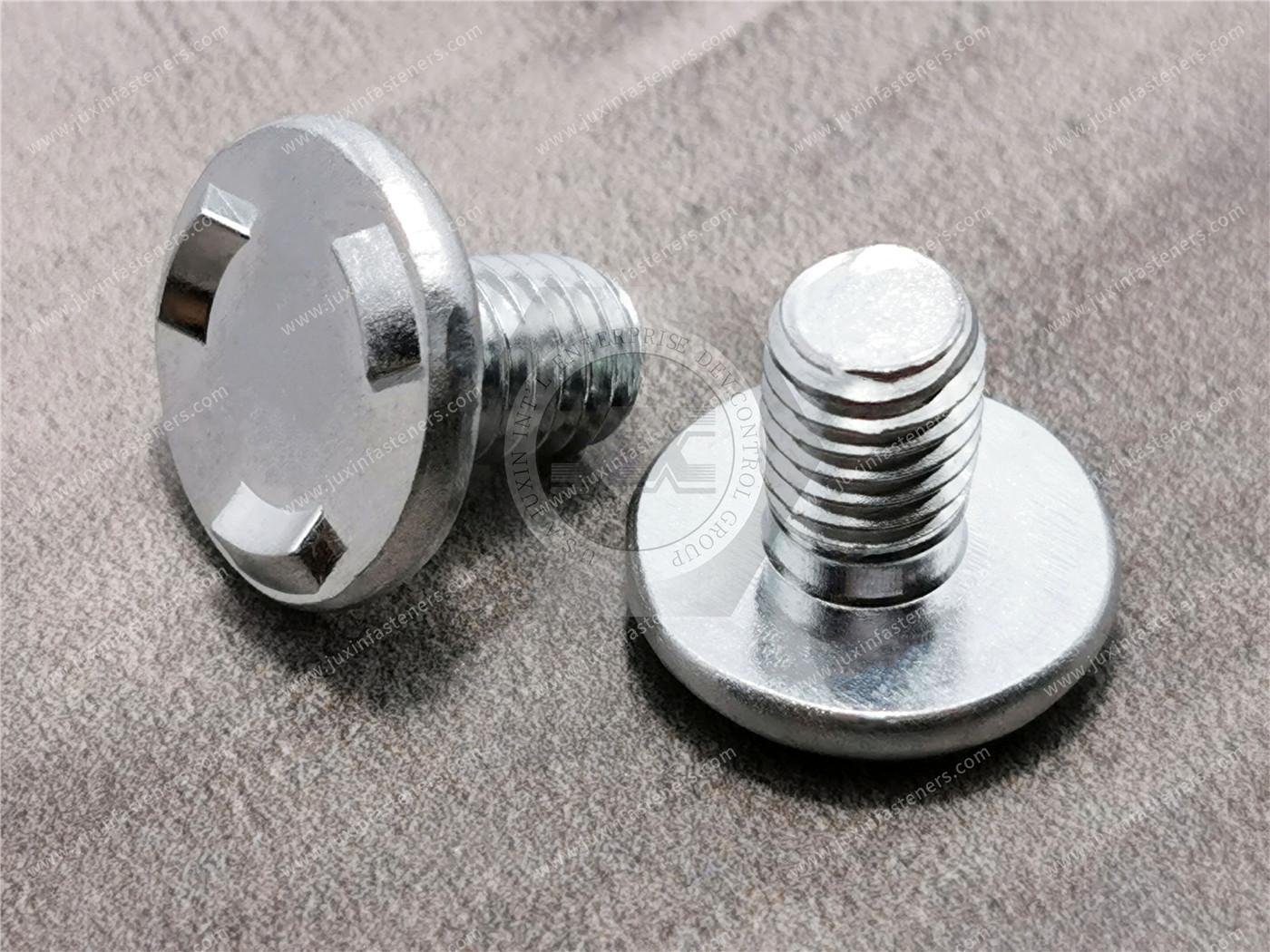
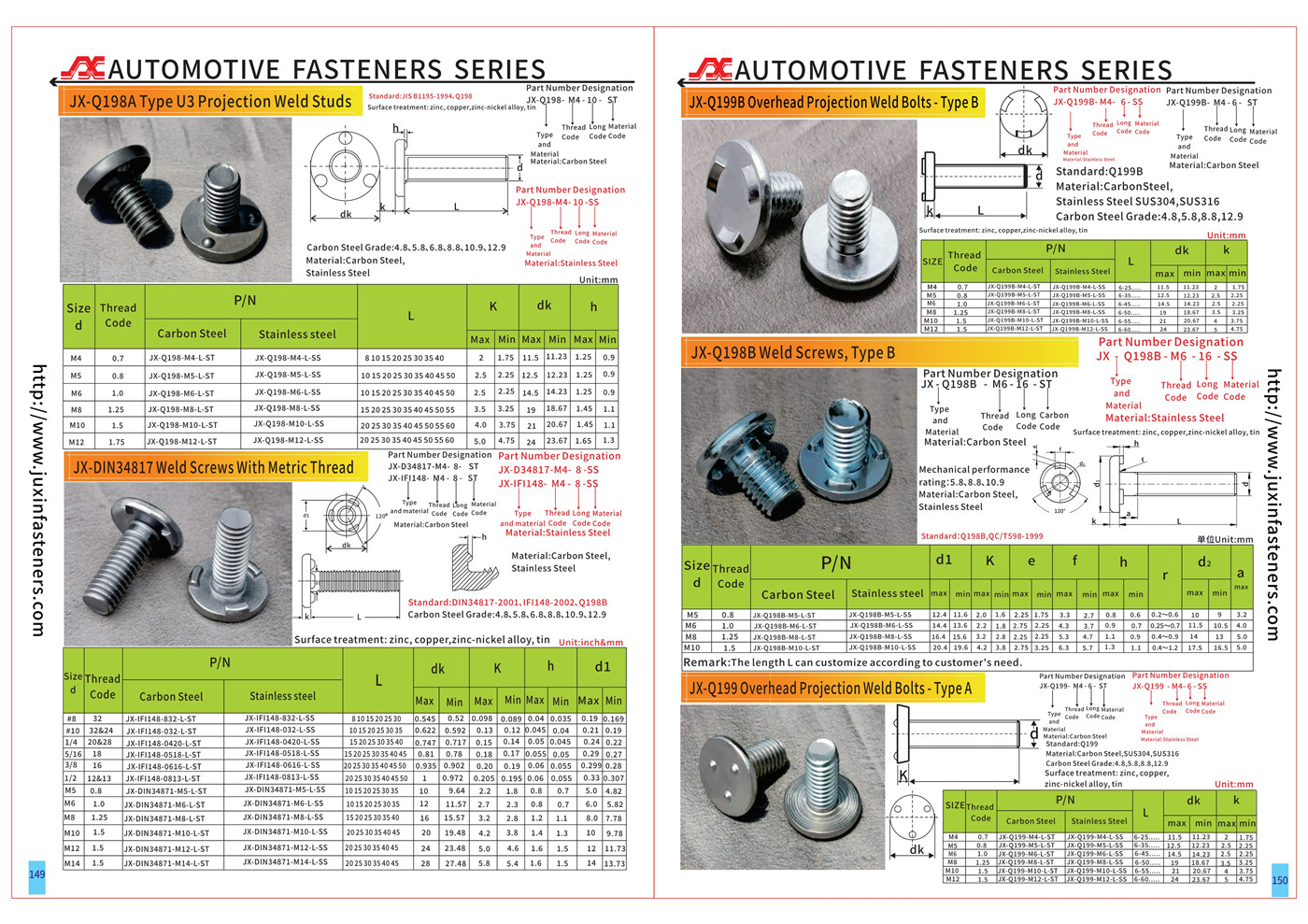
Overhead Projection Weld Studs (Q199B)
Automotive Resistance Welding Fasteners According to QC/T 599 (B) – 2013
Overhead Projection Weld Studs (Q199B) are flat round head projection weld screws specifically designed for resistance projection welding in automotive manufacturing.
Manufactured according to QC/T 599 (B) – 2013, Q199B weld studs enable direct welding onto thin sheet metal without pre-drilling, creating reliable mounting points in high-volume automated production lines.
These weld studs are widely used in Body-in-White (BIW), chassis systems, and EV battery pack assemblies.
What Are Q199B Overhead Projection Weld Studs?
Q199B is a projection weld screw with:
Flat round head
Engineered projection welding points
Optimized collapse geometry
Automotive-grade dimensional precision
The projection design concentrates welding current at defined contact points, ensuring stable fusion and consistent collapse during resistance welding.
This design eliminates the need for pre-drilling, preventing substrate weakening and reducing leakage risk.
Standard Specification – QC/T 599 (B) – 2013
Q199B weld studs comply with the Chinese automotive standard QC/T 599 (B) – 2013.
Key technical features include:
Controlled projection geometry
Defined thread tolerances
Specified material composition
Mechanical property classification
Automotive production suitability
For international OEM supply chains, Q199B studs are often manufactured with documentation aligned to global automotive quality systems.
Core Advantages of Q199B Projection Weld Studs
1. High-Speed Automated Welding
The projection station design enables:
Concentrated current flow
Stable heat generation
Reduced welding time
High repeatability
Ideal for robotic projection welding systems.
2. No Pre-Drilling Required
Direct welding onto a thin metal sheet:
Preserves substrate integrity
Eliminates hole weakening
Prevents potential fluid leakage
Reduces manufacturing steps
3. Strong Mechanical Bonding
Typical mechanical grades:
Property class 4.8,8.8,10.9
Ensures adequate tensile strength and torque resistance for automotive structural applications.
Material and Surface Treatment
Q199B welding screws are typically manufactured from weldable carbon steel with:
Carbon content ≤ 0.25%
Common surface treatments include:
Natural anti-corrosion protection
Zinc plating with passivation
Surface finishing can be tailored to meet corrosion resistance requirements.
Typical Thread Sizes
Common metric sizes include:M5,M6,M8,M10
Custom sizes are available upon request.
Conclusion
Overhead Projection Weld Studs (Q199B) provide a reliable, efficient fastening solution for automotive resistance welding applications.
With optimized projection geometry and compliance with QC/T 599 (B) – 2013, they support high-volume automated production while maintaining structural integrity.
For OEM and Tier suppliers, Q199B weld studs offer a stable, cost-effective solution for fastening thin sheet metal.
Automotive Applications of Q199B Overhead Projection Weld Studs
From Body-in-White to EV Battery Pack Assemblies
In modern vehicle manufacturing, projection weld studs must perform reliably under dynamic load, vibration, and environmental exposure.
Q199B Overhead Projection Weld Studs are extensively used across multiple automotive systems.
1. Body-in-White (BIW) Structure
Q199B welding screws are widely welded onto thin sheet components such as:
Side panels
Floor panels
Roof panels
They serve as mounting bases for:
Door hinges
Hood hinges
Trunk lid mechanisms
Limiters and latches
These connection points must maintain dimensional accuracy and long-term structural reliability.
2. Chassis and Suspension Systems
On chassis components, including:
Subframes
Control arms
Cross members
Q199B weld studs secure:
Shock absorber mounting points
Stabilizer bar brackets
Steering mechanism connections
The weld must withstand vibration, torque, and fatigue loading.
3. Powertrain and Engine Compartment
In internal combustion vehicles, Q199B studs are used for:
Wiring harness brackets
Sensor mounts
Pipe supports
Stable welding prevents loosening during thermal cycling.
4. Electric Vehicle Applications
In EV platforms, Q199B weld studs are suitable for:
Battery pack housing mounting points
Motor housing brackets
Electrical grounding positions
Because EV battery trays often use thin sheet metal, projection welding without drilling preserves enclosure integrity and sealing performance.
Why Automotive Manufacturers Choose Q199B
Fast automated welding
Reduced process steps
Stable mechanical performance
Compatibility with thin sheet structures
Q199B weld studs are designed to integrate seamlessly into high-volume automotive production.
Engineering Advantages of Q199B Overhead Projection Weld Studs
Optimized Projection Design for Resistance Welding Stability
The key advantage of Q199B weld studs lies in their engineered projection-welding-station design.
Unlike conventional fasteners, projection weld screws rely on controlled current concentration.
Concentrated Heat Generation
The projection points:
Increase local resistance
Focus heat on specific areas.
Promote rapid fusion
Heat input follows:
Q = I² × R × t
Because current is concentrated at projection points, weld formation is fast and consistent.
Controlled Collapse Behavior
During welding:
Projections soften first
Collapse under electrode force
Form uniform fusion nugget.
Proper collapse ensures:
Strong mechanical bonding
Reduced porosity
Stable torque performance
Thin Sheet Compatibility
Q199B studs are particularly suitable for:
0.8 – 3.0 mm sheet thickness
Benefits include:
No substrate perforation
Reduced deformation
Improved sealing
Critical for automotive exterior panels and EV battery enclosures.
Mechanical Performance
Material: Weldable carbon steel (C ≤ 0.25%)
Mechanical grades:
4.8 (general mounting)
8.8,10.9 (higher strength structural application)
Mechanical properties must align with automotive load requirements.
Surface Protection Options
Depending on the application environment:
Natural finish
Zinc plating
Zinc passivation
Higher-corrosion-resistance coatings can be applied for chassis or EV battery pack use.
Conclusion
Q199B Overhead Projection Weld Studs combine:
Efficient resistance welding
Structural reliability
Process simplification
Thin sheet compatibility
They are a critical fastening component in modern automotive manufacturing.
Contact Us
Tel.:
+86 020 8621 0320
+86 020 3121 6067
E-mail:
Technical Support:
Navigation
SEND INQUIREY