Call Us
+86 136 6007 9809
Call Us
+86 136 6007 9809

Material: Stainless steel, Carbon steel, Brass
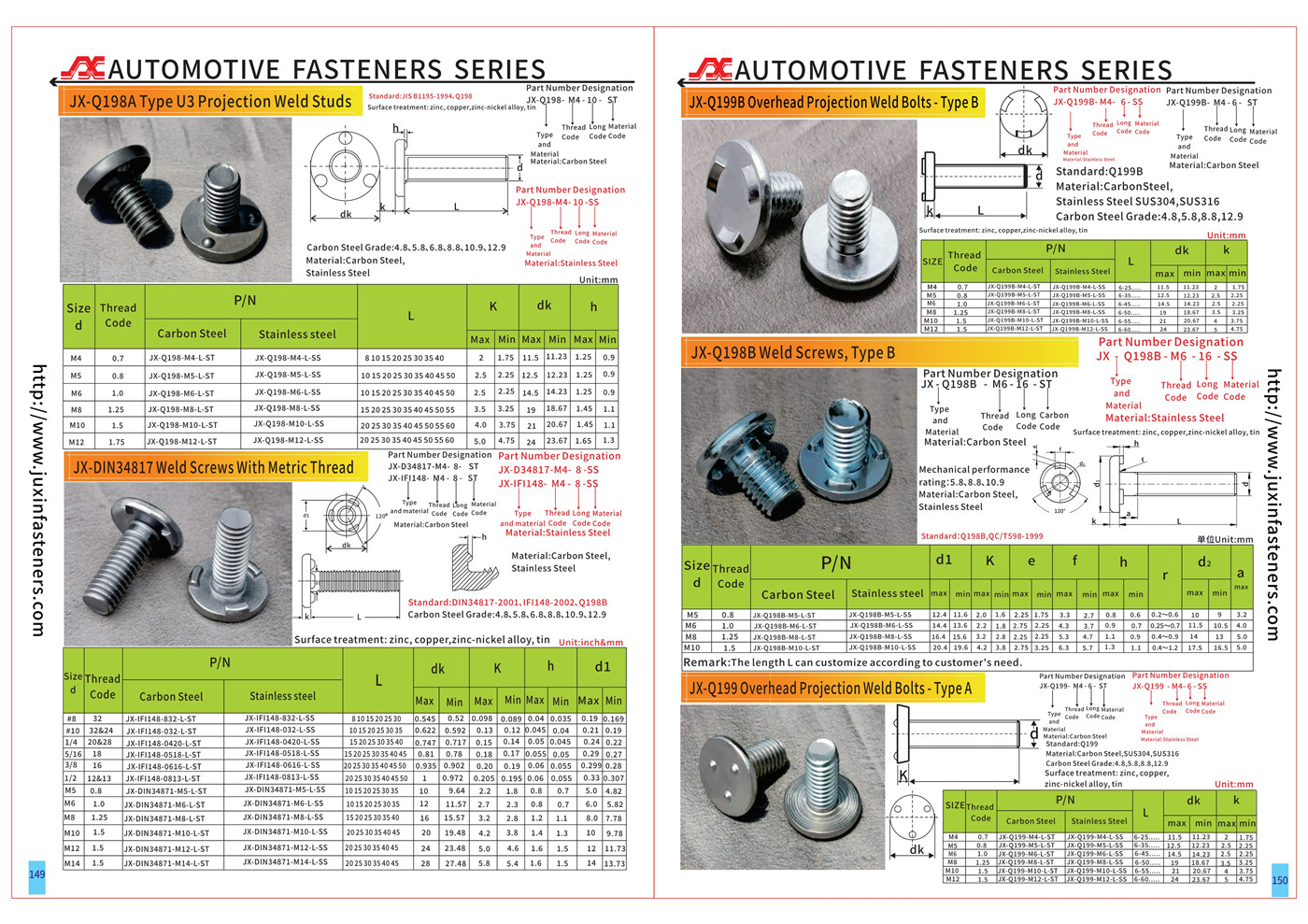
Standard: Q 198B&DIN 34817 - 2001&IFI 148 (US3) - 2002 TUS3
Metal Weld Stud Materials
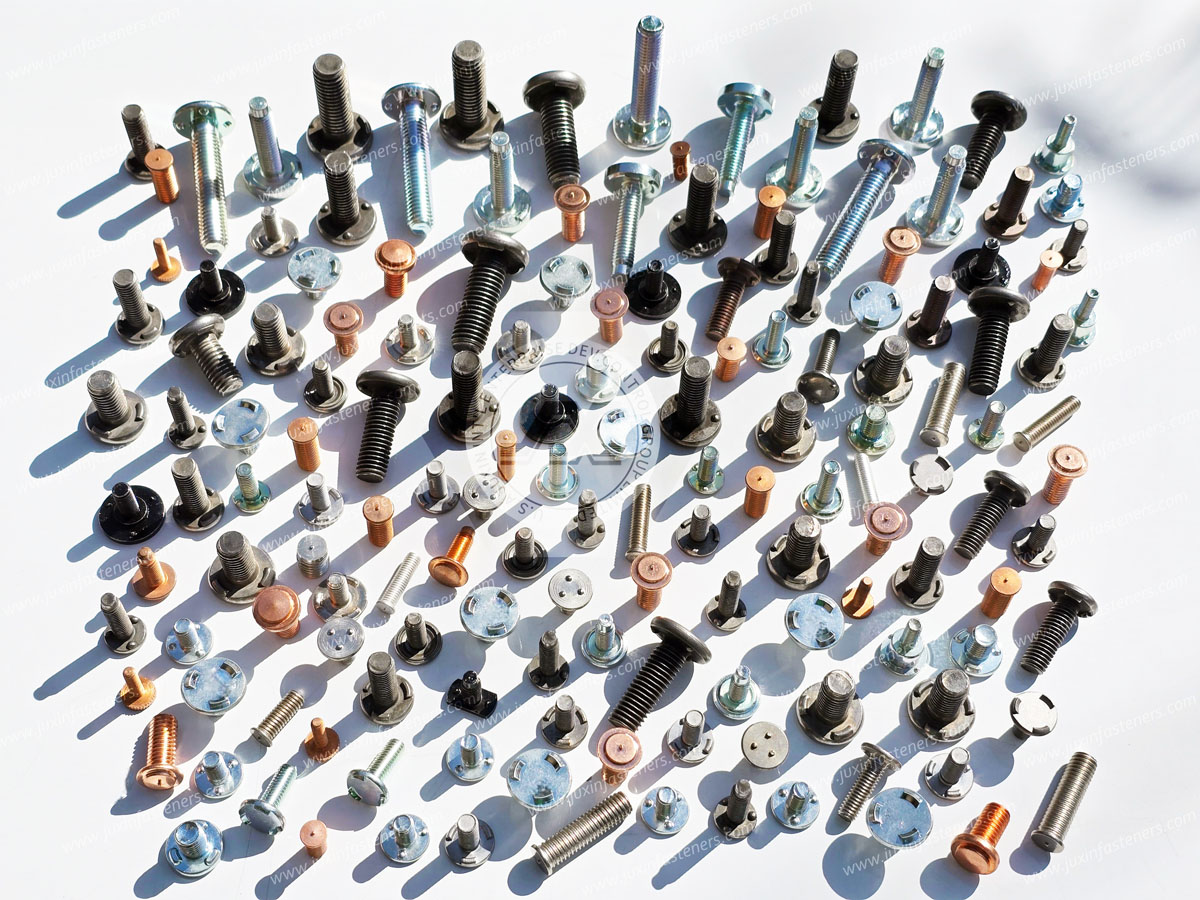
Depending on your project specifications, weld studs are available in several material options. These materials provide strength and corrosion resistance for weld fasteners in various environments. Almost all Juxin Fasteners weld studs are available in inch and metric sizes and are available in the following material options:
Stainless Steel
Carbon Steel (clear zinc finish upon request)
Aluminum
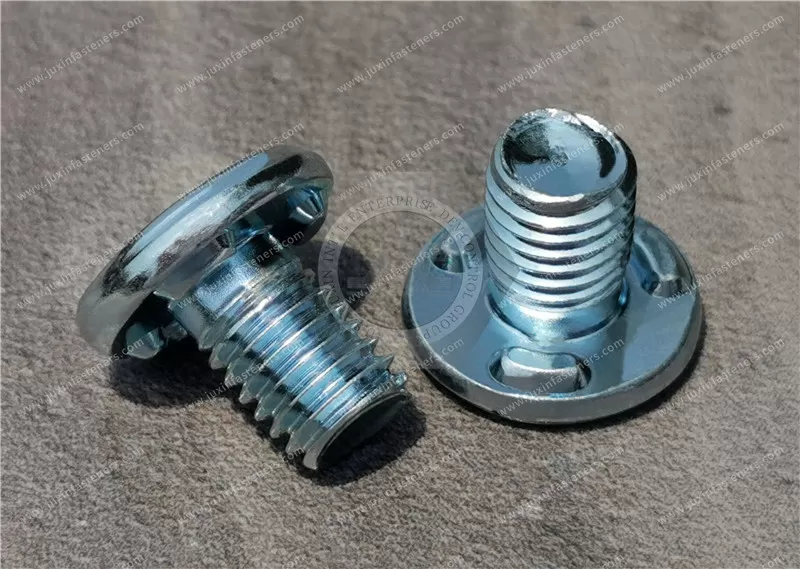
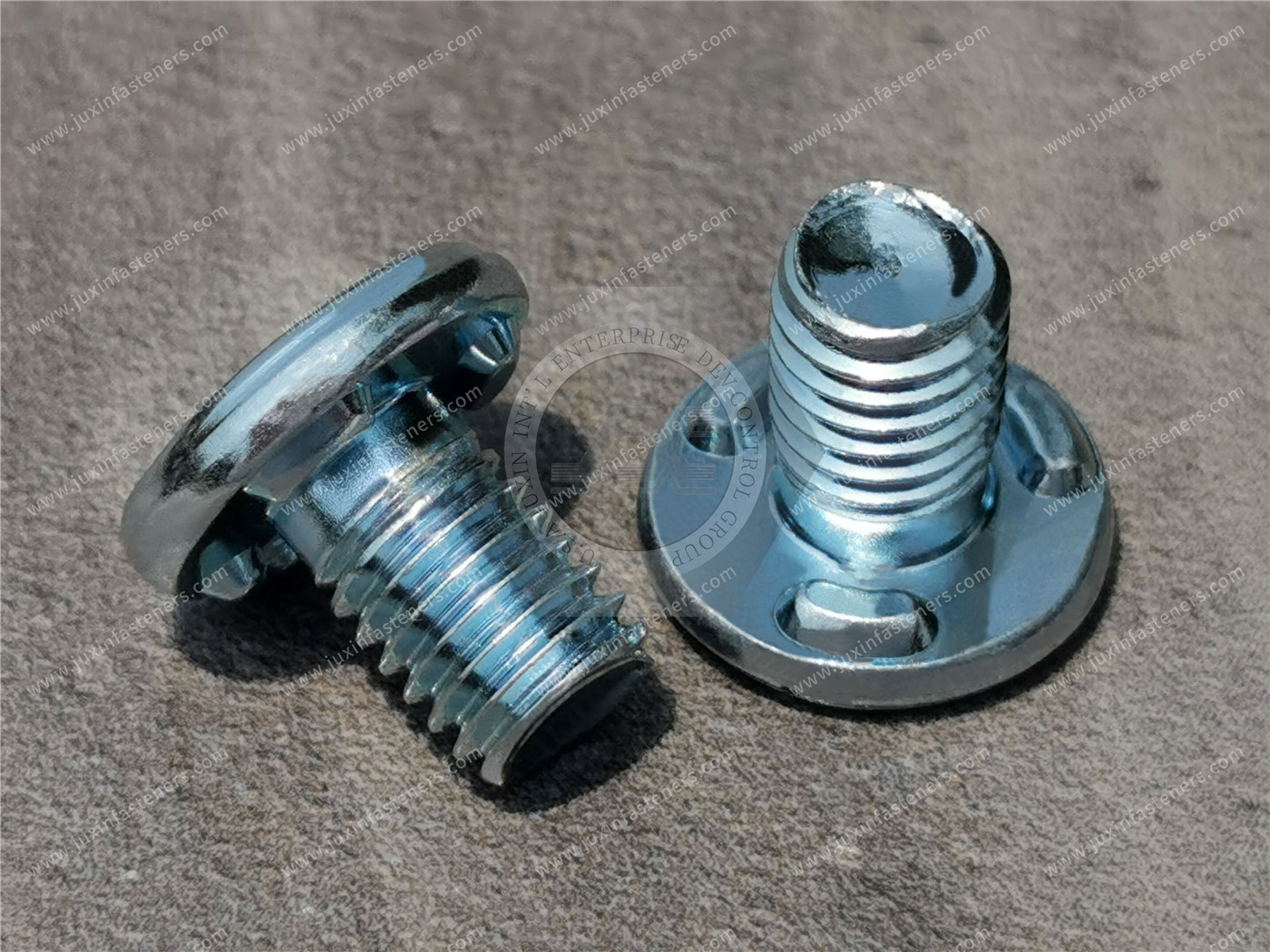
Many industrial applications require the use of a Projection Weld Screw that will provide an airtight seal to protect against leakage of water, oil, air, or gas. This weld screw is ideally suited for such applications. Its 360° ring projection provides a strong and durable weld joint. The entire ring projection is highly versatile and enables cross-wire welding and welding to various surface shapes and materials. These industrial fasteners are available from Juxin Fasteners in different materials, dimensions, and thread sizes (inch and metric).
Product Specification
Name:Weld Stud
Material: Carbon Steel, Stainless Steel
Carbon steel Grade:5.8,6.8,8.8,10.9
1. The working principle of projection welding:
Projection welding is an evolution of spot welding. Generally speaking, a mountain point is punched out on one of the two plates, and then welded. Due to the concentration of current, it overcomes the defect of nugget offset during spot welding. One or more nuggets form at the joint.
2. Features of the projection welding process:
During projection welding, the electrode must drop rapidly as the bump is sub-collapsed, otherwise spatter will occur due to pressure loss, so a projection welding machine with good electrode followability should be used.
The electrode pressure should ensure that the bumps are completely sub-collapsed when they reach the welding temperature so that the workpieces can fit closely. If the pressure is too high, the bumps will be crushed prematurely, and the function of projection welding will be lost.
The reduced flow density will reduce the strength of the joint, and the pressure will be too small to cause sub-heavy splashing.
Usually, the welding time of projection welding is longer than that of spot welding, and the flow is smaller than that of spot welding. Multi-point projection welding is a slightly longer welding time than single-point projection welding to reduce the difference in heating at each point caused by inconsistent bump heights.
The current required for each spot of projection welding is smaller than that of spot welding the same spot, but the current must be able to melt the bump before the bump is completely crushed. The welding current is approximately the current required for each bump multiplied by the number of bumps.
Size Can also be According to the Customer's requirement for manufacturing, please check the detailed specification sheet details PDF, CAD, 149-150 Page See more product details.
DIN 34817 Weld Stud Solutions for New Energy Vehicle Battery PACK Applications
Engineered Resistance Welding Fasteners for EV Battery Pack Structural Integration
In new energy vehicle (NEV) platforms, the battery PACK is a highly integrated structural and electrical system that combines mechanical load-bearing structures, thermal management modules, a high-voltage electrical architecture, and electronic control systems.
Within this complex assembly, fastening systems must meet requirements for:
Structural load stability
Vibration resistance
Electrical insulation integrity
Manufacturing efficiency in automated production lines
DIN 34817 weld studs are standardized resistance welding fasteners designed for metric threads ranging from M5 to M14. While not part of the core electrical welding process of battery cells, they provide reliable solutions for auxiliary structural fastening applications within EV battery PACK systems.
DIN 34817 Weld Screws — Technical Standard Overview
The DIN 34817 standard defines welded screws for resistance welding applications, specifying:
Metric thread sizes (M5–M14)
Mechanical property classes such as 8.8 and 10.9
Material requirements, including 19MnB4 and B1021 alloy steel
Dimensional and geometric tolerances
Thread tolerance class 6g
These weld studs are engineered to form permanent metallurgical bonds via projection or resistance welding.
For automotive and EV manufacturers, this ensures:
Stable load-bearing mounting points
High repeatability in robotic welding systems
Reduced need for secondary machining operations
Application Scenarios of DIN 34817 Weld Studs in EV Battery PACK Systems
It is important to clarify that DIN 34817 weld screws are not used for core electrical interconnections inside battery cells or busbar laser welding operations. Instead, their applications are concentrated in non-electrical structural fastening zones within the PACK assembly.
1. Battery Module Frame and Bracket Fixing
In EV battery PACK design, module frames and reinforcement brackets often require secure attachment to steel support structures.
DIN 34817 weld studs provide:
Reliable mounting points on steel structural frames
High shear and tensile strength
Stable vibration resistance under vehicle operation
These are suitable for:
Steel reinforcement brackets
Internal support frames
Mounting lugs and structural plates
Because of standardized dimensions and controlled welding projections, they integrate well into automated PACK production lines.
2. Battery Management System (BMS) and Sensor Mounting
Electronic components such as:
BMS control boards
Temperature sensors
Communication modules
must be precisely positioned and mechanically secured within the battery enclosure.
Weld studs allow:
Accurate positioning
Strong mechanical retention
Repeatable installation during mass production
This is particularly beneficial in steel substructures inside the PACK housing.
3. High-Voltage Connector and Junction Box Mounting
High-voltage connectors and junction boxes require rigid mounting bases to maintain stability under vibration and dynamic loading.
DIN 34817 weld screws can be used to:
Secure steel mounting brackets
Provide threaded interfaces for HV component installation
Ensure structural durability during long-term vehicle operation
These applications enhance mechanical reliability without interfering with electrical insulation design.
Engineering Limitations and Process Considerations
From a professional engineering perspective, it is critical to understand the application boundaries of DIN 34817 weld studs in battery PACK systems.
Not Applicable for Core Electrical Welding
Core battery manufacturing processes rely primarily on:
Laser welding of cell tabs
Busbar welding between modules
Sealing welding of battery enclosures
These processes require:
Extremely low thermal distortion
Precision electrical conductivity control
Hermetic sealing performance
DIN 34817 resistance welding screws are not designed to replace these laser welding operations.
Material Compatibility Considerations
The DIN 34817 standard requires base materials with carbon content typically not exceeding 0.15% for optimal welding performance.
However, many battery PACK housings are manufactured using aluminum alloys such as:
Al3003 aluminum alloy
Because steel weld studs cannot be directly resistance welded to aluminum housings, application scenarios are typically limited to:
Steel internal support frames
Steel reinforcement brackets within hybrid material structures
Material compatibility analysis is essential during PACK structural design.
Mechanical Performance Advantages in EV Structural Zones
When applied correctly in compatible steel structures, DIN 34817 weld studs offer:
Mechanical strength class 8.8 or 10.9
High tensile and shear resistance
Good fatigue durability
Excellent performance under vibration loading
These characteristics support long-term durability in electric vehicle environments where continuous vibration and thermal cycling are common.
Manufacturing Benefits for EV Production Lines
For EV manufacturers pursuing automated and scalable production, DIN 34817 weld studs provide:
Fast resistance welding cycle time
High positioning repeatability (up to ±0.2 mm in controlled environments)
Reduced assembly complexity
Lower risk of thread damage compared to post-drilling operations
This improves consistency in structural fastening across large-volume battery PACK programs.
Conclusion — Auxiliary Structural Fastening Solution for EV Battery PACK Systems
DIN 34817 weld screws serve as an effective auxiliary fastening solution within new energy vehicle battery PACK structures.
Their primary value lies in:
Structural bracket fixation
Sensor and BMS mounting
High-voltage component bracket integration
Steel structural reinforcement fastening
They are not intended for core electrical welding or sealing operations but provide reliable mechanical fastening performance in compatible structural zones.
For engineering teams designing EV battery systems, properly specified resistance-welding studs ensure structural stability, vibration resistance, and manufacturing efficiency in auxiliary structural applications.
Product Packaging
Packaging: The inner packaging is a plastic bag, and the outer packaging is a carton. Then the tray. Carton size: 29*19*19.5cm and 23.5*17.5*8, cm and pallet size: 215*100*90cm, or as your request
Product Pictures
Contact Us
Tel.:
+86 020 8621 0320
+86 020 3121 6067
E-mail:
Technical Support:
Navigation
SEND INQUIREY