Call Us
+86 136 6007 9809
Call Us
+86 136 6007 9809

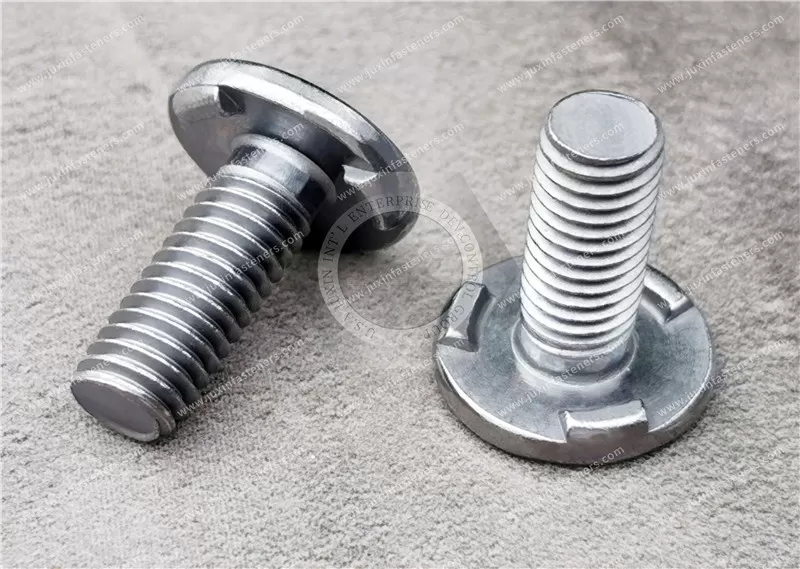
Name:DIN34817 Type TUS3 Projection Weld Studs
Material: Stainless steel, Carbon steel, Brass
Standard: Q 198B&DIN 34817 - 2001&IFI 148 (US3) - 2002 US3&
Precision Welding Screws DIN 34817
Welding screws with round heads and metric thread, according to DIN 34817, are a reliable solution for professional welding applications. Available in a variety of materials and strength classes, including 8.8, A2, and A4, these screws provide excellent stability and durability of connections.
Excellent Durability and Corrosion Resistance
DIN 34817 zinc-plated (Zn) screws offer not only excellent strength but also corrosion resistance, which is crucial for long-term use in a variety of atmospheric and industrial environments. The round head and precise metric thread guarantee easy and reliable welding, translating into high assembly efficiency.
Product Specification
Name:Weld Stud
Material: Carbon Steel, Stainless Steel
Carbon steel Grade:5.8,6.8,8.8,10.9
1. The working principle of projection welding:
Projection welding is an evolution of spot welding. Generally speaking, a mountain point is punched out on one of the two plates, and then welded. Due to the concentration of current, it overcomes the defect of nugget offset during spot welding. One or more nuggets form at the joint.
2. Features of the projection welding process:
During projection welding, the electrode must drop rapidly as the bump is sub-collapsed, otherwise spatter will occur due to pressure loss, so a projection welding machine with good electrode followability should be used.
The electrode pressure should ensure that the bumps are completely sub-collapsed when they reach the welding temperature so that the workpieces can fit closely. If the pressure is too high, the bumps will be crushed prematurely, and the function of projection welding will be lost.
The reduced flow density will reduce the strength of the joint, and the pressure will be too small to cause sub-heavy splashing.
Usually, the welding time of projection welding is longer than that of spot welding, and the flow is smaller than that of spot welding. Multi-point projection welding is a slightly longer welding time than single-point projection welding to reduce the difference in heating at each point caused by inconsistent bump heights.
The current required for each spot of projection welding is smaller than that of spot welding the same spot, but the current must be able to melt the bump before the bump is completely crushed. The welding current is approximately the current required for each bump multiplied by the number of bumps.
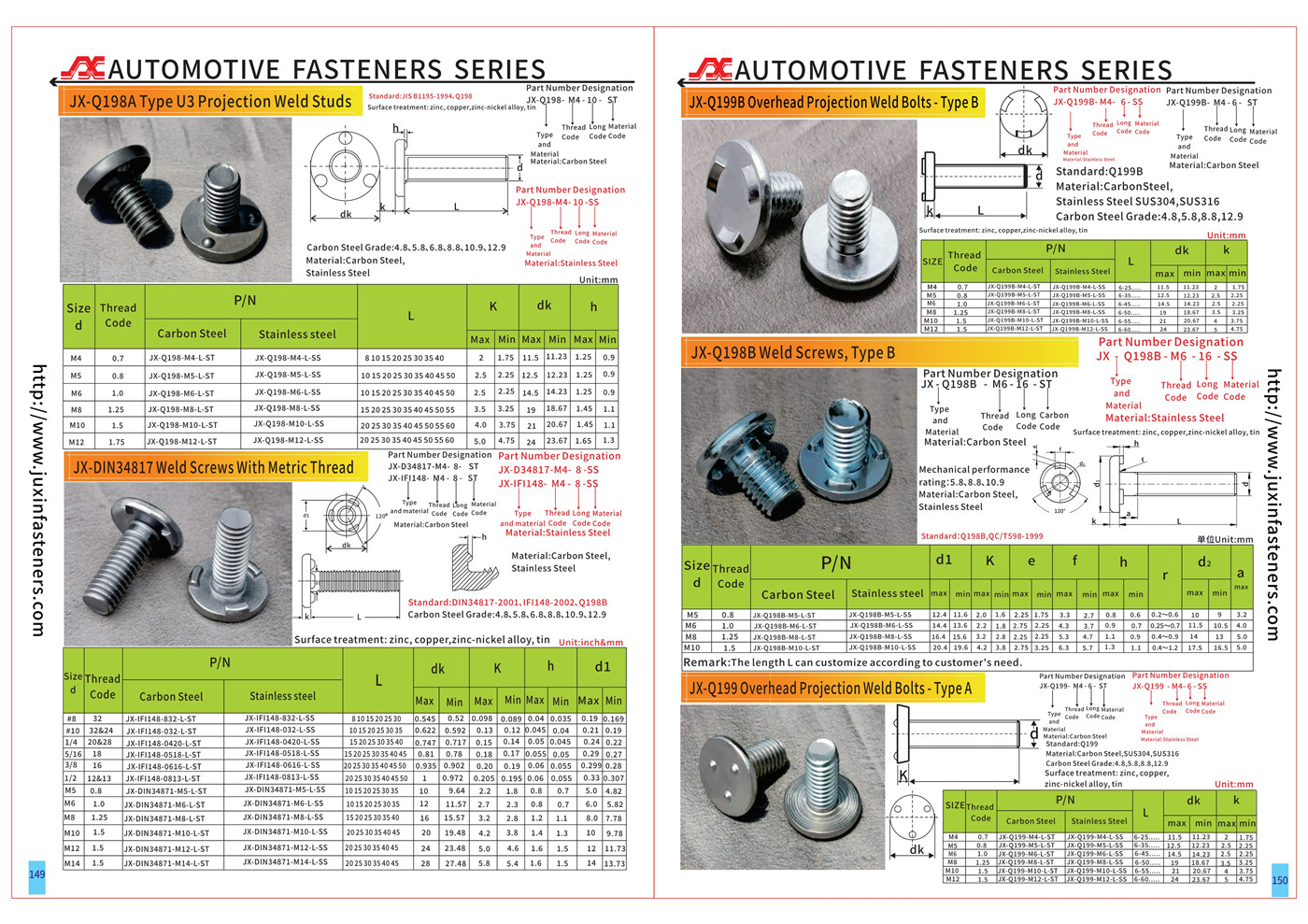
Size Can also be According to the Customer's requirement for manufacturing, please check the detailed specification sheet details PDF, CAD, 149-150 Page See more product details.
DIN 34817 Type TUS3 Projection Weld Studs
Automotive-Grade Structural Fastening Solutions
DIN 34817 Type TUS3 Projection Weld Studs are high-strength welded fasteners specifically designed for resistance welding applications in automotive manufacturing.
These studs are directly projection-welded to sheet-metal components of the body-in-white (BIW), chassis, and structural assemblies, creating permanent threaded anchor points without the need for pre-drilling.
As a widely recognized automotive fastening standard, DIN 34817 weld studs play a critical role in structural safety, production efficiency, and vehicle lightweight design.
What Is DIN 34817 Type TUS3?
DIN 34817 specifies projection weld studs intended for automated resistance welding processes.
Type TUS3 refers to a specific stud configuration optimized for:
Controlled projection geometry
Stable weld current concentration
Uniform projection collapse
High repeatability in robotic welding environments
These studs are engineered for high-volume automotive production where dimensional accuracy and weld consistency are mandatory.
Key Automotive Applications of DIN 34817 Projection Weld Studs
1. Body-in-White Structural Components
DIN 34817 TUS3 studs are primarily welded to sheet metal panels for:
Reinforcement brackets
Door hinge supports
Anti-collision beam mounting
Body strengthening plates
By eliminating drilled holes, projection-welded studs improve body sealing integrity and torsional rigidity.
2. Safety-Critical Fastening Points
For applications such as:
Seatbelt anchorage systems (M4–M12)
High-load structural joints
High tensile strength is required to meet crash safety standards.
Projection weld studs ensure a metallurgical bond capable of sustaining dynamic impact loads.
3. Interior and NVH-Optimized Installations
DIN 34817 studs are also used to secure:
Wiring harness brackets
Insulation panels
Interior trim mounting structures
Because no through-holes are required, this hole-free fastening method enhances NVH (Noise, Vibration, Harshness) performance and improves corrosion resistance.
4. Chassis and Electrical Systems
Applications include:
Suspension system brackets
Steering assemblies
Brake line supports
EV battery enclosure grounding studs
In electric vehicle platforms, conductive projection weld studs are widely used for stable electrical grounding connections.
Core Advantages of DIN 34817 TUS3 Projection Weld Studs
High Production Efficiency
Short-cycle welding processes (typically 20–100 ms) make these studs ideal for automated robotic production lines.
This significantly improves throughput while maintaining weld consistency.
Structural Strength and Reliability
The projection welding process creates a strong metallurgical joint with:
High tensile strength
Consistent torque performance
Improved fatigue resistance
This ensures long-term structural reliability under vibration and load.
Hole-Free Integration
No pre-drilling is required, which:
Maintains sheet metal integrity
Enhances sealing performance
Improves corrosion resistance
Supports lightweight design strategies
Cost Optimization
By reducing secondary machining, additional hardware, and assembly steps, DIN 34817 projection weld studs help control overall manufacturing costs.
Technical Specifications
DIN 34817 Type TUS3 Projection Weld Studs are typically manufactured with the following characteristics:
Material: 10B21 19MnB4 or 23MnB4 (quenched and tempered steel)
Mechanical Property Class: 8.8,10.9
Thread Tolerance: 6g
Product Grade: A
Surface Treatment: Zinc plating, Geomet®, Dacromet®, or customized coatings
Welding Process and Quality Control
The most common process used is short-cycle arc or projection welding.
Key controlled parameters include:
Welding current (e.g., ~400A for M6 studs, depending on substrate)
Weld time (20–100 milliseconds)
Lift height and collapse control
Post-weld inspections may include:
Visual inspection
Hammer testing
Torque testing
Tensile testing
These measures ensure weld integrity without defects such as porosity, incomplete fusion, or burn-through.
DIN 34817 Weld Studs: A Foundation of Modern Automotive Manufacturing
From body structure reinforcement to EV battery grounding applications, DIN 34817 Type TUS3 Projection Weld Studs remain indispensable fastening components in automotive production.
They provide:
Structural safety
Automation compatibility
Production efficiency
Lightweight optimization
Long-term durability
For automotive OEMs and Tier suppliers, consistency in weld performance is not optional — it is essential.
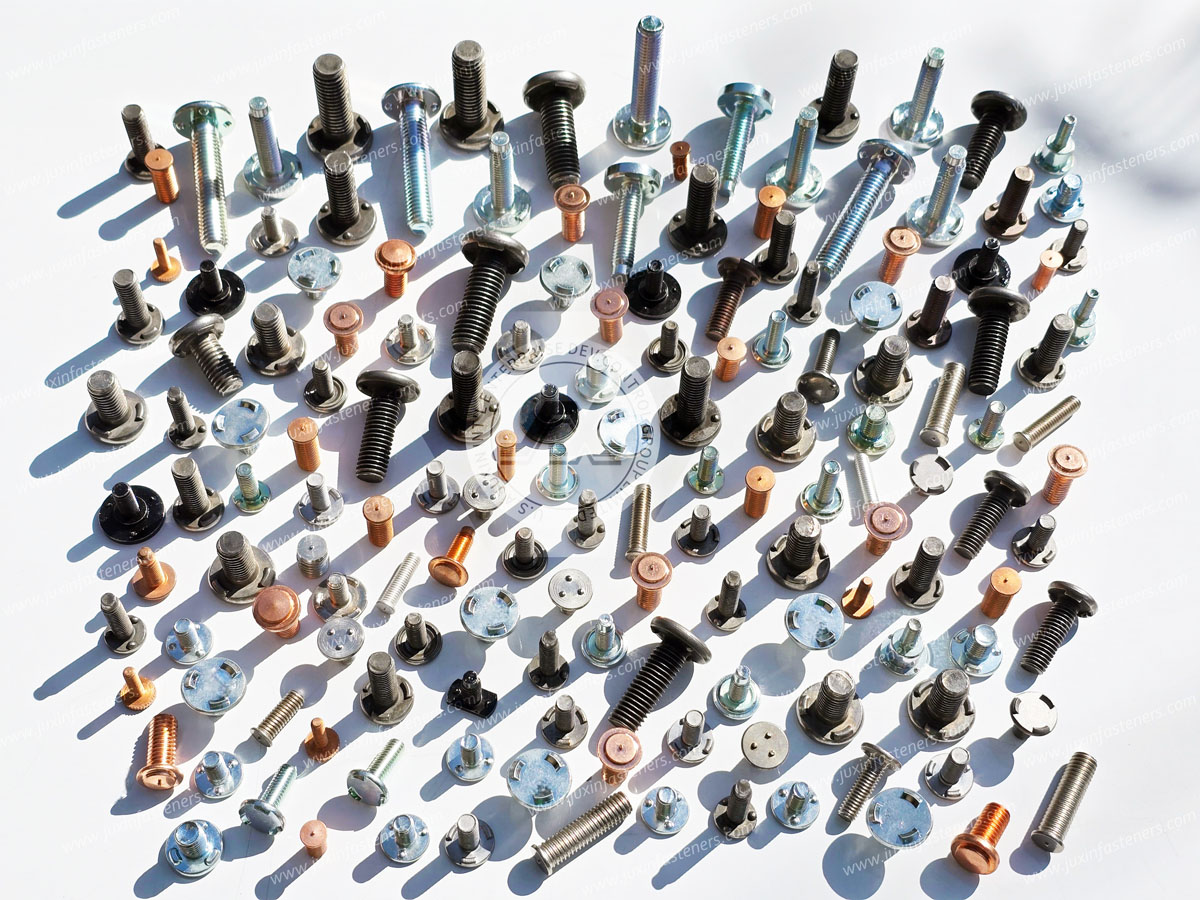
DIN 34817 Type TUS3 Projection Weld Studs for EV Battery Pack Applications
Automotive Standard Fastening Solutions for Electric Vehicle Battery Systems
As electric vehicle (EV) production continues to expand globally, battery pack structures demand fastening solutions that meet strict safety, durability, and automation standards.
DIN 34817 Type TUS3 Projection Weld Studs provide an automotive-standard solution for integrating high-strength threaded anchor points directly into EV battery enclosures, module support frames, and grounding systems.
Designed for resistance projection welding, these studs enable permanent structural attachment without compromising enclosure integrity.
Why DIN 34817 Weld Studs Are Ideal for EV Battery Packs
Electric vehicle battery packs operate under demanding conditions:
Continuous vibration and road shock
Thermal expansion and contraction
Moisture and corrosion exposure
High-voltage electrical grounding requirements
Crash and impact load compliance
DIN 34817 Type TUS3 studs are engineered to deliver:
Stable metallurgical bonding
High tensile strength (Class 8.8)
Consistent projection collapse during welding
Reliable performance in automated production
Their standardized geometry ensures compatibility with robotic welding systems used in EV battery manufacturing lines.
Key Applications in EV Battery Pack Systems
1. Battery Enclosure and Housing Structures
DIN 34817 projection weld studs are welded onto:
Upper and lower battery tray panels
Side impact reinforcement structures
Cross-member support frames
Structural mounting brackets
Because projection welding does not require through-holes, the sealing performance of the battery enclosure is improved — a critical factor for IP protection ratings.
2. Module and Cooling Plate Mounting
Inside the battery pack, studs provide threaded anchor points for:
Battery module brackets
Cooling system supports
Busbar mounting components
Structural cross supports
The permanent weld eliminates the risk of loosening caused by long-term vibration.
3. High-Voltage Grounding and Electrical Connections
For EV platforms, reliable grounding is essential.
DIN 34817 weld studs can function as:
Conductive grounding points
Electrical bonding connectors
Power distribution mounting supports
Stable torque retention and low contact resistance contribute to long-term electrical reliability.
Technical Characteristics of DIN 34817 Type TUS3 for EV Use
Typical specifications include:
Material: 19MnB4 or 23MnB4 quenched and tempered steel
Mechanical property class: 8.8
Thread tolerance: 6g
Product grade: A
Surface treatment: Zinc plating, Geomet®, Dacromet®, or customized coatings
For EV battery applications, corrosion resistance and salt spray performance are particularly important due to environmental exposure.
Projection Welding Advantages in EV Production
Controlled Heat Input
Projection geometry concentrates current at specific points, reducing overall heat input.
This is beneficial when welding thin sheet materials used in lightweight EV battery enclosures.
Automation Compatibility
Short-cycle welding times (typically 20–100 ms) support:
Robotic integration
High repeatability
Consistent weld penetration
High-volume mass production
Structural and Crash Performance
Battery packs are structural components in many EV platforms.
DIN 34817 projection weld studs contribute to:
Improved load transfer
Increased pack rigidity
Enhanced impact resistance
Long-term fatigue durability
Quality Assurance in EV Battery Applications
To ensure consistent performance, quality control measures typically include:
Visual weld inspection
Projection collapse verification
Torque testing
Tensile pull-out testing
Parameter monitoring (current, time, pressure)
Strict process control ensures uniform weld integrity across high-volume EV production.
Supporting the Future of Electric Mobility
As EV platforms demand:
Lightweight structures
High structural safety
Intelligent automated production
Reliable electrical performance
DIN 34817 Type TUS3 Projection Weld Studs remain a trusted automotive fastening solution.
From battery enclosure integrity to high-voltage grounding stability, these studs provide the foundation for safe and efficient electric vehicle manufacturing.
Product Packaging
Packaging: The inner packaging is a plastic bag, and the outer packaging is a carton. Then the tray. Carton size: 29*19*19.5cm and 23.5*17.5*8, cm and pallet size: 215*100*90cm, or as your request
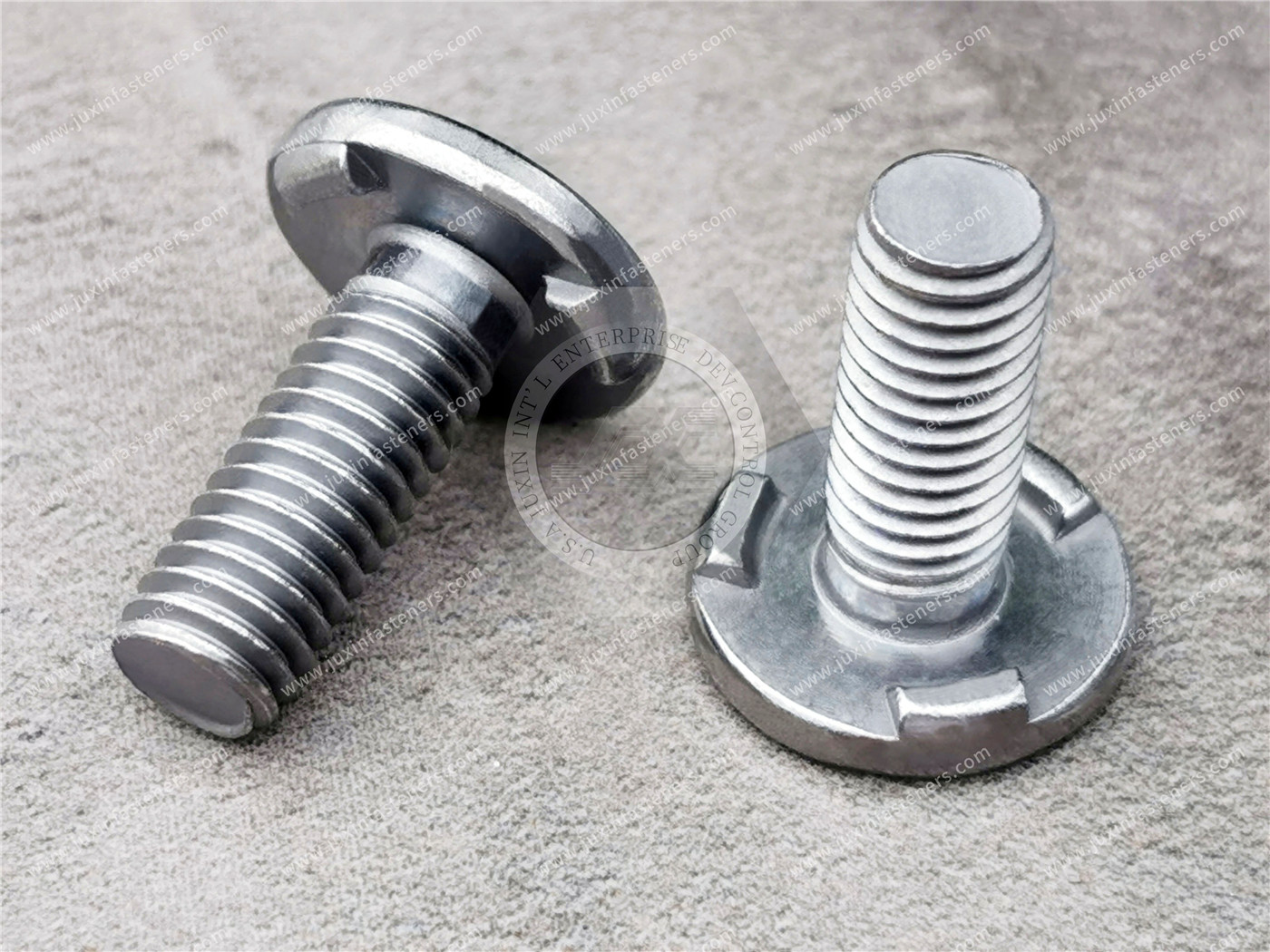
Product Pictures
DIN 34817 vs ISO Automotive Weld Stud Standards
Understanding the Differences in Projection Weld Stud Specifications
In automotive manufacturing, weld studs must comply with strict dimensional and mechanical standards to ensure structural safety and production consistency.
Among the commonly referenced specifications, DIN 34817 Type TUS3 Projection Weld Studs are widely used in European automotive platforms. However, many OEMs and Tier suppliers also refer to ISO-based or internal automotive standards.
Understanding the differences between DIN 34817 and ISO weld stud specifications is essential for global sourcing and platform compatibility.
Overview of DIN 34817 Projection Weld Studs
DIN 34817 defines projection weld studs for resistance-welding applications.
Key characteristics include:
Defined projection geometry
Standardized head and shank dimensions
Thread tolerance class 6g
Mechanical property class typically 8.8
Product grade A dimensional precision
Type TUS3 refers to a specific configuration optimized for automated projection welding in high-volume automotive production.
ISO Automotive Weld Stud Standards
ISO standards typically provide broader global harmonization of:
Mechanical property classes
Thread dimensions
Tolerance systems
Material classifications
However, ISO specifications may not always define projection geometry as thoroughly as DIN 34817, particularly for automotive-specific welding applications.
In many cases, OEMs adopt ISO standards combined with internal welding parameter requirements.
Key Differences Between DIN 34817 and ISO Weld Stud Specifications
1. Projection Geometry Definition
DIN 34817 clearly defines the projection configuration and dimensions optimized for resistance welding.
ISO standards may require supplementary drawings or OEM-specific requirements for projection details.
2. Automotive Platform Adoption
DIN 34817 is historically dominant in European automotive manufacturing.
ISO-based specifications are more frequently referenced in globally harmonized vehicle platforms.
3. Welding Process Optimization
DIN 34817 Type TUS3 studs are engineered specifically for projection welding repeatability.
ISO-compliant studs may require validation to ensure they are projection-compatible with automated welding systems.
4. Sourcing and Validation
When supplying cross-regional platforms:
Material certification must align
Mechanical properties must be verified
Welding validation testing is required
Corrosion protection performance must meet OEM standards
In practice, many automotive suppliers manufacture DIN 34817-compliant studs while ensuring compliance with ISO mechanical properties.
Choosing the Right Standard for Your Automotive Project
When selecting between DIN 34817 and ISO-based weld stud standards, engineering teams should evaluate:
Vehicle platform origin
Welding equipment compatibility
Crash performance requirements
Corrosion resistance specifications
Global supply chain alignment
For EV battery packs and structural assemblies, projection weld consistency and dimensional precision are often more critical than the nominal standard reference alone.
Conclusion
Both DIN 34817 Type TUS3 and ISO automotive weld stud standards play important roles in modern vehicle manufacturing.
The key to successful implementation lies in the compatibility of the welding process, compliance with mechanical properties, and rigorous quality validation.
For automotive manufacturers, selecting the correct weld stud standard is not simply a specification decision — it is a structural safety decision.
Why Choose a Professional DIN 34817 Type TUS3 Projection Weld Stud Manufacturer?
Automotive-Grade Welding Fasteners Backed by 23 Years of Experience
In automotive manufacturing, weld studs are not commodity fasteners. They are structural components directly impacting vehicle safety, crash performance, and production efficiency.
Choosing a qualified DIN 34817 Type TUS3 Projection Weld Stud manufacturer is critical to ensuring long-term reliability and consistent weld performance.
The Importance of Manufacturing Expertise
Projection weld studs require:
Precise projection geometry
Controlled material composition
Consistent mechanical properties
Accurate dimensional tolerances
Even minor variations in projection height or material hardness can affect weld penetration and joint strength.
An experienced manufacturer understands the relationship between:
Stud geometry
Welding current
Weld time
Substrate thickness
Collapse behavior
This process knowledge ensures stable performance in automated automotive production lines.
What to Look for in a DIN 34817 Weld Stud Supplier
1. Material and Mechanical Compliance
10B21, 19MnB4 or 23MnB4 quenched and tempered steel
Mechanical property class 8.8,10.9
Verified heat treatment process
Thread tolerance 6g
Material traceability is essential for automotive applications.
2. Welding Performance Validation
A reliable supplier should provide:
Projection dimension control
Weld parameter recommendations
Torque and tensile test data
Salt spray and corrosion testing
Consistency in weld collapse and fusion quality directly impacts structural safety.
3. Production Capacity and Automation Compatibility
Automotive production requires:
High-volume capability
Stable process control
Dimensional repeatability
Batch-to-batch consistency
Manufacturers must support robotic welding environments without variability.
23 Years of Industrial Fastener Manufacturing Experience
With 23 years of expertise in industrial and automotive fasteners, JUXIN provides DIN 34817 Type TUS3 Projection Weld Studs engineered for:
Body-in-White structural assemblies
Chassis and suspension systems
EV battery pack enclosures
Electrical grounding applications
Our production processes emphasize:
Strict dimensional inspection
Heat treatment control
Projection geometry precision
Consistent surface treatment quality
In automotive applications, reliability is not optional — it is mandatory.
Long-Term Value Beyond Price
Selecting a professional DIN 34817 weld stud manufacturer reduces:
Weld defects
Production downtime
Field failure risks
Rework and recall exposure
The true cost of a weld stud is not its unit price — it is its structural performance across the vehicle lifecycle.
Partner With an Experienced Automotive Weld Stud Supplier
If your project requires DIN 34817 Type TUS3 Projection Weld Studs for structural or EV applications, working with an experienced manufacturer ensures:
Compliance
Stability
Production efficiency
Long-term reliability
Contact our engineering team to discuss your automotive fastening requirements.
Contact Us
Tel.:
+86 020 8621 0320
+86 020 3121 6067
E-mail:
Technical Support:
Navigation
SEND INQUIREY