Call Us
+86 136 6007 9809
Call Us
+86 136 6007 9809

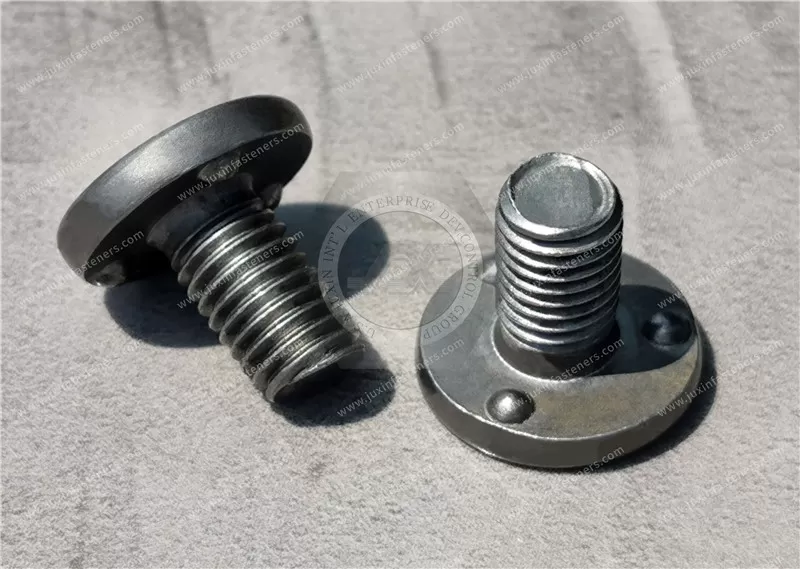
Type U3 Projection Weld Studs
Material: Stainless steel, Carbon steel, Brass
Standard: Q198 A&QC /T 598 (A)&JIS B 1195 - 2009 &BS 7670-1 - 1993&JIS B 1195 - 1994&KS B 1057 - 2001,IFI 148 (U3) - 2002
Product Specification
Weld Studs
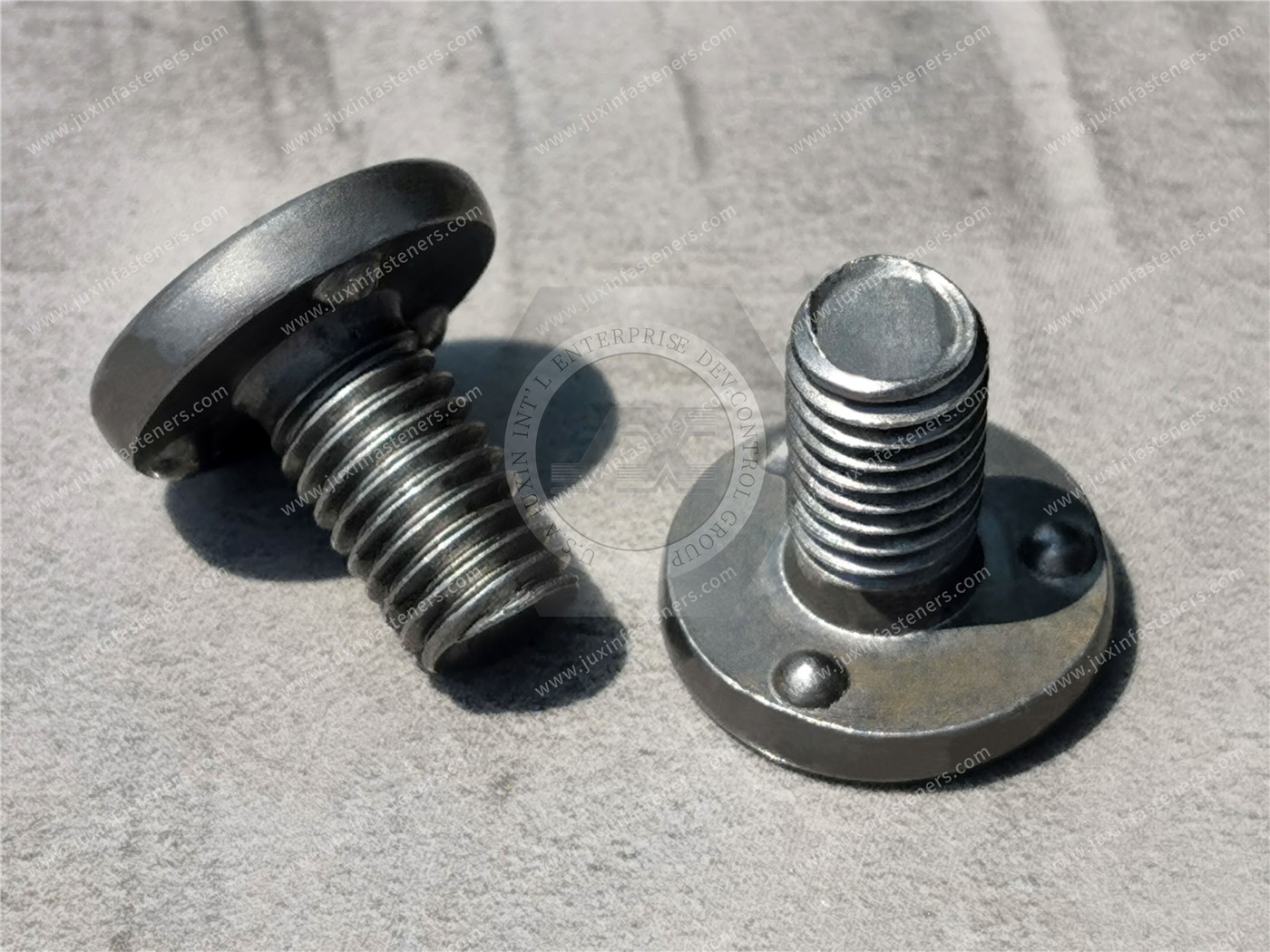
Threaded weld studs and screws allow the weld screw to be welded to or through a metal surface. The product's specific design also allows the screw or stud to be effectively welded within channels and other confined spaces. Weld fasteners are available in various materials, types, and sizes. Headed weld studs like these can be used in light and heavy-duty applications.
Juxin Fasteners provides premium threaded weld studs (weld screws) in several sizes and dimensions for all your project needs. These unique fasteners feature advanced strength (when compared with CD studs) and exceptional dependability. Additionally, our ring weld projection studs can save significant time and money over other, more demanding hand-welding processes. We provide you with the best weld fastener options at competitive industry prices.
Material: Steel with a carbon content of not more than 0.25% and with weldability. No easy-cutting steel shall be used.
Surface treatment: ① without treatment; ② galvanized passivation
Size and shape of the convex weldment: the height difference between the three convex weldments of the same bolt is ≤ 0.15mm and the shape of the three convex weldments should be the same.
These studs have a broad base that distributes the load and projections that concentrate the weld. The length listed is the overall length.
Choose studs with below-head projection for a stronger hold that uses the full strength of the fastener. Pass these studs through a hole and weld them in place.
Choose studs with above-head projection to weld the screw directly to the surface of the material for a smoother appearance.
Name: Weld Studs
Material: Stainless steel ,Carbon steel
These studs have a wide base that distributes the load and projections that concentrate the weld. The length listed is the overall length. Choose studs with a below-head forecast for a stronger hold that uses the full strength of the fastener. Pass these studs through a hole and weld them in place. Choose studs with above-head projection to weld the screw directly to the material's surface for a smoother appearance.
Advantages of Carbon Steel Weld Studs
Low-carbon steel weld studs are suitable for use with HRB-80 or less materials. Benefits of carbon steel weld nuts include:
Cost-effective when compared to S.S.
Ideal for high-volume machine parts
Ideal for light and medium applications
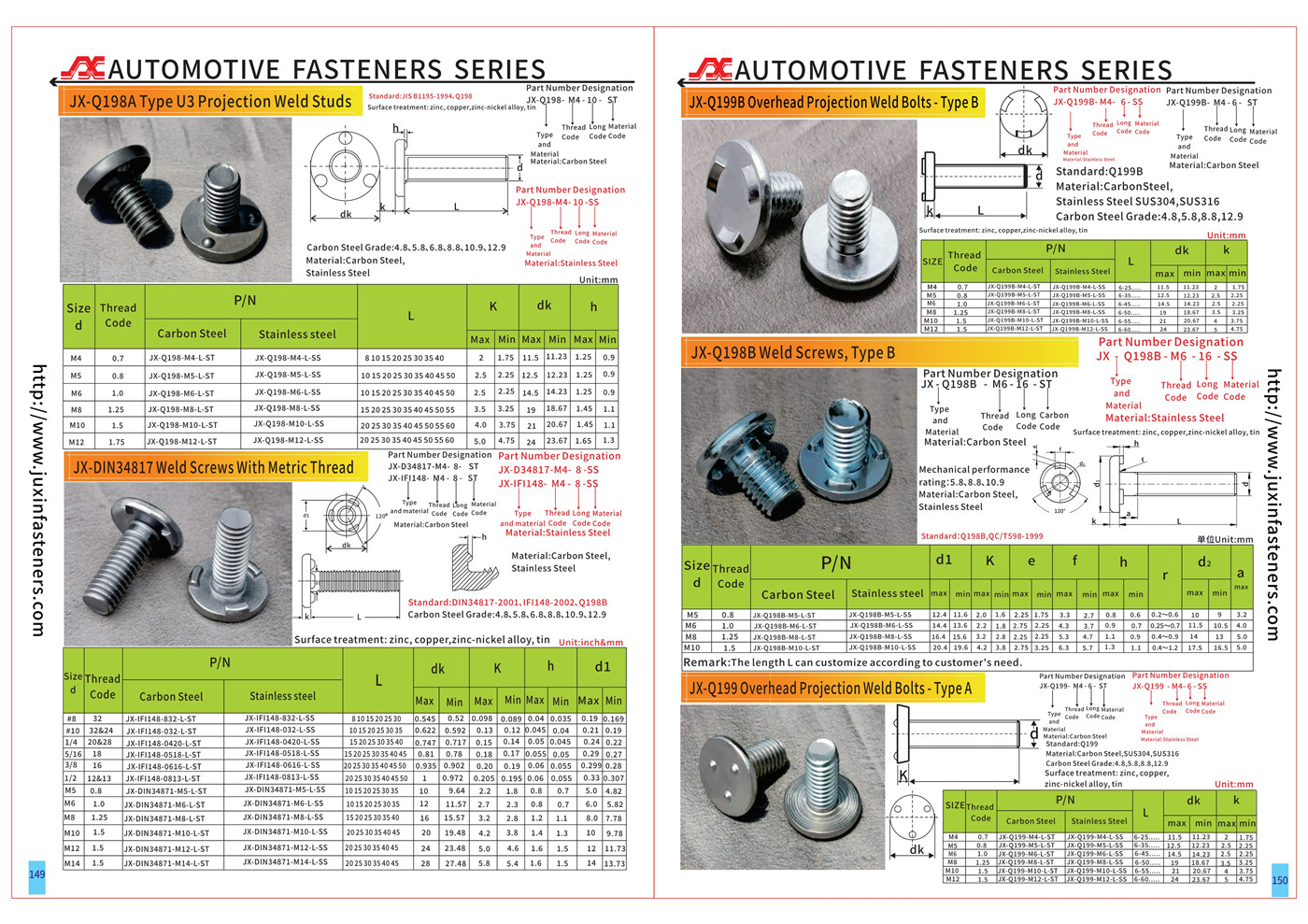
Size Can also be According to the Customer's requirement for manufacturing, please check the detailed specification sheet details PDF, CAD, 149-150 Page See more product details.
Automotive Welded Screws (Weld Studs): Structural Fastening Solutions for Modern Vehicle Manufacturing
What Are Automotive Welded Screws?
In automotive manufacturing, welded screws—commonly called weld studs—are threaded fasteners permanently joined to sheet metal components using a controlled stud-welding process.
Unlike conventional screws, which are mechanically driven into pre-tapped holes, weld studs are fused directly to the vehicle body or chassis by an electric arc. The process melts both the stud base and the substrate, forming a metallurgical bond that creates a highly durable threaded anchor point.
This technology enables manufacturers to integrate strong, load-bearing fastening points into thin sheet metal without drilling or tapping.
Core Functions of Weld Studs in Automotive Applications
1. Permanent Threaded Bases for Structural Assembly
Weld studs provide robust attachment points for bolts, brackets, modules, and structural components across the vehicle platform.
By eliminating the need for drilled and tapped holes in thin panels, they:
Improve structural integrity
Increase assembly efficiency
Reduce part count
Support high-speed automated production
Key Automotive Applications
Body Structure (BIW – Body in White)
Large-diameter weld studs (M8–M12) are commonly used in safety-critical areas such as:
Seatbelt anchorage systems (≥12 kN tensile requirement)
Anti-collision beams
Reinforcement plates
Door hinge brackets
These applications require high tensile performance and reliable weld integrity to ensure occupant safety during impact events.
Interior and Functional Components
Medium and small-diameter studs (M4–M8) are widely applied to secure:
Wiring harness brackets
Carpets and insulation panels
Door panel components
Electronic module brackets
Stud welding ensures accurate positioning and helps eliminate rattling or vibration-related noise.
Chassis and Undercarriage Systems
Weld studs are used to secure:
Suspension assemblies
Steering components
Brake line brackets
Underbody protection panels
In these applications, strength consistency and fatigue resistance are essential for long-term durability.
Performance Advantages in Automotive Manufacturing
1. Improved Sealing and NVH Performance
Because stud welding does not require through-holes in sheet metal, it:
Eliminates potential water and air leakage paths
Enhances body sealing performance
Improves NVH (Noise, Vibration, Harshness) control
Maintains overall body stiffness
This hole-free fastening solution supports higher vehicle refinement standards.
2. High-Speed Automation & Production Efficiency
Short-cycle arc stud welding is highly compatible with robotic automation.
Typical advantages include:
Single weld cycle time: 20–100 milliseconds
Over 30 welds per minute achievable
Fully programmable welding parameters
Reduced labor and process complexity
This enables “one-weld-and-use” fastening without secondary operations.
Supporting Modern Automotive Technology Trends
Electrification (EV Applications)
In electric vehicles, weld studs are used for:
Battery pack enclosure fastening
High-voltage electrical grounding points
Power distribution mounting
Materials must be compatible with lightweight substrates such as aluminum alloys while maintaining reliable electrical conductivity.
Lightweight Materials & Dissimilar Metal Joining
With the increasing use of aluminum and magnesium alloys, capacitor discharge (CD) stud welding offers:
Minimal heat input
Reduced thermal distortion
Improved joining performance on thin materials
Effective dissimilar metal joining solutions
This makes weld studs a key enabler in lightweight vehicle design.
Intelligent Quality Control in Stud Welding
Modern automotive stud welding systems incorporate:
Precise current and time control
Lift height monitoring
Real-time parameter tracking
Torque verification testing
Mechanical hammer testing
These quality assurance measures ensure consistent weld strength and production reliability.
Main Stud Welding Process Used in Automotive Manufacturing
The most common method is short-cycle arc stud welding, which consists of:
Arc ignition – The stud lifts and an arc is initiated
Melting phase – The arc melts both the stud base and workpiece surface
Pressure bonding – The stud is pressed into the molten pool
Rapid solidification – A high-strength metallurgical joint is formed
This process delivers consistent structural performance for high-volume automotive production.
Conclusion: The Invisible Structural Backbone of Modern Vehicles
Automotive weld studs serve as the invisible backbone of vehicle manufacturing. They combine:
Structural strength
Assembly efficiency
Lightweight compatibility
Automation readiness
Long-term durability
From life-critical seatbelt anchor points to precision wiring harness mounting inside the cabin, every welded stud contributes to vehicle safety, reliability, and comfort.
Why Partner with Juxin fastenersfor Automotive Weld Stud Solutions
With 23 years of manufacturing experience in industrial fasteners, JUXIN provides automotive-grade weld studs engineered for structural reliability and high-volume production environments.
We support OEMs and Tier suppliers with:
High-strength weld studs (Class 8.8 / 10.9 and customized grades)
Carbon steel and stainless steel options
Short-cycle arc and CD welding compatible designs
Custom head configurations and special geometries
Stable welding performance with minimal spatter
Corrosion protection solutions (Zn plating, Geomet®, Dacromet®, etc.)
PPAP documentation support upon request
Our engineering team works closely with customers during the design and validation phase to ensure:
Welding parameter compatibility
Substrate material matching
Structural load compliance
Long-term durability under vibration and fatigue
With 23 years of industry expertise, we understand that in automotive manufacturing, consistency is not optional — it is critical.
Technical Consultation for Your Automotive Project
Whether your application involves Body-in-White structures, EV battery enclosures, or chassis assemblies, our team can provide application-specific weld stud solutions tailored to your production line.
Please reach out to our engineering team today to discuss your project requirements.
Product Packaging
Packaging: The inner packaging is a plastic bag, and the outer packaging is a carton. Then the tray. Carton size: 29*19*19.5cm and 23.5*17.5*8, cm and pallet size: 215*100*90cm, or as your request
Product Pictures
Contact Us
Tel.:
+86 020 8621 0320
+86 020 3121 6067
E-mail:
Technical Support:
Navigation
SEND INQUIREY