Call Us
+86 136 6007 9809
Call Us
+86 136 6007 9809

Self-clinching nuts are installed by placing them in properly sized holes in sheets and applying a parallel squeezing force to the nut's head. The sheet metal surrounding the head cold flows into an undercut, thereby making the fastener an integral part of the sheet. A serrated clinching ring prevents the fastener from rotating after installation.
The Self-Clinching nut can be installed into a pre-punched or pre-drilled hole using a press capable of a squeezing action, causing the parent material to flow into the specially designed under-head configuration, offering a load-bearing and torque-resistant joint.
Product Specification
How It Works
Self-clinching fasteners require two features to properly secure themselves to a metal panel – an undercut and displacers that move material into the undercut. The installation of the fastener drives this displacement. Take a clinch nut (or press nut), for example. It uses knurls as displacers while the ramped shank creates an undercut and serves as a pilot within a panel hole.
During installation, the knurls are the first feature to touch the outer surface of the panel. They must move material out of the way so the barrel seats completely on the panel. Using the proper installation equipment and force, the material is guided into the undercut. Post-installation, the shank will now have to displace the material again in order to fall out of the panel, which requires forces similar to those associated with installation.
The specific self-clinching features often vary by fastener type. While the clinch nut uses knurls as displacers and a ramped shank as an undercut, many standoffs use the head as a displacer and a square undercut where the barrel meets the head. Some larger studs use large, coarse ribs to fill a trapezoidal undercut since there is more material to move, favoring
Advantages & Limitations
Self-clinching technology is a very secure and strong fastening solution for a variety of metals and sheet thicknesses. It minimizes loose parts like nuts and washers that would otherwise be required to complete a fastened joint, and installation is fast and consistent when using the proper equipment and procedure. Most cost savings come from reduced time and energy spent in production at scale with improvements in quality and consistency.
The greatest limitation of self-clinching fasteners is the cost of installation equipment and more expensive parts. While there are a wide variety of applications in which self-clinching is a valuable solution, more time is spent developing features for materials of varying hardness and ductility, for sheets of different thicknesses, and for corrosive environments. Given the production volume required to offset the investment in installation equipment, this can limit the versatility of self-clinching parts.
Self-clinching requires ductile metals to function properly – a material that commonly uses welding as a valid solution for installing threads in a panel. The equipment is simpler, the parts are simpler and typically cheaper, and innovations in laser welding have greatly improved the quality in dimensionally smaller applications. Nonetheless, energy usage is higher, and additional time is required for the welded joints to cool. Weld spatter can also cause quality problems that jeopardize an assembly if it isn’t caught during production. Where welding requires similar metals to function properly, self-clinching can work with a variety of dissimilar metals.
Common Applications
While self-clinching is limited to metal applications, it enables the use of corrosion-resistant coatings that remain intact during installation. This is useful for marine environments with temperature and humidity concerns. Mass production of automotive, telecom, medical, and consumer electronics parts can benefit from using self-clinching fasteners over alternative attachment technologies, especially as innovations in conductive fasteners continue to grow.
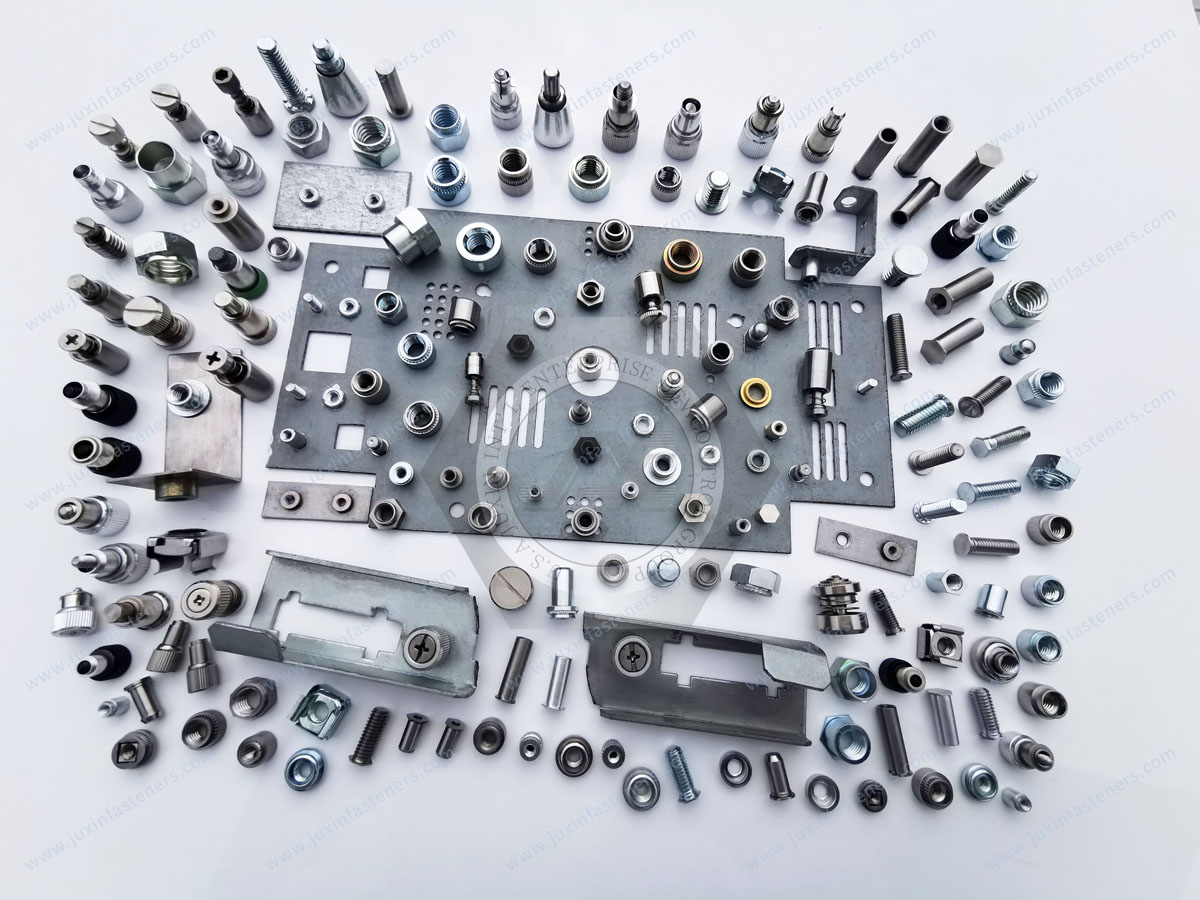
Product Pictures
Contact Us
Tel.:
+86 020 8621 0320
+86 020 3121 6067
E-mail:
Technical Support:
Navigation
SEND INQUIREY