Call Us
+86 136 6007 9809
Call Us
+86 136 6007 9809

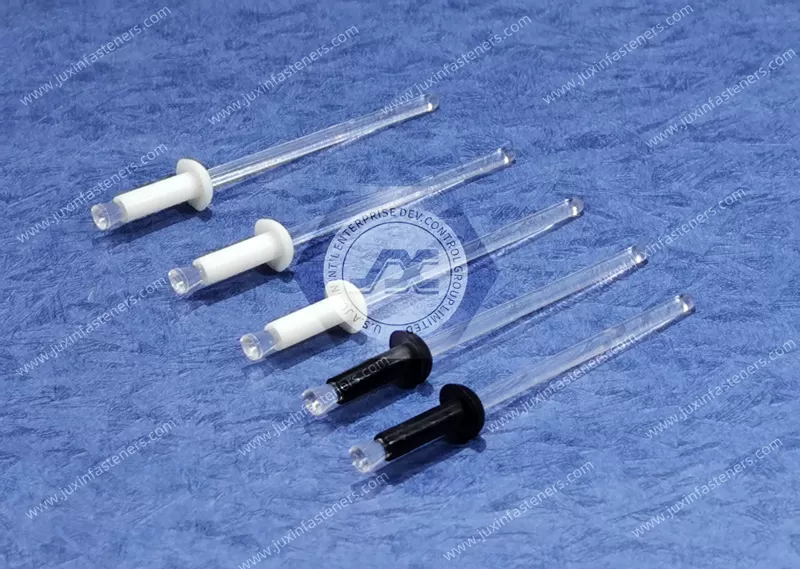
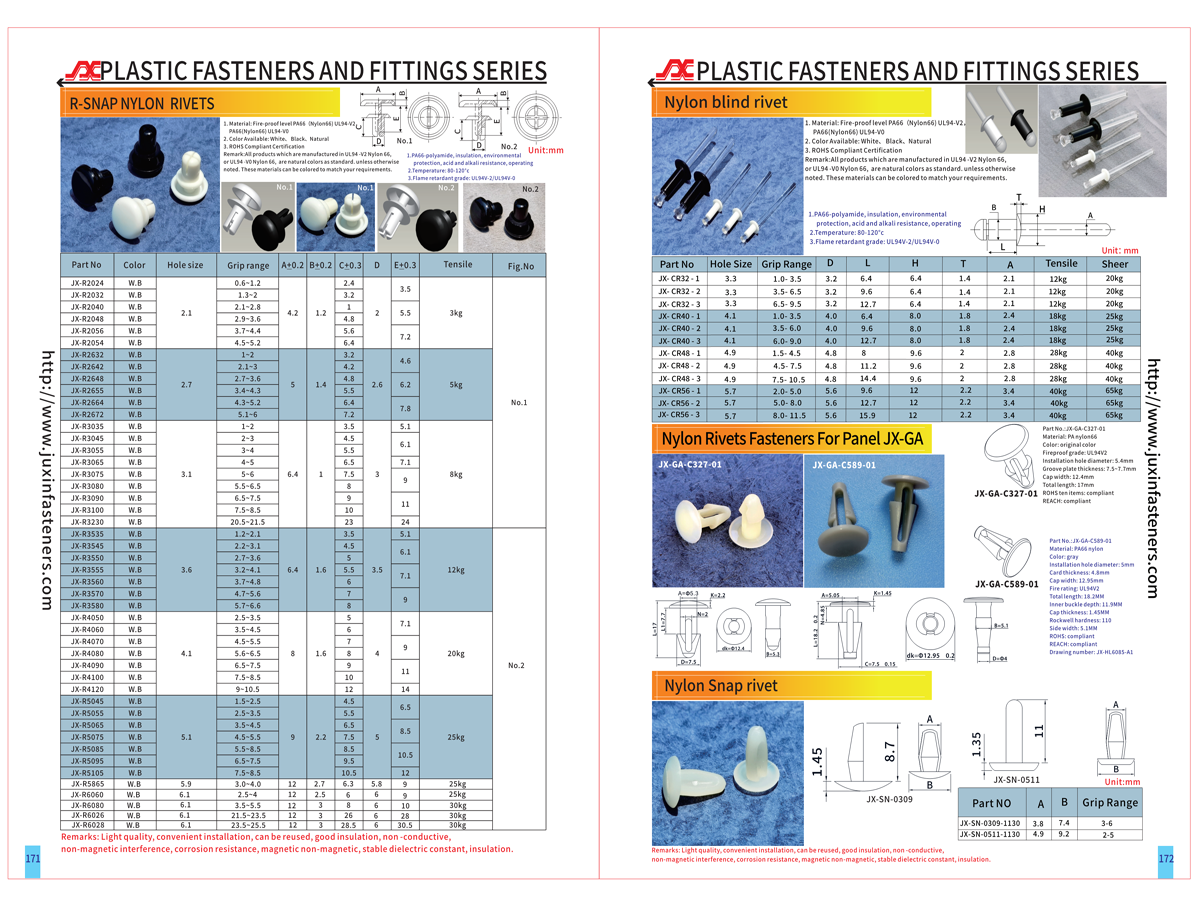
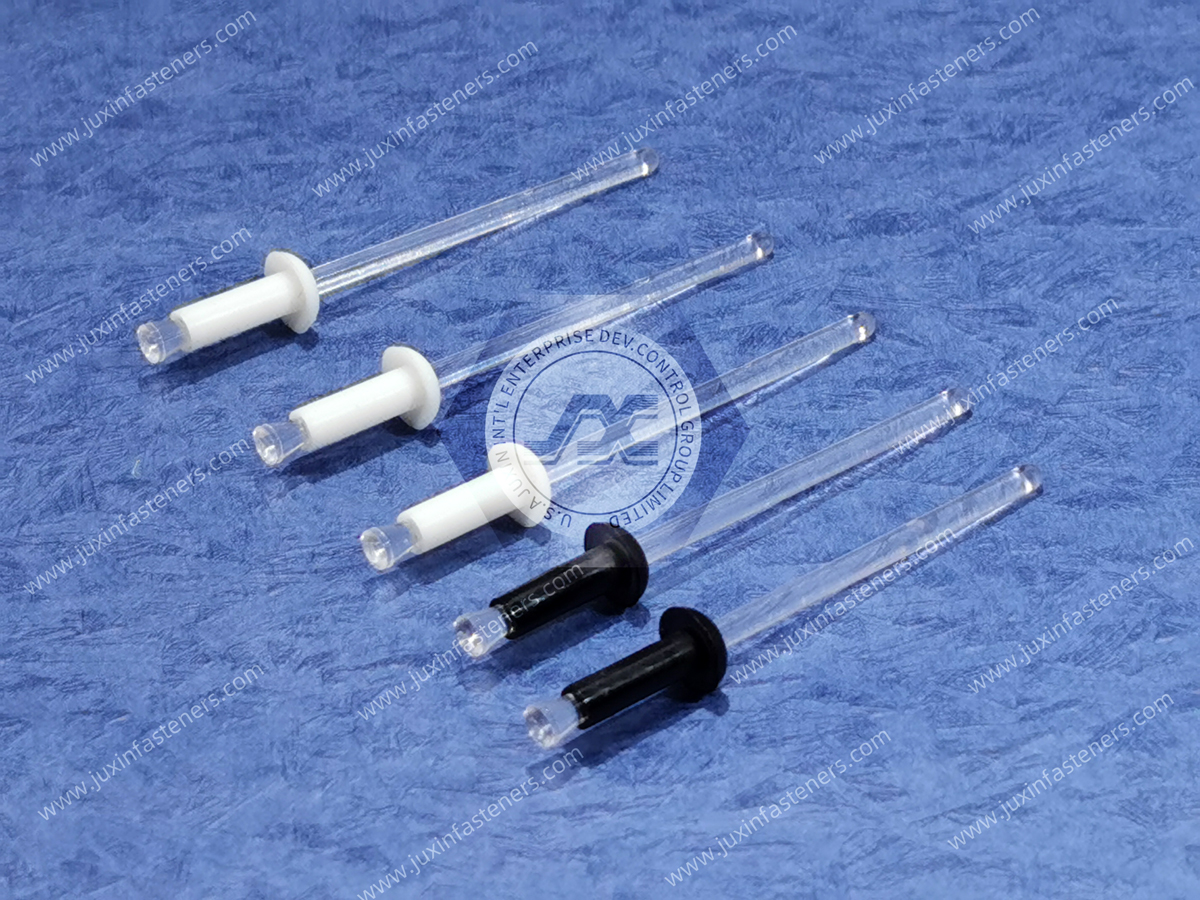
Name: Plastic Nylon 66 Blind Rivets
Material: Fire-proof level PA66(Nylon66) UL94-V2,PA66(Nylon66) UL94-V0
Color Available: White、Black、Natural, ROHS Compliant Certification
Size:3.2,4.0,4.8,5.6
Remark: All products manufactured in UL94 -V2 Nylon 66
or UL94 -V0 Nylon 66 are natural colors as standard. So that you know – unless otherwise
noted. These materials can be colored to match your requirements.
1.PA66-polyamide, insulation, environmental
protection, acid and alkali resistance, operating
2. Temperature: 80-120°c
3.Flame retardant grade: UL94V-2/UL94V-0
Corrosion-resistant and nonconductive, these rivets are designed to join plastic, fiberglass, wood, and metal. They join material when you only have access to one side. A low-profile domed head creates a finished appearance.
The combined thickness of the material must fall within the rivet's material thickness range. Shear strength is the force it takes to break a rivet from the side, and tensile strength is the pull a rivet can withstand without breaking. Joint strength is also affected by rivet spacing and hole size.
Nylon mandrels absorb moisture, which can affect dimensions and other properties. Acetal mandrels are more moisture-resistant than nylon.
A tool for plastic blind rivets (sold separately) with a nosepiece that matches the rivet's diameter is required for installation.
Product Specification
Rivets and Panel Fasteners
Clinch Rivet, PA6 UL94V2, PC UL94V2
Our fasteners and fixings cover a wide selection of plastic mountings and offer various application options for fixed connections, which are suitable for manufacturing needs in the automotive or electrical industry.
A clever solution for components based on a process in assembly and production.
An all-plastic alternative to the standard pop rivet. These rivets are nonconductive. It is ideal for joining two panels together even if the materials differ.
They are made from Acetal & Nylon polymers. The pin shears at the point of insertion to leave a neat finish.
The most crucial chemical performance indicators:
1. Acid resistance.
2. Alkali resistance.
3. Fire rating.
4. Insulation performance
Nylon blind rivets have unique chemical and physical properties. In the insulation, corrosion resistance, acid, alkali, and so on are better than conventional rivets. And its quality is relatively light. Relative to the screws, nylon blind rivets in the assembly speed is more convenient.
Why Nylon Blind Rivets Cannot Meet UL94 V-0 Flame Retardant Rating
Engineering Explanation for Plastic Fastener Selection
In plastic fastener applications, the UL94 V-0 flame-retardant rating is often specified for electronic, electrical, and industrial equipment. However, in real-world engineering practice, not all nylon fasteners are suitable for UL94 V-0 materials.
Nylon Blind Rivets are a typical example.
Many engineers and buyers ask:
“Can nylon blind rivets be made with UL94 V-0 Nylon 66?”
From a material and structural engineering perspective, the answer is no.
1. UL94 V-0 Nylon 66 and Material Property Changes
To achieve UL94 V-0 flame-retardant performance, Nylon 66 must be compounded with flame-retardant additives.
While this improves self-extinguishing behavior, it also significantly alters the mechanical properties of the material:
Reduced toughness and elongation
Increased material brittleness
Lower resistance to tensile deformation and impact stress
These changes are critical when the fastener must undergo plastic deformation during installation.
2. Installation Principle of Nylon Blind Rivets
Unlike snap or push rivets, blind rivets rely on a pulling-and-expanding process to achieve fixation.
During installation, nylon blind rivets must withstand:
High axial tensile force
Radial expansion
Controlled plastic deformation without cracking
This process demands high toughness, flexibility, and elongation at break from the nylon material.
3. Why UL94 V-0 Nylon Is Not Suitable for Blind Rivets
When UL94 V-0 Nylon 66 is used for blind rivets, the reduced toughness caused by flame-retardant additives leads to serious risks during installation:
Cracking at the expansion zone
Breakage during pulling
Incomplete rivet formation
Unstable or unreliable fastening performance
In practical testing and production, V-0-grade nylon blind rivets exhibit a high failure rate, making them unsuitable for mass production and industrial use.
For this reason, UL94 V-0 Nylon 66 is technically incompatible with the structural requirements of blind rivets.
4. Industry-Standard Practice
Across the plastic fastener industry, the standard solution is clear:
Nylon Blind Rivets
→ Produced using standard Nylon 66 (non-V0) to ensure sufficient toughness and reliable installation performance
UL94 V-0 Applications
→ Prefer Snap Rivets, Push Rivets, Panel Fasteners, where no high tensile deformation is required
This balance ensures both functional reliability and compliance with safety standards.
5. Engineering Recommendation for Correct Fastener Selection
When a project involves both flame-retardant requirements and mechanical fastening, material selection should be based on actual installation behavior, not just certification labels.
Need UL94 V-0 flame retardant rating
→ Choose snap-type or fixed plastic rivets
Need strong pull-through fastening and expansion
→ Choose standard Nylon 66 blind rivets
Material performance must match fastening mechanics — this is the foundation of reliable engineering design.
Conclusion
Although UL94 V-0 Nylon 66 performs well in fire safety tests, its reduced toughness makes it unsuitable for blind rivet structures.
For nylon blind rivets, mechanical reliability always takes priority over flame-retardant grading.
Understanding this limitation helps engineers and buyers avoid installation failures, product damage, and long-term reliability risks.
Product Pictures
Contact Us
Tel.:
+86 020 8621 0320
+86 020 3121 6067
E-mail:
Technical Support:
Navigation
SEND INQUIREY