Call Us
+86 136 6007 9809
Call Us
+86 136 6007 9809

Material: Stainless steel, Carbon steel, Brass
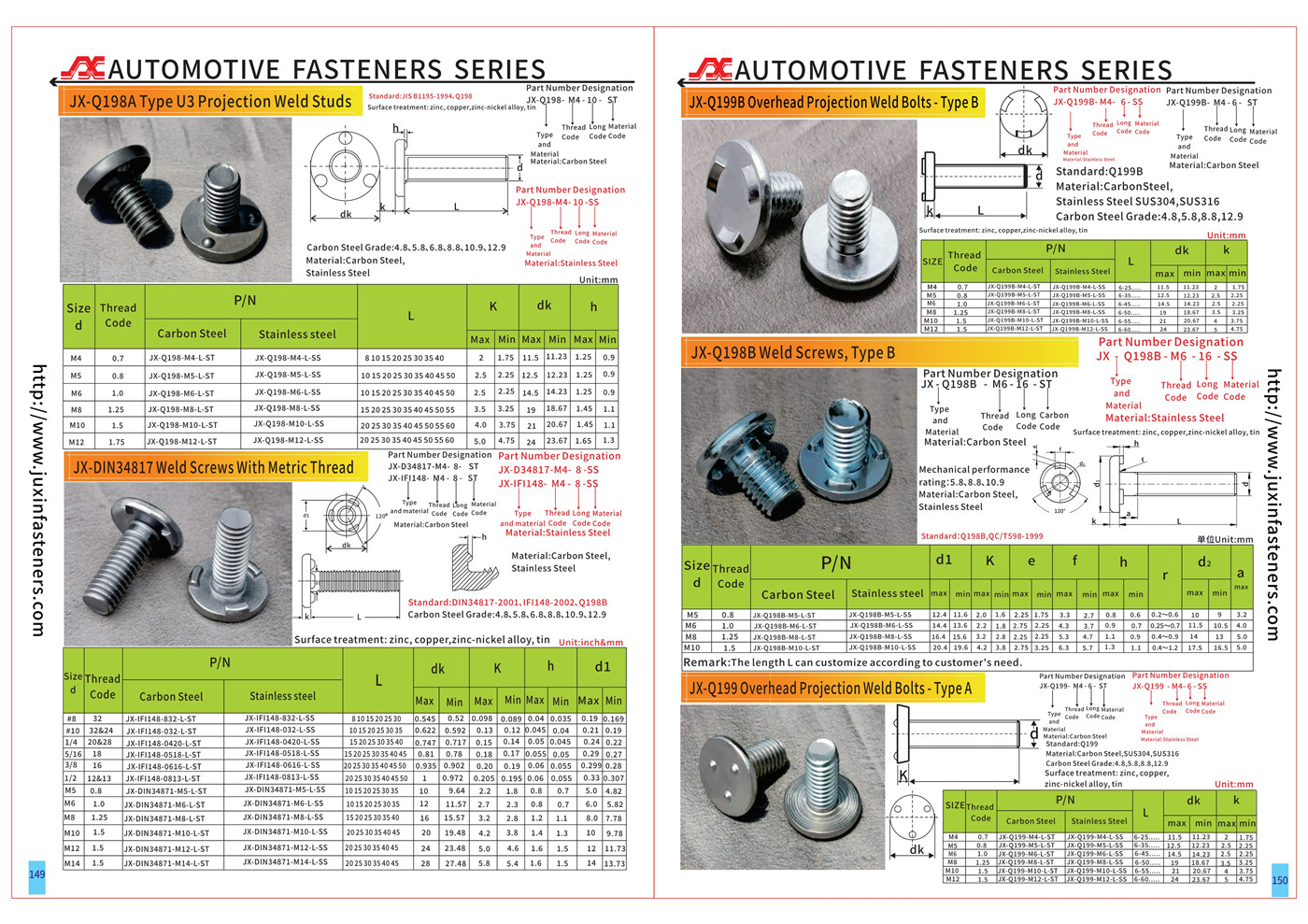
Standard: Q199B&QC /T 599 (B) - 2013
Product Specification
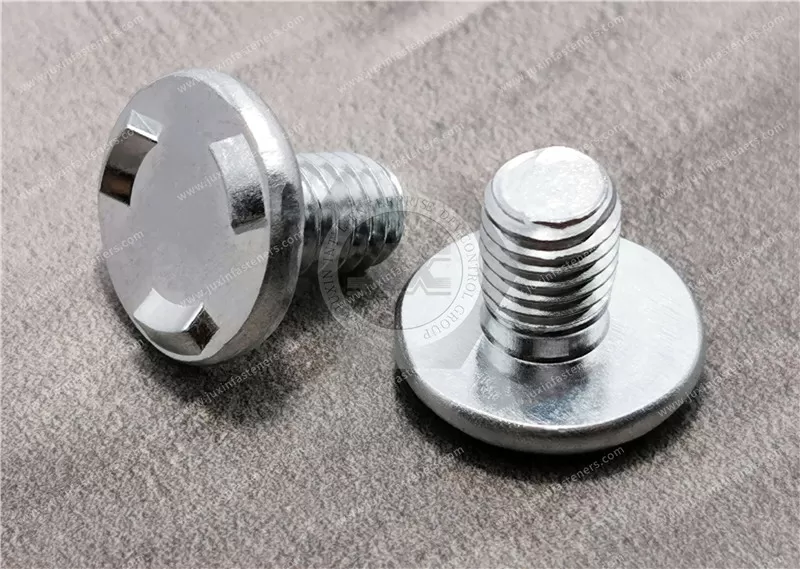
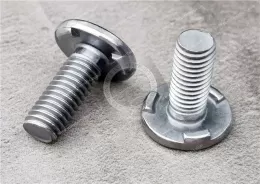
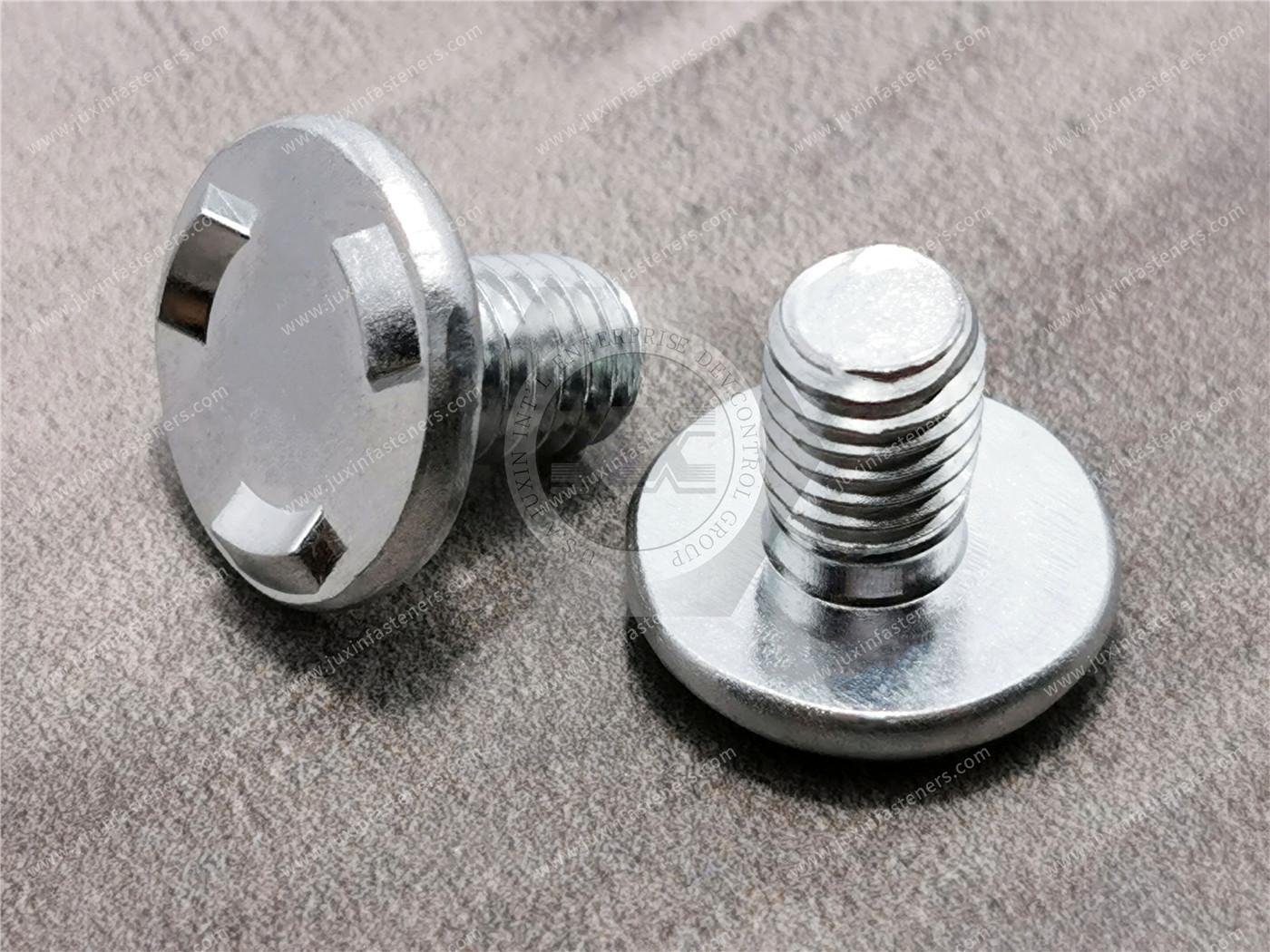
Name:Weld Stud
Material: Carbon Steel, Stainless Steel
Carbon steel Grade:5.8,6.8,8.8,10.9
1. The working principle of projection welding:
Projection welding is an evolution of spot welding. Generally speaking, a mountain point is punched out on one of the two plates, and then welded. Due to the concentration of current, it overcomes the defect of nugget offset during spot welding. One or more nuggets form at the joint.
2. Features of the projection welding process:
During projection welding, the electrode must drop rapidly as the bump is sub-collapsed, otherwise spatter will occur due to pressure loss, so a projection welding machine with good electrode followability should be used.
The electrode pressure should ensure that the bumps are completely sub-collapsed when they reach the welding temperature so that the workpieces can fit closely. If the pressure is too high, the bumps will be crushed prematurely, and the function of projection welding will be lost.
The reduced flow density will reduce the strength of the joint, and the pressure will be too small to cause sub-heavy splashing.
Usually, the welding time of projection welding is longer than that of spot welding, and the flow is smaller than that of spot welding. Multi-point projection welding is a slightly longer welding time than single-point projection welding to reduce the difference in heating at each point caused by inconsistent bump heights.
The current required for each spot of projection welding is smaller than that of spot welding the same spot, but the current must be able to melt the bump before the bump is completely crushed. The welding current is approximately the current required for each bump multiplied by the number of bumps.
Size Can also be According to the Customer's requirement for manufacturing, please check the detailed specification sheet details PDF, CAD, 149-150 Page See more product details.
Overhead Projection Weld Studs in Automotive Manufacturing
High-Strength Structural Fastening for Body, Chassis, and Electrical Systems
Overhead Projection Weld Studs play a critical role in modern automotive manufacturing. As vehicle platforms evolve toward lightweight structures, electrification, and high-speed automated assembly, projection stud welding has become a preferred fastening method for achieving structural integrity, production efficiency, and long-term durability.
Stud welding technology is widely applied across body structures, chassis systems, and vehicle electrical architectures. It provides permanent threaded anchor points without compromising sheet metal integrity.
What Are Overhead Projection Weld Studs?
Overhead Projection Weld Studs are specially designed fasteners with defined projection points that concentrate welding current and heat during the projection welding process.
During welding:
Controlled current flows through the projection points
Localized heat is generated at the contact interface
The projections collapse under pressure
A solid-state metallurgical bond is formed
This method ensures consistent weld quality, especially in automated robotic production lines and overhead welding positions commonly found in automotive body assembly.
Key Automotive Applications
1. Body Structure (Body-in-White)
Overhead Projection Weld Studs are extensively used in:
Frame assemblies
Body shells
Reinforcement brackets
Door, hood, and trunk support structures
By welding studs directly to structural panels, manufacturers create stable fastening points for subsequent assembly operations.
Engineering Benefits:
Improved torsional rigidity
Reduced deformation risk
Minimal heat-affected zone
Consistent positioning accuracy
Enhanced crash performance reliability
Because projection welding concentrates heat precisely at the projection interface, metal fatigue and distortion are effectively minimized.
2. Chassis and Suspension Systems
In chassis production, structural consistency and fatigue resistance are critical.
Projection weld studs are used to secure:
Suspension brackets
Steering assemblies
Cross members
Underbody protection components
Compared to multiple threaded connections, projection weld studs:
Reduce part count
Increase assembly speed
Lower total vehicle weight
Improve structural load distribution
This contributes to better vehicle handling stability and long-term durability.
3. Automotive Electrical and EV Systems
In both traditional and electric vehicles, stud welding is widely applied to secure:
Control modules
Sensor brackets
Grounding points
Battery enclosure components
For EV applications, projection weld studs provide reliable conductive attachment points while maintaining compatibility with lightweight substrates.
The strong metallurgical bond prevents loosening caused by vibration, shock loads, or long-term fatigue — ensuring electrical reliability and system safety.
Advantages of Overhead Projection Weld Studs Over Conventional Fastening
1. Automation Compatibility
Projection stud welding is fully adaptable to robotic production lines.
Benefits include:
High repeatability
Short weld cycles
Reduced manual labor
Stable quality control
Unlike traditional bolted assemblies, no tapping or secondary operations are required.
2. Structural Consistency
Because the stud is permanently fused to the substrate:
Connection integrity is uniform
Torque variation issues are eliminated
Risk of installation errors is reduced
Long-term fatigue performance improves
Projection weld studs ensure consistent structural behavior across high-volume automotive production.
3. Lightweight & Efficient Design
Projection welding eliminates the need for:
Through-holes
Additional reinforcement plates
Excess hardware
This supports lightweight vehicle design strategies and reduces overall manufacturing complexity.
Considerations in Design and Maintenance
While projection weld studs provide superior structural performance, they are permanent fastening solutions.
Design engineers must evaluate:
Service life requirements
Accessibility for maintenance
Replacement strategy in case of component failure
With proper design planning, these considerations can be effectively managed without compromising performance.
Why Overhead Projection Weld Studs Remain Essential in Modern Vehicle Production
As automotive platforms shift toward:
Electrification
Lightweight materials
Modular architecture
High-speed automation
Overhead Projection Weld Studs continue to deliver:
High connection stability
Enhanced vehicle rigidity
Improved crash safety
Efficient automated production
Long-term durability under vibration and fatigue
From body structural assemblies to chassis systems and EV electrical platforms, projection weld studs remain an indispensable fastening technology in modern automotive manufacturing.
Product Packaging
Packaging: The inner packaging is a plastic bag, and the outer packaging is a carton. Then the tray. Carton size: 29*19*19.5cm and 23.5*17.5*8, cm and pallet size: 215*100*90cm, or as your request
Product Pictures
Contact Us
Tel.:
+86 020 8621 0320
+86 020 3121 6067
E-mail:
Technical Support:
Navigation
SEND INQUIREY