
Call Us
+86 136 6007 9809
Call Us
+86 136 6007 9809

Feb. 28, 2026
UL 94 V-0 Flame-Retardant Nylon Rivets for Medical Electronics
Plastic Snap Rivets, Push-In Panel Fasteners and Custom Non-Metallic Fastening Solutions for Medical Equipment OEMs
Medical electronic equipment increasingly combines compact circuit boards, power supplies, embedded control systems, sensors and protective housings within limited installation space.
These assemblies require fastening components that satisfy mechanical, electrical, thermal and manufacturing requirements without introducing unnecessary complexity.
For selected non-implantable medical electronics applications, flame-retardant nylon snap rivets and plastic push-in fasteners can provide a practical alternative to conventional metallic fastening hardware.
Their potential advantages include electrical insulation, low weight, corrosion resistance in suitable environments and simplified assembly.
However, selecting a nylon rivet for medical electronics requires more than choosing a product advertised as flame-retardant.
Engineers must verify the material's actual flammability classification, the applicable tested thickness, mechanical retention performance, mounting-hole dimensions,
panel thickness, operating temperature and environmental compatibility.
The finished medical device must also satisfy its own applicable safety and regulatory requirements.
JUXIN FASTENERS supplies industrial fastening products and supports drawing-based OEM fastener sourcing, including plastic fastening solutions subject to material, design and manufacturing feasibility confirmation.
For projects requiring UL 94 V-0 flame-retardant nylon rivets, the exact material grade, supporting documentation, dimensional requirements and production specifications should be reviewed before quotation and approval.
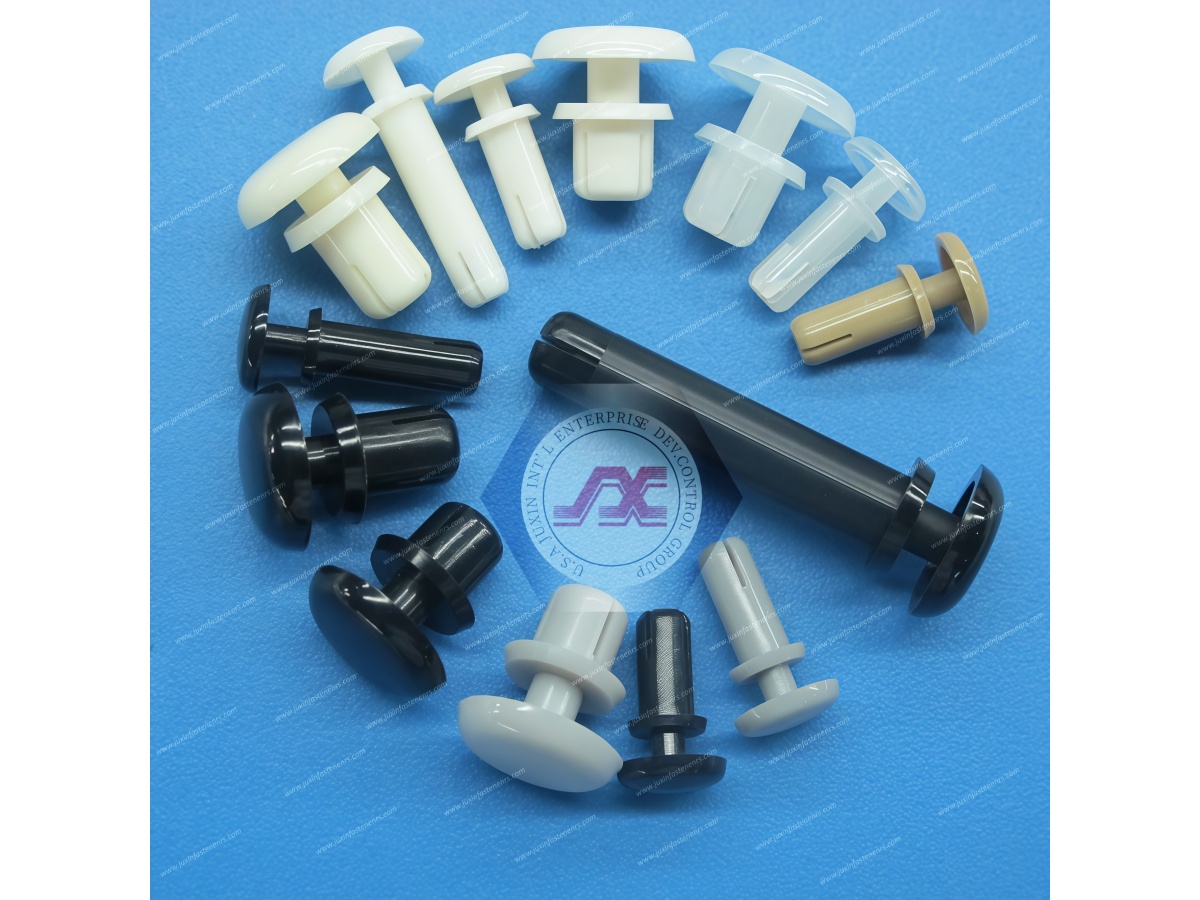
What Are UL 94 V-0 Nylon Snap Rivets?
Nylon snap rivets are non-metallic fastening components designed to secure compatible panels, housings or internal assemblies through a mechanical snap-fit or expansion mechanism.
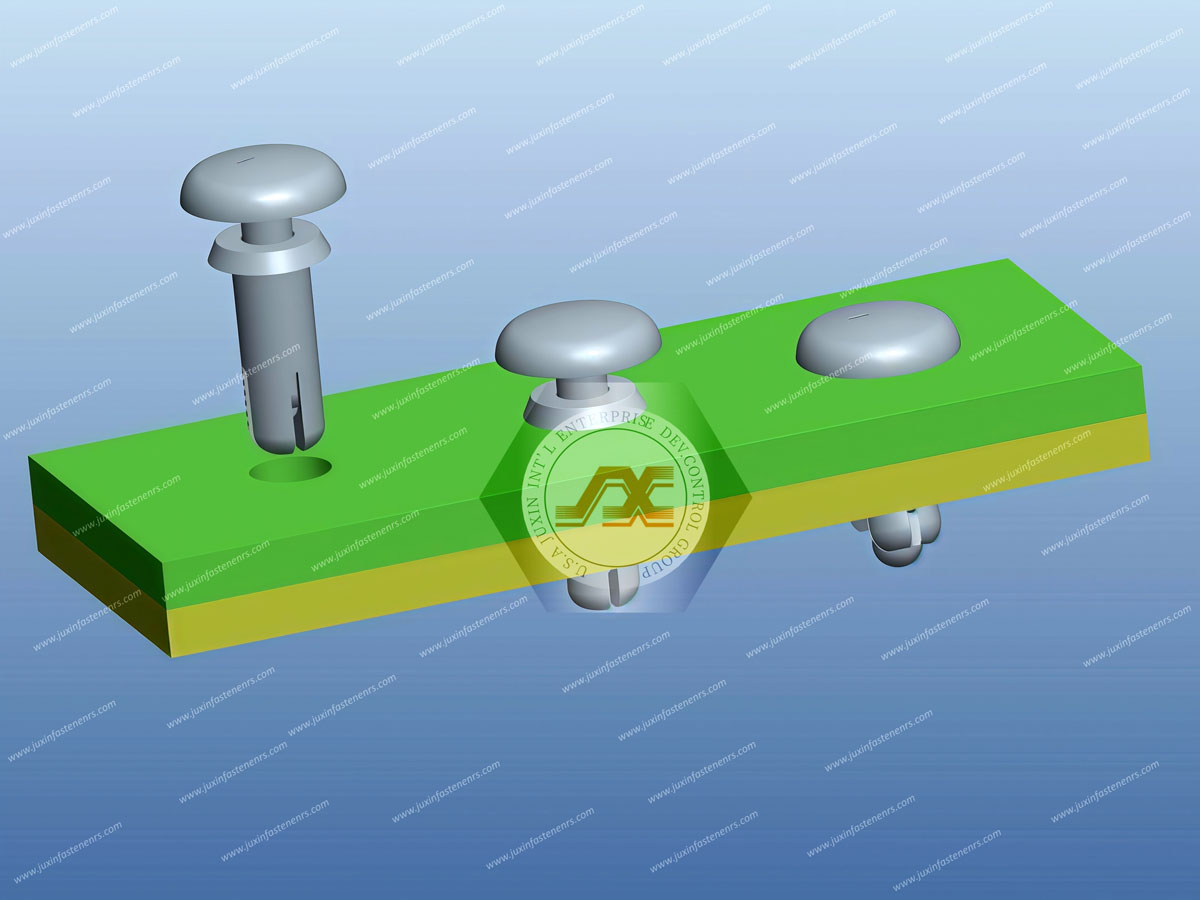
Depending on the design, the rivet may be pushed into a mounting hole, allowing flexible legs or another retaining feature to engage the material.
These products are also commonly searched for as:
Nylon snap rivets
Plastic push rivets
Push-in plastic rivets
Nylon panel fasteners
Plastic snap fasteners
Flame-retardant plastic rivets
PCB mounting rivets
Non-conductive panel fasteners
The exact terminology depends on the rivet geometry and installation method.
Not all plastic rivets use the same retention mechanism, and not all nylon rivets are manufactured from flame-retardant materials.
A product should be described as using UL 94 V-0-classified material only when the specified material grade and relevant supporting evidence substantiate that classification.
Understanding UL 94 V-0 Flame-Retardant Material Classification
UL 94 is a flammability test standard used to classify the burning behavior of plastic materials under specified laboratory conditions.
It is frequently referenced in electronic equipment design because polymer components may be located near electrical circuits, power supplies or other potential ignition sources.
However, UL 94 classifications must be interpreted correctly.
What Does V-0 Mean?
UL 94 V-0 is a vertical-burning classification.
Under the applicable test conditions, the material specimen must satisfy requirements relating to afterflame time, afterglow behavior and the absence of flaming drips that ignite the cotton indicator.
The classification is established through testing according to the standard.
It does not mean the material is nonflammable or incapable of burning under all conditions.
Why Tested Thickness Matters
UL 94 material classifications are associated with specified specimen thicknesses and other relevant test conditions.
A material that achieves V-0 at one thickness may not necessarily achieve the same classification at a thinner section.
This distinction is particularly important for plastic snap rivets because flexible legs, retaining wings and other functional features may be relatively thin.
Engineers should confirm whether the material's documented flammability performance is relevant to the actual part geometry and minimum wall thickness.
UL 94 V-0 Versus V-1, V-2 and HB
UL 94 includes several classifications.
HB refers to horizontal-burning behavior under the relevant test method.
V-2, V-1 and V-0 are vertical-burning classifications with different acceptance requirements.
V-0 generally imposes more restrictive afterflame and flaming-drip requirements than V-1 and V-2.
However, these classifications should not be treated as a complete ranking of fire safety performance for every finished application.
Does a V-0 Material Make the Finished Rivet UL Certified?
Not automatically.
A resin grade may have documented UL 94 V-0 performance, but that does not establish that every molded component made from the resin is independently UL certified.
Material identification, thickness, processing conditions and applicable documentation must be reviewed.
Likewise, using a V-0-classified plastic fastener does not certify the entire medical electronic device.
The finished assembly must be evaluated against the applicable equipment-level requirements.
Material Selection: Flame-Retardant PA6, PA66 and Modified Polyamides
Nylon is a common name for a family of polyamide engineering polymers.
PA6 and PA66 are among the materials that may be considered for plastic fastening applications.
Flame-retardant grades may use different additive systems and material formulations.
However, a general designation such as PA66 does not automatically establish UL 94 V-0 performance.
PA6 and PA66
Different polyamide grades have different mechanical, thermal, moisture absorption and processing characteristics.
The actual performance depends on the selected formulation and material condition.
For snap rivets, engineers should consider the balance between stiffness, toughness and flexibility.
A material that is too brittle may crack during insertion.
A material that is too flexible may not provide the required retention force.
Flame-Retardant Formulations
Flame-retardant additives can change mechanical properties, processing behavior and appearance.
A formulation selected primarily for flammability performance may behave differently from a general-purpose nylon grade.
The final material selection should consider both flammability classification and snap-fit performance.
Halogen-Free Material Requirements
Halogen-free flame-retardant formulations may be available for certain polymer grades.
However, halogen-free status should not be assumed from the V-0 classification.
If a project requires halogen-free material, the customer should specify the applicable definition and documentation requirements.
Moisture Absorption
Polyamides can absorb moisture from the surrounding environment.
Moisture content can influence dimensions, stiffness, toughness and mechanical behavior.
For snap-fit components, these changes may affect insertion force and retention performance.
Testing and dimensional evaluation should consider the relevant conditioning state.
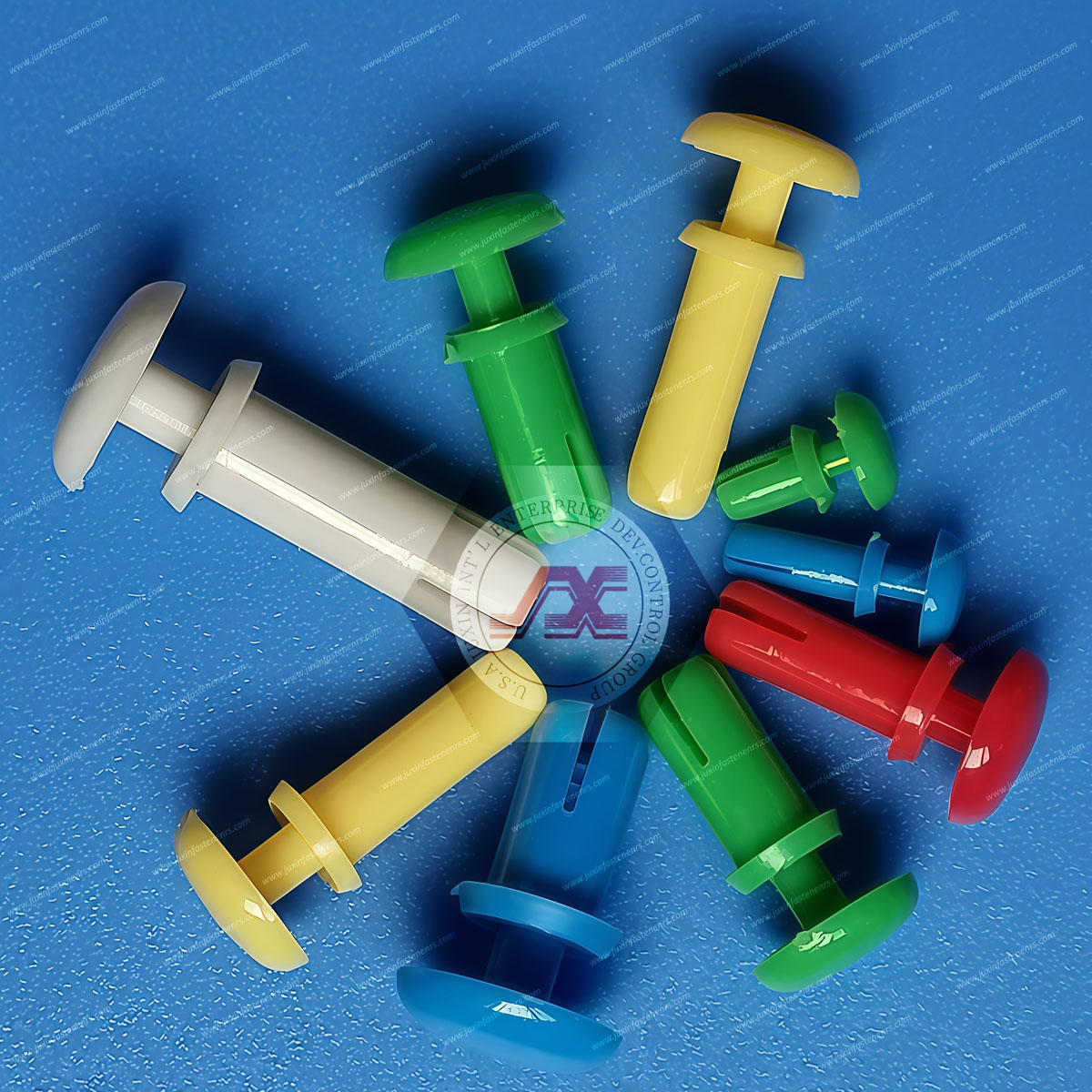
Material Traceability
Where the customer requires a particular flame-retardant resin grade, the approved material identification and substitution controls should be clearly established.
A change to a different nylon compound may require renewed engineering review, even if the replacement material is also described as V-0.
Mechanical Design of Nylon Snap Rivets
The mechanical performance of a plastic snap rivet depends on its complete geometry and installation conditions.
Important design features may include:
Rivet head diameter
Shank diameter
Retaining-leg geometry
Mounting-hole diameter
Panel thickness
Grip range
Insertion depth
Material stiffness
Installation direction
Retention mechanism
The geometry must provide sufficient flexibility for insertion while maintaining the required holding performance after installation.
Mounting-Hole Diameter and Tolerance
Hole diameter is one of the most important dimensions in a snap-rivet assembly.
If the hole is too small, insertion force may increase and the rivet legs may be overstressed.
If the hole is too large, the retaining features may not engage sufficiently.
This can reduce retention performance or create unwanted movement.
The correct mounting-hole specification depends on the exact rivet design and panel material.
A nominal rivet diameter should not be used as the mounting-hole diameter without checking the relevant product drawing.
Panel Thickness and Grip Range
Grip range describes the total thickness that a fastener is designed to retain.
For a snap rivet, the assembled thickness must allow the retaining features to engage correctly.
A rivet that is too short may not lock into position.
A rivet that is too long for the intended stack may create excessive clearance or inadequate clamping, depending on the design.
The complete panel stack should be considered, including any coatings, insulating sheets or other layers that affect the installed thickness.
Insertion Force
Insertion force influences production assembly efficiency and the risk of component damage.
Excessive insertion force may deform thin panels, damage printed circuit boards or overstress the rivet.
Insufficient insertion resistance may indicate an unsuitable fit or incomplete engagement.
The required insertion-force range should be established through evaluation of the actual rivet and mating assembly.
Retention and Pull-Out Force
Pull-out force describes the resistance to removal under a specified loading condition.
It is influenced by rivet geometry, panel material, hole diameter, grip thickness, temperature and material condition.
A universal pull-out value cannot be assigned to every UL 94 V-0 nylon rivet.
The original equipment manufacturer should define the required retention performance and the relevant test configuration.
Shear Loading
Some snap rivets may resist limited transverse loading, but the allowable load depends on the design.
Plastic snap rivets should not be assumed suitable for primary structural connections or safety-critical load-bearing joints.
Where significant shear or tensile loads are expected, the fastening arrangement must be evaluated accordingly.
Creep and Long-Term Retention
Polymers can deform over time under sustained stress.
This behavior, known as creep, may reduce clamping or retention performance.
Creep is influenced by temperature, load duration, material grade and environmental conditions.
For medical electronics that operate continuously or experience repeated heating, long-term retention should be considered during design validation.
Engineering Information Gain: A Snap Rivet Is a System, Not an Isolated Part
One of the most common specification mistakes is selecting a plastic rivet by its nominal diameter and material description alone.
In practice, the fastener works as part of a complete mechanical interface.
The effective fastening system consists of:
Rivet Geometry + Material Grade + Hole Tolerance + Panel Thickness + Assembly Method + Operating Environment
For example, a rivet that performs adequately in a rigid molded plastic panel may behave differently when installed in a thin metal panel or a printed circuit board.
The edge condition of the hole, local panel stiffness and actual thickness can affect insertion and retention.
Likewise, a rivet that passes a room-temperature pull-out test may not provide identical retention after extended thermal exposure or repeated disassembly.
For engineering approval, testing should reflect the intended assembly rather than relying exclusively on generic material properties.
Electrical Insulation in Medical Electronics
Nylon fasteners may provide electrical insulation where a non-conductive mechanical connection is required.
Potential applications include internal panel mounting, PCB support and selected electronic housing assemblies.
However, the electrical properties depend on the actual polymer grade, moisture condition, geometry and operating environment.
Dielectric Strength
Dielectric strength describes a material's resistance to electrical breakdown under specified test conditions.
A generic nylon material description does not establish a particular dielectric strength for the finished rivet.
Volume Resistivity
Volume resistivity is another relevant material characteristic.
Its value depends on the material formulation and test conditions.
Moisture and Electrical Performance
Because polyamides can absorb moisture, electrical properties may change with environmental conditioning.
Where insulation performance is critical, the relevant material condition should be considered.
Creepage and Clearance
Electrical safety design may require controlled creepage and clearance distances.
A plastic rivet does not automatically establish compliance with these requirements.
The complete equipment assembly must be evaluated according to the applicable electrical safety standard.
Non-Conductive Does Not Mean ESD-Safe
An electrically insulating nylon rivet is not necessarily an electrostatic dissipative component.
Where electrostatic discharge control is required, material selection and handling procedures should be evaluated separately.
Avoiding Conductive Bridging
Replacing a metal fastener with a suitable insulating plastic fastener may eliminate a direct conductive path through that fastening location.
However, this does not eliminate every electrical hazard or guarantee the insulation performance of the overall assembly.
Thermal Performance and Operating Temperature
Medical electronic equipment may contain power supplies, control modules, displays, batteries and other components that generate heat.
Plastic fasteners used near these components must maintain adequate mechanical performance at the intended operating temperature.
Continuous Service Temperature
The acceptable continuous operating temperature depends on the specific polymer grade, applied load, duration and environmental conditions.
It should not be inferred solely from a material's UL 94 V-0 classification.
Heat Deflection Temperature
Heat deflection temperature is a material test characteristic measured under specified conditions.
It is not equivalent to the maximum continuous operating temperature of a loaded snap rivet.
Thermal Cycling
Repeated temperature changes may influence dimensional fit, retention force and material behavior.
Thermal Expansion
Nylon and the surrounding panel materials may expand at different rates.
These differences can affect the installed fit.
Long-Term Mechanical Performance
For assemblies requiring continuous retention, the effect of elevated temperature on creep and stress relaxation should be evaluated.
Tool-Free Installation and Production Assembly Efficiency
Plastic push rivets can simplify assembly where their design permits manual or automated push-in installation.
For manufacturing engineers and production managers, the potential benefit is not merely the elimination of a screwdriver.
The important considerations are installation consistency, component damage risk, cycle time and verification of proper engagement.
Reduced Tooling Requirements
Some snap-rivet designs can be installed without torque-controlled tools.
However, certain designs may still require an insertion fixture or dedicated installation tool.
Consistent Installation
A properly designed snap-fit mechanism can provide a repeatable mechanical engagement when the hole diameter, panel thickness and insertion method are controlled.
Assembly Cycle Time
Push-in fastening may reduce the number of installation operations compared with threaded fasteners in suitable applications.
The actual cycle-time benefit should be established through production evaluation.
Automated Assembly
For high-volume production, rivet geometry, feeding orientation and insertion force may influence compatibility with automated equipment.
Inspection of Installed Rivets
Production quality controls may include visual engagement checks, seating-height verification or functional retention tests.
The appropriate method depends on the component and assembly requirements.
Avoiding Assembly Damage
Thin panels and printed circuit boards may require support during rivet insertion.
Without suitable support, insertion force may cause bending or local damage.
Medical Equipment Design Considerations
Medical electronics manufacturers should evaluate plastic fasteners within the context of the finished equipment.
PCB Mounting
Plastic rivets may be suitable for selected printed circuit board mounting applications.
Engineers should consider board thickness, mounting-hole dimensions, local support, electrical clearance and service requirements.
Internal Housing Assembly
Snap rivets may secure selected internal covers, panels or protective components.
The required retention depends on the enclosure geometry and expected loading.
Power Supply and Control Modules
Flame-retardant plastic fasteners may be considered for suitable mechanical interfaces near electrical assemblies.
However, the material's flammability classification does not replace equipment-level fire and electrical safety evaluation.
Patient Monitoring Equipment
Selected non-implantable monitoring equipment may contain internal plastic fastening applications.
The component must meet the device manufacturer's mechanical, electrical and material requirements.
Diagnostic Equipment
Internal panels, control modules and electronic assemblies may use non-metallic fastening components where appropriate.
Infusion and Therapy Equipment
Potential applications must be evaluated carefully against the equipment's safety requirements, cleaning environment and mechanical function.
A generic nylon snap rivet should not be assumed suitable for fluid-contact, patient-contact or safety-critical connections.
Medical Equipment Racks and Enclosures
Plastic push rivets may support suitable lightweight panels and internal assemblies where the mechanical requirements permit.
Chemical Resistance, Disinfectants and Cleaning Exposure
Medical equipment may be exposed to cleaning agents, disinfectants and repeated surface-wiping procedures.
The chemical compatibility of nylon depends on the exact polymer formulation, chemical composition, concentration, temperature and exposure duration.
Disinfectant Compatibility
A nylon rivet should not be described as resistant to all medical disinfectants.
Repeated exposure to certain chemicals may affect surface condition or mechanical performance.
Stress Cracking and Environmental Degradation
Mechanical stress combined with chemical exposure may contribute to material damage in susceptible polymers.
Moisture Exposure
Water absorption can affect dimensions and mechanical behavior.
UV Exposure
Prolonged ultraviolet exposure may degrade certain nylon formulations.
Where UV exposure is expected, the selected material should be evaluated for that environment.
Cleaning Validation
If the finished equipment requires validated cleaning procedures, the fastener material and geometry should be considered within the device manufacturer's validation program.
Serviceability and Repeated Removal
Not all snap rivets are designed for repeated removal.
Some plastic rivets are intended for one-time installation, while others permit limited reuse.
Repeated removal may damage retaining legs or change retention force.
The design should specify whether the component is disposable, replaceable or reusable.
For serviceable medical equipment, engineers should consider maintenance frequency and replacement procedures.
Where frequent disassembly is required, a removable threaded fastening solution may be more appropriate.
UL 94 V-0 Nylon Rivets Versus Metal Fasteners
Plastic snap rivets and metallic fasteners offer different engineering advantages.
Neither category is universally superior.
| Engineering Factor | Flame-Retardant Nylon Snap Rivets | Metal Fasteners |
|---|---|---|
| Electrical conductivity | Generally insulating, depending on material | Generally conductive |
| Material flammability | Depends on verified polymer classification | Metallic fastener itself is generally noncombustible under normal service conditions |
| Weight | Generally lower for comparable small components | Generally higher |
| Installation | May allow push-in assembly | Often requires threaded or other mechanical installation |
| Structural load capacity | Limited by polymer and snap-fit design | May support higher loads depending on specification |
| Long-term creep | Must be evaluated | Generally less susceptible to polymer-type creep at ordinary service temperatures |
| Corrosion behavior | Depends on polymer and chemical environment | Depends on metal and surface protection |
| Repeated disassembly | Depends on rivet design | Often suitable where the joint is designed for service |
| Electrical insulation | May be useful | Requires separate insulating design where needed |
For lightweight internal electronic assemblies requiring non-conductive fastening, plastic snap rivets may offer a practical solution.
For heavily loaded structural connections, high-temperature joints or assemblies requiring repeated tightening, metallic fasteners may be more appropriate.
The correct choice depends on the complete equipment design.
Medical Device Regulatory and Compliance Considerations
Medical electronics fasteners may be included in equipment subject to electrical safety, material compliance and quality management requirements.
However, the relevant obligations depend on the finished device, intended market and component function.
UL 94
UL 94 addresses material flammability testing.
It does not independently certify a finished medical device.
IEC 60601-1
IEC 60601-1 may be relevant to the basic safety and essential performance of applicable medical electrical equipment.
Its applicability and specific requirements must be determined at the equipment level.
A V-0-classified rivet does not automatically establish compliance with IEC 60601-1.
ISO 13485
ISO 13485 addresses quality management systems for medical devices and related organizations within its scope.
It is not a material standard or a fastener performance classification.
A fastener supplier should not claim ISO 13485 certification without an applicable, valid certification.
RoHS
RoHS restrictions may apply to certain electrical and electronic equipment and materials within the relevant regulatory scope.
Compliance must be supported by appropriate material and product documentation.
REACH
REACH-related obligations depend on the substance, article and applicable regulatory requirements.
A flame-retardant classification does not establish REACH compliance.
Biocompatibility
For components with relevant patient or body contact, biocompatibility requirements may need evaluation under the applicable medical device framework.
A standard internal nylon rivet should not automatically be described as medical-grade or biocompatible.
Non-Implantable Application Scope
The fastening applications discussed here concern selected non-implantable medical electronic equipment assemblies.
They do not establish suitability for implantation, direct patient contact, sterile fluid paths or life-sustaining safety-critical mechanical functions.
Quality Control for Custom Flame-Retardant Nylon Rivets
For OEM production, dimensional consistency and material control are important.
The required quality plan should reflect the actual fastener design and customer specifications.
Potential inspection characteristics include:
Material grade identification
Material flammability documentation
Head diameter
Shank dimensions
Retaining-leg geometry
Overall length
Mounting-hole compatibility
Grip-range verification
Insertion force
Retention or pull-out force
Visual condition
Molding defects
Customer-defined packaging requirements
Dimensional Inspection
The critical dimensions should be identified from the approved drawing.
Material Documentation
Where UL 94 V-0 performance is required, the material grade and relevant supporting classification evidence should be reviewed.
Functional Testing
Insertion and pull-out tests should use representative mating panels and defined test conditions.
Conditioning
Where moisture or temperature affects performance, conditioning requirements should be established before testing.
Production Consistency
Material substitutions, tooling changes and drawing revisions may influence component performance.
Appropriate change control should be defined for repeat OEM orders.
Design for Manufacturability of Plastic Snap Rivets
Custom plastic rivets may require attention to both functional geometry and molding feasibility.
Retaining-Leg Thickness
Thin retaining legs may provide flexibility but can be sensitive to material selection and manufacturing variation.
Wall Thickness Transitions
Abrupt changes in wall thickness may influence molding behavior and local stress.
Draft Angles
Molded components may require appropriate draft angles to support tool release.
Parting Lines and Flash
Molding flash or parting-line conditions can affect insertion or fit.
Material Shrinkage
Polymer shrinkage must be considered when developing the tooling and finished dimensions.
Gate Location
For injection-molded designs, gate location can influence filling behavior and local part characteristics.
Prototype Validation
Before committing to production tooling, the OEM should confirm the critical geometry and retention requirements through suitable samples and assembly testing.
The manufacturing route and tooling requirements depend on the specific design and production quantity.
OEM Procurement and Supplier Development
Purchasing managers and supplier development teams sourcing flame-retardant nylon rivets should evaluate more than the quoted unit price.
Verified Material Grade
The RFQ should identify the exact required resin grade or the material qualification requirements.
Flammability Documentation
The customer should specify the required UL 94 classification and applicable material thickness.
Dimensional Compatibility
The rivet must fit the approved mounting-hole and panel-stack specifications.
Retention Requirements
Functional performance should be defined through relevant acceptance criteria.
Standard Versus Custom Rivets
A standard plastic snap rivet may be economical where its dimensions and performance satisfy the design.
A custom rivet may be justified where a special head, shank, grip range or retention mechanism is required.
MOQ and Tooling
Minimum order quantities depend on the selected product, material, manufacturing process and tooling requirements.
Custom molded designs may require separate tooling evaluation.
Production Lead Time
Lead time depends on material availability, tooling, manufacturing complexity, inspection and quantity.
Change Control
For repeat orders, the approved material grade, drawing revision and functional requirements should remain controlled.
Total Cost of Assembly
A lower-priced rivet may not be economical if it causes difficult installation, inconsistent retention or production rework.
The purchasing decision should consider assembly efficiency, material verification, quality consistency and long-term supply requirements.
Preparing an RFQ for UL 94 V-0 Nylon Rivets
To support accurate engineering review and quotation, OEM customers should provide:
Product drawing or reference sample
Rivet head and shank dimensions
Mounting-hole diameter and tolerance
Panel material
Total panel thickness and grip range
Required retention or pull-out force
Installation method
Operating temperature range
Chemical or disinfectant exposure conditions
Required polymer grade
UL 94 classification and relevant tested thickness
Color and appearance requirements
Electrical insulation requirements where applicable
Inspection and documentation requirements
Prototype quantity and expected annual volume
Packaging and delivery requirements
Where the component is intended for regulated medical equipment, the customer should also identify any applicable material qualification or supplier documentation requirements.
This information helps distinguish a general-purpose plastic rivet from a component requiring specific material verification and application testing.

JUXIN FASTENERS for Medical Electronics OEM Fastening Projects
JUXIN FASTENERS supplies industrial fastening products and supports drawing-based OEM sourcing for international customers.
Relevant product categories may include plastic snap rivets, push-in fasteners, non-metallic panel fastening components and other custom fastening solutions, subject to product availability and technical confirmation.
For projects requiring flame-retardant nylon rivets, material selection, UL 94 documentation, tooling feasibility, dimensional specifications and functional performance must be confirmed for the actual product.
JUXIN FASTENERS does not represent every nylon fastener as UL 94 V-0-classified, medically certified or suitable for regulated medical applications without supporting evidence.
The final component specification and equipment qualification remain subject to the OEM's approved design and applicable requirements.
Request a Quote for Flame-Retardant Nylon Rivets
If your company is sourcing UL 94 V-0 nylon snap rivets, flame-retardant plastic push rivets, PCB mounting fasteners or custom non-metallic fastening components for medical electronics,
contact JUXIN FASTENERS for product evaluation and quotation.
Please send your drawings, mounting-hole specifications, panel thickness, material requirements, expected quantities and any applicable flammability or functional test requirements.
Our team can review the sourcing and manufacturing requirements and discuss suitable product specifications and commercial quotation details.
JUXIN FASTENERS
Website: https://www.juxinfasteners.com/
Email: info@juxinfasteners.com
Flame-Retardant Nylon Rivets | Plastic Snap Rivets | PCB Mounting Fasteners | Medical Electronics Panel Fasteners | Custom OEM RFQ Support
Contact Us
Tel.:
+86 020 8621 0320
+86 020 3121 6067
E-mail:
Technical Support:
Navigation
SEND INQUIREY



