
Call Us
+86 136 6007 9809
Call Us
+86 136 6007 9809

Aug. 29, 2025
Stainless Steel Slotted Long Dog Point Set Screws: DIN 417 / ISO 7435 Design and OEM Selection
Stainless steel slotted long dog point set screws are headless threaded fasteners designed for positioning, locating and selected mechanical retention functions in precision assemblies.
They combine a straight screwdriver slot with a projecting cylindrical end, commonly described in engineering terminology as a long dog point.
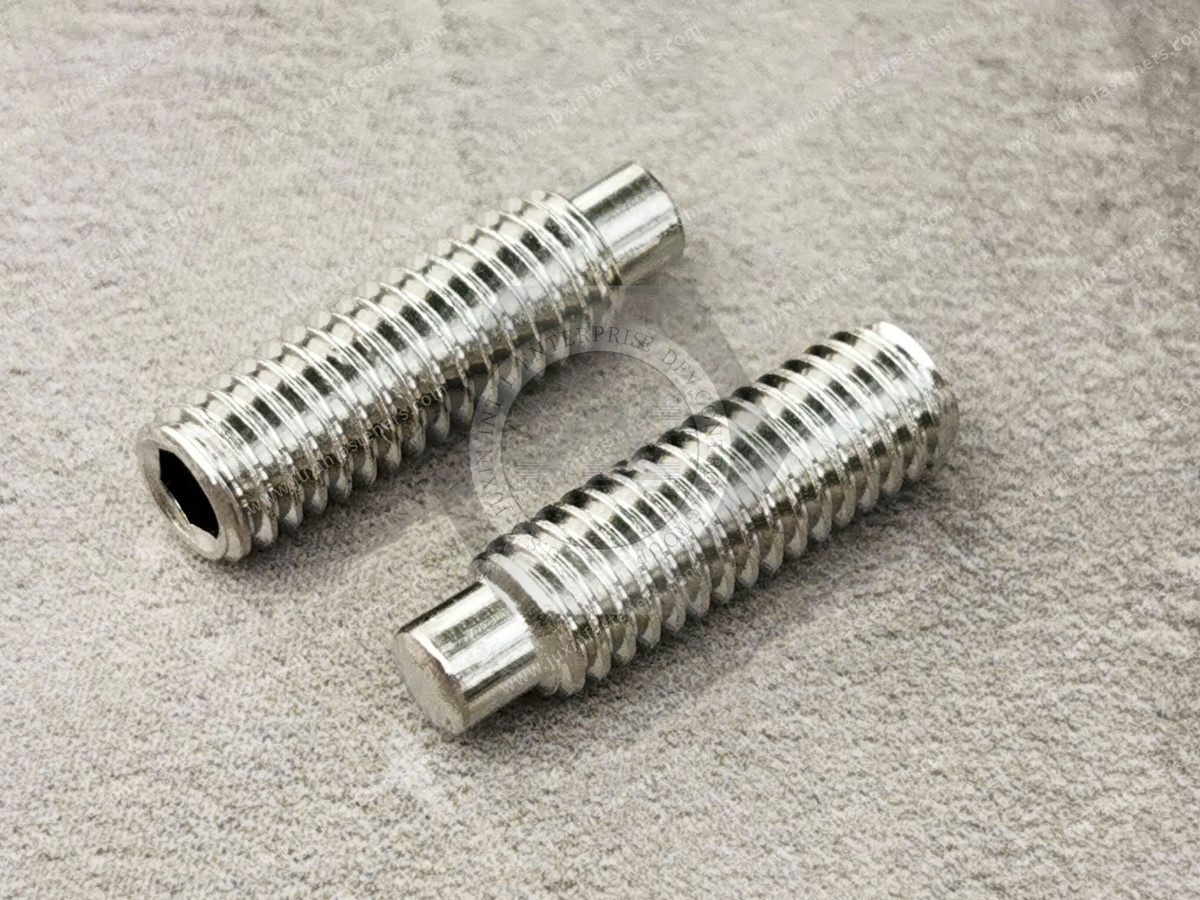
Unlike conventional cup point set screws that develop retention primarily through localized contact pressure against a mating surface, a long dog point can engage a suitably designed hole, recess or slot.
This makes the design useful where a component must be positioned relative to another part or where a defined mechanical locating feature is required.
However, reliable performance depends on the complete assembly.
The cylindrical projection must match the receiving feature, and the threaded body must provide sufficient engagement without introducing excessive bending, interference or installation stress.
For design and mechanical engineers, the main selection factors include dog point geometry, receiving-hole dimensions, positional tolerance, thread engagement and material compatibility.
For manufacturing engineers and production managers, the priorities include assembly access, consistent engagement, dimensional inspection and avoidance of damage during installation.
For purchasing and supplier development teams, the relevant requirements include standard conformity, drawing-specific geometry, stainless steel material selection,
machining feasibility, inspection documentation and supply consistency.
Juxin Fasteners welcomes inquiries for stainless steel slotted long dog point set screws, precision positioning screws and drawing-specific OEM fasteners.
What Is a Slotted Long Dog Point Set Screw?
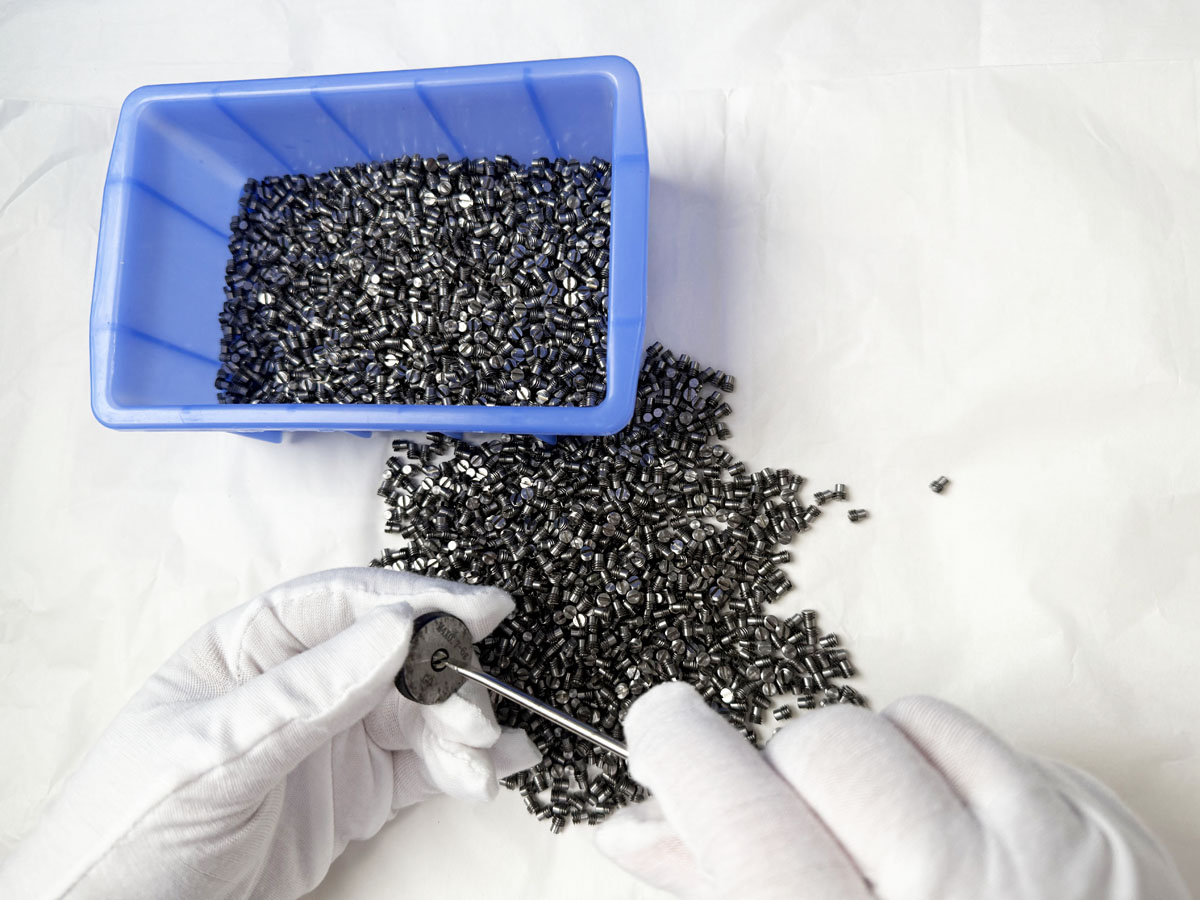
A slotted long dog point set screw is a headless screw with three principal features:
An externally threaded body
A straight slot for screwdriver engagement
A projecting cylindrical end extending beyond the threaded portion
The cylindrical projection can enter a mating hole or slot to provide a defined locating relationship.
The screw may be used to establish position, restrict movement or retain a component in an approved mechanical arrangement.
Common Engineering Names
The product may be described as:
Slotted long dog point set screw
Slotted dog point grub screw
Slotted cylindrical end set screw
Slotted long cylindrical point screw
Headless slotted locating screw
Stainless steel positioning set screw
The term grub screw is particularly common in British and international industrial purchasing terminology.
Why the Terminology Matters
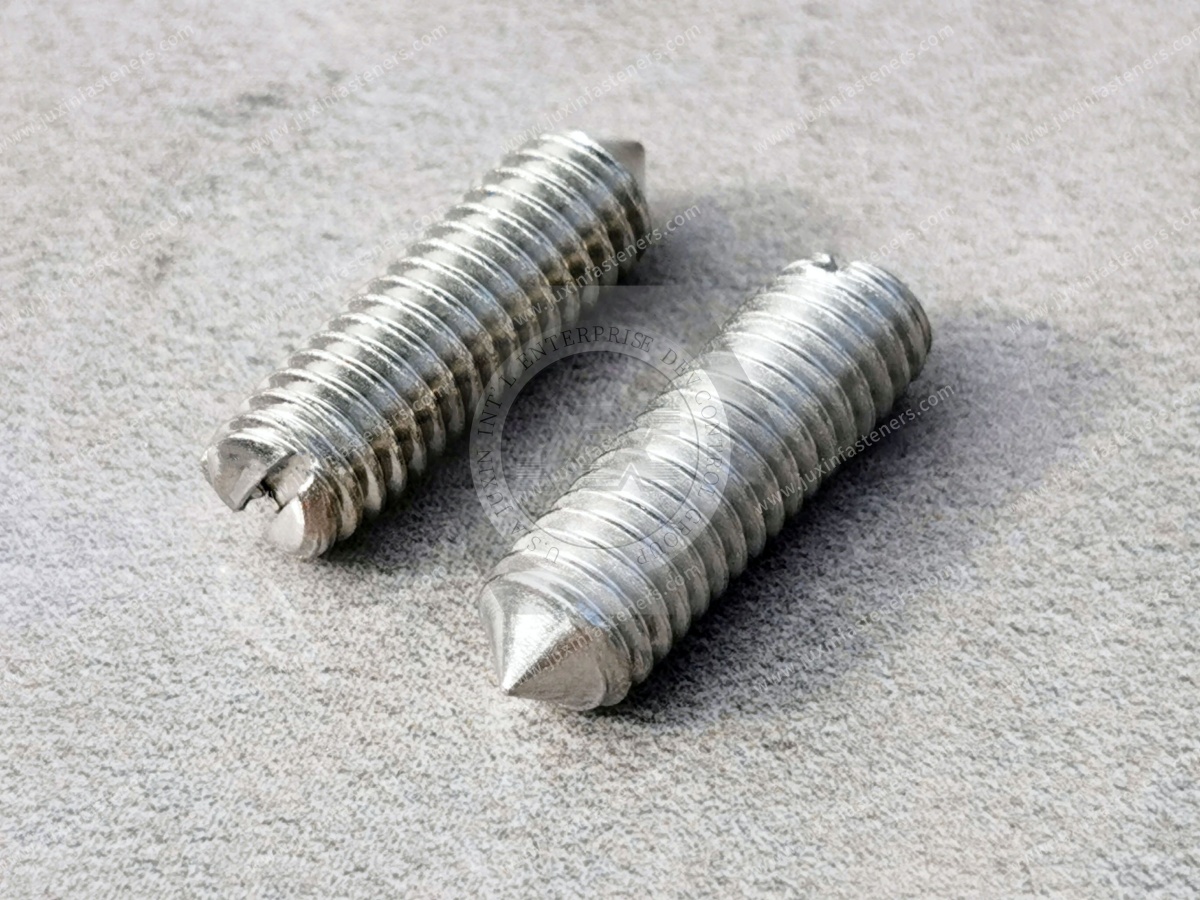
A long dog point is different from a cup point, cone point or flat point.
These point configurations interact with mating components in different ways.
Using the correct terminology helps engineers and procurement teams avoid receiving the wrong fastener.
How the Long Dog Point Works
The long dog point projects beyond the threaded body.
When the screw is installed, this projection may enter a matching receiving feature.
Depending on the geometry, the engagement can provide mechanical positioning or constrain selected directions of movement.
Locating Hole
A cylindrical receiving hole can locate the dog point at a defined position.
The fit and engagement depth must be selected to avoid interference and excessive stress.
Locating Slot
A slot can permit movement in one direction while restricting movement in another.
The actual motion depends on slot orientation, width, length and the dog point geometry.
Shaft Positioning
A dog point may engage a machined feature in a shaft or collar assembly.
This can provide a more defined locating interface than relying only on friction against a smooth shaft surface.
Important Engineering Limitation
The dog point does not automatically create a high-capacity shear pin or structural locking connection.
Its load capacity depends on the projection geometry, material, engagement depth and surrounding component design.
Long Dog Point vs Cup Point vs Flat Point Set Screws
Different set screw points serve different functions.
| Point type | Contact principle | Typical design purpose |
|---|---|---|
| Long dog point | Projecting cylinder enters a receiving feature | Locating, indexing or controlled movement |
| Cup point | Annular edge contacts the mating surface | Frictional retention or localized indentation |
| Flat point | Flat end contacts the mating surface | Positioning with broader end contact |
| Cone point | Pointed end engages a mating surface or recess | Localized positioning or retention |
| Short dog point | Short cylindrical projection | Locating where less projection is required |
Selection Principle
Choose a long dog point when the mating component is intentionally designed to receive the cylindrical projection.
Choose another point type when the connection requires a different contact mechanism.
Do not substitute point styles without reviewing the mating component.
DIN 417 and ISO 7435: Relevant Product Standards
DIN 417 and ISO 7435 are associated with slotted set screws featuring long dog points.
They are relevant references when evaluating this type of fastener.
What Engineers Should Verify
The selected standard and product edition should be checked for the required:
Thread designation
Nominal length
Cylindrical point geometry
Slot dimensions
Dimensional tolerances
Product configuration
Important Standardization Detail
A screw described as a long cylindrical end set screw is not automatically compliant with DIN 417 or ISO 7435.
Compliance depends on the actual dimensions and requirements of the relevant standard.
Custom OEM Designs
A customer may require a longer projection, unusual overall length, special thread or other non-standard geometry.
Such a product should be specified by an approved drawing rather than described as fully standard without verification.
Metric Thread Requirements
For metric threads, the relevant ISO thread geometry and tolerance specifications should be applied as required.
Inch Thread Requirements
If a customer requires UNC or UNF threads, the thread system must be explicitly defined.
Metric, UNC, UNF, BSW and BSF threads are not directly interchangeable.
An inch conversion of a metric diameter is only a dimensional reference unless a separately specified inch-thread product is confirmed.
Critical Dimensions for Long Dog Point Set Screws
The function of a long dog point screw depends strongly on its geometry.
| Feature | Engineering significance |
|---|---|
| Thread diameter | Determines mating thread compatibility |
| Thread pitch | Defines thread engagement geometry |
| Nominal screw length | Determines installed position |
| Dog point diameter | Controls fit within the receiving feature |
| Dog point projection length | Determines engagement depth |
| Dog point end geometry | Influences seating and interference |
| Slot width | Affects screwdriver compatibility |
| Slot depth | Influences tool engagement |
| Thread tolerance | Affects installation fit |
| Concentricity | Influences alignment between the point and threaded body |
| Surface condition | Influences friction, wear and corrosion behavior |
Why Dog Point Diameter Matters
The dog point must fit within the receiving feature while providing the required positioning function.
An excessively tight fit may prevent assembly or introduce unwanted stress.
Excessive clearance may reduce positioning accuracy.
Why Projection Length Matters
The point must engage sufficiently for the intended function.
An unnecessarily long projection may interfere with internal components or experience greater bending under transverse loading.
Why Concentricity Matters
A cylindrical point that is not sufficiently aligned with the threaded body may create installation difficulties or positional error.
Engineering Recommendation
Specify the dog point diameter, projection length and their relationship to the thread axis on the OEM drawing.
Receiving-Hole Design for Long Dog Point Screws
The receiving hole or slot is as important as the screw itself.
A correctly manufactured dog point may still perform poorly if the mating feature is unsuitable.
Hole Diameter
The hole diameter should provide the required fit and assembly clearance.
The appropriate clearance depends on positional accuracy, tolerance stack-up and operating conditions.
Hole Depth
The receiving feature must accommodate the dog point projection without unintended bottoming.
Hole Position
The location of the receiving feature must match the screw axis in the assembled condition.
Edge Distance
A receiving hole near the edge of a thin or weak component may reduce local strength.
Surface Finish
Burrs, sharp edges or damaged surfaces can interfere with installation.
Tolerance Stack-Up
The combined variation of the threaded hole, mating component, screw point and assembly location determines the actual fit.
Practical Design Principle
Do not specify the screw independently of the receiving hole.
Both components form one functional positioning system.
Long Dog Point Engagement: Clearance, Location and Movement
A dog point connection may be designed for different functional objectives.
Fixed Location
A closely controlled receiving feature may be used where the component must return to a defined position.
Guided Movement
A longer slot may permit controlled movement while restricting another direction.
Assembly Indexing
A receiving hole can help establish the intended orientation or position of a component.
Mechanical Retention
A dog point may help restrict movement when the geometry provides suitable engagement.
Important Limitation
The exact positional accuracy and retention capacity cannot be established from the screw description alone.
They must be evaluated using the complete mating assembly.
Slotted Drive Design and Installation Limitations
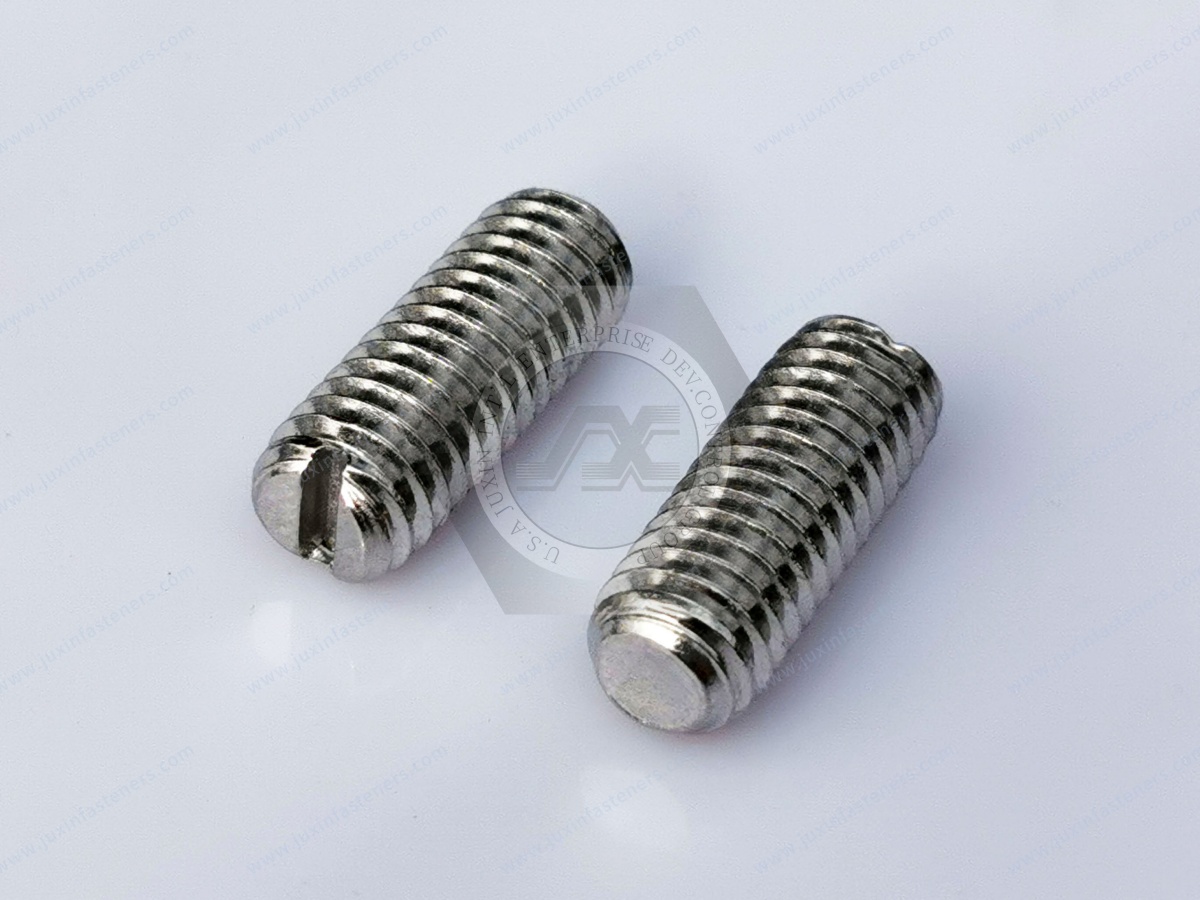
The straight slot is a simple and widely recognized drive form.
It allows installation with a compatible flat-blade screwdriver.
Potential Advantages
Simple tooling
Straightforward manual installation
Convenient maintenance
Familiar drive geometry
Suitable for certain low- to moderate-torque operations
Limitations
Slotted drives may be susceptible to tool slip when the screwdriver is poorly matched or misaligned.
The available torque transmission depends on slot geometry, tool engagement and screw size.
Production Consideration
For automated assembly, the straight slot may require greater attention to driver alignment and engagement than some alternative drive systems.
Engineering Recommendation
Confirm the installation method and tool access before selecting a slotted drive for high-volume production.
Stainless Steel 304 Long Dog Point Set Screws
304-type stainless steel is a common material option for corrosion-resistant industrial fasteners.
It may be suitable for general machinery, indoor equipment and selected outdoor environments.
Potential Advantages
Good general corrosion resistance
Useful formability
Availability in common industrial fastener applications
Compatibility with suitable machining and finishing processes
Typical Applications
Industrial fixtures
Automation equipment
Precision positioning mechanisms
Machinery adjustments
Electronic equipment assemblies
Engineering Limitation
304 stainless steel is not immune to corrosion.
Its suitability depends on the actual environment, temperature and exposure conditions.
Stainless Steel 316 Long Dog Point Set Screws
316-type stainless steel contains molybdenum, which generally improves resistance to certain localized corrosion mechanisms compared with 304.
It may be considered for applications involving greater moisture exposure or selected corrosive environments.
Potential Applications
Outdoor industrial equipment
Chemical processing equipment
Laboratory fixtures
Food processing machinery
Selected marine-adjacent equipment
Important Limitation
316 stainless steel is not universally resistant to chloride attack, crevice corrosion or stress corrosion cracking.
Material selection must be based on actual service conditions.
304 vs 316 Selection
| Selection factor | 304 stainless steel | 316 stainless steel |
|---|---|---|
| General corrosion resistance | Good in suitable environments | Good in suitable environments |
| Certain chloride exposures | More limited | Often improved |
| Material cost | Generally lower | Generally higher |
| Industrial positioning applications | Common option | Relevant where exposure requires it |
| Severe chemical service | Requires evaluation | Also requires evaluation |
Mechanical Strength of Stainless Steel Set Screws
Stainless steel set screws should not be described as high-strength fasteners solely because they are metallic or corrosion resistant.
Mechanical properties depend on the material grade, manufacturing condition, product geometry and applicable specification.
Why Small Set Screws Require Careful Design
A small screw may have limited torsional capacity at the drive recess.
The projecting dog point may also be vulnerable to bending or deformation under unsuitable transverse loading.
Engineering Recommendation
Evaluate the load path through the dog point and mating component.
Do not rely on general tensile strength statements to establish the positioning connection's allowable load.
Thread Galling in Stainless Steel Set Screws
Stainless steel threaded components can experience galling under unfavorable installation conditions.
Galling involves adhesive damage between contacting thread surfaces.
Potential Causes
High contact pressure
Unfavorable material pairing
Surface roughness
Excessive tightening
Inappropriate assembly conditions
Possible Consequences
Difficult installation
Thread seizure
Damaged mating threads
Inconsistent tightening
Difficult disassembly
Risk Reduction
Depending on the application, engineers may consider suitable material pairing, surface condition and approved lubrication or assembly procedures.
Any lubricant must be compatible with the application and must not be introduced without evaluating its effect on tightening and retention.
Surface Treatment and Passivation
Austenitic stainless steel fasteners generally obtain their corrosion resistance from the material's passive surface film.
They do not normally require conventional decorative zinc plating to provide basic corrosion resistance.
Passivation
Passivation may be specified to improve the surface condition by removing certain contaminants and supporting formation of the passive film.
ASTM A967/A967M may be relevant where chemical passivation requirements are specified.
Surface Finish
The required surface condition may depend on machining, cleaning, appearance and corrosion requirements.
Important Material Distinction
White zinc and blue zinc plating are more commonly associated with carbon steel fastener protection.
They should not be presented as standard default finishes for 304 or 316 stainless steel set screws.
RoHS Requirements
RoHS compliance cannot be inferred from a general coating description.
Where applicable, compliance must be supported by the actual material and substance documentation.
OEM Recommendation
Specify the stainless steel grade, surface condition and any required passivation or cleanliness requirements on the drawing.
Automotive Manufacturing Equipment Applications
Automotive production equipment frequently uses fixtures, adjustable stops and positioning mechanisms.
Long dog point set screws may be considered where a receiving hole or slot provides a defined locating function.
Potential Applications
Assembly fixtures
Tooling adjustments
Inspection equipment
Production positioning mechanisms
Non-safety-critical mechanical interfaces
Design Considerations
The screw must withstand the actual adjustment and operating loads.
Repeated movement or vibration may require additional retention measures.
EV Battery Manufacturing Equipment
EV battery manufacturing and test equipment may require compact locating components.
Potential applications include:
Battery assembly fixtures
Test equipment
Positioning mechanisms
Thermal-management equipment fixtures
Automated handling systems
Important Qualification
Use in manufacturing equipment does not automatically establish suitability for direct installation in a battery pack.
Safety-critical battery components require application-specific validation.
Rail Equipment and Maintenance Systems
Rail maintenance equipment may use precision positioning components.
Potential applications include:
Service fixtures
Mechanical adjustment mechanisms
Inspection equipment
Workshop machinery
Safety-critical rolling stock applications require separate qualification.
Aerospace Ground Support and Test Equipment
Ground support fixtures and industrial test equipment may require controlled mechanical positioning.
A general stainless steel set screw should not be represented as aerospace-qualified without the necessary approvals.
Electrical Cabinets and Electronic Equipment
Headless positioning screws can be useful where external head protrusion is undesirable.
Potential Applications
Instrument fixtures
Adjustment mechanisms
Control equipment
Internal mechanical positioning
Precision enclosure components
Engineering Considerations
Electrical insulation, grounding and clearance requirements must be evaluated separately.
A stainless steel set screw is an electrically conductive component and should not be assumed suitable for every electrical interface.
HVAC and Industrial Cooling Equipment
HVAC equipment may use positioning screws in mechanical adjustment systems and service fixtures.
Selection Factors
Moisture exposure
Corrosion resistance
Vibration
Temperature
Maintenance access
Mating material
The long dog point must be matched to the intended locating feature.
Medical and Laboratory Equipment
Selected laboratory equipment and medical equipment mechanisms may require compact positioning fasteners.
Relevant Considerations
Material compatibility
Surface cleanliness
Repeated adjustment
Corrosion exposure
Dimensional consistency
Application-specific regulatory requirements
A general industrial stainless steel set screw should not be described as medical-grade without supporting qualification.
Industrial Machinery and Construction Equipment
Machinery may require mechanical stops, locating features and adjustment components.
Long dog point set screws may be useful where the mating component contains a suitable hole or slot.
Important Limitation
For heavily loaded or impact-exposed mechanisms, a dedicated locating pin, dowel or other engineered component may be more appropriate.
Robotics, CNC Equipment and Automation
Precision equipment may use long dog point set screws for positioning and adjustment.
Potential Applications
Robotic fixtures
CNC machine accessories
Adjustable stops
Automation tooling
Precision positioning mechanisms
Engineering Priority
The positioning requirement must be translated into actual dimensional and functional tolerances.
A nominally precise screw cannot compensate for an inaccurate receiving feature.
Custom M2–M10 Slotted Long Dog Point Set Screws
The original product information identifies an M2–M10 thread range.
This range should be treated as a stated product scope requiring confirmation for the requested material, dimensions and manufacturing method.
Typical Customization Parameters
Thread diameter
Thread pitch
Overall length
Dog point diameter
Dog point projection length
Slot geometry
Material grade
Surface condition
Dimensional tolerances
Length Requirements
The original article also refers to custom lengths up to 200 mm.
Such a length is not necessarily covered by standard DIN 417 / ISO 7435 dimensional ranges.
It should be evaluated as a drawing-specific custom component.
Engineering Considerations for Long Screws
As overall length increases, additional factors may become important:
Straightness
Thread alignment
Handling damage
Machining method
Assembly clearance
Packaging protection
Manufacturing Feasibility
The achievable combination of diameter, length, material and tolerance must be confirmed before quotation.
CNC Machining and Drawing-Specific Set Screws
Custom long dog point screws may require machining operations to achieve non-standard geometry.
Depending on the design, relevant manufacturing considerations may include:
Thread production
Cylindrical point machining
Slot formation
End geometry
Surface finish
Dimensional inspection
The Original ±0.01 mm Tolerance Claim
The source article states a machining tolerance capability of ±0.01 mm.
This should not be interpreted as a universal tolerance for all screw dimensions, materials or production quantities.
A tolerance of this magnitude may be relevant to a particular controlled feature, but its feasibility depends on the geometry, process and inspection method.
OEM Recommendation
Identify which specific dimension requires the tolerance.
For example, a dog point diameter may require tighter control than the overall screw length.
Do not apply unnecessarily tight tolerances to every feature.
Information Gain: Why a Longer Dog Point Is Not Always Better
A longer cylindrical projection may appear to provide greater engagement.
However, increased projection length can introduce disadvantages.
Potential Benefit
A longer point may reach a deeper receiving feature or accommodate a specific assembly geometry.
Potential Risk
If the point experiences transverse loading, a longer unsupported projection may experience greater bending stress.
Potential Assembly Problem
An excessively long point may bottom out before the threaded body reaches its intended installed position.
Potential Accuracy Problem
A long point with excessive clearance in the receiving feature may not provide the expected positioning accuracy.
Engineering Lesson
Dog point projection length must be selected together with the receiving-hole geometry and expected load path.
The maximum possible projection is not necessarily the optimum design.
Information Gain: Locating Function vs Thread Locking Function
Long dog point set screws are sometimes described as locking screws.
This terminology can be misleading.
Locating Function
The cylindrical point engages a receiving feature to restrict or define component movement.
Thread Retention Function
The threaded body must remain in its installed position during service.
These are different functions.
A screw may locate a component correctly but gradually rotate loose under vibration.
Engineering Recommendation
Where vibration resistance is required, separately evaluate the screw's retention mechanism.
Do not assume that a long dog point automatically prevents self-loosening.

Common Failure Modes and Engineering Corrections
| Failure mode | Possible cause | Recommended review |
|---|---|---|
| Dog point does not enter hole | Misalignment or incorrect diameter | Check mating geometry and tolerances |
| Excessive positioning play | Too much clearance | Review point-to-hole fit |
| Point bends or deforms | Excessive transverse loading | Review load path and projection length |
| Screw bottoms out | Receiving feature too shallow | Review hole depth and installed position |
| Thread stripping | Insufficient engagement or weak mating material | Review thread design |
| Slot damage | Incorrect driver or excessive torque | Review tooling and tightening |
| Thread galling | Unfavorable stainless steel contact | Review materials and assembly |
| Screw loosening | Inadequate thread retention | Review locking strategy |
| Corrosion | Unsuitable grade or surface condition | Review environment and material |
| Assembly variation | Inconsistent point or hole dimensions | Review inspection and process controls |
Production Engineering: Consistent Installation of Dog Point Screws
A positioning screw must engage the receiving feature correctly during assembly.
Recommended Process Controls
Receiving Feature Inspection
Confirm the hole or slot is correctly positioned and free from obstructive burrs.
Screw Inspection
Verify thread dimensions, dog point geometry and slot condition.
Installation Alignment
Ensure the screw axis is aligned with the receiving feature.
Controlled Tightening
Use an appropriate installation procedure that avoids excessive torque and point damage.
Functional Verification
Confirm the intended locating or movement-limiting function.
Production Manager's Perspective
A low-cost set screw can create significant rework if it is difficult to install or if the dog point repeatedly misses its receiving hole.
Production efficiency depends on the design of both mating components.
Quality Inspection for Stainless Steel Long Dog Point Set Screws
Inspection requirements should follow the approved drawing and applicable product standard.
Thread Inspection
Verify the specified thread designation and tolerance requirements.
Dog Point Diameter
Confirm the cylindrical point meets the required dimension.
Projection Length
Check the length of the projecting portion.
Concentricity
Evaluate alignment between the dog point and threaded body where specified.
Slot Geometry
Inspect slot width, depth and condition.
Overall Length
Confirm the product length against the drawing.
Material Verification
Confirm the specified stainless steel grade and required documentation.
Surface Condition
Inspect the required finish, cleanliness and any specified passivation requirements.
Functional Inspection
Where appropriate, test the screw with a representative receiving feature.
Quality Principle
A screw may pass individual dimensional checks yet fail to locate properly if the mating hole and screw tolerances are not coordinated.
Supplier Development: Standard vs Custom Dog Point Screws
Procurement teams should distinguish standard catalog components from drawing-specific fasteners.
Standard Product Evaluation
Verify the applicable DIN or ISO standard, material, thread and dimensions.
Custom Product Evaluation
Provide a drawing defining the required geometry and functional requirements.
Alternative Supplier Qualification
Do not approve an alternative screw solely because the thread diameter and overall length match.
The dog point geometry may determine whether the product functions correctly.
Commercial Evaluation
Compare suppliers based on:
Drawing conformity
Material specification
Manufacturing feasibility
Inspection requirements
Sample approval
MOQ
Production volume
Packaging
Lead time
Cost
Supply continuity
OEM RFQ Checklist for Slotted Long Dog Point Set Screws
| RFQ requirement | Information to provide |
|---|---|
| Product description | Slotted long dog point set screw |
| Applicable standard | DIN 417 / ISO 7435 or approved custom drawing |
| Drawing | Drawing number and revision |
| Thread diameter | M2–M10 or specified alternative |
| Thread pitch | Exact metric or separately specified inch thread |
| Nominal length | Required length |
| Dog point diameter | Dimension and tolerance |
| Dog point projection | Length and tolerance |
| Point end geometry | Drawing-specific details |
| Slot geometry | Width, depth and requirements |
| Concentricity | Required tolerance where applicable |
| Material | 304, 316 or specified grade |
| Surface condition | As-machined, passivated or approved finish |
| Mating feature | Hole or slot dimensions |
| Functional requirement | Positioning, indexing or movement restriction |
| Operating environment | Moisture, temperature, chemicals and vibration |
| Inspection | Dimensional and functional requirements |
| Documentation | Material and inspection records |
| Prototype quantity | Sample requirement |
| Annual demand | Expected production volume |
| Packaging | Bulk or protected packaging |
| Delivery | Required schedule |
Frequently Asked Questions
What is a long dog point set screw?
It is a set screw with a projecting cylindrical end intended to engage a suitable receiving feature for positioning or mechanical location.
What is the difference between a long dog point and a cup point?
A long dog point engages a hole or slot, while a cup point typically develops retention through localized contact against a mating surface.
What standards apply to slotted long dog point set screws?
DIN 417 and ISO 7435 are relevant product standards, subject to confirmation of the applicable edition and dimensions.
Can a dog point set screw prevent vibration loosening?
Not automatically. The locating function and threaded retention function must be evaluated separately.
Are 304 and 316 stainless steel set screws interchangeable?
They may differ in corrosion behavior and material requirements. Substitution requires engineering approval.
Can a long dog point damage the mating component?
Yes, if the point geometry, receiving feature or loading conditions are unsuitable.
Can these screws be used with smooth shafts?
Their main locating advantage is realized when a suitable receiving hole or slot is provided. Use against a smooth shaft requires separate evaluation.
Are slotted set screws suitable for automated assembly?
They may be suitable, but driver alignment, recess engagement and cycle-time requirements must be evaluated.
Can custom lengths reach 200 mm?
The original article identifies lengths up to 200 mm. Actual feasibility must be confirmed for the requested diameter, material and tolerance.
Is ±0.01 mm available for every feature?
No universal capability should be assumed. The required feature and tolerance must be reviewed against the manufacturing process.
Can Juxin Fasteners review custom dog point screw drawings?
Yes. Drawing-based inquiries can be submitted for technical and commercial evaluation.
Juxin Fasteners: Stainless Steel Long Dog Point Set Screws and OEM Positioning Fasteners
Juxin Fasteners supplies industrial fasteners and welcomes inquiries for drawing-specific precision positioning components.
Relevant product inquiries include:
Stainless steel slotted long dog point set screws
DIN 417 / ISO 7435 type set screws
304 stainless steel positioning screws
316 stainless steel dog point screws
Custom-length headless slotted screws
Drawing-specific cylindrical point set screws
Precision OEM locating fasteners
Material selection, thread sizes, custom lengths, dimensional tolerances, manufacturing feasibility, MOQ and delivery schedules are subject to technical and commercial confirmation.
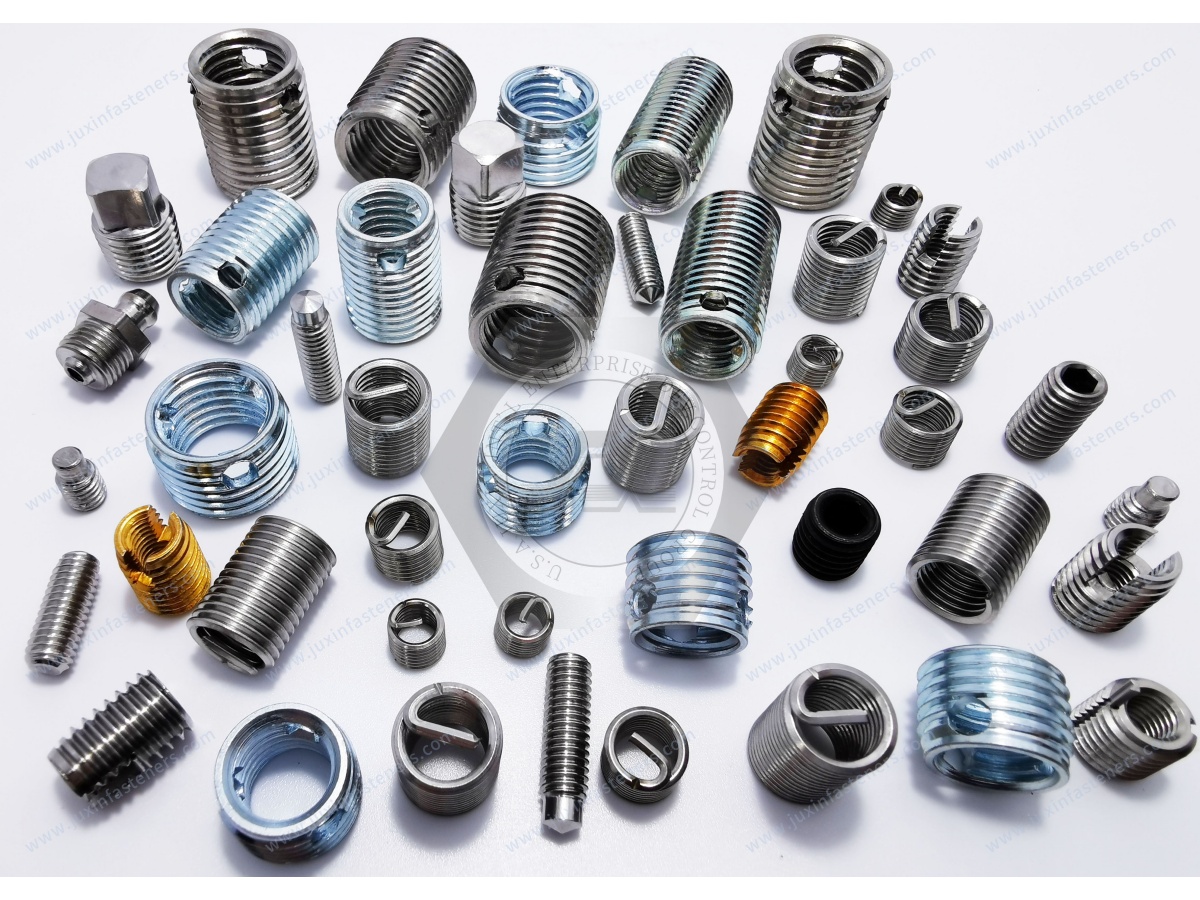
Request Stainless Steel Slotted Long Dog Point Set Screws and OEM Quotations
Are you sourcing DIN 417 / ISO 7435 slotted set screws, stainless steel long dog point screws, precision locating screws or custom OEM positioning fasteners?
Juxin Fasteners welcomes inquiries from design engineers, mechanical engineers, manufacturing engineers, production managers,
purchasing specialists, procurement managers and supplier development teams.
For technical review and quotation, please provide:
Product drawing and revision + applicable standard + thread diameter and pitch + overall length + dog point diameter + projection length
+ slot geometry + material grade + surface condition + mating hole or slot dimensions + functional requirements + inspection criteria
+ prototype quantity + annual demand + packaging + target delivery schedule.
Company: Juxin Fasteners
Website: https://www.juxinfasteners.com/
Email: info@juxinfasteners.com
Send your stainless steel slotted long dog point set screw drawings and OEM RFQ to Juxin Fasteners for technical confirmation and quotation.
Contact Us
Tel.:
+86 020 8621 0320
+86 020 3121 6067
E-mail:
Technical Support:
Navigation
SEND INQUIREY



