Call Us
+86 136 6007 9809
Call Us
+86 136 6007 9809

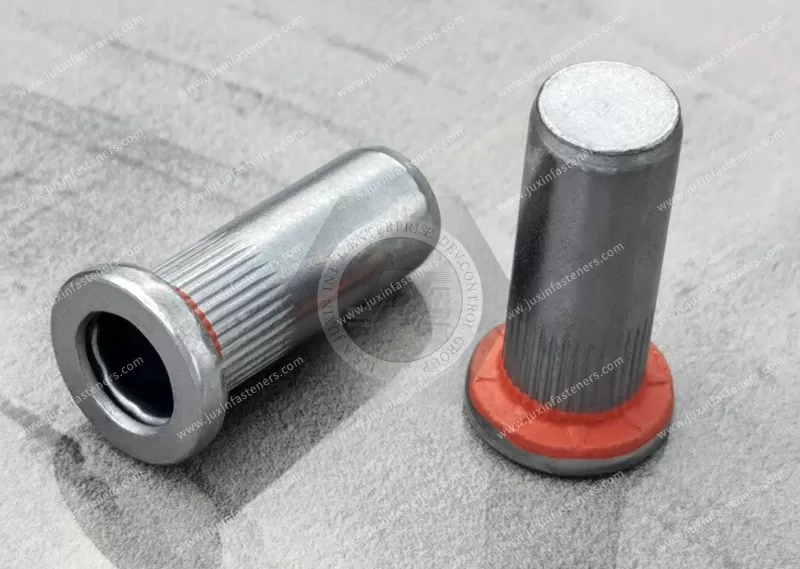
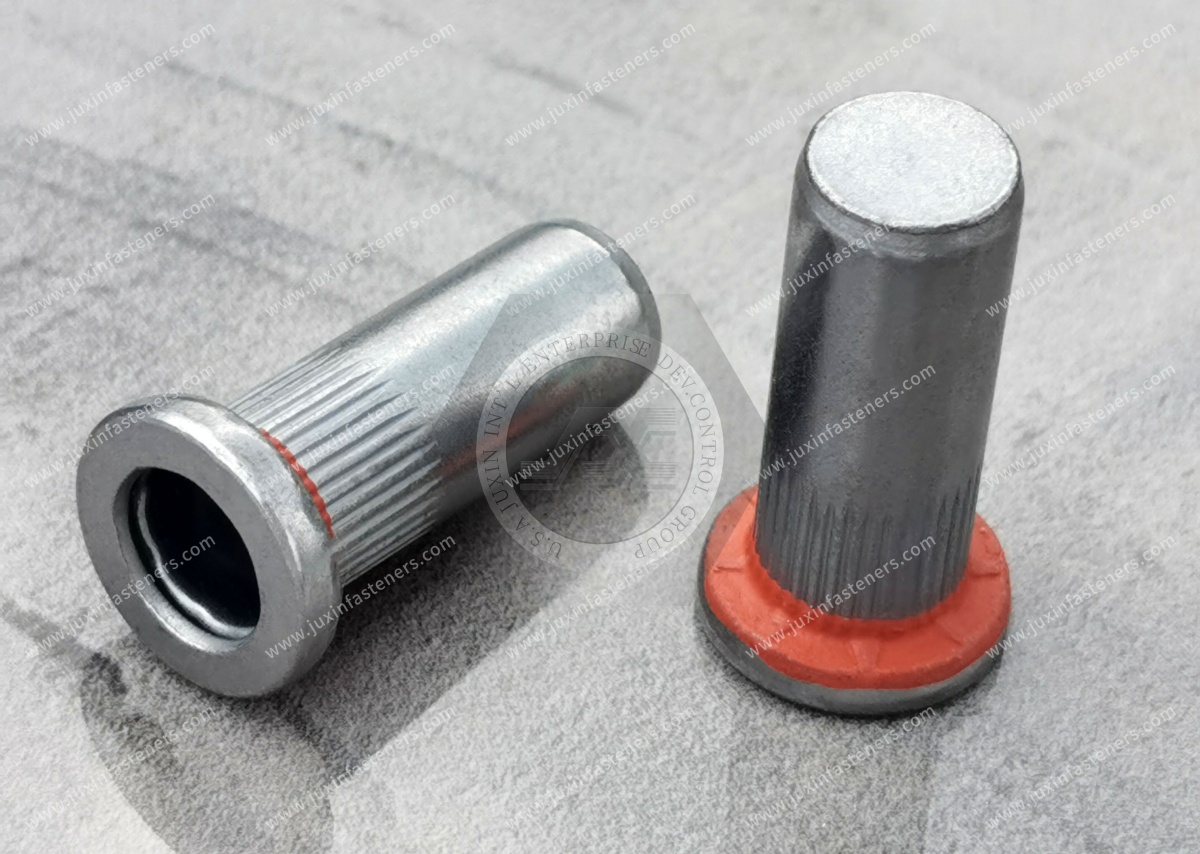
Name: Flat Head Closed end Round Body Knurled Blind Rivet Nuts—Open End
Size: M3、M4、M5、M6、M8、M10、M12
Material: Steel Natural color with anti-loosening glue
Grip Range: 0.5-4.0mm
Product Specification
FLANGE HEAD, CLOSED-END SEAL RIVET NUT, STEEL
Juxin fasteners type F steel closed-end rivet nuts are typically used where moisture or contamination into the product must be prevented. The flange head reinforces the hole and produces increased resistance to push-out forces.
Juxin fasteners blind rivet nuts provide load-bearing solid threads and are installed from one side only, so they are ideal for use in tube or box sections and sheet materials.
Our cylindrical head blind rivet nuts are high-quality fasteners that are offered at a competitive price. They reduce the risk of the insert being pulled or pushed through the hole.
These rivet nuts spread the load over a larger area, making them suitable for soft and thin materials.Closed-end Steel Flat head Series seal knurled Rivet Nuts.
The F Series Seal Steel Rivet Nuts is manufactured from grade steel and features UNC and UNF thread styles, which are base symbols of the Unified Screw Thread Series. Ribbed rivet nuts provide many features, including small or large flange heads, splined or non-splined bodies, ultra-strength heads, and more. Ribbed F Series rivet nuts are generally used for marine, industrial, and architectural applications.
As your premium steel rivet nut supplier, Juxin Fasteners offers our steel rivet nuts in various diameters, lengths, and thread sizes. These advanced-quality fasteners provide a unique way to install a threaded insert into tubing, sheet metal, extrusions, and more from a single side. Ribbed F Series rivet nuts also provide a solid threaded insert for bolts and screws. At Juxin Fasteners, we are your trusted F Series ribbed rivet nuts supplier. We provide superior quality steel rivet nuts at prices that can’t be beaten.
Fast Facts:
Blind hole, one-sided installation capability.
Provide load-bearing threads in sheet materials.
Suitable for thin or soft materials.
It is good for applications with large clamping loads.
It can be used as a spacer.
Available in aluminum, steel, and stainless steel.
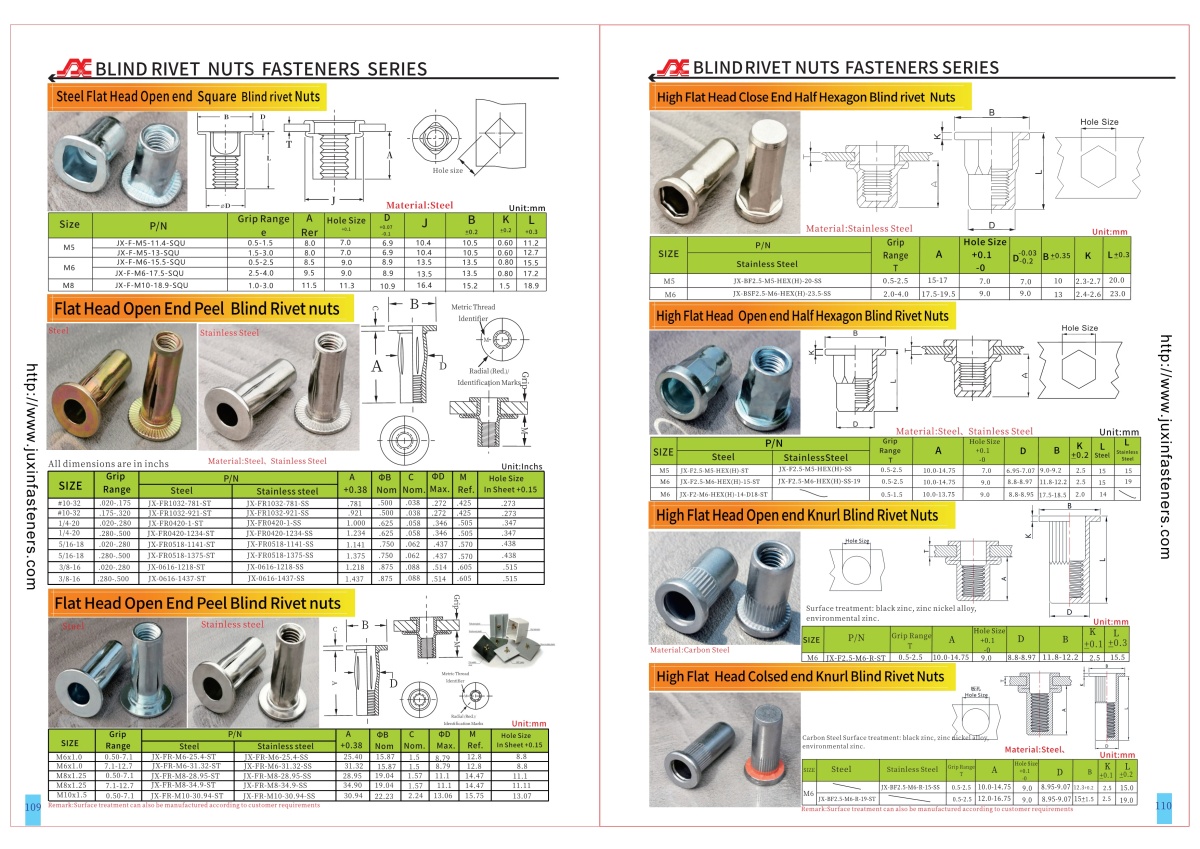
Size Can also be According to Customer's requirement and please check detailed specification sheet PDF, CAD, See more product details, PDF 110Page
Applications of Closed-End Rivet Nuts in New Energy Vehicles
Closed-end rivet nuts play a critical role in new energy vehicle (NEV) manufacturing, where lightweight design, high assembly precision, and safety reliability are essential. They are widely used in battery systems, body structures, and interior assemblies, especially where traditional welding or tapping is not feasible.
Key Applications in Battery Tray Assembly
The battery tray is a core safety component in new energy vehicles and requires extremely reliable fastening solutions. Traditional welding processes can easily cause deformation of aluminum housings, compromise sealing performance, and introduce heat-affected zones.
Closed-end rivet nuts eliminate the need for welding or tapping by forming a high-strength mechanical interlock during installation. This process preserves the structural integrity of aluminum or thin-wall substrates while ensuring consistent fastening quality.
In high-volume battery tray production lines, automated riveting systems combined with closed-end rivet nuts have demonstrated pass rates of up to 99.99% across thousands of fastening points, enabling full-process traceability and significantly improving production efficiency and quality stability.
Lightweight Body Structures and Dissimilar Material Joining
To achieve vehicle lightweighting, NEVs commonly integrate aluminum alloys, high-strength steel, and mixed-material structures. Closed-end rivet nuts allow secure fastening without pre-tapping, effectively preventing thread stripping and base material deformation.
Their blind-hole design makes them ideal for enclosed sections or one-sided access areas, such as door frames, roof rails, and enclosed profiles. This ensures reliable thread strength while maintaining a clean exterior surface and consistent assembly appearance.
Improved Sealing and Anti-Loosening Performance
New energy vehicles impose strict requirements for waterproofing, dust resistance, and long-term vibration stability. Advanced closed-end rivet nuts incorporate optimized flange designs and integrated sealing solutions to enhance joint integrity.
In some applications, sealant-coated flanges combined with O-ring structures form multi-layer sealing systems that significantly improve resistance to moisture ingress and corrosion. Additionally, the combination of serrated bodies and flange compression creates a dual mechanical locking effect, effectively reducing the risk of loosening under dynamic loads and improving overall vehicle safety.
Compatibility with Automated Assembly Lines
Closed-end rivet nuts are fully compatible with pneumatic, hydraulic, and automated riveting systems, making them suitable for modern automated production lines. In mixed-model manufacturing environments, programmable riveting equipment, combined with vision-guided positioning systems, enables rapid model changeover and precise control of installation force and stroke.
This allows fastening accuracy within ±0.1 mm, reduces defect rates, and minimizes dependence on manual operations—supporting scalable, high-efficiency NEV production.
Key Selection and Installation Techniques for Closed-End Rivet Nuts in New Energy Vehicles
Closed-end rivet nuts are essential fastening components in new energy vehicle (NEV) manufacturing, supporting lightweight design, high sealing performance, and stable, repeatable assembly processes. They are widely used in critical applications such as battery packs, body structures, and enclosed assemblies that require high joint reliability.
The following selection guidelines and installation best practices provide a practical reference for engineers and manufacturers to ensure consistent fastening quality and process stability.
I. Selection Guidelines
Thread Specification Matching
Select the internal thread size based on the nominal diameter of the mating bolt. Common sizes range from M4 to M8, with standard tolerance classes such as 6H recommended to ensure reliable thread engagement and long-term fastening stability.
Head Type Selection:
Flat Head vs. Countersunk Head
Flat Head Rivet Nuts
Provide a smooth surface finish after installation, and they are commonly used in exterior or visible assemblies where appearance and load distribution are essential.
Countersunk Head Rivet Nuts
Require pre-countersunk holes to achieve a flush surface and are typically applied in precision assemblies such as doors, interior panels, and trim components.
Advantages of Closed-End (Blind Rivet nuts) Design
The closed-end structure prevents moisture, dust, and contaminants from entering the internal thread, significantly improving sealing performance. This design is especially suitable for high-protection applications (IP67 and above), including battery trays, electronic control unit (ECU) housings, and enclosed structural sections.
Material Selection and Compatibility
Stainless Steel (304/316): Excellent corrosion resistance, suitable for exposed applications, such as chassis components and battery systems.
Aluminum Alloy: Ideal for aluminum body structures, reduces overall vehicle weight, and minimizes galvanic corrosion risk.
Carbon Steel (Zinc-Plated): Cost-effective option for internal structural components in low-corrosion environments.
Material and Surface Treatment Requirements
Surface treatments should comply with DIN EN ISO 4042 or equivalent international standards for electroplated coatings on fasteners. Common finishes include:
Blue-white zinc plating
Black zinc plating
These coatings enhance corrosion resistance in harsh automotive environments. Knurled body designs further enhance anti-rotation and torsional resistance, ensuring stable, reliable installation in thin metal panels and battery tray assemblies.
Applicable Sheet Thickness Range
Closed-end rivet nuts are generally suitable for sheet thicknesses from 0.5 mm to 6.0 mm. The rivet nut length (L value) should be selected according to the actual workpiece thickness to ensure proper deformation and secure expansion in the collapse zone.
II. Installation Process Specifications
Pre-Drilled Hole Accuracy
The hole diameter must precisely match the rivet nut's outer diameter to ensure consistent expansion and load performance. Typical reference values are:
M4: Ø6.0 mm
M5: Ø7.0 mm
M6: Ø9.0 mm (Ø10.0 mm for thick-wall types)
M8: Ø11.0 mm
Hole diameter tolerance is recommended to be controlled within 0 to +0.075 mm. Punching is preferred over drilling to improve hole consistency and repeatability in mass production.
Installation Tool Selection
Closed-end rivet nuts can be installed using manual, pneumatic, or hydraulic rivet guns. Tension-controlled tools are recommended, as they automatically adapt to varying sheet thicknesses and help prevent under-riveting or excessive deformation caused by improper stroke settings.
Standard Installation Procedure
Clean the entire area and remove burrs or debris.
Insert the rivet nut into the hole from the accessible side.
Attach the rivet gun mandrel to the internal thread, keeping the tool perpendicular to the workpiece surface.
Could you activate the tool? The applied tensile force causes the tail section to expand and form a secure bulge on the back side.
Could you release the tool and verify that the internal threads remain unobstructed?
Key Operating Precautions
Force must be applied from the threaded mandrel end only; reverse loading is not permitted.
I'd like for you to maintain perpendicular alignment between the rivet gun and the workpiece to avoid uneven deformation.
After installation, please look for looseness, cracking, or distortion of the base material.
III. Quality Inspection Criteria
Mechanical Performance
Installed rivet nuts must meet the specified design load requirements. For example, M6 stainless steel closed-end rivet nuts typically require a minimum shear strength of ≥320 MPa, depending on application conditions.
Thread Integrity
Use a GO gauge to verify internal thread smoothness and ensure no damage or deformation has occurred during installation.
Visual Inspection
The rear-side bulge must be fully formed and uniform, with no visible cracks or deformation. The flange should sit flush against the panel surface.
Features and Sealing Ratings of Waterproof Rivet Nuts in New Energy Vehicles
Waterproof rivet nuts are critical fastening components in new energy vehicles (NEVs), particularly for battery packs, electronic control units, and other high-protection assemblies. Their design addresses stringent requirements for high IP protection levels, environmental stress resistance, and long-term reliability.
Key Features
1. Integrated Sealing Design
To address the sealing challenges posed by battery packs exposed to vibration, thermal cycling, and repeated disassembly, waterproof rivet nuts often feature integrated sealing solutions.
Some designs feature pre-applied sealants (e.g., acrylic adhesives) on the flange surface. During installation, the sealant is compressed, filling micro-gaps and achieving “fastening + sealing” in a single step.
This approach avoids the potential failures of traditional O-rings caused by material fatigue or compression deformation, ensuring consistent, leak-free performance throughout the vehicle's lifecycle.
2. Extreme Operating Conditions Resistance
Waterproof rivet nuts are optimized for battery pack and EV component environments, capable of withstanding:
Temperature ranges from -40°C to 150°C
Continuous vibration and mechanical shock
Electrophoretic baking processes (>200°C) for coating or paint lines. These features ensure reliable performance during both assembly and the vehicle's operational life.
3. Durability and Maintainability
Advanced waterproof rivet nuts undergo repeated tightening fatigue tests, supporting over 30 disassembly and reassembly cycles without leakage.
This enhances battery pack maintainability, reduces lifecycle costs, and ensures long-term reliability for high-performance NEVs.
4. Materials and Mechanical Design
Materials: Stainless steel (304 / 316) or zinc-nickel alloys
Surface Treatments: Passivation, corrosion-resistant plating, or specialized coatings per DIN EN ISO 4042
Mechanical Design: Some models feature toothed + concave umbrella flanges, forming a dual mechanical interlock that resists axial displacement and rotational torque, further improving sealing durability.
Sealing Ratings
The sealing performance of waterproof rivet nuts is designed to match or exceed the protection level of the battery pack, typically achieving IP67, with some high-end applications requiring IP68.
Rating Description Typical Applications
IP67 Dust-tight (6) and immersion in 1 meter of water for 30 minutes (7). Mainstream battery packs, ensuring safety in heavy rain, puddle immersion, or harsh environments
IP68 Dust-tight (6) and continuous immersion beyond 1 meter (manufacturer-specified depth and duration, usually 1.5 m for 30 min) High-end battery packs or critical modules requiring enhanced sealing reliability
Note: Achieving these protection levels depends on a multi-layered system, including:
Rivet nut integrated sealing
Housing weld sealant
Flange sealing rings
Pressure balancing valves
Single components alone do not determine the IP rating; system-level design ensures reliable waterproofing.
Why This Matters for NEV Manufacturers
Reliable Fastening: Combines mechanical strength with robust sealing
Process Efficiency: Reduces assembly time with “riveting + sealing” in one step
Long-Term Safety: Maintains performance under vibration, thermal stress, and repeated maintenance cycles
Compliance: Meets mainstream IP standards (IP67 / IP68) widely recognized in automotive and EV industries
Waterproof rivet nuts are indispensable for NEV battery tray assembly and high-protection modules, providing engineers with a secure, durable, and maintainable fastening solution.
Product Pictures
Contact Us
Tel.:
+86 020 8621 0320
+86 020 3121 6067
E-mail:
Technical Support:
Navigation
SEND INQUIREY