Call Us
+86 136 6007 9809
Call Us
+86 136 6007 9809

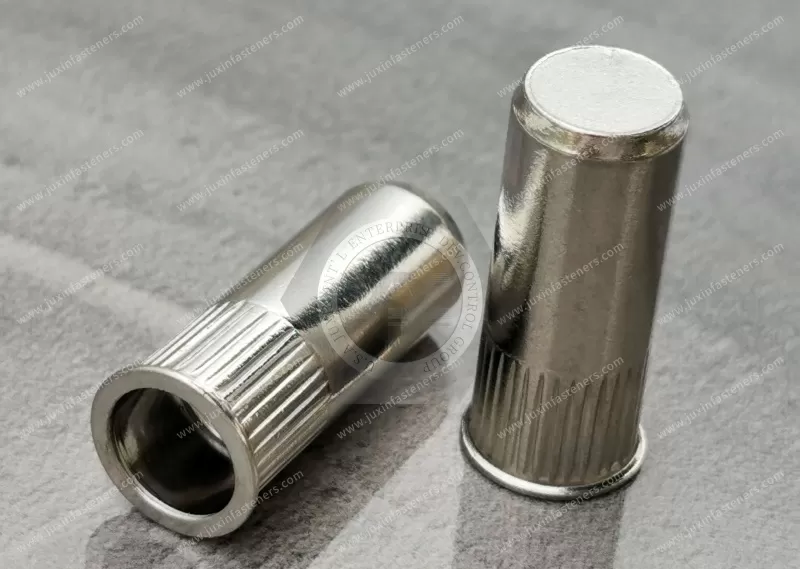
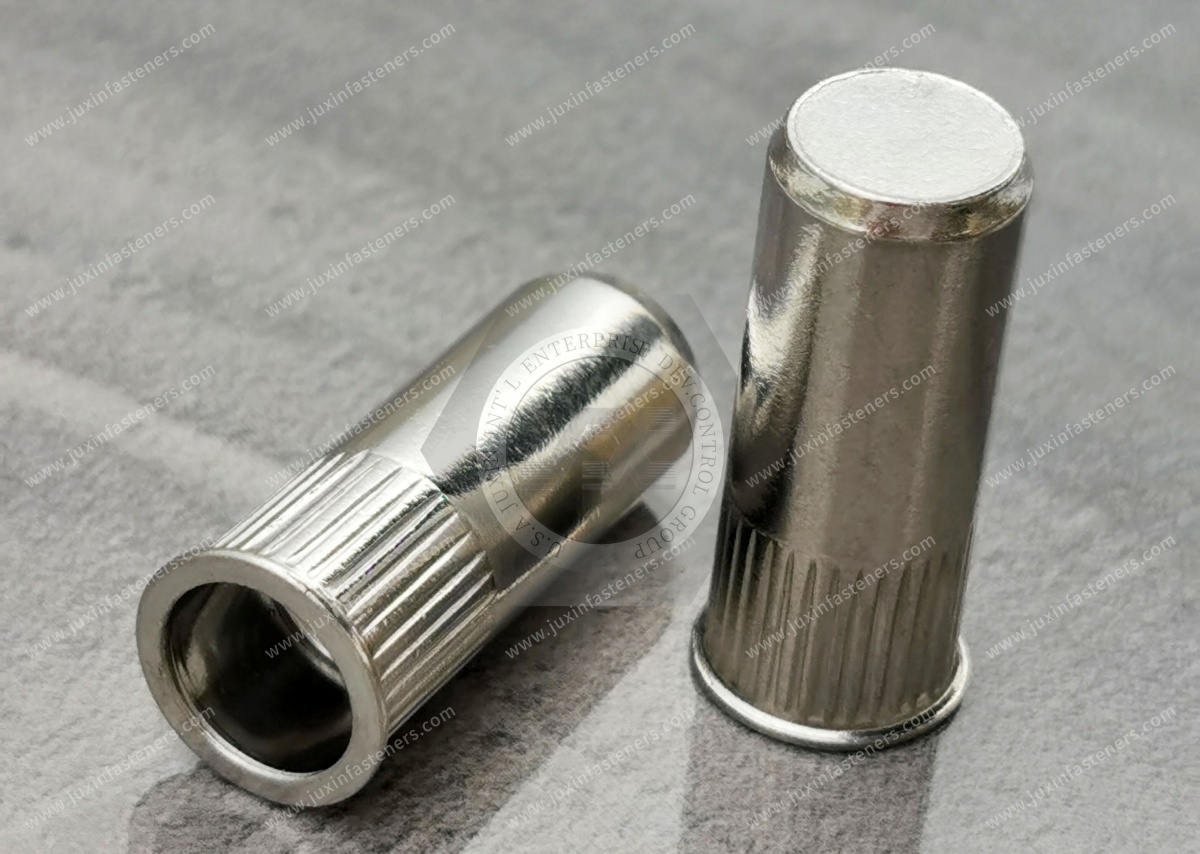
JUXIN FASTENERS supplies stainless steel thin head closed-end knurled blind rivet nuts for OEM sheet-metal assemblies requiring reliable internal threads and one-sided installation.
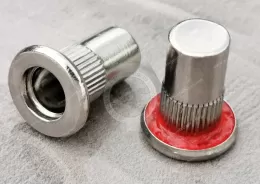
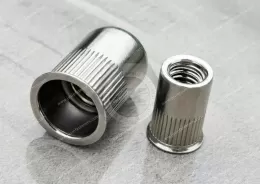
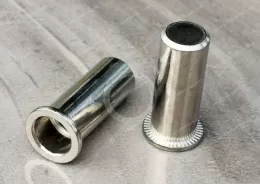
The low-profile flange reduces surface projection, while the ribbed round body helps resist insert rotation. The closed-end design prevents screw penetration through the insert and limits contamination entry through the barrel end.
Product Features
Thread sizes: M3, M4, M5, M6, M8, M10
Material: Stainless steel
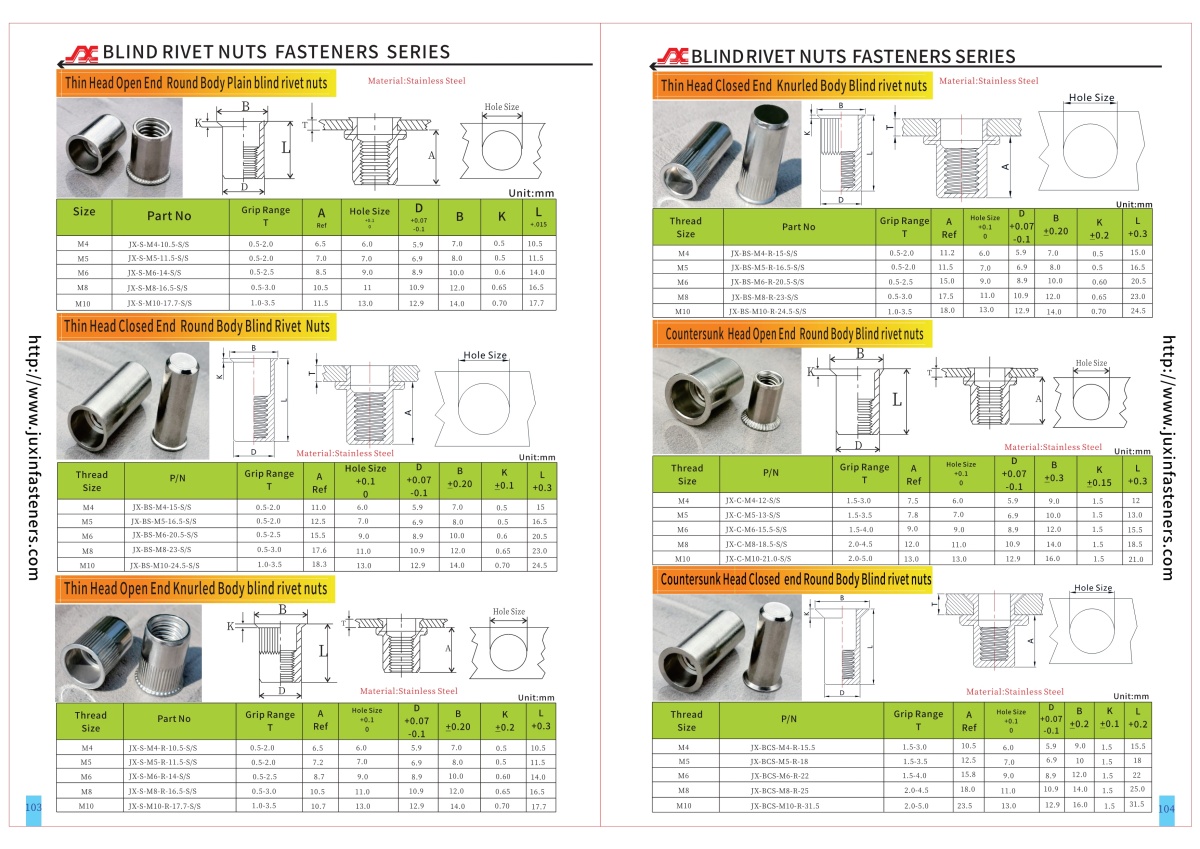
Grip range: 0.5–3.5 mm (approx. 0.020–0.138 in), depending on size
Head: Thin head / Low-profile flange
Body: Knurled / Ribbed round body
End: Closed end
Installation: One-sided blind installation
Stainless steel grade: Subject to confirmation
OEM dimensions: Drawing-based technical review
Applications include automotive components, electrical enclosures, electronic equipment, industrial machinery, HVAC cabinets, appliances, and OEM sheet-metal fabrication.
Product Specification
Stainless Steel Thin Head Closed-End Knurled Blind Rivet Nuts – Technical Specifications
JUXIN FASTENERS supplies stainless steel thin head closed-end knurled blind rivet nuts for OEM manufacturers, industrial equipment designers, sheet-metal fabricators, and global fastener procurement teams.
These internally threaded inserts provide mechanically retained fastening points in thin panels, hollow sections, and assemblies where access is available from only one side.
The combination of a low-profile flange, knurled round body, and closed-end barrel is particularly useful where engineers need reduced head projection, resistance to insert rotation, and protection against screw penetration through the insert.
Product Specifications
Product type: Closed-end blind rivet nut / Threaded rivet insert
Material: Stainless steel
Thread sizes: M3, M4, M5, M6, M8, M10
Head style: Thin head / Low-profile flange
Body configuration: Knurled / Ribbed round body
End configuration: Closed end
Product-family grip range: 0.5–3.5 mm (approx. 0.020–0.138 in)
Mounting hole: Round hole, according to the approved drawing
Installation: One-sided blind installation
Stainless steel grade: To be confirmed against the material specification
Inch-series threads: Subject to technical review and availability
Custom dimensions: Drawing-based OEM requirements
The stated grip range covers the product family and does not apply equally to every thread size. Exact dimensions, mounting-hole requirements, grip limits, and installation conditions must be verified for the selected part.
Engineering Features and Selection Considerations
Closed-End Design for Enclosed Assemblies
Unlike open-end rivet nuts, closed-end blind rivet nuts have a sealed barrel end that prevents a mating screw from extending through the insert.
This configuration can help limit the entry of dirt, moisture, and other contaminants through the barrel end of the insert.
It is particularly relevant to electrical enclosures, equipment housings, automotive assemblies, and sheet-metal cabinets where backside contamination is a concern.
However, a closed-end rivet nut alone does not guarantee a waterproof or airtight joint. Leakage may still occur around the flange, mounting hole, or surrounding panel interface.
Where an application requires a defined IP rating, liquid-tight performance, or environmental sealing, the complete joint assembly must be evaluated and tested.
Thin Head for Reduced Surface Projection
The reduced-height flange is designed for applications where a conventional flat-head rivet nut would create excessive surface projection.
Typical examples include close-fitting access covers, equipment panels, compact brackets, and sheet-metal housings.
A thin head may provide a near-flush appearance, but it should not be treated as fully flush without checking the actual flange thickness and mating-part geometry.
Engineers should also evaluate the bearing area under the flange, particularly when the parent material is thin or relatively soft.
Knurled Round Body for Rotation Resistance
The external knurled or ribbed surface helps resist insert rotation by engaging the surrounding material after installation.
This is useful when screws are repeatedly installed or removed during maintenance.
Actual resistance to rotation depends on the hole diameter, panel material, insert geometry, grip thickness, and installation process.
Knurling does not eliminate the need to verify spin-out torque. Where higher tightening torque or severe service loading is expected, engineers should compare the required joint performance with validated insert data.
Stainless Steel Material Selection
Stainless steel rivet nuts may be suitable for applications requiring corrosion resistance and durable internal threads.
However, the appropriate stainless steel grade depends on the operating environment, mechanical requirements, mating materials, and exposure conditions.
The source product description identifies stainless steel, while the technical reference also mentions A2 stainless steel. The exact supplied grade should therefore be confirmed before the final material specification is approved.
For assemblies exposed to chlorides, marine environments, cleaning chemicals, or dissimilar-metal contact, corrosion compatibility should be evaluated as part of the complete joint design.
Material certificates, traceability requirements, and applicable test documentation should be specified in the purchase requirements when necessary.
Blind Installation in Thin Sheet Materials
Closed-end blind rivet nuts create reusable internal threads without requiring access to the back of the workpiece during installation.
They can be useful in tubular structures, box sections, fabricated enclosures, and panels where conventional nuts cannot be positioned behind the joint.
The installation process deforms the rivet nut body to mechanically retain it against the parent material.
Successful installation depends on selecting the correct grip range, preparing the mounting hole, and controlling the setting process.
A panel thickness outside the approved grip range can reduce installation consistency and joint reliability.
Screw Length and Closed-End Clearance
Screw length is especially important when specifying closed-end threaded inserts.
Unlike an open-end rivet nut, a closed-end insert has a physical limit to screw penetration.
If the screw is too long, it may bottom against the closed end before the mating components are properly clamped.
This can produce misleading tightening torque and inadequate joint clamping force.
Engineers should verify available internal depth, thread engagement, mating-part thickness, and the required screw length before releasing the assembly.
Closed-End vs. Open-End Rivet Nuts
Closed-end rivet nuts are generally preferred when screw penetration must be restricted or contamination entry through the insert barrel needs to be reduced.
Open-end rivet nuts may be more appropriate when a longer screw must extend through the insert and sufficient backside clearance is available.
Neither configuration should be selected solely by appearance.
The choice should reflect the available assembly space, required thread engagement, contamination exposure, installation conditions, and maintenance requirements.
Industrial Applications and OEM Fastening Solutions
Automotive and Transportation
Closed-end stainless steel rivet nuts can be considered for equipment brackets, interior assemblies, service panels, and fabricated housings where one-sided installation is required.
Design teams should assess vibration, installation loads, corrosion exposure, and service accessibility before approval.
Electrical and Electronic Equipment
Applications include control cabinets, electrical housings, instrument panels, and equipment mounting structures.
The closed-end configuration can help reduce contamination pathways through the insert barrel, but any enclosure sealing requirement must be verified at the assembly level.
Industrial Machinery and Equipment
These inserts provide removable threaded attachment points for machine guards, access panels, maintenance covers, and fabricated equipment housings.
For repeatedly serviced assemblies, engineers should evaluate thread durability, installation retention, and the risk of insert rotation.
HVAC and Appliance Manufacturing
Potential applications include sheet-metal cabinets, equipment covers, brackets, and serviceable appliance assemblies.
The low-profile flange may be beneficial where cover clearance or surface projection is limited.
Architectural and General Sheet-Metal Fabrication
Closed-end knurled rivet nuts may be evaluated for fabricated metal panels, enclosed sections, and removable components requiring blind-side fastening.
Material selection and environmental exposure should be reviewed for the intended service conditions.
Engineering Selection Checklist
Before approving a closed-end blind rivet nut, confirm the following:
Required internal thread size and thread series
Stainless steel grade and material specification
Parent material and actual sheet thickness
Approved grip range for the selected size
Mounting-hole diameter and tolerance
Flange diameter and flange thickness
Body diameter and overall insert length
Available internal screw engagement depth
Screw length and risk of bottoming
Installation tooling and setting parameters
Required spin-out, push-out, and pull-out performance
Corrosion exposure and environmental sealing requirements
Inspection criteria and documentation requirements
Dimensional and Performance Verification
Closed-end rivet nuts should be evaluated using the approved product drawing and application-specific engineering requirements.
Relevant material, dimensional, corrosion, and mechanical test methods may be selected from applicable ISO, DIN, EN, ASTM, SAE, or ASME references where appropriate.
A standard should not be assumed to apply merely because a rivet nut has a similar shape or thread designation.
For example, metric thread requirements and UNC/UNF thread requirements belong to different thread systems and are not interchangeable.
Inch dimensions provided as conversions are reference values only. They do not establish the availability of corresponding inch-threaded products.
Where a specific test method, performance limit, or certification is required, it should be identified and agreed upon during technical review.
OEM Procurement and Supplier Evaluation
For OEM purchasing teams and supply chain managers, rivet nut selection involves more than matching the nominal thread size.
Important sourcing considerations include dimensional consistency, approved material specifications, repeatable installation performance, inspection requirements, production quantities, and delivery schedules.
A technically complete RFQ helps reduce the risk of selecting an insert that fits the thread requirement but fails to match the mounting-hole geometry or panel thickness.
For drawing-based projects, procurement teams should request confirmation of critical dimensions, material grade, and any application-specific performance requirements before approving production.
Custom Closed-End Rivet Nut RFQ Requirements
Please provide the following information for quotation and technical review:
Product drawing or 3D CAD model
Thread size and required quantity
Stainless steel grade
Head and body dimensions
Grip range and panel thickness
Mounting-hole requirements
Screw engagement and internal depth requirements
Mechanical or environmental performance criteria
Inspection and traceability requirements
Prototype, sample, or production requirements
Estimated annual demand and delivery destination
JUXIN FASTENERS supports OEM sourcing discussions and drawing-based technical reviews for industrial blind rivet nuts and related fastening components.
Final specifications, available material grades, manufacturing requirements, and inspection criteria should be confirmed before production approval.
Related Fastening Solutions
Open-End Knurled Blind Rivet Nuts
Suitable for assemblies requiring screw extension beyond the insert body where backside clearance is available.
Flat Head Blind Rivet Nuts
An alternative when a larger flange bearing surface is preferred.
Hex Body Blind Rivet Nuts
A potential option for compatible non-round mounting holes where rotational resistance is an important design consideration.
Custom Stainless Steel Threaded Inserts
Drawing-based fastening components for applications requiring specific dimensions, material grades, or assembly features.
Request an OEM Quotation
For stainless steel thin head closed-end knurled rivet nuts, custom blind rivet nuts, or drawing-specific fastening solutions, contact JUXIN FASTENERS with your engineering drawings and purchasing requirements.
Email: info@juxinfasteners.com
Website: www.juxinfasteners.com
JUXIN FASTENERS – Industrial Blind Rivet Nuts and Custom OEM Fastening Solutions.
Product Packaging
Packaging and Delivery – Stainless Steel Closed-End Knurled Blind Rivet Nuts
JUXIN FASTENERS reviews packaging requirements according to product size, order quantity, handling conditions, and OEM purchasing specifications.
Packaging Requirements
Packaging quantity: Subject to order confirmation
Inner packaging: According to approved packing instructions
Outer packaging: According to shipment requirements
Product identification: Part number, thread size, and material specification as required
Batch identification: According to agreed traceability requirements
Special packaging: Subject to technical and commercial review
Packaging and Handling Considerations
Stainless steel closed-end rivet nuts should be protected from unnecessary mechanical damage and contamination during handling, storage, and transportation.
Packaging arrangements should consider the protection of external knurling, flange surfaces, and internal threads.
For OEM production programs, part-number identification, batch traceability, packaging quantities, and labeling requirements should be agreed upon before shipment.
OEM Shipping and Documentation
Customers may specify labeling, inspection records, material documentation, and delivery requirements as part of their purchase specifications.
Final packaging details, shipment quantities, and supporting documentation are confirmed according to the approved order requirements.
For packaging instructions and OEM quotations, contact info@juxinfasteners.com.
Website: www.juxinfasteners.com
Product Pictures
Contact Us
Tel.:
+86 020 8621 0320
+86 020 3121 6067
E-mail:
Technical Support:
Navigation
SEND INQUIREY