
Call Us
+86 136 6007 9809
Call Us
+86 136 6007 9809

Juxin Fasteners manufactures custom flanged threaded sleeve nuts and stepped internally threaded connectors for OEM machinery, equipment assemblies and engineered fastening systems.
These made-to-drawing components feature cylindrical sleeve sections and an integral flange or shoulder for positioning and load transfer.
Depending on the approved design, internal threads may be specified at one or both ends, with matching or different thread sizes.
Material options include carbon steel, stainless steel, brass and copper, subject to manufacturing feasibility. Metric, UNC and UNF thread configurations can be evaluated from customer drawings.
Juxin Fasteners combines CNC turning, drilling, threading and suitable forming processes to manufacture custom sleeve nuts, flanged threaded bushings and special mechanical connectors.
Please provide a 2D drawing, 3D CAD model or physical sample for dimensional review, material selection and OEM production quotation.
Product Specification
Custom Double-Ended Threaded Flanged Sleeve Nuts
Made-to-Drawing Threaded Sleeves, Stepped Bushings and Special OEM Connection Nuts
Juxin Fasteners manufactures custom threaded flanged sleeve nuts for industrial machinery, mechanical equipment and engineered fastening assemblies.
These components combine a cylindrical sleeve body with an integral flange or shoulder.
Depending on the customer drawing, the design may incorporate internal threads at one or both ends, different thread sizes, stepped bores or other functional features.
Unlike standard hex nuts, custom sleeve nuts are designed to meet specific assembly requirements involving positioning, thread engagement, available installation space and load transfer.
Juxin Fasteners supports OEM/ODM manufacturing based on customer 2D drawings, 3D CAD models and approved physical samples.
Product Overview
| Parameter | Description |
|---|---|
| Product Name | Custom Threaded Flanged Sleeve Nuts |
| Alternative Names | Double-Ended Threaded Sleeve Nuts; Flanged Threaded Bushings; Stepped Threaded Connectors |
| Product Category | Custom Engineered Nuts |
| Main Body | Cylindrical or Stepped Sleeve |
| Positioning Feature | Integral Flange or Shoulder |
| Internal Threads | Single-End or Double-End, as Specified |
| Thread Configuration | Matching or Different Sizes, Subject to Drawing |
| Materials | Carbon Steel, Stainless Steel, Brass, Copper |
| Thread Systems | ISO Metric, UNC, UNF or Custom |
| Surface Treatment | According to Material and Customer Specification |
| Manufacturing | CNC Turning, Drilling, Threading and Suitable Forming |
| Production Type | OEM/ODM Made-to-Drawing Manufacturing |
All dimensions, materials and functional requirements must be confirmed against the approved drawing.
What Is a Double-Ended Threaded Sleeve Nut?
A double-ended threaded sleeve nut is a tubular fastening component designed with internal thread engagement at both ends.
The two threaded sections may share the same nominal diameter and pitch or use different thread configurations, depending on the intended assembly.
A flanged version includes an enlarged shoulder or collar that may provide axial positioning or a defined bearing surface.
The actual function of the flange depends on the mating component and joint design.
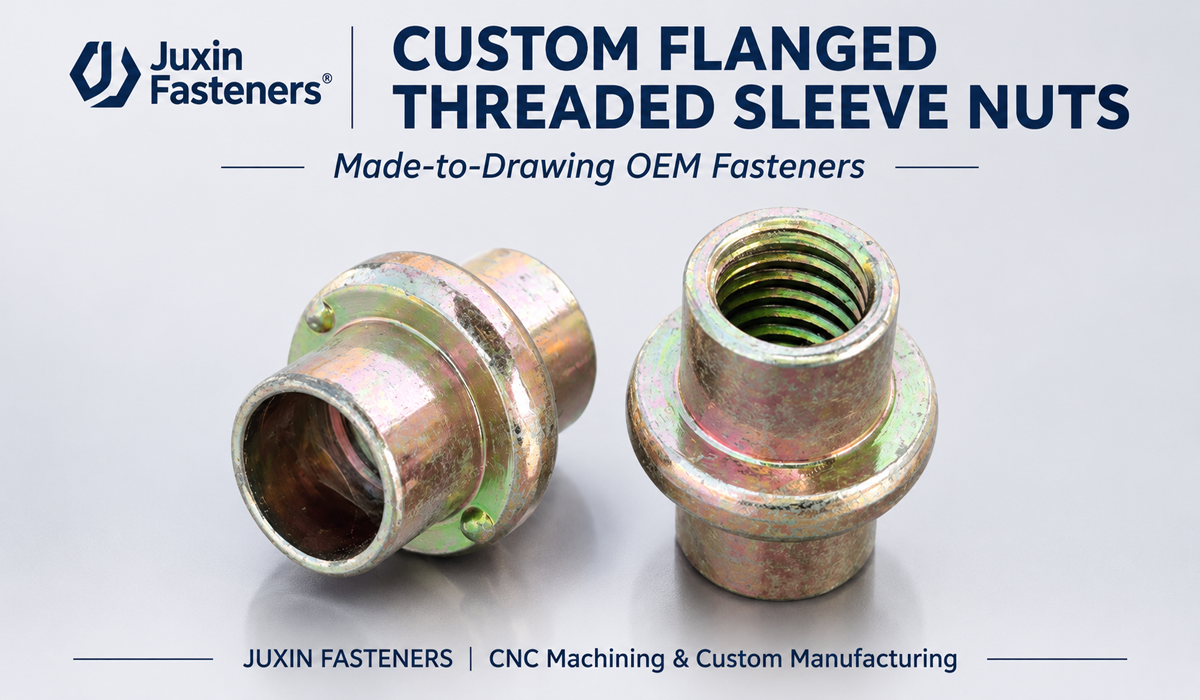
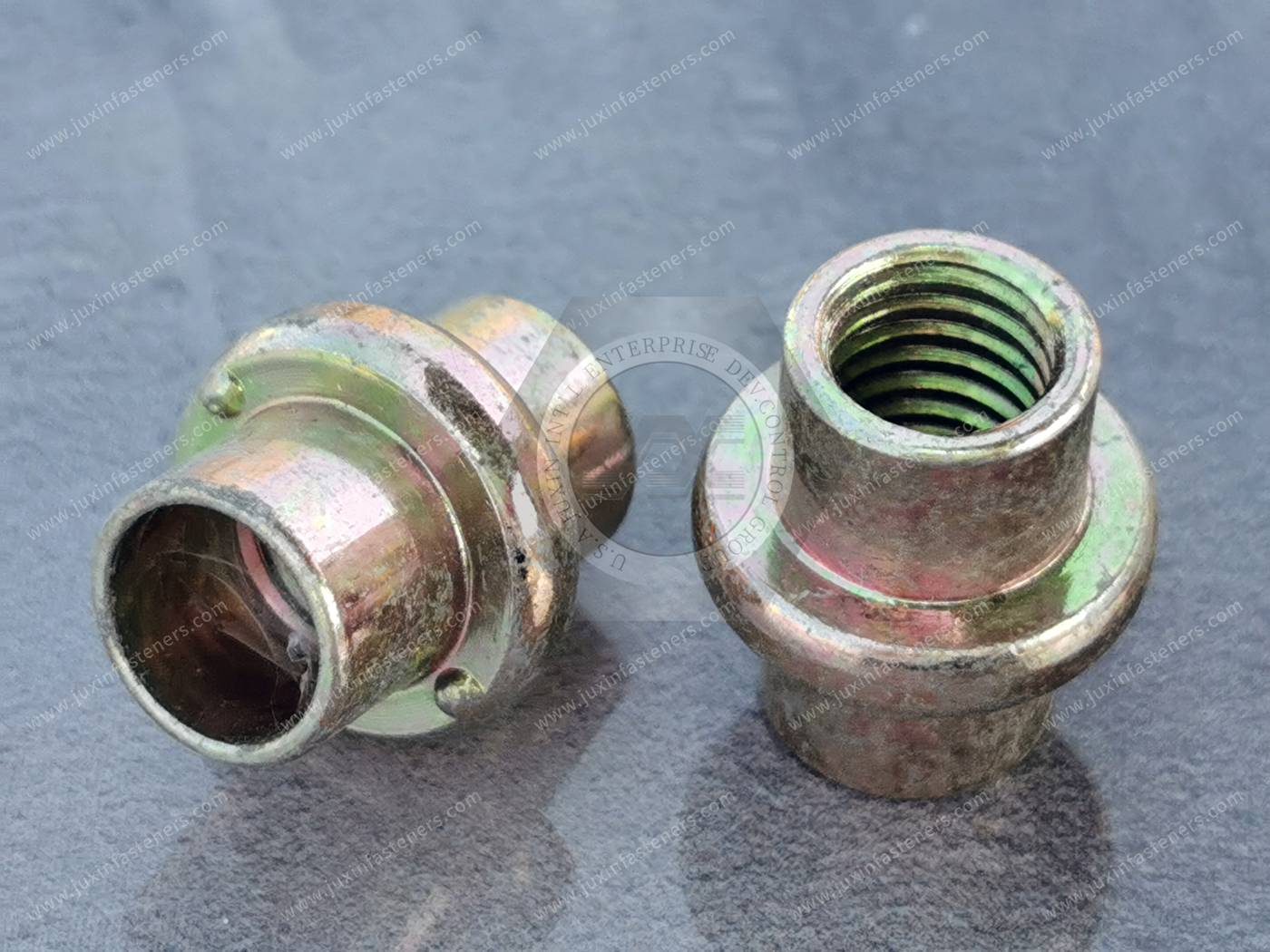
The product shown is a custom stepped sleeve component. Its complete internal thread configuration requires confirmation from an engineering drawing.
Double-Ended Threads vs. Continuous Internal Threads
These terms should not be used interchangeably.
A continuously threaded sleeve has one uninterrupted internal thread along the specified length.
A double-ended threaded sleeve may contain two separate threaded regions.
These regions may be identical or different.
Possible design configurations include:
One continuous internal thread.
Two separate internal threads of the same size.
Two different internal thread sizes.
Opposite thread directions.
A stepped internal bore with defined thread depths.
Only the approved drawing determines the actual configuration.
Flanged and Stepped Body Design
The external geometry of a custom sleeve nut may include multiple cylindrical diameters and an integral flange.
The flange may serve as an axial stop or provide a bearing surface against the mating assembly.
The stepped body may assist with positioning inside a corresponding bore or tubular structure.
Important design dimensions include:
Overall length.
Flange outside diameter.
Flange thickness.
First sleeve outside diameter.
Second sleeve outside diameter.
Thread diameter and pitch.
Thread depth.
Internal shoulder position.
Concentricity.
Face perpendicularity.
Surface finish.
Critical dimensions should be defined by the OEM engineering drawing.
Metric Internal Thread Options
Custom threaded sleeves may be designed around ISO metric machine screw threads.
Common engineering reference sizes include:
| Metric Thread | Standard Coarse Pitch |
|---|---|
| M5 | 0.8 mm |
| M6 | 1.0 mm |
| M8 | 1.25 mm |
| M10 | 1.5 mm |
| M12 | 1.75 mm |
These are general thread-design references, not confirmed stock sizes for this specific component.
Other metric diameters and pitches may be evaluated according to the customer drawing.
Inch Dimension References
For North American engineers, the following conversions may assist with dimensional review.
| Metric Nominal Diameter | Approximate Inch Diameter |
|---|---|
| M5 | 0.197 in |
| M6 | 0.236 in |
| M8 | 0.315 in |
| M10 | 0.394 in |
| M12 | 0.472 in |
These values are nominal diameter conversions only.
They do not establish interchangeability with Unified inch threads.
Custom UNC and UNF Threads
North American OEM projects may specify Unified National Coarse or Unified National Fine threads.
Examples for custom engineering review include:
| UNC Thread | UNF Thread |
|---|---|
| #10-24 | #10-32 |
| 1/4-20 | 1/4-28 |
| 5/16-18 | 5/16-24 |
| 3/8-16 | 3/8-24 |
| 1/2-13 | 1/2-20 |
These examples are not dimensional equivalents of the metric threads listed above.
Custom inch-thread components require the correct diameter, threads per inch, thread class and engagement length.
Different Thread Sizes at Opposite Ends
Some custom connectors are designed with different female threads at opposite ends.
This configuration may be useful where two mating components have different threaded connections.
However, different thread sizes require special consideration of:
Minimum wall thickness.
Thread engagement.
Internal shoulder geometry.
Axial load capacity.
Machining access.
Assembly sequence.
The larger internal thread may limit the remaining wall thickness of the sleeve.
Carbon Steel Threaded Sleeve Nuts
Carbon steel may be selected where strength, machinability and cost are important.
The actual grade should be specified according to mechanical requirements and manufacturing processes.
Potential surface treatments include zinc plating and other customer-specified protective finishes.
The photographed component has a yellow-iridescent metallic appearance, but its coating specification cannot be established from appearance alone.
Stainless Steel Threaded Sleeves
Stainless steel may be selected for equipment operating in humid or corrosion-sensitive environments.
Material options can be evaluated according to the application.
Relevant engineering considerations include:
Corrosion exposure.
Mechanical strength.
Machinability.
Thread galling.
Surface finish.
Material compatibility.
The actual stainless steel grade must be specified in the drawing or purchase requirements.
Brass Threaded Sleeve Connectors
Brass may be suitable for selected precision-machined connectors and equipment components.
The choice of brass alloy should account for machinability, strength, corrosion conditions and mating materials.
Brass should not be substituted for steel without checking the mechanical requirements.
Copper Threaded Components
Copper components may be evaluated for special electrical, thermal or mechanical applications.
However, pure copper has different mechanical properties and machining behavior from brass or steel.
Material grade, required strength and thread performance must be confirmed before manufacturing.
Surface Treatment and Corrosion Protection
Surface finishes may be specified according to the base material and operating environment.
Potential options include:
Zinc plating for suitable carbon steel parts.
Zinc-alloy coatings where specified.
Passivation for suitable stainless steel grades.
Nickel plating where compatible with the design.
Other customer-approved finishes.
Surface treatment can affect thread fit and dimensional tolerances.
The coating specification should therefore be included in the approved drawing.
Custom CNC Turning
CNC turning is an important manufacturing method for stepped cylindrical components.
It can be used to produce:
External sleeve diameters.
Integral flanges.
Stepped shoulders.
Internal bores.
Chamfers.
Precision faces.
Custom thread features.
Additional drilling, tapping or milling operations may be required depending on the design.
Cold Forming and Secondary Operations
Juxin Fasteners also supports cold heading and cold forming for suitable fastening components.
These processes may be evaluated for particular custom sleeve designs and production volumes.
Not every flanged threaded sleeve is suitable for cold forming.
Manufacturing feasibility depends on geometry, material, wall thickness and tooling requirements.
OEM Mechanical Equipment Applications
Custom threaded sleeve nuts may be used in engineered mechanical assemblies where standard nuts do not provide the required geometry.
Potential applications include:
Equipment frames.
Custom brackets.
Mechanical housings.
Machinery mounting systems.
Special threaded connections.
Industrial assembly fixtures.
The suitability of the component must be established by the equipment designer.
Tubular Structure and Frame Connections
Custom sleeve connectors may be considered for suitable tubular structures.
An internal sleeve may provide a defined threaded connection inside a compatible tube or housing.
The actual retention method must be specified.
Possible designs may require press fitting, welding, mechanical capture or another approved assembly method.
The photographed component should not automatically be described as a weld nut or press-fit insert.
Industrial Automation Equipment
Industrial automation systems may use special threaded connectors where compact assembly geometry or repeated equipment maintenance requires custom fastening solutions.
Applications may include selected machine frames, mounting fixtures and mechanical adjustment systems.
Electrical and Power Equipment
Special machined connectors may be evaluated for electrical equipment housings and mounting assemblies.
Where electrical conductivity or insulation is relevant, the material and complete joint design must be reviewed.
No electrical performance rating is claimed for this component.
Automotive and Transportation Equipment
Automotive and transportation OEMs may require nonstandard threaded sleeves for mechanical assemblies.
Material strength, fatigue behavior, vibration and installation requirements must be validated.
Safety-critical applications require customer approval and the applicable qualification process.
Furniture and Architectural Hardware
Custom threaded sleeves are also used in some furniture and architectural connection systems.
However, this product should not be classified as a standard furniture sleeve nut without confirmation of its intended application and installation geometry.
Engineering Design Considerations
A custom threaded sleeve nut should be evaluated as part of the complete mechanical connection.
Important factors include:
Axial load.
Thread engagement.
Wall thickness.
Flange contact area.
Mating component material.
Installation method.
Joint preload.
Fatigue loading.
Corrosion exposure.
Operating temperature.
These factors affect the component's functional reliability.
Thread Engagement and Wall Thickness
The required internal thread engagement depends on the material, mating fastener strength and loading conditions.
Thin-walled sleeves may require special attention to thread strength and manufacturing tolerances.
Where the two ends have different internal thread sizes, the design should be checked for adequate material between the threaded regions and outer surfaces.
Flange Contact and Axial Positioning
An integral flange may act as a positioning stop or bearing surface.
The flange diameter, thickness and mating surface condition influence how loads are transferred.
The flange should not be assumed to provide a sealing function unless the assembly is specifically designed and tested for sealing.
Dimensional Tolerances
Important inspection characteristics may include:
Internal thread accuracy.
External diameters.
Flange diameter.
Overall length.
Shoulder position.
Concentricity.
Perpendicularity.
Surface roughness.
Coating thickness.
Tolerance requirements should reflect the actual assembly function rather than applying unnecessarily tight tolerances to every dimension.
Relevant International Standards
Depending on the design, relevant references may include:
ISO 261 — ISO metric screw-thread general plan.
ISO 724 — Basic dimensions of ISO metric screw threads.
ISO 965 Series — ISO metric screw-thread tolerances.
ASME B1.1 — Unified inch screw threads.
ASME B1.20.1 — General-purpose pipe threads, only when the design specifically requires NPT pipe threads.
ISO 2768 — General tolerances where expressly specified and applicable.
This is a custom-engineered product rather than a confirmed standard DIN or ISO sleeve nut.
Compliance with a particular standard must be established from the approved drawing and inspection requirements.
Why Pipe Thread Terminology Must Be Verified
The term "pipe nut" can refer to several different types of components.
These may include pipe fittings, coupling nuts, tube-end connectors and special threaded adapters.
A mechanical sleeve nut with ISO metric or Unified machine threads should not automatically be described as an NPT or BSP pipe fitting.
NPT, BSPT and BSPP threads have different geometries and sealing requirements.
They are not interchangeable with ordinary metric or Unified machine screw threads.
OEM Manufacturing and Production Planning
Juxin Fasteners supports made-to-drawing production for custom threaded sleeves and special fastening components.
Manufacturing planning considers:
Material selection.
Machining operations.
Tooling feasibility.
Batch quantity.
Dimensional requirements.
Surface treatment.
Inspection procedures.
Packaging.
Delivery schedule.
MOQ, tooling cost and lead time are determined after engineering review.
Quality Inspection
Depending on the customer specification, inspection may include:
Material verification.
Thread gauging.
Diameter measurement.
Flange dimension inspection.
Overall length inspection.
Concentricity measurement.
Surface finish verification.
Coating inspection.
Functional assembly testing.
Any required mechanical or corrosion testing should be defined before production.
Frequently Asked Questions
What is a custom threaded flanged sleeve nut?
It is an internally threaded cylindrical fastening component with an integral flange or shoulder, manufactured according to the required assembly geometry.
Does double-ended mean the entire bore is threaded?
Not necessarily. A double-ended design may contain separate threaded regions.
Can the two ends have different thread sizes?
Yes, a custom design can be evaluated with different internal threads where wall thickness and manufacturing feasibility permit.
Is this product a standard pipe fitting?
Not necessarily. Pipe-fitting terminology is appropriate only when the actual design and application support that classification.
Can Juxin Fasteners manufacture stainless steel versions?
Yes. Stainless steel material options can be evaluated according to customer drawings and specifications.
Can brass or copper be used?
Brass and copper versions may be evaluated where their properties meet the intended application requirements.
Are UNC and UNF threads available?
Custom UNC and UNF thread configurations can be evaluated based on the approved drawing.
Can metric and inch threads be interchanged?
No. Metric and Unified thread systems require different dimensional specifications.
Is the flange designed for welding?
Not necessarily. The attachment method must be confirmed from the engineering drawing.
Can these parts be CNC machined?
Yes. CNC turning and suitable secondary machining operations are appropriate for many custom stepped threaded components.
Can Juxin Fasteners manufacture from samples?
Yes. Physical samples may be used for engineering evaluation, with critical dimensions and material requirements confirmed before production.
Request a Quote — Custom Threaded Flanged Sleeve Nuts
Juxin Fasteners is an industrial fastener manufacturer supporting international OEM and custom-engineered fastening projects.
Our manufacturing capabilities include cold heading, cold forming, CNC machining and suitable secondary operations.
We manufacture custom threaded sleeves, stepped bushings, flanged connectors and other special fastening components according to customer technical requirements.
Recommended RFQ Information
2D engineering drawing or 3D CAD model.
Physical sample, if available.
Overall length.
Flange outside diameter and thickness.
Sleeve outside diameters.
Internal thread size at each end.
Thread pitch or threads per inch.
Thread depth and direction.
Internal bore geometry.
Material grade.
Surface treatment.
Dimensional tolerances.
Mating component details.
Installation method.
Intended operating environment.
Mechanical loading requirements.
Inspection requirements.
Initial order quantity.
Estimated annual demand.
Required delivery schedule.
Please send your drawings, samples or technical specifications for manufacturing feasibility review and quotation.
Juxin Fasteners
Custom Industrial Fastener Manufacturer | Threaded Flanged Sleeve Nuts | CNC Machined Threaded Components | OEM Fastener Manufacturing
Website: https://www.juxinfasteners.com/
Email: info@juxinfasteners.com
Product Packaging
Packaging Standard
At Juxin Fasteners, we apply standardized export packaging to ensure product protection, traceability, and compliance with international logistics requirements.
1. Standard Export Packaging
Unless otherwise specified, all products will be packed according to our factory standard export packaging, which includes:
Moisture-resistant inner protection
Poly bag or small box packing as required
Reinforced export cartons
Clear labeling with part number, specification, batch number, and quantity
Palletizing for sea or air shipment when necessary
Our standard packaging is designed to ensure safe transportation, efficient warehousing, and long-distance international shipping.
2. Customized Packaging Options
We also provide customized packaging solutions according to customer requirements, including but not limited to:
Private labeling
Customized barcodes
Specific carton dimensions
Retail packaging
Special pallet configuration
Customer-specific marking and identification
So that you know, customized packaging may involve additional costs and extended lead time depending on the complexity of the requirements.
3. Compliance & Quality Assurance
All packaging processes are controlled under our ISO 9001 quality management system to ensure consistency, traceability, and product integrity throughout the supply chain.
Product Pictures
Contact Us
Tel.:
+86 020 8621 0320
+86 020 3121 6067
E-mail:
Technical Support:
Navigation
SEND INQUIREY


