Call Us
+86 136 6007 9809
Call Us
+86 136 6007 9809

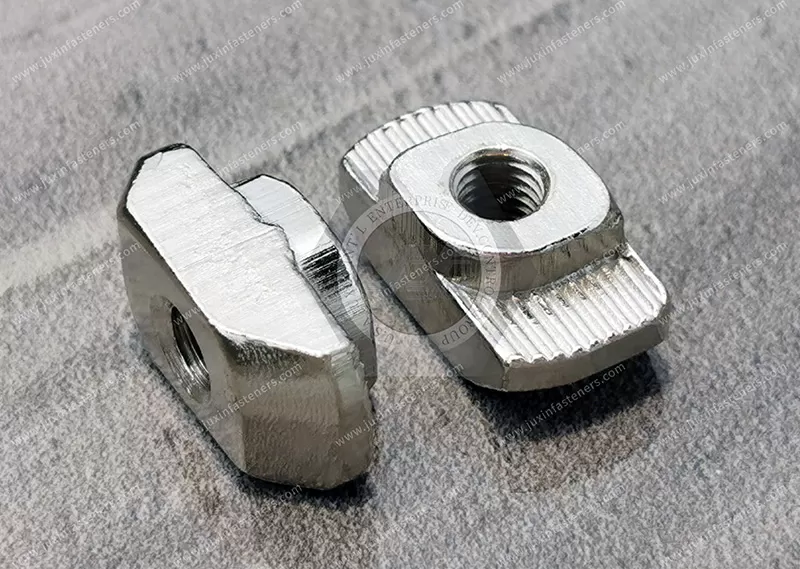
Juxin Fasteners manufactures drop-in hammer T-nuts for modular aluminum extrusion framing systems used in industrial automation, robotics, conveyors, machine guarding and equipment assembly.
These compact internally threaded fasteners are designed for compatible T-slot profiles.
Their hammer-shaped geometry allows insertion through the slot opening and rotation into the retaining position during installation, subject to the specific nut and profile design.
Available materials include carbon steel and stainless steel, with M3, M4, M5, M6 and M8 metric threads.
Zinc, nickel and zinc-nickel alloy finishes are available according to customer requirements.
Custom Unified inch-thread options can be evaluated for North American OEM projects.
Juxin Fasteners supports OEM/ODM manufacturing using cold heading, cold forming, CNC machining where required and suitable secondary operations.
Profile compatibility is determined by the actual slot geometry, nut dimensions and approved engineering drawing—not by nominal profile series alone.
Product Specification
Drop-In Hammer T-Nuts for Aluminum Extrusion Profiles
Metric M3–M8 T-Slot Framing Fasteners | Custom UNC Threads | Industrial OEM Manufacturing
Juxin Fasteners manufactures drop-in hammer T-nuts for aluminum extrusion framing systems used in industrial automation, robotics, conveyor equipment, machinery enclosures and modular industrial structures.
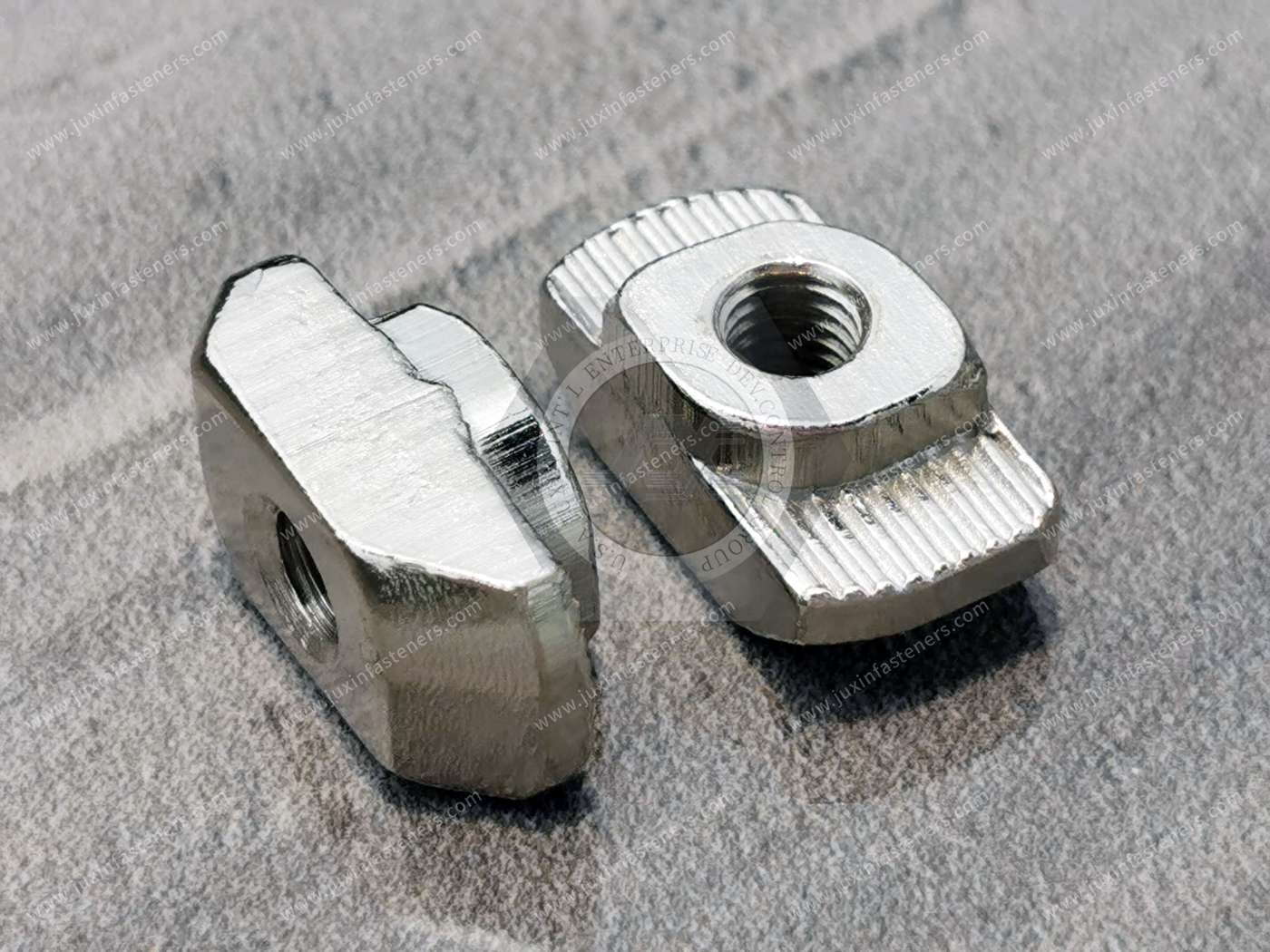
Also known as hammer nuts, drop-in T-slot nuts or quarter-turn T-nuts, these compact internally threaded fasteners are designed to fit compatible aluminum extrusion slots without requiring insertion from the open end of the profile.
Their distinctive hammer-shaped body allows the nut to be inserted through the slot opening and rotated into a retaining position as the mating screw is tightened, provided the nut and profile geometry are compatible.
Juxin Fasteners manufactures carbon steel and stainless steel configurations with M3, M4, M5, M6 and M8 metric threads.
Custom Unified inch-thread versions can be evaluated for North American OEM programs.
Our manufacturing capabilities include cold heading, cold forming, CNC machining where required and suitable secondary processes for made-to-drawing industrial fasteners.
Product Specifications
| Parameter | Specification |
|---|---|
| Product Name | Drop-In Hammer T-Nuts |
| Alternative Names | Hammer Nuts; Drop-In T-Slot Nuts; Quarter-Turn T-Nuts |
| Product Category | Custom Engineered Nuts |
| Application | Aluminum Extrusion T-Slot Framing |
| Materials | Carbon Steel; Stainless Steel |
| Metric Threads | M3, M4, M5, M6, M8 |
| Inch Threads | Custom UNC/UNF, Subject to Review |
| Surface Finishes | Zinc; Nickel; Zinc-Nickel Alloy |
| Installation | Drop-In, Rotating Engagement |
| Profile Families | Selected 20, 30, 40 and 45 Series |
| Slot Compatibility | Drawing-Specified |
| Manufacturing | Cold Forming, CNC Machining and Secondary Operations |
| Customization | OEM/ODM Made-to-Drawing |
Not every thread size is available for every slot or profile series. Final compatibility must be verified using the actual extrusion cross-section and nut dimensions.
What Is a Hammer T-Nut?
A hammer T-nut is an internally threaded fastener designed for installation in a compatible T-slot aluminum extrusion.
The nut has a narrow body profile that permits insertion through the slot opening.
During tightening, the nut rotates into a position where its wider bearing surfaces engage beneath the slot lips.
This provides a threaded attachment point for brackets, plates, accessories and other mounted components.
The rotation and engagement behavior depend on the specific nut geometry and T-slot profile.
How Drop-In Hammer Nuts Work
A typical installation sequence involves:
Confirming that the hammer nut matches the aluminum profile slot.
Inserting the nut through the slot opening.
Engaging the mating screw through the mounted component.
Tightening the screw to rotate the nut into its retaining position.
Verifying correct engagement and tightening according to the assembly specification.
Some designs rotate approximately 90 degrees, but this should not be assumed for every product.
A hammer nut that does not rotate or seat correctly may fail to engage the T-slot.
Benefits of Drop-In Installation
The main advantage of a drop-in hammer nut is the ability to add threaded attachment points to an existing aluminum extrusion structure.
Potential benefits include:
Installation without accessing the profile end.
Convenient addition of mounting brackets.
Easier modification of existing machinery frames.
Flexible positioning along the extrusion.
Reduced need to dismantle assembled structures.
Compatibility with automated and modular equipment designs.
The actual installation process depends on the selected profile and nut design.
Hammer T-Nuts vs. Slide-In T-Nuts
| Feature | Hammer T-Nut | Slide-In T-Nut |
|---|---|---|
| Installation | Through Compatible Slot Opening | Usually From Profile End |
| Engagement | Rotating Body | Sliding Body |
| Retrofitting | Convenient for Compatible Profiles | May Require End Access |
| Positioning | Adjustable | Adjustable |
| Geometry | Compact Hammer Shape | Profile-Specific T-Shape |
| Compatibility | Slot-Specific | Slot-Specific |
Neither type is universally interchangeable with the other.
Hammer T-Nuts vs. Roll-In T-Nuts
Roll-in T-nuts are another category of aluminum extrusion fasteners.
Some roll-in designs can be inserted through the slot opening and rotated into place.
However, roll-in nuts may incorporate different contact geometries, springs, balls or positioning features.
The correct terminology should follow the actual product design.
Metric Thread Specifications
The specified metric thread range includes:
| Thread | Nominal Diameter | Standard Coarse Pitch |
|---|---|---|
| M3×0.5 | 3 mm | 0.50 mm |
| M4×0.7 | 4 mm | 0.70 mm |
| M5×0.8 | 5 mm | 0.80 mm |
| M6×1.0 | 6 mm | 1.00 mm |
| M8×1.25 | 8 mm | 1.25 mm |
These are standard metric coarse-thread references.
The appropriate thread size depends on the slot dimensions, nut body geometry, required engagement length and mating screw.
American UNC and UNF Thread Options
North American modular framing systems may use Unified inch-thread fasteners.
Juxin Fasteners supports manufacturing feasibility review for custom inch-thread hammer nuts.
| Thread | Series | Nominal Diameter | Metric Diameter Reference |
|---|---|---|---|
| #8-32 | UNC | 0.1640 in | 4.166 mm |
| #10-32 | UNF | 0.1900 in | 4.826 mm |
| 1/4-20 | UNC | 0.2500 in | 6.350 mm |
| 1/4-28 | UNF | 0.2500 in | 6.350 mm |
| 5/16-18 | UNC | 0.3125 in | 7.938 mm |
| 5/16-24 | UNF | 0.3125 in | 7.938 mm |
| 3/8-16 | UNC | 0.3750 in | 9.525 mm |
These are reference thread designations for custom engineering inquiries.
The larger thread sizes require sufficient nut body dimensions and compatible slot geometry.
They are not confirmed stock configurations.
ASME B1.1 Unified Thread Requirements
For custom inch-thread hammer nuts, ASME B1.1 is the relevant Unified thread standard.
The customer drawing should specify:
Thread designation.
UNC or UNF series.
Internal thread class.
Thread engagement length.
Nut body dimensions.
Slot compatibility requirements.
ASME B1.1 defines thread requirements, not the external hammer nut geometry.
Metric and Inch Threads Are Not Interchangeable
Metric and Unified inch threads have different nominal diameters, pitches and tolerances.
For example:
| Parameter | M6×1.0 | 1/4-20 UNC |
|---|---|---|
| Nominal Diameter | 6.000 mm | 6.350 mm |
| Pitch | 1.000 mm | 1.270 mm |
| Thread System | ISO Metric | Unified Coarse |
| Interchangeable | No | No |
The mating screw must match the actual nut thread.
Aluminum Extrusion Profile Compatibility
Hammer T-nuts are selected according to the geometry of the aluminum extrusion slot.
Important dimensions include:
Nominal slot opening width.
Internal slot cavity width.
Slot depth.
Retaining lip thickness.
Nut body length.
Nut body width.
Nut thickness.
Rotation clearance.
Thread engagement length.
Profile series alone does not establish compatibility.
20 Series Aluminum Extrusion Systems
20 series profiles are commonly used for compact modular structures.
Examples include 2020 and related extrusion sizes.
Depending on the actual slot design, suitable hammer nuts may use M3, M4 or M5 threads.
The slot opening and internal cavity must be checked before selecting a nut.
30 Series Aluminum Extrusion Systems
30 series profiles are commonly used in machinery frames, equipment enclosures and workstations.
Examples include 3030, 3060 and related profiles.
Suitable hammer nut dimensions depend on the profile manufacturer's slot design.
M4, M5 and M6 are common engineering thread considerations.
40 Series Aluminum Extrusion Systems
40 series profiles are used in modular industrial structures requiring larger framing sections.
Examples include 4040, 4080 and related profiles.
Depending on the slot geometry, M5, M6 or M8 hammer nuts may be considered.
A 40 mm extrusion does not necessarily have the same slot dimensions across all manufacturers.
45 Series Aluminum Extrusion Systems
45 series profiles are used in selected industrial framing systems.
The slot geometry and accessory dimensions must be verified against the specific extrusion manufacturer.
Custom metric and Unified inch-thread configurations may be evaluated.
Slot 6, Slot 8 and Slot 10
The nominal slot designation is a critical selection parameter.
| Slot Designation | Engineering Consideration |
|---|---|
| Slot 6 | Compact profile and nut geometry |
| Slot 8 | Common industrial extrusion interface |
| Slot 10 | Larger slot geometry and corresponding fasteners |
The slot designation alone is not a complete dimensional specification.
Different profile systems may have different internal geometries even when they share a nominal slot size.
European and North American Framing Systems
European modular framing systems frequently use metric profile dimensions and metric threads.
North American systems may use inch-based profile dimensions, metric threads or Unified inch threads.
A product described as a European-profile T-nut is not automatically compatible with every European extrusion.
Similarly, an American-profile hammer nut must match the actual slot geometry of the intended framing system.
Juxin Fasteners supports custom manufacturing based on the customer's extrusion drawing and fastener requirements.
Carbon Steel Hammer T-Nuts
Carbon steel is a common material choice for industrial T-slot fasteners.
Its suitability depends on:
Required mechanical properties.
Cold forming characteristics.
Thread strength.
Nut body geometry.
Coating requirements.
Operating environment.
The final steel grade and mechanical requirements should be specified on the approved drawing.
Stainless Steel Hammer T-Nuts
Stainless steel may be selected for corrosion-sensitive applications.
Potential uses include:
Stainless steel equipment assemblies.
Washdown environments.
Laboratory equipment.
Corrosion-sensitive machinery.
Outdoor industrial structures.
The exact stainless steel grade must be confirmed according to customer requirements.
Zinc-Plated Hammer Nuts
Zinc plating is a common surface treatment for carbon steel industrial fasteners.
The coating specification should identify:
Coating thickness.
Passivation.
Corrosion resistance requirements.
Surface appearance.
Thread compatibility.
Coating buildup must not prevent the hammer nut from rotating or seating correctly.
Nickel-Plated T-Slot Nuts
Nickel plating may be specified for selected industrial applications.
Its suitability depends on the required appearance, corrosion resistance and coating process.
The coating system should be approved for the intended material and operating environment.
Zinc-Nickel Alloy Coating
Zinc-nickel alloy plating may be selected for applications requiring customer-specified corrosion protection.
Relevant parameters include:
Coating thickness.
Alloy composition.
Passivation.
Sealer or topcoat.
Corrosion test requirements.
Dimensional effects.
No universal salt spray performance is claimed for every hammer nut configuration.
Industrial Automation Equipment
Hammer T-nuts are used in modular framing systems for industrial automation.
Potential applications include:
Automated assembly stations.
Machine frames.
Equipment brackets.
Linear motion support structures.
Pneumatic component mounting.
Sensor mounting interfaces.
Drop-in installation can support equipment modification without dismantling the complete frame.
Robotics and Motion Control Equipment
Robotic equipment and automation cells often incorporate aluminum extrusion framing.
Hammer T-nuts may be used for suitable mounting interfaces such as:
Sensor brackets.
Cable management hardware.
Protective covers.
Equipment mounting plates.
Auxiliary components.
The fastening system must be designed for the actual mechanical loading and operating conditions.
Conveyor and Material Handling Systems
Modular conveyors frequently use aluminum extrusion structures.
Hammer nuts may provide adjustable attachment points for:
Conveyor guides.
Sensor mounts.
Support brackets.
Guarding components.
Cable routing hardware.
Equipment accessories.
The nut and profile must be selected for the required load and installation geometry.
Machine Guarding and Safety Enclosures
Industrial machine guarding often uses modular aluminum extrusion frames.
Hammer T-nuts may be used to mount compatible panels, brackets and accessories.
Safety-related applications require engineering review of the complete guard structure and fastening system.
Industrial Workstations
Modular industrial workstations can incorporate hammer T-nuts for mounting:
Tool holders.
Monitor brackets.
Lighting accessories.
Shelves.
Equipment supports.
Cable management components.
The required loading and frame compatibility must be verified.
Semiconductor Equipment
Semiconductor equipment manufacturers may use aluminum extrusion structures in suitable machine frames and equipment enclosures.
Potential applications include:
Instrument mounting.
Equipment brackets.
Sensor supports.
Auxiliary frame components.
Cleanliness, surface treatment and contamination requirements must be specified for the intended environment.
AI Data Center and Electronics Equipment
Modular aluminum extrusion structures may be used in selected electronics equipment frames, test fixtures and auxiliary data center equipment.
Hammer T-nuts can support adjustable mounting interfaces where compatible framing is used.
Applications involving grounding, electrical continuity or electrostatic discharge protection require specific design and validation.
A standard plated hammer nut should not automatically be described as ESD-rated.
Laboratory and Medical Equipment
Laboratory and medical equipment manufacturers may use modular aluminum framing for suitable equipment supports and enclosures.
Material selection, cleanliness and regulatory requirements must follow the approved equipment specification.
Packaging Machinery
Packaging equipment manufacturers often require adjustable brackets, guides and accessories.
Drop-in hammer nuts can provide convenient mounting points in compatible modular framing systems.
Exhibition and Display Systems
Aluminum extrusion frames may also be used for modular display structures and adjustable equipment stands.
The correct fastener must be selected according to the actual profile and loading requirements.
Cold Heading and Cold Forming
Juxin Fasteners supports cold heading and cold forming for suitable hammer nut designs.
Process selection depends on:
Nut geometry.
Material grade.
Production quantity.
Dimensional requirements.
Thread size.
Surface treatment.
CNC Machining and Secondary Operations
CNC machining may be used for custom dimensions, special slot interfaces or drawing-specific features.
Secondary operations may include:
Thread manufacturing.
Dimensional finishing.
Deburring.
Surface treatment.
Inspection.
Not every hammer nut requires CNC machining.
Custom OEM Hammer T-Nuts
Juxin Fasteners supports made-to-drawing manufacturing for custom T-slot fasteners.
Custom options may include:
Metric or Unified threads.
Nut body length.
Nut body width.
Nut thickness.
Rotation geometry.
Slot engagement features.
Special chamfers.
Material grades.
Surface coatings.
Dimensional tolerances.
Packaging.
All custom configurations are subject to manufacturing feasibility review.
Engineering Selection Checklist
Before selecting a hammer T-nut, confirm:
Extrusion manufacturer or profile drawing.
Profile series.
Slot opening width.
Internal slot cavity dimensions.
Nut body dimensions.
Required thread.
Mating screw.
Installation direction.
Required tightening torque.
Joint loading.
Coating.
Environmental conditions.
The correct nut should be verified in the actual extrusion profile.
Installation and Assembly Considerations
Incorrect installation can result in incomplete engagement with the T-slot.
Potential issues include:
Nut not rotating into position.
Nut rotating beyond the intended position.
Interference with the slot cavity.
Insufficient thread engagement.
Incorrect mating screw length.
Damage to the extrusion slot.
Inadequate clamp load.
The installation procedure should be validated for the actual nut and extrusion combination.
Load Capacity and Tightening Torque
The load capacity of a hammer nut connection depends on the complete assembly.
Important factors include:
Nut material.
Thread engagement.
Screw strength.
Slot lip geometry.
Aluminum extrusion material.
Bearing contact.
Installation torque.
Load direction.
A thread size alone does not establish the load capacity of the connection.
Quality Inspection
Depending on the customer specification, inspection may include:
Material verification.
Thread gauge inspection.
Nut body dimensions.
Slot engagement dimensions.
Surface finish.
Coating thickness.
Deburring.
Functional installation testing.
Packaging inspection.
The inspection plan should follow the approved drawing.
Production Manager Considerations
Production managers evaluating hammer T-nuts should consider:
Nut feeding and handling.
Installation efficiency.
Profile compatibility.
Thread consistency.
Surface coating.
Assembly torque.
Functional inspection.
Production batch consistency.
Packaging.
Delivery scheduling.
Purchasing and Supplier Development Requirements
Purchasing managers and supplier development engineers should provide:
Approved 2D drawing or 3D CAD model.
Aluminum extrusion cross-section.
Profile series.
Slot opening and cavity dimensions.
Required thread size.
Nut material.
Surface finish.
Mechanical requirements.
Initial order quantity.
Estimated annual demand.
Packaging and delivery requirements.
Relevant International Standards
Depending on the approved design, relevant standards may include:
ISO 261: ISO metric screw-thread general plan.
ISO 724: Basic dimensions of ISO metric screw threads.
ISO 965 Series: ISO metric screw-thread tolerances.
ASME B1.1: Unified inch screw threads.
ISO 898-2: Mechanical properties of applicable carbon steel and alloy steel nuts.
ISO 3506-2: Mechanical properties of applicable stainless steel nuts.
ISO 4042: Electroplated coating systems for fasteners, where applicable.
ISO 9227: Salt spray corrosion testing, where specified.
There is no claim that every hammer T-nut complies with a single universal aluminum extrusion dimensional standard.
The approved customer drawing controls product geometry and compatibility.
Frequently Asked Questions
What is a hammer T-nut?
A hammer T-nut is an internally threaded fastener designed to be inserted into a compatible aluminum extrusion T-slot and rotated into a retaining position.
What is the difference between a hammer nut and a slide-in T-nut?
A hammer nut can be inserted through a compatible slot opening, while a conventional slide-in T-nut generally enters from the profile end.
Can hammer nuts be installed after the frame is assembled?
Yes, when the profile and hammer nut are designed for drop-in installation.
Do all hammer nuts rotate exactly 90 degrees?
No. Rotation and engagement depend on the specific nut and profile geometry.
What metric sizes are available?
The specified range includes M3, M4, M5, M6 and M8.
Can Juxin Fasteners manufacture inch-thread hammer nuts?
Yes. Custom UNC and UNF thread configurations can be evaluated according to customer drawings.
Are M6 and 1/4-20 UNC interchangeable?
No. They have different thread dimensions and pitches.
Are hammer nuts compatible with every 2020 or 4040 extrusion?
No. Compatibility depends on the actual slot geometry.
What materials are available?
The specified materials include carbon steel and stainless steel.
What coatings are available?
Zinc, nickel and zinc-nickel alloy finishes are available according to customer requirements.
Can hammer nuts be used in automated equipment?
Yes, where the selected nut and profile provide the required mechanical and installation performance.
Can Juxin Fasteners manufacture custom slot geometry?
Yes. Custom hammer nut dimensions can be evaluated from engineering drawings.
Request a Quote — Drop-In Hammer T-Nuts
Juxin Fasteners is an industrial fastener manufacturer supporting OEM equipment manufacturers, automation integrators, robotics manufacturers,
machinery builders, mechanical engineers, manufacturing engineers, production managers, purchasing managers and supplier development teams.
Our capabilities include cold heading, cold forming, CNC machining where required and suitable secondary operations.
We support OEM/ODM manufacturing, made-to-drawing fasteners and industrial batch production.
Recommended RFQ Information
2D engineering drawing or 3D CAD model.
Aluminum extrusion profile drawing.
Profile series and slot dimensions.
Nut body length, width and thickness.
Metric or Unified thread designation.
Thread tolerance.
Carbon steel or stainless steel material.
Surface treatment.
Installation and rotation requirements.
Mechanical loading requirements.
Functional testing requirements.
Initial order quantity.
Estimated annual demand.
Packaging and delivery requirements.
Please send your drawings and technical specifications for manufacturing feasibility review and quotation.
Juxin Fasteners
Industrial Fastener Manufacturer | Hammer T-Nuts | Drop-In T-Slot Fasteners | Aluminum Extrusion Fasteners | OEM/ODM Manufacturing
Website: https://www.juxinfasteners.com/
Email: info@juxinfasteners.com
Product Packaging
Packaging Standard
At Juxin Fasteners, we apply standardized export packaging to ensure product protection, traceability, and compliance with international logistics requirements.
1. Standard Export Packaging
Unless otherwise specified, all products will be packed according to our factory standard export packaging, which includes:
Moisture-resistant inner protection
Poly bag or small box packing as required
Reinforced export cartons
Clear labeling with part number, specification, batch number, and quantity
Palletizing for sea or air shipment when necessary
Our standard packaging is designed to ensure safe transportation, efficient warehousing, and long-distance international shipping.
2. Customized Packaging Options
We also provide customized packaging solutions according to customer requirements, including but not limited to:
Private labeling
Customized barcodes
Specific carton dimensions
Retail packaging
Special pallet configuration
Customer-specific marking and identification
So that you know, customized packaging may involve additional costs and extended lead time depending on the complexity of the requirements.
3. Compliance & Quality Assurance
All packaging processes are controlled under our ISO 9001 quality management system to ensure consistency, traceability, and product integrity throughout the supply chain.
Product Pictures
Contact Us
Tel.:
+86 020 8621 0320
+86 020 3121 6067
E-mail:
Technical Support:
Navigation
SEND INQUIREY