Call Us
+86 136 6007 9809
Call Us
+86 136 6007 9809

Juxin Fasteners manufactures high-torque low-profile knurled thumb nuts and custom adjusting nuts for industrial machinery, compact fixtures, instrumentation and OEM equipment assemblies.
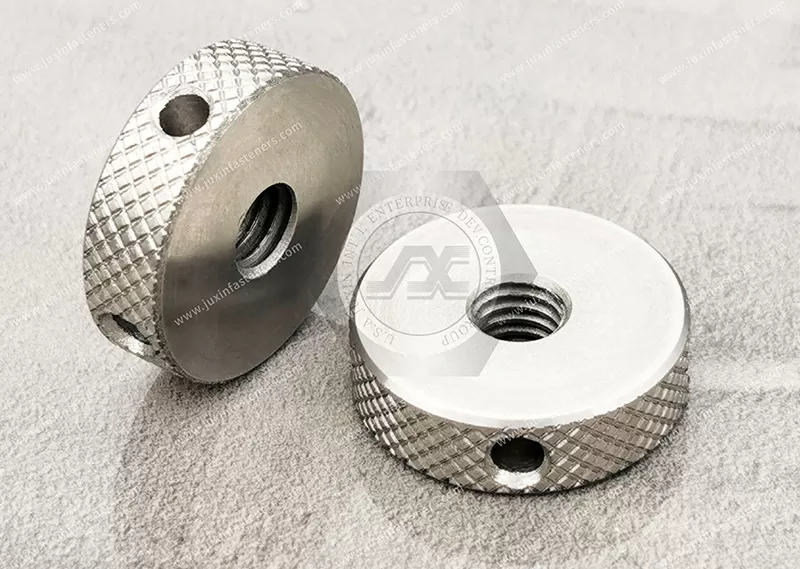
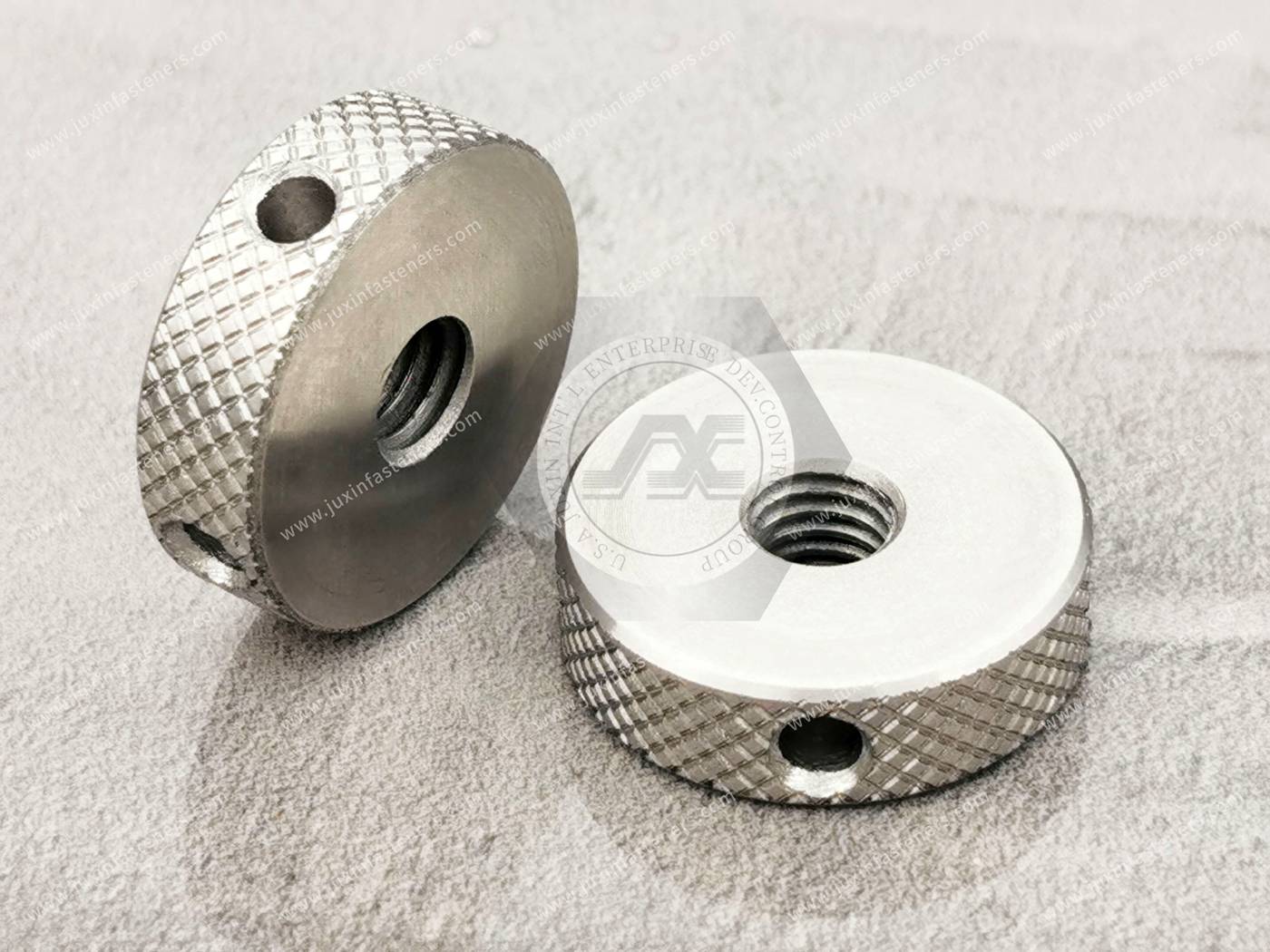
Featuring a flat cylindrical body, knurled outer circumference and radial pin holes, these internally threaded nuts support hand adjustment followed by additional tightening using a compatible pin, rod or tool.
The low-profile geometry is suitable for applications where axial installation clearance is limited.
In the American industrial market, this product type is known as a High-Torque Low-Profile Knurled-Head Thumb Nut.
Unlike DIN 466 high-type thumb nuts, it uses a thin disc-shaped body with radial tool-access holes. The knurled surface improves manual grip but does not provide inherent prevailing-torque locking.
Metric M4, M5, M6, M8, M10 and M12, together with Unified inch-thread references such as #10-32 UNF, 1/4-20 UNC, 5/16-18 UNC, 3/8-16 UNC, 1/2-13 UNC and 5/8-11 UNC, are relevant to this product category.
Individual Juxin Fasteners configurations and availability require drawing confirmation.
Material options for engineering review include stainless steel, carbon steel, brass and aluminum.
Juxin Fasteners supports CNC machining, knurling, radial-hole machining, internal threading and made-to-drawing OEM/ODM manufacturing for industrial batch production.
Product Specification
High-Torque Low-Profile Knurled Thumb Nuts with Pin Holes
Stainless Steel and Custom Machined Adjusting Nuts for Industrial Machinery, Precision Instruments and OEM Equipment
Juxin Fasteners is an industrial fastener manufacturer specializing in standard and custom-engineered metal fastening components for global OEM manufacturers,
mechanical engineers, production managers, procurement teams and supply chain professionals.
Our high-torque low-profile knurled thumb nuts combine a compact cylindrical body, textured outer gripping surface and radial pin holes for additional tightening leverage.
These adjusting nuts can be rotated manually for initial positioning. A compatible rod, pin or tool can then be inserted into a radial hole to apply additional turning force when required by the assembly design.
The compact, low-profile geometry is especially relevant to machinery, industrial fixtures, adjustment mechanisms and mechanical assemblies where axial installation clearance is limited.
In the American market, these components are commonly identified as High-Torque Low-Profile Knurled-Head Thumb Nuts.
Related engineering terminology includes:
Low-Profile Knurled Thumb Nuts
Knurled Adjusting Nuts
Radial-Hole Thumb Nuts
Pin-Wrench Adjusting Nuts
Cross-Hole Knurled Nuts
Custom Round Adjusting Nuts
Juxin Fasteners supports CNC machining, precision knurling, internal threading, radial-hole machining and OEM/ODM custom fastener manufacturing according to approved 2D and 3D engineering drawings.
Product Technical Specifications
| Parameter | Specification |
|---|---|
| Product Type | High-Torque Low-Profile Knurled Thumb Nut |
| American Market Name | High-Torque Low-Profile Knurled-Head Thumb Nut |
| Alternative Name | Radial-Hole Knurled Adjusting Nut |
| Historical Product Reference | JB/T 8004.4-1999 |
| Body Geometry | Low-Profile Cylindrical Disc |
| Gripping Surface | Knurled Outer Circumference |
| Tool Engagement | Radial Pin Holes |
| Thread Type | Internal Metric or Unified Inch Thread |
| Metric References | M4, M5, M6, M8, M10, M12 |
| Inch References | #10-32, 1/4-20, 5/16-18, 3/8-16, 1/2-13, 5/8-11 |
| Material Options for Review | Stainless Steel, Carbon Steel, Brass, Aluminum |
| Surface Finish | According to Material and Customer Specification |
| Manufacturing | CNC Turning, Knurling, Drilling and Internal Threading |
| Primary Function | Manual Adjustment and Tool-Assisted Tightening |
| Applications | Machinery, Fixtures, Instruments, Equipment Adjustments |
| Custom Manufacturing | OEM/ODM and Made-to-Drawing Production |
The product dimensions, material grades, number of radial holes, thread tolerances and mechanical requirements must be confirmed against the approved engineering drawing.
What Is a High-Torque Low-Profile Knurled Thumb Nut?
A high-torque low-profile knurled thumb nut is an internally threaded circular fastener designed for manual rotation and optional tool-assisted tightening.
The exterior features a knurled surface that improves finger grip.
The body incorporates radial holes that permit a suitable tool or pin to apply additional rotational force.
Compared with a conventional knurled thumb nut, the radial holes provide an additional means of applying torque.
The actual permissible torque depends on the nut material, body dimensions, radial-hole geometry, thread engagement and mating assembly.
The term high-torque describes the tool-assisted operating feature; it does not establish a specific torque rating.
Key Design Features
1. Low-Profile Disc Geometry
The thin circular body reduces the space required along the threaded axis.
This is useful where tall hand-operated nuts or conventional tool-driven nuts may interfere with adjacent components.
2. Knurled Outer Surface
The knurled circumference provides a textured gripping surface for manual tightening and adjustment.
3. Radial Pin Holes
Radial holes allow insertion of a compatible tool to increase the available turning moment.
4. Internal Machine Thread
The central threaded hole engages a matching bolt, threaded shaft or stud.
5. Reusable Adjustment Capability
The nut can be removed and reinstalled where the assembly design permits repeated operation.
Thread wear and retention requirements must be evaluated for the intended service life.
Why Radial Pin Holes Matter
The radial holes are the defining feature that distinguishes this product from conventional low-profile thumb nuts.
They allow the operator to apply force at a greater effective lever arm using a compatible tool.
This can be useful where finger tightening alone does not achieve the required adjustment or seating condition.
Important design parameters include:
Number of radial holes.
Hole diameter.
Hole depth.
Hole location.
Distance from the hole to the nut faces.
Minimum remaining wall thickness.
Tool engagement.
Material strength.
Allowable tightening torque.
The use of a longer tool can increase applied torque and the risk of damage.
A maximum tightening torque should therefore be established by engineering validation where required.
High-Torque Low-Profile Nuts vs. DIN 466 Thumb Nuts
These products have different geometries and search applications.
| Feature | High-Torque Low-Profile Nut | DIN 466 High-Type Thumb Nut |
|---|---|---|
| Main Body | Flat Circular Disc | Raised Collar and Head |
| Overall Profile | Low | Higher |
| External Grip | Knurled Circumference | Knurled Head |
| Additional Tool Access | Radial Pin Holes | Not a Defining Feature |
| Main Use | Adjustment and Tool-Assisted Tightening | Manual Hand Tightening |
| Standard Reference | JB/T 8004.4-1999 / Customer Drawing | DIN 466 |
| SEO Product Family | Low-Profile Adjusting Nuts | High-Type Thumb Nuts |
These two designs should not be represented as interchangeable without dimensional and functional verification.
Low-Profile Knurled Nuts vs. Precision Bearing Locknuts
Although both products may have a circular body, their engineering functions differ.
Precision bearing locknuts may incorporate:
Defined bearing seating surfaces.
Dedicated locking elements.
Tight face runout requirements.
Specialized installation tools.
Precision axial positioning requirements.
A low-profile knurled adjusting nut does not automatically provide these functions.
Where precision bearing preload or critical shaft retention is required, the assembly designer must select an appropriate validated locking system.
Metric Thread References
The following metric thread designations are relevant to this product category.
| Metric Thread | Coarse Pitch | Nominal Diameter in Inches |
|---|---|---|
| M4 × 0.7 | 0.70 mm | 0.1575 in |
| M5 × 0.8 | 0.80 mm | 0.1969 in |
| M6 × 1.0 | 1.00 mm | 0.2362 in |
| M8 × 1.25 | 1.25 mm | 0.3150 in |
| M10 × 1.5 | 1.50 mm | 0.3937 in |
| M12 × 1.75 | 1.75 mm | 0.4724 in |
These are nominal metric coarse-thread references.
Actual Juxin Fasteners production sizes, thread pitches and tolerances must follow the approved product specification.
American Inch-Series Thread References
American equipment manufacturers frequently specify Unified inch threads for adjusting nuts.
| Thread Designation | Series | Threads Per Inch | Nominal Diameter |
|---|---|---|---|
| #10-32 | UNF | 32 | 0.1900 in |
| 1/4-20 | UNC | 20 | 0.2500 in |
| 5/16-18 | UNC | 18 | 0.3125 in |
| 3/8-16 | UNC | 16 | 0.3750 in |
| 1/2-13 | UNC | 13 | 0.5000 in |
| 5/8-11 | UNC | 11 | 0.6250 in |
These inch-series thread sizes are documented in the American industrial market for related low-profile knurled nut designs.
Individual Juxin Fasteners configurations are subject to engineering and manufacturing verification.
Important: 5/8-11 UNC Thread Identification
The correct American thread designation is 5/8-11 UNC.
The designation 5/18-11 is not a standard Unified thread designation and should not be used in engineering specifications.
Metric and Inch Threads Are Not Interchangeable
Metric, UNC, UNF, BSW and BSF are separate thread systems.
Examples include:
M6 × 1.0 is not interchangeable with 1/4-20 UNC.
M8 × 1.25 is not interchangeable with 5/16-18 UNC.
M10 × 1.5 is not interchangeable with 3/8-16 UNC.
M12 × 1.75 is not interchangeable with 1/2-13 UNC.
Nominal diameter conversions are for reference only.
Stainless Steel Low-Profile Knurled Thumb Nuts
Stainless steel is relevant to industrial equipment requiring corrosion resistance, repeated handling and durable mechanical components.
Potential stainless steel grades for engineering evaluation include:
304 / 18-8 Stainless Steel
304-type stainless steel provides general corrosion resistance in many industrial environments.
Its suitability depends on operating temperature, cleaning exposure, thread loading and the mating materials.
316 Stainless Steel
316 stainless steel may provide improved resistance to localized corrosion in many chloride-containing environments compared with 304.
However, it is not immune to corrosion, and performance depends on the actual environment.
303 Stainless Steel
303 stainless steel may be considered for certain CNC-machined components where machinability is important.
Its corrosion characteristics differ from those of 304 and 316.
The exact stainless steel grade must be specified on the drawing.
Carbon Steel Knurled Adjusting Nuts
Carbon steel may be appropriate for industrial machinery and fixtures where corrosion conditions are controlled.
Potential finishes include:
Black oxide.
Zinc plating.
Other customer-specified protective treatments.
Black oxide provides limited corrosion protection and is generally more suitable for controlled environments unless additional protection is specified.
Brass Knurled Adjusting Nuts
Brass may be suitable for selected instrumentation and mechanical adjustment components.
Potential advantages include:
Good machinability for appropriate alloys.
Electrical conductivity.
Corrosion resistance in selected environments.
Attractive metallic appearance.
Mechanical strength and wear resistance must be evaluated against the intended loading.
Aluminum Knurled Adjusting Nuts
Aluminum may be considered for lightweight mechanical assemblies.
Potential benefits include reduced weight and good machinability for suitable alloys.
However, aluminum has different thread-strength and wear characteristics from steel.
The material must be selected according to the actual engineering requirements.
Plastic Knurled Adjusting Nuts
Plastic thumb nuts are a separate material configuration.
Some designs may incorporate metal threaded inserts.
Such products have different manufacturing methods, torque limits, thread performance and temperature characteristics.
Plastic versions should be treated as customer-specific engineering projects rather than assumed to meet the same performance requirements as metal adjusting nuts.
Material Selection Comparison
| Material | Main Advantage | Engineering Consideration |
|---|---|---|
| Carbon Steel | General Mechanical Strength and Cost | Corrosion Protection |
| 304 Stainless Steel | General Corrosion Resistance | Galling and Environment |
| 316 Stainless Steel | Improved Chloride Resistance | Material Cost and Exposure |
| 303 Stainless Steel | Machinability | Grade-Specific Corrosion Resistance |
| Brass | Machinability and Conductivity | Mechanical Strength |
| Aluminum | Low Weight | Thread Wear and Strength |
| Engineering Plastic | Low Weight and Potential Insulation | Different Torque and Temperature Limits |
Application 1: Machine Tool Fixtures
Machine tool fixtures may require compact adjustment components for positioning, retaining or setting mechanical accessories.
Low-profile knurled adjusting nuts may be useful in suitable:
Inspection fixtures.
Machine setup accessories.
Adjustable stops.
Positioning brackets.
Non-critical machine accessories.
The radial holes provide an additional tool-assisted tightening option.
These nuts should not be substituted for dedicated high-load clamping nuts without engineering approval.
Application 2: Packaging Machinery
Packaging equipment often includes adjustable mechanical assemblies.
Potential uses include:
Adjustable guide mechanisms.
Positioning fixtures.
Equipment accessory mounts.
Serviceable mechanical components.
Setup adjustment devices.
The design must consider vibration, operating frequency and maintenance requirements.
Application 3: Textile Machinery
Textile equipment may incorporate compact adjustment and positioning mechanisms.
Knurled adjusting nuts may be evaluated for:
Guide positioning assemblies.
Adjustment fixtures.
Machine accessory mounts.
Maintenance-access components.
Mechanical setup devices.
The final selection depends on the machine design and functional loading.
Application 4: Precision Instruments
Precision instruments frequently require compact threaded adjustment components.
Potential applications include:
Instrument mounting accessories.
Calibration fixtures.
Adjustable brackets.
Measurement equipment.
Positioning mechanisms.
The nut may provide manual adjustment, but it does not independently establish positioning accuracy or vibration resistance.
Application 5: Industrial Automation Equipment
Industrial automation systems may require accessible adjustment hardware in confined spaces.
Applications may include:
Sensor positioning accessories.
Adjustable mounting brackets.
Inspection equipment.
Equipment setup fixtures.
Mechanical alignment accessories.
A low-profile design can reduce interference with surrounding components.
Application 6: Electrical and Electronic Equipment
Electrical and electronic equipment may use compact metal adjustment components.
Potential applications include:
Equipment mounting fixtures.
Instrument panels.
Mechanical adjustment assemblies.
Removable equipment accessories.
Non-critical retaining mechanisms.
Metal thumb nuts are electrically conductive and should not be described as electrical insulators.
Application 7: Marine Transmission and Mechanical Equipment
Certain marine mechanical systems may require custom adjustment components.
Stainless steel versions can be evaluated for suitable corrosion-exposed environments.
The selection must consider:
Chloride exposure.
Mechanical loading.
Vibration.
Thread galling.
Galvanic compatibility.
Maintenance accessibility.
No marine classification approval or safety-critical application suitability is implied without supporting validation.
Application 8: Laboratory and Test Equipment
Laboratory and test equipment may use compact adjustment nuts in:
Measurement fixtures.
Instrument mounting brackets.
Test stands.
Calibration accessories.
Mechanical positioning devices.
Stainless steel or brass may be considered depending on the operating environment.
Application 9: Food Processing Equipment
Food processing machinery may incorporate manually adjustable mechanical fixtures and service components.
Stainless steel low-profile knurled nuts can be evaluated for suitable non-product-contact applications.
Knurled surfaces and radial holes may create cleaning challenges in hygienic zones.
Therefore, these nuts should not automatically be recommended for direct food-contact or sanitary washdown locations.
Any sanitation requirements must be assessed at the complete equipment level.
Application 10: OEM Custom Adjustment Assemblies
Custom equipment manufacturers may require special adjusting nuts with non-standard geometry.
Juxin Fasteners can evaluate:
Custom outside diameters.
Reduced body thickness.
Special internal threads.
Modified radial-hole quantity.
Custom radial-hole diameters.
Alternative knurl profiles.
Stainless steel material requirements.
Special surface finishes.
Customer-specific inspection criteria.
All custom designs require engineering and manufacturing feasibility review.
Engineering Selection Guide
| Requirement | Recommended Evaluation |
|---|---|
| Limited Axial Clearance | Low-Profile Knurled Nut |
| Manual Adjustment | Knurled Outer Diameter |
| Additional Tightening Leverage | Radial Pin Holes |
| Tool-Free Operation Only | Conventional Thumb Nut |
| Corrosion Resistance | Appropriate Stainless Steel Grade |
| High Precision Bearing Retention | Dedicated Precision Locknut |
| Vibration Resistance | Validated Locking Mechanism |
| Lightweight Equipment | Aluminum Custom Design |
| American Equipment Thread | UNC or UNF Configuration |
| Special Mechanical Geometry | Made-to-Drawing Manufacturing |
Using a Radial Pin or Tool
A compatible pin, rod or tool can be inserted into the radial hole to apply additional turning force.
The tool must fit the hole correctly.
Excessive force may damage:
The radial hole.
The knurled nut body.
The internal threads.
The mating threaded component.
The surrounding equipment.
The maximum permissible tightening torque must be established by engineering validation where necessary.
Can These Nuts Be Used as Jam Nuts?
Some low-profile knurled nuts can be used against another nut to create a jam-nut arrangement.
However, the effectiveness of such an arrangement depends on:
Nut thickness.
Thread engagement.
Mating nut geometry.
Material properties.
Installation sequence.
Applied torque.
Service loading.
Jam-nut performance must be validated for the actual assembly.
The knurled surface itself does not create a locking mechanism.
Are High-Torque Knurled Thumb Nuts Self-Locking?
No inherent prevailing-torque locking mechanism is established by the knurled surface or radial pin holes.
These nuts must not be confused with:
Nylon-insert locknuts.
All-metal prevailing-torque nuts.
Distorted-thread locknuts.
Precision bearing locknuts.
Positive-locking shaft nuts.
For applications involving severe vibration or safety-critical retention, a suitable validated locking system is required.
Manufacturing Process
Depending on the approved drawing and material, a custom low-profile knurled adjusting nut may be manufactured through:
Material selection and preparation.
CNC turning of the circular body.
Machining the required faces.
Producing the internal thread.
Knurling the outer circumference.
Drilling radial pin holes.
Deburring and edge finishing.
Applying the specified surface treatment.
Dimensional and functional inspection.
Packaging for industrial assembly.
The exact manufacturing sequence may differ according to product design.
Juxin Fasteners has manufacturing capabilities including cold heading, cold forming, CNC machining and product-specific secondary operations.
Not every product requires all processes.
Radial Hole Design and Manufacturing
The radial holes require careful engineering because they remove material from the nut body.
Relevant design considerations include:
Hole diameter.
Number of holes.
Angular spacing.
Hole depth.
Remaining wall thickness.
Burr control.
Tool fit.
Material strength.
Applied torque.
A larger radial hole is not automatically better.
The design must balance tool access with adequate body strength.
Knurling Quality
The outer knurled surface should provide consistent grip without unacceptable sharp edges or defects.
Inspection may include:
Knurl pattern.
Knurl depth.
Outer diameter.
Surface damage.
Burr condition.
Visual consistency.
The required knurl type should be identified on the approved engineering drawing.
Internal Thread Quality
Thread quality is important for repeatable assembly.
Inspection requirements may include:
Thread diameter.
Thread pitch.
Thread tolerance.
GO/NO-GO gauge acceptance.
Thread engagement length.
Burr inspection.
Functional mating checks.
Metric and Unified inch threads require the appropriate inspection standards and gauges.
Common Engineering Problems and Solutions
| Problem | Possible Cause | Recommended Review |
|---|---|---|
| Poor Manual Grip | Inadequate Knurl Geometry | Review Knurl Design |
| Damaged Radial Hole | Excessive Tool Force | Validate Tool and Torque |
| Thread Stripping | Excessive Tightening | Review Material and Engagement |
| Nut Loosening | No Inherent Locking Mechanism | Add Validated Retention |
| Thread Galling | Stainless Steel Friction | Review Material and Lubrication |
| Corrosion | Unsuitable Material or Finish | Evaluate Service Environment |
| Incorrect Assembly Fit | Wrong Body Diameter or Thickness | Verify Drawing |
| Difficult Tool Access | Hole Position or Equipment Interference | Review Assembly Clearance |
| Inconsistent Adjustment | Uncontrolled Tightening | Establish Assembly Procedure |
Quality Control and Inspection
A customer-specific inspection plan may include:
Material verification.
Outside diameter measurement.
Body thickness measurement.
Flatness inspection.
Knurl profile inspection.
Radial-hole diameter inspection.
Radial-hole location inspection.
Internal thread gauge inspection.
Burr and edge inspection.
Surface finish inspection.
Functional tool-engagement verification.
Packaging and quantity inspection.
Additional mechanical or corrosion tests may be specified by the customer.
No universal torque capacity or load rating is implied without testing.
OEM/ODM Custom Manufacturing
Juxin Fasteners supports made-to-drawing industrial fastener production.
Potential customization includes:
Metric coarse threads.
Metric fine threads.
Unified UNC threads.
Unified UNF threads.
Special outside diameters.
Custom body thickness.
Alternative knurl patterns.
Radial pin-hole configurations.
Customer-specific materials.
Surface finishing requirements.
Special dimensional tolerances.
Inspection and traceability requirements.
OEM packaging and identification.
All custom specifications are subject to engineering feasibility and production review.
Production Manager Considerations
Production managers evaluating these adjusting nuts should consider:
Operator access.
Installation-tool compatibility.
Assembly repeatability.
Manual tightening consistency.
Adjustment frequency.
Thread durability.
Inspection requirements.
Equipment maintenance time.
Production batch consistency.
Total assembly cost.
A well-designed adjusting nut can simplify equipment setup and maintenance, but its performance must be validated in the complete assembly.
Procurement and Supply Chain Considerations
OEM purchasing teams should evaluate:
Approved material grade.
Dimensional accuracy.
Thread quality.
Radial-hole consistency.
Knurling quality.
Manufacturing repeatability.
Drawing revision control.
Surface finish.
Inspection documentation.
Initial order quantity.
Annual purchasing forecast.
Packaging requirements.
Delivery planning.
Total procurement cost.
Clear engineering specifications support reliable manufacturing quotations and long-term supply planning.
Engineering Standards and References
JB/T 8004.4-1999
Historical Chinese machinery-industry reference for adjusting nuts. The applicable geometry and current standard status should be verified against the original engineering documentation.
ISO 261 / ISO 724
ISO metric screw-thread designations and basic dimensions.
ISO 965 Series
ISO metric screw-thread tolerances.
ASME B1.1
Unified inch-series screw-thread requirements.
Customer Engineering Drawings
The controlling specification for nut geometry, radial holes, threads, materials, finishes and dimensional tolerances.
Listing these standards does not independently establish product conformity.
Frequently Asked Questions
What are JB/T 8004.4 adjusting nuts called in the United States?
A closely matching American commercial product description is High-Torque Low-Profile Knurled-Head Thumb Nuts.
What is the purpose of the radial pin holes?
They allow a compatible pin or tool to apply additional tightening or adjustment torque.
What is the difference between this product and DIN 466?
This product has a low-profile disc body and radial tool-access holes, while DIN 466 features a raised collar and knurled head.
Are these nuts self-locking?
No inherent self-locking mechanism is provided by the knurling or radial holes.
Can these nuts be used as jam nuts?
They may be suitable for certain jam-nut arrangements, subject to engineering validation.
What metric sizes are relevant?
M4, M5, M6, M8, M10 and M12 are relevant reference sizes.
What American inch-thread sizes are relevant?
#10-32 UNF, 1/4-20 UNC, 5/16-18 UNC, 3/8-16 UNC, 1/2-13 UNC and 5/8-11 UNC.
Is 5/18-11 a standard thread?
No. The correct common Unified thread designation is 5/8-11 UNC.
Can Juxin Fasteners manufacture stainless steel versions?
Stainless steel designs can be evaluated according to customer drawings, material grades and manufacturing requirements.
Can brass and aluminum versions be manufactured?
Customer-specific brass and aluminum designs can be reviewed for feasibility.
Are these nuts suitable for precision bearing preload?
They should not be treated as precision bearing locknuts without specific engineering validation.
Can Juxin Fasteners manufacture custom radial-hole patterns?
Yes. Custom radial-hole configurations can be evaluated from approved drawings.
Are metric and inch threads interchangeable?
No. ISO metric, UNC, UNF, BSW and BSF threads are separate systems.
Request a Quote — High-Torque Low-Profile Knurled Thumb Nuts
Juxin Fasteners manufactures industrial fasteners and custom precision metal components for global OEM manufacturers,
machinery builders, mechanical engineers, production managers and procurement teams.
We support custom knurled adjusting nuts, low-profile threaded components and made-to-drawing mechanical fasteners for machinery, fixtures, instrumentation and industrial equipment.
Recommended RFQ Information
2D engineering drawing or 3D CAD model.
Required metric or Unified inch thread.
Thread tolerance.
Nut outside diameter.
Overall body thickness.
Knurl type and dimensions.
Number of radial holes.
Radial-hole diameter and location.
Material grade.
Surface finish.
Installation-tool requirements.
Required tightening torque, if applicable.
Initial order quantity.
Annual purchasing forecast.
Inspection requirements.
Packaging and delivery requirements.
Please send your drawings and purchasing specifications for technical review and manufacturing quotation.
Juxin Fasteners
Industrial Fastener Manufacturer | High-Torque Knurled Thumb Nuts | CNC Machined Adjusting Nuts | OEM/ODM Precision Metal Components
Website: https://www.juxinfasteners.com/
Email: info@juxinfasteners.com
Product Packaging
Packaging Standard
At Juxin Fasteners, we apply standardized export packaging to ensure product protection, traceability, and compliance with international logistics requirements.
1. Standard Export Packaging
Unless otherwise specified, all products will be packed according to our factory standard export packaging, which includes:
Moisture-resistant inner protection
Poly bag or small box packing as required
Reinforced export cartons
Clear labeling with part number, specification, batch number, and quantity
Palletizing for sea or air shipment when necessary
Our standard packaging is designed to ensure safe transportation, efficient warehousing, and long-distance international shipping.
2. Customized Packaging Options
We also provide customized packaging solutions according to customer requirements, including but not limited to:
Private labeling
Customized barcodes
Specific carton dimensions
Retail packaging
Special pallet configuration
Customer-specific marking and identification
So that you know, customized packaging may involve additional costs and extended lead time depending on the complexity of the requirements.
3. Compliance & Quality Assurance
All packaging processes are controlled under our ISO 9001 quality management system to ensure consistency, traceability, and product integrity throughout the supply chain.
Product Pictures

Contact Us
Tel.:
+86 020 8621 0320
+86 020 3121 6067
E-mail:
Technical Support:
Navigation
SEND INQUIREY