Call Us
+86 136 6007 9809
Call Us
+86 136 6007 9809

Juxin Fasteners manufactures custom M6 flanged binding barrel nuts for furniture assembly, panel-to-panel fastening and engineered industrial connections.
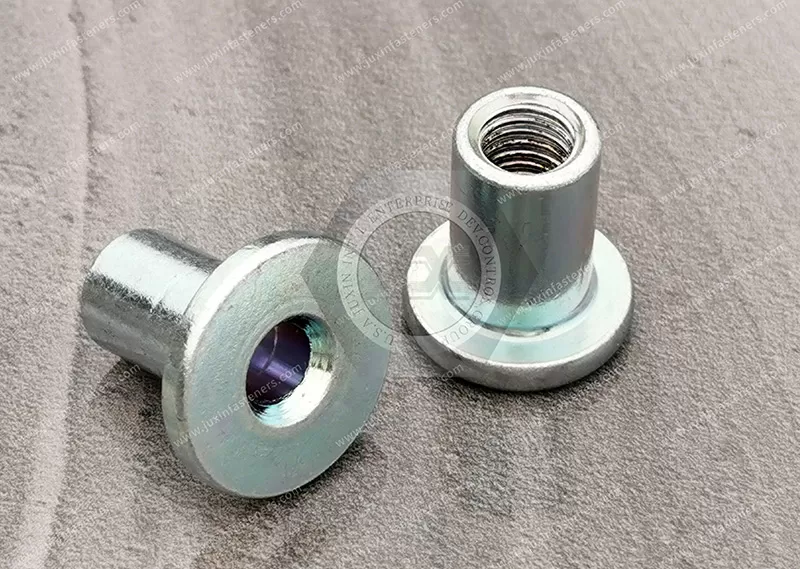
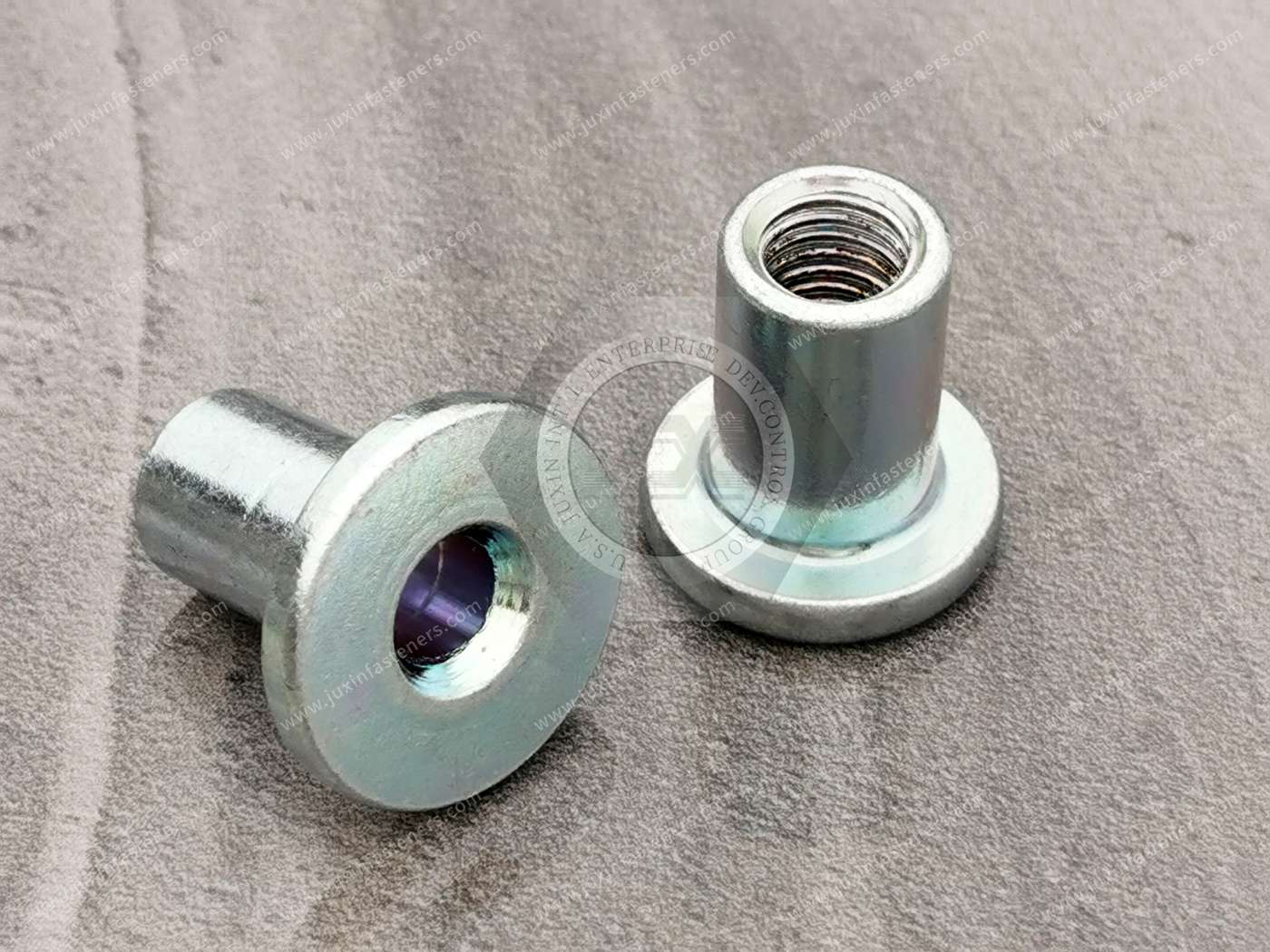
These female threaded fasteners feature a cylindrical barrel and an integral flange head.
The barrel fits into a compatible clearance hole and receives a mating screw or bolt, providing a compact, removable connection between panels or other components.
Carbon steel, stainless steel, brass and copper material options can be evaluated according to customer specifications.
Zinc-plated carbon steel is suitable for selected indoor applications, subject to coating requirements.
Metric M6 threads are the primary product focus, with custom Unified inch-thread configurations available for engineering review.
Juxin Fasteners supports cold heading, cold forming, CNC machining and product-specific secondary operations according to geometry, tolerance and production requirements.
OEM/ODM manufacturing is available from customer 2D drawings and 3D CAD models for industrial batch production.
Product Specification
M6 Flanged Binding Barrel Nuts for Panel and Furniture Assembly
Custom Female Threaded Barrels for Furniture Connectors, Through-Panel Fastening and OEM Industrial Assemblies
Juxin Fasteners manufactures custom M6 flanged binding barrel nuts for furniture manufacturing, panel assembly and engineered fastening applications.
These internally threaded components feature a cylindrical barrel with an integral flange head.
The barrel is positioned through a compatible clearance hole, while a mating screw or bolt engages the internal thread to connect the assembled components.
Unlike conventional hex nuts, flanged binding barrels can provide a compact connection with the threaded engagement located inside the assembled material.
Juxin Fasteners supports OEM/ODM manufacturing, made-to-drawing fasteners and industrial batch production using manufacturing processes selected according to material,
geometry, dimensional tolerance and production requirements.
Product Specifications
| Parameter | Specification |
|---|---|
| Product Name | M6 Flanged Binding Barrel Nuts |
| Alternative Names | Female Binding Barrels; Flanged Barrel Nuts; Furniture Connector Barrel Nuts |
| Primary Thread | M6 |
| Product Configuration | Cylindrical Barrel with Integral Flange |
| Thread Orientation | Axial Internal Thread |
| Materials | Carbon Steel, Stainless Steel, Brass, Copper |
| Surface Finish | Drawing-Specified; Zinc Plating for Suitable Steel Versions |
| Manufacturing | Cold Heading, Cold Forming, CNC Machining and Applicable Secondary Operations |
| Installation | Through-Hole Assembly with Mating Screw or Bolt |
| Customization | OEM/ODM Made-to-Drawing Manufacturing |
| Production | Custom Industrial Batch Manufacturing |
Material grades, dimensions, thread tolerances and manufacturing processes must be confirmed from the approved engineering drawing.
What Is a Flanged Binding Barrel Nut?
A flanged binding barrel nut is an internally threaded cylindrical fastener designed to work with a compatible screw or bolt.
The cylindrical section fits into a clearance hole, while the flange provides a bearing surface against the material.
When the mating fastener is tightened, the connected components are clamped together.
These fasteners are commonly used in applications where a conventional nut would be difficult to access, visually intrusive or unsuitable for the available assembly space.
How Flanged Binding Barrels Work
A typical connection includes:
A flanged female threaded barrel.
A compatible male threaded screw or bolt.
One or more components with aligned clearance holes.
Suitable bearing surfaces.
The barrel is inserted into the prepared hole, and the mating fastener is installed from the opposite side.
Tightening the screw creates the required clamping force, subject to the joint design and material limitations.
The barrel length, screw length and thread engagement must be selected together.
Integral Flange Head Design
The flange head serves as a bearing surface and helps locate the barrel axially within the assembly.
Important flange dimensions include:
Head outside diameter.
Head thickness.
Head profile.
Bearing surface geometry.
Edge chamfer.
Surface finish.
The flange may help distribute contact pressure, but the actual bearing performance depends on the head dimensions and the connected material.
Cylindrical Barrel Geometry
The barrel section provides the internal threaded connection.
Important engineering parameters include:
Barrel outside diameter.
Barrel length measured from beneath the head.
Internal thread diameter.
Thread depth.
Barrel wall thickness.
Concentricity.
Entry chamfer.
Internal clearance.
The outside diameter must be compatible with the installation hole and the required assembly fit.
M6 Metric Thread Configuration
The primary product reference is M6.
For standard metric coarse threading:
| Parameter | Reference |
|---|---|
| Thread Designation | M6×1.0 |
| Nominal Diameter | 6 mm |
| Thread Pitch | 1.0 mm |
| Thread System | ISO Metric |
The thread tolerance and minimum engagement length must be specified according to the application.
Other metric thread sizes can be evaluated for custom manufacturing.
American UNC and UNF Thread Options
For North American OEM projects, binding barrels may be specified with Unified inch threads.
Potential custom thread references include:
| Thread | Thread Series | Nominal Diameter |
|---|---|---|
| #8-32 | UNC | 0.1640 in |
| #10-24 | UNC | 0.1900 in |
| #10-32 | UNF | 0.1900 in |
| 1/4-20 | UNC | 0.2500 in |
| 1/4-28 | UNF | 0.2500 in |
| 5/16-18 | UNC | 0.3125 in |
These are engineering references for custom manufacturing review, not confirmed stock sizes.
The correct thread system must match the mating screw.
M6×1.0 and 1/4-20 UNC are not interchangeable.
Selecting the Correct Barrel Length
Barrel length is one of the most important design parameters.
A barrel that is too short may provide insufficient thread engagement.
A barrel that is too long may interfere with the mating component, prevent proper clamping or bottom against the screw.
The design should consider:
Total material thickness.
Hole depth.
Flange thickness.
Available screw engagement.
Screw length.
Required clamp-up.
Installation clearance.
For blind internal threads, the screw must not bottom out before the joint reaches the required clamping condition.
Thread Engagement and Joint Reliability
The required thread engagement depends on:
Barrel material.
Screw material and strength.
Thread size.
Thread tolerance.
Applied tightening torque.
Required clamp load.
Repeated assembly requirements.
Insufficient engagement may cause thread stripping.
Excessive tightening torque may damage the barrel, screw or connected panel.
Thread engagement should be validated according to the actual joint design.
Flanged Binding Barrels vs. Conventional Hex Nuts
| Feature | Flanged Binding Barrel | Conventional Hex Nut |
|---|---|---|
| Body Shape | Cylindrical Barrel | Hexagonal |
| Bearing Surface | Integral Flange | Nut Face |
| Installation | Through a Prepared Hole | On an Exposed Thread |
| Thread Engagement | Inside Barrel | Inside Hex Nut |
| Typical Application | Panel and Furniture Assembly | General Bolted Joints |
| External Access | Depends on Barrel Design | Wrench Access Generally Required |
A binding barrel is not a universal substitute for a conventional nut.
Flanged Binding Barrels vs. Cross Dowel Nuts
Cross dowel nuts have a cylindrical body with an internal thread oriented across the body.
Flanged binding barrels have an internal thread aligned with the barrel axis.
Their hole geometry and installation methods are different.
The correct product must be selected according to the joint configuration.
Flanged Binding Barrels vs. T-Nuts
Conventional furniture T-nuts often use prongs or other retention features that engage the material.
T-slot nuts are designed for specialized framing channels.
Flanged binding barrels instead use a cylindrical sleeve and flange head in a compatible hole.
These fastener types are not directly interchangeable.
Flanged Binding Barrels vs. Clip-On Nuts
Clip-on nuts typically attach to the edge of a panel using a spring clip or similar retention structure.
Flanged binding barrels do not rely on a spring clip.
Their primary fastening action is produced by engagement with the mating screw or bolt.
Carbon Steel Binding Barrels
Carbon steel is a practical material option for many industrial and furniture fastening applications.
Material selection should consider:
Formability.
Thread strength.
Mechanical properties.
Surface protection.
Production quantity.
Total manufacturing cost.
The exact steel grade must follow the approved drawing.
Zinc-Plated Steel Binding Barrels
Zinc plating may be selected for carbon steel components requiring corrosion protection in suitable service environments.
Relevant coating requirements include:
Coating thickness.
Surface appearance.
Corrosion resistance.
Thread fit.
Coating adhesion.
Customer acceptance criteria.
A zinc coating should not be assigned a specific corrosion rating without the relevant test specification and verified results.
Stainless Steel Binding Barrels
Stainless steel may be selected for applications requiring increased corrosion resistance.
The appropriate stainless steel grade depends on the environment, manufacturing process and mechanical requirements.
Thread galling and assembly friction should be considered when using stainless steel screws and barrels together.
Brass Binding Barrels
Brass can be evaluated for applications requiring suitable corrosion resistance, machinability or appearance.
Brass may also be relevant where electrical conductivity is an intentional design requirement.
The material grade and required mechanical properties must be confirmed before production.
Copper Material Options
Copper is included among the specified custom material options.
Because copper has different mechanical properties from brass and steel, it requires separate engineering assessment.
Copper versions should not automatically be treated as mechanically interchangeable with steel binding barrels.
Furniture Manufacturing Applications
Flanged binding barrel nuts can be used in furniture connections requiring removable mechanical fasteners.
Potential applications include:
Panel furniture assemblies.
Tables and desks.
Cabinets.
Shelving systems.
Modular furniture.
Metal-and-wood furniture structures.
Custom furniture connecting hardware.
The fastener dimensions must be selected for the panel thickness, material and intended loading.
Panel-to-Panel Connections
Binding barrels are suitable for certain through-panel fastening configurations.
The cylindrical body fits into a prepared hole and provides a female threaded connection.
For wood or composite panels, designers should evaluate:
Hole diameter.
Panel thickness.
Edge distance.
Bearing pressure.
Local crushing.
Screw tightening torque.
Repeated assembly requirements.
Industrial Equipment Panels
Custom binding barrels may be used in suitable machinery and equipment panel connections.
Potential applications include:
Equipment covers.
Removable panels.
Machine accessories.
Custom mounting assemblies.
Industrial enclosures.
Vibration, joint loading and maintenance frequency must be considered during selection.
Electrical and Electronic Equipment
Compact binding barrel connections may be evaluated for selected enclosure and mounting applications.
Where electrical conductivity or grounding is required, the complete connection must be designed and verified for that function.
Electrical performance must not be assumed solely from the fastener material.
Architectural and Interior Hardware
Binding barrels are used in the broader hardware market for certain door, panel and architectural assemblies.
Custom configurations may be evaluated for suitable interior hardware applications.
The connection must meet the applicable mechanical and installation requirements.
Modular Displays and Equipment Fixtures
Removable threaded connections can be useful in modular displays, equipment fixtures and adjustable assemblies.
Binding barrels may provide a compact fastening interface where access and appearance are important.
Designing for Repeated Assembly
For products requiring repeated disassembly, engineers should evaluate:
Thread wear.
Screw and barrel material compatibility.
Tightening torque.
Thread engagement.
Hole wear.
Flange bearing pressure.
Installation tool access.
Repeated assembly capability must be verified for the actual materials and joint conditions.
Preventing Barrel Rotation During Assembly
Some binding barrels include a drive feature or retention geometry to prevent rotation during tightening.
The supplied photograph does not establish a specific drive feature.
If anti-rotation is required, it must be included in the approved product design.
Possible design approaches should be reviewed according to installation access, material and manufacturing feasibility.
Cold Heading and Cold Forming
Juxin Fasteners supports cold heading and cold forming for suitable fastening components.
These processes may be considered for producing cylindrical bodies and flange features where the geometry and material permit.
The manufacturing method depends on the approved design and production volume.
CNC Machining for Precision Features
CNC machining may be selected for custom barrel dimensions, internal features, flange geometry or tighter dimensional requirements.
Depending on the product, cold forming and CNC machining may be combined, or a different manufacturing route may be selected.
No single manufacturing process is assumed for every binding barrel design.
Internal Thread Manufacturing
Internal threads must be produced and inspected according to the approved drawing.
Important considerations include:
Thread designation.
Thread tolerance.
Thread depth.
Concentricity.
Burr control.
Thread entry.
Functional engagement.
OEM/ODM Made-to-Drawing Manufacturing
Juxin Fasteners manufactures custom-engineered fastening components based on customer specifications.
For binding barrel projects, customization may include:
Metric or Unified threads.
Barrel outside diameter.
Barrel length.
Flange diameter.
Flange thickness.
Head profile.
Internal thread depth.
Special drive features.
Material grade.
Surface finish.
Dimensional tolerances.
Packaging requirements.
All custom configurations are subject to engineering and manufacturing feasibility review.
Engineering Drawing Review
A complete drawing should identify the dimensions controlling installation and joint performance.
For binding barrels, these include:
Internal thread.
Barrel diameter.
Barrel length.
Flange dimensions.
Thread depth.
Material.
Surface finish.
General and critical tolerances.
The mating screw and assembled panel geometry should also be considered.
Manufacturing Consistency
For industrial batch production, consistency in barrel dimensions and internal threads is important.
Manufacturing and quality planning may address:
Material requirements.
Dimensional repeatability.
Thread inspection.
Surface finish.
Functional fit.
Batch acceptance criteria.
Packaging.
Assembly Efficiency
Production and manufacturing engineers should consider:
Hole preparation.
Barrel insertion method.
Screw feeding.
Tool access.
Installation torque.
Assembly orientation.
Component handling.
Inspection access.
A properly selected barrel and screw combination can simplify certain panel fastening operations, but the actual benefit depends on the assembly design.
Common Design and Assembly Risks
Insufficient Thread Engagement
A short barrel or incorrect screw length may reduce available thread engagement.
Screw Bottoming
A screw may reach the end of a blind threaded hole before the components are fully clamped.
Panel Crushing
Excessive tightening force may damage wood, composite or other relatively soft panel materials.
Barrel Rotation
A barrel without sufficient retention or tool engagement may rotate during screw installation.
Thread Damage
Incorrect thread systems, poor alignment or excessive tightening torque can damage the internal thread.
Corrosion
Unsuitable material or coating selection may cause corrosion in the intended environment.
These risks should be addressed during engineering review and assembly validation.
Purchasing and Supplier Development Considerations
When evaluating a custom binding barrel manufacturer, purchasing and supplier development teams should review:
Engineering drawing capability.
Material specification.
Manufacturing feasibility.
Tooling requirements.
Dimensional control.
Thread inspection.
Surface treatment.
Sample approval.
Batch production requirements.
MOQ and order volume.
Production scheduling.
Packaging.
Long-term supply planning.
MOQ, tooling cost and delivery lead time should be confirmed during quotation rather than assumed.
Relevant International Standards
Depending on the approved design, relevant engineering references may include:
ISO 261: ISO metric screw-thread general plan.
ISO 724: Basic dimensions of ISO metric screw threads.
ISO 965 Series: ISO metric screw-thread tolerances.
ASME B1.1: Unified inch screw threads.
ISO 4042: Electroplated coating systems for fasteners, where applicable.
ISO 9227: Salt spray corrosion testing, where specified.
These references do not establish that a custom binding barrel conforms to a particular standard without verification.
Frequently Asked Questions
What is an M6 flanged binding barrel nut?
It is an internally threaded cylindrical fastener with a flange head, designed to connect components using a compatible M6 screw or bolt.
Is a binding barrel the same as a T-nut?
No. Binding barrels and T-nuts have different geometries and installation requirements.
Can binding barrels be used in furniture?
Yes. They are commonly used in suitable furniture and panel fastening applications.
Can binding barrels connect metal panels?
Yes, provided the joint geometry, material and mechanical requirements are appropriate.
What is the purpose of the flange?
The flange provides an axial bearing surface and helps locate the barrel in the assembled component.
Are these nuts suitable for repeated assembly?
They may be used in removable connections, but repeated assembly performance depends on the thread, material and joint design.
Can Juxin Fasteners manufacture custom barrel lengths?
Yes. Custom lengths can be evaluated according to customer drawings.
Are UNC and UNF threads available?
Custom Unified inch-thread configurations can be evaluated for manufacturing feasibility.
Is M6 interchangeable with 1/4-20 UNC?
No. These are different thread systems with different nominal dimensions and pitches.
What materials are available?
Carbon steel, stainless steel, brass and copper are included among the specified material options, subject to engineering review.
Can the flange shape be customized?
Yes. Custom flange dimensions and profiles can be evaluated from engineering drawings.
Can Juxin Fasteners manufacture binding barrels for OEM projects?
Yes. Juxin Fasteners supports OEM/ODM manufacturing, drawing-based customization and industrial batch production.
Request a Quote — M6 Flanged Binding Barrel Nuts
Juxin Fasteners is an industrial fastener manufacturer specializing in standard and custom-engineered fastening components for global OEM, Tier-1 and Tier-2 manufacturing programs.
Our manufacturing capabilities include cold heading, cold forming, CNC machining and product-specific secondary operations. Manufacturing processes are selected according to product geometry, material, dimensional tolerances and production requirements.
We support custom fastener manufacturing, made-to-drawing production and industrial batch manufacturing for furniture hardware, panel fastening and engineered equipment assemblies.
Recommended RFQ Information
2D engineering drawing or 3D CAD model.
Internal thread size and tolerance.
Barrel outside diameter.
Barrel length.
Flange diameter.
Flange thickness.
Thread depth.
Mating screw specification.
Panel material and thickness.
Installation hole dimensions.
Material grade.
Surface treatment.
Mechanical or functional requirements.
Inspection requirements.
Initial order quantity.
Estimated annual demand.
Packaging requirements.
Required delivery schedule.
Please send your drawings and technical specifications for engineering feasibility review and quotation.
Juxin Fasteners
Industrial Fastener Manufacturer | M6 Binding Barrel Nuts | Custom Furniture Fasteners | Made-to-Drawing Fastener Manufacturing
Website: https://www.juxinfasteners.com/
Email: info@juxinfasteners.com
Product Packaging
Packaging Standard
At Juxin Fasteners, we apply standardized export packaging to ensure product protection, traceability, and compliance with international logistics requirements.
1. Standard Export Packaging
Unless otherwise specified, all products will be packed according to our factory standard export packaging, which includes:
Moisture-resistant inner protection
Poly bag or small box packing as required
Reinforced export cartons
Clear labeling with part number, specification, batch number, and quantity
Palletizing for sea or air shipment when necessary
Our standard packaging is designed to ensure safe transportation, efficient warehousing, and long-distance international shipping.
2. Customized Packaging Options
We also provide customized packaging solutions according to customer requirements, including but not limited to:
Private labeling
Customized barcodes
Specific carton dimensions
Retail packaging
Special pallet configuration
Customer-specific marking and identification
So that you know, customized packaging may involve additional costs and extended lead time depending on the complexity of the requirements.
3. Compliance & Quality Assurance
All packaging processes are controlled under our ISO 9001 quality management system to ensure consistency, traceability, and product integrity throughout the supply chain.
Product Pictures
Contact Us
Tel.:
+86 020 8621 0320
+86 020 3121 6067
E-mail:
Technical Support:
Navigation
SEND INQUIREY