
Call Us
+86 136 6007 9809
Call Us
+86 136 6007 9809

Sep. 03, 2026
In critical bolted joints across automotive powertrains, high-temperature turbines, pressure vessels, EV battery systems, and industrial heavy machinery,
design engineers and maintenance teams frequently encounter a puzzling failure mode:
A high-strength bolt is torqued to its exact design preload and exhibits zero rotational loosening, yet the joint gradually loses clamping force over time.
The bolt still looks tight.
There may be no visible thread movement.
However, the actual preload inside the joint can be substantially lower than the original installation value.
When clamping force decays, gasket seals can lose compression, flanges can leak, and structural joints can become more vulnerable to fatigue failure under cyclic shear loads—all while the bolt appears visibly tight.
This silent failure mode is driven by stress relaxation, material creep, viscoelastic deformation, and micro-plastic strain accumulation.
Understanding the micro-mechanics of stress relaxation—and specifying the correct fastener alloys, joint stiffness, grip length, and spring compensation—is essential for engineering reliable, low-maintenance bolted assemblies.
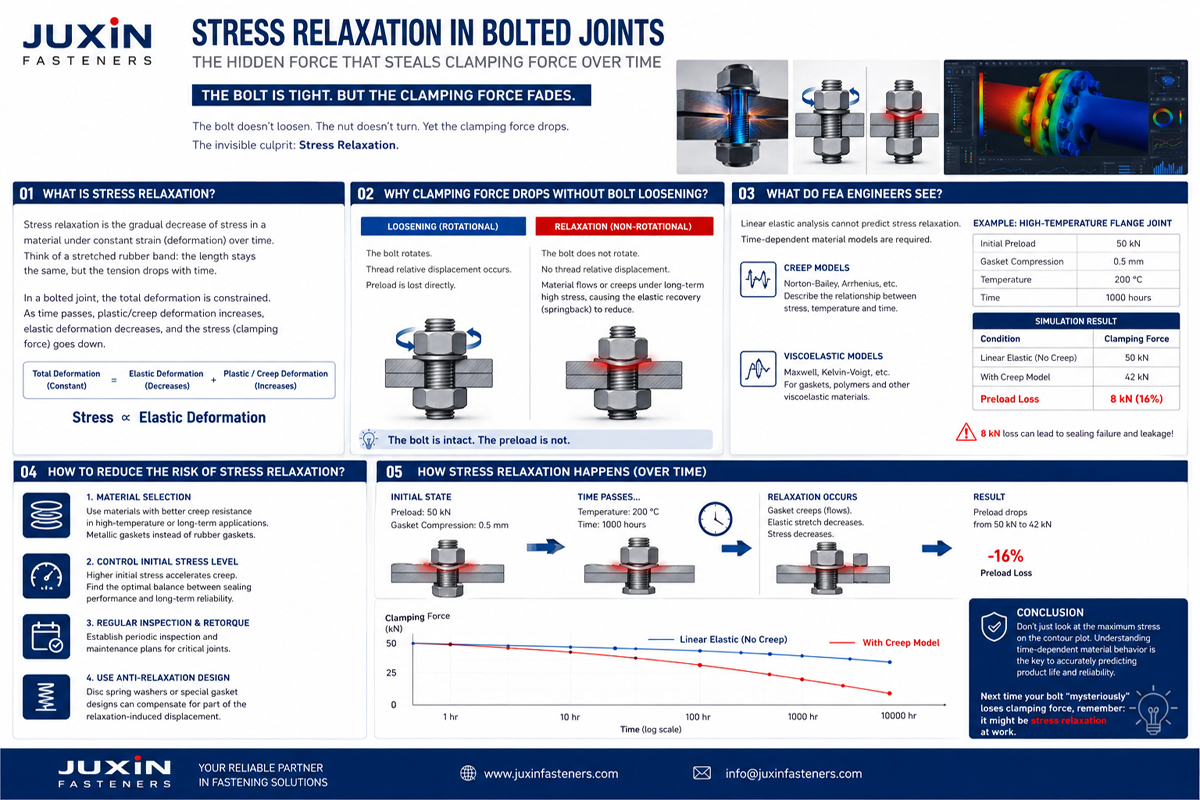
One of the most important engineering distinctions in bolted-joint design is understanding the difference between rotational thread loosening and stress relaxation.
These mechanisms can both produce bolt preload loss, but the physical failure mechanisms are fundamentally different.
Applied Torque / Vibration
↓
Thread Rotates Backward
↓
Direct Axial Displacement Loss
↓
Preload Drops Rapidly
Constant Total Strain ($\epsilon_{\text{total}} = \text{constant}$)
↓
No Thread Rotation Occurs
↓
Elastic Strain Converts to Creep / Plastic Strain
↓
Clamping Force Decays Gradually Over Time
Rotational Loosening:
Caused by transverse vibration, shock impact, or insufficient thread friction. The bolt physically rotates, resulting in immediate axial backing out and potentially rapid preload loss.
Stress Relaxation:
Occurs under a constant strain state ($\epsilon_{\text{total}} = \text{constant}$).
No thread rotation takes place. Instead, the initial elastic stretch of the bolt and joint substrate gradually transforms into permanent microscopic plastic or creep strain, lowering the internal stress state and reducing clamping force.
This distinction matters because adding a conventional anti-loosening solution does not necessarily solve a stress-relaxation problem.
A joint that never rotates can still lose preload.
When a bolt is tightened, it behaves like a stiff mechanical spring.
The applied torque stretches the bolt elastically ($\Delta L_b$), creating an internal tensile force known as the preload ($F_p$).
At the same time, the clamped joint members, flange, washers, and gaskets are compressed by the tightening process ($\Delta L_m$).
The fundamental mechanical strain balance of a tightened joint can be expressed as:
At initial installation ($t = 0$), all deformation is considered purely elastic:
As time progresses ($t > 0$), sustained mechanical stress—amplified by thermal exposure or dynamic mechanical loads—causes atoms within the crystal lattice of the metal fastener, flange, substrate, or gasket to move.
Micro-plastic deformation and creep strain ($\epsilon_{\text{creep}}$) accumulate:
Because tensile stress ($\sigma$) is directly proportional to elastic strain:
as elastic strain decreases, the internal clamping stress also decreases.
The time-dependent clamping force can therefore be represented as:
Where:
$E$ = Elastic modulus of the bolt material
$A_b$ = Stress area of the bolt shank/thread
$\epsilon_{\text{creep}}(t)$ = Time-dependent creep strain
The key point is that the bolt does not need to rotate backward for preload to decrease.
If the joint members, gasket, coating, thread interface, or other compressed material experiences permanent deformation, the original elastic deformation balance changes.
The bolt subsequently carries less tensile stress.
That means:
No visible loosening ≠ no preload loss.
This is why stress relaxation must be considered separately from conventional thread-locking and vibration-loosening design.
Different materials exhibit radically different creep and relaxation rates under thermal and mechanical strain.
| Material Class | Typical Fastener / Substrate Types | Creep / Relaxation Threshold Temperature | Primary Industrial Application | Relaxation Risk & Behavior |
|---|---|---|---|---|
| Elastomers & Polymers | Rubber Gaskets, PTFE Seals, Nylon Washers | > 20°C (Ambient) | Low-pressure fluid seals, electronic housings | Extreme: Rapid viscoelastic relaxation within hours; requires continuous spring compensation. |
| Light Alloys | Aluminum 6061/7075, Magnesium Engine Blocks | > 80°C – 100°C | EV battery enclosures, automotive engine casings | High: Differential thermal expansion ($CTE$) accelerates creep at interface threads. |
| Carbon & Alloy Steels | Class 8.8, 10.9, 12.9 Fasteners, Mild Steel Flanges | > 150°C – 200°C | Automotive powertrains, industrial gearbox flanges | Moderate: Stable at room temperature; requires creep-resistant alloys above 200°C. |
| Stainless Steels | A2-70 (304), A4-80 (316) Stainless Steel Bolts | > 300°C | Chemical processing, exhaust manifolds, outdoor marine | Low to Moderate: Excellent room-temperature stability; work-hardening affects high-temperature creep. |
| High-Temp Superalloys | A286, Inconel 718, Alloy B7 / L7 | > 500°C – 650°C | Gas turbines, turbochargers, power generation valves | Very Low: Engineered crystal structures resist dislocation creep under extreme loads. |
Engineering note: Actual creep and stress-relaxation behavior depends on material grade, heat treatment, stress level, temperature, joint geometry, surface condition, exposure time, and substrate/gasket material. The thresholds above are therefore engineering comparison points rather than universal material limits.
Standard linear-elastic FEA simulations:
cannot predict stress relaxation because they do not include time-dependent deformation.
Accurately modeling clamp-force decay over 1,000+ operating hours requires time-dependent constitutive creep laws.
For high-temperature bolted joints, engineers need to account for:
Temperature-dependent material behavior
Time-dependent creep strain
Stress-dependent deformation
Joint-member stiffness
Gasket compression and recovery
Bolt elastic deformation
Thermal expansion
Interface contact conditions
In finite element solver environments such as ANSYS, ABAQUS, and Nastran, secondary-stage thermal creep rate ($\dot{\epsilon}_{\text{creep}}$) can be represented using the Norton-Bailey Power Law:
Where:
$\sigma$ = Equivalent von Mises stress
$t$ = Total operational exposure time
$T$ = Absolute temperature in Kelvin
$Q$ = Activation energy for material creep
$C_1, C_2, C_3$ = Material-specific calibration constants derived from laboratory stress-rupture tests
The advantage of incorporating a time-dependent creep constitutive model is that the FEA simulation can predict how a joint's internal elastic strain and clamp force evolve during long-duration service.
Clamp Force (kN)
50 kN — Linear Elastic Model: Ignores Creep — UNREALISTIC for time-dependent relaxation analysis
↓
40 kN — Time-Dependent Creep Model: FEA Prediction
↓
30 kN — Continued clamp-force decay
↓
0 kN
Operating Time: 0 → 250 → 500 → 1,000 hours
The key engineering difference is that a purely elastic model can continue to show the original preload indefinitely, while a time-dependent creep model can predict progressive preload decay.
Consider a high-temperature exhaust flange joint operating at 300°C.
Bolt preloaded to $50\text{ kN}$
Soft metallic gasket compressed by $0.40\text{ mm}$
The linear-elastic model predicts:
$50\text{ kN}$ remaining clamp force after 1,000 hours
This fails to detect the time-dependent relaxation mechanism.
The Norton-Bailey creep simulation predicts:
$0.04\text{ mm}$ of micro-plastic creep deformation across the gasket and thread contact faces
Elastic stretch decreases from $0.40\text{ mm}$ to $0.36\text{ mm}$
Clamping force decreases from $50\text{ kN}$ to $41.2\text{ kN}
Total joint clamping-force loss = 17.6%
This level of preload decay can place a high-temperature flange at increased risk of seal degradation and potential seal blowout.
The case demonstrates why long-duration FEA analysis should not rely exclusively on linear-elastic material assumptions when creep-sensitive materials or elevated temperatures are involved.
Stress relaxation cannot always be eliminated completely. However, engineers can substantially reduce its effect by optimizing:
Joint stiffness
Bolt elastic reserve
Thermal expansion matching
Grip length
Initial preload
Spring compliance
Gasket selection
Material temperature capability
A Belleville disc spring washer provides additional elastic compliance inside the joint.
High-Strength Bolt Head
↓
Belleville Disc Spring Washer
Maintains an elastic energy reserve
↓
Clamped Flange Substrate
Micro-creep can occur here
When the joint substrate or gasket experiences permanent thickness reduction, the Belleville washer can deflect to compensate for part of the lost joint height.
This helps preserve useful clamp force without requiring immediate manual retorquing.
Longer, more elastic bolts store significantly more strain energy than short, stiff bolts.
Design joints with a grip length-to-diameter ratio ($L/D$) of at least 4:1 to 6:1.
When micro-creep reduces joint thickness by $0.01\text{ mm}$, a flexible bolt loses a smaller fraction of its total elastic stretch than a very short, stiff bolt.
This allows the joint to maintain a greater proportion of its original clamp force.
Belleville washers act as high-capacity mechanical energy stores placed under the bolt head or nut.
If the gasket or joint substrate experiences creep relaxation, the Belleville washer can deflect and take up part of the lost distance, helping preserve structural clamping force.
This is particularly useful where:
Gasket relaxation is significant
Polymer or composite substrates are compressed
Thermal cycling changes joint dimensions
Retorquing access is difficult
Long maintenance intervals are required
Minimize the stiffness of the bolt relative to the clamped members:
A compliant bolt clamping a stiff flange distributes joint compression more efficiently and can reduce the proportion of preload lost when the joint experiences creep-induced dimensional changes.
The joint should therefore be designed as a complete elastic system rather than treating the bolt as an isolated component.
Avoid over-torquing bolts beyond 70–75% of their yield strength in high-temperature applications.
Excessively high initial stress can dramatically accelerate initial primary creep rates.
For critical joints, initial preload should therefore be selected based on:
Bolt yield strength
Operating temperature
Joint stiffness
Gasket behavior
Required sealing load
Fatigue requirements
Thermal cycling
Long-term service life
For procurement managers, purchasing fasteners based solely on unit price can lead to significantly higher field-maintenance costs when stress relaxation causes leakage, preload loss, or repeated retorquing.
The actual procurement cost of a fastener is therefore better evaluated through Total Cost of Ownership (TCO).
A lower-cost bolt that requires frequent field maintenance can become more expensive over the full product lifecycle than a higher-performance fastener with greater temperature capability and better long-term preload retention.
Specifying creep-resistant alloys such as Alloy B7, Grade 660/A286, or heat-treated stainless steel can reduce maintenance caused by stress relaxation and repeated retorquing of high-temperature bolted joints.
This can reduce the labor costs associated with sending field service technicians to periodically re-torque critical assemblies.
High-performance, anti-relaxation fasteners can help prevent seal degradation in applications such as:
EV battery packs
Industrial compressors
High-temperature flanges
Powertrain assemblies
Heat exchangers
Industrial machinery
Reducing preload decay can reduce field warranty claims associated with leakage, joint movement, and maintenance requirements.
Industrial buyers should verify:
Raw material chemical composition
Material grade
Heat-treatment condition
Elevated-temperature stress-rupture test data
Heat-lot traceability
Mill Test Reports (MTR)
PPAP documentation
Quality-system certification
JUXIN FASTENERS supplies ISO 9001 certified products with full PPAP Level 3 documentation, heat-lot certificates, and mill test reports (MTR).
| Joint Evaluation Metric | Engineering Priority | Procurement Priority | Strategic Sourcing Focus |
|---|---|---|---|
| Material Creep Threshold | Critical | High | Select temperature-matched alloys to prevent micro-plastic flow. |
| Grip Length Ratio ($L/D \ge 4$) | Critical | Medium | Standardize longer bolt lengths to increase elastic strain capacity. |
| FEA Creep Data Availability | High | Low | Request temperature-dependent material properties from supplier. |
| Belleville Spring Compliance | High | Medium | Integrate washer hardware to compensate for substrate creep. |
| PPAP Level 3 / Material Traceability | High | Critical | Guarantee batch consistency and verify alloy heat treatment. |
| Total Cost of Ownership (TCO) | Medium | Critical | Evaluate initial fastener cost against retorquing labor overhead. |
This matrix highlights an important sourcing principle:
Fastener selection should be based on joint performance over the complete service life—not simply purchase price per piece.

EV battery enclosures and cooling plates frequently combine aluminum frames with steel fasteners.
Thermal cycling creates:
Differential thermal expansion
CTE mismatch
Interface micro-creep
Gasket compression loss
Potential preload decay
High-strength stainless steel bolts paired with Belleville spring washers can maintain more consistent seal compression on battery-pack perimeter gaskets.
The objective is to maintain sealing performance and support IP67/IP68 ingress-protection requirements over the vehicle's service life.
High-vibration gearbox flanges and engine mounts experience continuous dynamic shear loads alongside thermal stress.
These joints require both:
High mechanical strength
Adequate elastic reserve
Precision Class 10.9 and 12.9 alloy steel bolts designed with optimized shank-to-thread transitions maximize elastic reserve and help reduce joint slip.
The design objective is to maintain stable preload while resisting dynamic loading and thermal cycling.
High-pressure steam flanges and chemical piping can experience gasket creep relaxation.
Loss of gasket compression can result in:
Leakage
Reduced sealing reliability
Increased maintenance
Potential exposure to hazardous or toxic media
High-temperature ASTM A193 B7 / A194 2H stud bolts and custom stainless steel standoffs can be selected for elevated-temperature applications,
including service conditions up to 450°C, subject to the specific material grade, stress level, joint design, and operating environment.
JUXIN FASTENERS provides factory-direct engineering and manufacturing support for standard and custom high-reliability fasteners.
For OEM programs, fastener selection can be coordinated around:
Material grade
Operating temperature
Preload requirements
Joint geometry
Surface treatment
Dimensional tolerances
Annual production volume
PPAP requirements
Material traceability
Custom assembly requirements
High-Temperature Alloy & Stainless Steel Bolts — Class 8.8, 10.9, 12.9, A2-70, A4-80, A286
Self-Clinching Nuts & Standoffs for Sheet Metal
Industrial Solid, Semi-Tubular, Step, and Blind Rivets
Custom Engineered Fasteners & Belleville Washer Assemblies
For OEM and industrial applications, combining the correct bolt material with the correct joint geometry and spring compensation system can be more effective than simply increasing bolt strength.
Need 3D STEP models for CAD assembly validation, FEA material creep parameters, or a factory-direct RFQ for volume manufacturing?
Email your 2D/3D drawings, operating temperatures, joint requirements, and estimated annual usage directly to the JUXIN FASTENERS technical engineering team.
Direct Technical Contact:
info@juxinfasteners.com
To accelerate engineering review and fastener selection, provide:
2D Technical Drawings & 3D STEP Files
Base Material Grades & Surface Treatment Specifications
Operating Temperature Range & Environmental Exposure
Target Preload / Torque Values & Joint Thickness
Annual Production Volume
PPAP / Quality Documentation Requirements
Required Fastener Standards or Existing Part References
Application and Assembly Method
The more complete the engineering input, the more accurately the fastener material, geometry, preload strategy, and production specifications can be evaluated.
Company:
JUXIN FASTENERS — Engineered Industrial Fastening Solutions for Global OEM Manufacturing
Sustained clamping force is a dynamic, time-dependent parameter.
When a bolted joint loses clamping force without rotational movement, the problem may not be conventional thread loosening.
Instead, stress relaxation is converting part of the initial elastic deformation into permanent micro-plastic or creep strain, reducing the elastic stretch available to maintain preload.
Overcoming stress relaxation requires a complete joint-system approach.
Select fastener alloys matched to the actual operating temperature, stress level, and environmental conditions.
Increase bolt elastic reserve by maximizing grip length and targeting an appropriate:
Longer, more compliant bolts can be less sensitive to small amounts of joint thickness loss.
Use Belleville disc washers or other suitable spring elements where high-creep substrates, gaskets, thermal cycling, or long maintenance intervals make preload retention critical.
For high-temperature or creep-sensitive applications, consider time-dependent FEA using appropriate material creep data rather than relying solely on linear-elastic analysis.
Avoid excessive initial stress, particularly in high-temperature applications where elevated stress can accelerate primary creep.
Work with an experienced OEM fastener manufacturer such as JUXIN FASTENERS to support:
Material selection
Custom fastener design
Heat-treatment requirements
Material traceability
PPAP documentation
MTR documentation
CAD verification
Engineering samples
Volume production
Factory-direct sourcing
The fundamental engineering principle is simple:
A bolt can remain tight to the eye while becoming loose mechanically.
Reliable bolted-joint design therefore requires engineers and procurement teams to evaluate preload retention over time, not merely whether the bolt rotates after installation.
For CAD files, technical cross-referencing, sample kits, or volume production quotes:
Email: info@juxinfasteners.com
Website: https://www.juxinfasteners.com/
JUXIN FASTENERS — Engineered Industrial Fastening Solutions for Global OEM Manufacturing
 MORE NEWS
Contact Us
Tel.:
+86 020 8621 0320
+86 020 3121 6067
E-mail:
Technical Support:
Navigation
SEND INQUIREY