
Call Us
+86 136 6007 9809
Call Us
+86 136 6007 9809

Sep. 01, 2026
Threaded Inserts for Plastic: Industrial Design & Application Guide
Plastic components are widely used across automotive, electronics, industrial equipment, telecommunications, medical devices, consumer products and other engineered applications.
However, when a plastic housing or molded component needs to be assembled with a machine screw, relying on a molded plastic thread is often not enough.
Threaded inserts for plastic provide a reliable metal thread inside a polymer component, allowing engineers to create stronger, repeatable and serviceable fastening points without replacing the plastic structure with metal.
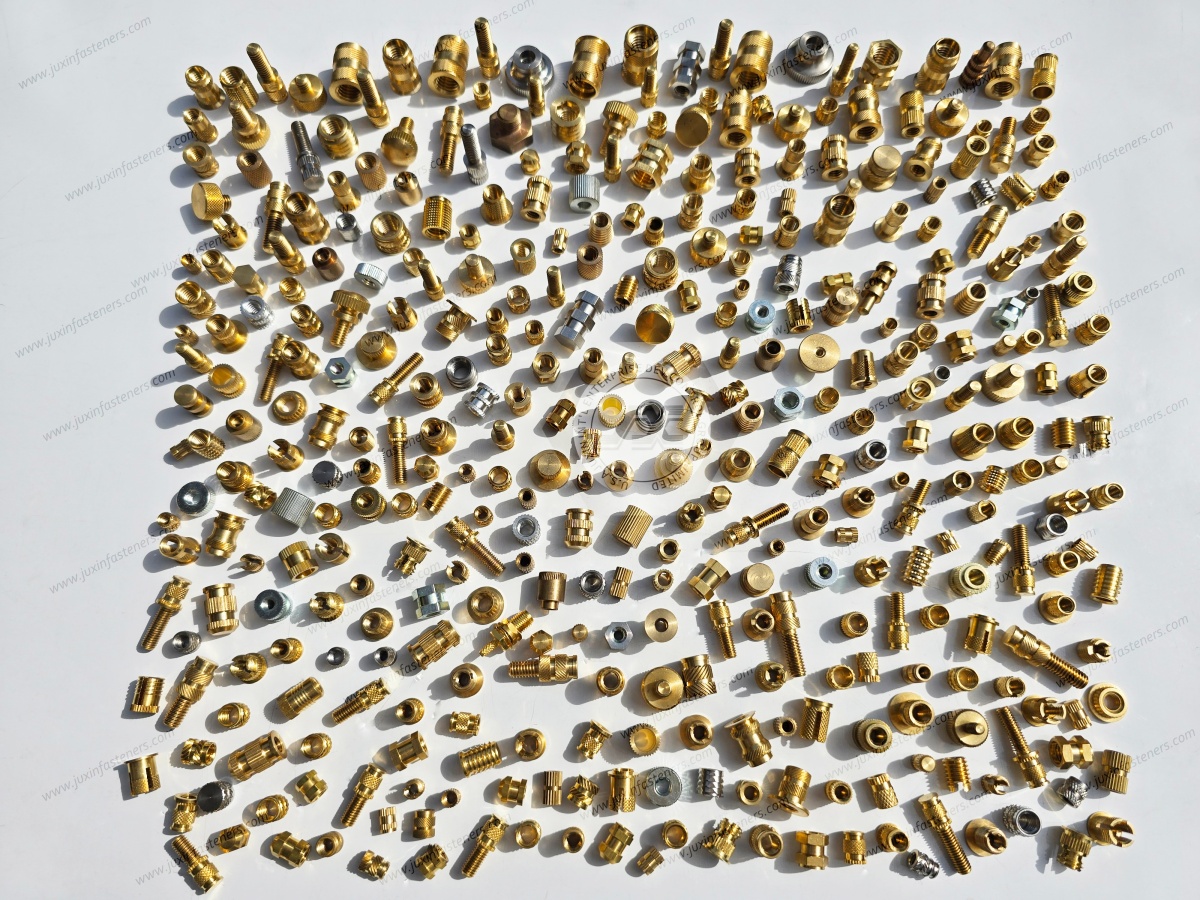
JUXIN Fasteners supplies plastic threaded inserts, threaded insert nuts and threaded bushings for injection-molded and engineered plastic components, with material and installation options selected according to resin type, load requirements, temperature, corrosion conditions and production volume.
For procurement teams and design engineers, the key is not simply choosing an insert.
The correct solution depends on how the insert will be installed, what plastic it will be installed into, and what mechanical performance the finished assembly requires.
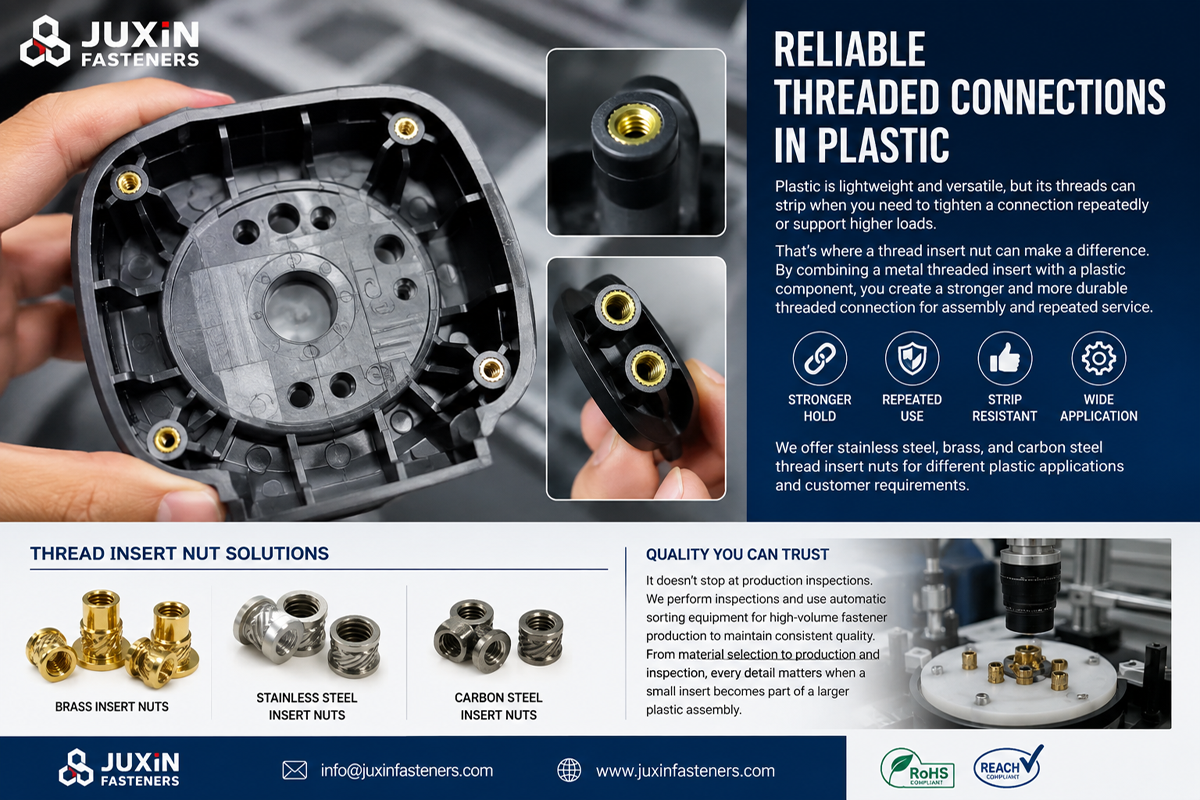
What Are Threaded Inserts for Plastic?
Threaded inserts for plastic are metal components installed into plastic or composite parts to provide a durable internal thread for screws, bolts or other threaded fasteners.
Compared with directly tapping a plastic hole, a metal insert can provide:
Higher thread durability
Better resistance to repeated assembly and disassembly
Improved pull-out resistance
Better torque performance
More consistent thread engagement
Greater dimensional stability
A stronger fastening interface in thin-wall plastic components
Threaded inserts are commonly manufactured from brass, aluminum or stainless steel, depending on the requirements of the application.
The insert profile can include knurls, ribs, barbs, undercuts or other external features. These features interact with the surrounding plastic to resist rotation and axial pull-out.
A flange can also be incorporated into the design when additional pull-through resistance, positioning or electrical contact is required.
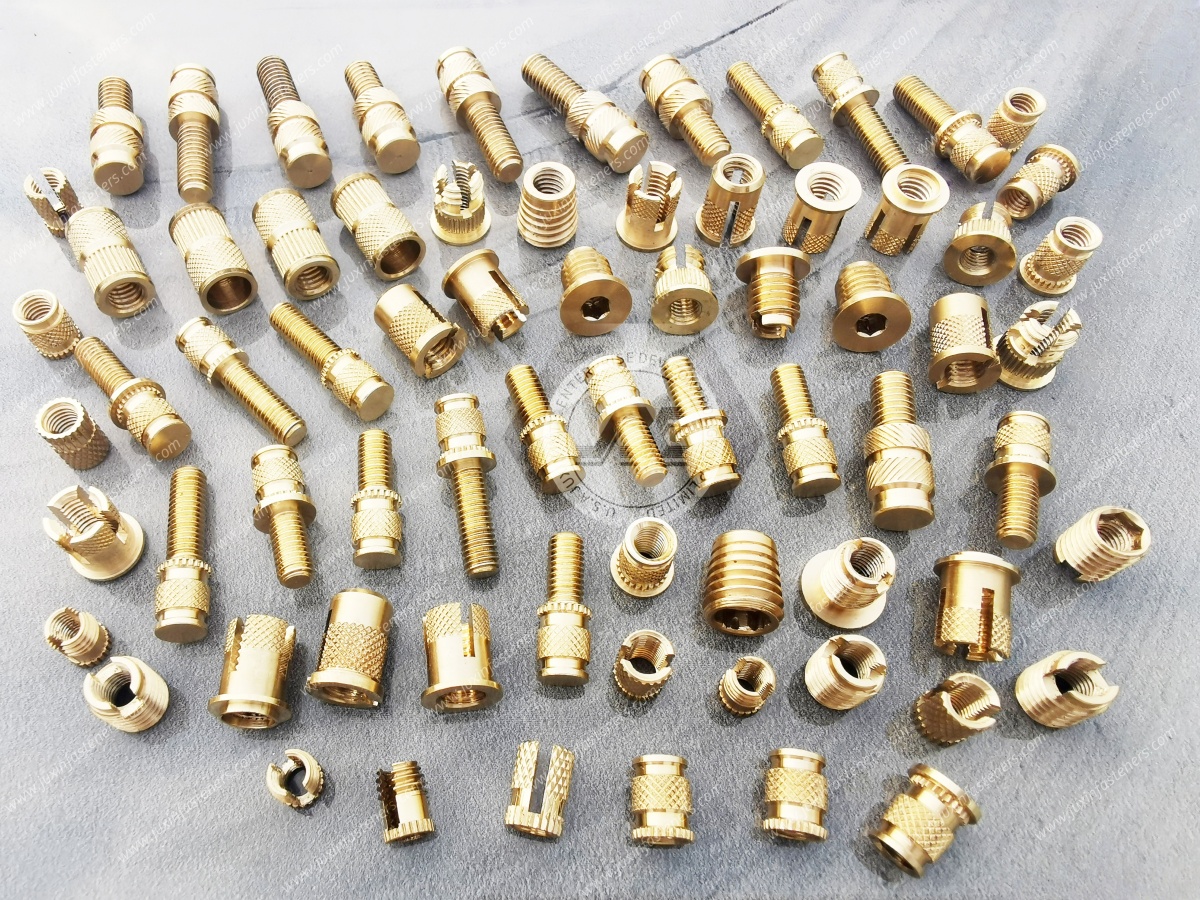
Why Use Metal Threaded Inserts Instead of Plastic Threads?
For low-load applications, a molded or tapped plastic thread may be sufficient.
However, many industrial products require a fastening point that can survive repeated assembly, vibration, thermal cycling or higher installation torque.
A metal threaded insert separates the thread function from the plastic structure.
This is particularly useful when the plastic housing itself needs to remain lightweight while the fastening interface requires greater mechanical strength.
Typical applications include:
Automotive plastic components
EV battery and electrical enclosures
Electronic housings
Telecom cabinets
Industrial control panels
HVAC equipment
Medical equipment housings
Robotics
Industrial machinery
Consumer electronics
Power electronics
Electrical equipment
Plastic structural components
For OEMs, this can make the difference between a plastic component that is assembled once and one that can be repeatedly serviced throughout its product life.
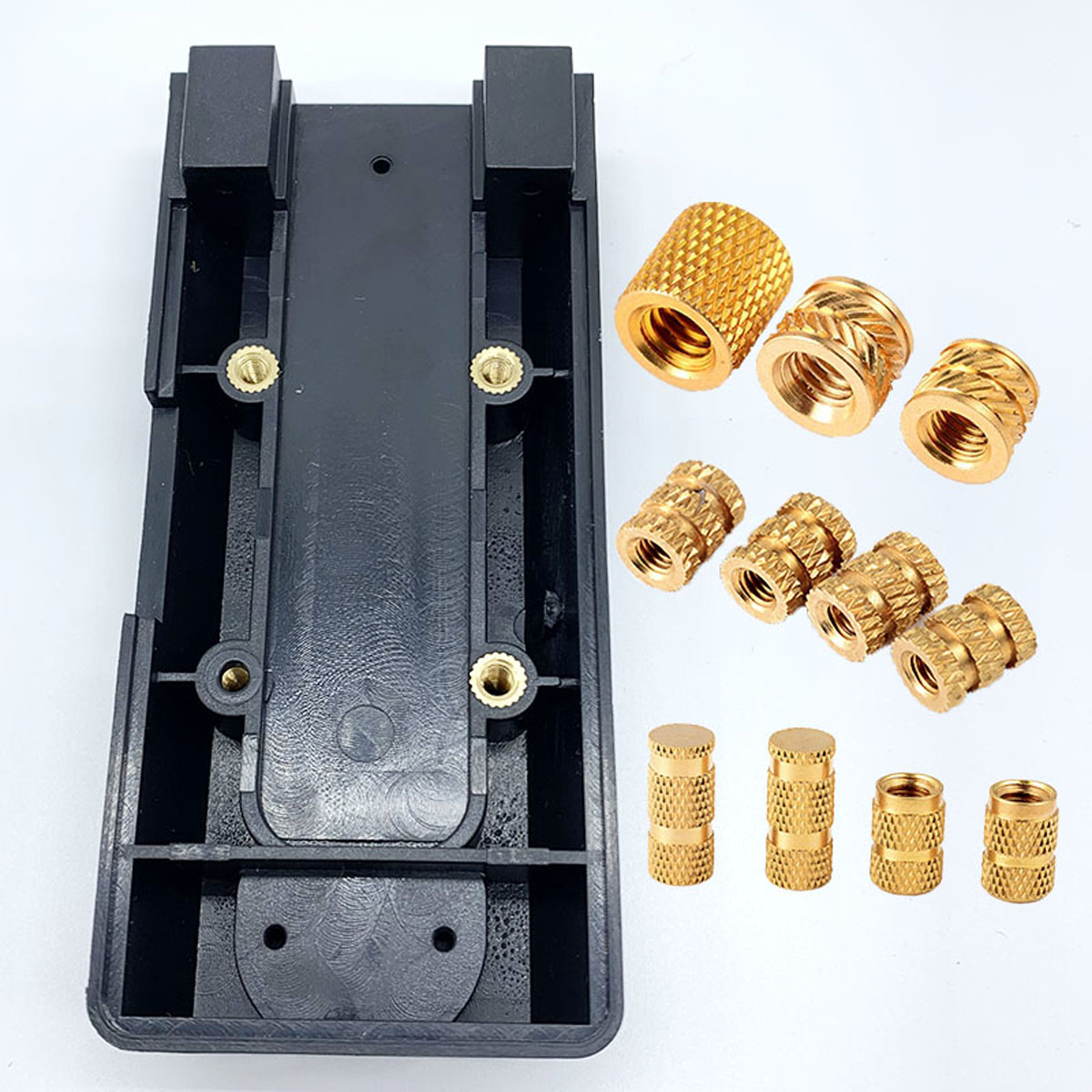
Types of Threaded Inserts for Plastic
Different plastic materials and manufacturing processes require different insert geometries.
The most common solutions include molded-in inserts, heat staking inserts, ultrasonic inserts and press-in inserts.
1. Molded-In Threaded Inserts
Molded-in inserts are installed directly during the injection molding process.
The insert is positioned inside the mold before the polymer is injected. As the plastic flows around the external profile, the insert becomes mechanically integrated into the molded component.
External knurling and undercuts can provide resistance against:
Rotation
Pull-out
Axial movement
Installation torque
Molded-in inserts are particularly suitable for high-volume production where the insert can be incorporated into the molding process.
Typical applications include:
Automotive components
Plastic manifolds
Electrical housings
Industrial equipment
Structural plastic assemblies
For high-volume OEM programs, molded-in inserts can eliminate secondary installation operations and provide consistent positioning.
2. Heat Staking Inserts
Heat staking inserts are installed after molding by applying controlled heat and pressure.
The insert is heated to a suitable temperature and pressed into a prepared boss or hole.
The surrounding thermoplastic softens and flows around the external knurling or profile of the insert. After cooling, the polymer solidifies and locks the insert into position.
Heat staking is especially effective for thermoplastic materials where the polymer can be softened and re-solidified.
Common materials include engineered thermoplastics such as:
ABS
PA / Nylon
PC
PBT
PET
PEEK
Other engineering thermoplastics
The actual installation temperature and process parameters must be established according to the specific resin and component design.
Engineering consideration
The insert should not simply be selected according to thread size.
The design engineer should also evaluate:
Resin melting or softening behavior
Boss diameter
Boss wall thickness
Insert outside diameter
Installation temperature
Insertion depth
Heating time
Installation force
Cooling conditions
Required pull-out strength
Required torque resistance
Correct process control is essential to avoid plastic cracking, excessive deformation or insufficient material flow around the insert.
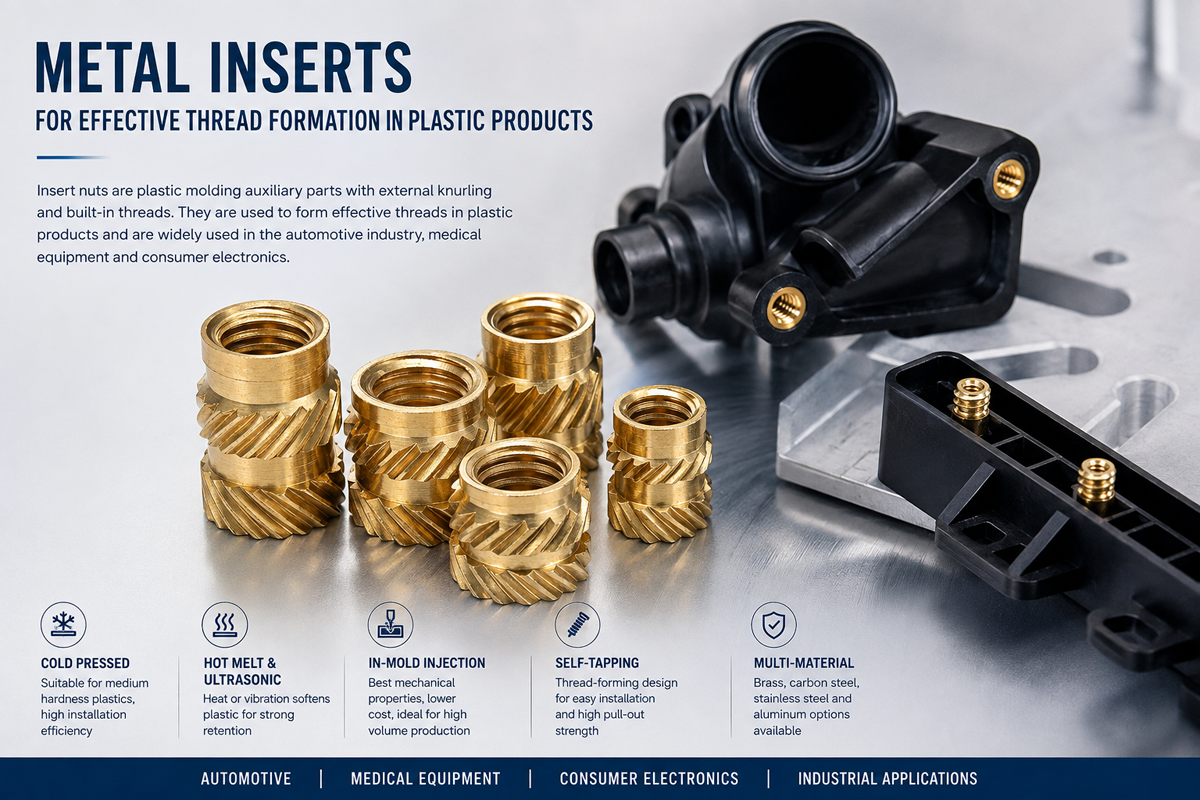
3. Ultrasonic Threaded Inserts
Ultrasonic inserts use ultrasonic energy to generate localized heating at the plastic-insert interface.
The surrounding thermoplastic softens and flows around the insert profile. Once the ultrasonic energy stops, the plastic cools and solidifies around the insert.
Ultrasonic installation can provide:
Fast cycle times
Repeatable installation
Controlled insertion
Low overall thermal exposure
Suitability for automated production
This method is commonly considered for high-volume plastic assemblies where installation speed and repeatability are important.
For production engineering teams, ultrasonic insertion can be attractive when the fastening process needs to be integrated into an automated assembly line.
4. Press-In Threaded Inserts
Press-in inserts are mechanically pressed into a prepared hole or boss.
They normally use external ribs, knurls or other interference-fit features to resist movement after installation.
Press-in inserts can be useful when:
Post-molding installation is required
Heat cannot be applied to the component
Production volumes do not justify specialized thermal equipment
The plastic material provides sufficient interference-fit performance
However, the design engineer should verify the required insertion force and the resulting stress around the plastic boss.
For brittle plastics or highly loaded applications, a simple press-fit design may not provide the same performance as a properly designed heat-staked, ultrasonic or molded-in insert.
Choosing the Right Installation Method
The correct installation method depends heavily on the polymer.
Thermoplastics
Thermoplastics can soften when heated, making them suitable for post-mold installation methods such as:
Heat staking
Ultrasonic insertion
Press-in installation
Semi-crystalline thermoplastics such as PET, PBT and PEEK have defined melting characteristics,
while amorphous materials such as ABS and PVC soften through a glass-transition range rather than having a single sharp melting point.
Therefore, installation parameters should be established based on the actual resin grade and component design rather than using one generic temperature for every plastic.
Thermoset Plastics
Thermoset polymers behave differently.
Once cured, they do not simply melt and reform when reheated. For these materials, molded-in inserts are often the preferred solution.
This makes polymer classification an important part of insert selection.
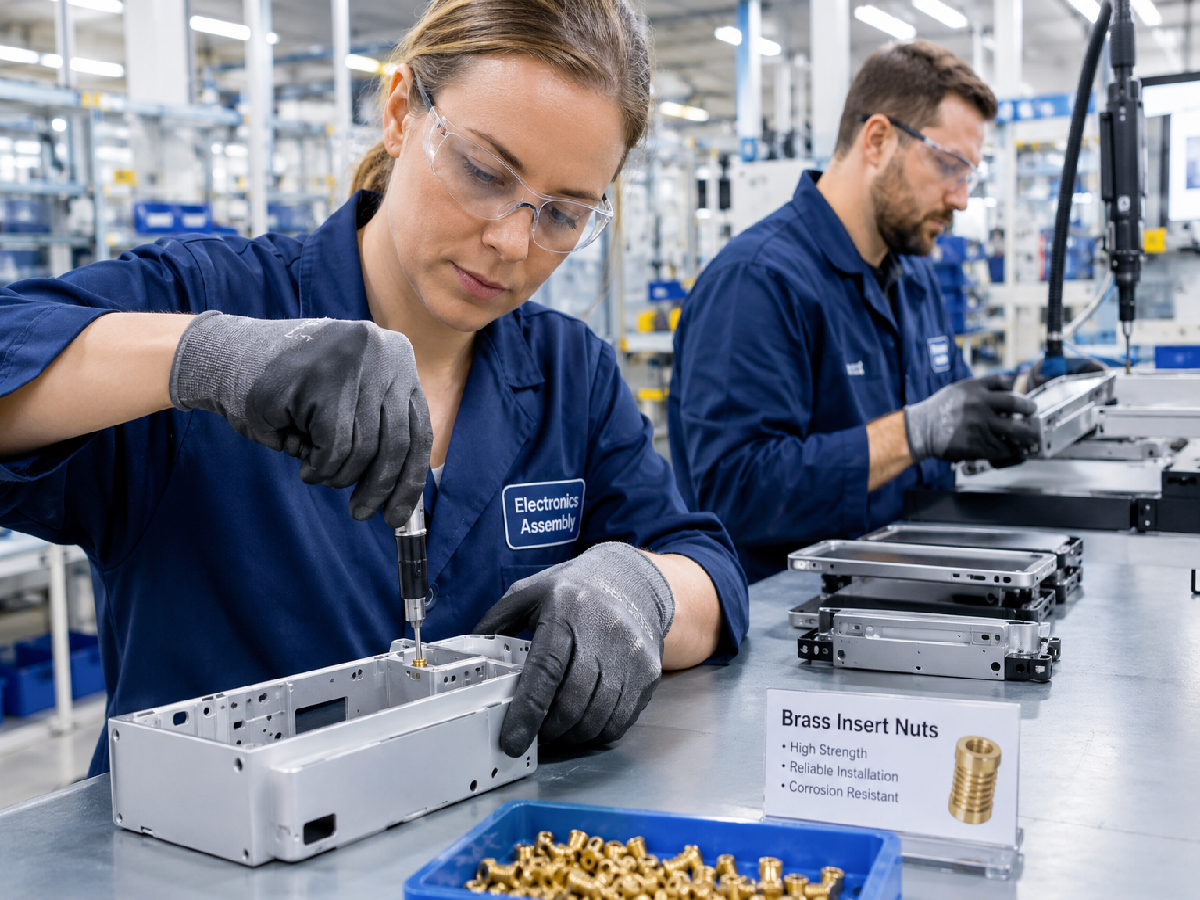
Threaded Insert Materials
Material selection affects conductivity, weight, corrosion resistance, temperature performance, machinability and cost.
Brass Threaded Inserts
Brass threaded inserts are widely used because they offer an effective combination of:
Good machinability
Good electrical conductivity
Corrosion resistance
Suitable mechanical performance
Cost efficiency
Brass is commonly selected for electronics, electrical housings, consumer products, industrial equipment and injection-molded plastic assemblies.
For many general-purpose applications, brass remains the standard choice for threaded inserts for plastic.
Aluminum Threaded Inserts
Aluminum threaded inserts are useful when weight reduction is an important design requirement.
Typical applications include:
Lightweight automotive components
Aerospace-related equipment
Portable equipment
Transportation systems
Weight-sensitive industrial assemblies
Aluminum can reduce component weight while providing a metal thread inside a polymer structure.
Stainless Steel Threaded Inserts
Stainless steel threaded inserts are selected when higher corrosion resistance, temperature capability or mechanical performance is required.
They can be considered for:
Medical equipment
Outdoor equipment
Marine environments
Chemical processing equipment
High-temperature applications
Industrial machinery
Corrosive operating environments
The specific stainless steel grade should be selected according to the actual environmental and mechanical requirements.
Threaded Inserts for Injection Molded Parts
Injection molding allows complex plastic components to be produced at high volume, but the fastening interface must be designed carefully.
For threaded inserts for injection molded parts, engineers should consider the complete assembly rather than the insert alone.
Important design parameters include:
Boss Geometry
The plastic boss must have sufficient material around the insert to withstand installation and service loads.
Insert Diameter
The outside diameter of the insert must be compatible with the boss geometry and required interference or polymer flow.
Insert Length
The insert length affects thread engagement and pull-out resistance. Longer is not always better if the surrounding boss cannot support it.
External Profile
Knurls, ribs and undercuts influence how effectively the insert transfers torque and axial loads into the polymer.
Thread Size
The internal thread must match the mating screw while providing adequate thread engagement.
Plastic Resin
The same insert geometry may behave differently in ABS, PA, PBT, PC, PEEK or glass-filled polymers.
Production Method
The optimum insert can change depending on whether the component is:
Molded-in
Heat staked
Ultrasonically installed
Press fitted
Threaded Inserts for Automotive and EV Components
Automotive manufacturers increasingly use engineered plastics and composite materials to reduce vehicle weight and integrate complex functions.
This creates a growing need for reliable fastening interfaces inside plastic components.
Applications can include:
Engine air intake components
Plastic manifolds
Electrical housings
Sensor housings
Interior components
Battery-related components
EV electrical enclosures
Thermal management assemblies
Under-hood plastic components
For example, glass-filled engineering plastics can provide a combination of strength, thermal resistance and weight reduction.
A properly designed heat staking insert can be installed into a molded boss, allowing a metal screw to generate the clamping force required to secure the assembly.
In applications such as air intake systems, the fastening interface may also contribute to maintaining the compression and sealing performance of the assembled component.
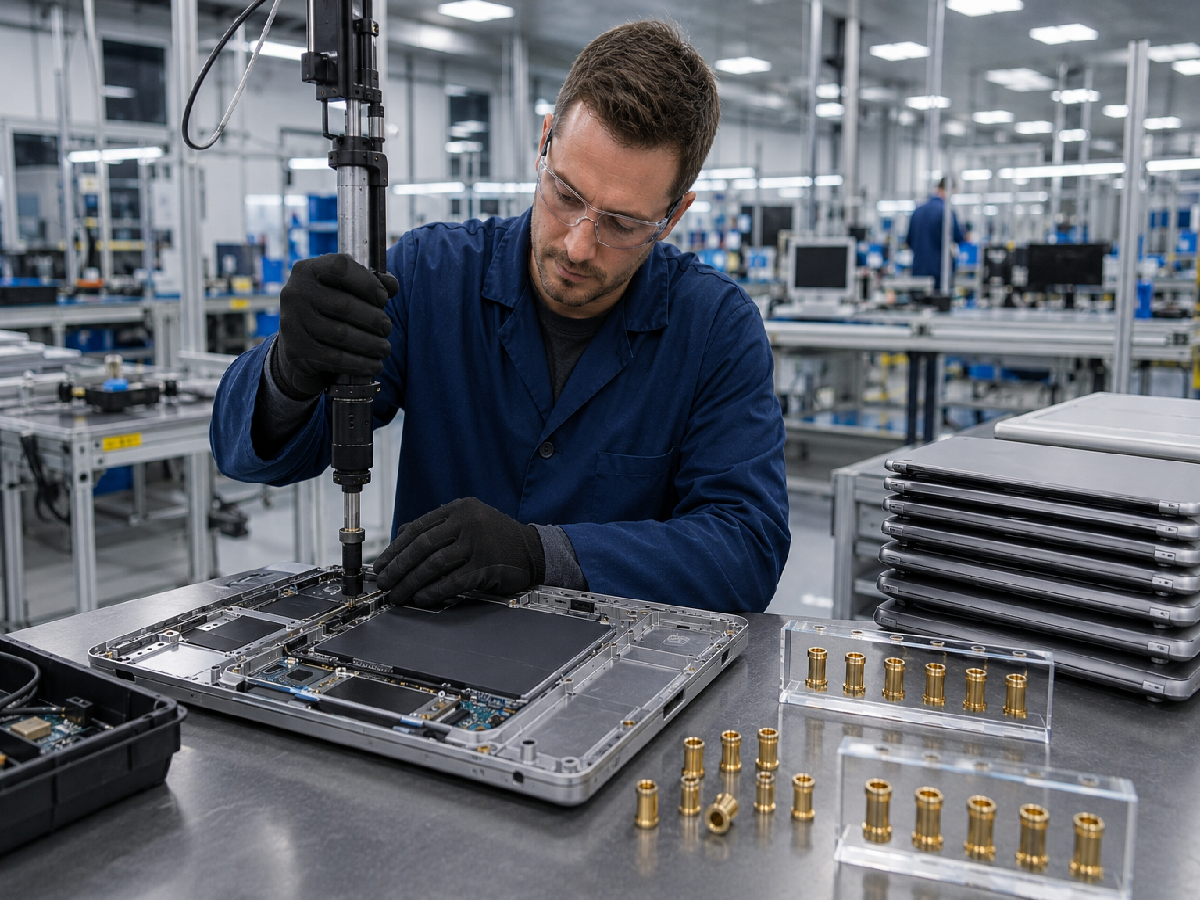
Threaded Inserts for Electronics and Electrical Enclosures
Electronic and electrical equipment frequently uses plastic housings to provide insulation, corrosion resistance and weight reduction.
However, the housing may still require metal screws for assembly.
Threaded inserts for plastic enclosures can provide repeatable fastening points for:
PCB mounting
Cover panels
Electrical components
Cable management components
Cooling assemblies
Internal brackets
Access covers
Control modules
For electrical applications, brass can be particularly attractive because of its conductivity and machinability.
Where environmental exposure or higher temperature is a concern, stainless steel or another application-specific material may be considered.
Threaded Inserts for Industrial Equipment
Industrial equipment often requires components to be assembled and serviced multiple times throughout their operating life.
Plastic housings, covers and structural components may therefore need a fastening interface that can withstand repeated screw installation.
Typical applications include:
Industrial control equipment
Robotics
Automation systems
HVAC equipment
Pumps
Sensors
Instrumentation
Power electronics
Telecom equipment
Industrial machinery
For procurement managers, this means insert selection should consider not only the unit price of the insert, but also the total manufacturing process and expected service life of the finished assembly.
Threaded Inserts for Medical Equipment
Medical and laboratory equipment can contain extensive plastic housings and internal molded components.
Threaded inserts can be used to create secure mounting points without increasing the overall weight of the housing.
Depending on the equipment and operating environment, engineers may evaluate:
Brass inserts
Stainless steel inserts
Custom insert geometries
Tight dimensional tolerances
Corrosion resistance
Clean manufacturing requirements
Repeated assembly performance
The final material and finish should always be selected according to the applicable equipment specifications and regulatory requirements.
Procurement Considerations for Threaded Inserts
For purchasing teams and supply chain managers, specifying only the thread size is usually insufficient.
A professional RFQ should ideally include:
Specification | Example Requirement |
Insert Type | Molded-in / Heat staking / Ultrasonic / Press-in |
Thread | M3 / M4 / M5 / M6 / Custom |
Material | Brass / Aluminum / Stainless Steel |
Internal Thread | Metric / UNC / UNF / Custom |
External Profile | Knurl / Rib / Barb / Custom |
Insert Length | According to component design |
Plastic Resin | ABS / PA / PC / PBT / PEEK / etc. |
Installation Method | Heat / Ultrasonic / Press-fit / Molded-in |
Application | Automotive / Electronics / Industrial / Medical |
Surface Finish | Application-specific |
Quality Requirement | Drawing / inspection standard |
Packaging | Bulk / tray / custom packaging |
For OEM production, the insert should be evaluated together with the plastic component and mating screw.
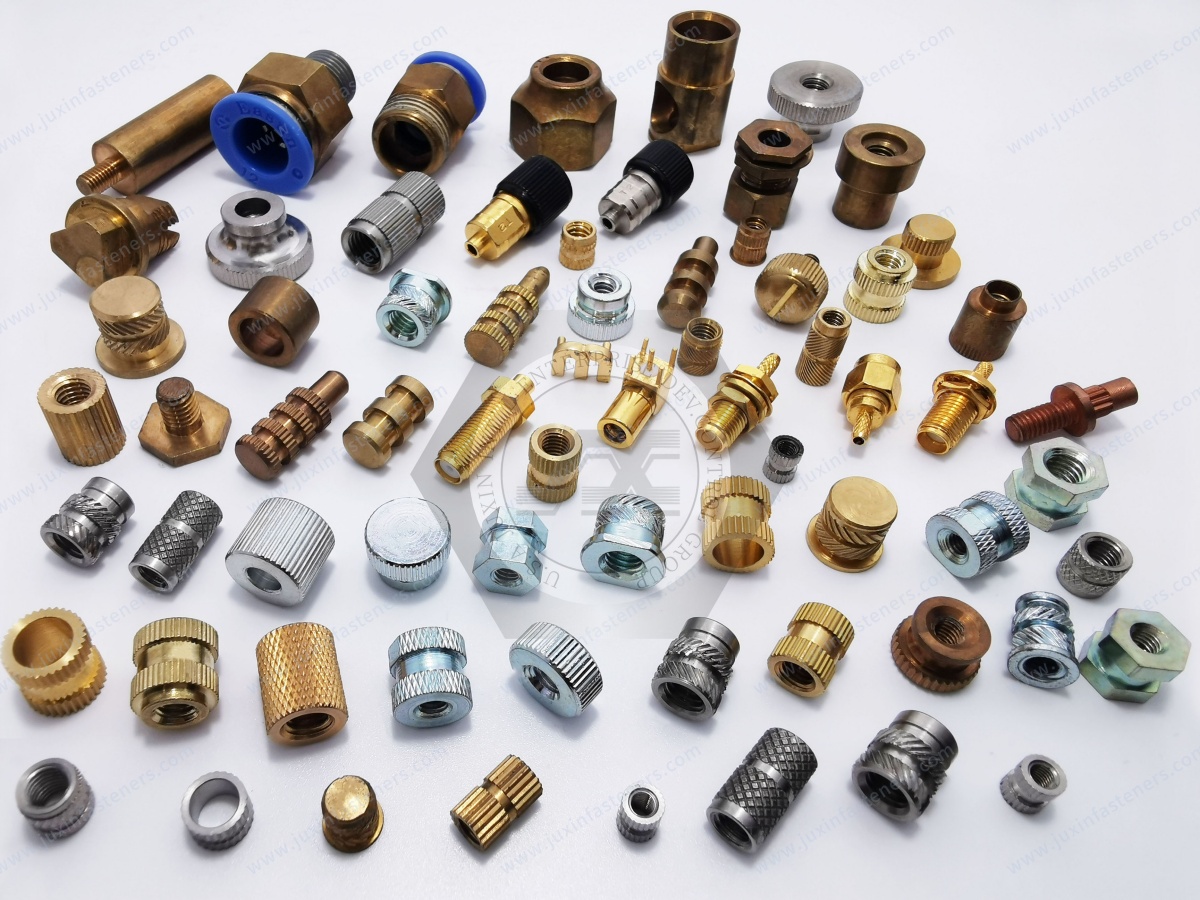
Custom Threaded Inserts for OEM Applications
Standard threaded inserts are suitable for many applications, but OEM products frequently require customized dimensions or profiles.
JUXIN Fasteners can support custom threaded insert nuts and threaded bushings according to engineering drawings and application requirements.
Customization can include:
Custom outside diameter
Custom insert length
Special knurling
Custom ribs or undercuts
Special flange geometry
Metric threads
UNC / UNF threads
Special internal threads
Brass construction
Aluminum construction
Stainless steel construction
Application-specific tolerances
The objective is not simply to manufacture a metal insert. It is to develop an insert that works correctly with the customer's plastic resin, molding process, installation equipment and final assembly.
How Engineers Should Select a Plastic Threaded Insert
A practical engineering selection process can follow six steps.
Step 1 — Identify the Plastic
Determine whether the component is manufactured from:
ABS
PA / Nylon
PC
PBT
PET
PEEK
PVC
Glass-filled polymer
Thermoset resin
Other engineering plastic
Step 2 — Determine the Installation Method
Select between:
Molded-in
Heat staking
Ultrasonic
Press-in
Step 3 — Define the Mechanical Requirements
Evaluate:
Installation torque
Pull-out force
Strip-out resistance
Vibration
Repeated assembly
Clamp load
Temperature cycling
Step 4 — Select the Insert Material
Consider:
Strength
Weight
Conductivity
Corrosion
Temperature
Cost
Step 5 — Review the Plastic Boss Design
The insert and plastic boss must be designed as one fastening system.
Step 6 — Validate the Assembly
Prototype testing or production validation should verify the required torque, pull-out resistance and long-term performance.
JUXIN Fasteners: Industrial Threaded Insert Solutions
JUXIN Fasteners provides industrial fastener solutions for OEM manufacturers, engineering companies, procurement teams and supply chain partners.
With more than 23 years of fastener industry experience, JUXIN supports the development and supply of threaded fastening components for plastic and composite assemblies.
Our capabilities can support applications requiring:
Threaded inserts for plastic
Plastic threaded inserts
Threaded insert nuts
Threaded bushings
Brass threaded inserts
Aluminum threaded inserts
Stainless steel threaded inserts
Heat staking inserts
Ultrasonic inserts
Press-in inserts
Molded-in inserts
Custom threaded inserts
Our engineering approach focuses on the complete application — plastic material + insert geometry + installation process + mating fastener + production requirements.
This approach helps OEM customers reduce fastening problems during product development and establish a more reliable production solution.
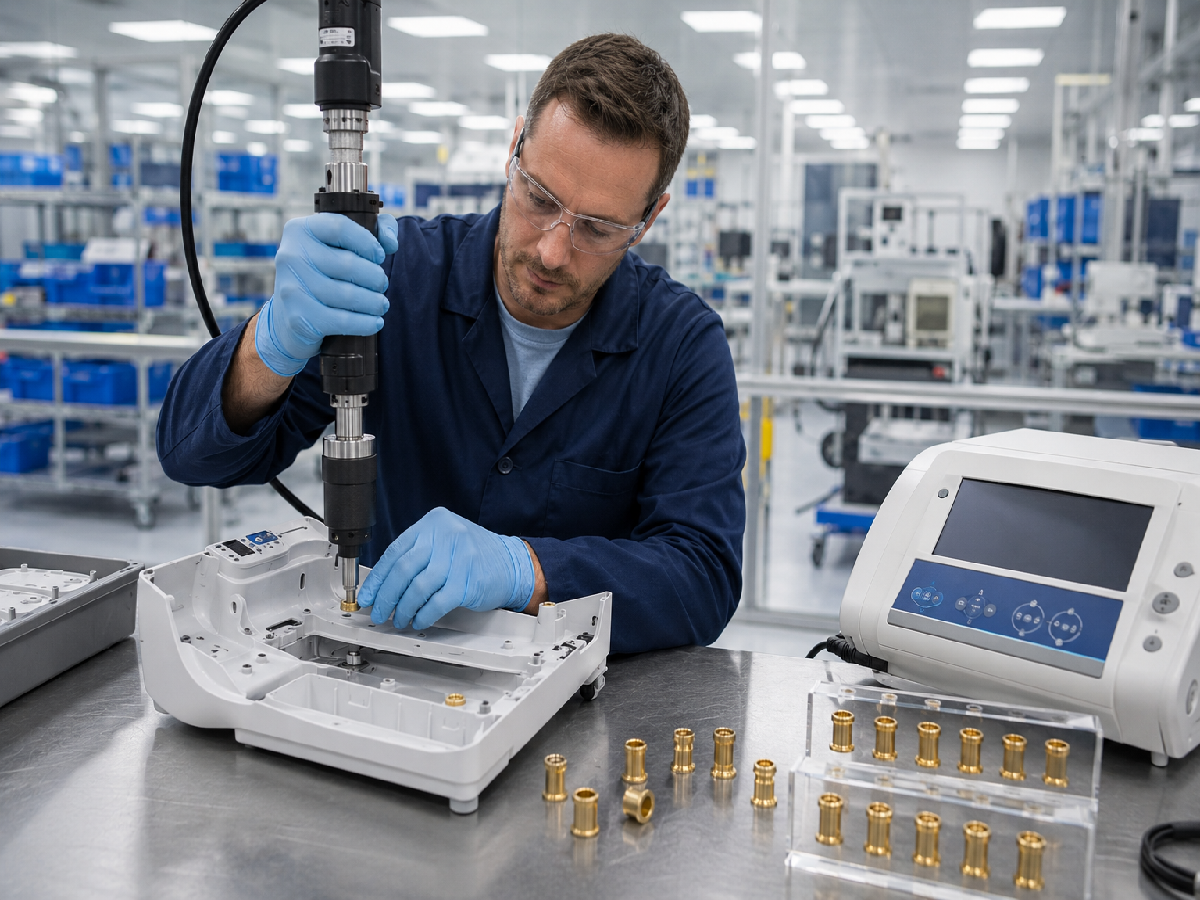
Industries We Support
Our threaded insert solutions can be applied across a broad range of engineered plastic and composite products, including:
Automotive & EV
Plastic automotive components, electrical housings, battery-related assemblies and thermal management components.
Electronics & Electrical Equipment
Electronic housings, control modules, PCB assemblies and electrical enclosures.
Telecommunications
Telecom cabinets, network equipment, communication housings and internal mounting systems.
Industrial Machinery
Machine covers, control systems, automation equipment and plastic structural components.
Robotics & Automation
Lightweight housings, actuator assemblies, sensors and internal mounting components.
HVAC
Plastic housings, control systems, air-handling components and equipment enclosures.
Medical Equipment
Plastic housings, laboratory equipment and precision equipment assemblies.
Energy & Power Electronics
Electrical housings, power modules, energy storage equipment and related plastic components.
Request a Threaded Insert Solution for Your Plastic Component
If you are developing an injection-molded plastic component and need a reliable metal fastening point,
JUXIN Fasteners can help evaluate the appropriate threaded insert for plastic based on your drawing, plastic resin, installation method and production requirements.
For OEM projects, please provide:
Plastic material or resin grade
Insert drawing or component drawing
Required thread size
Insert dimensions
Installation method
Estimated annual quantity
Mechanical or environmental requirements
We can then evaluate the appropriate insert construction and manufacturing solution for your application.
JUXIN FASTENERS
23+ Years of Fastener Industry Experience
OEM & Industrial Fastener Solutions
Email: info@juxinfasteners.com
Website: www.juxinfasteners.com
 MORE NEWS
Sep. 22, 2026
Sep. 22, 2026
Sep. 22, 2026
Contact Us
Tel.:
+86 020 8621 0320
+86 020 3121 6067
E-mail:
Technical Support:
Navigation
SEND INQUIREY