Call Us
+86 136 6007 9809
Call Us
+86 136 6007 9809

Steel Multi-Grip Dome Head Blind Rivets
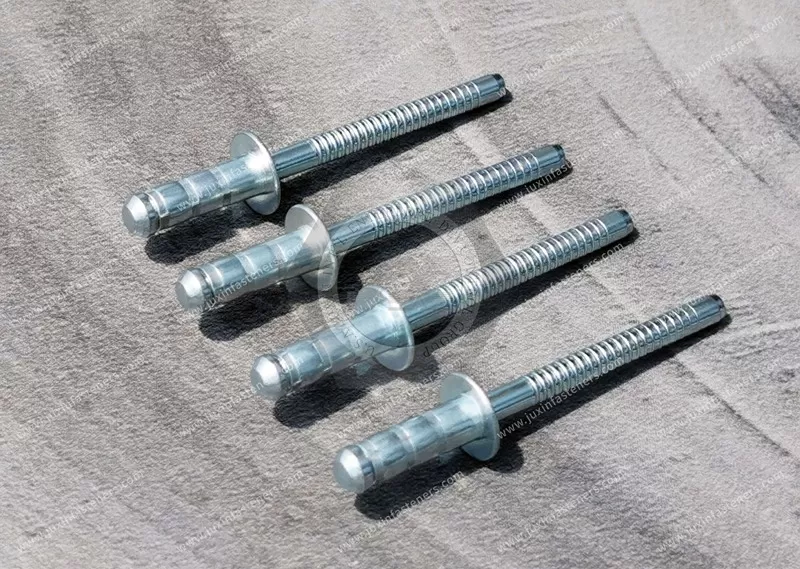
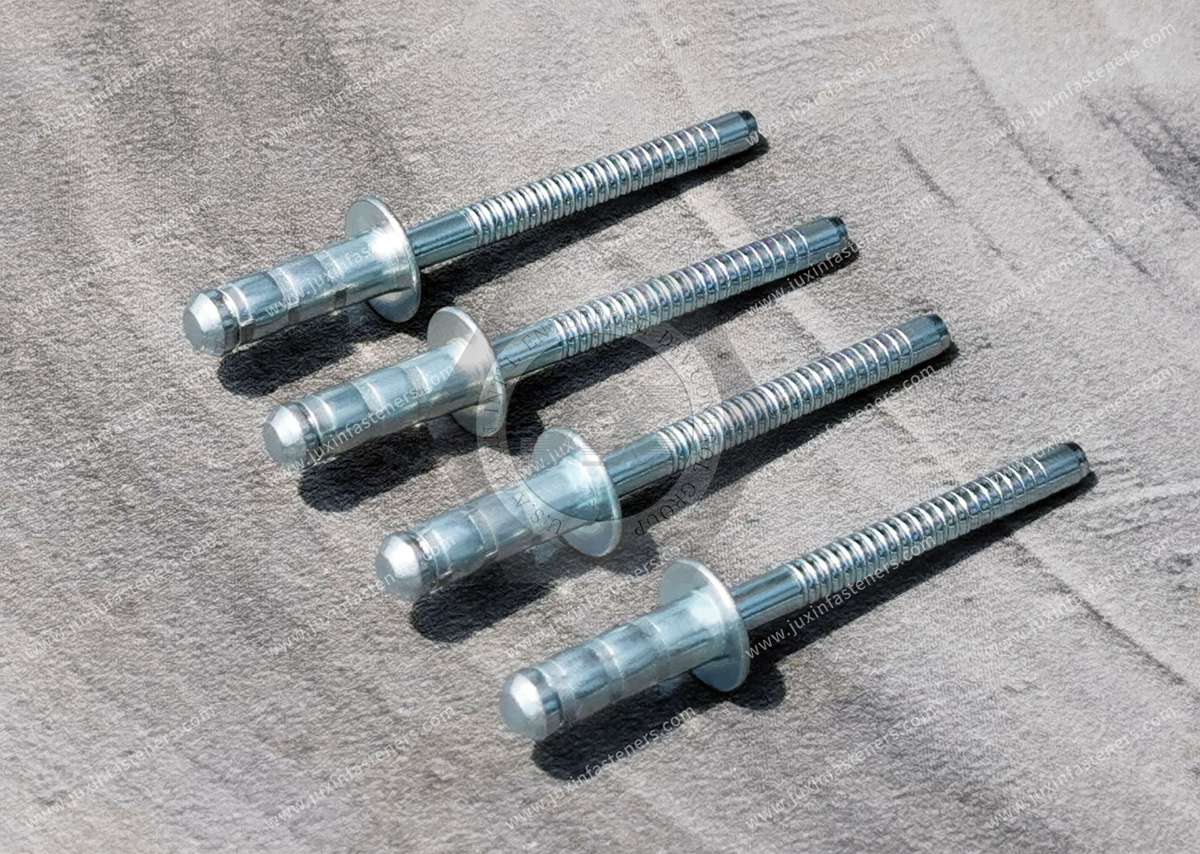
JUXIN FASTENERS supplies steel-body, steel-mandrel multi-grip blind rivets with dome heads for one-sided fastening of compatible sheet-metal assemblies.
The extended grip-range design can accommodate multiple material stack-ups and may reduce rivet length variations in OEM production.
For steel equipment enclosures, industrial cabinets and fabricated panels.
Actual grip ranges, blind-side formation and mechanical performance must be confirmed from the approved technical specification.
Product Specification
Steel Multi-Grip Dome Head Blind Rivets for Variable Sheet-Metal Thicknesses
Product Overview
JUXIN FASTENERS supplies steel multi-grip dome head blind rivets for industrial sheet-metal assemblies, fabricated metal enclosures and OEM manufacturing applications.
The specified construction uses a steel rivet body and steel pull mandrel.
The multi-grip design is intended to accommodate a wider range of compatible material thicknesses than a conventional narrow-grip blind rivet.
This can help manufacturers standardize fastening across related assemblies with different panel and bracket thicknesses,
provided the selected rivet satisfies the required grip range, mounting-hole dimensions and joint performance.
The original product information also refers to a double-drum rivet design.
The exact blind-side deformation geometry, mandrel retention mechanism and any special break-groove features must be confirmed
from the original engineering drawings before they are included as guaranteed product characteristics.
Product Identification and Construction
| Item | Specification |
|---|---|
| Product Type | Multi-Grip Blind Rivet |
| Head Style | Dome Head |
| Rivet Body Material | Steel |
| Pull Mandrel Material | Steel |
| Material Combination | Steel / Steel |
| Main Function | Extended Grip Range |
| Installation Method | One-Sided Blind Riveting |
| Blind-Side Geometry | Subject to drawing verification |
| Double-Drum Design | Referenced in original description; confirmation required |
| Mandrel Retention | To be verified |
| Surface Finish | To be confirmed |
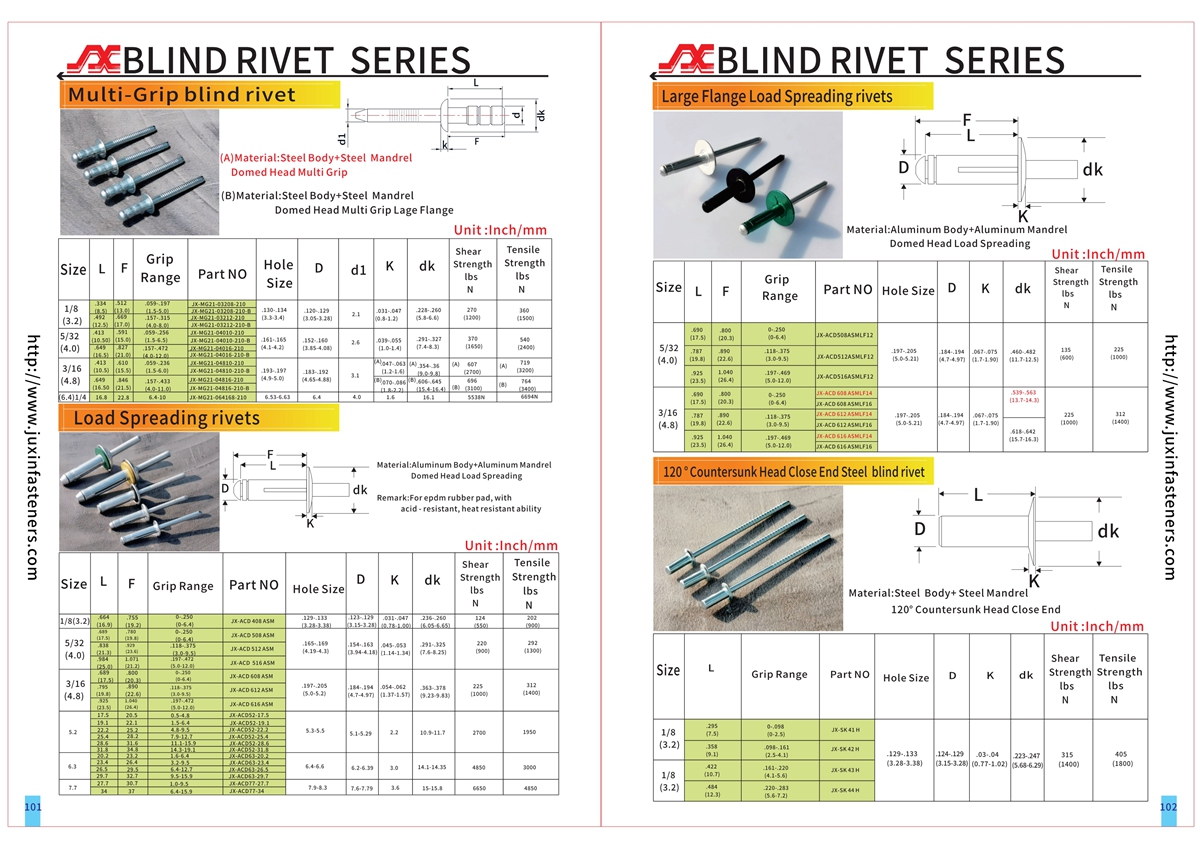
| Technical Reference | Original PDF/CAD, pages 101–102 |
Material Configuration Clarification
The original product information lists two configurations:
(A) Steel Body + Steel Mandrel, Dome Head Multi-Grip
(B) Steel Body + Steel Mandrel
Both identify the same basic material combination.
No separate head style, coating, dimensions or mechanical characteristics have been provided for configuration B.
The two entries should therefore not be represented as different technical products until their part numbers or drawings establish the distinction.
Key Product Features
Steel rivet body
Steel pull mandrel
Dome head configuration
Extended grip range for compatible material thicknesses
One-sided blind installation
Potential reduction in rivet length variations
Suitable for engineering evaluation in fabricated metal assemblies
Drawing-based OEM dimensional and material requirements
Blind-side deformation and mandrel behavior to be verified by specification
Dimensions and Technical Specifications
| Parameter | Engineering Requirement |
|---|---|
| Rivet Body Diameter (d) | Refer to original PDF/CAD |
| Rivet Body Length (L) | Refer to original PDF/CAD |
| Dome Head Diameter (D) | Refer to original PDF/CAD |
| Head Height (H) | Refer to original PDF/CAD |
| Mandrel Diameter | According to approved drawing |
| Minimum Grip Thickness | According to selected rivet size |
| Maximum Grip Thickness | According to selected rivet size |
| Recommended Hole Diameter | According to selected rivet size |
| Blind-Side Formation | According to actual product design |
| Mandrel Break Characteristics | According to approved specification |
| Mandrel Retention | To be verified |
| Shear Strength | According to verified test data |
| Tensile Strength | According to verified test data |
| Steel Grades | To be confirmed |
| Surface Coating | To be confirmed |
Technical Documentation
Refer to the existing JUXIN product PDF/CAD specification, pages 101–102.
The original drawings and specification tables govern available sizes, grip ranges, dimensional tolerances, material grades and mechanical requirements.
Engineering Solution 1 — Multi-Grip Fastening Across Variable Material Thicknesses
The principal advantage of a multi-grip blind rivet is its ability to accommodate a wider range of material stack-ups.
Different industrial assemblies may use different combinations of sheet metal, brackets and reinforcing components.
A conventional blind rivet may require a different body length for each thickness interval.
A suitable multi-grip blind rivet may cover several of these assemblies with one part number.
Potential benefits include:
Fewer fastener lengths
Reduced purchasing complexity
Simplified inventory management
Fewer assembly-line picking errors
Easier production standardization
Reduced changeover requirements
These benefits depend on verified grip-range coverage and successful joint qualification.
Engineering Example — Consolidating Rivet Lengths
Consider a manufacturer producing three variants of an industrial equipment cabinet.
| Assembly | Illustrative Material Stack-Up |
|---|---|
| Cabinet A | 2.0 mm |
| Cabinet B | 3.5 mm |
| Cabinet C | 5.0 mm |
These figures are illustrative engineering examples, not confirmed JUXIN grip specifications.
If a selected steel multi-grip rivet has a verified grip range covering all three thicknesses, and its installed joints satisfy the applicable requirements,
the manufacturer may be able to use one rivet part number across the three assemblies.
However, the rivet must be evaluated at the minimum and maximum stack-ups.
A wide grip range alone does not establish acceptable joint strength or installation consistency.
Engineering Solution 2 — Double-Drum and Double-Bulb Blind-Side Formation
The original description refers to an all-steel double-drum rivet.
In blind riveting terminology, a double-drum or double-bulb design may describe a rivet that develops two expanded regions on the blind side during installation.
This geometry is distinct from a conventional blind rivet that forms a single retaining head.
The engineering function of the blind-side deformation is to retain the joined components and transfer the required loads through the joint.
However, the following characteristics depend on the actual rivet design:
Number and shape of formed bulbs
Blind-side bearing area
Mandrel head geometry
Mandrel retention
Grip-range coverage
Installed joint strength
Setting force
Mandrel break position
A double-drum description should not be interpreted as proof of a mechanical mandrel lock, a sealed joint or a particular strength rating.
Drawing Verification Required
Before describing this JUXIN product as a confirmed double-bulb or double-drum rivet, the engineering drawing should establish the intended blind-side geometry.
If the drawing shows a conventional multi-grip deformation pattern instead, the product should remain identified simply as a Steel Multi-Grip Blind Rivet.
Engineering Solution 3 — Mandrel Retention and Break Characteristics
The mandrel is pulled during installation to deform the rivet body and create the retaining portion on the blind side.
After the setting operation, the mandrel breaks at the designed location.
Some specialized multi-grip rivets use mechanical mandrel retention features, but not every multi-grip blind rivet has this construction.
For this product, engineers should confirm:
Mandrel head geometry
Designed break location
Retained mandrel condition
Whether mechanical locking is present
Whether multiple break grooves are provided
Whether any retained mandrel movement is permitted
Mandrel locking and break-groove behavior should be treated as drawing-controlled features, not assumed from the multi-grip designation.
Engineering Solution 4 — Steel Body and Steel Mandrel Selection
This product uses steel for both the rivet body and pull mandrel.
Steel/steel construction is a recognized material configuration for industrial multi-grip blind rivets.
The actual performance depends on the steel grades, geometry, coating and installation conditions.
Engineers should consider:
Steel body grade
Steel mandrel grade
Surface coating
Required setting force
Shear and tensile performance
Panel material compatibility
Corrosion exposure
Production tooling
A steel/steel rivet should not automatically be assigned a specific mechanical strength or corrosion rating without verified technical data.
Engineering Solution 5 — Dome Head Geometry and Panel Support
The dome head provides a conventional protruding bearing surface against the accessible panel.
Selection should consider:
Head diameter
Head height
Panel thickness
Mounting-hole diameter
Available surface clearance
Joint loading
Panel stiffness
The dome head should not be described as a large flange unless the original drawing confirms enlarged head dimensions.
For thin or relatively soft panels, engineers should evaluate whether the head provides sufficient bearing support.
Engineering Solution 6 — Mounting-Hole Fit and Alignment
Multi-grip rivets are sometimes selected for industrial assemblies with variation in panel thickness and manufacturing tolerances.
However, extended grip range does not mean that any mounting-hole diameter is acceptable.
The selected rivet must be installed within the recommended hole-size tolerance.
Important controls include:
Hole diameter
Hole alignment
Burr removal
Panel flatness
Rivet body fit
Blind-side clearance
Edge distance
Material stack-up
Some proprietary multi-grip designs provide enhanced radial hole filling, but this capability must be confirmed for the actual JUXIN product before it is claimed.
Engineering Solution 7 — Minimum and Maximum Grip Validation
For OEM production, a multi-grip rivet should be evaluated across the intended thickness range.
A practical validation plan includes:
Identify the minimum and maximum material stack-ups.
Select the proposed rivet diameter and length.
Confirm that all assemblies fall within the verified grip range.
Check mounting-hole compatibility.
Install samples at representative minimum and maximum thicknesses.
Inspect dome head seating.
Inspect blind-side formation.
Check mandrel break and retention characteristics.
Conduct mechanical testing where required.
Approve the rivet for the intended assemblies according to agreed acceptance criteria.
This helps prevent a rivet from being approved solely because its published grip range appears sufficient.
Installation Method
Steel multi-grip blind rivets require a compatible blind riveting tool and nosepiece.
Typical installation steps are:
Confirm the selected rivet and grip range.
Prepare the mounting holes according to the approved drawing.
Verify the material stack-up.
Align the components.
Insert the blind rivet.
Seat the dome head against the accessible panel.
Engage the steel mandrel using the appropriate tool.
Pull the mandrel to form the blind-side retaining portion.
Complete the setting operation at the designed break point.
Inspect the installed joint.
Tool compatibility and setting capacity must be confirmed for the actual rivet configuration.
Mechanical Performance and Joint Reliability
Shear strength and tensile strength describe different loading conditions.
Actual joint performance depends on:
Rivet body diameter
Steel material grades
Grip thickness
Hole dimensions
Blind-side geometry
Mandrel retention
Panel stiffness
Rivet spacing and edge distance
Installation quality
Operating loads and vibration
A multi-grip rivet is not automatically stronger than a conventional blind rivet.
Likewise, a double-drum design does not establish a particular fatigue life or vibration resistance without supporting engineering evidence.
Corrosion and Surface Finish Considerations
Steel blind rivets may require an appropriate protective coating depending on their service environment.
The original product information does not establish the exact coating specification for this product.
Possible procurement requirements may include:
Coating type
Coating thickness
Passivation requirements
Surface appearance
Corrosion test method
Acceptance criteria
Compatibility with mating materials
No particular zinc coating, salt spray duration or outdoor service life is claimed without confirmation.
Industrial Applications & Engineering Fastening Solutions
Steel multi-grip blind rivets may be evaluated for industrial applications where variable material thicknesses, one-sided installation and compatible permanent mechanical fastening are required.
The following examples are potential engineering use cases, not application-specific certifications.
1. Container Manufacturing — Metal Panels and Auxiliary Structures
Container manufacturers may assemble auxiliary covers, equipment compartments, brackets and sheet-metal fittings with different material stack-ups.
Steel multi-grip rivets may help standardize fastening across compatible panel and bracket combinations.
Engineering checks include:
Material thickness variation
Mounting-hole dimensions
Vibration and fatigue
Corrosion protection
Blind-side formation
Joint loading
Load-bearing container structures require separate engineering approval.
2. AI Data Center Cabinet Manufacturing — Server and Power Equipment Enclosures
AI data center cabinets may use different panel thicknesses, reinforcement brackets and equipment mounting arrangements.
Multi-grip blind rivets may help reduce the number of rivet lengths needed across compatible cabinet variants.
Engineers should evaluate:
Material stack-up
Head clearance
Installation access
Electrical bonding requirements
Vibration
Cleanliness
Maintenance access
Blind rivets should not be assumed to provide electrical continuity or watertight sealing.
3. Electrical Power Equipment Manufacturing — Switchgear and Distribution Cabinets
Electrical equipment manufacturers may use varying sheet-metal thicknesses across control cabinets, switchgear housings and distribution enclosures.
Steel multi-grip rivets may be considered for approved noncritical mechanical panel connections.
Electrical clearance, grounding, bonding and equipment safety requirements must be assessed separately.
4. Telecommunications Equipment Manufacturing — Equipment Cabinet Families
Telecommunications manufacturers may produce several cabinet sizes using different panel and bracket thicknesses.
A suitable multi-grip rivet may support fastener standardization across compatible enclosure designs.
Outdoor applications require additional corrosion and material compatibility evaluation.
5. Automotive Manufacturing — Auxiliary Sheet-Metal Assemblies
Automotive OEM and Tier-1 manufacturing may involve noncritical brackets, covers and auxiliary metal panels with varying stack-ups.
Multi-grip rivets may reduce fastener length variations where approved.
The joint should be evaluated for vibration, fatigue, corrosion and customer-specific production requirements.
No safety-critical automotive suitability is implied.
6. Motorcycle Manufacturing — Covers and Equipment Brackets
Motorcycle manufacturers may assemble guards, auxiliary brackets and covers with different thickness combinations.
Steel multi-grip rivets may be considered for suitable noncritical connections.
Vibration, fatigue, corrosion and serviceability must be evaluated.
7. Bicycle Manufacturing — Auxiliary Accessories
Bicycle equipment may include metal accessories, guards and noncritical brackets.
Multi-grip blind rivets may be considered where one-sided fastening is appropriate.
They should not be assumed suitable for frames, forks, brakes or other safety-critical components.
8. Racing Vehicle Manufacturing — Auxiliary Panels
Racing vehicle manufacturing may use lightweight covers and auxiliary equipment panels with varying reinforcement thicknesses.
Steel multi-grip rivets may be evaluated for noncritical applications where their weight and mechanical performance are acceptable.
Vibration, fatigue, inspection and motorsport-specific requirements must be considered.
9. Rail Transit Equipment Manufacturing — Interior and Auxiliary Enclosures
Rail transit manufacturers may assemble interior panels, electrical cabinets and auxiliary housings with varying material stack-ups.
Multi-grip rivets may be considered for suitable noncritical connections.
Project-specific vibration, fatigue, fire and smoke, traceability and approval requirements must be reviewed.
10. HVAC Equipment Manufacturing — Sheet-Metal Housings
HVAC manufacturers use sheet-metal covers, fan guards, equipment housings and mounting brackets.
Different equipment models may use different panel thicknesses.
Steel multi-grip rivets may help standardize fastener selection across compatible assemblies.
Engineers should evaluate vibration, condensation, corrosion and air leakage requirements.
Open-end blind rivets are not inherently airtight or watertight.
11. Energy Equipment Manufacturing — Battery and Power Conversion Enclosures
Energy equipment may include battery storage cabinets, power conversion housings and renewable-energy equipment panels.
Multi-grip rivets may be considered for approved noncritical sheet-metal connections across different enclosure designs.
Thermal movement, vibration, corrosion, electrical isolation and safety requirements must be evaluated.
12. Electronics and Electrical Appliance Manufacturing
Electronics and appliance manufacturers may use several housing variants with different sheet-metal thicknesses.
Steel multi-grip rivets may support inventory and assembly standardization where permanent fastening is acceptable.
Hole tolerances, head clearance, panel deformation and production tooling should be checked.
13. Semiconductor Equipment Manufacturing — Auxiliary Cabinets
Semiconductor equipment may use auxiliary enclosures, electrical cabinets and supporting metal panels.
Multi-grip rivets may be considered for non-process-critical assemblies.
Cleanliness, particle generation, installation debris and maintenance access must be evaluated.
No cleanroom or process-chamber qualification is implied.
14. Medical Equipment Manufacturing — Noncritical Equipment Housings
Medical equipment manufacturers may use instrument cabinets, carts and auxiliary covers with different thickness combinations.
Steel multi-grip rivets may be considered for approved non-patient-contact assemblies.
Material traceability, cleaning exposure, corrosion and applicable regulatory requirements must be assessed.
No medical-device certification or sterilization suitability is claimed.
15. Food Processing Machinery Manufacturing — Non-Product-Contact Guards
Food machinery may use protective guards, covers and supporting panels with variable material stack-ups.
Steel multi-grip rivets may be considered for appropriate non-product-contact assemblies.
Cleaning, corrosion, crevice formation and hygienic design requirements must be evaluated.
Open-end steel blind rivets are not inherently hygienic fasteners.
16. Marine Equipment Manufacturing — Auxiliary Panels
Marine equipment may use metal housings and auxiliary covers with varying material thicknesses.
Steel multi-grip rivets may be considered only where their coating, material and joint performance meet the environmental requirements.
Seawater exposure and severe chloride environments require particular caution.
17. Leisure Equipment Manufacturing — Covers and Brackets
Leisure equipment may use metal covers, protective panels and auxiliary brackets.
Multi-grip rivets may be considered where the assembly has variable thicknesses and limited rear-side access.
Impact, vibration, corrosion and maintenance requirements should be reviewed.
18. Outdoor Fencing Manufacturing — Metal Panels and Fittings
Outdoor fencing products may use metal panels, covers and fittings with varying stack-ups.
Steel multi-grip rivets may be considered where the coating and joint design are suitable.
Outdoor corrosion and structural loading requirements require separate evaluation.
19. Aerospace Equipment Manufacturing — Ground-Support Equipment
Aerospace-related manufacturing may involve ground-support tooling, inspection fixtures, equipment cabinets and nonflight-critical enclosures.
Steel multi-grip rivets may be considered only where the approved engineering specification permits them.
No aircraft structural, flight-critical or aerospace-qualified application is claimed.
Industrial Application Selection Matrix
| Engineering Requirement | Selection Consideration |
|---|---|
| Variable sheet-metal thickness | Verify extended grip range |
| Multiple rivet lengths in production | Evaluate SKU consolidation |
| One-sided installation | Confirm tool access and setting requirements |
| Double-drum blind-side formation | Verify actual drawing geometry |
| Mandrel locking | Require product-specific evidence |
| Vibration exposure | Validate installed joint performance |
| Outdoor or marine exposure | Specify suitable material and coating |
| Electrical enclosures | Verify grounding, bonding and clearance |
| Hygienic or regulated equipment | Confirm application-specific requirements |
| Safety-critical connections | Require separate qualification |
Production Engineering — Fastener Standardization Workflow
For manufacturing engineers and production managers, the most useful way to evaluate multi-grip rivets is to compare them against existing assembly requirements.
A practical process includes:
Collect current rivet part numbers.
Record the rivet diameter and grip range for each assembly.
Identify assemblies with compatible mounting-hole requirements.
Compare minimum and maximum material stack-ups.
Select a proposed multi-grip alternative.
Verify material and head geometry.
Validate installation at representative thickness extremes.
Confirm required mechanical performance.
Update approved drawings and work instructions after qualification.
Monitor installation consistency during production.
The objective is controlled standardization, not simply reducing the number of purchased parts.
Common Installation Problems and Engineering Checks
| Potential Problem | Engineering Check |
|---|---|
| Incomplete blind-side formation | Verify grip range and setting process |
| Loose joint | Check material stack-up and hole fit |
| Inconsistent results across assemblies | Validate thickness extremes |
| Dome head does not seat properly | Check burrs, alignment and panel flatness |
| Unexpected mandrel behavior | Verify break geometry and tooling |
| Mandrel movement after installation | Confirm whether retention is specified |
| Premature corrosion | Review steel grades, coating and environment |
| Excessive panel deformation | Evaluate head bearing area and joint design |
International Standards and Technical References
Blind rivet standards distinguish products according to head geometry, material combination, construction and dimensional requirements.
A steel/steel multi-grip rivet should not automatically be described as complying with a standard for conventional open-end rivets or a different blind-side deformation design.
Likewise, proprietary multi-grip product descriptions from other manufacturers do not establish conformity or equivalent performance for this product.
Where ISO, DIN, EN, ASTM or IFI requirements are specified, the applicable standard scope, edition and product conformity must be verified.
The approved JUXIN engineering drawing and customer specifications remain the controlling references until compliance is established.
OEM Procurement and Supplier Development
For purchasing managers, supplier development engineers and supply chain managers, the main commercial opportunity of a multi-grip rivet is potential part-number consolidation across compatible assemblies.
Before approving an alternative supplier, verify:
Rivet body and mandrel material grades
Dome head dimensions
Rivet body diameter and length
Minimum and maximum grip range
Mounting-hole requirements
Blind-side formation
Mandrel break and retention requirements
Surface coating
Mechanical performance
Installation tooling
Drawing revision
Inspection and traceability requirements
Packaging specifications
Annual demand forecast
A similar product name does not establish dimensional, mechanical or functional interchangeability.
Frequently Asked Questions
What is a steel multi-grip blind rivet?
It is a steel-body, steel-mandrel blind rivet designed to accommodate a wider range of compatible material thicknesses than a conventional narrow-grip rivet.
What is the advantage of multi-grip construction?
It may allow one rivet size to cover several material stack-ups, potentially reducing the number of rivet lengths required in OEM production.
What is a double-drum blind rivet?
Double-drum generally describes a blind-side deformation geometry involving expanded drum-like regions. The exact construction must be confirmed from the product drawing.
Is this JUXIN product definitely a double-bulb rivet?
The original description refers to double-drum construction, but the actual blind-side geometry requires drawing verification.
Does the mandrel automatically lock after installation?
Not necessarily. Mechanical mandrel retention must be confirmed from the actual rivet design.
Are multi-grip and peel-type blind rivets the same?
No. Multi-grip describes grip-range capability, while peel-type refers to a particular blind-side deformation mechanism.
Can one multi-grip rivet replace several conventional rivet lengths?
Potentially, if its verified grip range, dimensions and installed joint performance meet the requirements of all intended assemblies.
Are steel multi-grip rivets suitable for outdoor applications?
Suitability depends on the steel grades, surface coating, mating materials and environmental exposure.
Are multi-grip rivets stronger than standard blind rivets?
Not automatically. Strength depends on the actual design, material, dimensions and installation conditions.
Can JUXIN supply custom steel multi-grip blind rivets?
Customer-specific drawings, grip-range requirements and technical specifications can be submitted for engineering review and quotation.
Request an OEM Steel Multi-Grip Blind Rivet Quotation
JUXIN FASTENERS supplies industrial blind rivets for OEM manufacturing, fabricated metal assemblies and bulk purchasing projects.
For technical evaluation and quotation, please provide:
Rivet body diameter and length
Dome head dimensions
Minimum and maximum material stack-up
Required grip range
Mounting-hole diameter and tolerance
Steel body and mandrel grades
Surface coating requirements
Double-drum or other blind-side geometry requirements
Mandrel retention requirements, if applicable
2D engineering drawings or 3D CAD files
Required shear and tensile performance
Installation tooling requirements
Inspection and quality requirements
Packaging specifications
Expected order quantity and annual demand forecast
Target delivery schedule
Email: info@juxinfasteners.com
Website: https://www.juxinfasteners.com/
JUXIN FASTENERS — Steel Multi-Grip Blind Rivets and Custom Fastening Solutions for Global OEM Applications.
Product Packaging
Packaging Standard
At Juxin Fasteners, we apply standardized export packaging to ensure product protection, traceability, and compliance with international logistics requirements.
1. Standard Export Packaging
Unless otherwise specified, all products will be packed according to our factory standard export packaging, which includes:
Moisture-resistant inner protection
Poly bag or small box packing as required
Reinforced export cartons
Clear labeling with part number, specification, batch number, and quantity
Palletizing for sea or air shipment when necessary
Our standard packaging is designed to ensure safe transportation, efficient warehousing, and long-distance international shipping.
2. Customized Packaging Options
We also provide customized packaging solutions according to customer requirements, including but not limited to:
Private labeling
Customized barcodes
Specific carton dimensions
Retail packaging
Special pallet configuration
Customer-specific marking and identification
So that you know, customized packaging may involve additional costs and extended lead time depending on the complexity of the requirements.
3. Compliance & Quality Assurance
All packaging processes are controlled under our ISO 9001 quality management system to ensure consistency, traceability, and product integrity throughout the supply chain.
Product Pictures
Contact Us
Tel.:
+86 020 8621 0320
+86 020 3121 6067
E-mail:
Technical Support:
Navigation
SEND INQUIREY