
Call Us
+86 136 6007 9809
Call Us
+86 136 6007 9809

JUXIN FASTENERS provides manufacturing and custom OEM production of titanium grey anodized 6061 aluminum nylon-insert hex flange lock nuts in M2–M16.
These lightweight fasteners combine a nylon prevailing-torque insert with an integrated flange.
We support drawing-based manufacturing for bicycle accessories, motorsport equipment, robotics and precision machinery, including custom dimensions,
approved anodizing colors, inspection requirements and UNC/UNF thread inquiries.
Product Specification
Titanium Grey Anodized 6061 Aluminum Nylon-Insert Hex Flange Lock Nuts – OEM Manufacturing & Custom Fastening Solutions
JUXIN FASTENERS provides industrial fastener manufacturing and custom OEM production solutions for titanium grey anodized 6061 aluminum nylon-insert hex flange lock nuts.
Designed for selected lightweight mechanical assemblies, these prevailing-torque fasteners combine an aluminum alloy body, a non-metallic nylon locking insert and an integrated hexagonal flange.
The titanium grey anodized finish provides a metallic grey appearance for manufacturers requiring coordinated fastening components in bicycle accessories,
mountain bike equipment, motorsport accessories, robotics, precision machinery and industrial equipment.
In addition to the listed metric M2–M8 product range, JUXIN FASTENERS supports engineering review of custom dimensions,
material specifications, anodizing requirements and inch-series thread configurations for industrial OEM manufacturing programs.
Our manufacturing and technical support is intended for OEM manufacturers, Tier-1 and Tier-2 suppliers, mechanical engineers, design engineers,
manufacturing engineers, production managers, purchasing managers and global supply chain teams.
Product Specifications
| Parameter | Specification |
|---|---|
| Product | Titanium Grey Anodized 6061 Aluminum Nylon-Insert Hex Flange Lock Nuts |
| Product Family | Aluminum Prevailing-Torque Lock Nuts |
| Body Material | 6061 Aluminum Alloy |
| Material Temper | According to Approved Material Specification |
| Surface Finish | Titanium Grey Anodizing |
| Color Description | Titanium Grey / Metallic Grey |
| Locking Insert | Nylon / Polyamide |
| Standard Metric Sizes | M2, M2.5, M3, M4, M5, M6, M8 |
| Thread Series | Metric Coarse |
| Locking Method | Non-Metallic Insert Prevailing Torque |
| Head Configuration | Hexagonal Nut with Integrated Flange |
| Dimensional Reference | DIN 6926-Style Configuration |
| Inch-Series Requests | UNC / UNF Subject to Manufacturing Review |
| Custom Manufacturing | Customer-Specific Drawings and Approved Specifications |
| Technical Documentation | Drawings, PDF and CAD Subject to Availability |
| Production Focus | OEM Manufacturing and Industrial Batch Orders |
Titanium Grey Means Color – Not Titanium Alloy
Titanium grey describes the anodized surface appearance.
The nut body is 6061 aluminum alloy. It is not manufactured from titanium metal or titanium alloy.
The product should not be confused with titanium fasteners, titanium-coated steel nuts or titanium nitride-coated components.
Titanium grey, titanium gray, metallic grey and gunmetal grey may be used as descriptive search terms, but they are not automatically identical color specifications.
Where appearance is critical, the final anodizing shade should be established using an approved physical reference sample.
6061 Aluminum Alloy: Lightweight Material for Precision Fastener Manufacturing
6061 aluminum is a magnesium-silicon aluminum alloy widely used in machined components, transportation equipment and lightweight mechanical assemblies.
It offers a useful combination of low density, machinability and corrosion resistance for appropriately engineered fastening applications.
Weight Reduction
The typical density of 6061 aluminum is approximately 2.70 g/cm³.
Carbon steel has a typical density of approximately 7.85 g/cm³.
For equivalent solid metal volume, aluminum is approximately 65% lighter than steel.
The actual weight difference between finished lock nuts depends on the flange diameter, overall height, thread dimensions and nylon insert.
For weight-sensitive bicycle accessories, motorsport equipment, drones and robotics, engineers may evaluate aluminum fastening components where the mechanical requirements permit their use.
Material Temper and Mechanical Performance
6061 aluminum is available in different material conditions.
The alloy designation alone does not establish a specific tensile strength, proof-load capacity, fatigue performance or thread stripping resistance.
6061-T6 is a particular heat-treated condition and must not be assumed without supporting material documentation.
For custom OEM manufacturing, the customer should identify the required temper and mechanical acceptance criteria.
Aluminum nylon-insert lock nuts must not automatically replace high-strength steel lock nuts in structural or safety-critical joints.
Machinability and Dimensional Control
6061 aluminum is suitable for many precision-machined mechanical components.
For custom locknut manufacturing, the approved drawing should define:
Nominal thread size and pitch.
Thread tolerance.
Nut height.
Width across flats.
Flange diameter and thickness.
Bearing surface requirements.
Nylon insert geometry and retention.
Surface treatment requirements.
Mechanical and functional acceptance criteria.
Manufacturing feasibility and inspection requirements should be reviewed before bulk production.
Titanium Grey Anodizing for OEM Equipment Manufacturing
Titanium grey anodizing provides a metallic grey appearance for equipment manufacturers seeking coordinated component finishes.
The color can complement precision-machined aluminum parts, bicycle accessories, robotics equipment, industrial instruments and specialty mechanical products.
The anodized oxide layer can also provide surface protection when the process is correctly specified.
However, anodizing color alone does not establish superior strength, locking performance or corrosion resistance.
OEM Color Matching and Anodizing Consistency
Color consistency is important for manufacturers assembling visible hardware into finished products.
For repeatable OEM production, JUXIN FASTENERS can review customer requirements for:
Titanium grey color references.
Approved physical master samples.
Surface preparation.
Anodizing process specifications.
Coating thickness.
Surface sealing.
Appearance and cosmetic acceptance criteria.
Color consistency between manufacturing batches.
Scratch protection during packaging.
Outdoor exposure requirements where applicable.
Actual anodizing appearance may vary with alloy condition, surface preparation, process parameters and lighting.
For color-sensitive programs, customers should approve a physical sample before bulk production.
Titanium Grey vs. Black, Silver and Other Anodized Colors
This product belongs to the same 6061 aluminum nylon-insert flange locknut family as other anodized color versions.
The underlying fastening design, material requirements and locking mechanism remain consistent unless the approved engineering specification states otherwise.
Titanium grey is selected for its metallic grey appearance.
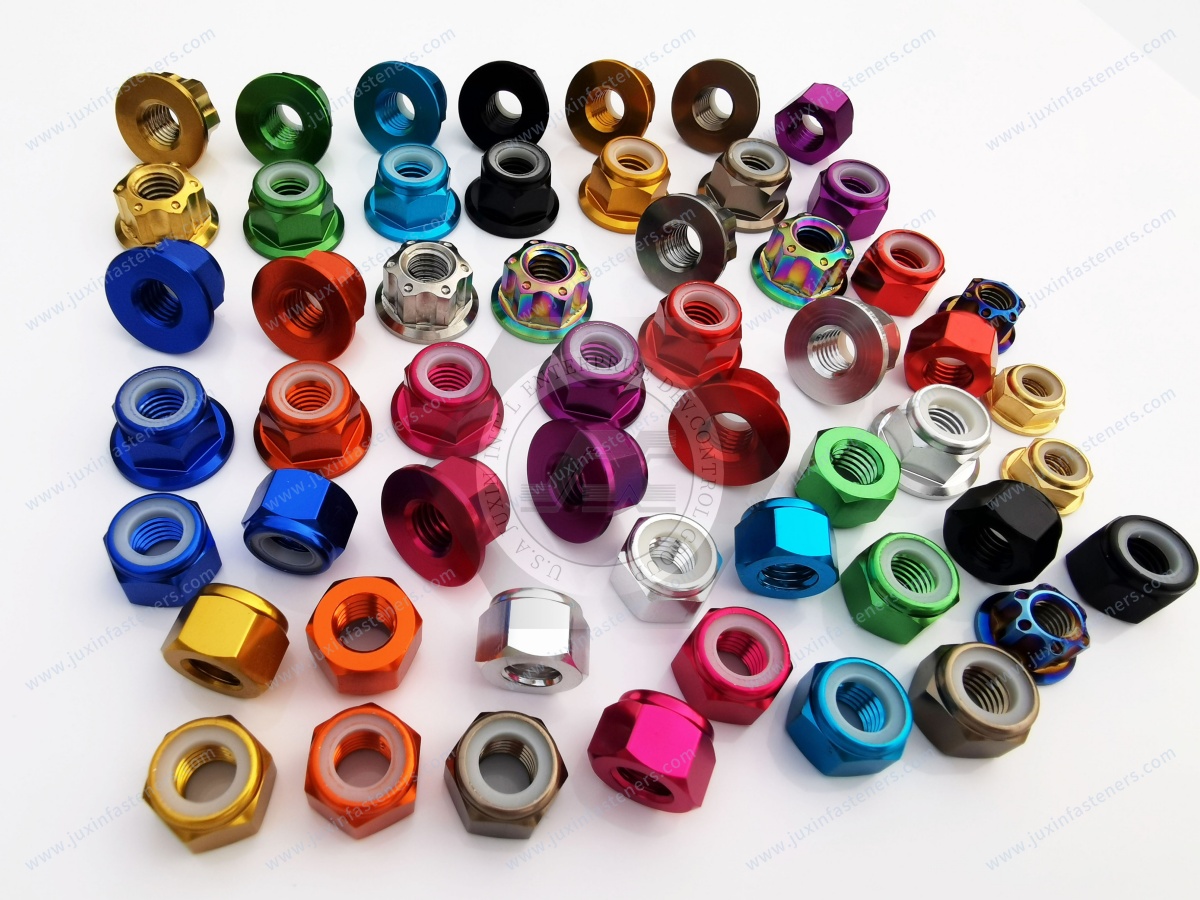
Black, silver, gold, green, purple and other colors serve different appearance requirements.
A change in decorative color does not automatically change the mechanical strength or prevailing-torque performance of the fastener.
For manufacturers using several anodized colors in one product family, consistent drawings and clearly defined color codes can help reduce purchasing and assembly errors.
Metric Thread Sizes M2–M16
The listed product range includes M2, M2.5, M3, M4, M5, M6 and M8.
| Metric Thread | Standard Coarse Pitch (mm) |
|---|---|
| M2 | 0.40 |
| M2.5 | 0.45 |
| M3 | 0.50 |
| M4 | 0.70 |
| M5 | 0.80 |
| M6 | 1.00 |
| M8 | 1.25 |
These are standard metric coarse-thread pitch references.
Actual dimensions, thread tolerances and nylon insert geometry must follow the approved manufacturing drawing.
M2–M4 Miniature Aluminum Lock Nuts
M2, M2.5, M3 and M4 configurations may be considered for compact instruments, miniature robotics, RC racing equipment and lightweight mechanical accessories.
Small aluminum threads require careful torque control and appropriate thread engagement.
M5–M8 Aluminum Lock Nuts
M5, M6 and M8 configurations may be evaluated for selected bicycle accessories, motorsport equipment mounts, machinery covers and lightweight industrial brackets.
The thread diameter alone does not establish suitability for high-load or safety-critical applications.
UNC and UNF Inch-Series Thread References for US OEM Manufacturing
North American manufacturers may request custom lock nuts using Unified National Coarse (UNC) or Unified National Fine (UNF) threads.
The following table lists common inch-series thread designations for engineering reference.
| Nominal Inch Size | UNC Thread | UNF Thread |
|---|---|---|
| #2 | #2-56 UNC | #2-64 UNF |
| #4 | #4-40 UNC | #4-48 UNF |
| #6 | #6-32 UNC | #6-40 UNF |
| #8 | #8-32 UNC | #8-36 UNF |
| #10 | #10-24 UNC | #10-32 UNF |
| 1/4" | 1/4-20 UNC | 1/4-28 UNF |
| 5/16" | 5/16-18 UNC | 5/16-24 UNF |
These thread designations are provided for custom OEM engineering inquiries.
They are not confirmation of existing inventory or established production specifications for this titanium grey aluminum locknut.
Custom inch-series manufacturing requires review of:
Thread designation and tolerance.
Mating bolt requirements.
Aluminum material and temper.
Flange geometry.
Nylon insert design.
Prevailing-torque performance.
Production quantity and tooling feasibility.
Inspection and acceptance criteria.
Metric and UNC/UNF threads are not interchangeable.
Similar nominal diameters do not establish thread compatibility.
How Nylon-Insert Prevailing-Torque Lock Nuts Work
The nylon insert is retained near the upper section of the hexagonal nut.
During installation, the mating bolt engages the nylon insert and creates controlled interference.
This interference generates prevailing torque, which resists relative rotation between the nut and bolt.
The integrated flange provides a broader bearing surface than a conventional hex nut without a washer.
Functional Advantages
Lightweight 6061 aluminum alloy construction.
Prevailing-torque resistance to rotational loosening.
Integrated flange bearing surface.
Titanium grey anodized appearance.
Compact fastening configuration.
Potential reduction in separate washer handling.
Custom dimensions for OEM assemblies.
Color-matched hardware for industrial products.
Prevailing torque does not replace adequate joint preload.
Correct tightening, thread engagement, bearing stress and mechanical design remain essential.
Industrial Applications & Engineering Solutions
1. Bicycle Component Manufacturing
Titanium grey anodized aluminum lock nuts may be considered for selected non-safety-critical bicycle accessories and lightweight equipment mounts.
Potential applications include:
Bicycle lighting brackets.
Cycle computer mounts.
Sensor mounting accessories.
Bottle cage accessory hardware.
Fender and mudguard accessories.
Approved equipment holders.
Color-coordinated bicycle accessories.
The metallic grey finish can complement machined aluminum bicycle components.
Bicycle OEM engineers should verify joint loading, installation torque, fatigue, corrosion and maintenance requirements.
These lock nuts must not automatically replace approved fasteners in brakes, steering, wheel retention or other safety-critical bicycle systems.
2. Mountain Bike Equipment Manufacturing
Mountain bike accessories may experience vibration, repeated impacts, mud, water and frequent servicing.
Titanium grey aluminum lock nuts may be evaluated for approved accessory brackets, protective covers and lightweight equipment mounts.
Engineering requirements include:
Repeated vibration and impact.
Thread stripping resistance.
Fatigue loading.
Galvanic corrosion.
Cleaning chemical exposure.
Anodizing damage.
Maintenance and reuse.
Suspension pivots, braking systems and steering assemblies require separately approved fasteners.
3. Racing Bicycle and Performance Cycling Components
Weight-sensitive racing bicycle accessories may benefit from appropriately engineered aluminum fastening components.
Potential uses include approved instrument brackets, lightweight accessory mounts and non-critical equipment holders.
The titanium grey appearance supports coordinated product design.
Competition use requires appropriate mechanical and fatigue validation.
4. Motorsport and Racing Car Equipment
Titanium grey aluminum lock nuts may be considered for selected non-structural motorsport accessories.
Potential applications include:
Data acquisition brackets.
Dashboard instrument mounts.
Camera accessories.
Non-critical bodywork accessories.
Lightweight equipment covers.
Racing workshop fixtures.
Motorsport engineers should evaluate temperature, vibration, fatigue and joint loading.
These lock nuts must not replace approved fasteners in brakes, steering, suspension, wheel retention, restraints or other safety-critical systems.
5. Racing Motorcycles and Powersports
Potential applications include approved non-critical motorcycle accessories, instrument brackets, decorative covers and lightweight equipment mounts.
The metallic grey finish can complement custom powersports components.
Critical braking, steering, suspension and wheel-related connections require approved fastening specifications.
6. RC Racing Cars and Model Engineering
M2–M4 aluminum lock nuts may be considered for miniature RC racing equipment, compact accessory mounts, protective covers and model engineering assemblies.
Low component mass and coordinated anodized appearance may be beneficial.
Small-thread torque limits and repeated assembly performance must be evaluated.
7. Drone and UAV Accessory Manufacturing
Potential applications include non-flight-critical camera mounts, sensor brackets, protective covers and lightweight accessory supports.
6061 aluminum may reduce component mass compared with equivalent steel geometries.
Flight-critical fastening systems require approved components and independent engineering validation.
8. Robotics and Industrial Automation Manufacturing
Titanium grey aluminum lock nuts may be considered for selected robot-cell accessories, sensor brackets, compact tooling, lightweight equipment mounts and protective covers.
The metallic grey finish can coordinate with machined aluminum components.
Manufacturing engineers should evaluate:
Thread accuracy.
Installation torque.
Dimensional repeatability.
Nylon insert retention.
Prevailing-torque consistency.
Maintenance requirements.
Production batch traceability.
9. Automotive Component Manufacturing
Potential applications include approved non-critical automotive accessories, instrument mounts, lightweight brackets and equipment covers.
Automotive OEM and Tier-1 suppliers must evaluate vibration, temperature, corrosion and joint loading.
Aluminum lock nuts must not automatically replace specified high-strength steel fasteners in structural or safety-critical vehicle assemblies.
10. Electric Vehicle and Battery Pack Manufacturing
Potential applications include approved auxiliary brackets, sensor mounts and non-electrical enclosure accessories.
6061 aluminum may be relevant to lightweight equipment designs.
EV and battery engineers must verify:
Electrical isolation.
Operating temperature.
Vibration and fatigue.
Galvanic compatibility.
Required clamp load.
Fire and safety requirements.
Ordinary nylon-insert aluminum lock nuts are not automatically suitable for high-voltage terminals or critical battery retention.
11. Rail Transit Equipment Manufacturing
Potential applications include approved non-critical interior equipment, instrumentation brackets and auxiliary enclosure hardware.
Rail transit environments may involve vibration, thermal cycling, corrosion and fire-performance requirements.
Nylon insert materials require assessment against the applicable environmental and fire-safety specifications.
Safety-critical railway joints require approved fastening systems.
12. Aerospace Ground Support Equipment Manufacturing
Titanium grey aluminum lock nuts may be evaluated for approved non-flight-critical ground support equipment, maintenance fixtures and workshop accessories.
Aircraft-installed fasteners require approved aerospace specifications, traceability and engineering authorization.
Commercial aluminum lock nuts must not be represented as aerospace-certified without supporting qualification.
13. Electrical Cabinet Manufacturing
Potential applications include lightweight equipment brackets, instrument housings, control cabinet accessories and non-critical mounting hardware.
Anodized aluminum can have different electrical contact characteristics from bare aluminum.
Electrical bonding, grounding and current-carrying requirements must be verified separately.
14. HVAC and Ventilation Equipment Manufacturing
Potential applications include lightweight instrument brackets, ventilation accessories, control-system supports and non-critical equipment covers.
Engineers should evaluate moisture exposure, temperature, vibration and galvanic compatibility.
15. Medical Equipment Manufacturing
Potential applications include approved non-patient-contact instrument brackets, laboratory machinery accessories and lightweight enclosure components.
The titanium grey finish may support coordinated equipment appearance.
Cleaning chemical compatibility, contamination control and regulatory requirements must be evaluated.
These commercial lock nuts are not inherently medical-grade, sterile or suitable for implantable applications.
16. Construction Machinery Manufacturing
Potential applications include auxiliary instrument mounts, lightweight guards, equipment covers and non-structural accessories.
Heavy machinery often requires higher-strength fastening components.
6061 aluminum lock nuts must not replace specified structural steel fasteners without engineering approval.
17. Sheet Metal Fabrication and Industrial Enclosures
The integrated flange provides a wider bearing surface for suitable fabricated brackets and enclosure assemblies.
Engineers should evaluate:
Sheet thickness.
Hole diameter.
Edge distance.
Bearing stress.
Flange seating.
Joint preload.
Where blind-side fastening is required, blind rivet nuts or self-clinching fasteners may be more appropriate.
18. Precision Machinery and Instrumentation Manufacturing
Potential applications include compact instruments, precision equipment brackets, camera accessories and lightweight mechanical housings.
Titanium grey anodizing can support coordinated equipment designs.
Thread accuracy, torque control and repeatable assembly are important manufacturing considerations.
OEM Manufacturing & Custom Production Capabilities
JUXIN FASTENERS provides industrial fastener manufacturing and custom OEM production solutions for international equipment manufacturers and engineering teams.
In addition to standard titanium grey anodized 6061 aluminum nylon-insert hex flange lock nuts, we support made-to-drawing manufacturing for customer-specific fastening requirements.
Custom Manufacturing Options
Customer-supplied 2D engineering drawings and 3D CAD models.
Custom metric and inch-series thread requirements.
Customer-specified 6061 aluminum material temper.
Special flange diameters and nut heights.
Modified wrenching geometry.
Customer-defined dimensional tolerances.
Titanium grey anodizing and approved color matching.
Application-specific nylon insert requirements.
Prevailing-torque performance criteria.
Inspection and traceability documentation.
Prototype and sample evaluation, subject to project requirements.
Repeatable OEM production and industrial batch manufacturing.
Customer-specific packaging and labeling.
Custom configurations are subject to manufacturing feasibility, tooling requirements, production quantity and approval of the final manufacturing drawing.
Manufacturing Support for OEM, Tier-1 and Tier-2 Supply Chains
Industrial OEM manufacturing programs require more than a product name and nominal thread size.
The fastening component must meet the customer's approved engineering, assembly, quality and purchasing requirements.
JUXIN FASTENERS supports technical and commercial review with:
Mechanical and design engineers.
Manufacturing and process engineers.
Production managers.
Purchasing and procurement managers.
Supplier development teams.
Supply chain managers.
OEM and Tier-1/Tier-2 sourcing teams.
For custom aluminum locknut projects, the manufacturing review can address material requirements, dimensional specifications, anodizing, prevailing torque, inspection criteria, tooling feasibility and production scheduling.
From Engineering Drawing to OEM Production
Step 1 – Technical Requirement Review
The customer provides drawings, specifications, operating conditions and estimated production quantities.
Step 2 – Manufacturing Feasibility Evaluation
The technical requirements are reviewed for material selection, dimensions, thread configuration, locking insert design and surface treatment.
Step 3 – Quotation and Production Planning
The commercial quotation is developed around the approved technical requirements, order quantity, tooling needs and manufacturing schedule.
Step 4 – Sample and Drawing Approval
Where required, samples and technical documentation are evaluated against the customer's acceptance criteria before bulk production.
Step 5 – Batch Manufacturing and Inspection
Production and inspection are carried out against the approved manufacturing specification and purchase requirements.
Step 6 – Packaging and Delivery Coordination
Finished components are packaged and prepared according to the agreed order and shipping requirements.
Manufacturing Quality Control and Inspection
For repeatable OEM production, quality planning may include:
6061 aluminum material identification.
Material temper verification.
Dimensional inspection.
Thread gauge inspection.
Flange diameter and nut height verification.
Width-across-flats inspection.
Nylon insert integrity and retention inspection.
Prevailing-torque testing against approved criteria.
Titanium grey anodizing thickness inspection.
Color comparison with approved samples.
Surface appearance inspection.
Corrosion testing where specified.
Lot identification and traceability.
Packaging and shipment inspection.
Inspection methods, sampling plans and acceptance criteria must follow the approved engineering drawing and customer requirements.
Installation and Assembly Engineering Guidelines
Tightening Torque
Aluminum threads may be damaged by excessive tightening.
Installation torque must be established from the actual 6061 material temper, thread size, mating bolt, surface condition and joint requirements.
High-strength steel fastener torque values must not be transferred directly to aluminum lock nuts.
Prevailing Torque and Joint Preload
The nylon insert generates prevailing torque during installation.
The tightening procedure must account for both the locking resistance and the torque required to establish the intended clamp load.
Thread Engagement
The mating bolt must engage the nylon insert sufficiently to establish the required locking function.
Thread engagement and bolt protrusion must follow the approved assembly requirements.
Operating Temperature
The nylon insert limits the permissible operating temperature of the complete fastening system.
Temperature capability depends on the nylon grade, exposure duration, mechanical load and environment.
A service range such as -50°C to +100°C must not be guaranteed without supporting material and performance verification.
Reusability
Reuse may be possible when permitted by the approved specification and when prevailing-torque performance remains acceptable.
Repeated installation can reduce locking resistance.
Damaged nylon inserts or aluminum threads require replacement.
Galvanic Corrosion
Aluminum may experience galvanic corrosion when coupled with dissimilar metals in the presence of moisture.
Mating steel, stainless steel, titanium and copper-alloy components should be evaluated.
Anodizing may provide surface protection but does not eliminate corrosion risk at exposed or damaged areas.
Flange Bearing Surface
The integrated flange provides a wider bearing area but does not automatically eliminate local deformation or the need for a washer.
Engineers should verify bearing stress, hole diameter, mating surface condition and flange geometry.
DIN 6926, ISO 7043 and International Standards
DIN 6926
A historical metric reference for prevailing-torque hex flange nuts with non-metallic inserts, associated primarily with steel configurations.
DIN EN 1663
A European reference for metric coarse-thread prevailing-torque hex flange nuts with non-metallic inserts.
ISO 7043:2012
Specifies metric coarse-thread prevailing-torque hex flange nuts with non-metallic inserts, M5–M20, with steel property classes 8, 9 and 10.
These steel mechanical property classes do not automatically apply to 6061 aluminum.
ISO 12125:2012
Covers specified metric fine-pitch prevailing-torque hex flange nuts with non-metallic inserts, M8–M20.
It is not a direct specification for the listed M2–M8 metric coarse-thread aluminum product range.
DIN EN 1666
A European reference for metric fine-thread prevailing-torque hex flange nuts with non-metallic inserts.
ASME B18.16.6
A United States standard for specified inch-series prevailing-torque locknuts.
Its nylon-insert hex flange configurations cover 1/4-inch through 3/4-inch nominal sizes and carbon steel mechanical requirements.
Miniature #2–#10 aluminum flange locknuts must not be represented as standardized ASME B18.16.6 hex flange products.
NF E 25-413, NF E 25-506 and NF E 25-507
French national fastener standard references whose exact scope, edition and applicability must be confirmed before claiming compliance or equivalence.
Standards Clarification
These standards are not universally interchangeable.
Titanium grey anodized 6061 aluminum nylon-insert flange lock nuts require separately approved material, dimensional, thread and prevailing-torque specifications.
Frequently Asked Questions
Are these lock nuts manufactured from titanium?
No. Titanium grey describes the anodized color. The specified body material is 6061 aluminum alloy.
Does JUXIN FASTENERS support custom aluminum locknut manufacturing?
Yes. JUXIN FASTENERS supports OEM and drawing-based custom manufacturing requirements, subject to technical and production feasibility review.
Can you manufacture custom flange dimensions?
Customer-specific flange diameters, nut heights and dimensional tolerances can be reviewed against approved engineering drawings.
Can you manufacture UNC or UNF aluminum lock nuts?
Custom inch-series requirements can be evaluated for manufacturing feasibility. The reference thread table does not imply stock availability.
What metric sizes are listed?
M2, M2.5, M3, M4, M5, M6 and M8.
Is the material 6061-T6?
The specified alloy is 6061 aluminum. The exact temper must be confirmed through approved material documentation.
Can titanium grey anodizing be matched to an OEM color sample?
Customer-specific color references and physical master samples can be reviewed for anodizing and appearance requirements.
Are these lock nuts suitable for bicycles and mountain bikes?
They may be considered for selected non-safety-critical accessories, subject to engineering validation of vibration, impact, corrosion and joint loading.
Can they be used in motorsport equipment?
They may be considered for approved non-critical equipment accessories. Safety-critical joints require separately approved fasteners.
Are these lock nuts fully compliant with DIN 6926 or ISO 7043?
Not automatically. The aluminum material and smaller sizes require separate specifications and performance verification.
Does anodizing color change the locking performance?
The decorative color itself does not establish a change in prevailing torque. Locking performance depends on the insert, thread geometry and manufacturing requirements.
Can the lock nuts be reused?
Reuse depends on the approved specification and continued performance of the nylon insert and aluminum threads.
What documents are needed for custom manufacturing?
A 2D drawing or 3D CAD model, thread specification, material requirements, dimensional tolerances, anodizing requirements, inspection criteria and production quantities are recommended.
Do you support repeat OEM production orders?
JUXIN FASTENERS supports industrial OEM manufacturing programs and repeat production requirements based on approved specifications and commercial agreements.
Request a Quote – Titanium Grey Aluminum Lock Nut Manufacturing
JUXIN FASTENERS provides manufacturing and custom OEM production support for lightweight aluminum fastening components used in bicycle accessories,
mountain bike equipment, motorsport accessories, robotics, precision machinery and industrial equipment.
We work with OEM manufacturers, Tier-1 and Tier-2 suppliers, design engineers, manufacturing engineers, production managers, procurement managers and global supply chain teams.
For an accurate manufacturing quotation, please provide:
Required metric or UNC/UNF thread designation.
6061 aluminum alloy and material temper requirements.
Flange diameter, nut height and dimensional tolerances.
Titanium grey anodizing specification and approved color reference.
Nylon insert and prevailing-torque requirements.
Operating temperature and environmental conditions.
Mechanical performance and inspection criteria.
Customer 2D engineering drawings or 3D CAD files.
Estimated annual consumption, batch quantity and delivery schedule.
Packaging, labeling, documentation and traceability requirements.
Our team can review your engineering requirements and provide technical and commercial support for suitable custom manufacturing and OEM production programs.
Email: info@juxinfasteners.com
Website: www.juxinfasteners.com
JUXIN FASTENERS – Industrial Fastener Manufacturing, Custom Aluminum Lock Nuts and OEM Engineered Fastening Solutions.
Product Packaging
Packaging Standard
At Juxin Fasteners, we apply standardized export packaging to ensure product protection, traceability, and compliance with international logistics requirements.
1. Standard Export Packaging
Unless otherwise specified, all products will be packed according to our factory standard export packaging, which includes:
Moisture-resistant inner protection
Poly bag or small box packing as required
Reinforced export cartons
Clear labeling with part number, specification, batch number, and quantity
Palletizing for sea or air shipment when necessary
Our standard packaging is designed to ensure safe transportation, efficient warehousing, and long-distance international shipping.
2. Customized Packaging Options
We also provide customized packaging solutions according to customer requirements, including but not limited to:
Private labeling
Customized barcodes
Specific carton dimensions
Retail packaging
Special pallet configuration
Customer-specific marking and identification
So that you know, customized packaging may involve additional costs and extended lead time depending on the complexity of the requirements.
3. Compliance & Quality Assurance
All packaging processes are controlled under our ISO 9001 quality management system to ensure consistency, traceability, and product integrity throughout the supply chain.
Product Pictures


Contact Us
Tel.:
+86 020 8621 0320
+86 020 3121 6067
E-mail:
Technical Support:
Navigation
SEND INQUIREY


