Call Us
+86 136 6007 9809
Call Us
+86 136 6007 9809

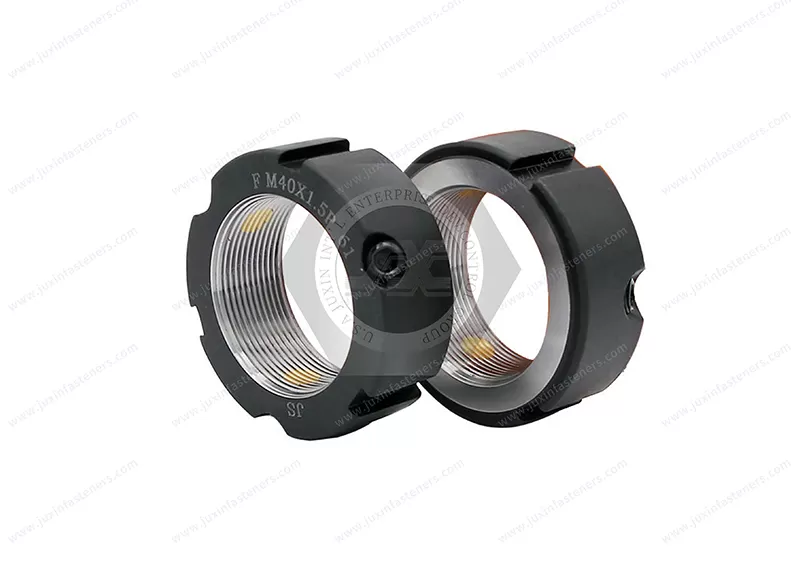
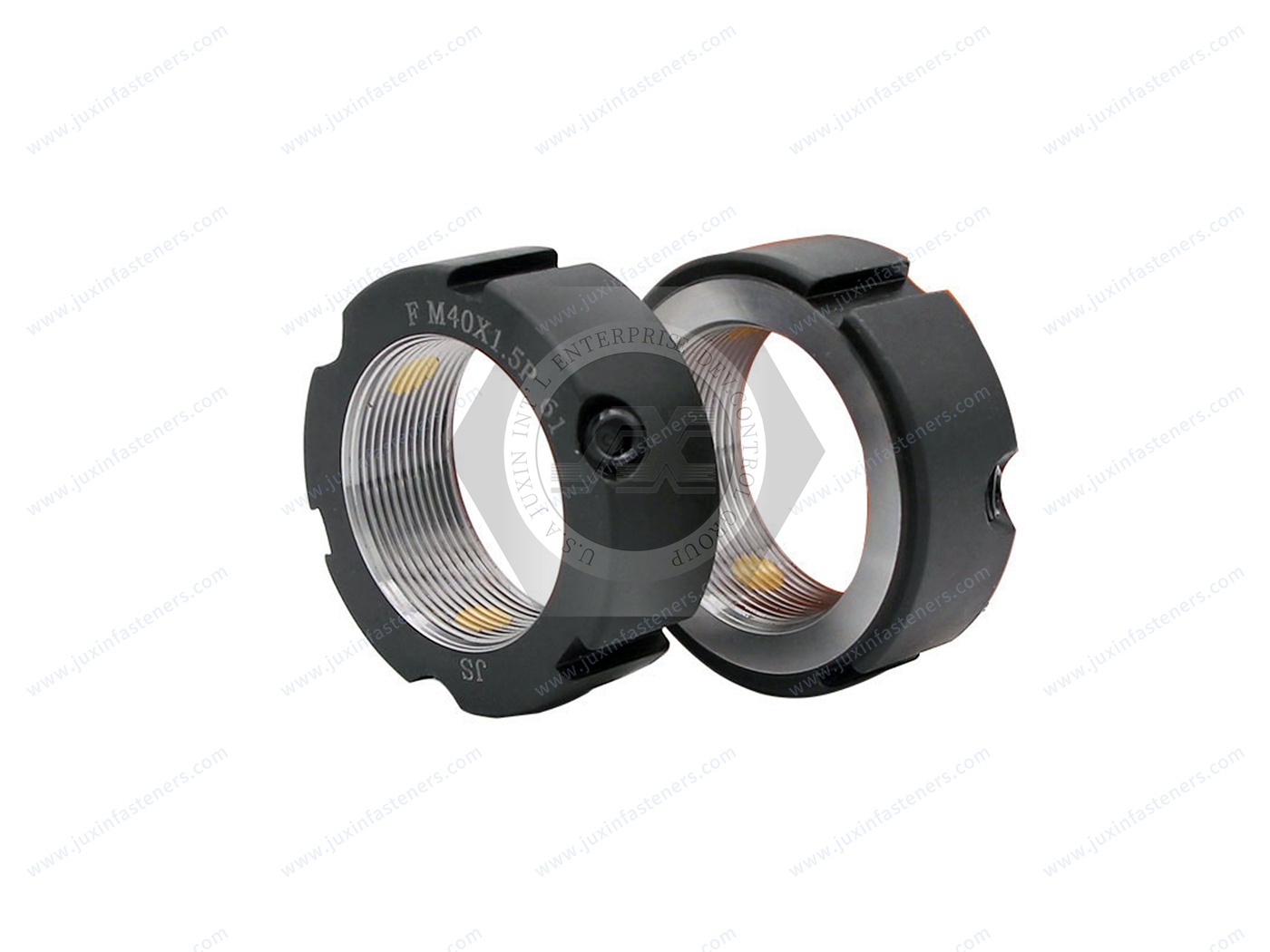
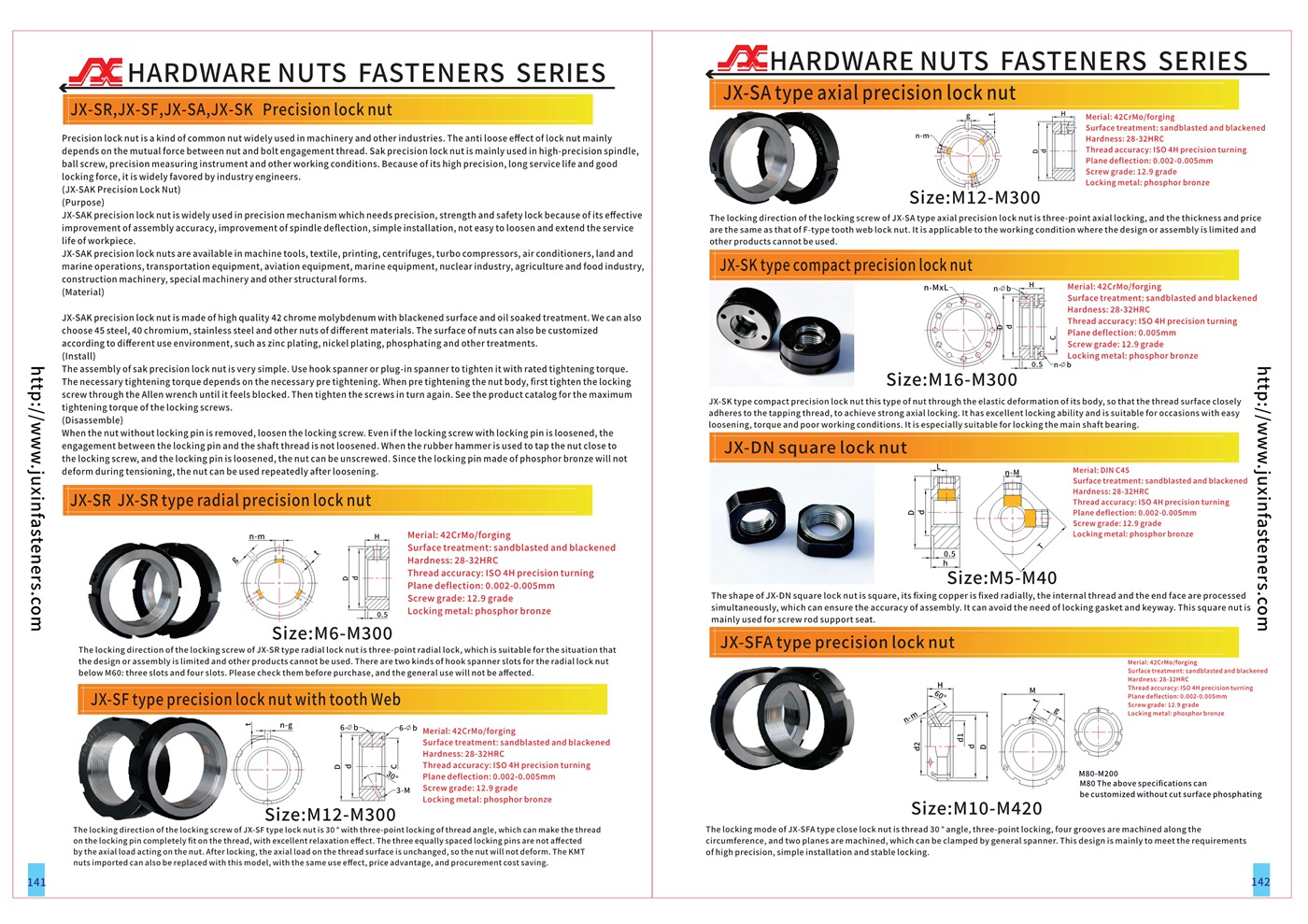
JX-SF Precision Bearing Locknuts from Juxin Fasteners combine a 30° three-point flank-locking mechanism with peripheral spanner slots for installation and adjustment in precision shaft assemblies.
The specified construction includes a 42CrMo forged alloy steel body, black sandblasted finish, quenched-and-tempered hardness of HRC 28–32, ISO 4H internal threads, Grade 12.9 locking screws and phosphor bronze locking inserts.
The supplied technical specification identifies a locating-face runout requirement of 0.002–0.005 mm, subject to manufacturing grade, size and drawing verification.
The JX-SF design is intended for bearing positioning, ball screw support assemblies, machine tool spindles and precision mechanical transmission systems.
The spanner slots provide a tool-engagement feature, while the separate phosphor bronze inserts generate locking resistance at the shaft thread flanks.
Juxin Fasteners is an industrial fastener manufacturer supporting CNC precision machining, OEM/ODM customization, made-to-drawing manufacturing and industrial batch production.
Custom metric fine-thread configurations and inch-series shaft designs can be reviewed according to customer engineering drawings.
Product Specification
JX-SF Precision Bearing Locknuts with Spanner Slots
30° Flank Locking, Phosphor Bronze Inserts and Precision Shaft Positioning for OEM Machine Tool Manufacturing
Juxin Fasteners is an industrial fastener manufacturer providing standard and custom-engineered fastening components for global OEM manufacturers,
machine tool builders, precision transmission manufacturers and industrial automation companies.
The JX-SF Precision Bearing Locknut is designed for precision shaft assemblies requiring controlled axial positioning and secure mechanical locking.
Its distinctive construction combines three functional features:
A precision-machined alloy steel nut body.
Peripheral spanner slots for installation and adjustment.
A 30° three-point flank-locking mechanism using metal locking inserts.
The product is intended for applications involving bearing positioning, ball screw support units, machine tool spindles and precision mechanical assemblies.
Juxin Fasteners supports OEM/ODM fastener manufacturing, made-to-drawing precision metal components, CNC machining and industrial batch production.
Product Technical Specifications
| Parameter | JX-SF Specification |
|---|---|
| Product Model | JX-SF |
| Product Type | Precision Bearing Locknut |
| Locking Method | 30° Three-Point Flank Locking |
| Installation Feature | Peripheral Spanner Slots |
| Nut Body Material | 42CrMo Alloy Steel / Forged Stock |
| Material Condition | Quenched and Tempered |
| Hardness | HRC 28–32 |
| Internal Thread Accuracy | ISO Metric 4H |
| Manufacturing Grade | Precision Turned; Ground Version Subject to Confirmation |
| Specified Face Runout | 0.002–0.005 mm, Depending on Grade and Drawing |
| Locking Screws | Property Class 12.9 |
| Locking Inserts | Phosphor Bronze |
| Surface Treatment | Black Sandblasted Finish |
| Thread Options | Metric Fine; Custom Inch-Series Review |
| Main Applications | Bearing Supports, Spindles, Ball Screws |
| Manufacturing Service | OEM/ODM and Made-to-Drawing Production |
The final dimensions, thread pitch, locking screw size, insert geometry and permissible runout must be confirmed against the approved product drawing.
What Is a JX-SF Precision Bearing Locknut?
The JX-SF is a specialized precision locknut designed to retain and position components on a threaded shaft.
It combines an integrated flank-locking mechanism with external spanner slots.
The nut can be positioned against a bearing inner ring, spacer or other designated shaft component.
After the required axial position has been established, the locking screws are tightened to engage the phosphor bronze inserts with the shaft thread flanks.
The locking mechanism resists unintended rotation of the nut.
The spanner slots are separate installation features that allow the use of a compatible spanner wrench.
Why Spanner Slots Matter
Peripheral spanner slots allow installation torque to be applied through a dedicated wrench engagement feature.
This can be useful where:
The shaft assembly has limited access.
A conventional hex wrench cannot be used.
Precise axial positioning is required.
Bearing preload must be established through a controlled assembly process.
The locknut must be accessible for maintenance.
The slot geometry must match the installation tool.
The required installation torque and bearing preload must be defined by the machine designer.
Spanner Slots Are Not the Locking Mechanism
The external slots and the internal locking mechanism perform different functions.
The slots provide tool engagement.
The phosphor bronze locking inserts provide the flank-locking function.
This distinction is important for engineers searching for precision locknuts with specific installation features.
The term "tooth web" should not be used as the primary engineering description of these external notches.
How the 30° Flank-Locking Mechanism Works
The JX-SF design uses three locking positions distributed around the nut circumference.
Each locking position includes a locking screw and a phosphor bronze insert.
The locking arrangement is inclined approximately 30° relative to the specified radial reference.
When the screws are tightened, the inserts engage the mating shaft thread flanks.
This creates locking resistance while aiming to limit unwanted deformation of the precision nut body.
The locking screws should be tightened according to the approved assembly procedure.
Phosphor Bronze Locking Inserts
Phosphor bronze is specified for the locking inserts.
These components provide the contact interface between the locking screws and the shaft threads.
The insert design is important because it influences:
Thread-flank contact.
Locking force distribution.
Resistance to local thread damage.
Assembly repeatability.
Reuse performance.
The actual insert alloy, hardness and geometry should be confirmed for the required application.
The inserts should not be described as nylon components.
Grade 12.9 Locking Screws
The supplied specification identifies Property Class 12.9 locking screws.
These screws actuate the locking inserts.
The screw property class does not establish the strength of the complete locknut assembly.
The final locking performance also depends on:
Screw dimensions.
Insert geometry.
Thread engagement.
Installation torque.
Nut body material.
Mating shaft thread.
A size-specific tightening torque should be provided in the approved engineering documentation.
42CrMo Alloy Steel Nut Body
The JX-SF nut body is specified as 42CrMo alloy steel manufactured from forged material.
42CrMo is a chromium-molybdenum alloy steel designation.
Related material systems include 42CrMo4 and SCM440, but exact substitution requires verification of the applicable material standard, chemistry, heat treatment and mechanical properties.
The specified hardness is HRC 28–32.
The material and heat-treatment condition should be confirmed through the agreed quality requirements.
Black Sandblasted Surface Finish
The supplied product specification identifies a black sandblasted surface finish.
Sandblasting is a surface preparation process and should not automatically be described as a corrosion-resistant coating.
If black oxide, phosphate treatment, oil protection or another coating is required, the actual finishing system must be specified separately.
Surface treatment requirements may include:
Surface appearance.
Corrosion protection.
Surface roughness.
Coating thickness.
Thread compatibility.
Cleaning and preservation.
The finished surface must not interfere with thread accuracy or locking function.
ISO 4H Internal Thread Accuracy
The JX-SF product specifies ISO metric internal thread tolerance class 4H.
This tolerance designation is relevant to the dimensional accuracy of the internal thread.
It does not automatically guarantee locating-face runout, bearing preload accuracy or locking torque.
These characteristics require separate verification.
Precision Turning and Locating-Face Runout
The supplied technical specification identifies precision turning and a face-runout range of 0.002–0.005 mm.
The exact applicable tolerance must be assigned to each size and manufacturing grade.
| Precision Requirement | Metric Value | Inch Conversion |
|---|---|---|
| High-Precision Target | 0.002 mm | 0.000079 in |
| Precision Target | 0.005 mm | 0.000197 in |
The values represent approximately 2–5 micrometers.
They should not be interpreted as a universal guarantee for all product sizes.
The engineering drawing must define the locating face, measurement datum and inspection method.
Why Locating-Face Runout Matters
A precision locknut may contact a bearing inner ring or a shaft-mounted spacer.
If the locating face is not sufficiently perpendicular to the intended shaft reference, contact conditions may become uneven.
Possible consequences include:
Bearing positioning error.
Uneven contact pressure.
Preload variation.
Increased assembly adjustment.
Reduced rotating-system accuracy.
The required tolerance depends on the bearing arrangement and machine design.
JX-SF vs. Standard F-Type Precision Locknuts
Both products use flank-locking principles, but their individual geometry and installation requirements must be distinguished.
| Feature | JX-SF Precision Locknut | General F-Type Precision Locknut |
|---|---|---|
| Locking Principle | 30° Flank Locking | 30° Flank Locking |
| Primary Page Focus | Spanner-Slot Configuration | General Flank-Locking Mechanism |
| Locking Inserts | Specified Phosphor Bronze | Drawing-Dependent |
| Locking Screws | Specified Class 12.9 | Drawing-Dependent |
| Surface | Black Sandblasted | Product-Dependent |
| OEM Selection | Tool Access and Specific Geometry | General Shaft Positioning |
The two designs should not be assumed dimensionally interchangeable.
The correct part must be selected using its drawing and mating shaft specifications.
Metric Fine-Thread Reference Sizes
Precision bearing locknuts commonly use fine-pitch metric threads.
The following are industry reference configurations for engineering comparison.
| Metric Thread | Pitch | Nominal Diameter in Inches |
|---|---|---|
| M10 × 0.75 | 0.75 mm | 0.3937 in |
| M12 × 1.0 | 1.00 mm | 0.4724 in |
| M15 × 1.0 | 1.00 mm | 0.5906 in |
| M17 × 1.0 | 1.00 mm | 0.6693 in |
| M20 × 1.0 | 1.00 mm | 0.7874 in |
| M25 × 1.5 | 1.50 mm | 0.9843 in |
| M30 × 1.5 | 1.50 mm | 1.1811 in |
| M35 × 1.5 | 1.50 mm | 1.3780 in |
| M40 × 1.5 | 1.50 mm | 1.5748 in |
| M50 × 1.5 | 1.50 mm | 1.9685 in |
| M60 × 2.0 | 2.00 mm | 2.3622 in |
These thread designations are reference examples, not confirmed JX-SF stock sizes.
The actual JX-SF size range must be verified using the corresponding product drawing or catalog.
The inch figures are nominal diameter conversions only.
American Inch-Series Thread References
For American machine tool and bearing equipment manufacturers, custom inch-series precision locknuts may be evaluated according to the approved shaft design.
| Nominal Size | Unified Thread Reference |
|---|---|
| 1/2 in | 1/2-20 UNF |
| 5/8 in | 5/8-18 UNF |
| 3/4 in | 3/4-16 UNF |
| 7/8 in | 7/8-14 UNF |
| 1 in | 1-12 UNF |
| 1-1/4 in | 1-1/4-12 UNF |
| 1-1/2 in | 1-1/2-12 UNF |
These are standard Unified thread references, not confirmed standard JX-SF offerings.
Custom inch-series production requires review of:
Thread diameter and pitch.
Thread tolerance.
Nut outside diameter.
Nut thickness.
Spanner slot geometry.
Locking insert engagement.
Shaft thread material.
Locating-face runout.
Metric and Inch Threads Are Not Interchangeable
Metric, UNC, UNF, BSW and BSF are separate thread systems.
Examples:
M12 × 1.0 is not interchangeable with 1/2-20 UNF.
M20 × 1.0 is not interchangeable with 3/4-16 UNF.
M25 × 1.5 is not interchangeable with 1-12 UNF.
A similar nominal diameter does not establish thread compatibility.
CNC Machine Tool Spindle Manufacturing
Machine tool spindles require accurate positioning of bearings and shaft-mounted components.
The JX-SF design may be evaluated for suitable:
CNC milling machine spindles.
Machining center spindle assemblies.
Precision grinding spindles.
Bearing retaining arrangements.
Serviceable shaft assemblies.
The locknut must match the required thread, locating-face accuracy and bearing assembly procedure.
Ball Screw Bearing Support Assemblies
Ball screw fixed-end supports often require accurate axial retention of bearing components.
Potential applications include:
CNC feed-axis assemblies.
Precision linear motion systems.
Ball screw support bearings.
Industrial actuator assemblies.
Automated positioning equipment.
The locknut should be selected according to the ball screw shaft end geometry and bearing arrangement.
Grinding Machine Applications
Precision grinding equipment may require strict control of bearing positioning and rotating component accuracy.
Relevant engineering requirements include:
Low locating-face runout.
Controlled preload.
Reliable locking.
Consistent assembly procedures.
Accessible adjustment features.
The required performance must be validated for the complete spindle system.
Industrial Automation and Robotics
Potential applications include suitable:
Precision shaft assemblies.
Linear motion components.
Servo-driven mechanical systems.
Industrial positioning mechanisms.
Automated machinery bearing supports.
Dynamic loading, vibration and maintenance requirements must be considered.
Precision Gearbox Manufacturing
Some precision gearboxes require accurately positioned bearings and shaft components.
A JX-SF precision locknut may be evaluated where its geometry and locking method are compatible with the gearbox design.
Axial loading, thermal expansion and lubrication must be reviewed.
Semiconductor Equipment Manufacturing
Precision bearing and motion-control assemblies may be used in semiconductor manufacturing equipment.
Potential applications are limited to mechanically suitable locations.
Cleanroom, vacuum, contamination and outgassing requirements must be evaluated separately.
No semiconductor-equipment qualification is implied.
Industrial Maintenance and Reassembly
Precision locknuts may need to be removed during machine servicing.
The JX-SF design can be considered for applications where the locking screws and inserts remain accessible.
Reuse should only be permitted after inspection of:
Shaft threads.
Nut threads.
Phosphor bronze inserts.
Locking screws.
Locating faces.
Spanner slots.
The allowable reuse condition must follow the equipment manufacturer's procedure.
Installation Engineering
A suitable assembly process should include:
Confirm the shaft thread and nut specification.
Inspect the mating threads.
Clean the bearing locating surfaces.
Use a compatible spanner wrench.
Position the nut according to the bearing assembly requirements.
Establish the specified preload or axial position.
Tighten the three locking screws using the approved procedure.
Verify the final assembly condition.
The installation torque for the nut and the tightening torque for the locking screws are different requirements.
Neither should be guessed.
Common Engineering Problems and Corrective Actions
| Problem | Possible Cause | Recommended Review |
|---|---|---|
| Excessive Face Runout | Incorrect Machining or Datum | Verify Face Runout |
| Bearing Preload Variation | Assembly Error | Review Bearing Stack |
| Thread Damage | Excessive Locking Screw Force | Check Torque and Insert Geometry |
| Spanner Slot Damage | Incorrect Installation Tool | Verify Wrench Fit |
| Locking Performance Loss | Worn Inserts | Inspect Locking Components |
| Difficult Installation | Incorrect Thread Fit | Verify ISO Thread Tolerance |
| Corrosion or Surface Damage | Unsuitable Finish | Review Surface Specification |
| Assembly Misalignment | Incorrect Locating Surfaces | Verify Shaft and Bearing Datums |
Juxin Fasteners Precision Manufacturing Capabilities
Juxin Fasteners is an industrial fastener manufacturer with manufacturing capabilities that include cold heading, cold forming, CNC machining and product-specific secondary operations.
For JX-SF precision locknuts, precision machining is particularly relevant to the product geometry, internal thread requirements, spanner slot features and locating-face accuracy.
The actual manufacturing route is selected according to:
Product geometry.
42CrMo material requirements.
Heat-treatment condition.
Internal thread tolerance.
Locating-face runout.
Locking insert design.
Surface finishing.
Production volume.
Manufacturing feasibility.
Not every JX-SF component necessarily requires every process available within Juxin Fasteners' broader manufacturing capabilities.
OEM/ODM Custom Manufacturing
Juxin Fasteners supports engineering review and made-to-drawing production for custom precision fastening components.
Potential customization requirements include:
Metric fine threads.
Custom inch-series threads.
Special nut outside diameters.
Reduced nut thickness.
Custom spanner slot configurations.
Special locking insert geometry.
Customer-defined locking screw requirements.
Precision-turned locating faces.
Precision-ground locating faces, subject to feasibility.
Specified runout tolerances.
Material and heat-treatment requirements.
Custom surface finishes.
OEM part numbers.
Batch inspection requirements.
Industrial packaging.
All custom specifications are subject to engineering and manufacturing feasibility review.
Quality Inspection and Acceptance
A product-specific inspection plan may include:
Material verification.
Hardness inspection.
Thread gauge inspection.
Thread pitch verification.
Nut thickness measurement.
Outside diameter inspection.
Spanner slot inspection.
Locating-face runout measurement.
Locking screw inspection.
Phosphor bronze insert inspection.
Surface finish inspection.
Functional locking verification.
The actual inspection methods and acceptance limits must be agreed against the approved drawing and purchasing specification.
Engineering Standards and References
ISO 965 Series
Relevant to ISO metric screw-thread tolerances, including internal thread tolerance class 4H.
ISO 261 and ISO 724
Relevant to metric thread designations and basic dimensions.
ASME B1.1
Relevant to Unified inch-series screw threads, including UNF and other specified Unified thread configurations.
Material Specifications
42CrMo material, heat-treatment condition and hardness requirements must be confirmed against the applicable customer-approved material specification.
Customer Engineering Drawings
The final JX-SF design must define the 30° locking arrangement, spanner slots, phosphor bronze inserts, locking screws, thread dimensions and locating-face runout.
A similar appearance to another manufacturer's precision locknut does not establish dimensional interchangeability or certification.
Frequently Asked Questions
What is a JX-SF precision locknut?
It is a precision bearing locknut with external spanner slots and a 30° three-point flank-locking mechanism.
What are the external notches used for?
They provide engagement points for a compatible spanner wrench.
Are the external notches the locking mechanism?
No. Locking is provided by the three phosphor bronze inserts and their locking screws.
What material is specified?
The nut body is specified as 42CrMo forged alloy steel.
What hardness is specified?
HRC 28–32.
What locking screw grade is used?
The supplied specification identifies Property Class 12.9 locking screws.
What is the locking insert material?
Phosphor bronze.
What is the thread accuracy?
ISO metric internal thread tolerance class 4H.
What face runout is specified?
The supplied technical data identifies 0.002–0.005 mm, subject to manufacturing grade, size and drawing verification.
Is the JX-SF the same as a nylon-insert locknut?
No. It uses metal locking inserts rather than nylon.
Can it be used for CNC machine tool spindles?
It may be suitable where the shaft geometry, bearing arrangement and precision requirements have been verified.
Can Juxin Fasteners manufacture custom inch-series designs?
Custom Unified inch-thread precision locknuts can be evaluated against customer drawings.
Can the locknut be reused?
Reuse depends on the condition of the threads, inserts, screws and locating surfaces.
Request a Quote — JX-SF Precision Bearing Locknut Manufacturer
Juxin Fasteners manufactures standard and custom-engineered industrial fasteners and precision metal components for international OEM, Tier-1 and Tier-2 manufacturing programs.
We support JX-SF precision locknut projects involving 30° flank locking, phosphor bronze inserts, spanner slot configurations, metric fine threads and customer-specific shaft assembly requirements.
Recommended RFQ Information
2D engineering drawing or 3D CAD model.
JX-SF model and required geometry.
Shaft thread diameter and pitch.
Metric or Unified inch thread system.
Internal thread tolerance.
Nut outside diameter and thickness.
Spanner slot dimensions.
42CrMo material specification.
Hardness and heat-treatment requirements.
Locking screw dimensions and property class.
Phosphor bronze insert requirements.
Required locating-face runout.
Precision turning or grinding requirement.
Surface treatment specification.
Bearing preload or shaft positioning requirements.
Inspection and functional acceptance criteria.
Initial order quantity and annual purchasing forecast.
Packaging and delivery requirements.
Please send your engineering drawings and purchasing specifications for technical review and manufacturing quotation.
Juxin Fasteners
Industrial Fastener Manufacturer | OEM/ODM Fastener Manufacturing | CNC Precision Components | Made-to-Drawing Industrial Fasteners
Website: https://www.juxinfasteners.com/
Email: info@juxinfasteners.com
Product Packaging
Packaging Standard
At Juxin Fasteners, we apply standardized export packaging to ensure product protection, traceability, and compliance with international logistics requirements.
1. Standard Export Packaging
Unless otherwise specified, all products will be packed according to our factory standard export packaging, which includes:
Moisture-resistant inner protection
Poly bag or small box packing as required
Reinforced export cartons
Clear labeling with part number, specification, batch number, and quantity
Palletizing for sea or air shipment when necessary
Our standard packaging is designed to ensure safe transportation, efficient warehousing, and long-distance international shipping.
2. Customized Packaging Options
We also provide customized packaging solutions according to customer requirements, including but not limited to:
Private labeling
Customized barcodes
Specific carton dimensions
Retail packaging
Special pallet configuration
Customer-specific marking and identification
So that you know, customized packaging may involve additional costs and extended lead time depending on the complexity of the requirements.
3. Compliance & Quality Assurance
All packaging processes are controlled under our ISO 9001 quality management system to ensure consistency, traceability, and product integrity throughout the supply chain.
Product Pictures
Contact Us
Tel.:
+86 020 8621 0320
+86 020 3121 6067
E-mail:
Technical Support:
Navigation
SEND INQUIREY