
Call Us
+86 136 6007 9809
Call Us
+86 136 6007 9809

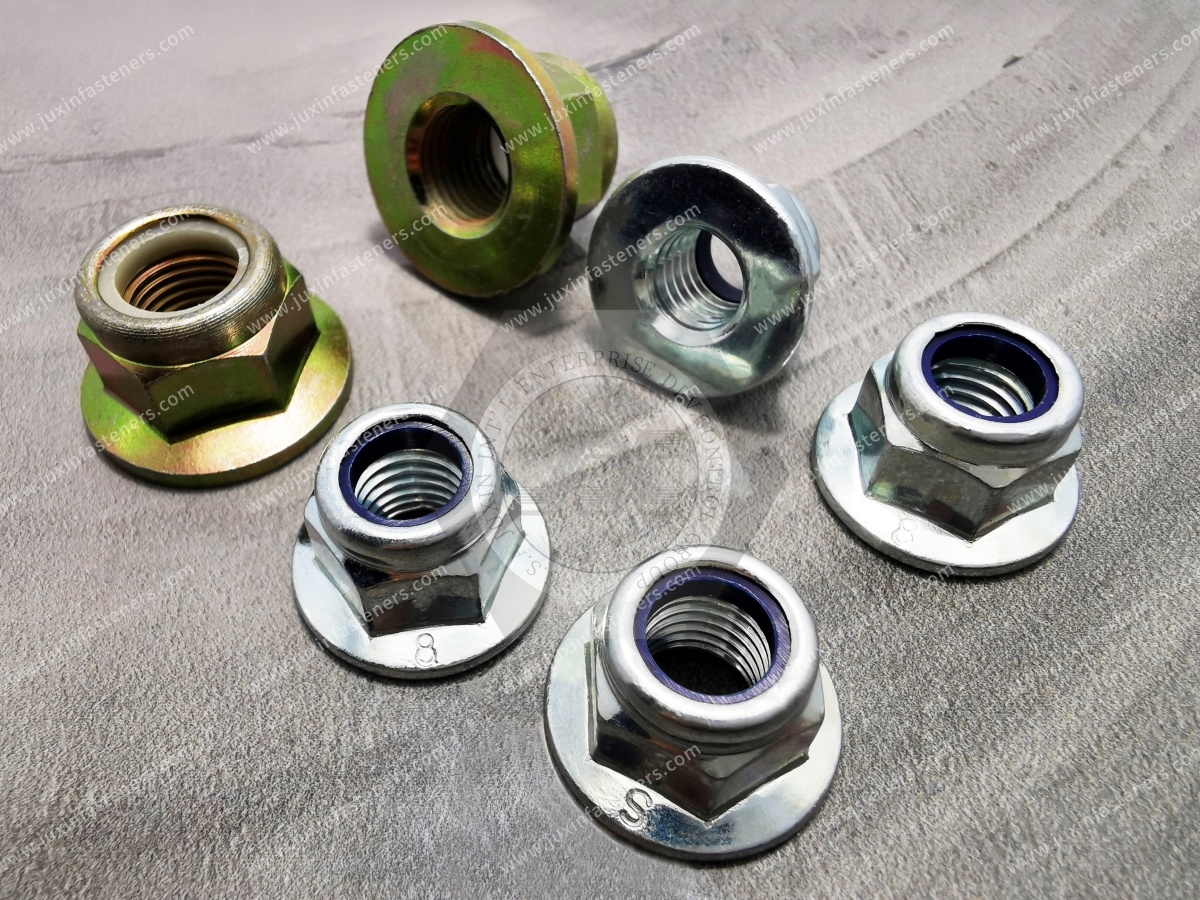
JUXIN FASTENERS supplies DIN 6926 nylon-insert hex flange lock nuts in carbon steel, property classes 8 and 10, with yellow zinc plating. Metric sizes range from M5 to M20.
These prevailing-torque locknuts combine a nylon locking insert with an integrated flange to resist rotational loosening and distribute bearing loads.
Suitable for automotive, industrial machinery, electrical enclosures and OEM assemblies.
Custom dimensions, coatings and inch-series requirements can be reviewed against customer specifications.
Product Specification
DIN 6926 Nylon-Insert Hex Flange Lock Nuts – Class 8 & 10, Yellow Zinc Plated
JUXIN FASTENERS supplies DIN 6926 nylon-insert hex flange lock nuts manufactured from carbon steel in property classes 8 and 10, with yellow zinc plating for industrial fastening applications.
Also known as nylon insert flange locknuts, prevailing-torque hex flange nuts, non-metallic insert flange nuts and vibration-resistant flange lock nuts,
these fasteners combine a nylon locking insert with an integral flange to provide rotational locking resistance and a wider bearing surface.
Designed for industrial OEM assemblies, they are suitable for engineering evaluation in automotive components,
EV battery equipment, industrial machinery, electrical cabinets, robotics, HVAC systems and other mechanical fastening applications.
Product Specifications
| Parameter | Specification |
|---|---|
| Product Name | Nylon-Insert Hex Flange Lock Nuts |
| Standard Designation | DIN 6926 / ISO 7043 |
| Material | Carbon Steel |
| Property Class | Class 8 / Class 10 |
| Surface Finish | Yellow Zinc Plated / Yellow Passivated Zinc |
| Metric Sizes | M5, M6, M8, M10, M12, M14, M16, M20 |
| Thread Type | Metric Coarse; Fine Thread by Specification |
| Locking Mechanism | Non-Metallic Nylon Insert, Prevailing Torque |
| Flange Configuration | Integral Hex Flange, Non-Serrated |
| Related Standards | DIN 6926, ISO 7043, DIN EN 1663 |
| Fine-Thread References | ISO 12125, DIN EN 1666 |
| Inch-Series Reference | ASME B18.16.6 |
| Customization | Thread, Dimensions, Coating and Packaging |
| Technical Documentation | Product Drawings, PDF, CAD and Inspection Requirements Subject to Availability |
Engineering Note: DIN, ISO, EN and ASME standards are not automatically interchangeable. Confirm the applicable edition, thread system,
dimensions, mechanical properties and prevailing-torque requirements before production or substitution.
Metric Sizes and DIN 6926 Dimensional Reference
The following values are commonly published for DIN 6926 nylon-insert hex flange lock nuts.
They are preliminary dimensional references and must be verified against the approved manufacturing drawing.
| Thread | Pitch (mm) | AF (mm) | Max. Height (mm) | Max. Flange Dia. (mm) |
|---|---|---|---|---|
| M5 | 0.8 | 8 | 7.1 | 11.8 |
| M6 | 1.0 | 10 | 9.1 | 14.2 |
| M8 | 1.25 | 13 | 11.1 | 17.9 |
| M10 | 1.5 | 15 | 13.5 | 21.8 |
| M12 | 1.75 | 18 | 16.1 | 26.0 |
| M14 | 2.0 | 21 | 18.2 | 29.9 |
| M16 | 2.0 | 24 | 20.3 | 34.5 |
| M20 | 2.5 | 30 | 24.8 | 42.8 |
AF refers to width across flats. Overall height includes the flange.
Important: M10 wrenching dimensions can differ between DIN 6926 and related EN/ISO configurations. Verify the applicable specification before substitution.
UNC and UNF Inch-Series Nylon-Insert Flange Lock Nuts
For United States and North American industrial procurement,
nylon-insert hex flange lock nuts may also be specified using Unified National Coarse (UNC) and Unified National Fine (UNF) thread systems.
ASME B18.16.6 covers specified inch-series prevailing-torque lock nuts, including nylon-insert hex flange configurations.
Common UNC and UNF Thread References
| Nominal Size | UNC | UNF |
|---|---|---|
| 1/4" | 1/4-20 UNC | 1/4-28 UNF |
| 5/16" | 5/16-18 UNC | 5/16-24 UNF |
| 3/8" | 3/8-16 UNC | 3/8-24 UNF |
| 7/16" | 7/16-14 UNC | 7/16-20 UNF |
| 1/2" | 1/2-13 UNC | 1/2-20 UNF |
| 9/16" | 9/16-12 UNC | 9/16-18 UNF |
| 5/8" | 5/8-11 UNC | 5/8-18 UNF |
| 3/4" | 3/4-10 UNC | 3/4-16 UNF |
These are engineering reference thread designations, not confirmation of stock availability for every size.
Metric and UNC/UNF threads are not interchangeable. Similar nominal diameters do not guarantee compatibility because thread pitch, profile and tolerances differ.
Class 8 vs. Class 10 Nylon-Insert Flange Lock Nuts
Class 8 – Medium-Strength Steel Lock Nuts
Class 8 carbon steel flange lock nuts are commonly selected for industrial fastening systems using appropriately matched metric bolts.
Typical applications include machinery brackets, equipment frames, enclosures, motor supports and general mechanical assemblies.
Class 10 – High-Strength Steel Lock Nuts
Class 10 flange lock nuts provide higher specified mechanical performance than Class 8 versions and are suitable for higher-load applications when used with compatible bolts and correctly engineered joints.
Potential applications include industrial power transmission equipment, heavy machinery, pumps, motors and selected vehicle components.
Mechanical property selection must follow applicable standards, including ISO 898-2 where relevant. Bolt strength, proof load, thread engagement and joint preload must be evaluated together.
For inch-series products, ASME B18.16.6 uses separate grading designations, including N2, N5 and N8. These must not be directly equated with metric Class 8 or Class 10.
How Nylon-Insert Flange Lock Nuts Resist Rotational Loosening
A nylon locking ring is retained inside the upper portion of the nut. When the mating bolt enters the insert, the nylon deforms around the external thread and produces prevailing torque.
This resistance to relative rotation helps reduce loosening caused by vibration and repeated mechanical movement.
The integrated flange provides a larger bearing surface and may reduce localized surface pressure compared with a conventional hex nut without a washer.
Key Engineering Advantages
Prevailing-torque resistance to rotational loosening.
Integrated flange for wider bearing-load distribution.
Reduced need for separate washers in suitable applications.
Potential simplification of automated assembly processes.
Multiple mechanical property class options.
Suitable for drawing-based OEM production programs.
Compact fastening arrangement for industrial machinery.
Prevailing torque does not replace proper bolt preload. Insufficient clamp load, joint separation and severe transverse loading can still cause joint failure.
Yellow Zinc Plating and Corrosion Protection
Yellow zinc plated nylon-insert flange lock nuts provide a protective zinc-based coating on the carbon steel body.
The yellow or iridescent finish is commonly specified for industrial fastening components requiring moderate corrosion protection and a recognizable plated appearance.
Coating Selection and Performance
Corrosion resistance depends on zinc coating thickness, passivation chemistry, supplementary sealers, installation conditions and environmental exposure.
For OEM applications, coating requirements may include:
Specified zinc plating thickness.
Trivalent passivation where required.
RoHS and REACH documentation where applicable.
Neutral salt spray performance requirements.
Surface appearance and coating uniformity.
Hydrogen embrittlement risk control where applicable.
Coating compatibility with tightening torque requirements.
Yellow zinc plating should not automatically be described as hexavalent-chromium-free or RoHS compliant. Coating chemistry and supporting documentation must be verified.
For highly corrosive or chemically aggressive environments, alternative coatings or materials may be required.
Industrial Applications & Engineering Solutions
1. Automotive Fastening Systems
Nylon-insert hex flange lock nuts can be considered for automotive brackets, auxiliary equipment mounts, vehicle interior assemblies and selected vibration-exposed mechanical components.
The prevailing-torque mechanism helps resist rotational loosening, while the integrated flange provides a broader bearing surface.
Automotive engineers should evaluate vibration, temperature, corrosion resistance, joint preload and application-specific quality requirements.
Safety-critical automotive assemblies require separate engineering validation and appropriate production approval.
2. Electric Vehicles and EV Battery Pack Assemblies
Potential applications include battery enclosure brackets, cooling-system supports, auxiliary equipment frames and non-electrical mechanical mounting components.
The integrated flange may simplify fastening arrangements where assembly efficiency and bearing area are important.
EV battery engineers must evaluate vibration resistance, electrical isolation, thermal exposure, corrosion compatibility and service requirements.
Standard nylon-insert lock nuts should not be assumed suitable for high-voltage electrical connections,
critical battery retention or high-temperature environments without application-specific validation.
3. Rail Transit and Railway Equipment
Potential applications include railway interior fittings, equipment enclosures, access panels, auxiliary support brackets and selected non-critical mechanical assemblies.
Rail transit environments introduce vibration, thermal cycling, corrosion and fire-performance requirements.
Where applicable, the nylon insert and complete fastening system must meet relevant railway specifications.
Standard industrial lock nuts are not automatically approved for railway safety-critical assemblies.
4. Aerospace Ground Support and Aviation Equipment
DIN 6926 industrial flange lock nuts may be evaluated for non-flight-critical ground support equipment, workshop fixtures, maintenance machinery and approved auxiliary applications.
Aircraft-installed fasteners require approved aerospace specifications, traceability and engineering authorization.
Standard industrial flange lock nuts must not be represented as aerospace-certified replacements.
5. Electrical Cabinets and Power Distribution Equipment
Potential applications include electrical cabinet frames, enclosure mounting brackets, equipment support rails, control panel structures and power distribution cabinet accessories.
The integrated flange can simplify mechanical fastening and distribute bearing loads across suitable metal surfaces.
Electrical bonding, grounding continuity, protective coatings and clearance requirements must be independently verified.
A nylon-insert flange lock nut does not automatically establish a reliable grounding connection.
6. HVAC and Ventilation Equipment
Nylon-insert flange lock nuts can be used in suitable HVAC equipment frames, fan supports, ductwork brackets, mechanical housings and vibration-exposed mounting assemblies.
The integrated flange may reduce separate washer handling and simplify assembly operations.
Service temperature, moisture exposure, vibration and maintenance requirements must be evaluated before selection.
7. Industrial Machinery, Pumps and Motors
These lock nuts are suitable for appropriately engineered machinery brackets, motor supports, pump mounting hardware, conveyor systems, protective guards and equipment frames.
Class 8 and Class 10 configurations support different mechanical performance requirements.
For rotating machinery, engineers should consider vibration, operating temperature, joint preload and service accessibility.
8. Robotics and Industrial Automation
Robotics applications may include automation frames, robot-cell guarding, tooling brackets, actuator supports and auxiliary mounting structures.
Repeated motion and cyclic loading require appropriate bolt preload, joint stiffness and verification of prevailing-torque performance.
For automated assembly lines, consistent thread quality, coating friction and dimensional control help maintain repeatable fastening operations.
9. Sheet Metal Fabrication and Metal Enclosures
Integrated flange lock nuts provide a wider bearing surface for suitable sheet-metal brackets, formed metal components, enclosure frames and fabricated assemblies.
Engineers should verify hole diameter, sheet thickness, edge distance, flange seating and local material deformation.
Where blind-side installation is required, blind rivet nuts or self-clinching fasteners may be more appropriate.
10. Construction Machinery and Equipment
Potential applications include equipment guards, machinery brackets, service panels, auxiliary structural components and mechanical support assemblies.
Fastener selection should consider environmental exposure, vibration, dynamic loading and maintenance requirements.
Structural connections governed by specific construction codes must use approved fastening systems rather than unverified substitutions.
11. Medical Equipment and Laboratory Machinery
Potential applications include approved non-patient-contact equipment brackets, instrument frames, laboratory machine enclosures and auxiliary mechanical assemblies.
Engineers must evaluate cleanliness, chemical exposure, temperature, corrosion resistance and applicable equipment requirements.
Ordinary yellow zinc plated carbon steel lock nuts should not be represented as medical-grade, sterile or implantable fasteners.
Installation and Assembly Engineering Guidelines
Bolt and Nut Thread Compatibility
Confirm the nominal thread diameter, pitch, tolerance and compatible mechanical property requirements.
Metric coarse, metric fine, UNC and UNF thread systems must not be mixed.
Tightening Torque and Joint Preload
Nylon-insert lock nuts generate prevailing torque during installation.
The tightening procedure must account for this resistance and the torque required to establish the intended clamp load.
Coating friction, lubrication, bolt strength and clamped material properties affect the relationship between tightening torque and achieved preload.
Use validated assembly torque requirements rather than assuming a universal tightening value.
Nylon Insert Engagement
The mating bolt must sufficiently engage the nylon insert to establish the required prevailing-torque function.
Thread engagement and bolt protrusion requirements should follow the applicable standard and approved assembly drawing.
Reusability and Maintenance
Nylon-insert lock nuts may be reused when permitted by the applicable specification and when the insert continues to meet the required locking performance.
Repeated installation can reduce prevailing torque.
Nuts with damaged inserts, worn threads or insufficient locking resistance should be replaced.
Operating Temperature
The nylon insert limits the permissible operating temperature of the complete fastening system.
High-temperature applications may require an all-metal prevailing-torque lock nut or another engineered locking method.
The actual insert material and continuous service temperature must be verified before selection.
Flange Bearing Surface
Ensure that the flange seats against a suitable mating surface without interference, excessive deformation or damage.
The integrated flange does not automatically replace a hardened washer or specialized bearing arrangement in every joint design.
OEM Quality Control and Inspection Requirements
For industrial OEM and repeat production programs, quality planning may include:
Material grade and chemical composition verification.
Mechanical property and proof-load requirements.
Thread gauge inspection and tolerance verification.
Width-across-flats and overall nut height inspection.
Flange diameter and geometry verification.
Nylon insert integrity and retention inspection.
Prevailing-torque performance testing.
Zinc plating thickness and appearance inspection.
Corrosion testing where specified.
Lot identification and production traceability.
Packaging and shipment inspection.
Relevant standards may include ISO 898-2 for mechanical properties, ISO 2320 for prevailing-torque steel nuts and ISO 4042 for electroplated fastener coatings, where applicable.
Inspection methods, sampling plans and acceptance criteria should follow the applicable standard and customer purchase specification.
DIN 6926, ISO 7043 and ASME B18.16.6 Comparison
DIN 6926: Legacy metric designation for nylon-insert hex flange lock nuts.
ISO 7043: International standard for metric coarse-thread prevailing-torque hexagon flange nuts with non-metallic inserts.
DIN EN 1663: European standard associated with metric coarse-thread nylon-insert hex flange nuts.
ISO 12125: Metric fine-thread prevailing-torque hexagon flange nuts with non-metallic inserts.
DIN EN 1666: European fine-thread nylon-insert flange nut specification.
ASME B18.16.6: United States inch-series prevailing-torque lock nut standard, including specified nylon-insert hex flange configurations.
These standards should not be treated as universally interchangeable.
Product substitution requires verification of dimensions, thread system, mechanical properties, locking performance and applicable standard editions.
Custom OEM Nylon-Insert Flange Lock Nut Solutions
JUXIN FASTENERS supports technical review of standard and drawing-based industrial lock nut requirements.
Potential customization areas include:
Metric coarse and fine-thread configurations.
UNC and UNF inch-series flange lock nut inquiries.
Class 8 and Class 10 carbon steel options.
Yellow zinc and alternative specified coatings.
Customized flange dimensions and nut heights.
Application-specific prevailing-torque requirements.
Customer-defined inspection and documentation.
Industrial bulk packaging and production supply.
Drawing-based custom fastener development.
Customized configurations are subject to technical feasibility, tooling requirements, production quantity and approval of the final product drawing.
Frequently Asked Questions
What is a DIN 6926 nylon-insert flange lock nut?
It is a hexagonal flange nut with a non-metallic insert that produces prevailing torque against the mating bolt thread.
The flange provides an integrated bearing surface.
Are DIN 6926 and ISO 7043 interchangeable?
They describe closely related metric nylon-insert flange lock nut configurations, but dimensional differences may exist.
Confirm the applicable edition and approved product drawing before substitution.
What is the difference between Class 8 and Class 10 flange lock nuts?
Class 10 provides higher specified mechanical performance than Class 8.
Selection must consider bolt compatibility, proof load, preload and operating conditions.
Are yellow zinc plated lock nuts suitable for outdoor use?
Suitability depends on coating thickness, passivation, environmental exposure and corrosion testing.
Severe outdoor or chemically aggressive environments may require enhanced protection.
Can DIN 6926 nuts be used with UNC or UNF bolts?
No. Metric DIN 6926 threads are not interchangeable with UNC or UNF threads. A separately specified inch-series nut is required.
Can nylon-insert flange lock nuts be reused?
Reuse may be possible when permitted by the applicable standard and when the nut continues to meet prevailing-torque requirements.
Reuse should not be assumed for critical assemblies.
Can these lock nuts be used at high temperatures?
The nylon insert has temperature limitations. The insert material and complete joint must be evaluated for the actual operating temperature.
What information is required for an OEM quotation?
Customers should provide the thread designation, applicable standard, mechanical property class, coating specification, dimensions,
estimated order quantity, technical requirements and drawings where available.
Request a Quote – DIN 6926 Nylon-Insert Hex Flange Lock Nuts
JUXIN FASTENERS supplies industrial fastening components for OEM manufacturers,
Tier-1 and Tier-2 suppliers, machinery builders, engineering teams and global procurement organizations.
For an accurate technical and commercial quotation, please provide:
Required DIN, ISO, EN or ASME standard.
Metric or UNC/UNF thread designation.
Required mechanical property class or grade.
Material and surface coating specification.
Flange dimensions, nut height and dimensional tolerances.
2D engineering drawings or 3D CAD files, if available.
Prevailing-torque and inspection requirements.
Estimated annual consumption and purchase quantity.
Packaging, documentation and delivery requirements.
Our team can review standard and customized fastener requirements and provide quotation support for suitable industrial production programs.
Email: info@juxinfasteners.com
Website: www.juxinfasteners.com
JUXIN FASTENERS – Industrial Lock Nuts, OEM Fastening Components and Custom Engineered Fastener Solutions.
Product Packaging
Packaging Standard
At Juxin Fasteners, we apply standardized export packaging to ensure product protection, traceability, and compliance with international logistics requirements.
1. Standard Export Packaging
Unless otherwise specified, all products will be packed according to our factory standard export packaging, which includes:
Moisture-resistant inner protection
Poly bag or small box packing as required
Reinforced export cartons
Clear labeling with part number, specification, batch number, and quantity
Palletizing for sea or air shipment when necessary
Our standard packaging is designed to ensure safe transportation, efficient warehousing, and long-distance international shipping.
2. Customized Packaging Options
We also provide customized packaging solutions according to customer requirements, including but not limited to:
Private labeling
Customized barcodes
Specific carton dimensions
Retail packaging
Special pallet configuration
Customer-specific marking and identification
So that you know, customized packaging may involve additional costs and extended lead time depending on the complexity of the requirements.
3. Compliance & Quality Assurance
All packaging processes are controlled under our ISO 9001 quality management system to ensure consistency, traceability, and product integrity throughout the supply chain.
Product Pictures


Contact Us
Tel.:
+86 020 8621 0320
+86 020 3121 6067
E-mail:
Technical Support:
Navigation
SEND INQUIREY


