Call Us
+86 136 6007 9809
Call Us
+86 136 6007 9809

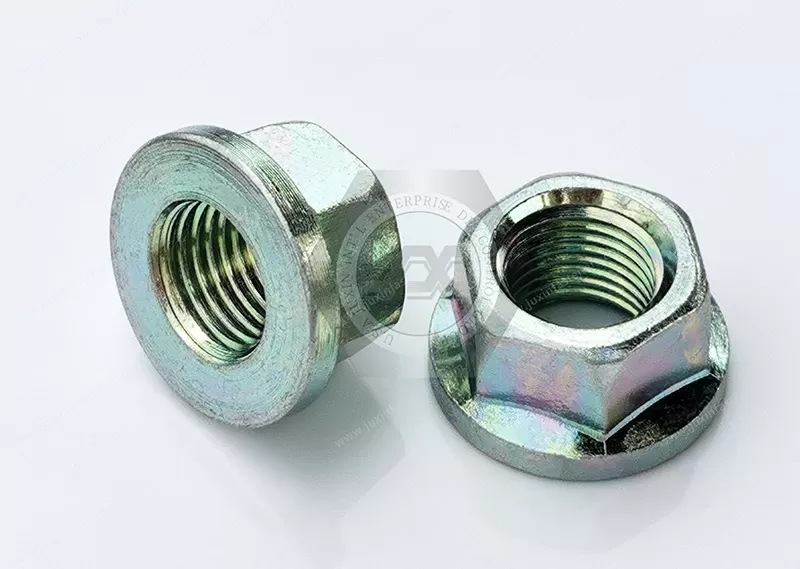
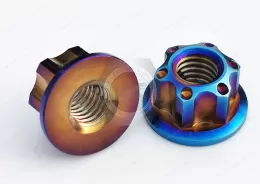
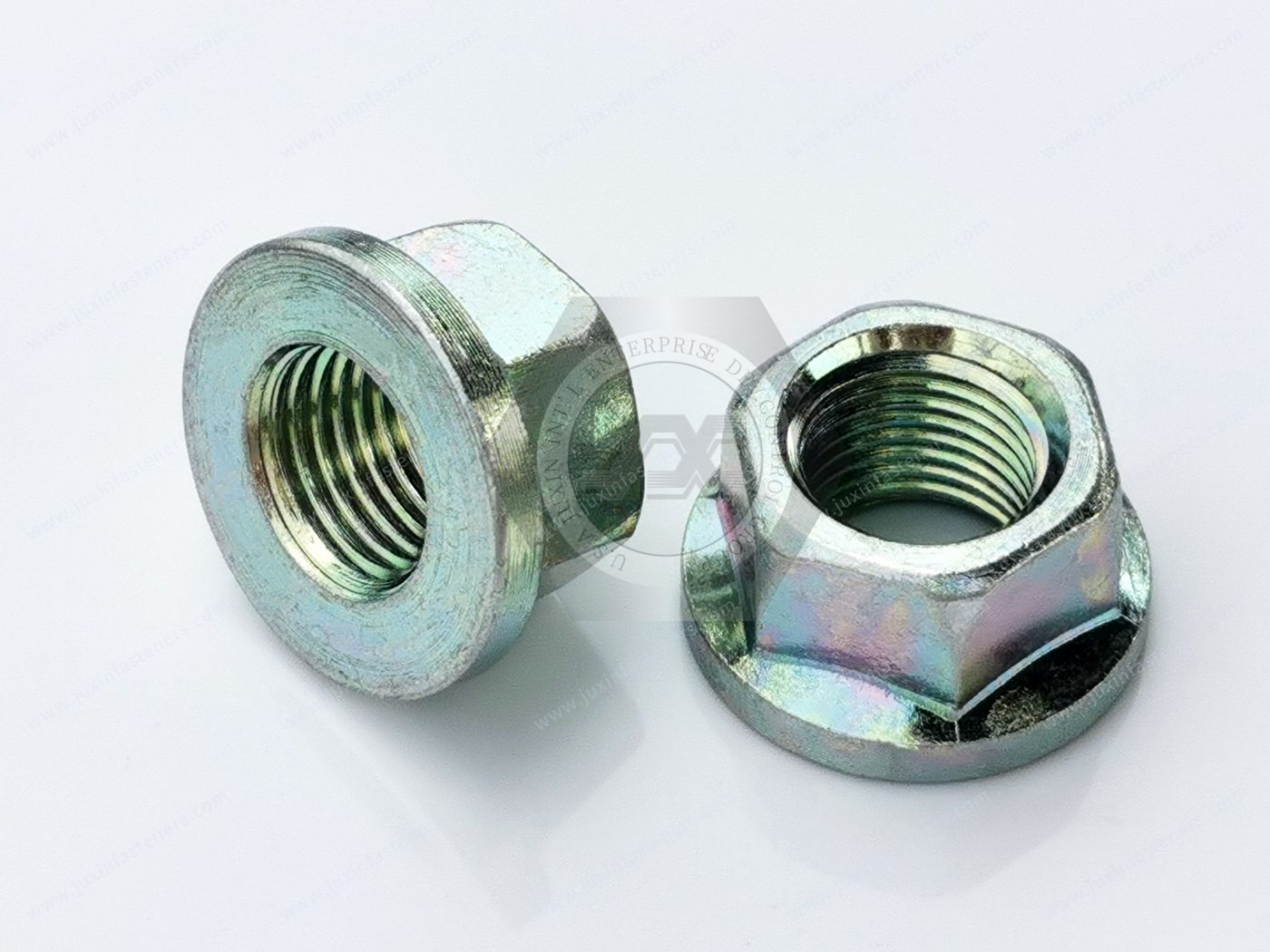
JUXIN FASTENERS supplies high-strength high-profile hex flange nuts for automotive OEMs, Tier-1/Tier-2 suppliers, commercial vehicles, industrial machinery and custom high-strength bolted assemblies.
The extended-height hexagonal body provides increased available wrench engagement and internal thread length compared with shorter nut configurations,
while the integrated flange provides a wider bearing surface without a separate washer where the joint design permits.
Materials include carbon steel and specified alloy steel, including 40Cr, with metric Property Class 10 mechanical requirements.
The featured finish is RoHS-compliant yellow/iridescent zinc plating with a specified 192-hour neutral salt spray requirement, subject to documented test criteria.
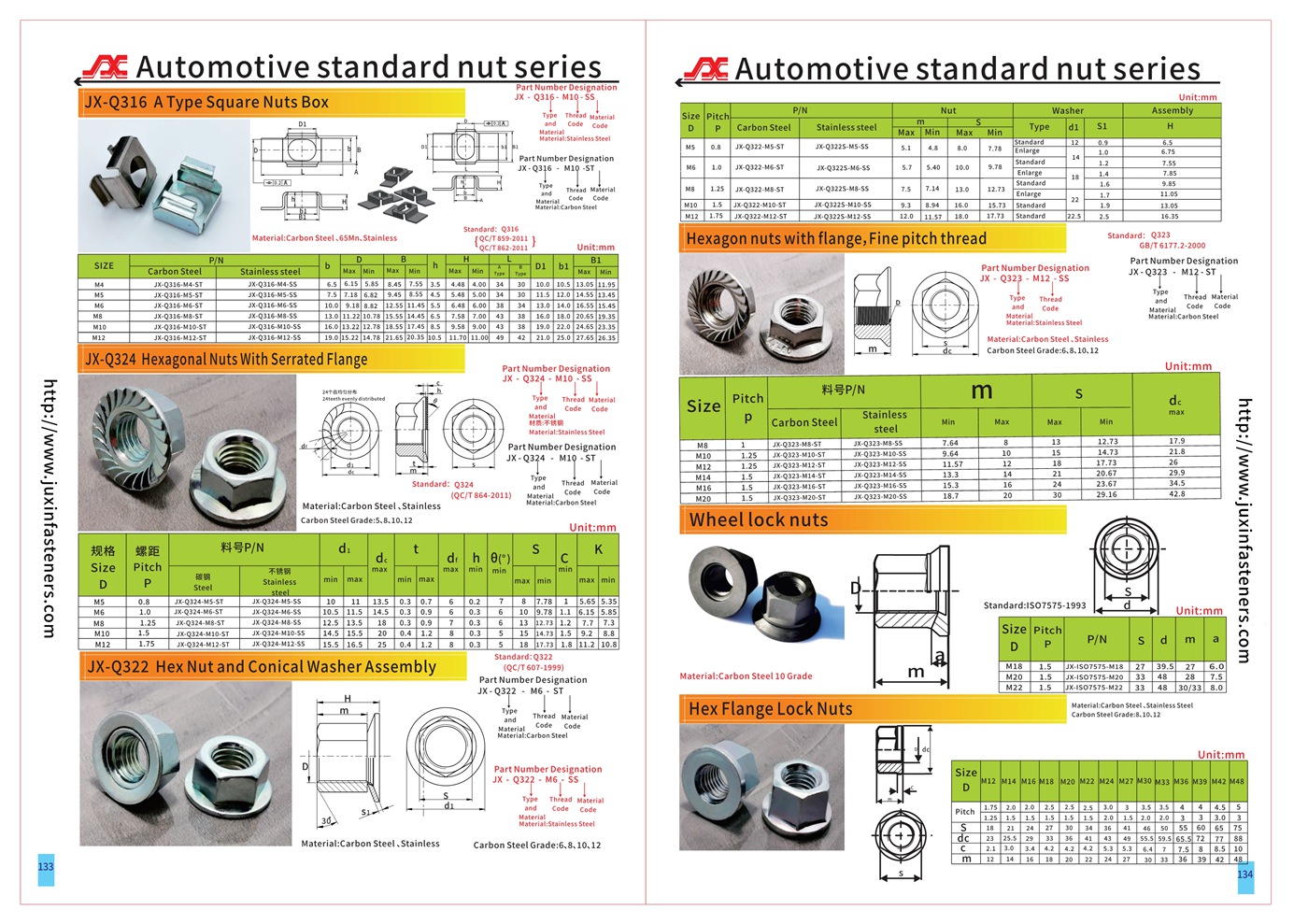
Original catalog sizes include M4–M20, with exact nut height, thread pitch and dimensional standard conformity subject to approved drawings.
We support engineering review, custom dimensions, quality documentation and bulk OEM RFQs.
Product Specification
High-Strength High-Profile Hex Flange Nuts – Class 10 Steel
Extended-Height Hex Flange Nuts for Automotive OEMs, Industrial Equipment and High-Strength Bolted Assemblies
JUXIN FASTENERS supplies high-strength high-profile hex flange nuts for automotive OEM manufacturers, Tier-1 and Tier-2 suppliers, commercial vehicle producers,
industrial equipment manufacturers, and international engineering and procurement teams.
High-profile hex flange nuts combine an extended-height hexagonal body with an integrated flange bearing surface.
Compared with shorter nut configurations of otherwise comparable geometry, the taller body provides greater available wrench engagement height and internal thread length.
The integrated flange increases the bearing contact area compared with a conventional hex nut without a flange.
In compatible joints, this can eliminate the need for a separate washer and simplify component handling.
The featured product specification includes carbon steel or specified alloy steel, including 40Cr, metric Property Class 10 requirements,
and RoHS-compliant yellow/iridescent zinc plating with a specified 192-hour neutral salt spray requirement.
JUXIN FASTENERS supports custom OEM flange nut sourcing based on approved engineering drawings, mechanical requirements,
coating specifications, quality documentation, and production quantities.
Product Overview and Technical Specifications
| Specification | Details |
|---|---|
| Product Name | High-Strength High-Profile Hex Flange Nuts |
| Primary Product Category | High-Profile Flange Nuts |
| Configuration | Extended-Height Hexagonal Nut with Integrated Flange |
| Material | Carbon Steel or Specified Alloy Steel |
| Alloy Steel Option | 40Cr, Subject to Approved Material Specification |
| Mechanical Property | Metric Nut Property Class 10 |
| Featured Finish | Yellow/Iridescent Zinc Plating |
| Passivation | RoHS-Compliant System as Specified |
| Corrosion Requirement | 192 Hours Neutral Salt Spray |
| Test Acceptance Criteria | According to Approved Test Specification |
| Original Dimensional Reference | DIN 6923 |
| Related Dimensional Reference | ISO 4161, Where Applicable |
| Mechanical Property Reference | ISO 898-2, Where Applicable |
| Original Catalog Sizes | M4, M5, M6, M8, M10, M12, M14, M16, M20 |
| Thread Pitch | According to Approved Drawing |
| Nut Height | High-Profile Configuration; Drawing Verification Required |
| Flange Bearing Surface | According to Approved Drawing |
| Custom Production | Subject to Engineering Review |
| Primary Markets | Automotive OEM, Commercial Vehicles and Industrial Equipment |
Important Product Classification
High-profile flange nuts, standard-profile flange nuts, low-profile flange nuts, and distorted-thread flange locknuts are different product configurations.
The featured product should be classified according to its actual body height, thread geometry, flange design, and mechanical properties.
A taller body does not automatically indicate a locking feature or conformity to a particular dimensional standard.
What Are High-Profile Flange Nuts?
High-profile flange nuts are hexagonal nuts designed with greater body height than a specified standard-profile reference.
The extended body offers additional available tool engagement height and internal thread length.
The flange provides an integrated bearing surface.
These features can be useful where a joint requires:
Increased wrench or socket contact height.
Additional available internal thread length.
An integrated flange bearing surface.
High-strength threaded fastening.
Controlled assembly and inspection.
A customer-specific nut geometry.
The suitability of the design depends on the mating bolt or stud, actual thread engagement, installation access, and joint loading.
High-Profile vs. Standard-Profile Flange Nuts
A standard-profile flange nut has the body height defined by its applicable design or standard.
A high-profile flange nut uses an extended body height.
Potential Advantages of an Extended-Height Design
More available wrench engagement height.
Additional available internal thread length.
Potential suitability for specific extended-engagement joints.
Greater flexibility for customer-defined nut dimensions.
Engineering Limitation
A taller nut does not automatically provide higher proof-load capacity.
Mechanical performance depends on the nut property class, effective thread engagement, material, heat treatment, and mating fastener.
The exact height difference must be confirmed dimensionally. A universal percentage increase should not be assumed.
High-Profile Flange Nuts vs. Hexagonal Jam Nuts
These products should not be confused.
A hexagonal jam nut is generally a thin nut used in specified adjustment or locking arrangements.
A high-profile flange nut is an extended-height configuration.
A product cannot be accurately classified as both a thin jam nut and a high-profile nut without explaining a special design.
For OEM procurement, the drawing dimensions take precedence over legacy catalog terminology.
High-Profile Flange Nuts vs. Distorted-Thread Locknuts
A distorted-thread locknut uses an intentionally deformed internal thread region to produce prevailing torque.
A high-profile flange nut is primarily defined by its extended height and integrated flange.
The featured product should not be described as a prevailing-torque locknut unless its thread design includes a verified locking feature.
High-Profile Flange Nuts vs. Serrated Flange Nuts
Flange nuts may use plain or serrated bearing surfaces.
Plain Flange Nuts
Use a non-serrated bearing face to transfer clamping load.
Serrated Flange Nuts
Use serrations intended to engage the mating surface.
The flange underside must be identified from the approved engineering drawing.
A plain flange should not be marketed as a vibration-locking feature.
Extended Wrench Engagement for Automotive Assembly
One potential advantage of a high-profile nut is its increased available wrench engagement height.
In automated or manual assembly, tool engagement affects installation reliability.
Important Engineering Factors
Width across flats.
Hexagonal body height.
Socket depth.
Tool clearance.
Socket-to-nut fit.
Installation orientation.
Surface coating.
Assembly torque.
Practical Engineering Insight
Increasing nut height can improve available socket contact, but it may also reduce installation clearance.
Production engineers should verify the complete tool envelope before approving an extended-height nut.
Additional Thread Length and Effective Engagement
A taller nut provides more available internal thread length.
However, this does not guarantee that more threads are engaged during installation.
Effective engagement depends on:
Mating bolt or stud thread length.
Nut internal thread length.
Thread pitch.
Thread tolerance.
Thread runout.
Joint stack height.
Required bolt protrusion.
Engineering Selection Principle
A longer nut is beneficial only when the mating fastener provides the required usable thread length and the joint geometry supports the design.
The actual thread engagement should be calculated or verified rather than assumed.
Integrated Flange Bearing Surface
The flange distributes clamping load over a wider contact area than the base of a comparable hex nut without a flange.
This can be useful when the joint design requires additional bearing support.
Potential Benefits
Wider bearing area.
Reduced local bearing pressure under suitable conditions.
Integrated washer-like function.
Reduced loose-component handling.
Simplified assembly inventory.
Important Limitation
An integrated flange is not a universal substitute for every washer.
Some joints require a hardened washer, insulating washer, locking washer, or customer-specific bearing component.
The flange diameter and bearing face must be compatible with the mounting surface.
Oversized and Irregular Mounting Holes
An integrated flange can provide additional bearing coverage around certain oversized or irregularly shaped holes.
However, flange coverage alone does not establish joint suitability.
Engineering Checks
Hole diameter and shape.
Minimum remaining bearing area.
Flange outside diameter.
Material thickness.
Bearing stress.
Joint slip resistance.
Bolt position.
Clamp-force requirements.
Critical Design Consideration
A flange nut should not be used to compensate for an unacceptable hole condition without engineering approval.
The joint must maintain adequate bearing support and structural integrity.
Metric Property Class 10 High-Strength Steel
The featured product is specified as metric Nut Property Class 10.
This is a mechanical property classification for certain metric nuts.
It is different from Property Class 10.9, which is commonly used for bolts and studs.
Relevant Mechanical Standard
ISO 898-2 specifies mechanical properties for certain carbon steel and alloy steel nuts.
Actual conformity depends on the applicable dimensions, property class, testing requirements, and standard scope.
Mechanical Verification May Include
Proof load.
Hardness.
Thread strength.
Material properties.
Heat treatment.
Dimensional conformity.
Mating fastener compatibility.
A nominal Class 10 designation must be supported by the appropriate production and inspection requirements.
Selecting Compatible High-Strength Bolts and Studs
Nut and bolt selection must be based on the complete joint specification.
Important Variables
Bolt property class.
Nut property class.
Thread diameter.
Thread pitch.
Thread tolerance.
Effective engagement.
Required preload.
Fatigue loading.
Operating temperature.
Surface treatment.
A high-strength nut should not be selected solely because its nominal strength designation appears similar to that of the bolt.
Carbon Steel and 40Cr Alloy Steel
The featured material information identifies carbon steel and specified alloy steel, including 40Cr.
Material selection must account for:
Chemical composition.
Heat treatment.
Mechanical strength.
Hardness.
Thread performance.
Fatigue requirements.
Coating compatibility.
Dimensional stability.
The approved material specification determines the final manufacturing requirements.
RoHS-Compliant Yellow/Iridescent Zinc Plating
The featured finish is environmentally compliant yellow or iridescent zinc plating.
For professional OEM procurement, coating specifications should identify the actual process rather than appearance alone.
A coating specification may include:
Zinc electrodeposition.
Chromium(VI)-free passivation.
Coating thickness.
Optional sealer.
Friction requirements.
Corrosion performance.
Appearance requirements.
Important Compliance Distinction
A yellow or iridescent appearance does not independently establish RoHS compliance.
The actual coating chemistry and supporting material declarations must meet the applicable requirements.
192-Hour Neutral Salt Spray Requirement
The featured product is specified with 192 hours of neutral salt spray performance.
Neutral salt spray testing is commonly conducted according to ISO 9227 or ASTM B117.
The test report should identify:
Test method.
Exposure duration.
Coating system.
Specimen condition.
Acceptance criteria.
White corrosion evaluation.
Red rust evaluation.
Test results.
Engineering and Procurement Insight
A statement of “192 hours NSS” is incomplete unless the required corrosion endpoint is defined.
For example, the absence of white corrosion products and the absence of red rust are different acceptance criteria.
The final product specification must match the approved coating test report.
Neutral salt spray results are accelerated laboratory measurements and should not be treated as a direct prediction of field service life.
High-Strength Fasteners and Hydrogen Embrittlement Risk
Electroplated high-strength steel fasteners require careful process control because hydrogen introduced during manufacturing or plating may create an embrittlement risk.
Important Controls May Include
Material hardness.
Surface preparation.
Plating process.
Hydrogen embrittlement prevention.
Appropriate post-plating treatment.
Mechanical testing.
Customer-specific specifications.
The applicable process and verification requirements should be defined by the OEM and coating specification.
Coating Friction and Torque–Tension Performance
The coating system affects friction during tightening.
Important Factors
Thread friction.
Flange bearing friction.
Zinc coating.
Passivation.
Sealer or lubricant.
Bolt surface condition.
Tightening method.
Assembly temperature.
Engineering Requirement
Changing the coating or lubricant may change the relationship between applied torque and achieved clamping force.
Torque values must be validated for the actual joint configuration.
Automotive OEM Application Solutions
1. Automotive Chassis Brackets
Automotive chassis brackets require reliable bolted connections and controlled installation.
Engineering Challenge
Joint strength, tool access, bearing contact, and corrosion protection must be coordinated.
Potential Fastening Solution
A Class 10 high-profile flange nut may be evaluated where the design requires an extended wrench engagement height and integrated bearing surface.
2. Automotive Subframe Assemblies
Subframe assemblies may experience repeated dynamic loads.
Engineering Challenge
Fastener strength, joint preload, and fatigue performance must meet the vehicle manufacturer's requirements.
Potential Fastening Solution
A drawing-approved high-strength flange nut may be considered where its dimensions and mechanical properties match the specified joint.
3. Suspension Support Brackets
Suspension-related brackets may experience vibration and variable loading.
Engineering Challenge
Maintaining the specified clamping force is essential.
Potential Fastening Solution
A high-strength flange nut may be evaluated with an appropriate locking strategy and validated tightening procedure.
The flange alone should not be treated as a self-locking mechanism.
4. Powertrain Mounting Brackets
Powertrain mounting assemblies may have restricted installation access.
Engineering Challenge
The nut must provide adequate tool engagement without interfering with surrounding components.
Potential Fastening Solution
An extended-height hex flange nut may be considered when the available assembly clearance supports its use.
5. Engine and Transmission Support Structures
Engine and transmission support connections require controlled mechanical performance.
Engineering Challenge
Material strength, thread engagement, and clamp-force consistency are important.
Potential Fastening Solution
A Property Class 10 flange nut may be evaluated as part of an approved high-strength bolted assembly.
6. Commercial Vehicle Chassis
Truck and bus structures contain numerous engineered bolted joints.
Engineering Challenge
High service loads and demanding environments require controlled fastening specifications.
Potential Fastening Solution
A high-profile steel flange nut may be considered where the approved chassis design requires its geometry and strength.
7. Electric Vehicle Battery Enclosure Mounting
EV battery enclosures contain mechanical mounting connections.
Engineering Challenge
Joint strength, corrosion protection, electrical isolation, and service access may all affect fastener selection.
Potential Fastening Solution
A drawing-approved flange nut may be evaluated for suitable structural mounting points.
Electrical isolation and galvanic corrosion requirements must be checked separately.
8. Automotive Manufacturing Fixtures
Production tooling and fixtures require repeatable assembly and maintenance.
Engineering Challenge
Frequent installation or adjustment may create tool-access challenges.
Potential Fastening Solution
A high-profile flange nut may be useful where additional wrench engagement height improves the available tool interface.
Industrial Equipment Application Solutions
9. Hydraulic Pump Mounting
Pump mounting joints require suitable clamp force and mechanical strength.
High-profile flange nuts may be evaluated where extended tool engagement and integrated bearing support are beneficial.
10. Electric Motor Mounting
Motor mounting assemblies can experience vibration and cyclic loading.
A high-strength flange nut may be used in a validated joint with the appropriate locking strategy.
11. Industrial Valves and Actuators
Valve and actuator support connections require controlled fastening.
The selected nut must match the mechanical, environmental, and maintenance requirements.
12. Industrial Machinery Frames
Machinery frames use bolted connections to maintain alignment and structural integrity.
High-profile flange nuts may be evaluated for suitable frame and bracket joints.
13. Construction Equipment
Construction machinery may require high-strength fasteners in demanding environments.
A drawing-approved Class 10 flange nut may be considered for compatible mechanical connections.
14. Agricultural Machinery
Agricultural equipment may experience vibration, dirt, and moisture.
Material, coating, joint design, and locking requirements must be validated for the intended environment.
15. Energy Equipment and Industrial Power Systems
Energy equipment may contain structural frames, brackets, and serviceable bolted joints.
High-profile flange nuts may be evaluated where their geometry, mechanical strength, and corrosion requirements are appropriate.
16. Electrical Equipment Enclosures
Electrical equipment may require mechanical fastening of brackets, frames, and supporting components.
Selection must consider mechanical loading, electrical clearance, grounding, and corrosion requirements.
17. Rail-Related Industrial Equipment
Rail maintenance equipment and supporting machinery may use high-strength bolted assemblies.
Any application must meet the relevant project-specific engineering and quality requirements.
Production Engineering and Assembly Efficiency
Production managers evaluate fasteners based on more than unit price.
Important considerations include:
Assembly cycle time.
Tool engagement.
Component handling.
Installation clearance.
Clamp-force consistency.
Rework rates.
Traceability.
Quality inspection.
Production continuity.
Potential Advantages
A high-profile flange nut may offer:
Additional available wrench engagement.
Integrated bearing support.
Reduced loose washer handling in compatible joints.
Additional internal thread length.
A single preassembled fastening component.
Important Production Tradeoff
The increased height may require additional installation clearance or different socket geometry.
Production teams should validate the assembly process before changing from a standard-height nut.
Engineering Selection Checklist
Before approving a high-profile flange nut, engineers should verify:
Actual nut height.
Width across flats.
Flange diameter.
Flange thickness.
Flange bearing surface geometry.
Thread diameter.
Thread pitch.
Thread tolerance.
Effective thread engagement.
Material and property class.
Heat treatment.
Surface treatment.
Friction requirements.
Mating bolt compatibility.
Installation clearance.
Required proof load.
Joint vibration and fatigue requirements.
Applicable dimensional standards.
Procurement and Supplier Qualification Checklist
For OEM purchasing and supply chain teams, the following information helps prevent sourcing errors:
Approved 2D drawing.
3D CAD model, where available.
Exact material specification.
Mechanical property requirements.
Heat treatment specification.
Surface treatment specification.
RoHS compliance evidence.
Corrosion test requirements.
Critical dimensional tolerances.
Required inspection documentation.
Production quantity.
Annual forecast.
Packaging specification.
Delivery requirements.
Change-control expectations.
Information Gain: Why Nut Height Alone Is Not Enough
A taller flange nut may appear mechanically superior because it contains more material and provides additional thread length.
However, engineering approval requires more than a height comparison.
1. Thread Engagement Must Be Real
Additional internal thread length has no benefit if the mating bolt does not engage the additional threads.
2. Bearing Area Must Be Adequate
A larger flange must be supported by sufficient mounting material.
3. Tool Access Must Be Verified
A taller nut can improve socket contact while creating interference in restricted spaces.
4. Property Class Must Be Verified
Nut height does not replace mechanical property testing.
5. Coating Must Be Included in Joint Validation
Coating friction and corrosion requirements can affect fastening performance.
6. Locking Performance Is a Separate Requirement
A taller body and integrated flange do not automatically prevent vibration loosening.
These six checks help engineering and procurement teams avoid selecting a fastener based solely on its appearance or catalog name.
DIN 6923 and ISO 4161 Dimensional References
DIN 6923 is a recognized reference for hexagon flange nuts.
ISO 4161 specifies Style 2 hexagon flange nuts within its defined dimensional and thread scope.
Important Standard Qualification
A custom high-profile flange nut may have dimensions outside the relevant standard.
The actual height, flange geometry, thread size, and other dimensions must be compared with the applicable standard before claiming conformity.
Where the product differs, the approved customer drawing should define the required configuration.
ISO 898-2 Mechanical Requirements
ISO 898-2 is a relevant reference for mechanical properties of specified carbon steel and alloy steel metric nuts.
For Property Class 10, the required mechanical performance must be verified according to the applicable standard and customer specification.
Metric Thread Size Range
The original product information identifies the following nominal sizes:
| Size | Thread Pitch |
|---|---|
| M4 | Drawing Confirmation Required |
| M5 | Drawing Confirmation Required |
| M6 | Drawing Confirmation Required |
| M8 | Drawing Confirmation Required |
| M10 | Drawing Confirmation Required |
| M12 | Drawing Confirmation Required |
| M14 | Drawing Confirmation Required |
| M16 | Drawing Confirmation Required |
| M20 | Drawing Confirmation Required |
Important Size Qualification
The original catalog size range does not independently confirm that every size is supplied in Property Class 10 or in the same high-profile geometry.
Availability and conformity must be verified by part number and drawing.
Metric Coarse and Fine Threads
Metric flange nuts may use different thread pitches.
The correct designation must be specified.
For example, M10 alone does not identify every possible fine-thread configuration.
The approved drawing must define the required pitch and tolerance.
American Inch-Series Thread References
American OEMs may specify Unified inch-series threads such as:
1/4"-20 UNC
5/16"-18 UNC
3/8"-16 UNC
1/2"-13 UNC
1/2"-20 UNF
5/8"-11 UNC
5/8"-18 UNF
These are market reference designations, not confirmation of availability for this specific product.
Metric and Inch-Series Compatibility
Metric, UNC, and UNF threads are not interchangeable.
The mating fastener must match the exact thread system, diameter, pitch, tolerance, and mechanical requirements.
Quality Inspection and Production Verification
Dimensional Controls
Nut height.
Width across flats.
Flange outside diameter.
Flange thickness.
Bearing face geometry.
Thread dimensions.
Thread pitch.
Thread tolerance.
Critical drawing tolerances.
Mechanical Controls
Material verification.
Heat treatment.
Hardness.
Proof load.
Thread strength.
Property class verification.
Coating Controls
Zinc plating specification.
Coating thickness.
Passivation type.
RoHS compliance documentation.
Neutral salt spray testing.
Defined corrosion acceptance criteria.
Thread fit after coating.
Assembly Controls
Socket engagement.
Thread engagement.
Torque–tension performance.
Clamp-force consistency.
Bearing surface condition.
Joint-level validation.
Automotive Quality Documentation
Depending on customer requirements, supporting documents may include:
Approved engineering drawings.
Material certificates.
Heat treatment records.
Dimensional inspection reports.
Mechanical test reports.
Coating reports.
Salt spray test reports.
First article inspection.
Production lot traceability.
Process control records.
PPAP documentation, where required.
Documentation must be supported by actual manufacturing and inspection records.
Common Engineering Problems and Corrective Considerations
Insufficient Socket Engagement
Check the actual hexagonal height, socket depth, and tool fit.
Insufficient Thread Engagement
Verify the mating bolt thread length and usable internal thread length.
Thread Stripping
Review mechanical property compatibility, thread dimensions, and tightening conditions.
Excessive Bearing Pressure
Check the flange bearing area and mounting surface material.
Inconsistent Clamp Force
Review coating friction, lubrication, and tightening procedure.
Unexpected Corrosion
Review the coating system, test acceptance criteria, and operating environment.
Thread Interference After Plating
Verify coating thickness and thread allowance.
Vibration Loosening
Evaluate the joint preload and required locking strategy.
Incorrect Product Classification
Confirm whether the part is high-profile, standard-profile, low-profile, or a prevailing-torque locknut.
Incorrect Standard Claim
Verify actual dimensions before specifying DIN 6923 or ISO 4161 conformity.
Custom High-Profile Flange Nuts for OEM Programs
JUXIN FASTENERS supports custom flange nut inquiries based on customer drawings and engineering specifications.
Potential custom requirements include:
Extended nut height.
Custom flange diameter.
Custom flange thickness.
Metric coarse or fine threads.
Inch-series threads, subject to feasibility.
Carbon steel or specified alloy steel.
40Cr material specifications.
Property Class 10 mechanical requirements.
Customer-defined heat treatment.
RoHS-compliant zinc plating.
Specified corrosion performance.
Friction requirements.
Dimensional tolerances.
Mechanical testing.
Quality documentation.
Bulk production packaging.
Manufacturing feasibility and actual supply conditions must be confirmed during technical review.
Frequently Asked Engineering and Procurement Questions
What is a high-profile flange nut?
A hexagonal flange nut with an extended body height compared with a specified standard-profile design.
Why choose a high-profile flange nut?
It provides additional available wrench engagement height and internal thread length.
Does a taller nut automatically provide greater strength?
No. Mechanical strength depends on material, property class, effective thread engagement, and joint design.
Can a high-profile flange nut replace a washer?
In compatible joints, the integrated flange may eliminate a separate washer. The joint design must be verified.
Is a high-profile flange nut the same as a jam nut?
No. Jam nuts are generally thin; high-profile nuts are taller.
Is a high-profile flange nut self-locking?
Not automatically. A locking feature must be separately specified.
What is the correct strength classification?
For the featured metric high-strength nut, Property Class 10 is the intended designation.
Is Property Class 10 the same as Class 10.9?
No. Class 10.9 is commonly used for bolts and studs.
What materials are specified?
Carbon steel and specified alloy steel, including 40Cr.
What coating is featured?
RoHS-compliant yellow/iridescent zinc plating.
What does 192-hour neutral salt spray performance mean?
It refers to a specified laboratory exposure requirement. The test method and acceptance criteria must be defined.
Does yellow zinc plating automatically meet RoHS requirements?
No. Compliance depends on the actual coating chemistry and supporting documentation.
Does DIN 6923 cover every high-profile flange nut?
No. Actual dimensions must be checked against the standard.
Can the nut be manufactured to an OEM drawing?
Customer-specific designs can be evaluated for manufacturing feasibility.
Are metric and UNF threads interchangeable?
No. They use different thread systems.
Can JUXIN FASTENERS support bulk OEM inquiries?
Yes. Engineering drawing inquiries, technical specifications, and production-volume RFQs are welcome.
Related Fastening Solutions
For complete fastening system selection, explore related JUXIN FASTENERS product categories:
Industrial Nuts: High-strength nuts, flange nuts, prevailing-torque locknuts, and custom nut configurations.
Weld Fasteners: Weld nuts and weld studs for compatible sheet-metal and structural assemblies.
Self-Clinching Fasteners: Permanent threaded fastening solutions for suitable sheet-metal applications.
Blind Rivet Nuts and Studs: Threaded fastening solutions for applications with limited rear-side access.
Automotive Fasteners: Application-specific fastening components for vehicle manufacturing and assembly.
CNC Machining Parts: Custom precision components manufactured according to engineering drawings.
These related categories support engineering comparisons and sourcing of compatible fastening solutions.
Request a High-Profile Flange Nut RFQ
JUXIN FASTENERS supports global OEM sourcing for high-strength high-profile flange nuts, custom automotive fasteners, and industrial threaded components.
For an accurate engineering review and quotation, please provide:
2D engineering drawing or 3D CAD file.
Product application.
Required material.
Mechanical property class.
Applicable dimensional standard.
Thread diameter and pitch.
Nut height.
Hexagon dimensions.
Flange diameter and thickness.
Flange bearing surface requirements.
Heat treatment specification.
Zinc plating and passivation requirements.
RoHS documentation requirements.
Neutral salt spray test method.
Corrosion acceptance criteria.
Torque–tension requirements, where applicable.
Mechanical test requirements.
Quality documentation requirements.
Initial order quantity.
Estimated annual production volume.
Target delivery schedule.
Our team can review your technical specifications and discuss manufacturing feasibility, dimensional requirements, surface treatment, inspection, and quotation.
JUXIN FASTENERS
Website: https://www.juxinfasteners.com/
Email: info@juxinfasteners.com
Send Your Engineering Drawings and Bulk Purchasing Requirements for a Custom High-Strength High-Profile Flange Nut RFQ.
Product Packaging
Packaging Standard
At Juxin Fasteners, we apply standardized export packaging to ensure product protection, traceability, and compliance with international logistics requirements.
1. Standard Export Packaging
Unless otherwise specified, all products will be packed according to our factory standard export packaging, which includes:
Moisture-resistant inner protection
Poly bag or small box packing as required
Reinforced export cartons
Clear labeling with part number, specification, batch number, and quantity
Palletizing for sea or air shipment when necessary
Our standard packaging is designed to ensure safe transportation, efficient warehousing, and long-distance international shipping.
2. Customized Packaging Options
We also provide customized packaging solutions according to customer requirements, including but not limited to:
Private labeling
Customized barcodes
Specific carton dimensions
Retail packaging
Special pallet configuration
Customer-specific marking and identification
So that you know, customized packaging may involve additional costs and extended lead time depending on the complexity of the requirements.
3. Compliance & Quality Assurance
All packaging processes are controlled under our ISO 9001 quality management system to ensure consistency, traceability, and product integrity throughout the supply chain.
Product Pictures
Contact Us
Tel.:
+86 020 8621 0320
+86 020 3121 6067
E-mail:
Technical Support:
Navigation
SEND INQUIREY