Call Us
+86 136 6007 9809
Call Us
+86 136 6007 9809

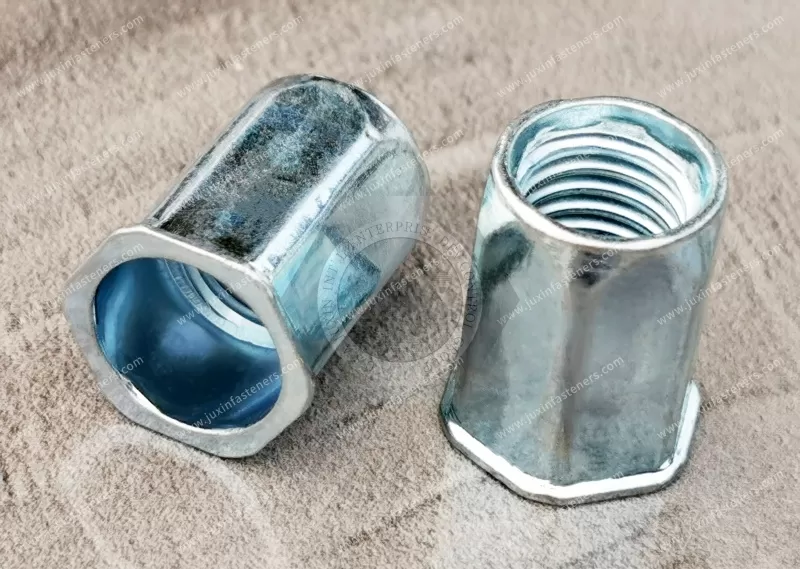
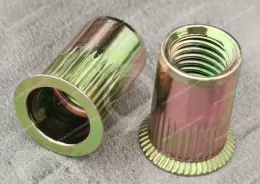
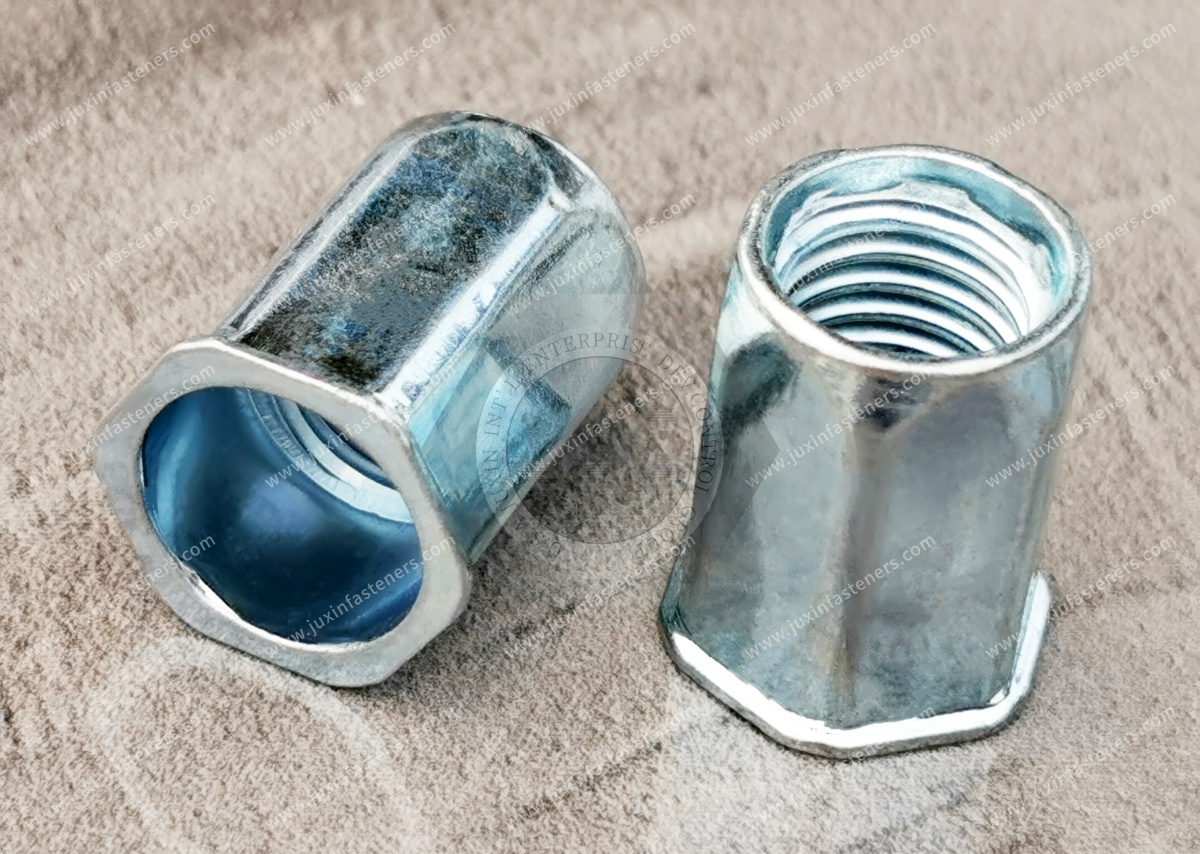
JUXIN FASTENERS manufactures thin head, open-end steel full-hex blind rivet nuts with blue zinc plating for creating reusable internal threads in thin sheet metal, hollow sections, and industrial assemblies requiring one-sided installation.
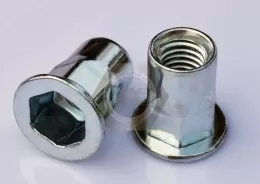
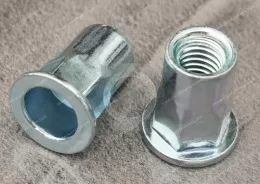
The full hexagonal body engages with a matching hexagonal mounting hole to help resist insert rotation during screw tightening and removal. The reduced-height flange minimizes head projection, while the open-end barrel allows screw extension where sufficient backside clearance is available.
Product Features
Metric thread sizes: M4, M5, M6, M8, M10, M12
Inch-series threads: Custom OEM requirements subject to drawing review
Material: Steel
Surface finish: Blue zinc plating
Grip range: 0.5–6.0 mm (approx. 0.020–0.236 in) across the product family, depending on configuration
Head style: Thin head / Low-profile flange
Body style: Full-hex / Full hexagonal body
End style: Open end
Installation: One-sided blind installation into compatible hexagonal mounting holes
Typical applications include electrical enclosures, telecommunications cabinets, industrial machinery, automotive components, electronic equipment housings, and OEM sheet-metal assemblies requiring reduced flange projection and improved rotational resistance.
Product Specification
Thin Head Full-Hex Steel Blind Rivet Nut Specifications
| Parameter | Specification |
|---|---|
| Product Type | Full-Hex Blind Rivet Nut |
| Head Configuration | Thin Head / Reduced Head |
| Body Configuration | Full Hexagonal |
| End Configuration | Open End |
| Material | Steel |
| Surface Finish | RoHS Blue Zinc |
| Metric Thread Sizes | M4, M5, M6, M8, M10, M12 |
| Stated Family Grip Range | 0.5–6.0 mm |
| Mounting Hole | Matching Hexagonal Hole |
| Installation | One-Sided Mechanical Setting |
| Custom Dimensions | Subject to Drawing Review |
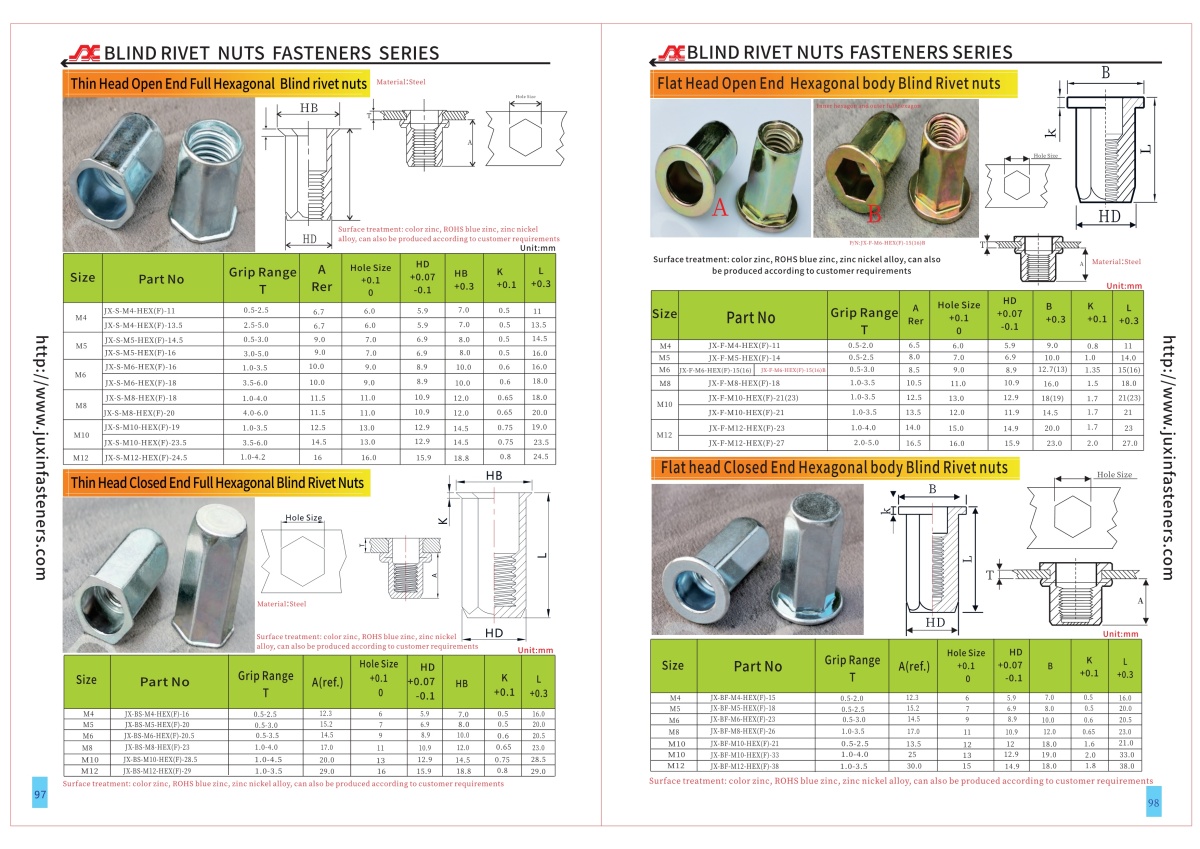
| Technical Catalog | Pages 97–98 |
Technical Drawing and CAD Information
Detailed product dimensions should be confirmed using the corresponding specification sheet and CAD drawing.
Important dimensions include the across-flats body measurement, flange diameter, flange thickness, overall length, barrel length and required mounting-hole tolerance.
For technical review or drawing-based quotations, contact info@juxinfasteners.com.
Technical Specifications
| Parameter | Specification |
|---|---|
| Product Name | Thin Head Full-Hex Blind Rivet Nut |
| Alternative Names | Full Hex Nutsert, Hexagonal Blind Threaded Insert, Reduced Head Hex Rivet Nut |
| Material | Steel |
| Surface Treatment | RoHS Blue Zinc |
| Head Type | Thin Head / Reduced Head |
| Body Type | Full Hexagonal |
| End Type | Open End |
| Thread Sizes | M4, M5, M6, M8, M10, M12 |
| Stated Family Grip Range | 0.5–6.0 mm |
| Installation | One-Sided Mechanical Setting |
| Mounting Hole | Matching Hexagonal Profile |
| Custom Dimensions | Subject to Drawing Review |
| Catalog Reference | Pages 97–98 |
Important: The 0.5–6.0 mm grip range describes the stated product family.
Each thread size and barrel configuration must be checked against its corresponding drawing to confirm the actual permissible material thickness.
Full-Hex vs Half-Hex vs Round-Body Rivet Nuts
Selecting the correct rivet nut body geometry is important because different designs transfer installation and service loads differently.
| Feature | Full-Hex Rivet Nut | Half-Hex Rivet Nut | Round-Body Rivet Nut |
|---|---|---|---|
| Body Geometry | Full hexagonal section | Partial hexagonal section | Round |
| Mounting Hole | Hexagonal | Hexagonal or specified shaped profile | Round |
| Anti-Rotation Principle | Geometric engagement | Partial geometric engagement | Friction and body deformation |
| Hole Preparation | Hexagonal tooling required | Matching shaped-hole tooling | Conventional round-hole process |
| Typical Selection Priority | Anti-rotation performance | Balance of geometry and installation needs | Round-hole manufacturing compatibility |
| Application Validation | Required | Required | Required |
When Should Engineers Choose Full-Hex Rivet Nuts?
A full-hex rivet nut is worth evaluating when a design requires:
Resistance to insert rotation during screw tightening
Repeatable assembly and disassembly
Threaded attachment in thin sheet metal
Installation from one side only
Compatibility with a prepared hexagonal mounting hole
A low-profile flange configuration
However, a full-hex design is not automatically stronger in every loading direction than a half-hex or round-body alternative.
Axial pull-out resistance, push-out resistance and fatigue behavior depend on the complete joint design and installation conditions.
Engineering Design Considerations
1. Mounting-Hole Geometry
The mounting hole must match the selected full-hex rivet nut geometry.
Critical characteristics include:
Across-flats dimension
Corner geometry
Hole tolerance
Burr condition
Panel flatness
Material thickness
Edge distance
An oversized hole may reduce anti-rotation performance.
An undersized or incorrectly formed hole can prevent proper seating or damage the insert during installation.
The required mounting-hole dimensions must be taken from the approved product drawing.
2. Panel Thickness and Grip Range
The stated family grip range is 0.5–6.0 mm.
Engineers must confirm that the actual panel thickness falls within the specified grip range of the selected part number.
For multilayer assemblies, the combined thickness and the intended clamping arrangement should be reviewed.
Grip range should not be interpreted as a universal load rating.
3. Parent Material Compatibility
Full-hex steel rivet nuts may be considered for compatible steel and aluminum sheet metal applications.
However, the mechanical properties of the parent material influence the installed connection.
Softer panels may deform around the mounting hole, while harder materials may require different setting conditions.
For brittle, composite or unusually thin materials, additional application-specific validation may be necessary.
4. Spin-Out Torque
Spin-out torque is a key consideration for threaded inserts that will experience screw tightening or removal.
The hexagonal body helps transfer rotational load through mechanical engagement with the mounting hole.
For production approval, spin-out torque should be measured using representative panel material, thickness and hole geometry.
The specified tightening torque of the mating screw should remain within the validated capability of the installed fastening system.
5. Axial Pull-Out Resistance
Axial pull-out resistance describes the force required to extract the installed rivet nut from the parent material.
Performance depends on the deformed backside geometry, flange design, panel material and installation conditions.
A full-hex body should not be assumed to provide superior pull-out performance without testing.
6. Flange Bearing Area
Thin-head rivet nuts offer a compact surface profile, but generally provide a smaller or thinner head configuration than large-flange alternatives.
Where substantial push-through loads or bearing stresses are expected, engineers should evaluate whether a larger flange would be more appropriate.
7. Screw Engagement and Rear Clearance
Because this product has an open end, the mating screw may extend beyond the insert.
Designers should verify:
Minimum effective thread engagement
Screw length
Available rear clearance
Interference with internal equipment
Required assembly torque
These factors are particularly important in compact electronic and electrical enclosures.
Industrial Applications
Electrical Cabinets and Switchgear Enclosures
Electrical equipment manufacturers often require threaded fastening points in thin sheet metal panels.
Full-hex blind rivet nuts can be considered for:
Electrical cabinet covers
Internal mounting brackets
Control panel supports
Distribution equipment housings
Removable inspection panels
Non-safety-critical mechanical attachments
The full-hex geometry helps resist unwanted rotation when service technicians remove and reinstall screws.
For electrical bonding points, the complete assembly must be evaluated for electrical continuity and applicable safety requirements.
Telecommunications Cabinets and Network Equipment
Telecommunications enclosures often contain removable sheet metal panels, equipment brackets and internal support structures.
Thin-head full-hex rivet nuts can provide low-profile threaded fastening points in compatible panel designs.
Typical applications include:
Network equipment cabinets
Communication equipment housings
Rack-mounted equipment accessories
Cable support brackets
Removable access covers
Internal electronic module supports
The reduced-height head can be useful where adjacent components have limited clearance.
Data Center Infrastructure Equipment
Data center equipment manufacturers may require reliable threaded attachment points for fabricated sheet metal assemblies.
Potential applications include equipment housings, network cabinet accessories, service panels and internal support brackets.
Full-hex rivet nuts may be useful where repeated screw removal creates a need for improved resistance to insert rotation.
Mechanical loading, vibration exposure and maintenance requirements must be assessed for each installation.
Industrial Automation and Machinery
Industrial automation equipment often includes protective housings, instrument panels and removable machine covers.
Full-hex blind rivet nuts can provide threaded mounting points without requiring access behind the panel.
Applications may include:
Automation control enclosures
Machine guarding accessories
Instrument mounting brackets
Equipment service covers
Fabricated sheet metal assemblies
Safety-related machine guarding connections require separate engineering approval.
Automotive Sheet Metal Assemblies
Automotive OEM and Tier-1 engineering teams may consider full-hex rivet nuts for appropriate sheet metal attachment points.
Potential applications include interior equipment brackets, serviceable covers, electronic module housings and selected non-critical body accessories.
Automotive applications require project-specific validation of mechanical loads, vibration, corrosion and assembly conditions.
No vehicle safety or structural suitability should be assumed from the rivet nut geometry alone.
HVAC and Thermal Equipment
HVAC equipment manufacturers frequently use fabricated sheet metal housings and removable panels.
Full-hex blind rivet nuts may be considered for mounting brackets, equipment covers and service access points.
The selected coating and installation design must be suitable for the actual temperature, humidity and corrosion exposure.
How to Install Full-Hex Blind Rivet Nuts
Step 1: Confirm the Product Drawing
Verify the thread size, body dimensions, grip range and mounting-hole requirements.
Step 2: Prepare the Hexagonal Hole
Produce the specified hexagonal mounting hole using an appropriate manufacturing process.
Possible methods include punching, laser cutting, machining or dedicated hole-forming equipment, depending on material and production requirements.
A round hole should not be used as a substitute unless the approved installation process includes a validated method of forming the required hexagonal profile.
Step 3: Inspect the Hole
Check the across-flats dimensions, corner geometry, burrs and panel condition.
Step 4: Select the Installation Tool
Use a suitable manual, pneumatic, hydraulic or automated rivet nut setting system.
The tool mandrel must match the internal thread of the insert.
Step 5: Position the Insert
Insert the rivet nut into the mounting hole and ensure that the flange seats correctly.
Step 6: Set the Rivet Nut
Operate the setting tool according to the validated installation parameters.
The tool deforms the insert body behind the parent material to establish mechanical retention.
Step 7: Inspect the Installed Joint
Confirm proper seating, backside deformation and thread integrity.
Where required, perform spin-out, pull-out or push-out testing.
Step 8: Assemble the Mating Screw
Install the specified mating screw using the approved tightening procedure.
Avoid excessive torque that could damage the insert or surrounding panel.
Can Full-Hex Rivet Nuts Be Installed Without a Dedicated Tool?
A proper rivet nut setting tool is recommended for controlled industrial installation.
Improvised bolt-and-nut methods sometimes used for manual installation do not provide the same process control as a qualified setting system.
For OEM production, installation stroke, alignment and mechanical retention should be repeatable and validated.
Full-hex rivet nuts also require the correct mounting-hole profile, which may involve separate hole-production tooling.
Mechanical Performance and Quality Validation
For OEM procurement, product dimensions alone are not sufficient to establish installed joint reliability.
A suitable validation plan may include:
Dimensional Inspection
Verify thread dimensions, body geometry, flange dimensions and overall length.
Mounting-Hole Compatibility
Confirm that the insert fits the approved hexagonal hole without excessive clearance or interference.
Spin-Out Torque Testing
Evaluate resistance to rotation under representative assembly conditions.
Axial Pull-Out Testing
Evaluate the force required to extract the installed insert from the parent material.
Push-Out Testing
Assess resistance to displacement through the mounting panel.
Thread Function Testing
Confirm that the internal thread remains functional after setting.
Installation Repeatability
Evaluate the consistency of installation across representative production samples.
Corrosion Evaluation
Confirm whether the specified coating meets the customer's environmental requirements.
Acceptance criteria should be established by the customer or through an approved engineering specification.
Steel Material and RoHS Blue Zinc Surface Finish
The stated product configuration uses steel with a RoHS blue zinc surface finish.
Zinc plating is commonly used to provide sacrificial corrosion protection for steel components.
However, the coating color alone does not determine corrosion performance.
For OEM specifications, coating requirements should address:
Zinc coating thickness
Passivation chemistry
Additional sealing treatment, if required
Corrosion-resistance criteria
Dimensional effects on the internal thread
Applicable restricted-substance requirements
Relevant international engineering references may include:
ISO 261 — ISO general-purpose metric screw thread plan
ISO 724 — Basic dimensions of metric screw threads
ISO 965 — Tolerances for metric screw threads
ISO 2081 — Electroplated zinc coatings on iron or steel
ASTM B633 — Electrodeposited zinc coatings on iron and steel
These references provide a basis for specification development. They do not establish product certification or a specific coating performance level.
For RoHS-sensitive projects, supporting material and coating declarations should be confirmed against the actual supplied product.
Custom Full-Hex Blind Rivet Nuts for OEM Manufacturing
JUXIN FASTENERS supports drawing-based technical review for industrial fastening requirements.
Potential customization options include:
Special metric or imperial threads
Modified full-hex body dimensions
Custom flange diameter and thickness
Alternative barrel lengths
Application-specific grip ranges
Different steel material specifications
Alternative zinc coating systems
Special inspection requirements
Customer-specific packaging and labeling
Customization feasibility, tooling requirements and minimum order quantities depend on the approved drawing and projected production volume.
OEM Procurement and Supplier Qualification Checklist
Before requesting a quotation, sourcing and supplier development teams should prepare the following information:
Required thread size and tolerance
Full-hex rivet nut drawing or reference part number
Panel material and thickness
Hexagonal mounting-hole dimensions
Head height and flange diameter requirements
Grip range and barrel length
Coating specification and corrosion requirements
Required spin-out and pull-out performance
Annual forecast and order quantity
Packaging, labeling and inspection requirements
Providing these details helps reduce technical uncertainty and supports a more accurate quotation.
Frequently Asked Questions
What is a full-hex blind rivet nut?
A full-hex blind rivet nut is an internally threaded insert with a hexagonal body.
It is installed from one side of a workpiece into a matching hexagonal hole to provide a threaded fastening point.
What is the difference between full-hex and half-hex rivet nuts?
Full-hex rivet nuts have a more extensive hexagonal body section, while half-hex rivet nuts have a partial hexagonal section.
Both designs use geometric engagement to resist rotation, but actual mechanical performance depends on the product and installation.
Why use a thin-head full-hex rivet nut?
The thin-head configuration reduces flange protrusion while the full-hex body provides anti-rotation engagement.
This combination can be useful for compact, serviceable sheet metal assemblies.
Do full-hex rivet nuts require hexagonal holes?
Yes. The full-hex design requires a matching hole geometry to provide its intended anti-rotation function.
Can full-hex rivet nuts be used in 0.5 mm sheet metal?
The stated product family includes grip configurations beginning at 0.5 mm. Suitability must be confirmed for the specific part number, panel material and installation conditions.
Are open-end rivet nuts waterproof?
No. The open threaded end does not provide a sealed barrier. Applications requiring ingress protection may need a closed-end insert and additional sealing provisions.
Can JUXIN FASTENERS provide custom full-hex rivet nuts?
Custom dimensions, thread configurations and surface treatments can be submitted for drawing-based technical and manufacturing feasibility review.
Request a Quotation for Full-Hex Steel Blind Rivet Nuts
JUXIN FASTENERS provides industrial fastening and custom component solutions for OEM manufacturers, engineering teams and global procurement organizations.
Whether your project requires standard M4–M12 full-hex rivet nuts or custom drawing-defined threaded inserts,
our team can review the fastening requirements and help identify a suitable sourcing solution.
Send your drawings, material specifications, expected annual demand and application requirements for quotation review.
JUXIN FASTENERS
Email: info@juxinfasteners.com
Website: www.juxinfasteners.com
Contact: https://www.juxinfasteners.com/contact-us/
Product Packaging
Industrial Packaging and OEM Shipment
JUXIN FASTENERS supplies thin head full-hex blind rivet nuts in plastic inner bags and protective outer cartons, with palletized shipment arrangements where required.
Reference Packaging Dimensions
| Packaging Type | Dimensions |
|---|---|
| Carton Option 1 | 29 × 19 × 19.5 cm |
| Carton Option 2 | 23.5 × 17.5 × 8 cm |
| Reference Pallet | 215 × 100 × 90 cm |
Actual packing quantities depend on the thread size, product weight and customer order requirements.
Customer-specific packaging, part-number labels, batch identification and shipment configurations can be reviewed for OEM procurement programs.
Email: info@juxinfasteners.com
Website: www.juxinfasteners.com
Product Pictures
Tags
Contact Us
Tel.:
+86 020 8621 0320
+86 020 3121 6067
E-mail:
Technical Support:
Navigation
SEND INQUIREY