Call Us
+86 136 6007 9809
Call Us
+86 136 6007 9809

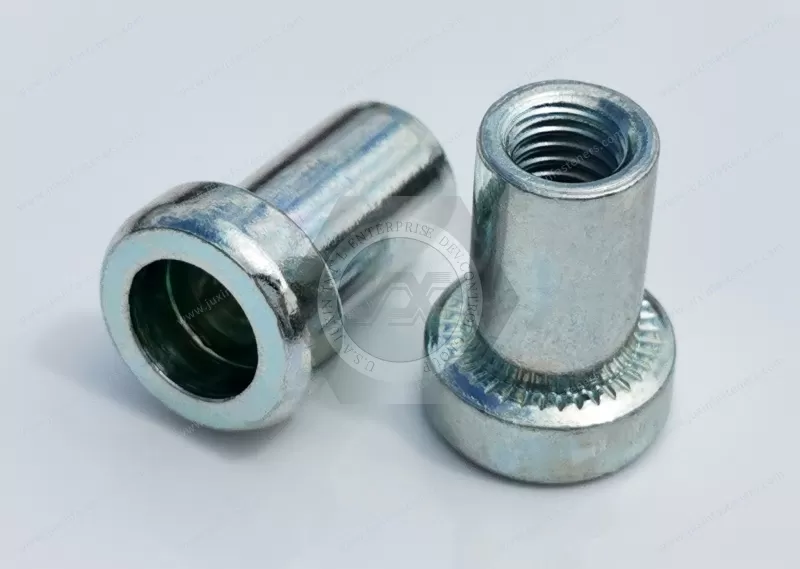
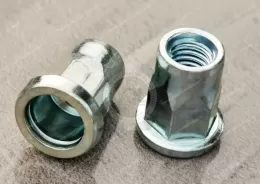
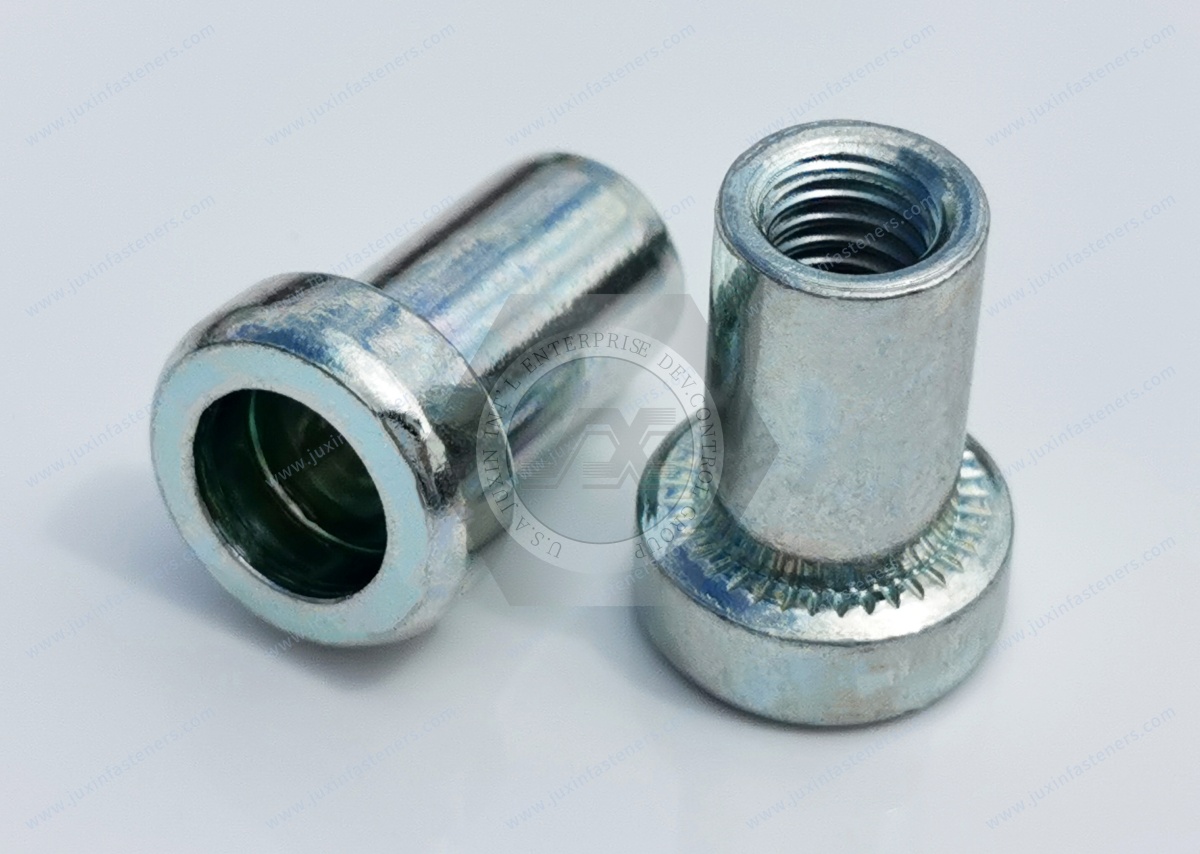
JUXIN FASTENERS supplies custom M6 Steel 5 mm Thick Flat Head Open-End Plain Round Body Blind Rivet Nuts for one-sided installation in thin sheet-metal assemblies.
The specially designed 5 mm thick flange provides a defined head geometry, while the smooth round body forms backside retention during installation.
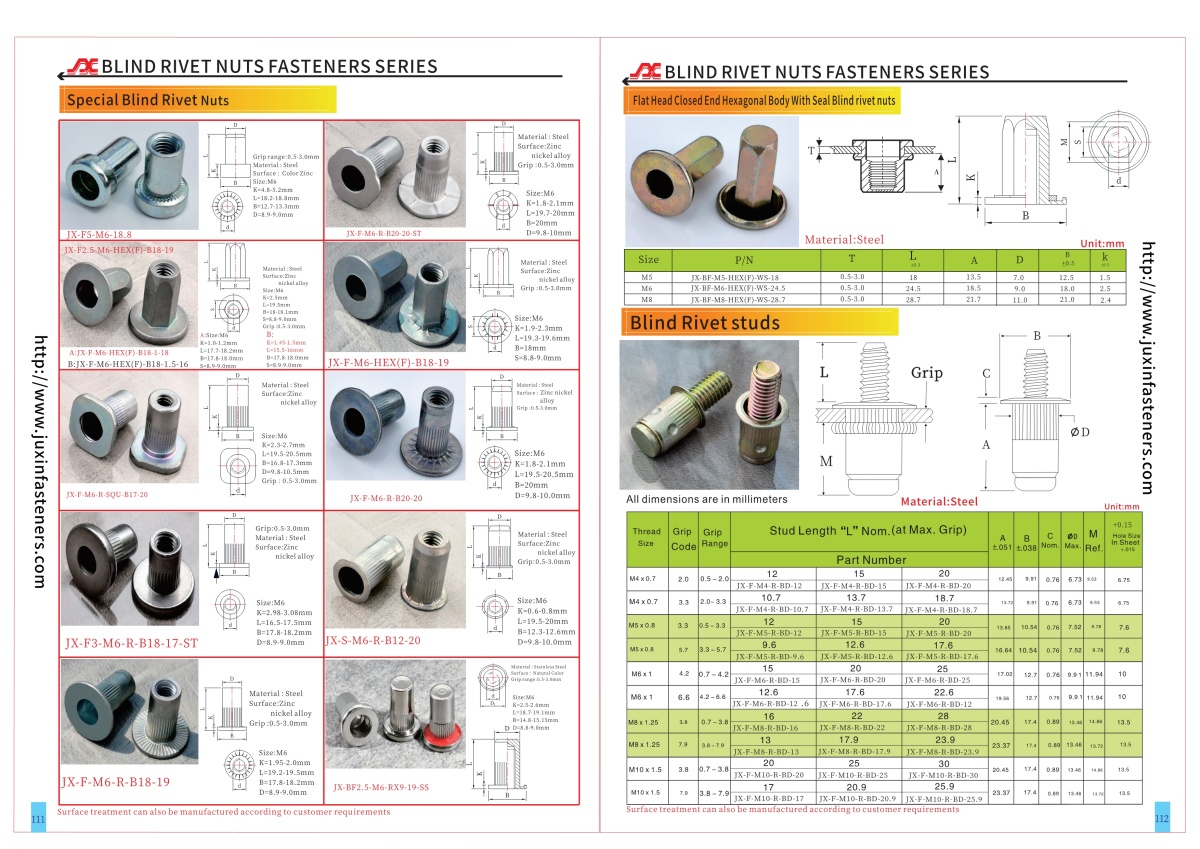
Part No.: JX-F5-M6-18.8
Thread Size: M6
Material: Steel
Head Thickness: 5 mm
Grip Range: 0.5–3.0 mm
Surface Treatment: Color Zinc or RoHS Blue Zinc
Body Type: Plain Round Body
End Type: Open End
Product Specification
Product Specifications
Product Name: M6 Steel 5 mm Thick Flat Head Open-End Plain Round Body Blind Rivet Nut
Part Number: JX-F5-M6-18.8
Product Category: Special Steel Blind Rivet Nuts
Thread Size: M6
Material: Steel
Head Type: Special 5 mm Thick Flat Head
Head Thickness: 5.0 mm (approximately 0.197 in)
Body Type: Plain / Smooth Round Body
End Configuration: Open End
Grip Range: 0.5–3.0 mm (approximately 0.020–0.118 in)
Surface Treatment: Color Zinc or RoHS Blue Zinc
Installation Method: One-Sided Blind Installation
Mounting Hole: Round hole, diameter according to the approved drawing
Thread Pitch and Tolerance: According to the approved drawing
Overall Length and Body Dimensions: According to the approved drawing
Mechanical Performance: Subject to application-specific testing
Primary Application: Elevator and Lift Equipment Assemblies
Product Overview
JUXIN FASTENERS supplies custom M6 steel blind rivet nuts with a specially designed 5 mm thick flat-head flange for elevator manufacturers, lift equipment OEMs, and industrial sheet-metal assembly applications.
Unlike conventional thin-flange or standard flat-head rivet nuts, this product incorporates a substantially thicker head geometry specified for a particular assembly requirement.
The plain round body allows installation in a compatible round mounting hole, while the deformable barrel creates backside retention when set with an appropriate rivet nut installation tool.
The open-end configuration provides an internal threaded attachment point and allows mating screw projection through the insert where backside clearance permits.
Part number JX-F5-M6-18.8 is a special-design product. Its dimensions and installation requirements should be evaluated using the approved drawing rather than assuming interchangeability with standard M6 blind rivet nuts.
Why a 5 mm Thick Head Matters in Elevator Fastening
The defining feature of this product is its 5 mm thick flat-head flange.
For elevator equipment designers, head thickness is an important dimensional consideration because it affects the installed fastener's front-side projection and the surrounding component geometry.
A custom thick-head configuration may be specified where the assembly requires:
A defined 5 mm flange height
A particular component spacing arrangement
Clearance coordination with adjacent parts
A specified bearing interface
Compatibility with an existing OEM design
Replacement of a drawing-specific fastening component
However, a thicker flange does not automatically establish greater pull-out strength, higher load capacity, or improved vibration resistance.
These characteristics depend on the complete insert geometry, parent material, installation conditions, and joint design.
The 5 mm head thickness must not be confused with the panel grip range.
This product has a 5 mm thick head and a separately specified 0.5–3.0 mm grip range.
Elevator and Lift Equipment Applications
Elevator manufacturers use fabricated sheet-metal components, equipment housings, support brackets, and removable panels that require threaded fastening points.
Custom thick-head blind rivet nuts may be considered for selected elevator assemblies where the 5 mm flange geometry matches the approved design.
Potential applications include:
Elevator cabin sheet-metal assemblies
Lift car interior equipment brackets
Elevator control cabinet mounting panels
Elevator door equipment housings
Elevator operating panel support structures
Elevator service access panels
Lift equipment covers and guards
Elevator machinery equipment housings
Elevator electrical equipment brackets
Escalator and moving-walkway equipment panels
Industrial lift equipment enclosures
Commercial building vertical transportation equipment
These applications require engineering review and are not blanket approvals for safety-critical elevator components.
For load-bearing, passenger-safety, door-retention, or other safety-related connections, the responsible elevator manufacturer must validate the complete joint against the applicable design and regulatory requirements.
The product should not be represented as an approved safety-critical elevator fastener without documented qualification.
Elevator Engineering: Why Special Fastener Geometry Is Important
Elevator equipment often combines fabricated panels, brackets, covers, and structural components within restricted installation spaces.
In such assemblies, a standard fastener may not match the required flange height or mating-component geometry.
A drawing-specific rivet nut can address a dimensional requirement that is not satisfied by a conventional catalog part.
For JX-F5-M6-18.8, the 5 mm head thickness is the key feature to verify.
Before substituting another M6 rivet nut, engineers should compare:
Flange thickness
Flange diameter
Overall insert length
Body diameter
Grip range
Mounting-hole diameter
Internal thread specification
Backside deformation geometry
Available assembly clearance
Matching the M6 thread alone does not establish interchangeability.
5 mm Thick Head vs. Standard Flat Head Rivet Nuts
A conventional flat-head rivet nut and a special 5 mm thick-head rivet nut may have the same nominal thread size but different installation and assembly characteristics.
The special thick-head configuration creates additional projection above the parent panel.
This projection must be considered in the assembly stack-up.
For example, if a mating bracket contacts the top of the rivet nut flange rather than the surrounding sheet-metal surface, the resulting joint geometry may differ from a design using a thinner flange.
This can influence:
Contact location
Component spacing
Screw-length selection
Joint stiffness
Local bending
Installation-tool access
The flange should not automatically be treated as a precision spacer or structural standoff unless the approved drawing and application validation establish that function.
For elevator OEM purchasing, the exact head thickness and tolerance are therefore essential specifications.
Plain Round Body: Installation and Retention
The product uses a plain round body rather than an externally knurled, hexagonal, or square body.
This distinction is important.
A smooth round body does not rely on the same geometric anti-rotation engagement as a hexagonal body or the surface engagement of a knurled body.
Its installed rotational resistance depends on the interaction between the deformed insert, mounting hole, flange, and parent material.
For applications involving repeated screw tightening or removal, spin-out resistance should be verified.
A plain round-body rivet nut should not be described as inherently equivalent to a knurled or hexagonal anti-rotation design.
The appropriate body style depends on the actual joint requirements.
Round-Hole Mounting Requirements
The plain round-body design is intended for installation in a compatible round mounting hole.
Round holes may be produced by drilling, punching, or another approved sheet-metal manufacturing process.
For elevator sheet-metal assemblies, mounting-hole quality should be controlled.
Important variables include:
Hole diameter
Hole tolerance
Roundness
Burr condition
Panel thickness
Parent-material hardness
Surface coating
Tool alignment
An oversized mounting hole may reduce retention.
An undersized hole may interfere with insertion or damage the insert or panel.
The correct mounting-hole diameter must be obtained from the approved JX-F5-M6-18.8 drawing.
Grip Range: 0.5–3.0 mm
The specified grip range for this product is 0.5–3.0 mm.
This range refers to the parent-material thickness accommodated by the selected insert configuration.
It does not describe the flange thickness or the total fastener length.
For elevator manufacturing, panel thickness must be checked against the actual installation.
Where several sheets or components are stacked together, engineers must determine the effective material thickness engaged by the rivet nut.
If the material is thinner or thicker than the approved grip range, backside deformation and retention may be affected.
Although other rivet nut designs may be available for panel thicknesses approaching 6 mm or more, that does not extend the approved grip range of JX-F5-M6-18.8.
For thicker elevator panels, a different grip-range configuration must be reviewed.
Metric and Inch Dimensional Reference
The confirmed thread size for this product is M6.
The following dimensional references may assist North American and European engineering and purchasing teams.
| Specification | Metric | Approximate Inch Reference |
|---|---|---|
| Nominal Thread Diameter | M6 / 6.0 mm | 0.2362 in |
| Special Head Thickness | 5.0 mm | 0.1969 in |
| Minimum Grip Thickness | 0.5 mm | 0.0197 in |
| Maximum Grip Thickness | 3.0 mm | 0.1181 in |
M6 × 1.0 is a common ISO metric coarse-thread designation. The actual thread pitch and tolerance must be confirmed against the approved drawing.
Relevant references include ISO 261 and ISO 965.
For North American purchasing, M6 should not be substituted with 1/4-20 UNC or 1/4-28 UNF.
These Unified thread forms are not directly interchangeable with M6 metric threads.
ASME B1.1 may be relevant when comparing Unified thread requirements, but it does not replace the metric thread specification of this product.
Open-End Design and Screw Engagement
The open-end barrel allows the mating screw to extend through the rivet nut when sufficient clearance is available behind the panel.
This may simplify screw-length selection compared with a closed-end configuration.
However, the complete assembly must still be evaluated for:
Mating screw thread compatibility
Required thread engagement
Screw projection
Backside clearance
Interference with adjacent equipment
Required clamp load
Installation and service access
The 5 mm flange thickness may affect the effective joint stack-up.
Engineers should verify screw length using the actual assembly dimensions rather than nominal insert dimensions alone.
An open-end rivet nut does not provide a sealed threaded connection.
Where moisture or dust ingress must be controlled, an appropriate joint-level sealing arrangement is required.
Installation Process for Elevator Manufacturing
The product is installed from one accessible side of the parent panel using a compatible blind rivet nut setting tool.
During installation, the tool applies axial force to deform the designated barrel section behind the panel.
This creates the mechanical retention needed to hold the threaded insert in place.
For the special 5 mm thick-head design, installation-tool compatibility should be confirmed before production use.
The flange thickness may influence nosepiece clearance and the installed component geometry.
Recommended installation checks include:
Correct mounting-hole dimensions
Parent-panel thickness within the approved grip range
Correct mandrel and nosepiece
Tool alignment
Flange seating
Setting force or stroke
Backside deformation
Internal thread condition
Insert rotation
Axial retention
Under-setting may produce insufficient retention.
Over-setting may damage the insert, distort the parent panel, or affect the internal thread.
Setting parameters must be established using representative production materials.
Pull-Out, Push-Out, and Spin-Out Performance
For elevator OEM applications, mechanical retention should be evaluated according to the actual function of the connection.
Pull-out resistance describes the axial force required to extract the installed insert under a defined test arrangement.
Push-out resistance describes resistance to displacement in the opposite axial direction.
Spin-out resistance describes the torque required to rotate the installed insert within the mounting hole.
These characteristics are not interchangeable.
A thick flange may influence front-side bearing behavior, but it does not automatically establish the pull-out or spin-out performance of the complete installed rivet nut.
Mechanical performance depends on:
Insert material
Body geometry
Parent-panel material
Panel thickness
Mounting-hole dimensions
Installation deformation
Applied load direction
Test conditions
No numerical load capacity or retention rating is claimed without verified product-specific test data.
Vibration and Repeated Maintenance
Elevator equipment may experience vibration, repeated operation, and periodic maintenance.
Threaded joints should therefore be evaluated for the expected service conditions.
For connections that are repeatedly assembled or disassembled, engineers should consider insert spin-out resistance and internal thread durability.
For vibration-sensitive joints, the complete fastening system should be reviewed, including:
Mating screw strength
Tightening torque
Joint stiffness
Thread engagement
Clamp-load retention
Operating vibration
Service intervals
A plain round-body rivet nut does not independently provide screw-locking performance.
Where required, a suitable locking strategy must be specified and validated.
Steel Material and Surface Treatment
The confirmed material for JX-F5-M6-18.8 is steel.
Available surface-treatment options are Color Zinc and RoHS Blue Zinc.
Zinc coatings are commonly used to protect steel fasteners in industrial environments.
For indoor elevator equipment installed in relatively dry environments, zinc-plated steel may be considered where the approved corrosion requirements permit.
However, corrosion performance depends on the complete coating system and service environment.
For elevator equipment exposed to condensation, humidity, cleaning chemicals, or more aggressive environments, additional corrosion evaluation may be required.
The coating specification should define:
Approved coating system
Coating thickness
Passivation requirements
Corrosion-performance criteria
Restricted-substance requirements
Inspection and documentation
Color Zinc and Blue Zinc should not be evaluated solely by appearance.
RoHS compliance must be supported by the actual coating chemistry and appropriate documentation.
Relevant references may include ISO 4042 for electroplated fastener coating systems and ISO 9227 or ASTM B117 for specified corrosion testing.
No particular salt-spray performance is claimed without supporting test evidence.
Steel vs. Stainless Steel for Elevator Fastening
Material selection depends on the operating environment and the approved mechanical requirements.
Zinc-Plated Steel
Steel with an appropriate zinc coating may be a practical choice for selected indoor elevator equipment where cost, dimensional requirements, and corrosion protection are balanced.
Stainless Steel 304
Stainless steel 304 may be considered for certain applications requiring improved general corrosion resistance compared with unprotected carbon steel.
Stainless Steel 316
Stainless steel 316 may be considered for some environments involving greater chloride exposure or more demanding corrosion conditions.
However, material substitution is not automatically permitted.
A stainless steel rivet nut may differ from the specified steel product in deformation behavior, installation requirements, mechanical retention, and dimensional availability.
JX-F5-M6-18.8 is specified as steel. Stainless steel 304 and 316 are discussed here as engineering alternatives, not confirmed material options for this particular part number.
For any material change, a new drawing and installation qualification may be required.
Elevator Standards and Engineering Compliance
Elevator fastening requirements should be assessed within the applicable equipment and installation framework.
Depending on the market and equipment type, relevant elevator safety frameworks may include:
EN 81-20 and EN 81-50 for applicable lift safety requirements
ASME A17.1/CSA B44 for applicable elevator and escalator safety requirements
ASME A18.1 for applicable platform lifts and stairway chairlifts
These standards concern broader elevator or lift safety requirements and do not automatically certify an individual blind rivet nut.
The responsible elevator manufacturer must determine the applicable standards, joint design requirements, and validation procedures.
A custom rivet nut should not be selected for a safety-critical connection solely because its dimensions match an existing component.
OEM Custom Fastener Development
Custom blind rivet nuts are often specified when standard catalog dimensions do not match an established equipment design.
For this product, the defining custom feature is the 5 mm thick flat-head flange.
When reviewing a new elevator OEM project, engineering teams should confirm whether the existing design requires:
An exact 5 mm head thickness
A particular flange diameter
A specified body length
A defined mounting-hole size
A specific grip range
Particular axial or rotational retention
Compatibility with existing installation equipment
If an alternative design is proposed, the dimensional and functional differences should be documented before approval.
The part number JX-F5-M6-18.8 should be used to identify this specific configuration during technical and commercial discussions.
Elevator OEM Purchasing and Supplier Development
For elevator manufacturers, purchasing managers, sourcing engineers, and supplier development teams, custom fastener procurement should begin with a complete technical specification.
Two rivet nuts with an M6 thread may have different flange thicknesses, body lengths, grip ranges, hole requirements, and installation characteristics.
For a drawing-specific elevator fastener, nominal thread size alone is not sufficient to approve a replacement.
Important purchasing considerations include:
Drawing revision control
Dimensional consistency
Steel material specification
Surface-treatment consistency
Installation compatibility
Mechanical retention requirements
Inspection criteria
Lot traceability
Packaging and labeling
Estimated annual purchasing volume
Delivery planning
The total installed cost may also include hole preparation, assembly time, inspection, rework, and supplier qualification.
A correctly specified custom rivet nut can help avoid assembly changes associated with an unsuitable standard substitute.
Quality Inspection and Production Approval
For OEM production, inspection requirements should be agreed according to the approved drawing and customer specifications.
Potential inspection characteristics include:
M6 internal thread
5 mm head thickness
Flange diameter
Body diameter
Overall length
Grip-range designation
Material conformity
Surface-treatment requirements
Visual condition
Installation compatibility
Where required, customers may request dimensional inspection reports, material documentation, coating records, first article inspection, or additional qualification testing.
No particular certification or mechanical approval is implied unless supported by verified documentation.
Other Industrial Applications
Although this special-design product is primarily positioned for elevator and lift equipment, similar thick-head blind rivet nut configurations may be evaluated for:
Industrial machinery housings
Automation equipment
Commercial equipment panels
Electrical cabinets
HVAC equipment
Building equipment enclosures
Industrial maintenance panels
Fabricated sheet-metal brackets
The 5 mm flange geometry must match the actual application.
These additional industries are potential engineering markets, not claims that the exact product has already been approved for every use.
Related Blind Rivet Nut Solutions
Steel High Flat Head Open-End Knurled Body Blind Rivet Nuts
A related design for applications where knurled body engagement is preferred.
Steel High Flat Head Open-End Partial Hex Body Blind Rivet Nuts
An alternative body geometry for suitable anti-rotation mounting arrangements.
Steel Flat Head Open-End Square Body Blind Rivet Nuts
An alternative configuration for compatible square mounting holes.
Steel Flat Head Open-End Slotted Shank Blind Rivet Nuts
An alternative for applications requiring a different backside deformation and load-distribution mechanism.
Aluminum Flat Head Open-End Plain Round Body Blind Rivet Nuts
An alternative material and head configuration for suitable lightweight assemblies.
Each alternative should be evaluated against the approved mounting-hole geometry, grip range, flange dimensions, material requirements, and mechanical performance.
OEM RFQ and Drawing Requirements
For a technical review and quotation, please provide:
Required product: JX-F5-M6-18.8
Approved 2D drawing or 3D CAD model
Required thread specification
Head thickness and tolerance
Flange diameter
Body diameter and length
Parent-panel material
Panel thickness
Mounting-hole dimensions
Required grip range
Installation-tool information
Mating screw specifications
Required mechanical retention
Surface-treatment specification
Environmental and corrosion requirements
Inspection and documentation requirements
Prototype or production quantities
Estimated annual demand
Delivery destination
Why Source Custom Elevator Rivet Nuts from JUXIN FASTENERS?
JUXIN FASTENERS supplies industrial fastening products for drawing-based OEM purchasing requirements.
For elevator manufacturers, the sourcing discussion can focus on exact flange dimensions, mounting-hole compatibility, grip range, installation performance, material specifications, and production requirements.
JX-F5-M6-18.8 is identified as a special M6 steel open-end plain round-body blind rivet nut with a 5 mm thick flat head and a 0.5–3.0 mm grip range.
Final dimensional details, mechanical requirements, and installation parameters must be confirmed before production approval.
Request an OEM Quotation
Looking for custom 5 mm thick-head rivet nuts, M6 elevator blind rivet nuts, or drawing-specific threaded inserts for lift equipment manufacturing?
Send your drawings, technical requirements, and estimated purchasing quantities to JUXIN FASTENERS.
Email: info@juxinfasteners.com
Website: www.juxinfasteners.com
Product Packaging
Product Packaging
JUXIN FASTENERS arranges packaging for custom M6 steel 5 mm thick flat-head open-end plain round-body blind rivet nuts according to confirmed order quantities, product dimensions, surface-treatment requirements, and OEM customer instructions.
Packaging Configuration
Inner Packaging: Protective bags or suitable containers, as agreed.
Outer Packaging: Cartons according to confirmed shipment requirements.
Pallet Packaging: Subject to order and logistics arrangements.
Custom OEM Packaging: According to approved customer specifications.
Quantity per Package: Confirmed during order processing.
Product Identification
Where required, packaging labels may include:
Product Name: M6 Steel 5 mm Thick Flat Head Blind Rivet Nut
Part Number: JX-F5-M6-18.8
Thread Size: M6
Material: Steel
Head Thickness: 5 mm
Grip Range: 0.5–3.0 mm
Surface Treatment: Color Zinc or RoHS Blue Zinc
Lot or Batch Number
Package Quantity
Customer Purchase Order Number
Product Protection
Packaging should protect the 5 mm thick-head flange, plain round body, internal threads, and zinc-plated surfaces against unnecessary damage during handling, storage, and transportation.
Special attention should be given to protecting the flange geometry and internal threads, as these features are important for drawing-specific elevator assembly requirements.
Different product configurations and surface-treatment variants should be identified separately to reduce the risk of specification mix-ups.
Elevator OEM Packaging and Traceability
For elevator manufacturers and industrial OEM purchasing programs, packaging and identification requirements can be agreed according to the customer's production and logistics procedures.
Where required, arrangements may include lot identification, barcode labeling, inspection documentation, batch segregation, and customer-specific packaging instructions.
Final packaging quantities, carton configurations, labeling formats, and shipment arrangements are confirmed before delivery.
Product Pictures
Tags
Contact Us
Tel.:
+86 020 8621 0320
+86 020 3121 6067
E-mail:
Technical Support:
Navigation
SEND INQUIREY