
Call Us
+86 136 6007 9809
Call Us
+86 136 6007 9809

Juxin Fasteners manufactures diamond-knurled brass male heat-set threaded inserts for thermoplastic assemblies.
JX-HTD and JX-FHTD feature external threaded studs, crosshatched anchoring surfaces and stepped locating geometry.
Designed for suitable thermal or ultrasonic installation processes, these components provide integrated mounting points in automotive, electrical, industrial automation and electronic housings.
Custom metric and UNC/UNF threads, stud lengths, knurl dimensions and drawing-based OEM production are available.
Product Specification
Size Can also be According to Customer's requirement and please check detailed specification sheet PDF, CAD, See more product details, PDF 71-72Page
Diamond-Knurled Brass Male Heat-Set Threaded Inserts for Plastic – JX-HTD & JX-FHTD
Juxin Fasteners manufactures diamond-knurled brass male threaded inserts for heat and ultrasonic installation in thermoplastic components.
The JX-HTD and JX-FHTD series feature an external male threaded stud, a crosshatched knurled anchoring body and stepped locating features designed for secure integration into molded plastic assemblies.
Unlike conventional female threaded inserts, these components provide a projecting metal stud that allows mounting brackets,
electronic modules, mechanical hardware and other components to be attached directly to a plastic housing using a mating nut.
The diamond-knurled surface creates a mechanical interlock with the surrounding thermoplastic after controlled installation and cooling.
The resulting assembly provides a reusable external threaded fastening point without relying on threads formed directly in the plastic.
Juxin Fasteners supports custom OEM manufacturing, precision CNC machining, metric and Unified inch threads,
drawing-based production and batch manufacturing for automotive, industrial electrical, automation, electronics and equipment manufacturers.
Product Specifications
Product Name: Diamond-Knurled Brass Male Heat-Set Threaded Inserts for Plastic
Alternative Names: Brass Male Threaded Inserts, Knurled Brass Threaded Stud Inserts, Male Heat-Staking Inserts, Ultrasonic Male Threaded Inserts, Brass Stud Inserts for Thermoplastics
Product Series: JX-HTD and JX-FHTD
Primary Material: Brass and Brass Alloys
Material Selection: Customer-Specified Brass Grades, Subject to Material and Machining Verification
Alternative Materials: Stainless Steel and Carbon Steel Upon Engineering Review
Thread Configuration: External Male Thread
Thread Systems: ISO Metric, UNC and UNF
Anchoring Geometry: Diamond or Crosshatched Knurling
Body Configuration: Knurled Cylindrical Body with Stepped Locating and Shoulder Features
Installation Methods: Thermal Insertion and Ultrasonic Insertion, Subject to Application Validation
Primary Substrate: Thermoplastic Materials
Manufacturing Processes: Precision CNC Turning, Thread Machining, Knurling, Groove Machining and Dimensional Inspection
Customization: Thread Diameter, Stud Length, Knurl Geometry, Body Diameter, Overall Length and Material
Manufacturing Service: OEM and ODM Drawing-Based Manufacturing
Diamond-Knurled Anchoring Design
The defining characteristic of the JX-HTD and JX-FHTD product family is its diamond-knurled anchoring surface.
The external surface incorporates intersecting diagonal knurl patterns that form a crosshatched diamond geometry.
During heat or ultrasonic installation, controlled localized softening allows the surrounding thermoplastic to flow into the spaces between the knurled features.
After cooling, the plastic mechanically engages the metal insert and helps resist rotation and axial extraction.
Important engineering characteristics include:
Knurl outside diameter
Diamond knurl pitch
Knurl depth
Knurled body length
Anchoring section diameter
Shoulder geometry
Installation depth
Plastic hole diameter
Surrounding wall thickness
The final retention performance depends on the complete insert and plastic assembly rather than the knurl pattern alone.
Diamond Knurling Versus Chevron Knurling
Different knurl geometries provide different mechanical interactions with thermoplastic materials.
Diamond knurling uses intersecting diagonal patterns to create a crosshatched surface.
Chevron-style knurling uses angled retention patterns that may be arranged in opposing directions.
Straight knurling uses parallel longitudinal features.
Each design influences plastic flow, torque resistance, axial retention and installation stress.
Diamond knurling should not automatically be considered superior to straight or chevron knurling.
The most suitable geometry depends on the plastic resin, insert dimensions, required tightening torque, axial load and installation conditions.
For OEM projects, Juxin Fasteners can manufacture specified knurl profiles according to approved engineering drawings.
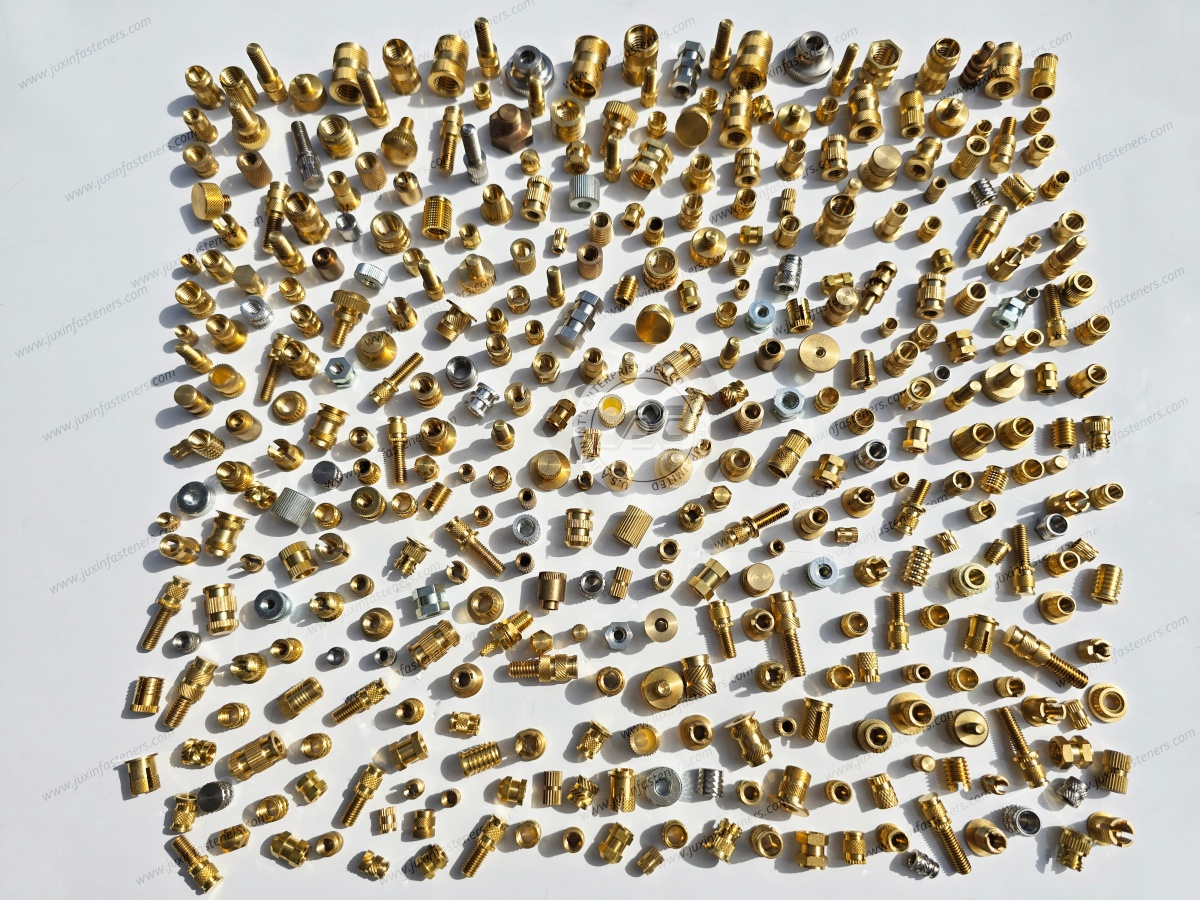
External Male Threaded Stud
The projecting external thread provides an integrated mounting point within the thermoplastic component.
This arrangement is particularly useful where the final assembly requires a nut to secure a bracket, enclosure or mechanical component.
Typical mounting arrangements include:
Plastic housing to metal bracket
Automotive plastic module to mounting support
Electrical enclosure to equipment frame
Sensor housing to installation bracket
Industrial controller to mounting panel
Electronic assembly to structural hardware
The stud length can be customized to accommodate the mating component thickness, washer arrangement and required thread engagement.
Thread selection must account for the expected tensile load, tightening torque and operating environment.
Stepped Body and Shoulder Features
The photographed JX-HTD and JX-FHTD components incorporate stepped body geometry near the external threaded stud and anchoring section.
These features can be designed to support positioning, insertion-depth control and mechanical integration with the plastic assembly.
A shoulder may also provide a defined interface for installation tooling or mating components, depending on the approved design.
The exact function of each shoulder or locating feature must be confirmed against the engineering drawing.
For custom production, Juxin Fasteners can manufacture specified shoulder diameters, step heights, locating surfaces and dimensional tolerances.
Brass Material Advantages
Brass is widely selected for heat-installed threaded components because of its thermal conductivity, machinability and useful corrosion resistance.
Thermal Conductivity
Brass transfers heat efficiently during controlled thermal insertion.
This helps soften the surrounding thermoplastic and allows the plastic to flow into the retention features.
Precision Machinability
Brass supports precision CNC turning, external threading and detailed knurl machining.
This makes it suitable for small and complex custom mounting studs.
Electrical Conductivity
Brass is electrically conductive and can be useful in selected electrical and electronic equipment.
Any grounding or electrical connection function must be verified at the assembly level.
Corrosion Resistance
Brass provides useful corrosion resistance in many indoor and controlled industrial environments.
Chemical exposure, moisture, temperature and galvanic compatibility should be evaluated for the intended application.
Material Selection and Compliance
Juxin Fasteners can evaluate customer-specified brass alloys, including H63, H65, H68, H70 and H90.
Material selection should consider machining performance, mechanical properties, chemical composition and cost.
Lead-free brass can be evaluated when required by customer specifications or applicable regulatory restrictions.
Material compliance must be supported by the selected alloy and relevant documentation rather than assumed from the brass designation.
Heat-Set Installation Process
Heat-set installation is a post-molding process used to embed metal inserts into suitable thermoplastic materials.
A molded or machined installation hole is prepared in the plastic component.
The metal insert is positioned using controlled installation equipment.
Heat is transferred to the anchoring section, softening the thermoplastic around the installation hole.
The insert is pressed into the plastic under controlled force and depth.
As the plastic cools, it solidifies around the diamond-knurled features.
This creates a retained metal stud within the plastic component.
Recommended Process Development Steps
Confirm the thermoplastic resin and filler content.
Establish the installation hole diameter and depth.
Select the insert anchoring diameter and engagement length.
Prepare suitable thermal installation tooling.
Determine the initial installation temperature and pressure.
Install the insert to the specified depth.
Allow the plastic to cool under controlled conditions.
Inspect stud alignment and plastic deformation.
Conduct torque resistance and pull-out testing.
Validate the process before production release.
Installation settings must be established through testing using production-representative components.
Ultrasonic Installation
Ultrasonic insertion uses high-frequency mechanical vibration to generate localized heat at the metal-to-plastic interface.
The thermoplastic softens and flows around the external knurl geometry.
After cooling, the plastic forms a mechanical interlock with the insert.
This method can be suitable for automated thermoplastic assembly when the insert geometry, horn design, plastic material and equipment parameters are compatible.
Potential production advantages include:
Controlled post-mold installation
Localized heating
Compatibility with automated assembly equipment
Repeatable insertion depth when properly controlled
Integration into suitable high-volume manufacturing processes
Ultrasonic installation must be validated for the specific JX-HTD or JX-FHTD configuration.
Thermal Installation Versus Ultrasonic Installation
Thermal installation relies on controlled external heating.
Ultrasonic installation relies on vibration-generated heat at the installation interface.
Both methods require sufficient plastic flow into the retention features.
Thermal installation may be preferred when controlled heating and gradual plastic displacement are advantageous.
Ultrasonic installation may be selected where suitable equipment and validated process parameters support the production requirements.
Neither process should be selected solely on installation speed.
The final choice should consider retention performance, plastic stress, equipment investment, production volume and assembly consistency.
Thermoplastic Material Compatibility
Potential thermoplastic materials include:
ABS – Acrylonitrile Butadiene Styrene
PC – Polycarbonate
PC/ABS – Polycarbonate/ABS Blends
PA6 – Polyamide 6
PA66 – Polyamide 66
PBT – Polybutylene Terephthalate
PET – Polyethylene Terephthalate
PPS – Polyphenylene Sulfide
PEEK – Polyether Ether Ketone
Glass-Filled Engineering Thermoplastics
These materials have different thermal and mechanical characteristics.
Compatibility depends on the specific resin grade, filler percentage, installation method and operating conditions.
Glass-filled thermoplastics may require different insertion settings from unfilled materials.
Thermosetting plastics generally cannot be softened and reformed through conventional heat-set installation.
Installation Hole and Plastic Boss Design
The surrounding plastic structure is critical to the retention performance of a male threaded insert.
Design engineers should evaluate:
Hole diameter
Hole depth
Boss outside diameter
Wall thickness
Distance from molded edges
Plastic shrinkage
Local stress concentration
Knurl engagement length
Stud alignment
Installation depth
Mating nut tightening torque
An undersized installation hole can generate excessive radial stress and potentially damage the plastic boss.
An oversized hole can reduce plastic engagement with the knurl features.
The required boss dimensions should be determined from the insert geometry, resin characteristics and mechanical loading conditions.
Metric Male Thread Specifications
Juxin Fasteners supports drawing-based manufacturing of custom metric threaded studs.
Common metric thread specifications for engineering evaluation include:
M2 × 0.4
M2.5 × 0.45
M3 × 0.5
M4 × 0.7
M5 × 0.8
M6 × 1.0
M8 × 1.25
M10 × 1.5
M12 × 1.75
These are potential custom thread specifications, not a confirmed standard size range for every JX-HTD or JX-FHTD configuration.
The actual available thread diameter, stud length and anchoring geometry must be verified against the approved manufacturing drawing.
Metric thread requirements should reference applicable ISO thread standards.
UNC and UNF Inch Thread Specifications
For American OEM and industrial equipment applications, Juxin Fasteners can evaluate custom Unified inch-threaded stud inserts.
Potential thread specifications include:
#2-56 UNC
#4-40 UNC
#6-32 UNC
#8-32 UNC
#10-24 UNC
#10-32 UNF
1/4-20 UNC
1/4-28 UNF
5/16-18 UNC
5/16-24 UNF
3/8-16 UNC
3/8-24 UNF
Larger or nonstandard thread sizes can be reviewed according to engineering drawings.
Unified inch threads should be specified according to ASME B1.1.
Metric and UNC/UNF threads are not directly interchangeable.
Equivalent nominal diameters do not establish thread compatibility.
Industrial Applications
Automotive and Electric Vehicle Manufacturing
Automotive manufacturers use molded thermoplastic components in mechanical, electrical and electronic assemblies.
Diamond-knurled brass male threaded inserts can provide integrated mounting studs in suitable plastic components.
Potential applications include:
Automotive sunroof component housings
Interior trim mounting assemblies
Dashboard electronic modules
Automotive sensor housings
Lighting equipment enclosures
Battery management system housings
EV electronic control modules
Charging equipment plastic components
For automotive OEM and Tier-1/Tier-2 applications, important requirements may include vibration resistance, temperature cycling, dimensional consistency and controlled assembly torque.
The complete fastening system must be validated under the intended operating conditions.
Industrial Electrical Equipment
Electrical equipment manufacturers often require mounting points within molded plastic housings.
Potential applications include:
Electrical control cabinets
Switchgear control modules
Power distribution control components
Industrial electrical enclosures
Electrical monitoring equipment
Power supply housings
Electronic protection modules
A male threaded stud allows a mating bracket or mechanical component to be secured using a nut.
Electrical safety, insulation and grounding requirements must be evaluated separately.
Power Electronics and Energy Storage
Power electronics and energy storage equipment frequently incorporate thermoplastic housings and control components.
Potential applications include:
UPS control assemblies
AC-DC converter housings
DC-DC converter control modules
Energy storage monitoring enclosures
Battery management electronics
Charging infrastructure control housings
Insert material and joint design should be selected according to mechanical loading, electrical requirements and operating temperature.
Industrial Automation and Robotics
Industrial automation manufacturers use plastic housings for sensors, control devices and electronic interfaces.
Potential applications include:
PLC controller housings
Industrial sensor assemblies
Robotic control modules
Automation interface panels
Industrial monitoring equipment
Machine control enclosures
Male threaded inserts can simplify mounting arrangements by integrating a permanent stud into the plastic component.
Telecommunications and Data Center Equipment
Suitable applications include:
Network equipment housings
Communication control modules
Server monitoring devices
Data center sensor enclosures
Electronic interface components
Industrial communication equipment
The threaded stud can provide a mechanical attachment point for mounting brackets and compatible hardware.
HVAC and Building Control Systems
Potential applications include:
Thermostat housings
HVAC electronic control modules
Environmental sensor enclosures
Heating equipment control assemblies
Air handling control components
Building automation equipment
Plastic resin compatibility and operating temperature must be considered during insert selection.
Medical and Laboratory Equipment
Potential applications include non-implantable medical equipment housings and laboratory instrument enclosures.
Examples include:
Diagnostic equipment housings
Laboratory control modules
Patient monitoring equipment enclosures
Instrument mounting components
Plastic equipment brackets
Material compliance, cleaning requirements and relevant product regulations must be verified for the intended application.
Consumer Electronics and Industrial Appliances
Potential applications include:
Electronic equipment housings
Smart home devices
Lighting control equipment
Appliance control modules
Power tool housings
Electronic mounting fixtures
These applications may benefit from repeatable installation processes and precision-manufactured metal mounting studs.
Engineering Performance Requirements
Torque Resistance
The diamond-knurled anchoring section helps resist rotation when a mating nut is tightened.
Actual torque resistance depends on insert geometry, plastic material and installation quality.
Pull-Out Resistance
Pull-out resistance measures the axial load required to extract the installed insert from the plastic component.
The retention performance depends on the knurl geometry, engagement length and surrounding plastic structure.
External Thread Strength
The projecting stud must withstand the expected assembly loads.
Thread diameter, brass alloy, engagement length and mating nut properties must be considered.
Stud Alignment
Correct alignment is important for reliable assembly and consistent tightening.
Installation tooling should control the position and perpendicularity of the stud relative to the plastic mounting surface.
Plastic Stress and Creep
Thermoplastic materials may deform under sustained mechanical loading or elevated temperatures.
Long-term retention and joint performance should be evaluated under realistic operating conditions.
Vibration Resistance
The knurled anchoring body provides retention within the plastic.
However, it does not automatically prevent a mating nut from loosening under vibration.
Appropriate locking hardware should be specified where required.
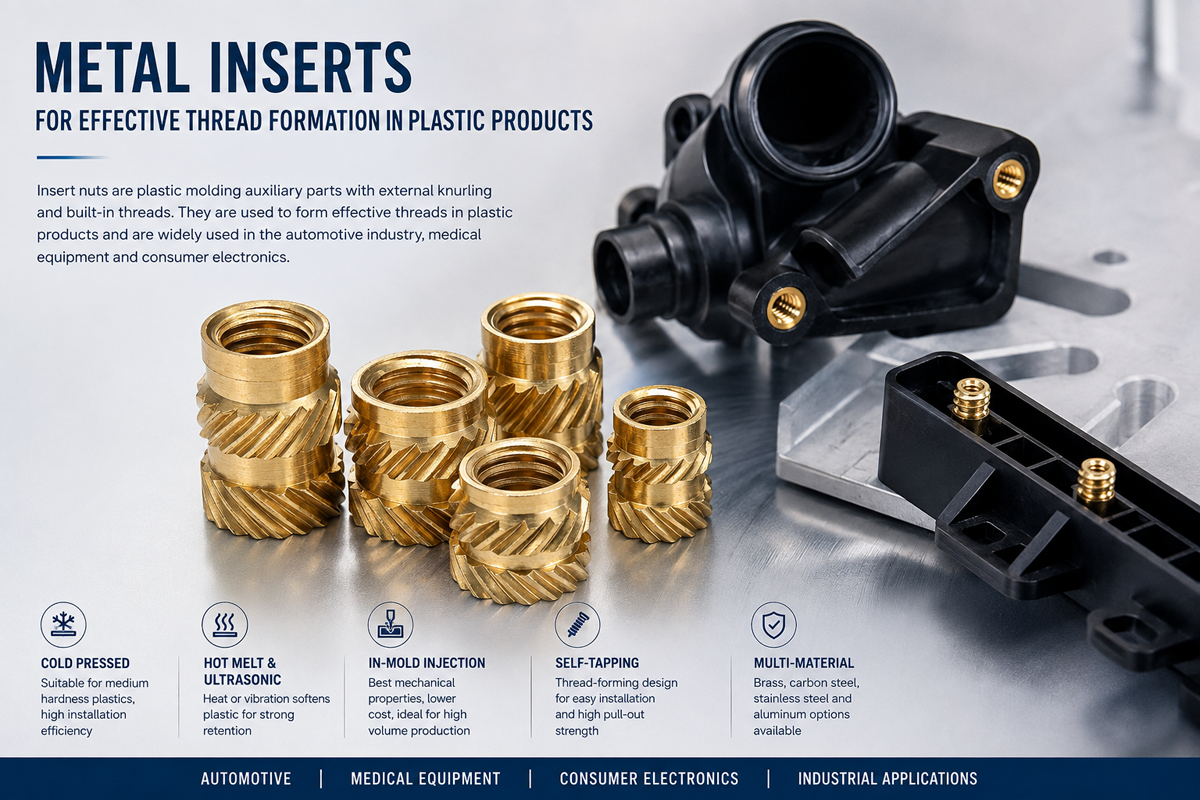
JX-HTD and JX-FHTD Custom Manufacturing
Juxin Fasteners manufactures custom brass male threaded inserts according to customer drawings and approved specifications.
Customizable characteristics include:
External thread diameter
Thread pitch
Thread tolerance
Stud projection length
Knurled body diameter
Diamond knurl pitch
Knurl depth
Anchoring body length
Shoulder diameter
Locating step geometry
Overall length
Material selection
Surface finish
Dimensional tolerances
The exact dimensional differences between JX-HTD and JX-FHTD should be established from their respective engineering drawings.
Precision Manufacturing and Quality Control
Juxin Fasteners combines industrial fastener manufacturing capabilities with precision CNC machining.
For custom brass male threaded inserts, manufacturing operations may include:
CNC precision turning
External thread machining
Diamond knurl machining
Shoulder and step machining
Groove machining
Precision cutting
Dimensional inspection
Batch quality verification
Important inspection characteristics include:
Material specification
Thread diameter and pitch
Thread tolerance
Stud length
Knurl outside diameter
Knurl geometry
Anchoring length
Shoulder dimensions
Overall length
Concentricity
Burr control
Surface condition
Inspection documentation and material certification requirements can be reviewed during the RFQ process.
Design for Manufacturing and Cost Optimization
For high-volume OEM projects, production cost is influenced by material selection, component geometry and machining requirements.
Important cost factors include:
Brass alloy
Material diameter
Stud length
Thread complexity
Knurl geometry
Machining cycle time
Dimensional tolerance
Surface finish
Inspection requirements
Annual production volume
Juxin Fasteners can review drawing-based designs for manufacturing feasibility and potential cost optimization.
Any proposed dimensional or material changes require customer engineering approval before production.
Frequently Asked Questions
What is a diamond-knurled brass male threaded insert?
It is a metal insert with an external threaded stud and a diamond-knurled anchoring body, designed to provide a permanent mounting point in suitable plastic components.
How is it different from a female threaded insert?
A male insert provides an external stud for a mating nut.
A female insert provides an internal thread for a screw or bolt.
What is the purpose of diamond knurling?
Diamond knurling provides external retention features that engage the surrounding plastic after installation and cooling.
Are diamond knurls always stronger than straight knurls?
No. Retention performance depends on the complete insert geometry, plastic resin, installation process and applied loads.
Can JX-HTD and JX-FHTD inserts be installed using heat?
These products are intended for suitable thermal insertion applications.
The installation method must be validated against the specific part geometry and plastic material.
Can they be installed ultrasonically?
Ultrasonic installation may be suitable when the component geometry, resin and equipment parameters are compatible.
Can the inserts be used in automotive plastic components?
Yes, suitable applications can be evaluated for automotive assemblies after the required mechanical and environmental validation.
Can Juxin Fasteners manufacture inch-threaded studs?
Yes. Custom UNC and UNF threaded studs can be evaluated according to approved drawings.
Can the stud length and knurl diameter be customized?
Yes. Juxin Fasteners supports drawing-based customization of thread dimensions, stud length, knurl geometry and anchoring body dimensions.
What is required for a manufacturing quotation?
Customers should provide the engineering drawing, material specification, thread size, stud length, anchoring dimensions, plastic resin, installation method, required quantity and annual demand.
Request a Quote – Diamond-Knurled Brass Male Threaded Inserts
Juxin Fasteners manufactures precision brass male heat-set threaded inserts, diamond-knurled threaded studs and custom metal fastening components for industrial OEM applications.
Our manufacturing services support:
Design Engineers
Mechanical Engineers
Structural Engineers
Manufacturing Engineers
Production Managers
Procurement Development Teams
Purchasing Specialists
Procurement Managers
Supply Chain Managers
For an accurate quotation, please provide:
Product Reference: JX-HTD or JX-FHTD
2D Drawing or 3D Model
Brass Alloy Specification
Metric or UNC/UNF Thread Size
External Stud Length
Knurled Body Diameter
Anchoring Length
Shoulder Dimensions
Overall Component Length
Plastic Resin Specification
Installation Method
Mechanical Performance Requirements
Order Quantity
Estimated Annual Demand
Inspection Requirements
Engineering samples can be arranged for qualified OEM projects, subject to specification review.
Contact Juxin Fasteners for custom manufacturing, engineering evaluation and industrial batch production quotations.
Email: info@juxinfasteners.com
Website: www.juxinfasteners.com
Juxin Fasteners – Diamond-Knurled Brass Male Threaded Insert Manufacturing for Automotive and Industrial OEM Applications.
Product Packaging
Packaging Standard
At Juxin Fasteners, we apply standardized export packaging to ensure product protection, traceability, and compliance with international logistics requirements.
1. Standard Export Packaging
Unless otherwise specified, all products will be packed according to our factory standard export packaging, which includes:
Moisture-resistant inner protection
Poly bag or small box packing as required
Reinforced export cartons
Clear labeling with part number, specification, batch number, and quantity
Palletizing for sea or air shipment when necessary
Our standard packaging is designed to ensure safe transportation, efficient warehousing, and long-distance international shipping.
2. Customized Packaging Options
We also provide customized packaging solutions according to customer requirements, including but not limited to:
Private labeling
Customized barcodes
Specific carton dimensions
Retail packaging
Special pallet configuration
Customer-specific marking and identification
So that you know, customized packaging may involve additional costs and extended lead time depending on the complexity of the requirements.
3. Compliance & Quality Assurance
All packaging processes are controlled under our ISO 9001 quality management system to ensure consistency, traceability, and product integrity throughout the supply chain.
Product Pictures


Contact Us
Tel.:
+86 020 8621 0320
+86 020 3121 6067
E-mail:
Technical Support:
Navigation
SEND INQUIREY


