Call Us
+86 136 6007 9809
Call Us
+86 136 6007 9809

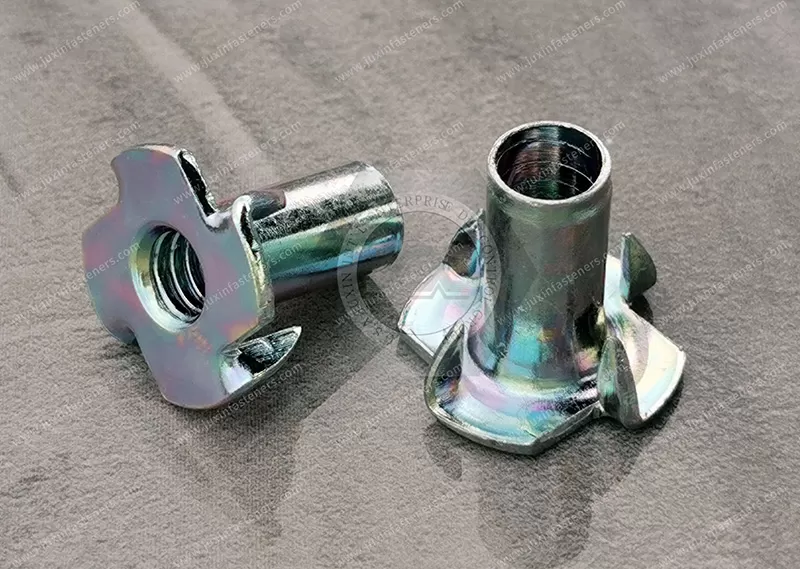
Juxin Fasteners manufactures four-prong tee nuts for wood, also known as pronged Tee-nuts or tee-nut threaded inserts.
These hammer-in fasteners provide reusable internal threads in hardwood, softwood, plywood and suitable engineered wood panels.
Available materials include carbon steel and stainless steel, with metric M6, M8 and M10 threads and UNC 1/4-20, 5/16-18 and 3/8-16 threads.
Surface finish options include plain steel, zinc plating and black oxide, subject to material and production requirements.
Designed for furniture manufacturing, seating systems, cabinetry, bed frames, wooden equipment assemblies and other OEM wood-to-metal connections.
Juxin Fasteners supports batch manufacturing, drawing-based customization and dimensional inspection for international OEM procurement programs.
Product Specification
Four-Prong Tee Nuts for Wood – Steel & Stainless Steel OEM Manufacturing
Juxin Fasteners manufactures four-prong tee nuts for wood, providing reliable internally threaded fastening solutions for furniture manufacturers,
woodworking equipment producers, commercial seating manufacturers and industrial OEM assembly operations.
Also known as four-prong T-nuts, pronged tee nuts, hammer-in tee nuts and tee-nut threaded inserts for wood,
these fasteners create reusable metal threads in wooden components without requiring the wood itself to be tapped.
Our manufacturing capabilities support carbon steel and stainless steel tee nuts in metric and Unified National Coarse (UNC) thread sizes,
with customized dimensions and surface finishes available for drawing-based OEM production.
Four-Prong Tee Nut Design and Function
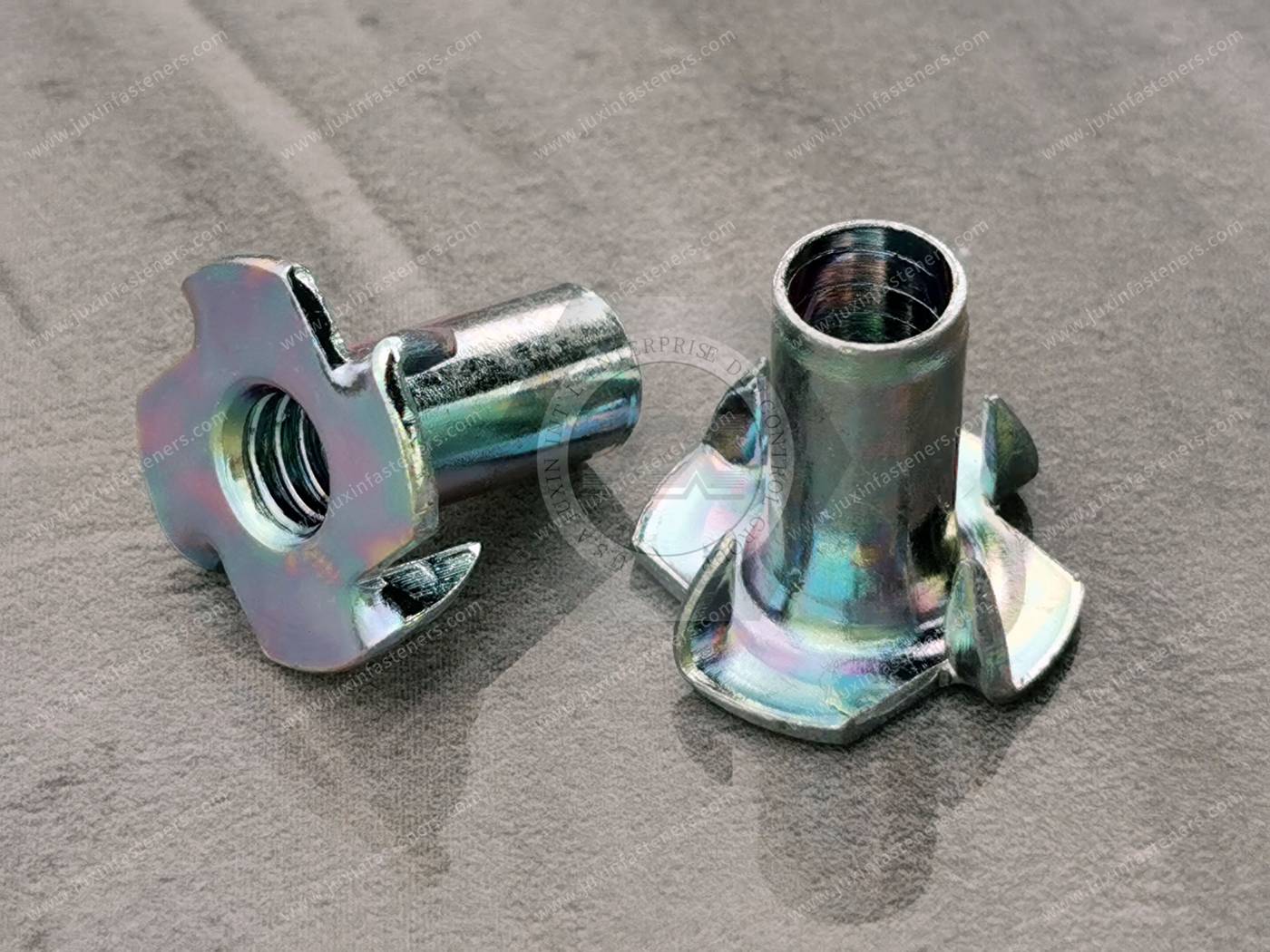
A four-prong tee nut consists of a cylindrical internally threaded barrel, a flange and four anchoring prongs positioned around the flange.
The barrel fits into a predrilled hole in the wooden component. During installation, the prongs are driven into the surrounding wood to help prevent the insert from rotating when a mating screw or bolt is tightened.
The flange provides a bearing surface on the installation side of the wood, helping distribute axial loads over a larger contact area.
Main Design Characteristics
Four anchoring prongs for rotational resistance in suitable wood substrates.
Internally threaded barrel for repeated screw or bolt installation.
Flanged construction to distribute bearing loads.
Hammer-in or controlled press-in installation.
Carbon steel and stainless steel material options.
Metric and UNC thread configurations.
Custom barrel lengths, flange dimensions and prong geometry for OEM applications.
The actual holding performance depends on the wood species, panel density, installation-hole diameter, prong penetration, fastener dimensions and applied loads.
Four-prong tee nuts are generally suited to light- and medium-duty assemblies where their retention performance has been validated.
They should not be selected for safety-critical structural connections without application-specific testing.
Technical Specifications – Metric and Inch Tee Nuts
Juxin Fasteners supplies standard and drawing-based four-prong tee nuts for wood assemblies.
| Specification | Available Options |
|---|---|
| Product Type | Four-Prong Tee Nut / Pronged Threaded Insert |
| Materials | Carbon Steel, Stainless Steel |
| Metric Threads | M6 × 1.0, M8 × 1.25, M10 × 1.5 |
| Inch Threads | 1/4-20 UNC, 5/16-18 UNC, 3/8-16 UNC |
| Flange Type | Four-Prong Flange |
| Installation | Hammer-In / Press-In |
| Barrel Design | Internally Threaded, Open-End |
| Surface Finishes | Plain Steel, Zinc Plating, Black Oxide; Other Finishes on Request |
| Substrate Compatibility | Hardwood, Softwood, Plywood and Suitable Engineered Wood Panels |
| Customization | Barrel Length, Flange Diameter, Prong Geometry, Thread and Finish |
| Production | OEM / ODM Batch Manufacturing to Approved Drawings |
Dimensions and material combinations are subject to the approved product drawing and manufacturing confirmation.
Metric Thread Sizes
M6 × 1.0: Furniture joints, seating components and medium-size wooden assemblies.
M8 × 1.25: Furniture frames, wooden equipment supports and assemblies requiring larger threaded connections.
M10 × 1.5: Larger wooden assemblies where the panel thickness and required load capacity support the selected insert.
UNC Inch Thread Sizes for North American OEMs
1/4-20 UNC: Common in furniture hardware, woodworking assemblies and equipment mounting.
5/16-18 UNC: Used in larger furniture joints and industrial wood-to-metal fastening applications.
3/8-16 UNC: Suitable for larger fastening assemblies where the wood substrate and tee nut geometry have been verified.
UNC thread sizes are specified by nominal inch diameter and threads per inch (TPI).
Important Thread Compatibility Note
Metric threads and UNC threads are different thread systems and are not directly interchangeable.
For example, M6 × 1.0 and 1/4-20 UNC have different nominal diameters and thread pitches. Likewise, M8 × 1.25 and 5/16-18 UNC must not be substituted without an approved engineering redesign.
UNF (Unified National Fine) threads are another inch-based thread series and are not interchangeable with UNC threads of the same nominal diameter. UNF configurations require separate manufacturing confirmation.
Engineers and purchasing teams should specify the exact thread designation on all drawings and purchase orders.
Material Selection – Carbon Steel vs. Stainless Steel Tee Nuts
Material selection should consider operating conditions, corrosion exposure, required mechanical performance and total assembly cost.
Carbon Steel Four-Prong Tee Nuts
Carbon steel tee nuts are a practical choice for high-volume furniture manufacturing and indoor industrial wood assemblies.
Typical finishing options include:
Plain Steel
Suitable for controlled, dry indoor environments where additional corrosion protection is unnecessary or subsequent finishing is planned.
Zinc-Plated Steel
Provides additional corrosion protection compared with unfinished carbon steel. Suitable for many indoor furniture and equipment applications with limited moisture exposure.
Black-Oxide Steel
Provides a dark surface appearance, often selected for exposed or dark-colored furniture hardware. Black oxide alone offers limited corrosion protection and is generally more appropriate for dry environments.
Additional finishes may be evaluated according to the OEM drawing, appearance requirements and environmental conditions.
Stainless Steel Four-Prong Tee Nuts
Stainless steel tee nuts provide improved corrosion resistance for applications involving humidity, cleaning exposure or outdoor service conditions.
18-8 stainless steel is a commonly used North American material designation for austenitic stainless fasteners. Specific grades such as AISI 304 must be confirmed in the approved material specification.
Stainless steel may be preferred for:
Outdoor furniture assemblies.
Furniture used in humid environments.
Wooden equipment enclosures.
Selected commercial seating applications.
Wood-to-metal joints exposed to periodic moisture.
Stainless steel is not universally immune to corrosion. Chloride exposure, coastal conditions, cleaning chemicals and contact with dissimilar metals must be considered during material selection.
For particularly aggressive environments, alternative stainless grades can be evaluated as a separate custom manufacturing requirement.
Installation Guidelines for Four-Prong Tee Nuts
Correct installation is essential to achieve reliable retention and repeatable assembly performance.
Step 1 – Confirm Wood Substrate and Thickness
Identify whether the application uses hardwood, softwood, plywood, MDF or another engineered wood material.
Panel thickness, density and internal structure influence the ability of the four prongs to engage securely.
For engineered panels, trial installation is recommended before production approval.
Step 2 – Select the Correct Hole Diameter
The hole must accommodate the tee nut barrel while allowing the prongs to engage the surrounding wood.
An oversized hole can reduce stability. An undersized hole can damage the wood, distort the insert or create excessive installation force.
Drill-hole dimensions should follow the approved tee nut drawing and be verified on the actual production substrate.
Step 3 – Insert the Barrel
Position the internally threaded barrel in the prepared hole with the four prongs facing the wooden surface.
Check that the tee nut is properly aligned before applying installation force.
Step 4 – Seat the Flange and Prongs
Use a suitable installation press or controlled hammering method to drive the prongs into the wood.
Apply force evenly to prevent flange distortion, thread damage or uneven prong engagement.
The flange should seat against the intended surface without excessive crushing or splitting of the substrate.
Step 5 – Verify Assembly Performance
Install the mating screw or bolt and confirm:
Correct thread engagement.
No unwanted rotation of the tee nut.
Acceptable flange seating.
No visible substrate cracking.
Required tightening performance.
Adequate resistance to pull-out and push-out loads.
Production validation should be performed using the actual wood material, mating fastener and assembly conditions.
Industrial Applications and OEM Assembly Solutions
Furniture Manufacturing
Four-prong tee nuts are widely used in furniture production where wooden components must be joined to metal brackets, frames or removable hardware.
Typical applications include:
Office chairs and seating frames.
Sofas and upholstered furniture.
Bed frames and headboards.
Wooden tables and furniture supports.
Modular and knock-down furniture.
Commercial furniture and hospitality furnishings.
OEM Engineering Consideration: Repeated assembly and disassembly requires consistent internal thread quality and reliable insert retention.
For furniture manufacturers, Juxin Fasteners supports dimensional consistency and batch supply based on approved drawings.
Cabinetry and Woodworking Equipment
Cabinet manufacturers and woodworking equipment producers use tee nuts where removable metal hardware must connect to wooden panels.
Applications may include:
Cabinet mounting components.
Adjustable wooden fixtures.
Equipment support panels.
Removable brackets and accessory mounts.
Wooden jigs and workshop fixtures.
Manufacturing Consideration: Hole position, panel thickness and barrel length must be coordinated to prevent interference and achieve repeatable installation.
Commercial Seating and Interior Fixtures
Commercial seating, exhibition furniture and interior equipment may require threaded connections that allow maintenance or component replacement.
Four-prong tee nuts can provide reusable fastening points in suitable wooden structural components.
Selection should account for vibration, cyclic loading, installation orientation and maintenance frequency.
For load-bearing seating components, assembly testing is particularly important.
Wooden Equipment Assemblies
Wood-to-metal threaded connections are also used in equipment packaging, industrial fixtures, machinery accessories and wooden support assemblies.
Potential applications include:
Industrial wooden mounting panels.
Equipment fixtures.
Removable wooden access panels.
Wood-based assembly platforms.
Custom manufacturing jigs.
Engineers should verify retention under the expected installation and service loads rather than relying solely on nominal thread size.
Climbing Wall Panels and Recreational Equipment
Four-prong tee nuts are used in certain climbing wall systems as threaded attachment points for removable climbing holds.
These applications require particular attention to panel material, fastener retention, repeated loading and inspection requirements.
Safety Consideration: Climbing wall applications require system-specific engineering validation, suitable fastener retention methods and compliance with applicable safety requirements.
A standard furniture-grade tee nut should not be assumed suitable without qualification.
Four-Prong Tee Nuts vs. Other Threaded Inserts for Wood
Choosing the correct insert depends on installation method, wood substrate, load direction and service requirements.
| Fastener Type | Installation Method | Typical Selection Consideration |
|---|---|---|
| Four-Prong Tee Nut | Hammer-In / Press-In | Economical threaded connection in suitable wood panels |
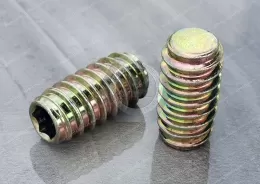
| Screw-In Threaded Insert | Screwed into Prepared Hole | Threaded engagement with the surrounding wood |
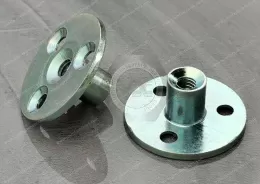
| Screw-Mount Threaded Nut | Secured with Mounting Screws | Mechanical retention through additional screws |
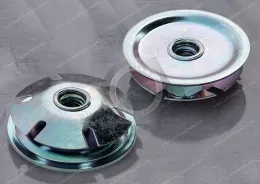
| Press-Fit Threaded Insert | Pressed into Prepared Hole | Retention through insert geometry and substrate engagement |
Four-prong tee nuts should not be considered direct replacements for screw-mounted or externally threaded wood inserts without evaluating installation conditions and mechanical performance.
For OEM engineers, the appropriate choice depends on the required pull-out resistance, rotational resistance, substrate characteristics, production process and service environment.
Engineering Considerations for OEM Design Teams
Barrel Length and Panel Thickness
The barrel length must be coordinated with the wood thickness, mating screw engagement and available clearance.
A barrel that is too long may interfere with adjacent components. A barrel that is too short may provide insufficient thread engagement.
The dimensional definition of installed length, including flange thickness where applicable, should be stated clearly on the drawing.
Flange Diameter and Prong Geometry
Flange diameter affects the bearing area, while prong length, width and geometry influence engagement with the wood.
Larger flanges or modified prongs do not automatically guarantee higher retention strength.
Design changes should be verified through application-specific testing.
Thread Quality
Consistent internal threading helps reduce assembly problems, including cross-threading, incomplete engagement and inconsistent tightening.
Thread inspection should follow the approved thread specification and inspection plan.
Production Installation Efficiency
For production managers, important considerations include:
Compatibility with automated or semi-automated insertion equipment.
Repeatable insertion force.
Consistent flange seating.
Stable prong geometry.
Reduced installation-related wood damage.
Consistent thread engagement during final assembly.
A validated installation process can help reduce rework and improve assembly consistency.
OEM Manufacturing Capabilities – Juxin Fasteners
Juxin Fasteners is an industrial fastener manufacturer supporting international OEM and ODM production programs.
Our manufacturing capabilities include cold forming, cold heading and CNC machining for fasteners and precision metal components.
For four-prong tee nuts, the production route is selected according to the approved part geometry, material and production requirements.
Depending on the design, manufacturing may involve metal forming, piercing, threading, secondary machining and surface finishing.
Custom Manufacturing Options
Juxin Fasteners can evaluate drawing-based requirements for:
Metric and inch thread configurations.
Customized barrel lengths.
Customized flange diameters.
Modified four-prong geometry.
Carbon steel and stainless steel materials.
Specified surface treatments.
OEM part identification and packaging.
Batch production requirements.
Application-specific inspection criteria.
Custom dimensions, material combinations and manufacturing feasibility are confirmed through engineering review before production approval.
Dimensional and Quality Inspection
Inspection requirements can include:
Internal thread GO/NO-GO gauge inspection.
Barrel outside diameter and length.
Flange diameter and thickness.
Prong geometry and dimensional consistency.
Visual inspection of surface finish.
Material verification against purchase specifications.
Drawing-based dimensional inspection.
Packaging and batch identification.
Where required, additional coating or mechanical performance testing can be agreed upon during the RFQ and sample approval process.
Applicable standards and test methods should be identified according to the actual product design, material and customer requirements.
International OEM Procurement and Supply Programs
Juxin Fasteners supports international B2B customers purchasing threaded fasteners for industrial production and repeat-order assembly programs.
For procurement managers and supply chain teams, the important purchasing factors include:
Correct metric or UNC thread specification.
Material and surface finish consistency.
Approved dimensions and tolerances.
Stable production quality.
Batch quantity and repeat-order requirements.
Packaging suitable for international transportation.
Drawing revision control.
Inspection and documentation requirements.
Lead time and production planning.
Our focus is manufacturing supply for OEM production rather than consumer retail sales.
We work with customers in North America, South America, Europe and other international markets, supporting technical evaluation and production-based procurement.
Frequently Asked Questions
What is a four-prong tee nut?
A four-prong tee nut is an internally threaded metal insert with a flange and four anchoring prongs. It is installed into a predrilled hole in wood to provide a reusable metal thread.
Are T-nuts and tee nuts the same?
In woodworking fastener terminology, T-nuts and tee nuts commonly refer to the same general type of flanged threaded insert. However,
Tee-nut is also used for other fastener designs, including T-slot nuts. The four-prong configuration should therefore be specified clearly.
Can four-prong tee nuts be used in plywood?
Yes, suitable plywood panels can accommodate four-prong tee nuts. Retention depends on panel thickness, construction, density, hole diameter and installation quality. Testing on the actual panel is recommended.
Can they be used in MDF?
Certain MDF applications may be suitable, but prong retention and resistance to substrate damage require validation. MDF performance should not be assumed equivalent to solid hardwood or plywood.
What is the difference between 1/4-20 UNC and M6?
1/4-20 UNC has a nominal major diameter of 6.35 mm and 20 threads per inch, equivalent to a 1.27 mm pitch. M6 × 1.0 has a nominal major diameter of 6 mm and a 1.0 mm pitch.
These threads are not interchangeable.
Are stainless steel tee nuts suitable for outdoor furniture?
Stainless steel tee nuts can provide improved corrosion resistance for outdoor furniture, but suitability depends on the specific stainless grade, exposure conditions, wood treatment chemicals and assembly design.
Can Juxin Fasteners manufacture customized tee nuts?
Yes. Juxin Fasteners supports drawing-based OEM manufacturing and can evaluate custom thread sizes, barrel lengths, flange dimensions, prong geometry, materials and finishes.
What information is needed for an OEM quotation?
A technical drawing or complete dimensional specification is preferred. Please include thread size, material, surface finish, dimensions, tolerances, application, estimated order quantity and any inspection requirements.
Request a Quote – Four-Prong Tee Nuts for Wood
Juxin Fasteners manufactures steel and stainless steel four-prong tee nuts for OEM furniture, woodworking equipment and industrial wood-to-metal assembly applications.
For standard or customized production requirements, please send us your drawing, material specification, thread size and estimated purchasing quantity.
Our team can review the technical requirements, manufacturing feasibility, sample needs and production quotation.
Manufacturer: Juxin Fasteners
Product: Four-Prong Tee Nuts for Wood
Metric Threads: M6 × 1.0, M8 × 1.25, M10 × 1.5
UNC Threads: 1/4-20, 5/16-18, 3/8-16
Materials: Carbon Steel and Stainless Steel
Manufacturing: OEM / ODM, Drawing-Based Custom Manufacturing and Batch Production
Email: info@juxinfasteners.com
Website: www.juxinfasteners.com
Send your 2D/3D drawings or technical specifications to request an OEM manufacturing quotation.
Product Packaging
Packaging Standard
At Juxin Fasteners, we apply standardized export packaging to ensure product protection, traceability, and compliance with international logistics requirements.
1. Standard Export Packaging
Unless otherwise specified, all products will be packed according to our factory standard export packaging, which includes:
Moisture-resistant inner protection
Poly bag or small box packing as required
Reinforced export cartons
Clear labeling with part number, specification, batch number, and quantity
Palletizing for sea or air shipment when necessary
Our standard packaging is designed to ensure safe transportation, efficient warehousing, and long-distance international shipping.
2. Customized Packaging Options
We also provide customized packaging solutions according to customer requirements, including but not limited to:
Private labeling
Customized barcodes
Specific carton dimensions
Retail packaging
Special pallet configuration
Customer-specific marking and identification
So that you know, customized packaging may involve additional costs and extended lead time depending on the complexity of the requirements.
3. Compliance & Quality Assurance
All packaging processes are controlled under our ISO 9001 quality management system to ensure consistency, traceability, and product integrity throughout the supply chain.
Product Pictures
Contact Us
Tel.:
+86 020 8621 0320
+86 020 3121 6067
E-mail:
Technical Support:
Navigation
SEND INQUIREY