Call Us
+86 136 6007 9809
Call Us
+86 136 6007 9809

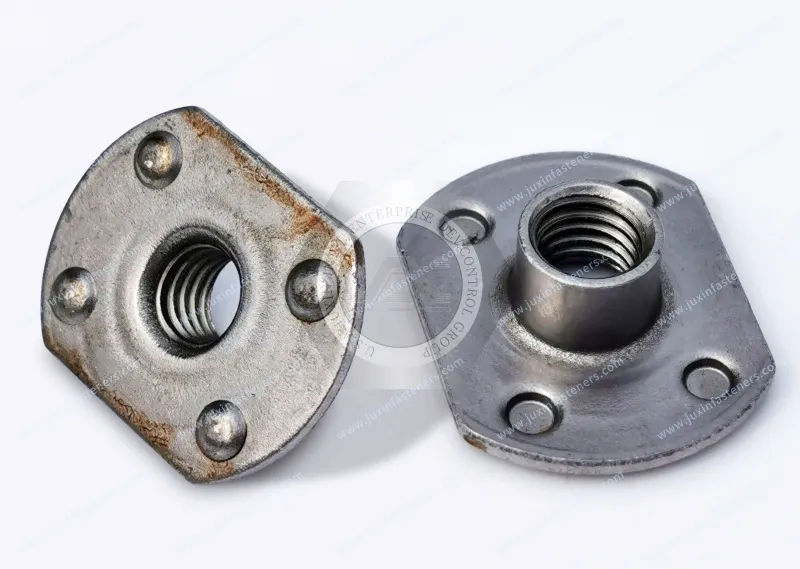
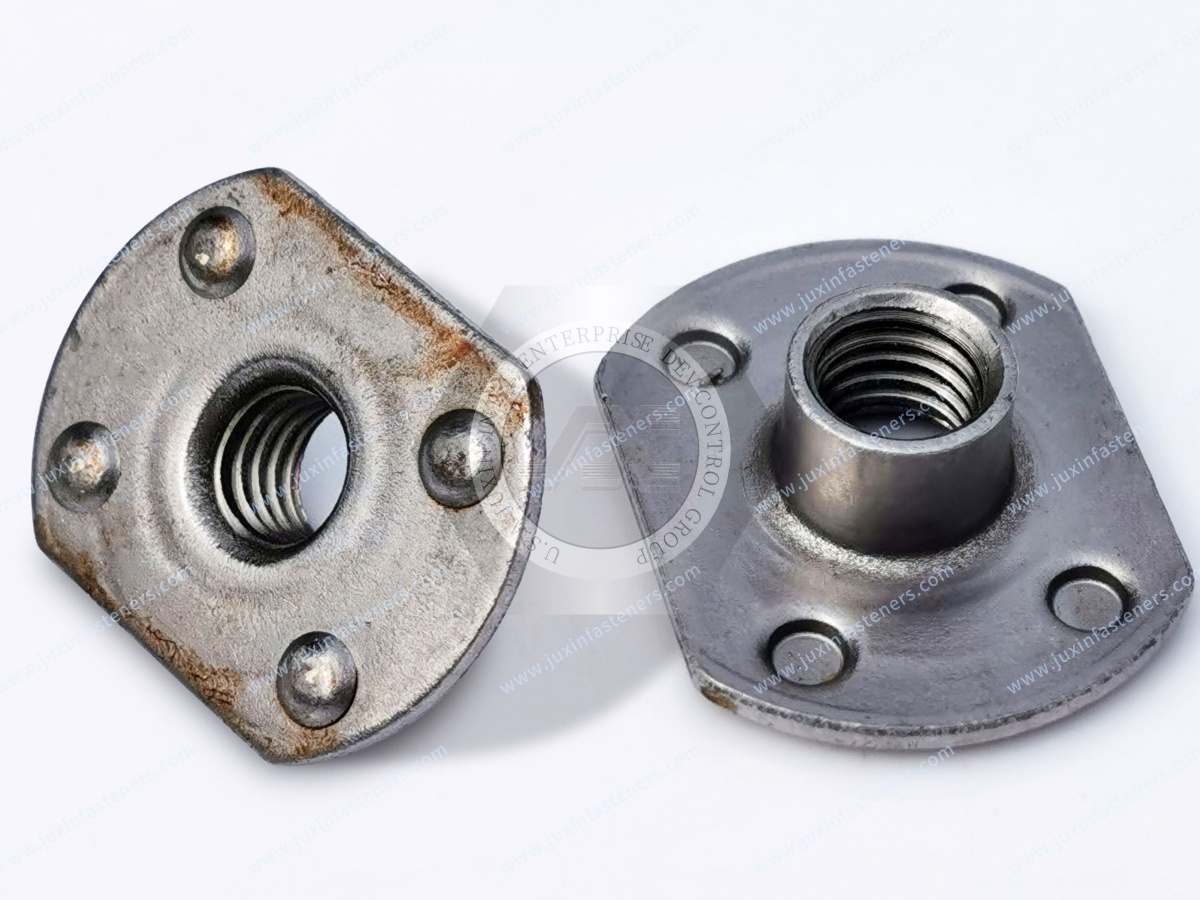
M6 × 1.0 four-projection compact-base weld nuts provide permanent threaded attachment points for steel sheet metal assemblies requiring a limited mounting footprint and repeatable resistance projection welding.
The configuration incorporates a raised internally threaded boss and four welding projections positioned on a compact mounting base.
Typical applications include automotive mounting brackets, electrical control cabinets, industrial equipment housings, appliance structures and OEM sheet metal components.
Juxin Fasteners is an industrial fastener manufacturer supporting custom weld nut manufacturing, drawing-based engineering review, material selection, dimensional inspection and industrial batch production.
Custom base dimensions, boss geometry, welding projections, locating features, thread tolerances and surface finishes can be evaluated against customer engineering drawings and application requirements.
Product Specification
M6 Four-Projection Compact-Base Weld Nuts for OEM Sheet Metal Assemblies
Precision M6 × 1.0 Weld Nuts for Automotive Brackets, Electrical Enclosures and Industrial Equipment
Juxin Fasteners manufactures M6 four-projection compact-base weld nuts for OEM sheet metal assemblies requiring permanently attached threaded fastening points within restricted mounting areas.
This configuration features an M6 × 1.0 internal thread, a raised cylindrical threaded boss and four resistance-welding projections positioned on a compact mounting base.
The product is intended for resistance projection welding to compatible sheet metal components. Typical applications include automotive mounting brackets, electrical control cabinets, industrial equipment housings, appliance assemblies and customer-specific steel sheet metal structures.
This page focuses specifically on the compact M6 configuration, including mounting clearance, welding projection consistency, mating sheet thickness, locating-hole requirements, thread alignment and production welding validation.
Juxin Fasteners is an industrial fastener manufacturer supporting OEM/ODM custom fastener manufacturing, made-to-drawing production and industrial batch manufacturing.
Our manufacturing capabilities include cold heading, cold forming, CNC machining and product-specific secondary operations. The appropriate manufacturing route is selected according to product geometry, material, tolerances, manufacturing feasibility and production requirements.
Product Technical Specifications
| Parameter | Specification |
|---|---|
| Product Name | M6 Four-Projection Compact-Base Weld Nut |
| Product Reference | YJT 90620 M6 Configuration |
| Thread | M6 × 1.0 |
| Nominal Thread Diameter | 6.00 mm / 0.2362 in |
| Thread Pitch | 1.00 mm / 0.03937 in |
| Thread System | ISO Metric Coarse |
| Welding Projections | Four |
| Welding Method | Resistance Projection Welding |
| Threaded Body | Raised Cylindrical Boss |
| Mounting Base | Compact, Drawing-Specified Geometry |
| Base Dimensions | According to Approved Drawing |
| Boss Dimensions | According to Approved Drawing |
| Projection Geometry | According to Approved Drawing |
| Locating Features | Drawing-Specified |
| Material Options | Suitable Carbon Steel; Selected Stainless Steel Subject to Evaluation |
| Surface Finish | Plain or Customer-Specified |
| Thread Tolerance | Customer-Specified ISO Metric Tolerance |
| Mating Sheet Thickness | Application-Specific |
| Manufacturing | OEM/ODM Made-to-Drawing Batch Production |
| Inspection | Project-Specific Dimensional and Functional Requirements |
Engineering Note: Exact base dimensions, boss height, projection geometry, material grade and dimensional tolerances must be verified against the approved engineering drawing. YJT 90620 is retained as a product reference and is not presented as a verified international dimensional standard.
Compact-Base Geometry for Restricted Sheet Metal Assemblies
The compact mounting base is a defining feature of this M6 weld nut configuration.
In fabricated sheet metal assemblies, fastening locations may be restricted by nearby bends, reinforcement ribs, enclosure walls, mounting brackets or other structural features.
A compact-base weld nut may provide a suitable threaded attachment point where larger weld nut bases cannot be accommodated.
Typical design considerations include:
Available mounting footprint.
Base length, width and thickness.
Distance between the threaded boss and base edges.
Projection-to-edge clearance.
Nearby sheet metal bends.
Electrode access.
Locating-hole position.
Clearance for assembly fixtures.
Required welded-joint performance.
The compact base must provide sufficient contact area for the specified welding projections and intended mechanical loads.
A smaller mounting base does not automatically provide the same welded-joint strength as a larger design. Suitability must be established through engineering review and welding validation.
Four-Projection Resistance Welding Design
Four welding projections are arranged around the threaded body according to the approved product geometry.
During resistance projection welding, the projections establish localized electrical contact between the weld nut and mating sheet metal.
Controlled electrode force and welding current generate heat at the contact interfaces, allowing the projections to deform and form welded joints.
Important manufacturing characteristics include:
Projection height.
Projection profile.
Projection spacing.
Projection symmetry.
Base flatness.
Projection-to-thread alignment.
Surface condition.
Material consistency.
Dimensional repeatability.
Consistent projection geometry helps support repeatable electrical contact and weld formation during production.
However, four projections do not independently guarantee a particular welded-joint strength.
Actual performance depends on material compatibility, projection geometry, welding equipment, electrode conditions and validated process parameters.
M6 × 1.0 Internal Thread Specifications
The featured configuration uses an ISO metric coarse thread.
| Thread Parameter | Value |
|---|---|
| Thread Designation | M6 × 1.0 |
| Nominal Major Diameter | 6.000 mm |
| Nominal Diameter in Inches | 0.2362 in |
| Thread Pitch | 1.000 mm |
| Pitch in Inches | 0.03937 in |
| Mathematical TPI Equivalent | 25.4 |
| Thread System | ISO Metric |
The inch values are dimensional conversions for engineering reference.
The 25.4 TPI equivalent is not a Unified inch-thread designation.
Thread tolerance, functional gauge requirements and mating bolt compatibility must be established according to the customer specification.
For welded assemblies, thread inspection may be required after welding to verify that the internal thread remains suitable for assembly.
Mounting Hole, Pilot Geometry and Thread Alignment
Correct positioning of the weld nut relative to the mating sheet metal hole is important for both welding and final bolt assembly.
Relevant dimensions include:
Sheet metal hole diameter.
Hole position tolerance.
Boss outside diameter.
Locating pilot diameter, where applicable.
Pilot engagement height.
Mating sheet thickness.
Thread-axis alignment.
Clearance around the welding interface.
Incorrect locating geometry may prevent the welding projections from contacting the mating sheet metal correctly.
Excessive positioning variation may also create difficulties during automated bolt installation.
The locating method and dimensional requirements should follow the approved assembly drawing.
Material Selection for M6 Projection Weld Nuts
Carbon Steel
Suitable carbon steel grades are commonly considered for resistance projection-welded fasteners used with compatible steel sheet metal.
Material selection should account for:
Weldability.
Formability.
Thread strength.
Projection manufacturing requirements.
Mechanical loading.
Surface coating requirements.
Production cost.
Manufacturing feasibility.
The specific carbon steel grade must be defined by the customer or approved through engineering review.
Stainless Steel
Selected stainless steel materials may be evaluated for applications requiring corrosion resistance.
Potential grades include AISI 304 and AISI 316, subject to the product design, manufacturing feasibility and welding requirements.
Stainless steel has different electrical and thermal characteristics from carbon steel.
Consequently, welding conditions must be developed and validated for the selected material combination.
Stainless steel weld nuts should not automatically be assumed compatible with welding parameters developed for carbon steel components.
Surface Finishing and Welding Compatibility
Surface finish selection can influence both corrosion resistance and resistance welding performance.
Potential finishing approaches include:
Plain steel.
Customer-specified protective coatings.
Selected zinc-based finishes, subject to welding validation.
Stainless steel surface treatments.
Post-weld corrosion protection.
Pre-applied coatings may affect electrical resistance, weld formation and electrode life.
For applications requiring protective finishes, the coating process should be reviewed together with the intended welding method.
The final surface treatment must satisfy the customer's functional and environmental requirements.
Automotive Bracket Manufacturing Applications
Automotive OEM manufacturers and Tier-1/Tier-2 suppliers may use compact M6 weld nuts in selected steel sheet metal mounting applications.
Potential applications include:
Interior mounting brackets.
Door-related equipment supports.
Auxiliary component brackets.
Non-critical body attachment components.
Serviceable mechanical mounting interfaces.
Automotive equipment support panels.
Engineering requirements may include dimensional repeatability, welding consistency, corrosion protection, assembly accessibility and mechanical joint performance.
Safety-critical automotive applications require separate engineering qualification and customer approval.
Electrical Control Cabinets and Industrial Enclosures
Electrical enclosure manufacturers may require permanently attached M6 threaded fastening points for internal equipment mounting.
Potential applications include:
Steel control cabinet brackets.
Internal mounting plates.
Electrical equipment supports.
Mechanical accessory mounting points.
Removable enclosure components.
Compact-base weld nuts may be useful when available mounting space is restricted.
Electrical bonding and grounding requirements must be evaluated independently from mechanical attachment performance.
Industrial Automation and Machinery Equipment
Industrial machinery manufacturers frequently use fabricated sheet metal components for machine guards, equipment housings and mounting structures.
Compact M6 weld nuts may be evaluated for:
Machine guarding assemblies.
Industrial equipment brackets.
Automation control housings.
Inspection equipment structures.
Removable steel covers.
Manufacturing equipment accessories.
Permanently attached threaded fastening points can reduce the need to position separate loose nuts during final assembly.
Production suitability depends on the actual assembly geometry, joint loading and installation process.
Appliance and HVAC Sheet Metal Applications
Appliance and HVAC equipment manufacturers may require compact threaded attachment points in fabricated steel housings and support brackets.
Potential applications include:
Appliance chassis brackets.
Washing machine mounting components.
Equipment cabinet supports.
HVAC mounting panels.
Air-handling equipment accessories.
Serviceable mechanical assemblies.
Material selection and welding performance should account for vibration, environmental exposure, sheet thickness and expected service loads.
Server Cabinets and Data Center Equipment
Compact M6 weld nuts may also be considered for selected steel cabinet components used in server infrastructure and data center equipment.
Potential applications include:
Internal cabinet brackets.
Equipment enclosure accessories.
Cable-management supports.
Steel equipment mounting panels.
Mechanical support structures.
The required welded-joint performance must be determined from the actual cabinet design and service conditions.
OEM Custom Manufacturing and Engineering Support
Juxin Fasteners provides industrial fastener manufacturing capabilities for standard and custom-engineered fastening components.
Our manufacturing capabilities include:
Cold heading.
Cold forming.
CNC machining.
Product-specific secondary manufacturing operations.
Precision metal component manufacturing.
Custom fastener manufacturing.
Drawing-based OEM production.
Industrial batch manufacturing.
Cold heading, cold forming and CNC machining are complementary manufacturing capabilities.
Depending on the approved product design, a component may require forming operations, machining operations or a combination of processes.
For this M6 compact-base weld nut, the actual manufacturing route must be determined according to material, geometry, dimensional tolerances, projection features and production volume.
Not every product requires every available manufacturing process.
Custom M6 Weld Nut Configurations
OEM customers may require modifications to standard or existing weld nut geometry.
Potential customization includes:
Modified base width and length.
Custom boss diameter.
Special boss height.
Alternative projection geometry.
Modified locating features.
Customer-specified M6 thread tolerances.
Special material requirements.
Surface finishing requirements.
Inspection specifications.
OEM packaging requirements.
All custom configurations are subject to engineering and manufacturing feasibility review.
Production Manager Considerations
For production managers, selecting an M6 projection weld nut involves more than confirming the thread size.
The fastening component must also be compatible with the intended welding and assembly process.
Important considerations include:
Automated part feeding.
Nut orientation.
Welding fixture compatibility.
Projection consistency.
Electrode access.
Electrode alignment.
Welding cycle requirements.
Thread condition after welding.
Production inspection.
Assembly repeatability.
Rework and scrap control.
Total manufacturing cost.
Consistent fastener geometry can support repeatable production processes when combined with suitable welding equipment and validated process controls.
Resistance Welding Process Validation
The welding process must be developed for the actual weld nut and mating sheet metal combination.
| Process Parameter | Engineering Requirement |
|---|---|
| Nut Material | Confirm Weldability |
| Mating Sheet Material | Verify Material Compatibility |
| Sheet Thickness | Define Approved Range |
| Projection Geometry | Control Dimensions |
| Electrode Force | Establish Through Welding Trials |
| Welding Current | Validate for Actual Joint |
| Welding Time | Establish Through Process Testing |
| Electrode Alignment | Maintain Correct Contact |
| Surface Coating | Evaluate Welding Influence |
| Weld Strength | Define Customer Acceptance Criteria |
| Thread Condition | Verify After Welding |
Welding schedules developed for other M6 weld nut designs should not be applied automatically to this compact-base configuration.
The appropriate welding conditions must be established through process trials and assembly validation.
Dimensional Inspection and Quality Requirements
An OEM inspection plan may include:
Material grade verification.
M6 thread gauge inspection.
Boss diameter measurement.
Boss height measurement.
Base length and width inspection.
Base thickness measurement.
Projection height inspection.
Projection position inspection.
Projection symmetry inspection.
Base flatness inspection.
Burr and edge condition.
Surface finish inspection.
Packaging and quantity verification.
Inspection frequency, sampling requirements and acceptance limits should follow the approved customer specification.
Welded-Joint Mechanical Validation
Depending on the application, the completed welded assembly may require:
Torque-out resistance testing.
Push-out strength testing.
Pull-out testing.
Destructive weld evaluation.
Thread integrity inspection.
Weld consistency evaluation.
Application-specific durability testing.
The appropriate tests and acceptance values must be defined for the project.
The M6 thread designation and four-projection geometry do not establish universal mechanical strength values.
Common Welding and Assembly Problems
| Problem | Possible Cause | Engineering Review |
|---|---|---|
| Uneven Weld Formation | Projection Height Variation | Verify Projection Dimensions |
| Weak Weld Attachment | Incorrect Welding Conditions | Validate Welding Parameters |
| Thread Distortion | Excessive Heat or Force | Inspect Thread and Process Settings |
| Nut Misalignment | Incorrect Locating Geometry | Review Hole and Pilot Dimensions |
| Weld Spatter | Unstable Welding Process | Review Electrode and Current |
| Poor Base Seating | Contact Interference | Check Base and Projection Geometry |
| Corrosion | Inadequate Material or Finish | Review Environmental Requirements |
| Low Torque-Out Resistance | Insufficient Weld Integrity | Perform Joint Testing |
| Production Variation | Inconsistent Parts or Process | Establish Process Controls |
These are possible technical causes rather than confirmed diagnoses. Actual failures require inspection and process investigation.
American Inch-Thread Alternatives
For North American OEM applications, custom projection weld nut configurations using Unified inch threads may be evaluated.
| Thread | Series | Nominal Diameter | TPI |
|---|---|---|---|
| #6-32 | UNC | 0.1380 in | 32 |
| #8-32 | UNC | 0.1640 in | 32 |
| #10-24 | UNC | 0.1900 in | 24 |
| #10-32 | UNF | 0.1900 in | 32 |
| 1/4-20 | UNC | 0.2500 in | 20 |
These are separate custom engineering configurations and do not represent confirmed standard inventory.
M6 × 1.0 and Unified inch-thread fasteners are not interchangeable.
M6 × 1.0 Compared with 1/4-20 UNC
| Parameter | M6 × 1.0 | 1/4-20 UNC |
|---|---|---|
| Thread System | ISO Metric | Unified Coarse |
| Nominal Diameter | 6.000 mm | 6.350 mm |
| Pitch | 1.000 mm | 1.270 mm |
| Threads per Inch | 25.4 Equivalent | 20 |
| Interchangeable | No | No |
Although the nominal diameters are relatively close, the thread dimensions and geometry differ.
The mating bolt and internal thread must use the same compatible thread specification.
Relevant Engineering Standards
ISO 261
General plan for ISO metric screw threads.
ISO 724
Basic dimensions for ISO metric screw threads.
ISO 965 Series
ISO metric screw-thread tolerances.
ASME B1.1
Unified inch screw-thread requirements for separately engineered UNC and UNF configurations.
ISO 18278 Series
Resistance welding references within their applicable technical scope.
Customer-Approved Engineering Drawings
The controlling specifications for product geometry, material, thread tolerances, projection dimensions and inspection requirements.
References to these standards do not independently establish product certification or welded-joint qualification.
OEM Procurement and Supplier Evaluation
For purchasing managers, sourcing engineers and supply chain teams, an M6 weld nut quotation should be based on the actual engineering and production requirements.
Important purchasing information includes:
Approved engineering drawing.
Drawing revision.
Thread specification.
Material grade.
Base dimensions.
Boss dimensions.
Welding projection requirements.
Surface finish.
Mating sheet metal specifications.
Required welded-joint performance.
Sample approval requirements.
Inspection criteria.
Initial order quantity.
Estimated annual demand.
Packaging requirements.
Production scheduling requirements.
For repeat OEM manufacturing programs, consistent dimensional specifications and controlled product revisions are important for purchasing continuity and production reliability.
Frequently Asked Questions
What is an M6 four-projection compact-base weld nut?
It is an internally threaded M6 fastener featuring a compact mounting base and four projections designed for resistance projection welding to compatible sheet metal.
What is the thread pitch?
The featured configuration uses an M6 × 1.0 metric coarse thread.
Why use a compact mounting base?
A compact base may provide an attachment solution where available sheet metal mounting space is limited. Its suitability depends on welding geometry and mechanical requirements.
Are four welding projections stronger than three?
Not necessarily. Weld strength depends on projection design, materials, welding conditions and joint qualification.
Can the base dimensions be customized?
Yes. Customer-specific base dimensions and boss geometry can be evaluated according to engineering drawings.
Can stainless steel be used?
Selected stainless steel grades may be evaluated subject to material compatibility, manufacturing feasibility and welding validation.
Is M6 equivalent to 1/4-20 UNC?
No. They have different nominal diameters, thread pitches and thread systems.
Can this product be used in automated welding lines?
Potentially, provided the weld nut geometry, feeding system, welding equipment and process parameters are compatible and validated.
Is a projection weld nut self-locking?
No. Welding fixes the nut to the sheet metal but does not automatically create a prevailing-torque locking thread.
Does Juxin Fasteners support OEM manufacturing?
Yes. Juxin Fasteners supports drawing-based manufacturing, custom fastener engineering review and industrial batch production.
Request a Quote — M6 Four-Projection Compact-Base Weld Nuts
Juxin Fasteners is an industrial fastener manufacturer supporting global OEM manufacturers, Tier-1/Tier-2 suppliers, mechanical engineers, production managers and industrial procurement teams.
We support custom M6 projection weld nut manufacturing requirements for automotive brackets, electrical cabinets, industrial equipment housings, appliance assemblies and other compatible sheet metal applications.
Recommended RFQ Information
2D engineering drawing or 3D CAD model.
Product reference and drawing revision.
M6 × 1.0 thread tolerance.
Base width, length and thickness.
Boss outside diameter and height.
Welding projection dimensions and location.
Locating pilot requirements, where applicable.
Material grade.
Surface finish.
Mating sheet metal material.
Mating sheet thickness.
Mounting-hole dimensions.
Required welded-joint performance.
Welding process requirements.
Inspection and acceptance criteria.
Initial order quantity.
Annual purchasing forecast.
Packaging and delivery requirements.
Please send your engineering drawings and purchasing specifications for manufacturing feasibility review and quotation.
Juxin Fasteners
Industrial Fastener Manufacturer | Custom Weld Nut Manufacturing | OEM/ODM Fasteners | Precision Metal Components
Website: https://www.juxinfasteners.com/
Email: info@juxinfasteners.com
Product Packaging
Packaging Standard
At Juxin Fasteners, we apply standardized export packaging to ensure product protection, traceability, and compliance with international logistics requirements.
1. Standard Export Packaging
Unless otherwise specified, all products will be packed according to our factory standard export packaging, which includes:
Moisture-resistant inner protection
Poly bag or small box packing as required
Reinforced export cartons
Clear labeling with part number, specification, batch number, and quantity
Palletizing for sea or air shipment when necessary
Our standard packaging is designed to ensure safe transportation, efficient warehousing, and long-distance international shipping.
2. Customized Packaging Options
We also provide customized packaging solutions according to customer requirements, including but not limited to:
Private labeling
Customized barcodes
Specific carton dimensions
Retail packaging
Special pallet configuration
Customer-specific marking and identification
So that you know, customized packaging may involve additional costs and extended lead time depending on the complexity of the requirements.
3. Compliance & Quality Assurance
All packaging processes are controlled under our ISO 9001 quality management system to ensure consistency, traceability, and product integrity throughout the supply chain.
Product Pictures
Contact Us
Tel.:
+86 020 8621 0320
+86 020 3121 6067
E-mail:
Technical Support:
Navigation
SEND INQUIREY