Call Us
+86 136 6007 9809
Call Us
+86 136 6007 9809

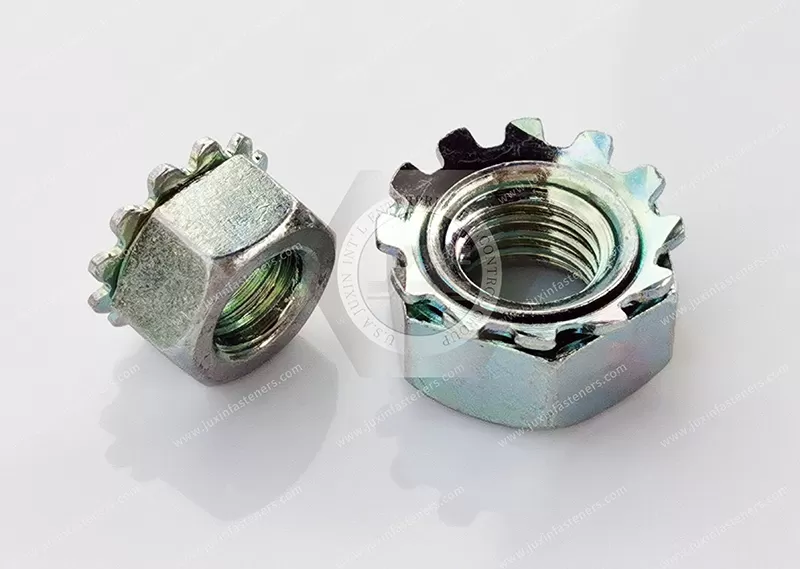
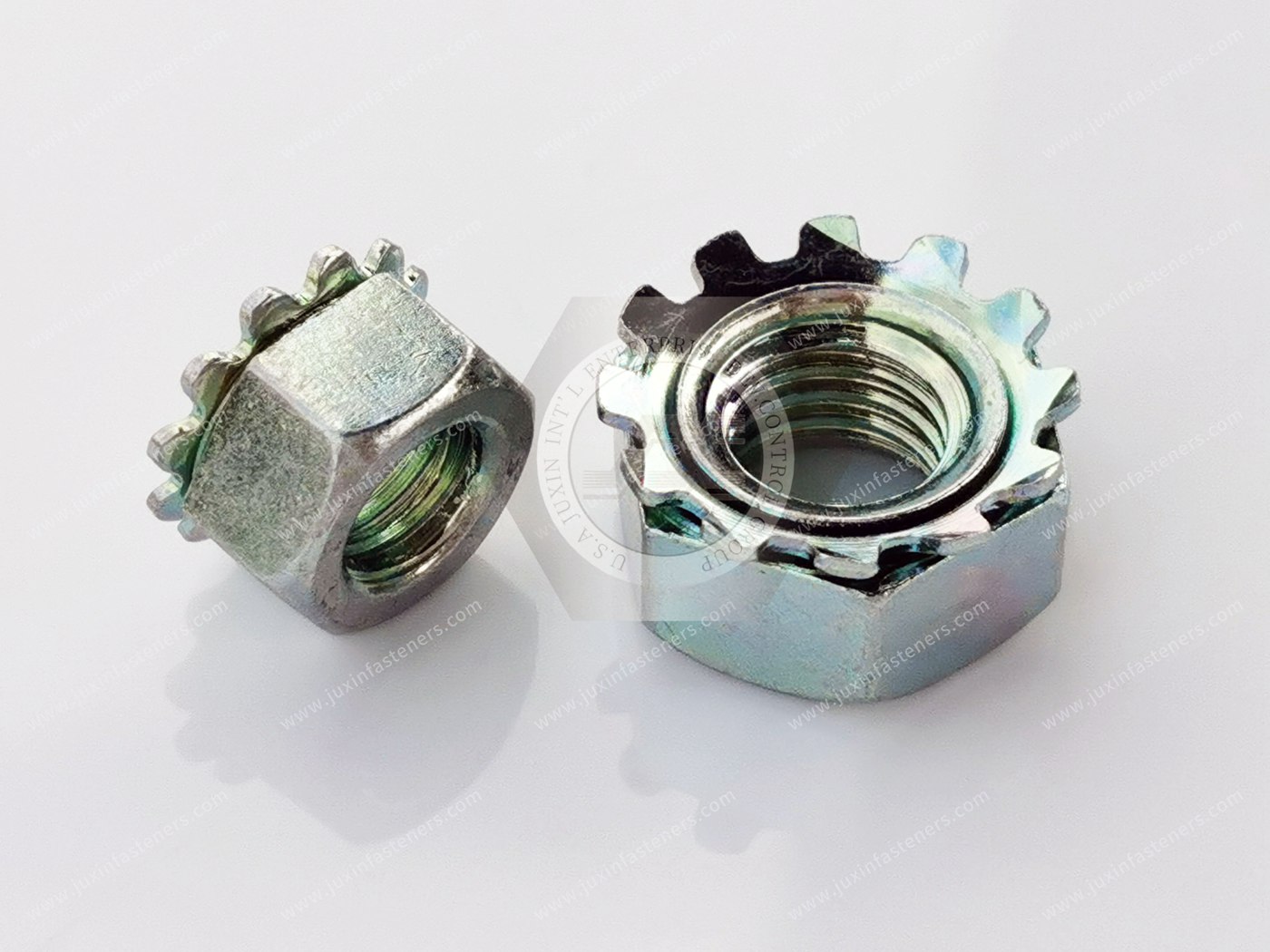
Steel locknuts with external-tooth lock washers, also known as steel Keps nuts or K-Lock nuts, combine a carbon steel hex nut with a captive toothed washer for efficient industrial assembly and mild resistance to loosening.
Juxin Fasteners manufactures metric M3–M12 and Unified inch-thread configurations from #4-40 to 1/2-13, with customer-specified zinc, black zinc, yellow zinc, blue-passivated zinc and zinc-nickel finishes.
Designed for electrical enclosures, industrial motors, machinery, appliances, HVAC equipment and automotive auxiliary assemblies, these fasteners support OEM/ODM customization, drawing-based manufacturing and industrial batch production.
Product Specification
Steel Locknuts with External-Tooth Lock Washer
Carbon Steel Keps Nuts and Zinc-Plated K-Lock Nuts for OEM Industrial Manufacturing
Juxin Fasteners manufactures steel locknuts with external-tooth lock washers for industrial equipment manufacturers requiring integrated washer retention,
convenient installation and consistent fastening components for batch assembly.
Also known as steel Keps nuts or steel K-Lock nuts, these fasteners combine a carbon steel hex nut with a captive, free-spinning external-tooth lock washer.
The washer remains attached to the nut during handling and installation, eliminating the need to position a separate external-tooth washer.
When the nut is tightened against the mating component, the washer teeth engage the bearing surface and create resistance to relative rotation.
This fastening mechanism is suitable for selected industrial assemblies requiring efficient installation and mild resistance to loosening.
Juxin Fasteners supports standard and custom steel Keps nut manufacturing, metric and Unified inch-thread configurations, customer-specified coatings and OEM/ODM industrial batch production.
Steel Keps Nut Technical Specifications
| Parameter | Specification |
|---|---|
| Product Name | Steel Locknut with External-Tooth Lock Washer |
| Common Names | Steel Keps Nut, Steel K-Lock Nut |
| Nut Material | Carbon Steel |
| Washer Material | Suitable Spring Steel, Drawing-Specified |
| Product Structure | Hex Nut with Captive External-Tooth Washer |
| Washer Movement | Free-Spinning Before Final Tightening |
| Locking Mechanism | Washer Teeth Engaging Bearing Surface |
| Metric Thread Range | M3–M12 |
| Unified Inch Thread Range | #4-40 to 1/2-13 |
| Thread Series | ISO Metric Coarse, UNC |
| Additional Threads | Custom UNF Configurations Subject to Review |
| Steel Strength Grade | Customer-Specified |
| Surface Finishes | Zinc, Blue-Passivated Zinc, Yellow Zinc, Black Zinc, Zinc-Nickel |
| Hex Dimensions | According to Approved Drawing |
| Washer Outside Diameter | According to Approved Drawing |
| Washer Thickness | Drawing-Specified |
| Overall Height | Includes Captive Washer |
| Washer Retention | Product-Specific Mechanical Retention |
| Manufacturing | OEM/ODM Industrial Batch Production |
| Inspection | Dimensional and Functional Requirements |
Exact nut dimensions, washer geometry, strength class, material grade, thread tolerance and coating requirements must be confirmed for each configuration.
How Steel External-Tooth Washer Locknuts Work
A steel Keps nut incorporates an external-tooth lock washer retained on one side of the hex nut.
Before final tightening, the washer can rotate relative to the nut, allowing the fastener to be threaded onto a compatible bolt or stud with relatively little resistance from the locking washer.
Once the washer contacts the mating surface, further tightening compresses the toothed washer.
The external teeth engage the bearing surface and provide additional resistance to rotation.
The locking action is influenced by:
Installation torque.
Joint preload.
Washer tooth geometry.
Washer material and hardness.
Mating surface hardness.
Surface coating.
Contact pressure.
Mechanical loading.
Vibration exposure.
The teeth act primarily against the bearing surface rather than gripping the threaded rod.
Conventional Keps nuts should not be described as prevailing-torque locknuts unless the specific design includes a separately qualified thread-locking feature.
Advantages of Carbon Steel Keps Nuts
Integrated Washer Handling
A captive washer reduces the number of loose components handled during assembly.
This can be particularly useful in production environments involving repeated fastening operations.
Convenient Installation
The free-spinning washer allows the nut to be positioned before final tightening.
Installation is completed using a suitable wrench, socket or controlled assembly tool.
Carbon Steel Manufacturing Flexibility
Carbon steel provides options for different mechanical property requirements, forming processes and surface finishes.
Multiple Coating Options
Zinc and zinc-alloy coatings can be specified according to corrosion exposure, appearance and customer requirements.
OEM Production Compatibility
Customer-specific dimensions, thread configurations and washer requirements can be evaluated for repeat industrial production.
Carbon Steel Material and Mechanical Strength
Steel Keps nuts may be manufactured from different carbon steel grades depending on the required mechanical properties and manufacturing process.
Material selection should consider:
Nut proof load requirements.
Thread strength.
Formability.
Washer retention.
Surface finishing.
Assembly loading.
Manufacturing cost.
Production volume.
Metric Steel Nut Strength Classes
Metric steel Keps nut configurations may be specified using applicable mechanical property classes, such as Class 6 or Class 8, subject to product design and engineering verification.
The actual class must be established according to the approved specification.
Unified Inch Steel Nut Grades
For American OEM projects, applicable carbon steel nut configurations may use Grade 2, Grade 5 or other specified mechanical property requirements.
Grade selection must account for the mating bolt and intended joint loading.
A steel Keps nut should not automatically be assumed to have Grade 5 strength merely because it has a zinc-plated finish.
External-Tooth Washer Material Requirements
The captive washer is a functional component of the locking system.
Its material properties may differ from those of the carbon steel nut body.
Important washer characteristics include:
Spring characteristics.
Material hardness.
Tooth forming capability.
Washer thickness.
Tooth geometry.
Retention strength.
Resistance to deformation.
Coating compatibility.
For certain industry designs, spring steel washer materials are used to achieve the required tooth characteristics.
The specific washer material, heat treatment and hardness must be confirmed through the approved product specification.
Zinc-Plated Steel Keps Nuts
Zinc plating is commonly specified for carbon steel fasteners requiring general corrosion protection.
Zinc-plated Keps nuts may be used in suitable indoor industrial equipment and applications involving occasional moisture exposure.
Important coating considerations include:
Coating thickness.
Passivation type.
Corrosion resistance requirements.
Surface appearance.
Thread fit after plating.
Washer movement after finishing.
Coating consistency.
Environmental compliance.
The required corrosion performance must be defined by the customer specification.
Blue-Passivated Zinc Steel Keps Nuts
Blue-passivated zinc finishes provide a metallic appearance commonly used for industrial fasteners.
Depending on the specified coating system, the finish may appear silver or slightly blue.
Typical applications include:
Electrical equipment.
Industrial machinery.
Appliance components.
Equipment brackets.
General steel assemblies.
The coating thickness, passivation and corrosion requirements should be defined through the approved finishing specification.
Yellow Zinc-Plated Steel Keps Nuts
Yellow zinc finishes may be specified for customer applications requiring a particular appearance or corrosion protection system.
The final color and protective performance depend on the coating process and passivation chemistry.
Yellow appearance alone does not establish a specific corrosion resistance rating.
Black Zinc-Plated Steel Keps Nuts
Black zinc plating provides a dark finish for industrial equipment where appearance and corrosion protection are both relevant.
Potential applications include:
Black equipment housings.
Machinery accessories.
Electrical cabinets.
Industrial equipment brackets.
Selected automotive auxiliary components.
Black zinc plating should not be confused with black oxide.
These are different surface treatment systems with different corrosion protection characteristics.
Zinc-Nickel Alloy-Plated Steel Keps Nuts
Zinc-nickel alloy coatings may be considered for industrial applications requiring enhanced corrosion protection compared with certain conventional zinc systems.
The actual performance depends on:
Nickel content.
Coating thickness.
Passivation system.
Sealing treatment.
Base material.
Surface preparation.
Required corrosion testing.
Service environment.
Zinc-nickel coatings may be relevant to selected automotive and industrial equipment applications.
However, no particular salt-spray duration or corrosion performance should be assumed without a verified coating specification and test results.
Surface Finish Selection for OEM Manufacturing
| Surface Finish | Typical Selection Consideration |
|---|---|
| Clear Zinc | General Industrial Corrosion Protection |
| Blue-Passivated Zinc | Metallic Appearance and Specified Protection |
| Yellow Zinc | Customer-Specified Finish and Protection |
| Black Zinc | Dark Appearance with Zinc-Based Protection |
| Zinc-Nickel Alloy | Engineered Corrosion Protection Requirements |
Coating selection must account for thread fit, washer functionality, material strength and application environment.
For higher-strength steel components, electroplating-related hydrogen embrittlement risks must also be assessed where applicable.
Metric Steel Keps Nuts — M3 to M12
Juxin Fasteners supports the following metric thread sizes within the supplied steel Keps nut range.
| Metric Thread | Nominal Diameter | Common Coarse Pitch |
|---|---|---|
| M3 | 3.0 mm | 0.50 mm |
| M4 | 4.0 mm | 0.70 mm |
| M5 | 5.0 mm | 0.80 mm |
| M6 | 6.0 mm | 1.00 mm |
| M8 | 8.0 mm | 1.25 mm |
| M10 | 10.0 mm | 1.50 mm |
| M12 | 12.0 mm | 1.75 mm |
These values represent common ISO metric coarse-thread specifications.
Actual nut dimensions, washer outside diameters, strength classes and thread tolerances must be confirmed according to the approved drawing.
Custom metric configurations may be evaluated for OEM manufacturing.
Unified Inch-Thread Steel Keps Nuts
American industrial manufacturers frequently specify Unified inch threads for steel Keps nuts.
| Thread Size | Series | Nominal Diameter | TPI |
|---|---|---|---|
| #4-40 | UNC | 0.1120 in | 40 |
| #6-32 | UNC | 0.1380 in | 32 |
| #8-32 | UNC | 0.1640 in | 32 |
| 1/4-20 | UNC | 0.2500 in | 20 |
| 5/16-18 | UNC | 0.3125 in | 18 |
| 3/8-16 | UNC | 0.3750 in | 16 |
| 1/2-13 | UNC | 0.5000 in | 13 |
Additional American thread requirements may include #10-24 UNC, #10-32 UNF, 1/4-28 UNF and other customer-specific configurations.
These additional sizes are subject to engineering and manufacturing feasibility review.
Metric and Unified inch-thread fasteners must not be interchanged.
Nut and Washer Dimensional Engineering
Steel Keps nuts combine several dimensional features that must function together.
Important dimensions include:
Thread designation.
Thread tolerance.
Hex width across flats.
Nut body height.
Overall height with washer.
Washer outside diameter.
Washer thickness.
Tooth profile.
Tooth quantity.
Washer retention geometry.
Washer rotational clearance.
The washer must remain attached during handling while retaining the movement required for installation.
Excessive interference between the washer and nut body may affect assembly.
Insufficient retention may allow the washer to separate during handling or installation.
Dimensional requirements should be established through the approved engineering drawing.
Industrial Motor and Machinery Applications
Steel Keps nuts may be evaluated for selected motor housings, machinery brackets and auxiliary mechanical assemblies.
Potential applications include:
Motor accessory brackets.
Machinery covers.
Equipment mounting panels.
Industrial equipment housings.
Mechanical accessory supports.
Serviceable machine components.
For motor-related assemblies, vibration exposure must be evaluated carefully.
Steel Keps nuts should not automatically be selected for severe vibration or critical rotating machinery connections.
Where higher locking reliability is required, an appropriately qualified prevailing-torque or other engineered locking system may be necessary.
Electrical Enclosure and Control Cabinet Applications
Steel Keps nuts are relevant to electrical equipment manufacturing where efficient mechanical assembly is important.
Potential applications include:
Control cabinet mounting brackets.
Steel enclosure accessories.
Internal equipment supports.
Electrical panel hardware.
Mechanical cabinet components.
Industrial control equipment.
The captive washer reduces the need for separate washer handling.
However, external teeth may penetrate protective coatings or mark the bearing surface.
Electrical bonding and grounding requirements must be validated separately according to the applicable equipment design and standards.
Home Appliance Manufacturing
Home appliance manufacturers may use steel Keps nuts in selected structural and mechanical assembly positions.
Potential applications include:
Washing machine equipment brackets.
Appliance housing components.
Refrigerator accessory supports.
Equipment mounting panels.
Serviceable mechanical assemblies.
For appliance production, relevant considerations include assembly speed, coating compatibility, fastening consistency and cost.
Automotive Auxiliary Assembly Applications
Automotive manufacturers and Tier-1/Tier-2 suppliers may evaluate steel Keps nuts for selected non-critical auxiliary components.
Potential applications include:
Interior equipment brackets.
Auxiliary mounting supports.
Non-critical mechanical accessories.
Equipment housings.
Serviceable steel assemblies.
Automotive applications require appropriate review of vibration, corrosion, installation torque and mechanical joint requirements.
For applications involving severe vibration or safety-related components, the locking method must be separately qualified.
HVAC Equipment Manufacturing
HVAC equipment manufacturers may use steel Keps nuts in suitable cabinet and equipment assembly positions.
Potential applications include:
Air handling equipment brackets.
Control box assemblies.
Steel equipment housings.
Mechanical support panels.
Serviceable cabinet accessories.
Finish selection should account for humidity, environmental exposure and maintenance requirements.
Industrial Automation Equipment
Automation manufacturers may use captive washer nuts in selected steel bracket and equipment housing assemblies.
Potential applications include:
Automation cabinet components.
Inspection equipment brackets.
Machine guard accessories.
Equipment support panels.
Control housings.
For production managers, integrated washer handling may simplify repetitive assembly operations.
Telecommunications and Data Center Enclosures
Steel Keps nuts may be considered for selected mechanical attachments in telecommunications and data center equipment.
Potential applications include:
Steel equipment cabinets.
Internal mounting brackets.
Cable management supports.
Equipment enclosure accessories.
Serviceable mechanical panels.
The required locking performance and corrosion protection must be determined from the actual installation environment.
Furniture and Metal Frame Assembly
Steel Keps nuts may be used in suitable metal furniture and equipment frame assemblies.
Potential applications include:
Steel furniture brackets.
Metal cabinet components.
Equipment stands.
Mechanical frame accessories.
Adjustable support assemblies.
Surface marking, joint loading and reuse requirements should be evaluated for the intended design.
Installation and Assembly Considerations
A typical installation procedure includes:
Confirm the nut and mating bolt thread specifications.
Inspect the captive washer.
Check the bearing surface.
Thread the nut onto the compatible bolt or stud.
Position the washer against the mating component.
Tighten using an appropriate wrench or socket.
Apply the specified assembly torque.
Verify final seating and joint condition.
Installation torque must be determined according to the bolt grade, nut strength, thread condition, coating, lubrication and joint requirements.
A universal tightening torque cannot be assigned from the thread size alone.
Vibration Resistance and Application Limitations
Steel Keps nuts provide resistance to loosening through washer engagement with the bearing surface.
However, their performance depends on maintaining suitable clamp load and contact conditions.
They should not automatically be considered equivalent to nylon-insert or all-metal prevailing-torque locknuts.
Important limitations include:
Severe vibration exposure.
Repeated joint movement.
Soft bearing surfaces.
Delicate surface coatings.
High-temperature conditions.
Safety-critical joints.
Repeated installation and removal.
For demanding applications, fastening performance should be evaluated through appropriate joint testing.
Reuse and Maintenance
Some steel Keps nuts may be reused when the washer remains intact and the application permits reuse.
However, washer teeth may deform during installation.
Before reuse, inspect:
Washer retention.
Tooth condition.
Washer cracking.
Thread damage.
Nut deformation.
Corrosion.
Mating surface condition.
Where replacement is required by the application specification, a used Keps nut should not be reinstalled.
Common Assembly Problems
| Problem | Possible Cause | Recommended Review |
|---|---|---|
| Washer Slips | Inadequate Contact or Clamp Load | Review Torque and Bearing Surface |
| Washer Detaches | Retention Feature Damage | Inspect Washer Retention |
| Thread Stripping | Incorrect Strength or Thread Engagement | Verify Nut and Bolt Grades |
| Surface Scratching | External Tooth Engagement | Review Surface Compatibility |
| Joint Loosening | Insufficient Locking for Service Conditions | Evaluate Joint Design |
| Corrosion | Inadequate Coating | Review Finish Specification |
| Difficult Installation | Thread or Washer Interference | Check Dimensions |
| Inconsistent Assembly | Component or Process Variation | Review Production Controls |
Actual failure causes must be confirmed through inspection and engineering analysis.
Custom Steel Keps Nut Manufacturing
Juxin Fasteners is an industrial fastener manufacturer supporting standard and custom-engineered fastening components for global OEM manufacturers.
Our manufacturing capabilities include:
Cold heading.
Cold forming.
CNC machining.
Product-specific secondary operations.
Precision metal component manufacturing.
Custom fastener manufacturing.
Drawing-based OEM production.
Industrial batch manufacturing.
For steel Keps nuts, manufacturing requirements may involve nut body forming, internal threading, washer manufacturing, washer retention assembly and surface finishing.
The actual process route depends on product geometry, material, tolerances, strength requirements and production quantity.
Cold heading, cold forming and CNC machining are complementary manufacturing capabilities.
Not every steel Keps nut requires every manufacturing process.
OEM Customization Options
Customer-specific requirements may include:
Metric thread configurations.
UNC and UNF thread requirements.
Custom hex dimensions.
Modified nut heights.
Special washer outside diameters.
Washer tooth geometry.
Washer retention features.
Customer-specified steel grades.
Custom coating systems.
Dimensional tolerances.
Functional inspection requirements.
OEM packaging.
All special configurations are subject to engineering and manufacturing feasibility review.
Quality Inspection and Production Requirements
A project-specific inspection plan may include:
Material verification.
Thread gauge inspection.
Hex dimension measurement.
Nut height inspection.
Washer outside diameter inspection.
Washer thickness inspection.
Tooth geometry inspection.
Washer retention inspection.
Washer rotational freedom.
Surface coating inspection.
Functional assembly evaluation.
Packaging and quantity verification.
Where required, additional testing may include mechanical property evaluation, corrosion testing or application-specific joint performance testing.
Acceptance requirements must be defined by the customer specification.
Production Manager Considerations
Production managers should evaluate:
Part feeding and orientation.
Captive washer handling.
Assembly cycle time.
Tool compatibility.
Installation torque control.
Washer seating.
Surface marking.
Rework requirements.
Production consistency.
Total assembly cost.
The integrated washer may reduce component handling, but the assembly process must still be validated for the intended application.
OEM Purchasing and Supply Chain Requirements
Purchasing managers and supplier development teams should confirm:
Approved engineering drawing.
Thread designation.
Material grade.
Nut mechanical property requirements.
Washer material and hardness.
Hex dimensions.
Washer geometry.
Surface finish.
Functional requirements.
Inspection criteria.
Initial order quantity.
Annual purchasing forecast.
Packaging requirements.
Drawing revision control.
For repeat OEM manufacturing programs, consistent specifications and controlled product revisions support more predictable assembly and purchasing operations.
Relevant International Engineering Standards
ASME B1.1
Unified inch screw-thread requirements.
ASME B18.2.2
Dimensional requirements for applicable inch-series nuts.
ASME B18.21.1
Technical and dimensional requirements for applicable lock washers.
ISO 261 / ISO 724
ISO metric screw-thread designations and basic dimensions.
ISO 965 Series
ISO metric screw-thread tolerance requirements.
ISO 898-2
Mechanical properties of applicable carbon steel and alloy steel nuts with specified property classes.
SAE J995 / ASTM A563
Mechanical property references for applicable inch-series steel nut configurations.
ASTM B633
Electrodeposited zinc coating requirements for iron and steel.
ASTM B841
Electrodeposited zinc-nickel alloy coating requirements.
Customer-Approved Engineering Drawings
The controlling specifications for the assembled Keps nut geometry, materials, washer design, surface finish and inspection criteria.
These standards apply only within their respective scopes. References do not establish that every product configuration conforms to every listed standard or carries a certification.
Frequently Asked Questions
What is a steel Keps nut?
A steel Keps nut is a carbon steel hex nut combined with a captive external-tooth lock washer.
How does the locking washer work?
The washer teeth engage the mating bearing surface during tightening, providing resistance to relative rotation.
Does the washer grip the threaded rod?
No. The conventional external-tooth washer primarily engages the bearing surface rather than the threaded rod.
Are steel Keps nuts suitable for high vibration?
They should not be assumed suitable for severe vibration without joint-specific testing and engineering qualification.
What carbon steel finishes are available?
Customer-specified options include clear zinc, blue-passivated zinc, yellow zinc, black zinc and zinc-nickel alloy coatings.
Can zinc-nickel coatings be specified?
Yes. Zinc-nickel finishing requirements can be evaluated according to customer specifications and manufacturing feasibility.
What metric sizes are supported?
The supplied steel product range includes M3, M4, M5, M6, M8, M10 and M12.
What American inch-thread sizes are supported?
The supplied range includes #4-40, #6-32, #8-32, 1/4-20, 5/16-18, 3/8-16 and 1/2-13.
Can custom UNC or UNF sizes be manufactured?
Customer-specific Unified inch-thread requirements may be evaluated for OEM manufacturing.
Are steel Keps nuts reusable?
Reuse depends on washer condition, thread integrity and application requirements.
Can Juxin Fasteners manufacture custom steel Keps nuts?
Yes. Juxin Fasteners supports OEM/ODM manufacturing, drawing-based engineering review and industrial batch production.
Request a Quote — Steel Keps Nuts and K-Lock Nuts
Juxin Fasteners manufactures carbon steel fastening components for global OEM manufacturers,
Tier-1/Tier-2 suppliers, mechanical engineers, production managers, purchasing teams and industrial supply chain professionals.
We support custom steel Keps nut manufacturing for electrical enclosures, machinery, motor equipment, appliances,
HVAC systems, automotive auxiliary assemblies and other industrial applications.
Recommended RFQ Information
2D engineering drawing or 3D CAD model.
Metric, UNC or UNF thread designation.
Thread tolerance.
Carbon steel material grade.
Required mechanical strength class.
Washer material and hardness.
Hex dimensions.
Nut body height and overall height.
Washer outside diameter and thickness.
Washer tooth geometry.
Washer retention requirements.
Surface finish and coating specification.
Mating bolt grade.
Mating surface material.
Installation torque requirements.
Operating environment.
Inspection and acceptance criteria.
Initial order quantity.
Estimated annual purchasing volume.
Packaging and delivery requirements.
Please send your engineering drawings and purchasing specifications for manufacturing feasibility review and quotation.
Juxin Fasteners
Industrial Fastener Manufacturer | Steel Keps Nut Manufacturing | Zinc-Plated K-Lock Nuts | OEM/ODM Fasteners
Website: https://www.juxinfasteners.com/
Email: info@juxinfasteners.com
Product Packaging
Packaging Standard
At Juxin Fasteners, we apply standardized export packaging to ensure product protection, traceability, and compliance with international logistics requirements.
1. Standard Export Packaging
Unless otherwise specified, all products will be packed according to our factory standard export packaging, which includes:
Moisture-resistant inner protection
Poly bag or small box packing as required
Reinforced export cartons
Clear labeling with part number, specification, batch number, and quantity
Palletizing for sea or air shipment when necessary
Our standard packaging is designed to ensure safe transportation, efficient warehousing, and long-distance international shipping.
2. Customized Packaging Options
We also provide customized packaging solutions according to customer requirements, including but not limited to:
Private labeling
Customized barcodes
Specific carton dimensions
Retail packaging
Special pallet configuration
Customer-specific marking and identification
So that you know, customized packaging may involve additional costs and extended lead time depending on the complexity of the requirements.
3. Compliance & Quality Assurance
All packaging processes are controlled under our ISO 9001 quality management system to ensure consistency, traceability, and product integrity throughout the supply chain.
Product Pictures
Contact Us
Tel.:
+86 020 8621 0320
+86 020 3121 6067
E-mail:
Technical Support:
Navigation
SEND INQUIREY