
Call Us
+86 136 6007 9809
Call Us
+86 136 6007 9809

JX-DN square precision lock nuts provide accurate axial retention for ball screw support bearings and compact shaft assemblies.
Made from quenched-and-tempered C45 steel, they feature ISO 4H internal threads, precision-machined contact faces and radial locking screws acting through phosphor bronze inserts.
The original catalog covers metric M5–M40 thread options. Face-runout and hardness requirements are drawing-dependent.
Custom inch-thread configurations can be reviewed for OEM manufacturing.
Product Specification
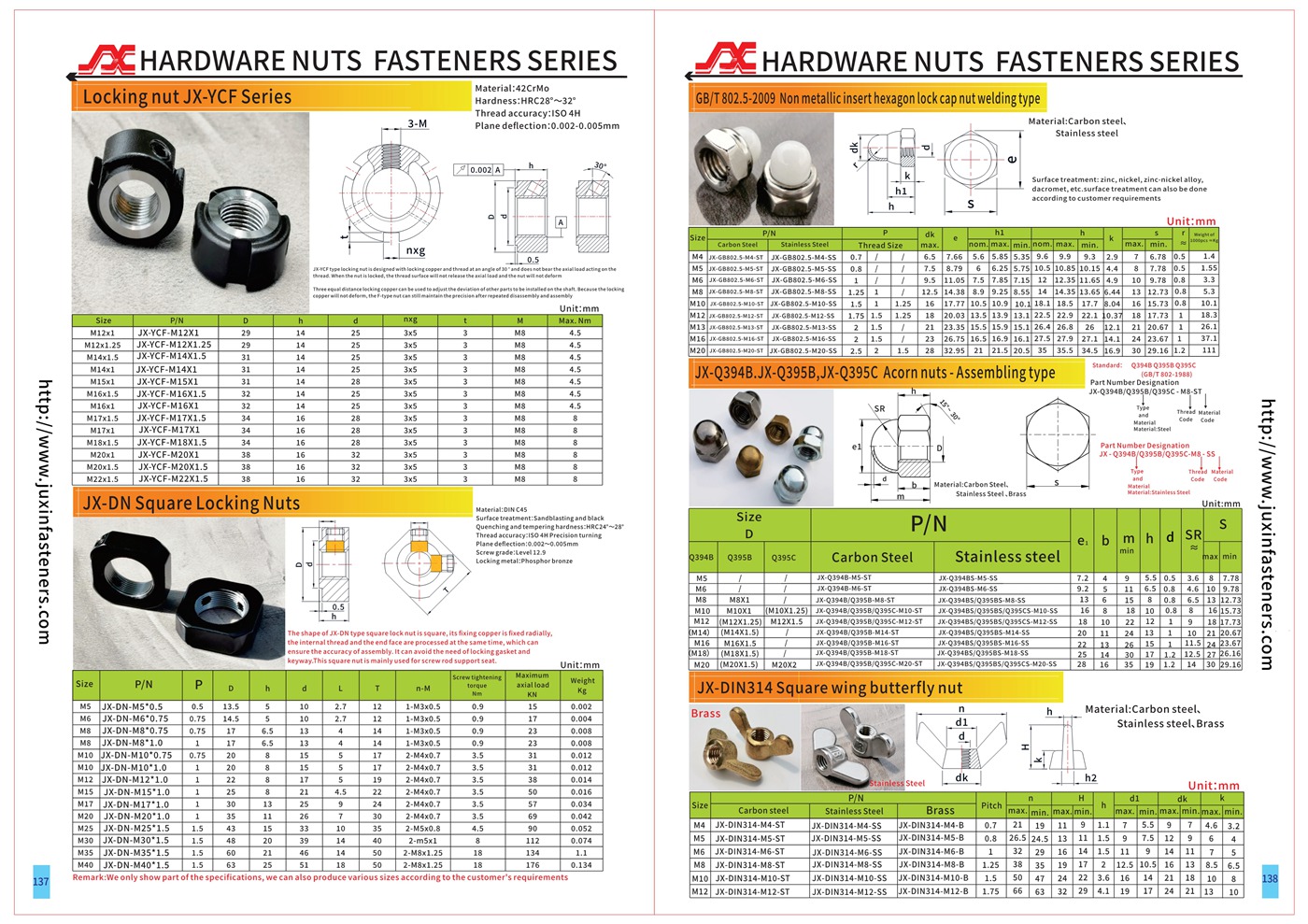
JX-DN Square Precision Lock Nuts – Radial-Locking Bearing Nuts
C45 Steel Precision Shaft Locknuts with Phosphor Bronze Locking Inserts for Ball Screw Support Bearings and Industrial Motion Systems
JUXIN FASTENERS supplies JX-DN Series square precision lock nuts for ball screw bearing support housings, precision shaft assemblies and industrial motion-control equipment.
The JX-DN Series features a compact square external profile and a radial locking mechanism that uses screw-actuated copper-alloy locking elements to engage the mating shaft threads.
Unlike conventional hexagonal nuts or ordinary all-metal prevailing-torque locknuts, the JX-DN Series is designed for precision shaft positioning and controlled axial retention.
The internal thread and bearing-contact end face are precision-machined to support accurate assembly.
The original JUXIN FASTENERS technical catalog lists metric fine-thread sizes from M5 through M40, C45 steel construction,
ISO 4H internal thread accuracy and precision face-runout references of 0.002–0.005 mm.
JX-DN square precision locknuts are particularly relevant to ball screw support bearings, precision machinery,
CNC equipment, automated production systems and other applications requiring compact bearing-retention components.
Product Technical Specifications
| Parameter | JX-DN Series |
|---|---|
| Product Name | JX-DN Square Precision Lock Nuts |
| Alternative Names | Square Bearing Lock Nuts, Radial-Locking Precision Locknuts |
| Series | JX-DN |
| External Geometry | Square Profile |
| Body Material | DIN C45 Carbon Steel |
| Heat Treatment | Quenched and Tempered |
| Hardness | HRC 24–28 in Original Catalog; HRC 28–32 in Supplied Product Text |
| Internal Thread Accuracy | ISO 4H |
| Manufacturing Method | Precision Turning |
| Face Runout | 0.002–0.005 mm Catalog Reference |
| Locking Mechanism | Radial Screw-Actuated Locking |
| Locking Insert Material | Phosphor Bronze per Original Catalog |
| Locking Screw Grade | Property Class 12.9 per Original Catalog |
| Surface Finish | Sandblasted and Blackened, Subject to Drawing |
| Catalog Metric Range | M5–M40 |
| Inch Thread Options | Custom Review, Not Standard Catalog Sizes |
| Primary Application | Ball Screw Bearing Support Housings |
| Customization | According to Approved OEM Drawings |
Specification Control Notice
The original technical catalog and the supplied product description contain different hardness values.
The final hardness requirement must be confirmed from the current approved JX-DN engineering drawing.
Similarly, face-runout requirements must be defined by the specific model, manufacturing process, inspection datum and acceptance criteria.
What Is a Square Precision Lock Nut?
A square precision lock nut is a specialized internally threaded component used to retain bearings or other precision mechanical components on a threaded shaft.
Its square outer profile distinguishes it from conventional round precision bearing locknuts.
The JX-DN Series uses a separate radial locking mechanism rather than relying on permanent deformation of the main nut threads.
The nut is positioned on the mating shaft and tightened against the required bearing or support component.
After the correct axial position has been established, the radial locking screws are tightened.
The screws press phosphor bronze locking elements against the shaft threads to resist unwanted rotation.
Key Engineering Features
Compact square body.
Precision internal threads.
Precision-machined bearing-contact face.
Radial screw-actuated locking.
Copper-alloy thread-contact elements.
Suitable for selected repeated adjustment applications.
No separate locking washer or shaft keyway required by the basic locking concept.
Metric fine-thread catalog configurations.
Custom dimensional options for OEM assemblies.
Square External Geometry
The square shape provides four external faces and a compact geometry suited to selected bearing support housings.
Potential Advantages
Convenient external engagement during assembly.
Defined orientation within compatible support structures.
Compact integration into selected mechanical layouts.
Compatibility with customer-specific installation tooling.
Important Design Consideration
The square nut's outside dimensions, corner radii, installation clearance and locking screw access must be checked against the actual bearing support housing.
A square precision locknut is not necessarily dimensionally interchangeable with a round bearing locknut of the same thread size.
Radial Locking Mechanism
The JX-DN Series uses radial locking screws acting through copper-alloy contact elements.
The original catalog identifies phosphor bronze as the locking element material.
Phosphor bronze is a copper-based alloy commonly used in engineered components where controlled mechanical contact,
wear characteristics and dimensional consistency are important.
How Radial Locking Works
The nut is threaded onto the shaft.
The nut is positioned against the bearing or specified mechanical component.
The required axial position or preload is established.
The radial locking screws are tightened according to the approved procedure.
The phosphor bronze locking elements engage the mating shaft threads.
The assembly is inspected to confirm its final position and locking condition.
Engineering Principle
The locking elements are intended to engage the shaft threads while reducing the need for direct contact between hardened steel locking screws and the mating thread surfaces.
The actual locking performance depends on insert geometry, screw torque, shaft material, thread accuracy and assembly conditions.
Two-Point Radial Locking Arrangement
Square precision locknuts commonly use two locking screws positioned approximately 90° apart.
The original JX-DN catalog identifies one locking screw for smaller models and two locking screws for larger models.
Therefore, the JX-DN Series should not be described as universally having two or three locking screws.
The exact locking arrangement depends on the selected part number.
Engineering Considerations
Number of locking screws.
Angular spacing.
Screw diameter.
Locking insert geometry.
Shaft-thread tolerance.
Locking torque.
Nut body stiffness.
Available installation clearance.
Why Precision Thread and Face Machining Matters
The nut's internal thread and bearing-contact face influence the accuracy of the complete assembly.
Manufacturing these features under controlled machining conditions helps reduce alignment errors between the thread axis and the bearing-contact surface.
Potential Benefits
Improved bearing seating.
More consistent axial positioning.
Reduced assembly variation.
Better control of contact-face runout.
Improved repeatability during production assembly.
Important Limitation
Precision machining does not independently guarantee the rotational accuracy of the assembled machine.
Shaft accuracy, bearing geometry, mounting conditions and preload also influence the final result.
DIN C45 Quenched-and-Tempered Steel
The original JX-DN specification identifies DIN C45 steel.
C45 is a medium-carbon engineering steel used for machined mechanical components.
Heat treatment can be used to obtain the required mechanical properties.
Material Selection Considerations
Chemical composition.
Heat-treatment condition.
Hardness.
Machinability.
Dimensional stability.
Mechanical strength.
Surface condition.
Thread performance.
Hardness Verification
The original JUXIN FASTENERS catalog lists HRC 24–28.
The supplied product text lists HRC 28–32.
These values should not be combined into an assumed HRC 24–32 acceptance range.
The required hardness must be confirmed from the current controlled engineering specification before production or inspection.
ISO 4H Internal Thread Accuracy
The JX-DN Series specifies ISO 4H internal threads.
The thread tolerance class is important because the locknut must fit the mating shaft accurately.
Thread Inspection Requirements
Nominal thread diameter.
Thread pitch.
Internal thread tolerance.
Thread form.
Pitch diameter.
Thread direction.
Mating shaft compatibility.
Important Engineering Note
ISO 4H describes the internal thread tolerance class.
It does not replace separate geometric tolerances for the nut's bearing-contact face, outside profile or locking screw positions.
Face Runout and Bearing Alignment
The original catalog identifies face-runout references of 0.002–0.005 mm.
The supplied product description specifies 0.005 mm.
Why Runout Matters
Excessive face runout may influence:
Bearing-ring seating.
Axial positioning.
Bearing preload distribution.
Rotational accuracy.
Assembly repeatability.
Bearing temperature and service life.
Inspection Requirements
The engineering drawing should define:
Measurement datum.
Contact-face reference.
Measurement equipment.
Inspection method.
Permissible runout.
Production acceptance criteria.
Important Qualification
Do not assume every JX-DN size is guaranteed to achieve 0.002 mm runout.
A 0.005 mm requirement should likewise be confirmed against the selected model and current drawing.
Original JX-DN Metric Thread Range
The following thread sizes and pitches are taken from the original JUXIN FASTENERS technical catalog.
| JX-DN Model | Metric Thread | Pitch |
|---|---|---|
| JX-DN-M5×0.5 | M5 × 0.5 | 0.5 mm |
| JX-DN-M6×0.75 | M6 × 0.75 | 0.75 mm |
| JX-DN-M8×0.75 | M8 × 0.75 | 0.75 mm |
| JX-DN-M8×1.0 | M8 × 1.0 | 1.0 mm |
| JX-DN-M10×0.75 | M10 × 0.75 | 0.75 mm |
| JX-DN-M10×1.0 | M10 × 1.0 | 1.0 mm |
| JX-DN-M12×1.0 | M12 × 1.0 | 1.0 mm |
| JX-DN-M15×1.0 | M15 × 1.0 | 1.0 mm |
| JX-DN-M17×1.0 | M17 × 1.0 | 1.0 mm |
| JX-DN-M20×1.0 | M20 × 1.0 | 1.0 mm |
| JX-DN-M25×1.5 | M25 × 1.5 | 1.5 mm |
| JX-DN-M30×1.5 | M30 × 1.5 | 1.5 mm |
| JX-DN-M35×1.5 | M35 × 1.5 | 1.5 mm |
| JX-DN-M40×1.5 | M40 × 1.5 | 1.5 mm |
Important Size Note
These are the original catalog thread configurations.
Customers should confirm current production availability and the approved dimensional drawing before ordering.
Original JX-DN Dimensional References
The original technical catalog includes dimensional data for each thread configuration.
The following examples illustrate the differences between models.
| Thread | Catalog D | Catalog h | Locking Screws |
|---|---|---|---|
| M5 × 0.5 | 13.5 mm | 5 mm | 1 × M3 × 0.5 |
| M6 × 0.75 | 14.5 mm | 5 mm | 1 × M3 × 0.5 |
| M8 × 1.0 | 17 mm | 6.5 mm | 1 × M3 × 0.5 |
| M10 × 1.0 | 20 mm | 8 mm | 2 × M4 × 0.7 |
| M12 × 1.0 | 22 mm | 8 mm | 2 × M4 × 0.7 |
| M15 × 1.0 | 25 mm | 8 mm | 2 × M4 × 0.7 |
| M20 × 1.0 | 35 mm | 11 mm | 2 × M4 × 0.7 |
| M25 × 1.5 | 43 mm | 15 mm | 2 × M5 × 0.8 |
| M30 × 1.5 | 48 mm | 20 mm | See Current Drawing |
| M35 × 1.5 | 60 mm | 21 mm | 2 × M8 × 1.25 |
| M40 × 1.5 | 70 mm | 25 mm | 2 × M8 × 1.25 |
Dimensional Qualification
The D and h designations follow the original catalog.
For M30, the catalog contains a locking-screw notation that should be checked against the engineering drawing before quotation.
The full drawing should be used to verify all remaining dimensions and tolerances.
Original Catalog Locking Torque References
The JX-DN catalog also includes locking screw tightening torque values.
| Thread Configuration | Catalog Locking Screw Torque |
|---|---|
| M5 × 0.5 | 0.9 Nm |
| M6 × 0.75 | 0.9 Nm |
| M8 × 0.75 / 1.0 | 0.9 Nm |
| M10 × 0.75 / 1.0 | 3.5 Nm |
| M12 × 1.0 | 3.5 Nm |
| M15 × 1.0 | 3.5 Nm |
| M17 × 1.0 | 3.5 Nm |
| M20 × 1.0 | 3.5 Nm |
| M25 × 1.5 | 4.5 Nm |
| M30 × 1.5 | 8 Nm |
| M35 × 1.5 | 18 Nm |
| M40 × 1.5 | 18 Nm |
Critical Torque Note
These values are original catalog references, not universal tightening instructions.
Before installation, confirm the current drawing, screw size, screw grade, lubrication condition and approved tightening procedure.
Do not confuse the locking screw tightening torque with the torque used to establish bearing preload.
Maximum Axial Load
The original catalog includes maximum axial load values for individual JX-DN models.
However, the definition, test method, safety factor and application conditions associated with these values must be confirmed before using them as allowable design loads.
Engineering Requirement
For a load-critical bearing assembly, verify:
Actual operating axial load.
Static and dynamic load conditions.
Shaft thread strength.
Bearing capacity.
Locknut engagement.
Locking mechanism performance.
Applicable safety factor.
Manufacturer-approved load rating.
American Inch-Series Precision Locknut References
In the United States, precision shaft locknuts may use Unified inch threads.
Relevant thread systems include:
UNF – Unified National Fine.
UNEF – Unified National Extra Fine.
UNS – Unified Special Thread Series, where applicable.
Common American Thread References
| Inch Thread | Nominal Diameter | Threads per Inch |
|---|---|---|
| 1/4"-28 UNF | 0.250 in | 28 |
| 5/16"-24 UNF | 0.3125 in | 24 |
| 3/8"-24 UNF | 0.375 in | 24 |
| 7/16"-20 UNF | 0.4375 in | 20 |
| 1/2"-20 UNF | 0.500 in | 20 |
| 1/2"-28 UNEF | 0.500 in | 28 |
| 5/8"-18 UNF | 0.625 in | 18 |
| 5/8"-24 UNEF | 0.625 in | 24 |
| 3/4"-16 UNF | 0.750 in | 16 |
| 3/4"-20 UNEF | 0.750 in | 20 |
| 7/8"-14 UNF | 0.875 in | 14 |
| 7/8"-20 UNEF | 0.875 in | 20 |
| 1"-12 UNF | 1.000 in | 12 |
| 1"-20 UNEF | 1.000 in | 20 |
Inch-Series Supply Qualification
The original JX-DN catalog lists metric sizes only.
The inch-thread designations above are relevant engineering references for American customers.
They are not confirmed JX-DN standard sizes or stock items.
Custom inch-thread production must be reviewed against the customer's shaft drawing, nut dimensions, locking screw arrangement and order requirements.
Metric and Inch Thread Compatibility
Metric fine threads and Unified inch threads cannot be directly interchanged.
For example:
M6 × 0.75 is not interchangeable with 1/4"-28 UNF.
M8 × 1.0 is not interchangeable with 5/16"-24 UNF.
M10 × 1.0 is not interchangeable with 3/8"-24 UNF.
M12 × 1.0 is not interchangeable with 1/2"-20 UNF.
M25 × 1.5 is not interchangeable with 1"-12 UNF.
Always confirm the actual mating shaft thread specification.
JX-DN vs. JX-YCF Precision Locknuts
JUXIN FASTENERS offers different precision locking configurations for different shaft and bearing arrangements.
| Feature | JX-DN Series | JX-YCF Series |
|---|---|---|
| External Shape | Square | Round |
| Primary Locking Direction | Radial | Approximately 30° Flank Locking |
| Body Material | C45 | SCM440 |
| Locking Contact Material | Phosphor Bronze per Catalog | Brass Contact Elements |
| Primary Application | Ball Screw Bearing Support Housings | Precision Bearings and Shaft Assemblies |
| Thread Accuracy | ISO 4H | ISO 4H |
| Runout | Drawing-Dependent Precision Requirement | Drawing-Dependent Precision Requirement |
Engineering Insight
These two series should not be treated as interchangeable merely because their nominal thread sizes match.
Nut geometry, locking mechanism, face dimensions and shaft assembly requirements must all be checked.
JX-DN vs. Conventional Bearing Locknuts
Conventional bearing locknuts may use locking washers, tab washers or keyways.
The JX-DN Series uses radial locking screws and phosphor bronze inserts.
Potential Advantages
No separate tab washer required by the basic locking mechanism.
No shaft keyway required solely for the radial locking function.
Compact square geometry.
Precision-machined contact face.
Controlled locking after axial positioning.
Important Limitation
The elimination of a tab washer or keyway must be approved by the mechanical designer.
The JX-DN nut must still meet the required axial retention and operating conditions.
JX-DN vs. Ordinary Square Nuts
Ordinary square nuts are general-purpose threaded fasteners.
The JX-DN Series is a precision shaft-locking component.
Key Differences
Precision internal thread requirements.
Controlled bearing-contact face.
Dedicated radial locking screws.
Phosphor bronze locking inserts.
Precision bearing-retention applications.
Drawing-specific dimensional and geometric tolerances.
JX-DN locknuts should not be confused with square weld nuts, square cage nuts or general-purpose square machine nuts.
Industrial Applications and Engineering Solutions
1. Ball Screw Support Bearing Housings
Ball screw systems rely on accurately positioned support bearings.
Engineering Challenge
Incorrect axial positioning may contribute to backlash, positioning errors and bearing performance problems.
Potential Solution
JX-DN square precision locknuts may be used in compatible ball screw support bearing housings.
2. CNC Machine Tools
CNC equipment contains precision shafts, bearings and motion-control assemblies.
Engineering Challenge
Assembly accuracy and reliable axial retention are important for positioning repeatability.
Potential Solution
JX-DN locknuts may be selected for suitable bearing-support arrangements.
3. Precision Linear Motion Systems
Linear motion systems often use ball screws and bearing supports.
Potential Solution
Square precision locknuts may provide compact shaft-retention solutions where the housing design permits.
4. Industrial Automation Equipment
Automated machinery contains rotary shafts, bearing supports and positioning mechanisms.
Potential Solution
JX-DN locknuts may be used in compatible precision mechanical assemblies.
5. Industrial Robotics
Robotic equipment requires controlled mechanical positioning and stable bearing support.
Potential Solution
Precision locknuts may be evaluated for appropriate joint-support and motion-control assemblies.
6. Semiconductor Manufacturing Equipment
Semiconductor manufacturing systems contain precision motion mechanisms.
Engineering Challenge
Mechanical accuracy, cleanliness and repeatability may be critical.
Potential Solution
JX-DN locknuts may be considered for compatible bearing-support assemblies, subject to the equipment's cleanliness and material requirements.
7. Precision Assembly Machines
Automated assembly equipment uses accurate positioning systems.
Potential Solution
Square precision locknuts may support the retention of selected ball screw bearings.
8. Packaging Machinery
Packaging lines often contain high-cycle positioning mechanisms.
Potential Solution
JX-DN locknuts may be specified for compatible precision shaft assemblies.
9. Printing Machinery
Industrial printing systems require stable mechanical positioning.
Potential Solution
Precision locknuts may be used in appropriate bearing-support and motion-control components.
10. Inspection and Metrology Equipment
Inspection systems contain precision mechanical assemblies.
Potential Solution
JX-DN locknuts may be evaluated where compact shaft retention and controlled face runout are required.
11. Precision Grinding Machines
Grinding machinery relies on accurate motion systems.
Potential Solution
Square precision locknuts may be considered for approved ball screw support-bearing arrangements.
12. Optical Equipment Manufacturing
Optical manufacturing machinery may use high-accuracy linear motion systems.
Potential Solution
JX-DN locknuts may be used in compatible precision bearing supports.
13. EV Motor Manufacturing Equipment
Electric motor production systems use automated positioning and assembly machinery.
Potential Solution
Precision bearing locknuts may be selected for suitable production-equipment motion systems.
14. Industrial Testing Equipment
Test benches and mechanical measurement systems may contain precision shafts.
Potential Solution
JX-DN locknuts may provide axial retention where their geometry and locking capacity meet the approved design.
15. Electronics Manufacturing Equipment
Electronics production lines use automated motion and positioning systems.
Potential Solution
Square precision locknuts may be evaluated for compatible ball screw support assemblies.
16. Medical Device Manufacturing Machinery
Precision manufacturing equipment for medical devices may use ball screw and bearing systems.
Potential Solution
JX-DN locknuts may be used in suitable manufacturing machinery, subject to equipment specifications.
17. Machine Tool Retrofit Projects
Maintenance and retrofit projects may require replacement bearing-retention components.
Potential Solution
JX-DN locknuts may be considered when the existing shaft thread, bearing-contact geometry and housing dimensions are compatible.
18. Custom OEM Motion-Control Assemblies
OEM manufacturers may require nonstandard precision shaft-locking components.
Potential Solution
JUXIN FASTENERS can review custom drawings for thread, body, locking mechanism and inspection requirements.
Installation and Assembly Guidelines
The installation procedure must follow the approved mechanical design and current JX-DN technical drawing.
Step 1 – Inspect the Nut
Check the internal threads, bearing-contact face, locking screws and phosphor bronze elements.
Step 2 – Inspect the Shaft
Verify the shaft thread, surface condition and dimensional accuracy.
Step 3 – Confirm Thread Compatibility
Check nominal diameter, pitch, tolerance and thread direction.
Step 4 – Position the Nut
Thread the nut onto the shaft and bring it into contact with the intended bearing or mechanical component.
Step 5 – Establish the Required Bearing Condition
Adjust the axial position or preload according to the bearing manufacturer's instructions.
Step 6 – Tighten the Radial Locking Screws
Use the approved tightening torque and sequence.
Step 7 – Verify the Assembly
Check the final axial position, bearing preload and locking condition.
Step 8 – Record Inspection Results
Document the required measurements for production traceability.
Important Installation Note
The catalog locking screw torque must not be confused with bearing preload adjustment torque.
Repeated Assembly and Reuse
The JX-DN radial locking mechanism may allow repeated installation and removal when handled correctly.
However, reuse depends on component condition and the approved maintenance procedure.
Inspect Before Reuse
Internal thread wear.
Phosphor bronze insert condition.
Locking screw damage.
Nut face damage.
Corrosion.
Shaft-thread condition.
Dimensional changes.
Runout requirements.
Damaged or out-of-tolerance components should not be reused in precision assemblies.
Surface Finish and Corrosion Considerations
The original product data describes sandblasting and blackening.
Technical Distinction
Sandblasting is a surface preparation process.
Blackening is a separate surface treatment.
The exact process should be confirmed from the approved manufacturing specification.
Engineering Considerations
Surface cleanliness.
Corrosion resistance.
Coating thickness.
Dimensional influence.
Storage conditions.
Contact-face condition.
A blackened steel surface should not be assumed suitable for severe outdoor, marine or chemically aggressive environments without additional corrosion protection and verification.
Quality Control and Inspection
Material Inspection
C45 material identification.
Material certification.
Heat-treatment condition.
Lot traceability.
Hardness Inspection
Confirmed HRC requirement.
Approved test method.
Measurement location.
Production acceptance criteria.
Thread Inspection
Nominal diameter.
Pitch.
ISO 4H tolerance.
Thread form.
Functional engagement.
Dimensional Inspection
Square outside dimensions.
Nut height.
Bearing-contact face.
Locking screw locations.
Internal thread position.
Geometric Inspection
Face runout.
Parallelism where specified.
Perpendicularity where specified.
Concentricity where specified.
Locking Mechanism Inspection
Phosphor bronze insert condition.
Locking screw grade.
Locking screw dimensions.
Locking screw torque.
Functional locking performance.
Surface Inspection
Blackened finish.
Surface defects.
Burrs.
Corrosion.
Cleanliness.
Important Quality Principle
Thread accuracy, face runout, parallelism and perpendicularity are different engineering requirements.
Each must be specified and inspected separately where relevant.
Common Problems and Engineering Solutions
Problem 1: Bearing Preload Changes After Locking
Possible Causes
Incorrect locking screw sequence.
Excessive screw torque.
Shaft-thread inaccuracies.
Incorrect bearing adjustment.
Recommended Action
Review the assembly procedure and verify the final bearing condition.
Problem 2: Nut Cannot Be Installed
Possible Causes
Incorrect thread pitch.
Damaged threads.
Incorrect shaft diameter.
Metric/inch thread confusion.
Recommended Action
Check the exact thread designation and tolerance.
Problem 3: Excessive Face Runout
Possible Causes
Incorrect nut geometry.
Damaged bearing-contact face.
Shaft error.
Contamination.
Recommended Action
Inspect the complete nut-and-shaft assembly using the specified datum.
Problem 4: Shaft Thread Damage
Possible Causes
Excessive locking torque.
Damaged phosphor bronze insert.
Incorrect thread fit.
Improper installation.
Recommended Action
Inspect the locking mechanism and follow the approved torque procedure.
Problem 5: Locking Screw Failure
Possible Causes
Incorrect tool.
Excessive torque.
Incorrect screw grade.
Thread contamination.
Recommended Action
Verify the screw specification and installation procedure.
Problem 6: Insufficient Axial Retention
Possible Causes
Incorrect nut selection.
Insufficient locking force.
Inadequate shaft-thread engagement.
Excessive operating load.
Recommended Action
Review the complete joint design and load requirements.
Problem 7: Housing Interference
Possible Causes
Incorrect square outside dimensions.
Insufficient corner clearance.
Inaccessible locking screws.
Recommended Action
Check the full 2D/3D assembly before procurement.
Problem 8: Incorrect Hardness Requirement
Possible Causes
Conflicting product data.
Uncontrolled drawing revision.
Recommended Action
Confirm the current approved engineering drawing before manufacturing.
Problem 9: Corrosion During Storage
Possible Causes
Inadequate packaging.
Moisture exposure.
Insufficient corrosion protection.
Recommended Action
Review packaging, storage and approved surface treatment requirements.
Problem 10: Unexpected Bearing Vibration
Possible Causes
Incorrect preload.
Shaft runout.
Bearing damage.
Misalignment.
Nut face error.
Recommended Action
Evaluate the complete bearing assembly rather than assuming the locknut is the sole cause.
Production Manager Considerations
Production managers evaluating JX-DN square precision locknuts should consider:
Dimensional repeatability.
Thread inspection efficiency.
Locking screw accessibility.
Assembly cycle time.
Bearing preload repeatability.
Rework rates.
Inspection documentation.
Supplier lot consistency.
Packaging protection.
Delivery reliability.
Engineering Insight
A precision locknut's total manufacturing value depends on assembly accuracy, inspection reliability and reduced production variation, not simply its unit price.
OEM Procurement Checklist
For accurate supplier evaluation, specify:
JX-DN model number.
Approved 2D drawing.
3D CAD model where available.
Metric or inch thread.
Thread pitch.
Thread tolerance.
Square outside dimensions.
Nut height.
Bearing-contact face geometry.
Face-runout tolerance.
Material grade.
Heat-treatment condition.
Hardness requirement.
Locking screw quantity.
Locking screw size.
Locking screw grade.
Locking screw torque.
Phosphor bronze insert requirements.
Surface finish.
Maximum axial load requirement.
Inspection documentation.
Packaging.
Initial order quantity.
Annual purchasing volume.
Delivery schedule.
Custom JX-DN Square Precision Locknuts
JUXIN FASTENERS welcomes customer-specific precision locknut inquiries.
Potential customization includes:
Metric fine threads.
Custom inch threads.
Custom square outside dimensions.
Custom nut heights.
Precision bearing-contact faces.
Radial locking screw arrangements.
Phosphor bronze locking inserts.
Customer-specified C45 material conditions.
Drawing-defined hardness.
Precision face-runout tolerances.
Blackened surface finishes.
Special packaging.
Dimensional inspection reports.
OEM production quantities.
All custom requirements are subject to technical review and manufacturing feasibility confirmation.
Frequently Asked Questions
What is a JX-DN square precision locknut?
It is a square-profile precision shaft locknut with a radial screw-actuated locking mechanism.
What is the American name for this product?
Square Precision Lock Nut, Square Bearing Lock Nut and Radial-Locking Precision Locknut are relevant terms.
Is this an F-type precision locknut?
No. The JX-DN Series uses radial locking and should be distinguished from 30° flank-locking designs.
What is the primary application?
Ball screw bearing support housings and compatible precision shaft assemblies.
What material is used?
The original catalog specifies DIN C45 steel.
What hardness is specified?
The original catalog states HRC 24–28, while the supplied product text states HRC 28–32. The current drawing must resolve this difference.
What is the thread accuracy?
ISO 4H.
What is the face-runout specification?
The original catalog lists 0.002–0.005 mm references. The actual acceptance value must be confirmed for each model.
What material is used for the locking inserts?
The original catalog identifies phosphor bronze.
What grade are the locking screws?
The original catalog identifies property class 12.9.
Does every JX-DN nut have two locking screws?
No. The original catalog shows one locking screw for smaller models and two for larger models.
What metric sizes are listed?
The original catalog includes selected fine-thread configurations from M5 to M40.
Are inch sizes available?
Custom UNF, UNEF or other inch-thread requirements may be reviewed against customer drawings.
Can metric and inch threads be substituted?
No.
Can JX-DN nuts be reused?
Potentially, if the components remain within the approved inspection and reuse requirements.
Do they require locking washers?
The radial locking mechanism is designed to avoid the need for a separate locking washer in suitable assemblies.
Can JUXIN FASTENERS manufacture custom dimensions?
Customer-specific drawings can be reviewed for manufacturing feasibility.
Can OEM customers request bulk quantities?
Yes. JUXIN FASTENERS welcomes industrial OEM and long-term production supply inquiries.
Related Industrial Fastening Solutions
JUXIN FASTENERS supplies related precision and industrial fastening components:
JX-YCF Precision Bearing Lock Nuts.
All-Metal Self-Locking Nuts.
Industrial Hex Nuts.
Specialty Lock Nuts.
Custom CNC Machining Parts.
Thread Repair Inserts.
Self-Clinching Fasteners.
Weld Fasteners.
Custom Threaded Components.
Related internal links should be added only after verifying the live page URLs.
Request a JX-DN Square Precision Locknut OEM RFQ
JUXIN FASTENERS supports international OEM manufacturers, precision machinery builders, mechanical engineers, production managers, purchasing engineers and supply chain teams.
For accurate technical evaluation and quotation, please provide:
JX-DN model number.
2D engineering drawing.
3D CAD model, if available.
Application and equipment type.
Shaft nominal diameter.
Thread pitch and tolerance.
Square outside dimensions.
Nut height.
Bearing-contact face dimensions.
Required face runout.
Material and hardness requirements.
Locking screw quantity and size.
Locking screw torque.
Phosphor bronze insert requirements.
Surface finish.
Axial load requirements.
Inspection and certification requirements.
Initial purchasing quantity.
Estimated annual volume.
Packaging requirements.
Delivery schedule.
Our technical sales team can review dimensional accuracy, material specifications, manufacturing feasibility, inspection requirements and production-volume quotations.
JUXIN FASTENERS
Website: https://www.juxinfasteners.com/
Email: info@juxinfasteners.com
Submit Your JX-DN Precision Locknut Drawings and OEM Purchasing Requirements for a Technical RFQ.
Product Packaging
Packaging Standard
At Juxin Fasteners, we apply standardized export packaging to ensure product protection, traceability, and compliance with international logistics requirements.
1. Standard Export Packaging
Unless otherwise specified, all products will be packed according to our factory standard export packaging, which includes:
Moisture-resistant inner protection
Poly bag or small box packing as required
Reinforced export cartons
Clear labeling with part number, specification, batch number, and quantity
Palletizing for sea or air shipment when necessary
Our standard packaging is designed to ensure safe transportation, efficient warehousing, and long-distance international shipping.
2. Customized Packaging Options
We also provide customized packaging solutions according to customer requirements, including but not limited to:
Private labeling
Customized barcodes
Specific carton dimensions
Retail packaging
Special pallet configuration
Customer-specific marking and identification
So that you know, customized packaging may involve additional costs and extended lead time depending on the complexity of the requirements.
3. Compliance & Quality Assurance
All packaging processes are controlled under our ISO 9001 quality management system to ensure consistency, traceability, and product integrity throughout the supply chain.
Product Pictures

Contact Us
Tel.:
+86 020 8621 0320
+86 020 3121 6067
E-mail:
Technical Support:
Navigation
SEND INQUIREY


