Call Us
+86 136 6007 9809
Call Us
+86 136 6007 9809

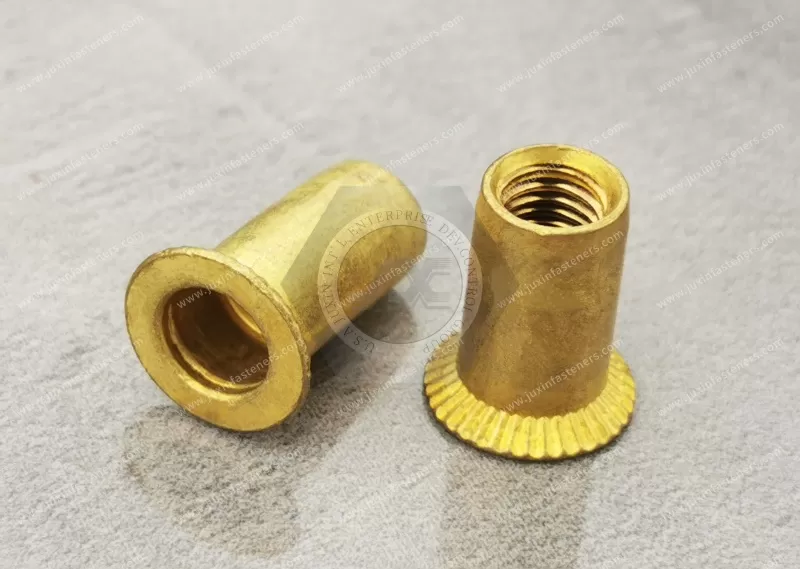
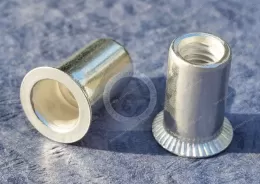
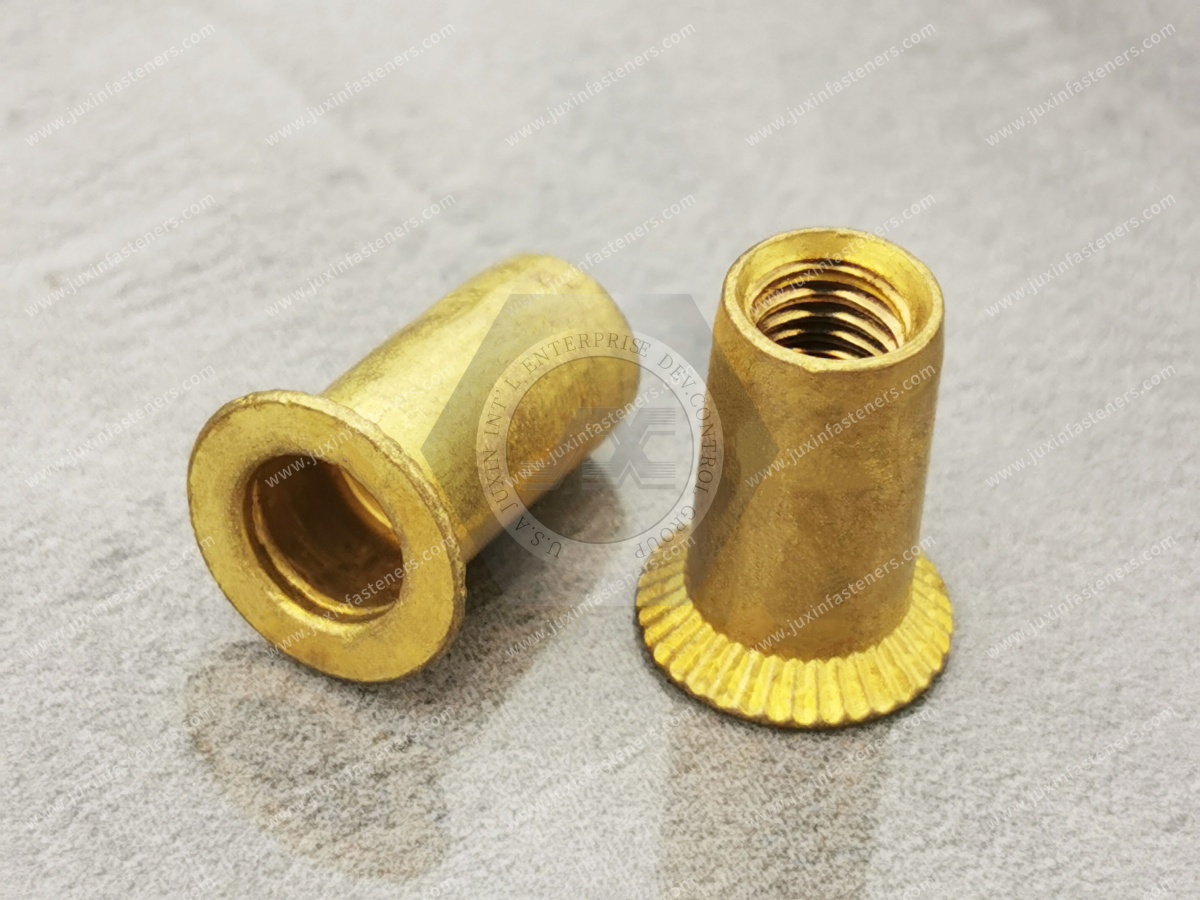
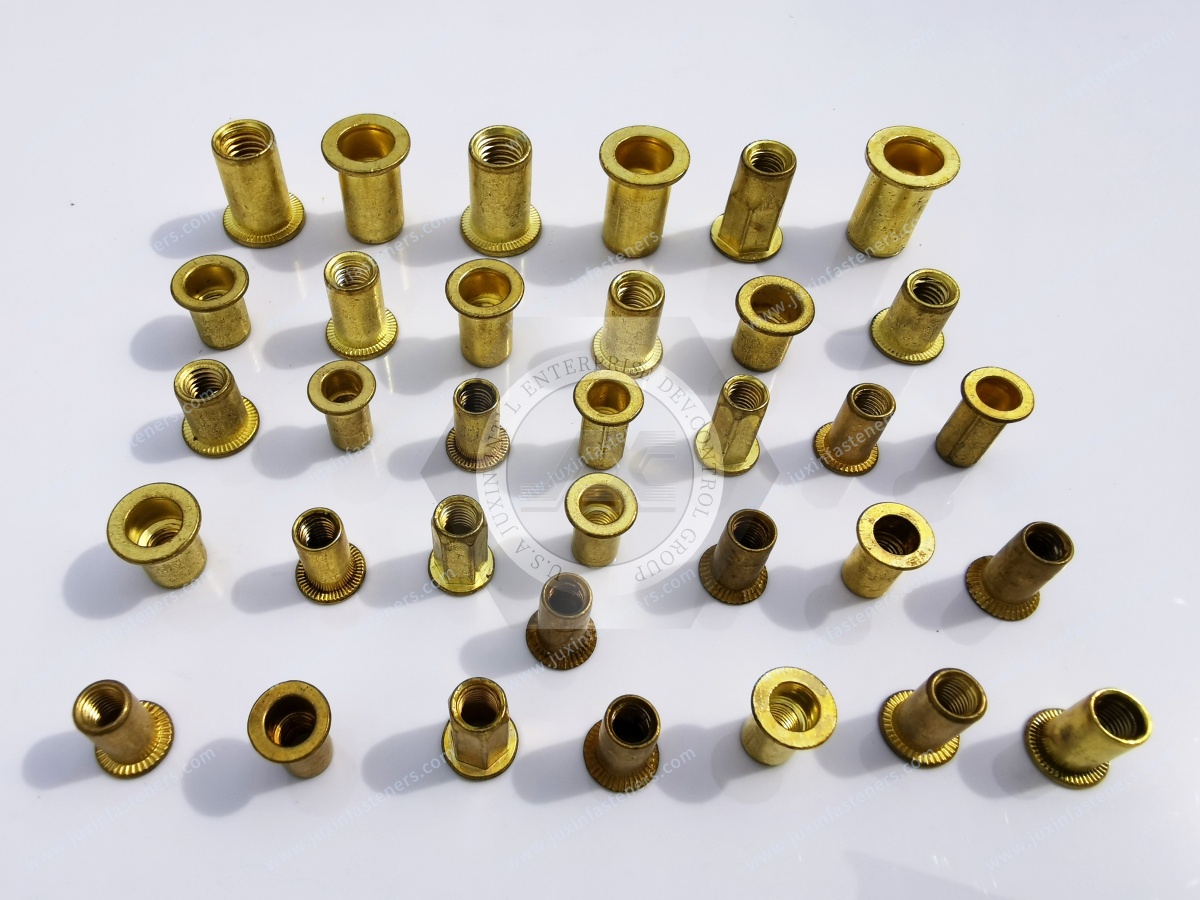
JUXIN FASTENERS supplies brass countersunk head open-end plain round body blind rivet nuts for OEM manufacturers requiring reusable internal threads, one-sided installation, and reduced flange projection in fabricated panels and hollow sections.
The countersunk head is designed to seat in a compatible recess, allowing a flush or near-flush installation when the head and mounting-hole geometry are correctly matched. The smooth cylindrical body is intended for a round mounting hole, while the open-end barrel permits mating screw extension where sufficient backside clearance is available.
Brass offers useful electrical conductivity and generally non-ferromagnetic material behavior. Its suitability for a particular mechanical or corrosive environment depends on the alloy, material condition, mating components, and operating conditions.
Product Features
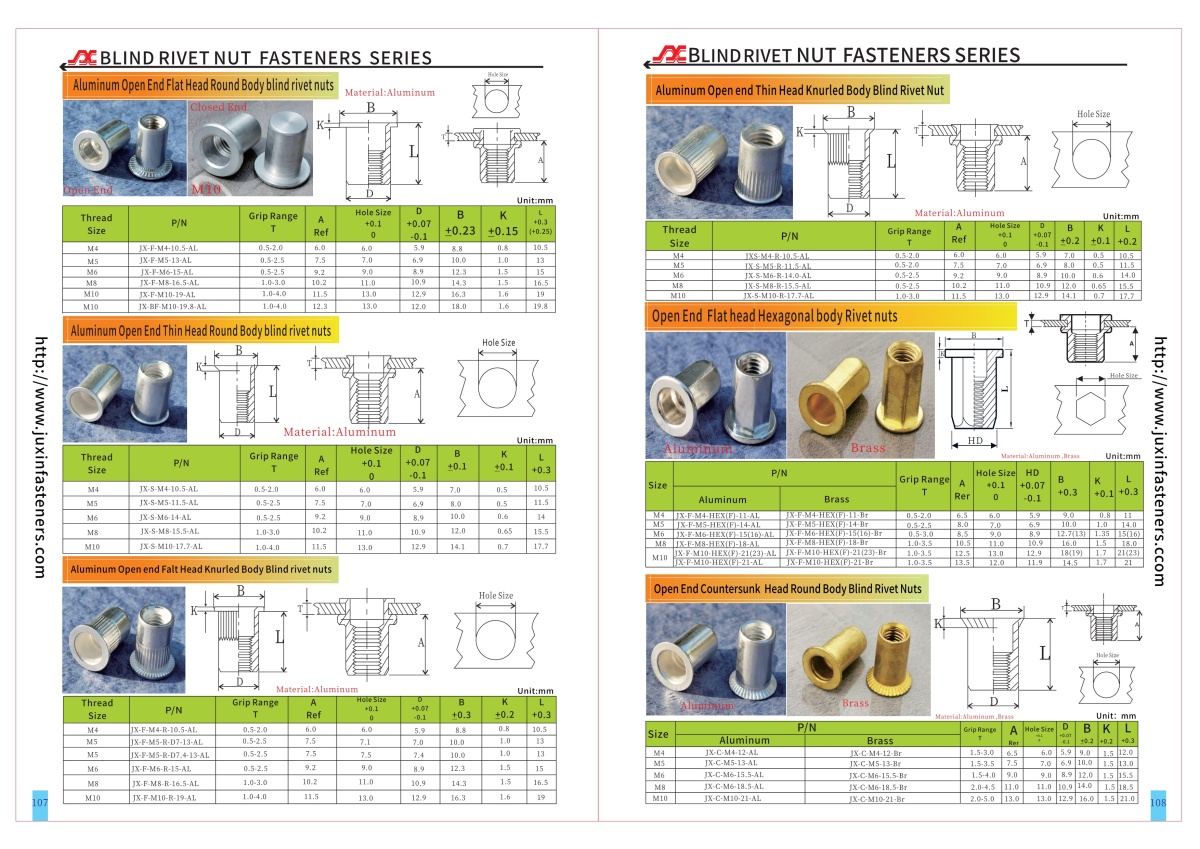
Thread sizes: M4, M5, M6, M8, M10
Material: Brass
Product-family grip range: 1.5–5.0 mm (approx. 0.059–0.197 in)
Head: Countersunk head
Body: Plain round / Smooth cylindrical body
End: Open end
Installation: One-sided blind installation
Mounting hole: Round hole with compatible countersink
Countersink angle and depth: According to approved drawing
Brass alloy and temper: Subject to confirmation
Surface finish: Subject to confirmation
OEM dimensions: Drawing-based technical review
Potential applications include electrical equipment housings, industrial control panels, instrumentation enclosures, telecommunications equipment, fabricated sheet-metal assemblies, and serviceable equipment panels.
For OEM technical review and quotations, contact info@juxinfasteners.com.
Product Specification
Brass Countersunk Head Open-End Plain Round Body Blind Rivet Nuts – OEM Electrical Equipment and Recessed Fastening Solutions
JUXIN FASTENERS supplies brass countersunk head open-end plain round body blind rivet nuts for OEM manufacturers, engineering teams, and industrial procurement organizations requiring reusable threaded fastening points in thin-walled panels and hollow fabricated structures.
This product combines a countersunk head, smooth cylindrical body, open-end internal thread, and brass construction.
The countersunk head is intended to fit a compatible recess in the accessible side of the parent panel. When the head and mounting-hole geometry are correctly matched, this arrangement can reduce flange projection and accommodate closely fitted covers, brackets, and mating components.
The brass material introduces additional considerations involving electrical conductivity, contact resistance, corrosion compatibility, thread strength, and installation deformation.
The product is intended for one-sided blind installation, rather than heat staking or insert molding.
Product Specifications
Product type: Brass Countersunk Head Open-End Plain Round Body Blind Rivet Nut
Material: Brass
Metric thread sizes: M4, M5, M6, M8, M10
Head configuration: Countersunk head
Body configuration: Plain round body / Smooth cylindrical shank
End configuration: Open end
Product-family grip range: 1.5–5.0 mm
Approximate inch reference: 0.059–0.197 in
Installation method: One-sided blind installation
Mounting-hole geometry: Round hole with compatible countersink
Countersink angle: According to approved drawing
Countersink depth: According to approved drawing
Brass alloy and temper: Subject to confirmation
Thread pitch and tolerance class: According to approved drawing
Flange diameter and thickness: According to approved drawing
Body diameter and length: According to approved drawing
Surface finish: According to approved specification
Installed backside projection: Subject to installation validation
Mechanical performance: Subject to product-specific testing
The 1.5–5.0 mm grip range represents the specified product family. The approved range for each individual thread size and body configuration must be verified against its drawing.
Engineering Design and Material Selection
Why Choose a Brass Countersunk Blind Rivet Nut?
A brass countersunk blind rivet nut combines a recessed mounting configuration with the material characteristics of brass.
It may be considered where the assembly requires:
Reusable internal threads
One-sided installation
Reduced flange projection
Compatibility with selected electrical equipment designs
Generally non-ferromagnetic insert material
Defined material appearance
Specific corrosion or material compatibility characteristics
However, brass is not automatically the strongest or most corrosion-resistant material for every application.
The exact brass alloy and temper must be selected according to the mechanical and environmental requirements.
Brass vs. Aluminum Countersunk Rivet Nuts
Brass and aluminum countersunk rivet nuts may have similar external geometries but different material properties.
Aluminum is often considered where reduced component weight is important.
Brass may be considered where electrical conductivity, non-ferromagnetic behavior, or particular material compatibility requirements are relevant.
Brass is generally denser than aluminum, so a similarly sized brass insert will typically weigh more.
Mechanical strength cannot be compared reliably without identifying the actual alloys and tempers.
For OEM selection, engineers should compare:
Material grade
Material condition
Thread strength
Installation deformation
Axial retention
Spin-out resistance
Corrosion compatibility
Electrical requirements
Weight requirements
A brass insert should not be substituted for an aluminum insert solely because both use the same nominal thread size.
Countersunk Head and Reduced Surface Projection
The countersunk head is designed to occupy a compatible recess in the parent panel.
This can reduce the flange projection above the accessible surface.
Potential benefits include:
Improved clearance for mating covers
Reduced interference with adjacent components
Controlled assembly stack height
A more recessed fastening appearance
Suitability for selected closely fitted panel assemblies
However, the final installed head position depends on the head dimensions, countersink geometry, and setting process.
A countersunk rivet nut is not automatically flush after installation.
Countersink Angle and Head Compatibility
The countersink angle must be compatible with the selected rivet nut head.
An incorrect angle can cause uneven seating, localized stress, or unwanted flange projection.
The approved drawing should define:
Countersunk head angle
Countersink angle
Countersink major diameter
Countersink depth
Head outside diameter
Head thickness
Surface projection requirement
No universal countersink angle is assumed for this product family.
The final geometry must be confirmed before production.
Remaining Panel Thickness After Countersinking
Countersinking removes material from the accessible side of the parent panel.
This reduces the local material section available to support the installed head.
For thin panels, excessive countersink depth may increase the risk of local deformation or pull-through.
Engineers should evaluate:
Original panel thickness
Countersink depth
Remaining material thickness
Parent-material strength
Flange-bearing area
Applied axial loading
Installation deformation
A nominal panel thickness within the published grip range does not automatically establish suitability for every countersink depth.
The complete installation geometry must be evaluated.
Countersink Concentricity and Hole Alignment
The countersink should be appropriately aligned with the main mounting hole.
Excessive eccentricity may prevent uniform head seating.
This can affect:
Installed head projection
Bearing contact
Insert alignment
Mating screw installation
Appearance
Retention consistency
Where accurate component positioning is important, suitable geometric tolerances should be established.
Plain Round Body and Smooth Shank Geometry
The plain round body has a smooth cylindrical exterior without knurling or hexagonal geometry.
It is intended for installation in a compatible round mounting hole.
During installation, the insert body deforms behind the parent panel to establish mechanical retention.
This configuration may be suitable where round-hole preparation and a smooth cylindrical body are preferred.
However, the smooth body does not provide the same geometric anti-rotation features as a hexagonal body.
Where elevated rotational retention is required, the selected configuration should be tested.
Brass Body Deformation During Installation
Blind rivet nuts are installed by deforming the body behind the parent panel.
The setting process must create adequate backside retention without damaging the internal thread or surrounding material.
Brass alloy and temper influence the deformation behavior.
Installation parameters developed for aluminum or steel rivet nuts should not automatically be transferred to brass inserts.
Production validation should include:
Correct installation mandrel
Tool capacity
Setting stroke or force
Countersink seating
Backside retaining-bulge formation
Internal thread condition
Axial retention
Rotational retention
The installation process must be qualified for the actual brass product.
Grip Range: 1.5–5.0 mm
This brass countersunk rivet nut family is specified with a grip range of 1.5–5.0 mm.
The approved grip range for each thread size must be confirmed.
Grip range refers to the parent-material thickness accommodated by the selected insert.
For countersunk installations, engineers must also consider the relationship between nominal panel thickness, recess depth, and remaining local material.
Installation outside the approved range may affect backside deformation and retention.
Brass Electrical Conductivity
Brass is electrically conductive.
However, the electrical performance of an installed rivet nut assembly depends on more than the bulk material.
Contact resistance can be influenced by:
Brass alloy
Surface oxide and contamination
Surface finish
Parent-panel material
Mating screw material
Contact pressure
Corrosion exposure
Temperature cycling
Where the rivet nut forms part of an electrical connection, the complete assembly must be evaluated.
A mechanically secure threaded connection does not automatically establish a qualified electrical current path.
Electrical Bonding and Grounding Requirements
Brass fasteners may be considered in selected electrical equipment assemblies.
However, brass conductivity alone does not establish suitability for protective earthing or electrical bonding.
The OEM must define the relevant electrical and mechanical requirements.
These may include:
Contact resistance
Fault-current requirements
Joint integrity
Surface coating restrictions
Corrosion exposure
Mechanical loosening
Applicable electrical equipment standards
No grounding certification or electrical current rating is claimed without supporting evidence.
Brass Thermal Conductivity
Brass conducts heat more readily than many common structural steels.
However, the actual thermal performance depends on the alloy and the complete assembly.
For electrical and industrial equipment, engineers should consider:
Operating temperature
Heat transfer requirements
Contact geometry
Surface condition
Thermal expansion
Material strength at temperature
Thermal conductivity alone does not establish suitability for high-temperature service.
The operating temperature range must be evaluated for the selected alloy and joint.
Non-Ferromagnetic Material Behavior
Brass is generally non-ferromagnetic.
This may be relevant in selected instrumentation, electronics, and measurement equipment.
However, the complete fastening assembly may include steel screws, washers, or other magnetic components.
Where magnetic behavior is critical, the complete assembly should be reviewed.
Pure copper material properties should not be used as proof of the properties of an unspecified brass alloy.
Brass Internal Thread Strength
Brass internal threads require appropriate tightening torque control.
A tightening torque developed for a steel nut should not automatically be applied to a brass rivet nut of the same nominal thread size.
The allowable torque depends on:
Brass alloy and temper
Thread geometry
Mating screw material
Thread engagement
Friction conditions
Insert retention
Parent-panel strength
Excessive torque may damage the internal thread, rotate the installed insert, or deform the surrounding panel.
The appropriate tightening specification should be established for the complete joint.
Thread Engagement and Screw Compatibility
The mating screw must provide adequate thread engagement for the intended joint loading.
Relevant variables include:
Thread size and pitch
Brass alloy
Mating screw material
Thread tolerance
Available engagement length
Tightening torque
Service loading
Metric thread compatibility must be verified.
An M6 metric thread should not be substituted with a similarly sized UNC thread.
Spin-Out Resistance
Spin-out resistance describes the installed rivet nut's resistance to rotation within the mounting hole.
For a smooth round body design, performance depends on the installed geometry and interaction with the parent material.
Relevant factors include:
Body diameter
Hole diameter
Hole tolerance
Panel thickness
Brass alloy and temper
Setting parameters
Parent-material strength
Where a defined spin-out resistance is required, the selected insert should be tested in representative production material.
Insert Spin-Out vs. Screw Loosening
Insert spin-out and screw loosening are separate engineering concerns.
Spin-out occurs when the rivet nut rotates within the parent panel.
Screw loosening occurs when the mating screw loses its intended clamping condition or rotates relative to the internal thread.
A properly installed rivet nut does not automatically prevent screw loosening under vibration.
Where vibration resistance is required, the complete bolted joint must be evaluated.
Pull-Out, Push-Out, and Spin-Out Performance
Different mechanical tests evaluate different failure mechanisms.
Pull-out resistance concerns axial removal under the specified test arrangement.
Push-out resistance concerns displacement in the opposite axial direction.
Spin-out resistance concerns rotation within the mounting hole.
Results depend on:
Insert geometry
Brass alloy and temper
Parent-panel material
Panel thickness
Hole and countersink geometry
Installation parameters
Test method
No numerical mechanical performance rating is claimed without supporting test data.
Open-End Barrel and Screw Projection
The open-end barrel allows the mating screw to extend through the insert where sufficient backside clearance is available.
This provides flexibility in screw-length selection.
However, the screw tip must not interfere with nearby components.
For electrical equipment, clearance around wiring, insulation, electronic components, and adjacent conductive structures may be especially important.
Engineers should verify:
Mating screw length
Joint stack thickness
Required thread engagement
Available backside clearance
Permissible screw projection
Open-end construction does not inherently provide environmental sealing.
Galvanic Corrosion and Dissimilar Metals
Brass can participate in galvanic corrosion when electrically connected to a dissimilar metal in the presence of an electrolyte.
For example, a brass insert installed in an aluminum panel may require corrosion review in humid or outdoor environments.
Relevant factors include:
Brass alloy
Parent-panel material
Mating screw material
Surface treatments
Moisture exposure
Relative exposed surface areas
Service environment
Suitable corrosion-control measures should be evaluated where necessary.
Dezincification Resistance
Some brass alloys can be susceptible to dezincification in particular corrosive environments.
This is a selective corrosion mechanism involving zinc removal from the alloy.
Susceptibility depends on the alloy composition and exposure conditions.
For applications involving aggressive water, condensation, or other corrosive environments, the brass alloy should be selected according to the actual service requirements.
A generic brass designation does not establish dezincification resistance.
Stress Corrosion Cracking
Certain brass alloys can be susceptible to stress corrosion cracking under specific combinations of tensile stress and environment.
Relevant factors include:
Alloy composition
Residual stress
Installation deformation
Applied loading
Environmental contaminants
Service temperature
Where the operating environment creates a potential risk, material selection and qualification should address the relevant failure mechanism.
Corrosion Resistance Is Environment-Specific
Brass does not develop the same red iron oxide rust associated with ordinary carbon steel.
However, this does not mean brass is immune to corrosion.
Brass can tarnish, discolor, or experience other forms of corrosion depending on the environment.
No universal service-life claim is appropriate without defined exposure conditions and supporting evidence.
The product should not be described as guaranteed to last more than ten years in every humid, acidic, or alkaline environment.
Seizing and Repeated Maintenance
Brass may offer useful friction and material compatibility characteristics in certain threaded connections.
However, it is not accurate to claim that brass threads cannot seize or become stuck.
Thread behavior depends on:
Mating screw material
Surface condition
Thread fit
Tightening torque
Lubrication
Corrosion exposure
Maintenance frequency
For serviceable equipment, the complete threaded connection should be evaluated.
Brass Blind Rivet Nuts vs. Heat-Set Inserts
Brass blind rivet nuts and brass heat-set inserts are different fastening products.
Brass Blind Rivet Nuts
These inserts are installed into compatible panels using a blind riveting process.
The body deforms behind the parent material to create mechanical retention.
Brass Heat-Set Inserts
These inserts are designed for installation into suitable thermoplastic materials using controlled heating.
The surrounding plastic softens and flows around designated retention features.
The two products differ in:
Body geometry
Installation method
Parent-material requirements
Retention mechanism
Tooling
Qualification testing
A brass blind rivet nut should not be marketed as a standard heat-set insert unless it is specifically designed and validated for that installation method.
Brass Blind Rivet Nuts vs. Mold-In Inserts
Mold-in inserts are positioned within a mold before or during the molding process.
The molded material surrounds the insert to establish retention.
A blind rivet nut is normally installed after the parent component has been manufactured.
The appropriate fastening method depends on the material, manufacturing sequence, mechanical requirements, and production process.
Brass Blind Rivet Nuts vs. Self-Clinching Nuts
Blind rivet nuts and self-clinching nuts use different installation principles.
A blind rivet nut is installed from one accessible side and forms a retaining bulge behind the parent panel.
A self-clinching nut is pressed into a suitable ductile panel, allowing parent material to flow into designated retention features.
The correct choice depends on:
Installation access
Parent-material properties
Panel thickness
Required mechanical performance
Installation equipment
Production sequence
Total installed cost
These products should not be treated as direct substitutes without engineering review.
Environmental Sealing
An open-end countersunk rivet nut is not inherently waterproof.
The open barrel and surrounding installation interface may permit fluid movement depending on the joint design.
A countersunk head does not automatically create a sealed connection.
Where environmental sealing is required, the complete assembly should be evaluated.
No IP rating is claimed without assembly-level verification.
Repeated Maintenance and Thread Wear
Brass rivet nuts provide reusable internal threads.
However, repeated tightening and loosening can affect thread condition and installed retention.
For serviceable equipment, engineers should evaluate:
Expected maintenance cycles
Mating screw material
Thread engagement
Tightening torque
Thread wear
Spin-out resistance
Parent-panel condition
Where frequent servicing is required, the selected insert should be qualified for the expected service conditions.
Industrial Applications and OEM Fastening Solutions
Electrical Equipment and Control Cabinets
Potential applications include equipment housings, fabricated mounting panels, control cabinets, and selected serviceable components.
Brass may be considered where material conductivity or non-ferromagnetic behavior is relevant.
Electrical bonding, grounding, and current-carrying requirements must be verified separately.
Instrumentation and Measurement Equipment
Brass countersunk rivet nuts may be considered for suitable instrument housings, mounting panels, and serviceable brackets.
Non-ferromagnetic material behavior may be relevant in certain applications.
The complete assembly must be reviewed for the actual instrumentation requirements.
Telecommunications and Electronic Equipment
Potential applications include equipment enclosures, fabricated panels, and removable covers.
The countersunk head may help reduce surface projection.
The open-end configuration requires verification of screw projection and internal component clearance.
Industrial Machinery and Automation
Potential applications include equipment housings, maintenance panels, mounting brackets, and fabricated structures.
Where a recessed fastening point is required, the countersunk configuration may be appropriate.
Rotational retention and thread durability should be evaluated for serviceable assemblies.
HVAC and Appliance Equipment
Potential applications include equipment cabinets, fabricated sheet-metal components, and selected mounting assemblies.
The suitability of brass should be assessed against mechanical loading, environmental exposure, and production cost.
Architectural and Decorative Metalwork
Brass countersunk rivet nuts may be considered where material appearance and recessed fastening geometry are relevant.
The required surface finish, corrosion exposure, and mechanical performance must be specified.
General OEM Sheet-Metal Fabrication
Potential applications include hollow sections, fabricated cabinets, removable panels, and threaded mounting points.
The selected insert should be validated for the actual parent material and expected service loads.
Engineering Decision: When Is a Brass Countersunk Rivet Nut the Wrong Choice?
A brass countersunk blind rivet nut may not be the best solution when:
The parent panel is too thin to accommodate the required countersink
Countersinking would remove excessive supporting material
High axial retention is required but the selected configuration has not been validated
The mounting surface does not require recessed fastening
The application requires a different material strength or weight profile
The operating environment presents unacceptable corrosion risks for the selected brass alloy
High rotational retention is required but the smooth-body configuration has not been validated
Backside clearance is insufficient for the installed retaining bulge or mating screw
The application actually requires a heat-set or mold-in insert for plastic
In these cases, an alternative head style, body geometry, material, or fastening method should be evaluated.
Engineering Selection Checklist
Before approving a brass countersunk head open-end plain round body rivet nut, confirm:
Required metric thread size
Brass alloy and temper
Parent material and panel thickness
Approved grip range for the selected size
Mounting-hole diameter and tolerance
Countersink angle
Countersink depth
Countersink major diameter
Remaining panel thickness
Countersink concentricity
Flange diameter and thickness
Installed head projection
Body diameter and length
Installed backside projection
Mating screw material and length
Required thread engagement
Installation tool compatibility
Setting stroke or force
Required axial retention
Required spin-out resistance
Tightening torque requirements
Electrical contact requirements, if applicable
Galvanic corrosion compatibility
Dezincification considerations, if applicable
Stress corrosion cracking considerations, if applicable
Environmental exposure
Inspection and traceability requirements
Engineering Standards and Technical Verification
Product selection should be based on the approved dimensional drawing and the requirements of the intended assembly.
Applicable ISO metric thread standards may include ISO 261 and ISO 965 where relevant.
The brass material specification should identify the appropriate alloy and condition using an applicable ASTM, EN, or other internationally recognized material designation.
The exact material standard must be confirmed for the selected product.
Where electrical equipment requirements apply, relevant IEC or EN standards should be identified by the OEM.
Where UNC or UNF threads are requested, applicable ASME B1.1 requirements should be identified separately.
Metric and UNC/UNF thread systems are not directly interchangeable.
Inch values shown as conversions are dimensional references only and do not establish availability of corresponding inch-threaded products.
No specific certification, electrical rating, mechanical performance value, or standard conformity should be assumed without supporting documentation.
OEM Procurement and Supplier Qualification
For purchasing managers and supplier development teams, brass countersunk rivet nuts require material and dimensional verification before supplier substitution.
Two products described as M6 brass countersunk open-end rivet nuts may differ in:
Brass alloy and temper
Countersunk head angle
Head diameter
Head thickness
Body diameter
Body length
Mounting-hole requirements
Grip range
Installation parameters
Surface finish
Mechanical retention performance
These differences may affect assembly compatibility, electrical behavior, installed head projection, and joint reliability.
Before approving an alternative supplier, procurement teams should compare complete drawings, material specifications, and representative installation test results.
For recurring OEM programs, inspection criteria, traceability, packaging requirements, annual demand, and delivery expectations should be established during sourcing.
Custom OEM Brass Countersunk Rivet Nut RFQ Requirements
Please provide:
2D drawing or 3D CAD model
Required metric thread size and pitch
Brass alloy and temper
Parent material and panel thickness
Mounting-hole diameter and tolerance
Countersink angle and depth
Countersink major diameter
Required installed head projection
Flange diameter and thickness
Body dimensions
Approved grip range
Available backside clearance
Mating screw material and length
Installation method and tooling requirements
Required axial and rotational retention
Tightening torque requirements
Electrical requirements, if applicable
Surface finish and corrosion requirements
Inspection and traceability requirements
Prototype or production quantity
Estimated annual demand
Delivery destination
JUXIN FASTENERS supports drawing-based technical reviews and OEM sourcing discussions for brass countersunk head open-end plain round body blind rivet nuts and related custom threaded fastening components.
Final dimensions, brass alloy availability, installation compatibility, mechanical performance, and inspection requirements should be confirmed before production approval.
Related Fastening Solutions
Aluminum Countersunk Head Open-End Plain Round Body Blind Rivet Nuts
An alternative where reduced component weight is important.
Brass Flat Head Open-End Full Hex Body Blind Rivet Nuts
An alternative brass configuration where geometric anti-rotation engagement is required.
Aluminum Flat Head Open-End Plain Round Body Blind Rivet Nuts
A conventional flat-head, smooth round-body alternative.
Aluminum Thin Head Open-End Plain Round Body Blind Rivet Nuts
An alternative where reduced flange projection is desired without a conventional countersink.
Stainless Steel Countersunk Head Open-End Plain Round Body Blind Rivet Nuts
An alternative material configuration where stainless steel is required, subject to application validation.
Request an OEM Quotation
Looking for brass countersunk head open-end plain round body blind rivet nuts in M4, M5, M6, M8, or M10?
Send JUXIN FASTENERS your engineering drawings, brass alloy requirements, panel thickness, mounting-hole and countersink dimensions, required installed head projection, and estimated purchasing quantities.
Email: info@juxinfasteners.com
Website: www.juxinfasteners.com
JUXIN FASTENERS – Industrial Blind Rivet Nuts and Custom OEM Fastening Solutions.
Product Packaging
Packaging and Delivery – Brass Countersunk Head Open-End Plain Round Body Blind Rivet Nuts
JUXIN FASTENERS reviews packaging arrangements according to product dimensions, order quantities, handling conditions, and OEM purchasing requirements.
Packaging Requirements
Material: Brass
Thread sizes: M4, M5, M6, M8, M10
Product-family grip range: 1.5–5.0 mm
Packaging quantity: Subject to order confirmation
Inner packaging: According to approved packing instructions
Outer packaging: According to shipment requirements
Product identification: Part number, thread size, and brass material specification as required
Batch identification: According to agreed traceability requirements
Custom packaging: Subject to technical and commercial confirmation
Packaging Protection
Brass countersunk rivet nuts should be protected from unnecessary mechanical damage, head deformation, thread contamination, and surface damage during handling, storage, and transportation.
Particular attention should be given to preserving the countersunk head geometry, smooth cylindrical body, and internal thread condition.
Where appearance or surface finish is specified, appropriate protection should be agreed upon before shipment.
OEM Supply and Documentation
For recurring OEM programs, packaging quantities, labeling, inspection documentation, material records, and delivery arrangements should be agreed upon before shipment.
Final packaging specifications are confirmed according to the approved purchase order.
For OEM packaging requirements and quotations, contact info@juxinfasteners.com.
Website: www.juxinfasteners.com
Product Pictures
Tags
Contact Us
Tel.:
+86 020 8621 0320
+86 020 3121 6067
E-mail:
Technical Support:
Navigation
SEND INQUIREY