Call Us
+86 136 6007 9809
Call Us
+86 136 6007 9809

Thin-sheet metal, closed profiles, tubes and fabricated enclosures often create the same engineering problem:
How do you install a reusable machine thread when you can reach only one side of the assembly?
Traditional nuts require rear-side access. Direct tapping may provide insufficient thread engagement in thin sheet.
Product Specification
Thin-sheet metal, closed profiles, tubes and fabricated enclosures often create the same engineering problem:
How do you install a reusable machine thread when you can reach only one side of the assembly?
Traditional nuts require rear-side access. Direct tapping may provide insufficient thread engagement in thin sheet.
Weld nuts require welding equipment and access during an earlier fabrication stage. Self-clinching nuts normally require press access to the installation location.
A blind rivet nut, also called a rivet nut, rivnut or blind threaded insert, solves a different problem.
It can create a permanent internal machine thread from one accessible side of the component.
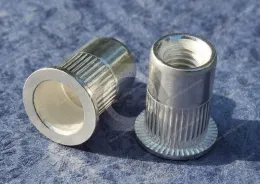
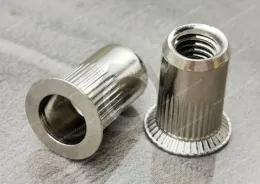
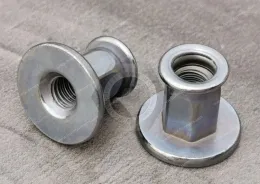
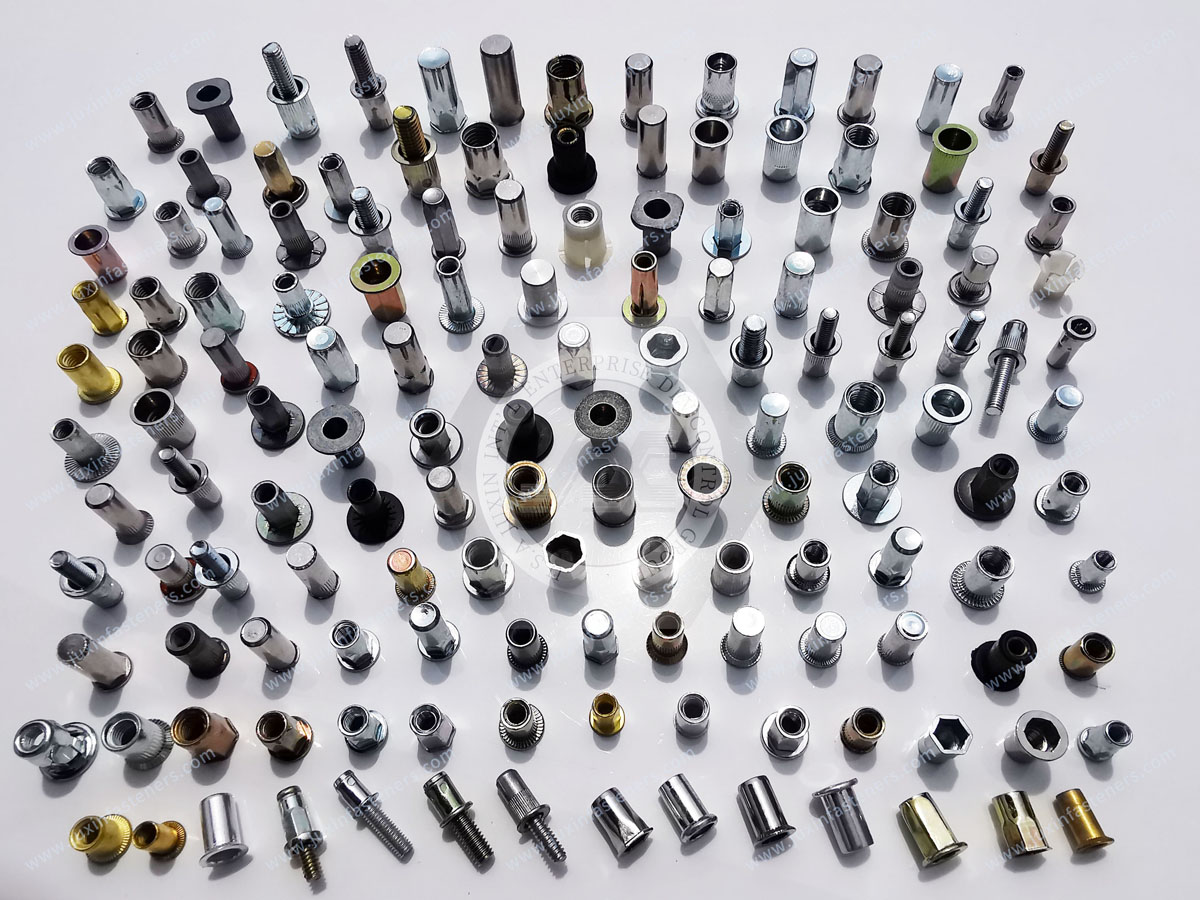
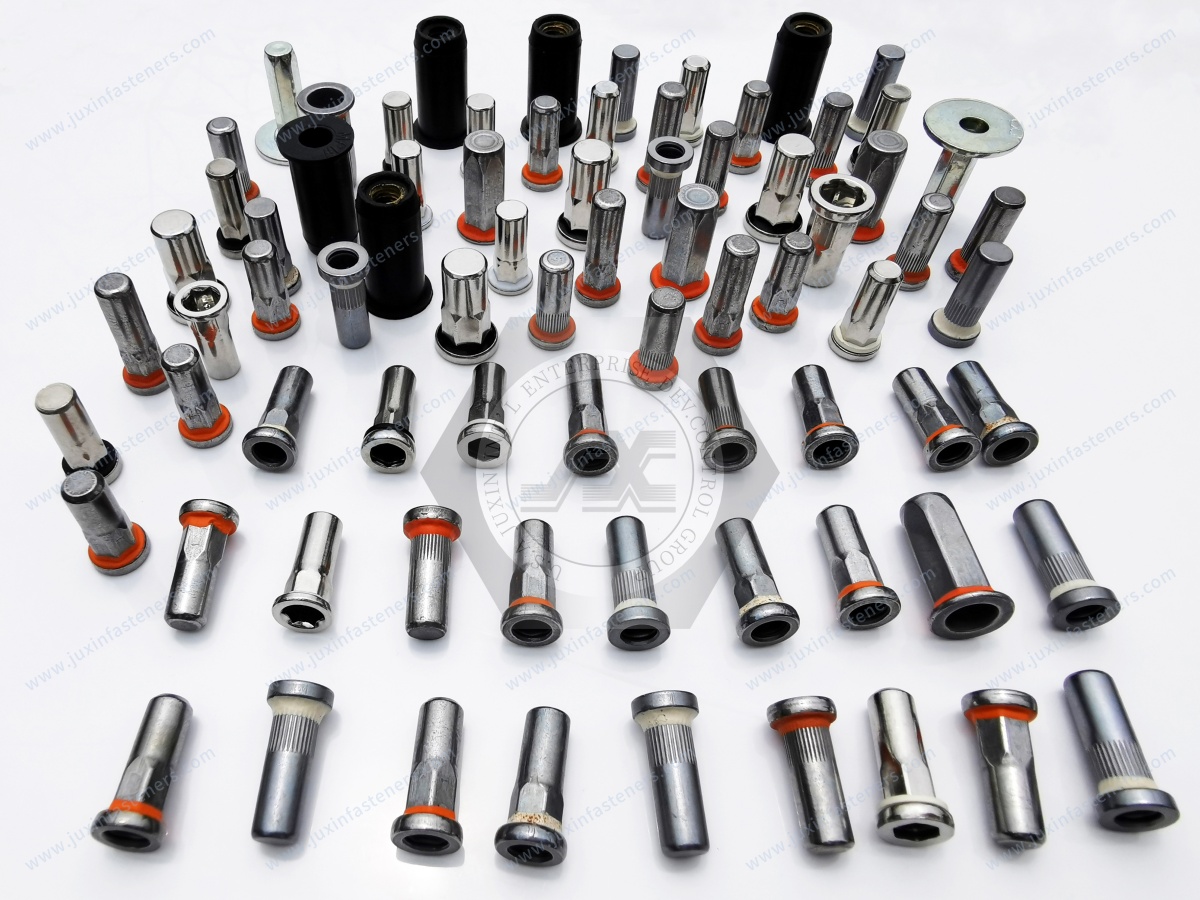
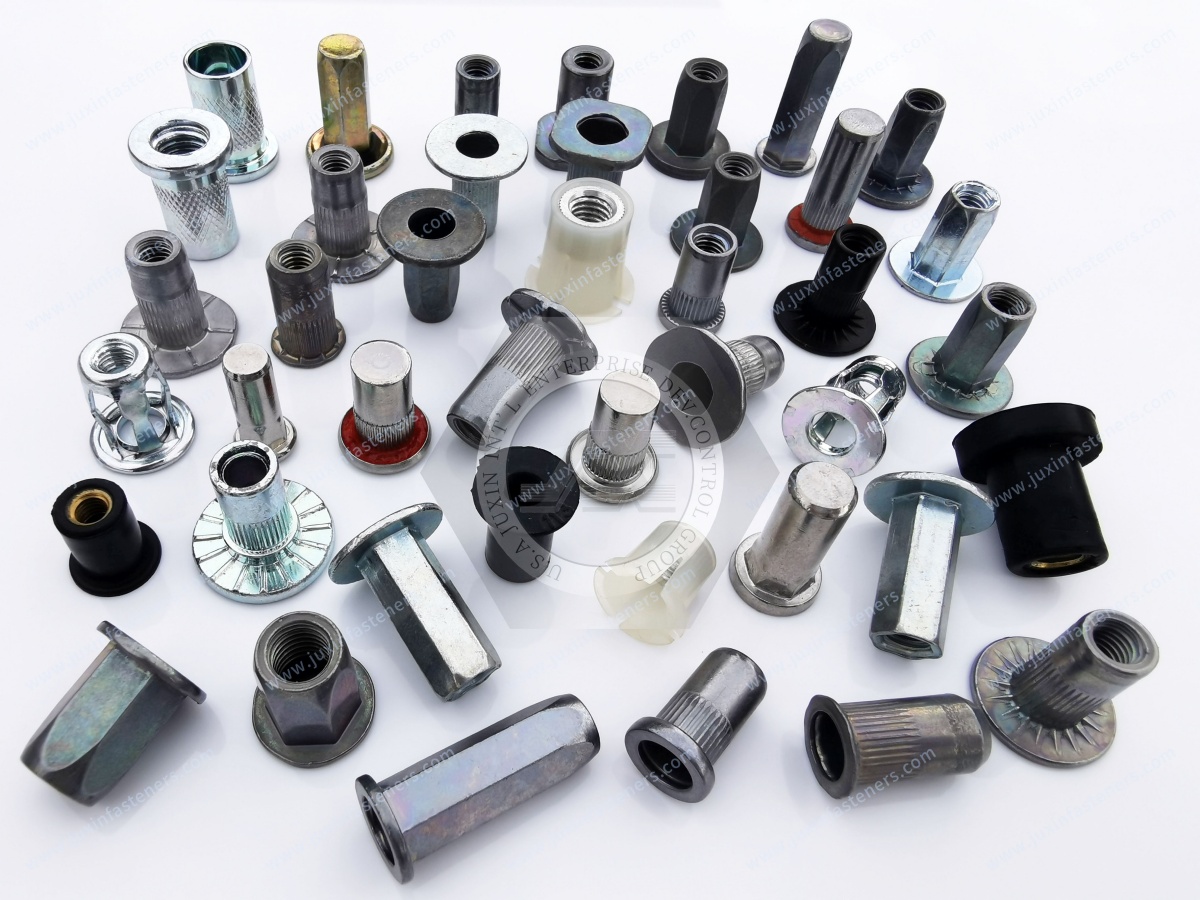
JUXIN FASTENERS supplies a broad range of blind rivet nut configurations, including:
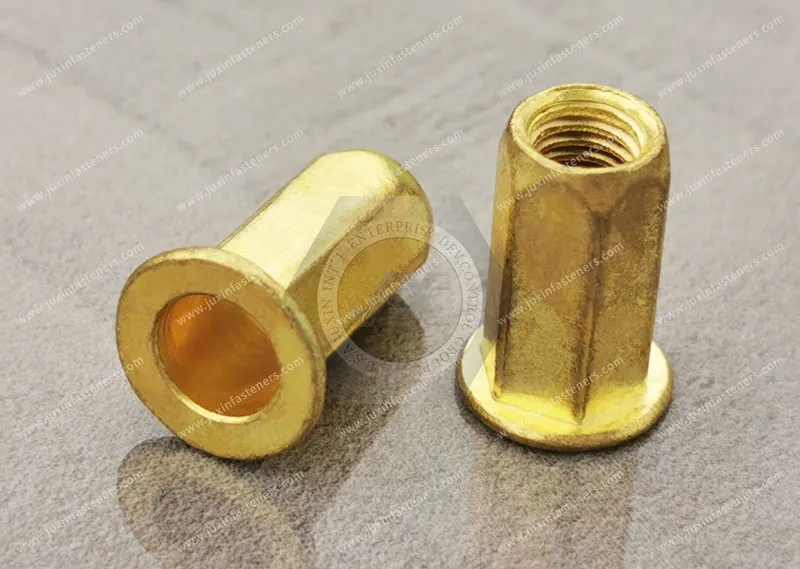
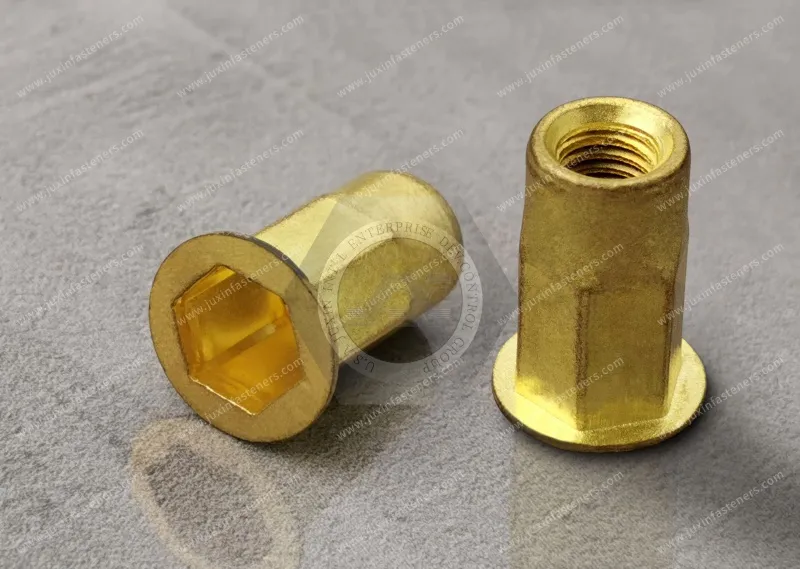
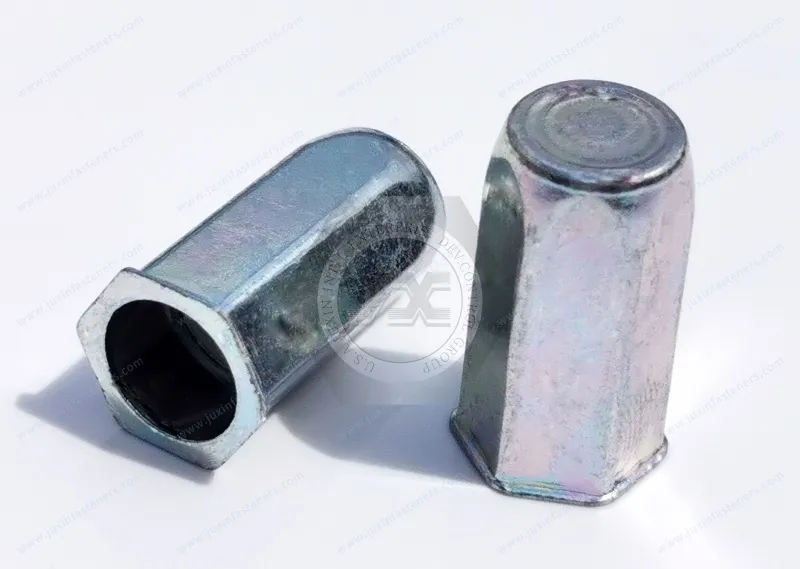
Full-hex rivet nuts
Half-hex rivet nuts
Smooth round-body rivet nuts
Knurled round-body rivet nuts
Ribbed rivet nuts
Flat-head rivet nuts
Reduced-head rivet nuts
Countersunk rivet nuts
Open-end rivet nuts
Closed-end rivet nuts
Floating rivet nuts
Steel rivet nuts
Stainless steel rivet nuts
Aluminum rivet nuts
Drawing-based custom rivet nuts
These products are used across railway equipment, HVAC systems, electrical cabinets, telecom equipment, automotive assemblies,
industrial machinery, commercial equipment and fabricated sheet-metal structures.
The correct rivet nut, however, cannot be selected by thread size alone.
Body style, head style, grip range, hole geometry, parent material, installation method and final joint load all matter.
Blind rivet nuts are particularly useful where rear-side access is unavailable or inconvenient.
Applications include:
Electrical cabinets
Control panels
Industrial enclosures
Server and telecom cabinets
Equipment housings
Access panels
Protective covers
Potential applications include:
Interior panels
Lighting assemblies
Equipment covers
HVAC components
Electrical cabinets
Ceiling systems
Partition structures
Passenger-area equipment
Serviceable interior components
The correct fastener depends on the specific rail application, substrate and project requirements.
Safety-critical railway applications require project-specific engineering validation and should not be treated as general-purpose rivet nut installations.
Blind rivet nuts can be used in:
Air-handling units
Equipment cabinets
Fan housings
Compressor enclosures
Access panels
Control boxes
Internal brackets
Service covers
Applications include:
Network cabinets
Telecom enclosures
Outdoor equipment cabinets
Server structures
Power distribution equipment
Battery and power-system enclosures
Depending on the assembly design, rivet nuts can be used in:
Body panels
Interior structures
Brackets
Access panels
Equipment mounting
Commercial vehicle bodies
Specialty vehicle assemblies
Blind rivet nuts are also useful in:
Machine guards
Tubular frames
Equipment covers
Control cabinets
Fabricated brackets
Closed structural sections
The common requirement is a reusable threaded connection installed from one side.

A rivet nut is inserted into a prepared hole from the accessible side of the component.
An installation tool engages the internal thread and applies controlled axial force.
This causes a designed section of the rivet nut body to deform behind the parent material.
The resulting blind-side deformation clamps the rivet nut to the sheet or structure.
After installation, the mandrel or installation tool is removed, leaving a permanent internal machine thread.
The installed joint therefore depends on the interaction between:
Rivet nut geometry
Grip range
Parent material
Hole size
Hole shape
Installation stroke or force
Tool setup
Final deformation
This is why a rivet nut is not simply a “threaded tube with a flange.”
Thread size receives most of the attention during sourcing.
But for a rivet nut, grip range can be just as important as the thread.
Grip range defines the parent-material thickness range for which the rivet nut is designed.
If the material is outside the intended grip range, the deformation zone may not form as designed.
Potential problems can include:
Incomplete blind-side deformation
Loose installation
Excessive deformation
Panel distortion
Reduced resistance to rotation
Poor axial retention
This means:
An M6 rivet nut is not automatically interchangeable with another M6 rivet nut.
The thread may be identical while the body length, deformation zone and grip range are different.
One of the most frustrating rivet nut failures occurs when the installed insert rotates in the sheet while the mating bolt is being tightened or removed.
Once the rivet nut spins, servicing the joint can become difficult.
Spin resistance depends on several factors:
Body geometry
Surface geometry
Hole shape
Hole size
Parent material
Grip range
Installation quality
Final bolt torque
Different body styles address this problem in different ways.
A full-hex rivet nut uses a hexagonal external body installed into a matching hexagonal hole.
The mating geometry provides positive mechanical resistance to rotation.
Full-hex rivet nuts can be attractive where:
High resistance to body rotation is important
Hexagonal punching is available
Automated sheet fabrication can create controlled hex holes
The assembly experiences relatively high installation torque
Potential applications include:
Industrial machinery
Equipment frames
Automotive structures
Rail equipment
Heavy sheet-metal assemblies
However, the anti-rotation benefit depends on the fit between the hex body and the prepared hole.
A poorly sized hexagonal hole can still compromise installation.
Half-hex rivet nuts combine a hexagonal anti-rotation section with another body geometry.
They can provide a useful balance between:
Anti-rotation performance
Installation characteristics
Manufacturing geometry
Grip requirements
Half-hex rivet nuts are commonly considered for OEM sheet-metal applications where rotational resistance is important but a full-hex configuration is not required.
JUXIN FASTENERS supplies both full-hex and half-hex blind rivet nuts for suitable applications.
Round-body rivet nuts are easier to install into round holes, which can simplify punching or drilling.
Knurled or ribbed external surfaces add mechanical interaction with the parent material.
They can improve resistance to rotation compared with a completely smooth cylindrical body in suitable substrates.
Applications include:
Sheet-metal cabinets
HVAC equipment
Electrical enclosures
Industrial equipment
General fabricated assemblies
However:
Knurling does not make a round rivet nut equivalent to a full-hex body.
The anti-rotation mechanism is different.
If high rotational resistance is a critical design requirement,
the engineer should compare the actual body/hole system rather than assuming that all “anti-spin” rivet nuts perform equally.
Smooth-body rivet nuts can be suitable for many general-purpose applications.
They offer:
Simple round-hole preparation
Straightforward installation
Broad application flexibility
They can be useful where:
Final bolt torque is moderate
Parent material supports the installed deformation
High anti-rotation performance is not the primary design requirement
The simplest geometry can often be the most economical solution when the application does not require a more complex body.
Because hex-body rivet nuts provide strong geometric resistance to rotation, engineers sometimes assume that full-hex should always be preferred.
But a hex body requires a matching non-round hole.
That can affect:
Punch tooling
Laser cutting
Fabrication cost
Hole tolerance
Replacement strategy
If a properly installed round knurled rivet nut provides sufficient performance for the application, specifying a hexagonal hole may add manufacturing complexity without a functional benefit.
The correct design balances:
joint performance + hole manufacturing + installation + cost.
A flat or large-head rivet nut provides a relatively broad bearing surface on the accessible side of the sheet.
This can be useful where:
The parent material is relatively thin
A larger bearing surface is desirable
The head does not interfere with the mating component
Flush installation is not required
The head remains above the panel surface, so mating-part geometry should be checked during design.
Reduced-head rivet nuts minimize the protrusion of the head compared with a conventional flat-head design.
They can be useful where:
Lower surface projection is preferred
The mating component requires closer contact with the panel
A full countersink is undesirable
However, a smaller head provides a different bearing interface with the parent material.
The correct choice depends on the load and panel geometry.
Countersunk rivet nuts can provide a low-profile or flush installation where the parent material and countersink geometry are suitable.
Potential applications include:
Visible enclosure surfaces
Equipment panels
Interior rail panels
Machinery covers
Sheet-metal assemblies requiring reduced head projection
But there is an important design trade-off.
A countersink removes material from the parent sheet.
In very thin sheet, the designer must verify that sufficient material remains to support the installed rivet nut.
A countersunk rivet nut should therefore not be selected purely for appearance.
Open-end rivet nuts provide an internal thread that remains open through the body.
They are widely used in general industrial applications.
Potential advantages include:
Broad size availability
Simple construction
Accommodation of longer mating screws where geometry permits
The required bolt engagement should still be controlled so that the screw does not interfere with surrounding equipment.
Closed-end rivet nuts have a closed base rather than an open threaded passage.
They can be useful where the designer wants to reduce direct passage through the bottom of the fastener.
Potential applications include:
Electrical enclosures
Outdoor equipment
HVAC systems
Fluid-adjacent assemblies
Contamination-sensitive equipment
However, an important distinction is required:
A closed-end rivet nut should not automatically be described as a waterproof joint.
The bottom of the fastener may be closed, but fluid can potentially migrate through other interfaces depending on:
Head design
Hole condition
Parent sheet
Installation
Sealing element
Surface condition
Pressure differential
If the assembly requires a defined IP rating, watertight joint or pressure seal, the complete installed system must be designed and tested accordingly.
Floating rivet nuts introduce controlled positional movement between the threaded element and the installed body.
This can be useful where multiple holes or mating components have accumulated positional tolerance.
Potential applications include:
Equipment panels
Modular assemblies
Access covers
Electrical equipment
Large fabricated structures
The objective is not to create a loose connection.
It is to provide a controlled amount of thread-position accommodation so that mating screws can align more easily.
Floating rivet nuts deserve separate engineering consideration from fixed rivet nuts because their purpose is tolerance management, not simply blind installation.
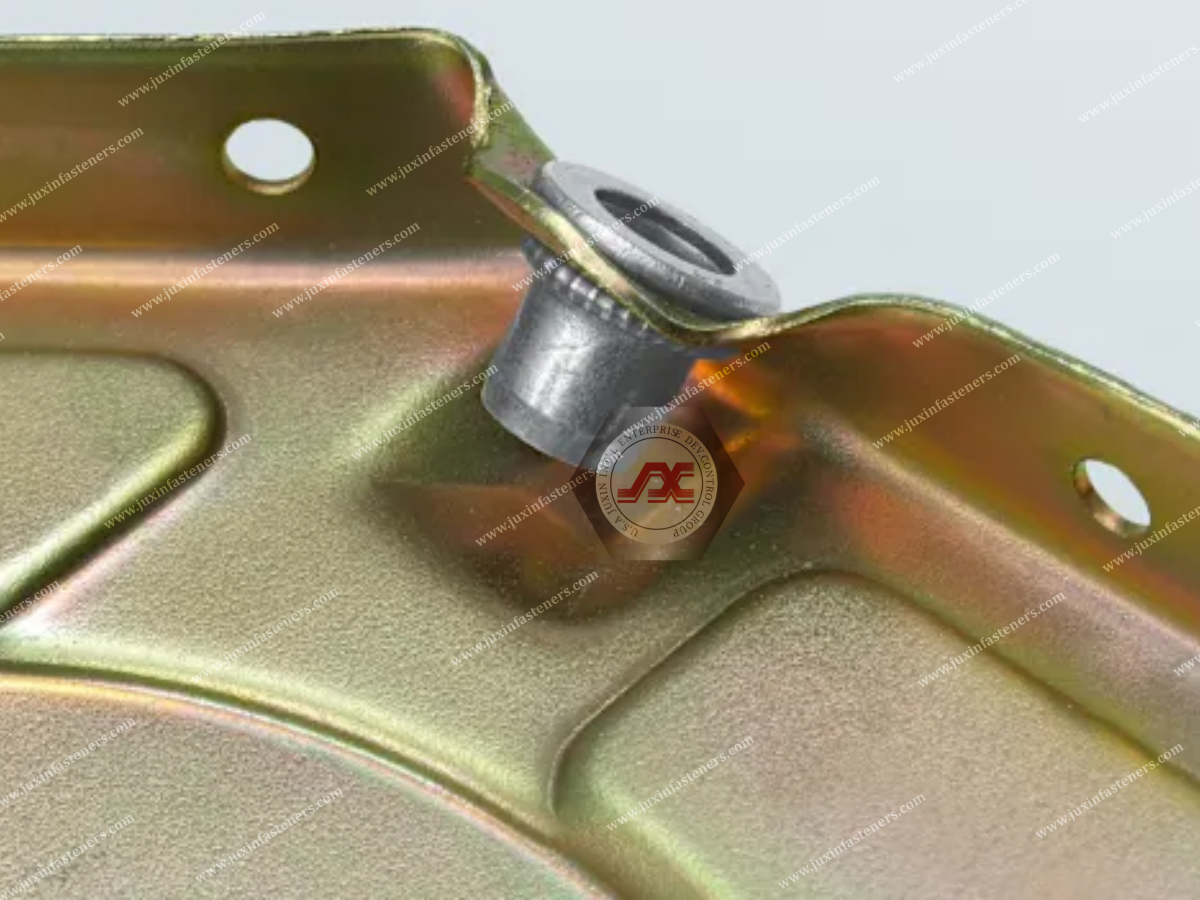
The installation hole is part of the rivet nut system.
A hole that is too small may:
Prevent insertion
Damage the rivet nut
Interfere with installation
A hole that is too large may:
Reduce rotational resistance
Affect centering
Reduce installation consistency
Increase movement
For round-body rivet nuts, hole diameter is critical.
For full-hex and half-hex rivet nuts, hole shape and across-flat dimensions also matter.
Hole specifications should therefore be included on the fabrication drawing rather than left to production interpretation.
Rivet nuts can be installed into many materials, including:
Carbon steel sheet
Galvanized steel
Stainless steel
Aluminum
Thin structural profiles
But the same rivet nut can behave differently in different substrates.
Important variables include:
Material strength
Hardness
Thickness
Surface coating
Local stiffness
Hole quality
For example, a soft aluminum panel and a stainless steel panel of the same thickness do not necessarily provide the same installation behavior.
The substrate should always be included in the RFQ.
Carbon-steel rivet nuts are widely used for industrial applications where cost efficiency and mechanical performance are important.
Surface treatment should be selected according to:
Corrosion environment
Customer specification
Assembly requirements
Parent material
Stainless steel rivet nuts can be appropriate where corrosion resistance, material compatibility or project specifications require stainless construction.
JUXIN FASTENERS supports stainless steel blind rivet nut configurations for suitable applications.
Installation tooling and force requirements should be considered because stainless steel variants can behave differently from carbon-steel versions.
Aluminum rivet nuts provide a lightweight fastening option for appropriate assemblies.
They can be considered where:
Low mass is important
Parent material is aluminum
Mechanical requirements are compatible with the selected insert
Corrosion compatibility is part of the design
Material should not be selected by weight alone.
Thread load and installation requirements still need to be evaluated.
Rivet nuts are often installed into sheet material different from the fastener itself.
Examples include:
Steel rivet nut in aluminum
Stainless steel rivet nut in aluminum
Steel rivet nut in galvanized steel
Aluminum rivet nut in aluminum
Where dissimilar metals are exposed to moisture or conductive contamination, galvanic corrosion can become a design consideration.
Risk depends on:
Material combination
Coating
Relative surface areas
Environmental exposure
Drainage
Electrical contact
For outdoor, railway and marine-adjacent applications, the complete material system should be reviewed.
ASTM B117 is widely used as a neutral salt-spray test method.
However, a statement such as “720-hour salt spray rivet nut” is incomplete without defining:
Coating system
Appearance criteria
White corrosion criteria
Red corrosion criteria
Sample preparation
Customer acceptance requirement
Salt-spray exposure also should not be treated as a direct prediction of real-world service life.
Where corrosion performance matters, procurement teams should specify the required coating and test criteria rather than relying on a marketing number.
Blind rivet nuts can be installed using different tooling principles.
The mandrel threads into the rivet nut and applies axial pulling force to collapse the deformation zone.
The tool uses rotational movement to create the installation action according to the tool and fastener system.
Tooling selection can influence:
Cycle time
Installation control
Operator consistency
Thread wear
Production volume
For high-volume production, the rivet nut should be evaluated together with the actual installation equipment.
A rivet nut must deform enough to create the required blind-side clamp without being excessively collapsed.
Depending on the installation system, tools may control installation through parameters such as stroke or force.
Incorrect setup can produce:
Under-installed rivet nuts
Over-compressed inserts
Panel distortion
Thread damage
Inconsistent retention
This is why changing rivet nut supplier, body length or grip range can require tooling settings to be reviewed.
The part may have the same thread size but require a different installation condition.
An installed rivet nut may appear correctly seated from the accessible side while the blind-side deformation is incorrect.
Potential hidden conditions include:
Incomplete bulb formation
Uneven collapse
Excessive deformation
Poor grip on the parent sheet
During process development, engineers should inspect both sides of representative test assemblies where possible.
For closed production structures where the blind side cannot later be viewed, installation parameters should be validated before the process is released.
Both technologies create machine threads in sheet metal.
Their installation requirements are different.
| Design Condition | Blind Rivet Nut | Self-Clinching Nut |
|---|---|---|
| Rear-side access | Not required | Installation normally requires press access |
| Installation method | Rivet nut installation tool | Press |
| Blind/closed structures | Strong advantage | Application dependent |
| Hole type | Round or shaped depending on body | Defined clinching hole |
| Retention | Blind-side deformation | Mechanical clinching interlock |
| Retrofit use | Often practical | Usually integrated earlier in fabrication |
| Typical applications | Closed profiles, finished enclosures | Sheet-metal chassis and panels |
For a closed tubular structure, the rivet nut may be the practical choice.
For an accessible flat sheet in a controlled press operation, a self-clinching nut may be more appropriate.
A projection weld nut requires welding access and a compatible welding process.
A rivet nut requires mechanical installation but no welding.
Consider a rivet nut where:
Welding heat is undesirable
Only one side is accessible
The component is already fabricated
Dissimilar or non-welded materials are used
Retrofit installation is required
Consider a weld nut where:
The structure is already part of a resistance-welding production line
Welding access is available
The threaded feature is integrated during fabrication
The parent material and process suit projection welding
Neither method is universally stronger or better.
The correct choice follows the manufacturing process.
A cage nut and rivet nut can both provide threaded attachment in fabricated equipment, but they solve different tolerance and service problems.
Cage nuts can be useful where:
The thread must have positional float
Rack mounting geometry is used
Replacement access is available
The design requires a removable captive nut
Rivet nuts can be useful where:
A fixed threaded location is required
Installation is from one side
The fastener should remain permanently attached to the panel
This distinction is especially relevant in server racks, telecom cabinets and electrical equipment.
Railway rolling stock contains many very different fastening environments.
A rivet nut used for an interior trim component does not necessarily have the same requirements as one used near HVAC equipment or an exterior structure.
Engineers should consider:
Mechanical load
Vibration
Fire/smoke requirements of surrounding materials where applicable
Corrosion exposure
Maintenance access
Substrate
Joint criticality
Project-specific railway specifications
The word “railway” alone is not a technical specification.
This is especially important for supplier development teams evaluating parts for rolling stock programs.
Design engineers should begin with these questions:
Can I access both sides of the component?
If not, a blind rivet nut becomes a strong candidate.
What is the parent material?
Steel, stainless steel, aluminum or another substrate?
What is the material thickness?
Use it to determine the required grip range.
How much rotational resistance is required?
Compare smooth, knurled, half-hex and full-hex bodies.
What head profile can the assembly accept?
Flat head, reduced head or countersunk?
Does the thread need a closed bottom?
Consider closed-end geometry, but evaluate sealing separately if required.
Is positional adjustment needed?
A floating rivet nut may be more appropriate.
How will the insert be installed?
Tooling and production volume influence the solution.
What load must the installed fastener resist?
Define axial, rotational and final assembly requirements.
This decision path is much more useful than searching only for “M6 rivet nut.”
For accurate evaluation, procurement teams should provide:
Thread size and pitch
Body style
Full-hex, half-hex, knurled, ribbed or smooth
Head style
Open-end or closed-end
Material
Surface finish
Parent sheet material
Parent sheet thickness
Required grip range
Hole size and shape
Required installed performance
Installation tool information where relevant
Environmental requirement
Prototype quantity
Annual production quantity
Packaging requirement
Inspection requirement
2D drawing where available
3D model where relevant
For existing projects, a sample plus drawing can help identify geometry, but the drawing should remain the controlled reference.
Do not compare only thread size and price.
Important sourcing characteristics include:
Grip range
Body length
Head dimensions
Hole requirement
Body geometry
Deformation zone
Material
Surface finish
Thread quality
Dimensional consistency
Installation consistency
Packaging
Drawing revision control
Sample-to-production repeatability
Two visually similar rivet nuts can behave differently during installation if their deformation zones or grip ranges differ.
Standard rivet nuts cover many applications.
Custom designs may be appropriate where the OEM requires:
Special body length
Special grip range
Custom flange diameter
Restricted head height
Full-hex or half-hex geometry
Special knurling
Closed-end configuration
Floating thread
Non-standard thread
Special material
Drawing-specific geometry
JUXIN FASTENERS supports drawing-based rivet nut development for OEM applications.
For custom projects, send both the fastener drawing and information about the parent material and installation process.
A practical development path can follow:
Application Requirement → Parent Material & Grip Review → Body / Head Selection → Drawing Confirmation → Sample Installation
→ Pull-Out / Torque / Assembly Evaluation → Golden Sample Approval → Production
The exact test requirements should be agreed according to the customer drawing and application.
JUXIN FASTENERS supports OEM manufacturers, rail equipment suppliers, HVAC manufacturers, electrical equipment companies,
telecom equipment manufacturers, automotive suppliers and sheet-metal fabricators with standard and customized blind rivet nut solutions.
This page serves as an engineering and sourcing entry point for blind rivet nuts.
Related pages can include:
Full-Hex Rivet Nuts — maximum geometric anti-rotation support for suitable hex-hole assemblies
Half-Hex Rivet Nuts — anti-rotation body geometry for OEM sheet-metal applications
Knurled Round-Body Rivet Nuts — round-hole installation with enhanced external engagement
Smooth Round-Body Rivet Nuts — economical general-purpose blind threaded installation
Closed-End Rivet Nuts — closed-bottom threaded inserts for selected enclosure applications
Countersunk Rivet Nuts — low-profile installation for suitable sheet geometry
Floating Rivet Nuts — controlled thread-position adjustment for tolerance-sensitive assemblies
Self-Clinching Fasteners for Telecom Cabinets & AI Data Center Enclosures — press-installed threaded features where tooling access is available
Projection Weld Nuts for Automotive Chassis & Sheet Metal Assemblies — resistance-welded threaded features for fabricated metal structures
Each detailed rivet nut product page should target its own geometry, material and application search intent while linking back to this selection guide.
If you are designing or sourcing rivet nuts for:
Railway rolling stock
HVAC equipment
Electrical enclosures
Telecom cabinets
Data center equipment
Automotive assemblies
Commercial vehicles
Industrial machinery
Control cabinets
Equipment housings
Closed tubular structures
Fabricated sheet-metal assemblies
send us your drawing, thread size, parent material, material thickness, required grip range, hole geometry, body style, head style, surface finish and estimated quantity.
If you are experiencing an installation problem such as spin-out, loose installation, panel deformation or inconsistent collapse, include the existing rivet nut and hole specifications with the RFQ.
JUXIN FASTENERS can evaluate full-hex, half-hex, knurled, ribbed, smooth, countersunk, open-end, closed-end and floating blind rivet nut configurations according to the application.
JUXIN FASTENERS
Website: www.juxinfasteners.com
Engineering & RFQ: info@juxinfasteners.com
Product Packaging
Packaging Standard
At Juxin Fasteners, we apply standardized export packaging to ensure product protection, traceability, and compliance with international logistics requirements.
1. Standard Export Packaging
Unless otherwise specified, all products will be packed according to our factory standard export packaging, which includes:
Moisture-resistant inner protection
Poly bag or small box packing as required
Reinforced export cartons
Clear labeling with part number, specification, batch number, and quantity
Palletizing for sea or air shipment when necessary
Our standard packaging is designed to ensure safe transportation, efficient warehousing, and long-distance international shipping.
2. Customized Packaging Options
We also provide customized packaging solutions according to customer requirements, including but not limited to:
Private labeling
Customized barcodes
Specific carton dimensions
Retail packaging
Special pallet configuration
Customer-specific marking and identification
So that you know, customized packaging may involve additional costs and extended lead time depending on the complexity of the requirements.
3. Compliance & Quality Assurance
All packaging processes are controlled under our ISO 9001 quality management system to ensure consistency, traceability, and product integrity throughout the supply chain.
Product Pictures
Contact Us
Tel.:
+86 020 8621 0320
+86 020 3121 6067
E-mail:
Technical Support:
Navigation
SEND INQUIREY