Call Us
+86 136 6007 9809
Call Us
+86 136 6007 9809

Blind rivet nuts, also known as rivet nuts, blind threaded inserts, or internally threaded blind rivets, provide permanent threaded attachment points in sheet metal,
hollow sections, tubes, and other suitable substrates where access to the opposite side is limited or unavailable.
Product Specification
Blind rivet nuts, also known as rivet nuts, blind threaded inserts, or internally threaded blind rivets, provide permanent threaded attachment points in sheet metal,
hollow sections, tubes, and other suitable substrates where access to the opposite side is limited or unavailable.
These fasteners are widely considered for automotive components, industrial enclosures, HVAC equipment, electrical cabinets, telecommunications housings,
railway equipment, machinery, and fabricated metal assemblies.
For mechanical engineers and OEM purchasing teams, selecting between hex-body and round-body blind rivet nuts is an important design decision.
The choice influences hole preparation, resistance to insert rotation, installation repeatability, sheet metal deformation, tooling compatibility, and total assembly cost.
A hex-body rivet nut engages with a suitably shaped hexagonal hole, while a round-body rivet nut is normally installed into a circular hole.
However, the external body shape alone does not determine the complete mechanical performance of the finished joint.
Reliable fastening requires appropriate material selection, grip range, hole tolerances, installation conditions, bolt preload, and validation under representative service loads.
JUXIN FASTENERS supplies industrial blind rivet nuts and drawing-based fastening solutions for international OEM manufacturing applications.
This engineering guide compares full-hex, half-hex, smooth round, knurled round, and ribbed blind rivet nuts, with particular attention to spin-out resistance,
sheet metal compatibility, vibration-related risks, production efficiency, and global OEM procurement.
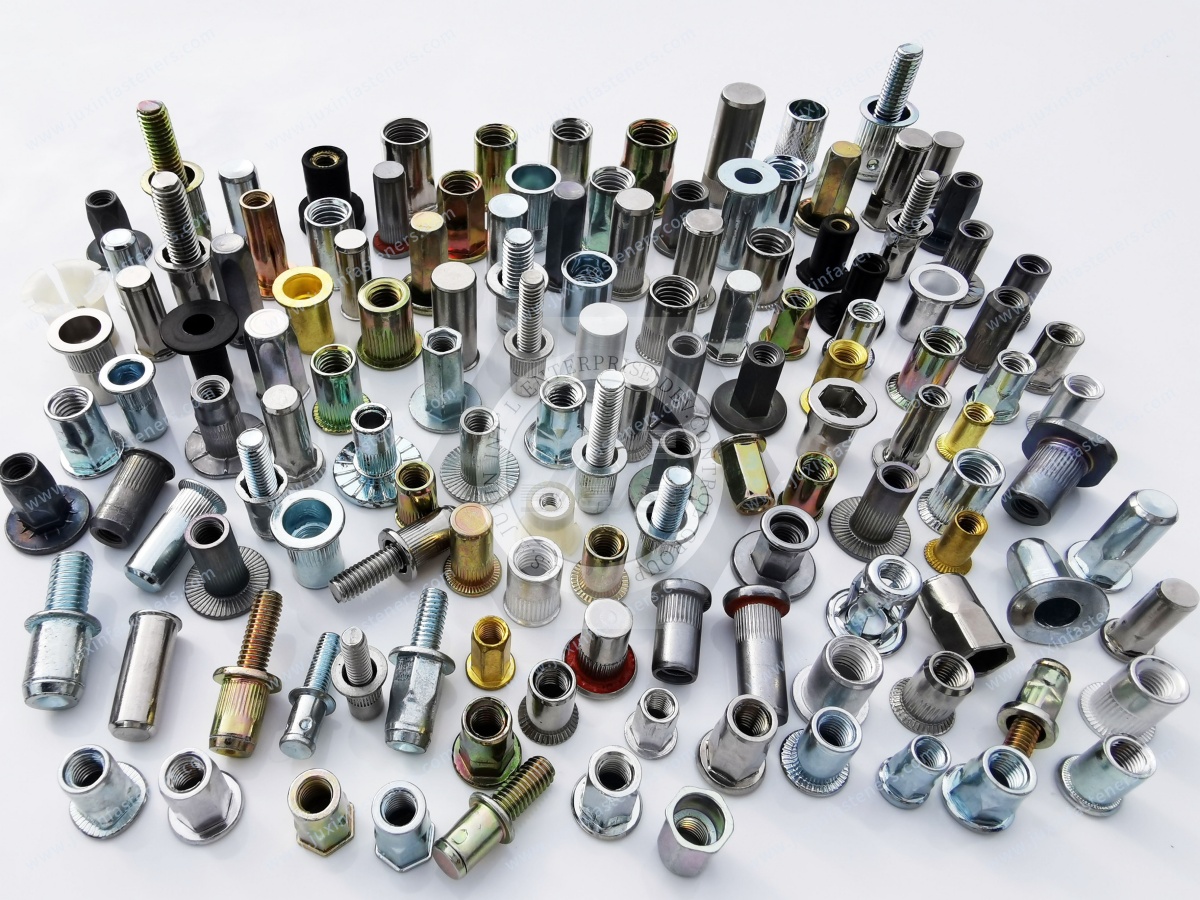
A blind rivet nut is an internally threaded fastener installed into a prepared hole using a suitable setting tool.
During installation, the tool applies axial force to deform a designated portion of the rivet nut body.
This deformation creates a retaining bulge or upset region behind the parent material, mechanically securing the insert in position.
After installation, the rivet nut provides an internal thread for attaching a mating screw or bolt.
Blind rivet nuts can be useful when:
Access is available from only one side of the assembly.
Welding is unsuitable or undesirable.
The substrate is too thin for sufficient direct thread engagement.
A reusable threaded connection is required.
The assembly contains hollow tubes or closed sections.
Post-fabrication threaded attachment points are needed.
A mechanical installation process is preferred.
The suitability of a blind rivet nut must be evaluated according to the actual substrate, hole geometry, joint loads, and installation requirements.
Industrial blind rivet nuts are available in several external body configurations.
These may include:
Full-hex body.
Half-hex body.
Smooth round body.
Knurled round body.
Ribbed round body.
Additional design variations may include open-end, closed-end, countersunk-head, reduced-head, and large-flange configurations.
Not every combination of body style, head style, material, and thread size is necessarily available. Actual supply specifications should be confirmed against the product drawing.
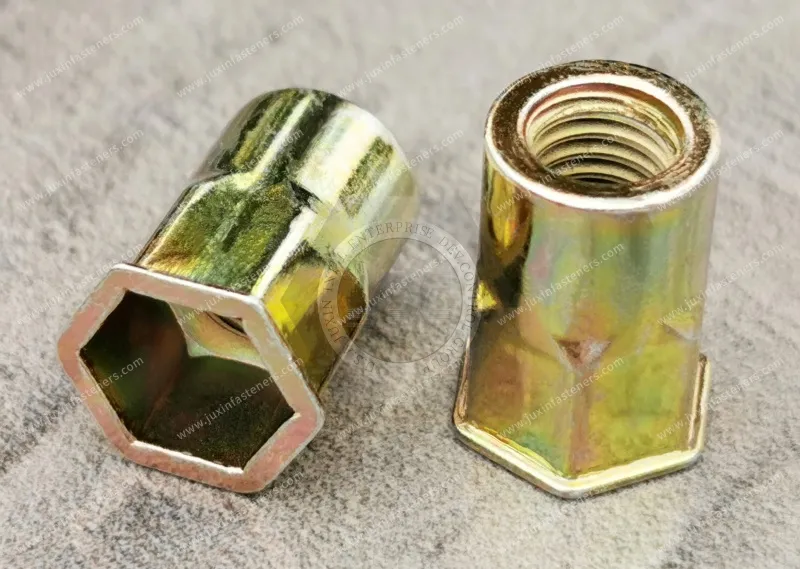
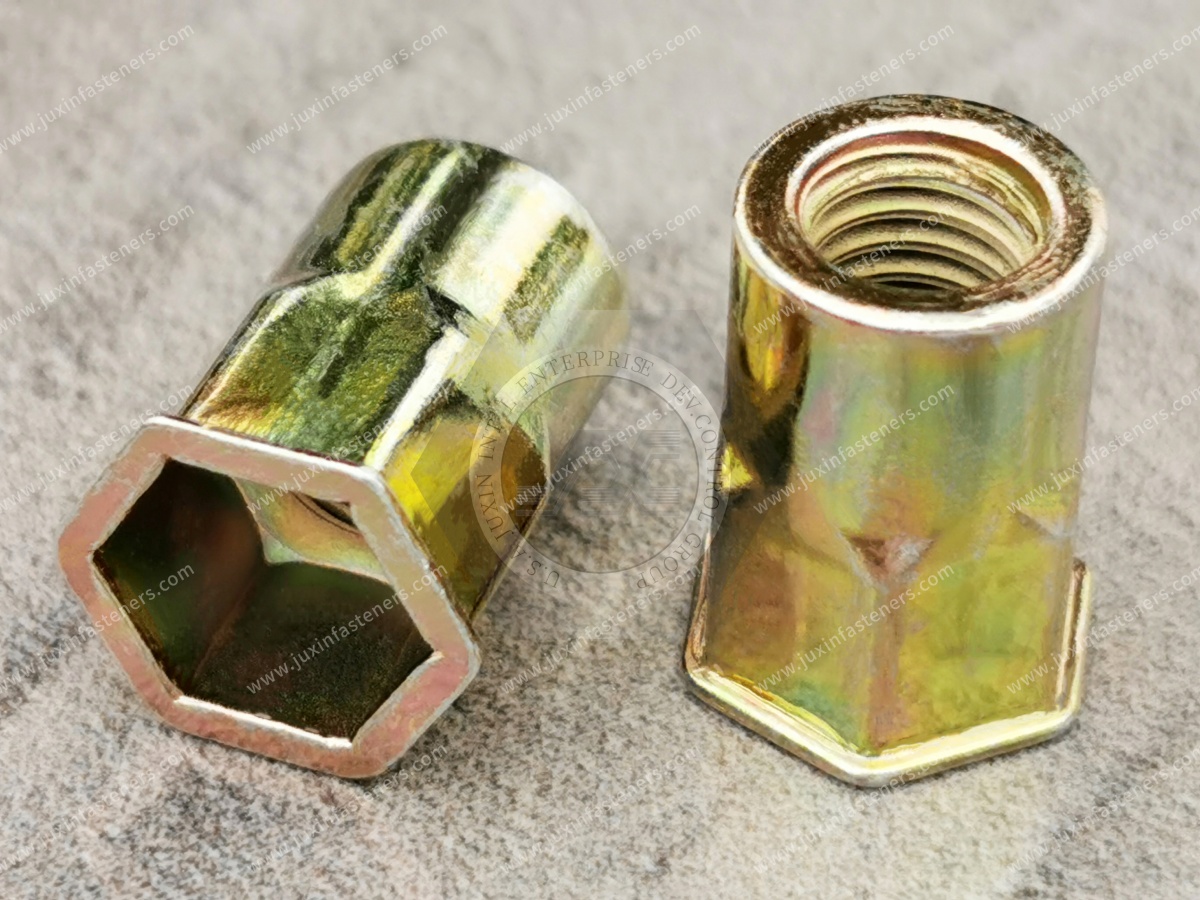
Full-hex blind rivet nuts have a hexagonal external body over the designated portion of the fastener.
They are intended for installation into appropriately sized and shaped hexagonal holes.
The mating hexagonal profiles provide geometric resistance to rotation.
When torque is applied to the internal thread, rotational load can be transferred through contact between the hexagonal body surfaces and the surrounding substrate.
This differs from a smooth round-body insert, which relies more heavily on frictional and mechanical engagement generated during installation.
However, the hexagonal geometry does not guarantee that the insert cannot rotate.
Actual resistance depends on:
Hole dimensions.
Body dimensions.
Material strength.
Installation quality.
Substrate thickness.
Local deformation.
Applied torque.
Joint condition.
Excessive torque may deform the surrounding hole or damage the installed fastener.
Potential advantages include:
Positive geometric engagement with the receiving hole.
Reduced dependence on friction alone for anti-rotation.
Suitability for applications where rotational retention is important.
Compatibility with engineered sheet metal assemblies using hexagonal holes.
Full-hex rivet nuts require compatible hole geometry.
The manufacturing process must control the hole dimensions, orientation, and edge condition.
Hole deformation, excessive clearance, or poor installation may reduce the intended mechanical engagement.
For thin or low-strength substrates, engineers must consider the possibility of local material deformation around the hexagonal hole.
Half-hex rivet nuts combine a hexagonal body region with a round body region.
The exact geometry varies by product design.
The hexagonal portion engages with a corresponding hexagonal hole region, while the remaining body geometry accommodates the installation and deformation mechanism.
The performance of a half-hex rivet nut depends on the length and dimensions of the hexagonal engagement region and the characteristics of the parent material.
Full-hex and half-hex rivet nuts should not be assumed to have identical anti-rotation performance.
Relevant differences may include:
Hexagonal engagement length.
Body geometry.
Grip range.
Installation behavior.
Hole compatibility.
Local load distribution.
For applications requiring defined spin-out resistance, the selected part should be evaluated using suitable product-specific testing.
Half-hex configurations may be considered when the product geometry and installation requirements favor a combination of hexagonal engagement and round-body deformation characteristics.
The appropriate design should be selected using the manufacturer's dimensional drawing and validated assembly requirements.
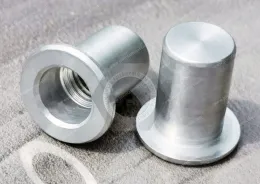
Round-body rivet nuts are installed into circular holes.
They are commonly used in sheet metal fabrication, industrial enclosures, equipment housings, and other assemblies where round holes are practical to manufacture.
Round-body designs may be smooth, knurled, or ribbed.
Smooth round-body rivet nuts rely on the mechanical retention developed during setting, including clamping and frictional engagement with the parent material.
Their performance depends on the installation geometry, substrate characteristics, and applied setting conditions.
Smooth-body designs may be appropriate where the specified rotational and axial retention requirements can be satisfied.
Knurled round-body rivet nuts incorporate external surface features intended to improve mechanical engagement with the surrounding material.
During installation, the knurled surface may engage or indent the hole wall, depending on the substrate and product geometry.
The resulting resistance to rotation depends on:
Knurl pattern.
Hole diameter.
Parent material.
Material thickness.
Setting force or stroke.
Installed deformation.
Applied torque.
Knurling does not automatically guarantee superior performance in every substrate.
Ribbed designs incorporate longitudinal or other external features intended to improve engagement with the parent material.
The effectiveness of these features depends on the specific product geometry and installation conditions.
Ribbed and knurled designs should be compared using actual engineering specifications rather than treating them as mechanically identical.
The following comparison describes general design principles. It does not replace product-specific mechanical testing.
| Engineering Factor | Hex-Body Rivet Nuts | Round-Body Rivet Nuts |
|---|---|---|
| Receiving hole | Matching hexagonal geometry | Circular geometry |
| Anti-rotation mechanism | Geometric engagement with hole flats | Friction, deformation and external surface engagement |
| Hole manufacturing | Hexagonal punching, suitable cutting or other controlled methods | Drilling, punching or other suitable round-hole methods |
| Installation tooling | Must suit selected hex-body geometry | Must suit selected round-body geometry |
| Spin-out resistance | Can offer strong geometric resistance when correctly installed | Depends on body features, substrate and setting conditions |
| Hole tolerance sensitivity | Hex geometry and clearance are important | Diameter, roundness and surface condition are important |
| Production considerations | Requires control of hexagonal hole quality | Often integrates readily with round-hole fabrication |
| Main design risks | Hole deformation, excessive clearance, local material damage | Insufficient engagement, oversized holes, insert rotation |
Not necessarily in every application.
A correctly installed hex-body rivet nut can provide strong geometric resistance to rotation.
However, performance comparisons must consider the specific fastener, hole geometry, substrate material, thickness, and test conditions.
A well-designed knurled round-body rivet nut may perform adequately or favorably in an application where the hex-body alternative is poorly matched to the substrate.
Engineers should compare products using relevant spin-out torque data and representative assembly testing.
Round holes are generally straightforward to produce using common drilling and punching processes.
However, installation efficiency depends on the entire production process, including hole preparation, part feeding, setting equipment, operator handling, and inspection.
A round-body design should not automatically be assumed to have a lower total installed cost.
One of the most important engineering distinctions is the difference between insert rotation and vibration-induced loosening of the completed bolted joint.
Spin-out occurs when the installed rivet nut rotates relative to the parent material.
It may occur during bolt tightening, removal, or other torsional loading.
Potential causes include:
Oversized mounting hole.
Inadequate installation.
Insufficient mechanical engagement.
Local substrate deformation.
Excessive applied torque.
Unsuitable fastener geometry.
Vibration-induced loosening involves changes in the assembled bolted joint under cyclic loading.
Depending on the joint design and loading conditions, transverse movement, loss of preload, embedding, relaxation, or other mechanisms may contribute to loosening.
A rivet nut may remain securely fixed in the panel while the mating bolt loses preload.
Therefore, high spin-out resistance does not automatically establish vibration-resistant bolt retention.
Hex-body rivet nuts are designed to resist rotation within compatible holes.
They do not independently prevent the mating bolt from loosening under vibration.
The complete bolted joint may require evaluation of:
Bolt preload.
Mating thread geometry.
Joint stiffness.
Clamp length.
Transverse loading.
Surface settlement.
Material deformation.
Locking features where appropriate.
Service temperature.
Assembly torque control.
For demanding applications, joint-level validation is more meaningful than relying solely on the external body shape of the rivet nut.
Automotive and railway assemblies may experience vibration, thermal cycling, and repeated mechanical loading.
Fastener selection must therefore address both insert retention and the performance of the complete joint.
Where safety-critical requirements apply, the assembly must be evaluated under the relevant engineering specifications and approval procedures.
No general rivet nut body style should be presented as universally suitable for safety-critical applications without validation.
Grip range is one of the most important specifications in blind rivet nut selection.
It defines the substrate thickness range for which a particular rivet nut is designed to be installed.
A rivet nut may be designed for a specified minimum and maximum material thickness.
The selected fastener must be compatible with the actual thickness of the material in which it is being set.
For example, if a product drawing specifies a grip range of 1.0–3.0 mm, the actual installation thickness must fall within that range, subject to the manufacturer's requirements.
This is an illustrative example and does not represent the grip range of every rivet nut.
The relevant grip thickness is normally the material thickness engaged by the rivet nut during installation.
It should not automatically be calculated by adding every component subsequently clamped by the mating bolt.
For example, a rivet nut installed in a 2 mm steel panel may later secure an additional bracket.
The bracket thickness affects the complete bolted joint, but it does not necessarily form part of the rivet nut's installation grip thickness.
This distinction is important when engineers prepare drawings and purchasing specifications.
A rivet nut selected outside its intended grip range may experience:
Incomplete backside deformation.
Insufficient clamping.
Excessive body deformation.
Thread distortion.
Local sheet damage.
Reduced retention.
Inconsistent installation.
The selected grip range should be confirmed using the actual product specification and substrate dimensions.
The mounting hole is a functional part of the rivet nut assembly.
A high-quality rivet nut cannot compensate for an incorrectly prepared hole.
Hex-body rivet nuts require suitable hexagonal holes.
Important characteristics include:
Across-flats dimension.
Hole orientation.
Corner geometry.
Dimensional tolerance.
Burr condition.
Parent material thickness.
Local flatness.
Excessive clearance can reduce geometric engagement and increase the risk of local deformation under torque.
Round-body rivet nuts require holes compatible with the selected body diameter and installation process.
Important characteristics include:
Hole diameter.
Roundness.
Burr height.
Hole perpendicularity.
Sheet flatness.
Surface coating condition.
Oversized holes may reduce retention, while undersized holes can cause insertion difficulties or damage.
Punching can be suitable for repeatable high-volume hole production when tooling and material conditions are appropriate.
Laser cutting may provide flexibility for prototype or lower-volume fabrication, but cut-edge quality, dimensional accuracy, and local material effects should be evaluated.
Neither process automatically guarantees the correct hole geometry.
Burrs can interfere with rivet nut seating or affect installation consistency.
Hole preparation should meet the approved drawing and assembly requirements.
Deburring or other edge preparation may be necessary depending on the manufacturing process.
Blind rivet nuts are installed using tools designed to deform the fastener body and create backside retention.
The setting process must match the fastener geometry, material, grip range, and substrate.
Hand-operated or powered installation tools may be suitable for prototype work, maintenance, and certain production applications.
The selected tool must be compatible with the rivet nut thread and setting requirements.
Powered setting tools can support repetitive assembly operations.
Production engineers should evaluate tool capability, maintenance, operator handling, and installation consistency.
Automated systems may integrate rivet nut feeding, positioning, setting, and inspection.
Compatibility depends on:
Fastener geometry.
Feeding orientation.
Thread size.
Head style.
Material.
Setting equipment.
Workpiece accessibility.
Production cycle requirements.
Some installation systems control setting displacement, while others use force-based or combined control methods.
The appropriate method depends on the fastener and equipment.
Incorrect settings can cause under-setting, over-setting, or inconsistent retention.
Under-setting occurs when the fastener is not deformed sufficiently to establish the intended retention.
Possible consequences include:
Loose installation.
Reduced axial retention.
Increased rotation risk.
Inconsistent joint behavior.
Over-setting occurs when the installation process applies excessive deformation or loading.
Possible consequences include:
Thread distortion.
Body cracking.
Excessive sheet deformation.
Reduced installation reliability.
Damage to the parent material.
The correct setting conditions should be established using product-specific installation guidance and validated assembly trials.
Blind rivet nuts are available in different materials to address mechanical, manufacturing, and environmental requirements.
The selected material affects installation behavior, corrosion resistance, strength, and cost.
Carbon steel rivet nuts are commonly considered for industrial sheet metal assemblies.
Surface treatments may be specified for corrosion protection.
Zinc-plated carbon steel rivet nuts are one possible option, subject to actual product availability and coating requirements.
The selected coating must be evaluated according to the service environment and customer specification.
Stainless steel rivet nuts may be considered for applications requiring particular corrosion resistance characteristics.
A2 and A4 are commonly used stainless steel fastener designations, but the exact alloy and material specification must be confirmed.
A2 is often associated with 304-type stainless steel, while A4 is often associated with molybdenum-containing 316-type stainless steel.
These descriptions do not establish that every stainless rivet nut meets a particular strength class or chemical composition.
Stainless steel fasteners may require different installation forces and tooling capabilities from carbon steel alternatives.
Aluminum rivet nuts may be considered where weight, material compatibility, or installation requirements favor aluminum.
Their suitability depends on the actual alloy, temper, geometry, and loading conditions.
Aluminum should not automatically be treated as equivalent to steel in mechanical performance.
When dissimilar metals are used together in the presence of an electrolyte, galvanic corrosion may occur.
Relevant factors include:
Material combination.
Environmental exposure.
Surface coatings.
Electrical contact.
Moisture retention.
Relative exposed surface areas.
For outdoor enclosures, transport equipment, and marine-related applications, corrosion protection should be evaluated at the assembly level.
Possible surface requirements may include zinc plating, zinc-nickel coating, passivation, or other treatments appropriate to the selected material.
The actual coating system, thickness, corrosion performance, and compatibility must be confirmed for the specific product.
No salt spray performance value should be assumed without applicable testing evidence.
Body style is not the only geometric consideration when selecting a blind rivet nut.
Head geometry affects seating, available space, and the interface with the parent material.
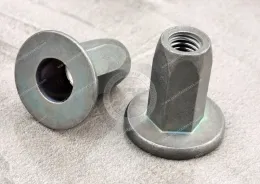
Flat-head or large-flange designs provide a bearing surface on the accessible side of the substrate.
The flange geometry may influence seating, load distribution, and the final assembly envelope.
Reduced-head designs may be considered where a smaller protrusion above the parent material is desirable.
However, the reduced bearing area and installation requirements must be evaluated.
Countersunk designs may be considered where a flush or recessed installation is required.
The parent material must support the specified countersink geometry without unacceptable weakening.
Open-end rivet nuts allow the mating screw to extend through the threaded body, subject to the actual design.
Closed-end rivet nuts incorporate a closed body end and may be considered where the application requires a particular enclosure or thread-end configuration.
A closed-end design should not automatically be described as leakproof or pressure-tight.
Sealing performance must be validated for the complete assembly.
Understanding installation and service failures helps engineers select suitable rivet nuts and establish effective production controls.
Possible causes:
Incorrect hole geometry.
Excessive hole clearance.
Inadequate setting.
Insufficient body engagement.
Local substrate deformation.
Excessive tightening torque.
Recommended engineering review:
Check the fastener drawing, hole dimensions, substrate characteristics, setting conditions, and applied assembly torque.
Possible causes:
Incorrect grip range.
Insufficient backside deformation.
Inadequate substrate strength.
Excessive axial loading.
Installation defects.
Recommended engineering review:
Evaluate the installed deformation, parent material, loading conditions, and selected fastener geometry.
Possible causes:
Excessive setting force.
Incorrect mandrel.
Thread mismatch.
Tooling damage.
Fastener deformation.
Recommended engineering review:
Verify installation equipment compatibility and inspect the internal thread before and after setting.
Possible causes:
Excessive setting load.
Inadequate local sheet stiffness.
Incorrect grip range.
Unsuitable head geometry.
Hole preparation problems.
Recommended engineering review:
Assess the parent material thickness, local geometry, setting process, and flange configuration.
Possible causes:
Insufficient bolt preload.
Joint settlement.
Transverse cyclic loading.
Inappropriate locking strategy.
Joint stiffness or design limitations.
Recommended engineering review:
Evaluate the complete bolted joint rather than assuming the rivet nut body shape is the cause.
Possible causes:
Fastener dimensional variation.
Hole manufacturing variation.
Tool wear.
Material thickness variation.
Inconsistent setting conditions.
Recommended engineering review:
Compare production batches against the approved specifications and evaluate process capability.
Blind rivet nuts may be considered for automotive brackets, interior assemblies, body-related components, and suitable fabricated structures.
Hex-body designs may be evaluated where rotational retention is important and compatible hexagonal holes are available.
Round-body designs may be considered where circular holes and the required retention performance are compatible with the assembly.
Automotive applications should be validated according to the actual loading and customer requirements.
HVAC manufacturers may use blind rivet nuts in cabinets, brackets, access panels, and fabricated sheet metal assemblies.
Relevant requirements include:
Sheet thickness.
Vibration exposure.
Corrosion protection.
Assembly access.
Production efficiency.
Maintenance requirements.
Blind rivet nuts can provide threaded mounting points in suitable sheet metal cabinets and enclosures.
Engineers should evaluate material compatibility, mounting loads, grounding requirements, and equipment-specific safety requirements.
The rivet nut alone does not establish electrical compliance.
Telecommunications enclosures and mounting structures may require reusable threaded connections in fabricated metal components.
For outdoor installations, corrosion exposure and sealing requirements may be important.
Blind rivet nuts may be used in machine covers, brackets, guards, control housings, and fabricated structures.
The selected body style should match the substrate geometry, installation access, and mechanical loading requirements.
Certain railway equipment assemblies may use blind threaded fasteners where the design permits.
However, vibration, fatigue, corrosion, and safety requirements must be evaluated according to the specific application.
A general-purpose rivet nut should not be represented as railway-certified without supporting qualification evidence.
Server cabinets, equipment racks, and fabricated electronic housings may require threaded attachment points in sheet metal.
Selection considerations include panel thickness, available installation space, service access, dimensional repeatability, and compatibility with enclosure manufacturing processes.
Blind rivet nuts can be particularly useful when the back side of a tube or hollow section cannot be accessed.
Engineers must consider local wall thickness, curvature, hole geometry, and the effect of installation deformation.
A rivet nut installed in a curved tube wall may behave differently from one installed in a flat sheet.
Representative installation testing is important where geometry differs from standard flat-panel conditions.
For international OEM purchasing, the phrase "blind rivet nut" is not a complete technical specification.
A reliable RFQ should identify the required geometry, thread, material, installation conditions, and commercial requirements.
Specify:
Full-hex.
Half-hex.
Smooth round.
Knurled round.
Ribbed round.
Where a particular design is required, provide the approved drawing or reference part number.
Identify the internal thread designation and pitch.
For metric requirements, examples may include M4 × 0.7, M5 × 0.8, M6 × 1.0, and M8 × 1.25.
For inch-based requirements, specify the applicable UNC or UNF designation.
Metric, UNC, UNF, BSW, and BSF threads must not be treated as interchangeable.
Actual availability must be confirmed for the requested design.
Specify the actual parent material thickness and the required grip range.
For assemblies involving multiple layers or unusual geometry, clarify which material thickness is engaged during installation.
Identify the required flange or head configuration.
Examples may include flat-head, reduced-head, or countersunk designs.
Specify the required material and coating.
Examples may include carbon steel, stainless steel, or aluminum, subject to actual supply availability.
Provide:
Hole geometry and dimensions.
Parent material grade.
Material thickness.
Installation equipment.
Setting method.
Available access.
Critical assembly constraints.
Where applicable, identify:
Spin-out torque requirements.
Axial retention requirements.
Bolt tightening requirements.
Environmental exposure.
Corrosion resistance requirements.
Relevant customer test methods.
Numerical acceptance criteria should be supported by the actual engineering specification.
Include:
Prototype quantity.
Initial production order quantity.
Estimated annual demand.
Packaging requirements.
Delivery destination.
Target lead time.
Drawing revision.
This information helps establish a more accurate quotation and supports supplier evaluation.
The lowest unit price does not necessarily produce the lowest total manufacturing cost.
For production programs, engineers and purchasing teams should consider the cost of the complete installed connection.
Hex-body rivet nuts require suitable hexagonal holes.
Depending on production volume and fabrication equipment, hole preparation may involve dedicated punching tools or other controlled cutting methods.
Round-body rivet nuts may use existing round-hole fabrication processes.
The total cost comparison should include tooling, fabrication time, inspection, and scrap.
Existing setting equipment may influence the preferred rivet nut design.
Production managers should evaluate whether a proposed alternative requires changes to tooling, mandrels, feeding systems, or process settings.
Incorrect hole dimensions or setting conditions may result in:
Insert rotation.
Pull-out failures.
Thread damage.
Sheet deformation.
Rework.
Production interruptions.
These costs may exceed small differences in fastener unit price.
For high-volume OEM programs, consistent body dimensions, head geometry, and thread quality support stable installation.
Critical characteristics should be identified in the approved drawing and inspection requirements.
Customers may request dimensional inspection records, material information, lot identification, or other agreed documentation.
The availability of specific test reports or certification documents must be confirmed for the product and order.
Supply chain managers should consider:
Stable product specifications.
Drawing revision control.
Production quantity requirements.
Agreed inspection criteria.
Packaging consistency.
Delivery scheduling.
Supplier communication.
Engineering change management.
A suitable long-term sourcing decision should account for both the fastener and its impact on the customer's manufacturing process.
Not universally.
Hex-body designs can provide strong geometric resistance to rotation in correctly prepared holes.
However, axial retention, thread strength, and overall joint performance depend on the specific fastener, substrate, installation, and loading conditions.
No body style alone guarantees vibration-resistant bolt retention.
Hex-body rivet nuts can resist rotation within the mounting hole, but the mating bolted joint must be evaluated separately for preload retention and vibration-induced loosening.
Full-hex designs have a hexagonal external body over the designated engagement region.
Half-hex designs combine hexagonal and round body regions.
Their performance depends on the specific geometry and installation conditions.
Not automatically.
The replacement may require a different hole geometry and renewed evaluation of spin-out resistance, installation behavior, and joint performance.
The actual material thickness engaged during installation must fall within the specified grip range of the selected rivet nut.
The manufacturer's product drawing and installation guidance should be used.
Suitable rivet nuts may be installed in stainless steel sheet when the fastener, material thickness, hole geometry, and setting equipment are compatible.
Higher installation loads or different tooling requirements may apply.
No.
Material selection depends on corrosion exposure, mechanical requirements, installation conditions, cost, and compatibility with the parent material.
Inch-thread rivet nut designs may be available, but the actual thread designation, dimensions, material, and supply availability must be confirmed.
Metric and inch-based threads are not interchangeable.
Provide the drawing, body style, thread specification, grip range, material, finish, hole dimensions, order quantity, annual forecast, and delivery requirements.
JUXIN FASTENERS supports international B2B sourcing inquiries for industrial blind rivet nuts, sheet metal fastening components, and drawing-based OEM fastening requirements.
Whether your project involves automotive assemblies, HVAC equipment, electrical cabinets, industrial machinery, telecommunications enclosures, or custom fabricated metal components, selecting the correct rivet nut geometry is important to installation reliability and production efficiency.
For hex-body and round-body blind rivet nut RFQs, please provide:
2D engineering drawing or 3D CAD model, where available.
Required body style: full-hex, half-hex, smooth round, knurled round, or ribbed.
Internal thread designation and pitch.
Head style and critical dimensions.
Parent material grade and thickness.
Hole geometry and tolerance.
Required grip range.
Material and surface finish.
Installation equipment and setting requirements.
Spin-out, pull-out, or other performance requirements, where applicable.
Sample quantity and initial production quantity.
Estimated annual purchasing volume.
Target delivery schedule and destination.
For custom OEM requirements, identify any deviations from standard product dimensions or installation conditions.
Our team can review the submitted specifications and confirm the applicable product sourcing, manufacturing feasibility, and quotation requirements.
Company: JUXIN FASTENERS
Website: www.juxinfasteners.com
Email: info@juxinfasteners.com
Contact JUXIN FASTENERS with your engineering drawings, product specifications, and purchasing requirements to request a quotation for hex-body rivet nuts, round-body rivet nuts, and related OEM sheet metal fastening components.
Product Packaging
Packaging Standard
At Juxin Fasteners, we apply standardized export packaging to ensure product protection, traceability, and compliance with international logistics requirements.
1. Standard Export Packaging
Unless otherwise specified, all products will be packed according to our factory standard export packaging, which includes:
Moisture-resistant inner protection
Poly bag or small box packing as required
Reinforced export cartons
Clear labeling with part number, specification, batch number, and quantity
Palletizing for sea or air shipment when necessary
Our standard packaging is designed to ensure safe transportation, efficient warehousing, and long-distance international shipping.
2. Customized Packaging Options
We also provide customized packaging solutions according to customer requirements, including but not limited to:
Private labeling
Customized barcodes
Specific carton dimensions
Retail packaging
Special pallet configuration
Customer-specific marking and identification
So that you know, customized packaging may involve additional costs and extended lead time depending on the complexity of the requirements.
3. Compliance & Quality Assurance
All packaging processes are controlled under our ISO 9001 quality management system to ensure consistency, traceability, and product integrity throughout the supply chain.
Product Pictures
Hot Products
Contact Us
Tel.:
+86 020 8621 0320
+86 020 3121 6067
E-mail:
Technical Support:
Navigation
SEND INQUIREY