Call Us
+86 136 6007 9809
Call Us
+86 136 6007 9809

Rivet Nut Fasteners Solutions for Automotive Applications
High-Efficiency Threaded Insert Systems for EV Battery Packs, Appliances & Rail Transit Manufacturing
In modern industrial manufacturing, rivet nut fasteners (blind rivet nuts / threaded inserts) have become a critical solution for creating strong, reusable threads in thin-walled materials where welding or tapping is not feasible. Their ability to provide high strength, single-sided installation, vibration resistance, and lightweight assembly makes them widely used across the automotive, home appliances, and rail transit industries.
This article presents a structured engineering overview of rivet nut applications in automotive manufacturing and related industries, focusing on real-world solutions for EV battery systems, appliance housings, and rail transit interior assemblies.
Product Specification
Rivet Nut Fasteners Solutions for Automotive Applications
High-Efficiency Threaded Insert Systems for EV Battery Packs, Appliances & Rail Transit Manufacturing
In modern industrial manufacturing, rivet nut fasteners (blind rivet nuts / threaded inserts) have become a critical solution for creating strong, reusable threads in thin-walled materials where welding or tapping is not feasible. Their ability to provide high strength, single-sided installation, vibration resistance, and lightweight assembly makes them widely used across the automotive, home appliances, and rail transit industries.
This article presents a structured engineering overview of rivet nut applications in automotive manufacturing and related industries, focusing on real-world solutions for EV battery systems, appliance housings, and rail transit interior assemblies.
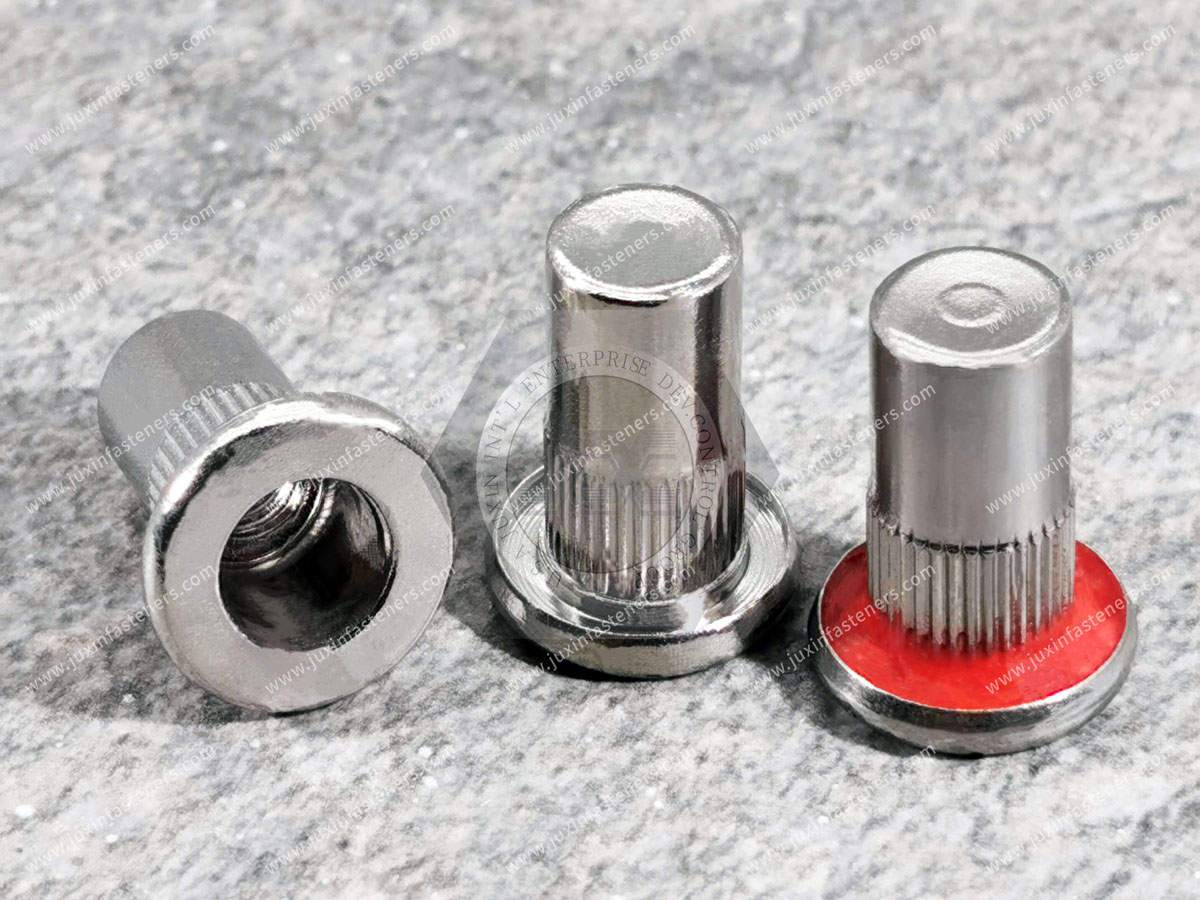
1. Engineering Value of Rivet Nut Fasteners in Industrial Applications
Rivet nuts and blind rivet nut systems are designed to solve one of the most common manufacturing challenges: creating durable threaded connections in thin materials such as aluminum, plastic, and sheet metal.
Key advantages of rivet nut fasteners:
Single-sided installation (no rear access required)
Weld-free fastening for heat-sensitive materials
High torque resistance and load-bearing capacity
Reusable internal threads
Excellent vibration resistance in dynamic environments
Suitable for automated mass production lines
These characteristics make automotive rivet nut fastening systems a preferred solution for modern lightweight engineering design.
2. Case Study 1 – Automotive EV Battery Housing Rivet Nut Solution
In new energy vehicle manufacturing, EV battery housing fastening systems require high strength, thermal stability, and precision assembly.
Engineering Challenge:
Traditional welding of aluminum battery housings often causes:
Thermal deformation
Dimensional instability
Reduced structural accuracy
Rivet Nut Solution:
The process was replaced with an M6 stainless-steel rivet-nut fastening system for EV battery enclosures.
Material: Stainless steel rivet nut (M6 specification)
Installation method: Pneumatic clinching tool
Installation time: ~8 seconds per point
Engineering Benefits:
Eliminates welding-induced deformation
Improves structural precision of battery casing
Enables fast, repeatable automated assembly
Enhances vibration resistance for EV applications
This demonstrates why automotive blind rivet nuts for battery housing systems are becoming a standard solution in electric vehicle manufacturing.
3. Case Study 2 – Home Appliance Housing Fastening System
In HVAC and appliance manufacturing, assembly efficiency and material integrity are critical.
Engineering Challenge:
Air conditioning housings made of plastic often suffer from:
Thread stripping when using self-tapping screws
Low assembly repeatability
Long production cycle times
Rivet Nut Solution:
The manufacturer adopted a blind rivet nut fastening system for appliance housings, combining plastic enclosures with metal brackets.
Key Improvements:
30% reduction in assembly time
Eliminates plastic thread damage
Enables pre-installed threaded inserts for automation
Improves structural stability of housing assemblies
This application highlights the advantages of rivet nuts for plastic-and-metal hybrid assembly systems in appliance manufacturing.
4. Case Study 3 – Rail Transit Interior Rivet Nut Applications
In rail transit manufacturing, interior components require lightweight, safe, and vibration-resistant fastening systems.
Application Scenario:
Luggage racks in train carriages
Interior panel mounting systems
Cabin structural accessories
Rivet Nut Solution:
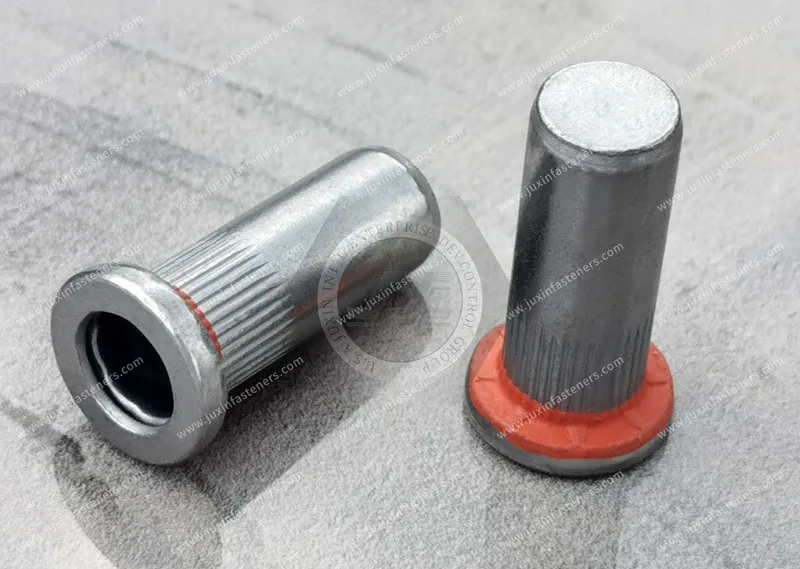
Anti-rotation hexagonal rivet nuts for rail transit interior systems were implemented.
Engineering Performance:
Hexagonal structure prevents rotation during installation
Compatible with pneumatic riveting tools
Production efficiency: up to 1,200 connection points per day
Labor cost reduction: approximately 40% compared to welding systems
This proves the effectiveness of rail transit rivet nut fastening systems for high-volume assembly environments.

5. Engineering Guidelines for Rivet Nut Applications
To ensure optimal performance of blind rivet nut fastening systems, the following engineering principles should be applied:
5.1 Specification Matching
Rivet nut size must match base material thickness
Material selection must consider load and corrosion conditions
Correct thread size ensures long-term reliability
5.2 Installation Force Control
Use calibrated pneumatic or hydraulic installation tools
Avoid excessive clinching force to prevent substrate damage
Ensure consistent deformation during installation
Proper force control is critical to the quality assurance of automotive rivet nut installations.
5.3 Batch Production Optimization
For high-volume manufacturing:
Use positioning fixtures for alignment accuracy
Standardize installation parameters
Implement automated or semi-automated riveting systems
This improves consistency in industrial rivet nut assembly operations.
6. Industry-Wide Benefits of Rivet Nut Fastening Systems
Across automotive, appliance, and rail transit industries, rivet nut fasteners provide measurable engineering and economic benefits:
Faster assembly cycles in production lines
Reduced rework caused by thread failure
Improved lightweight structural design capability
Lower maintenance and replacement costs
Higher reliability under vibration and dynamic loads
These advantages make blind rivet nuts a key fastening technology for modern manufacturing systems.
7. JUXIN FASTENERS Rivet Nut Solutions
As a professional manufacturer of high-performance rivet nuts and threaded insert fastening systems, JUXIN FASTENERS provides engineered solutions for:
Automotive EV battery systems
Appliance housing and structural assemblies
Rail transit interior and structural fastening systems
Custom OEM rivet nut solutions
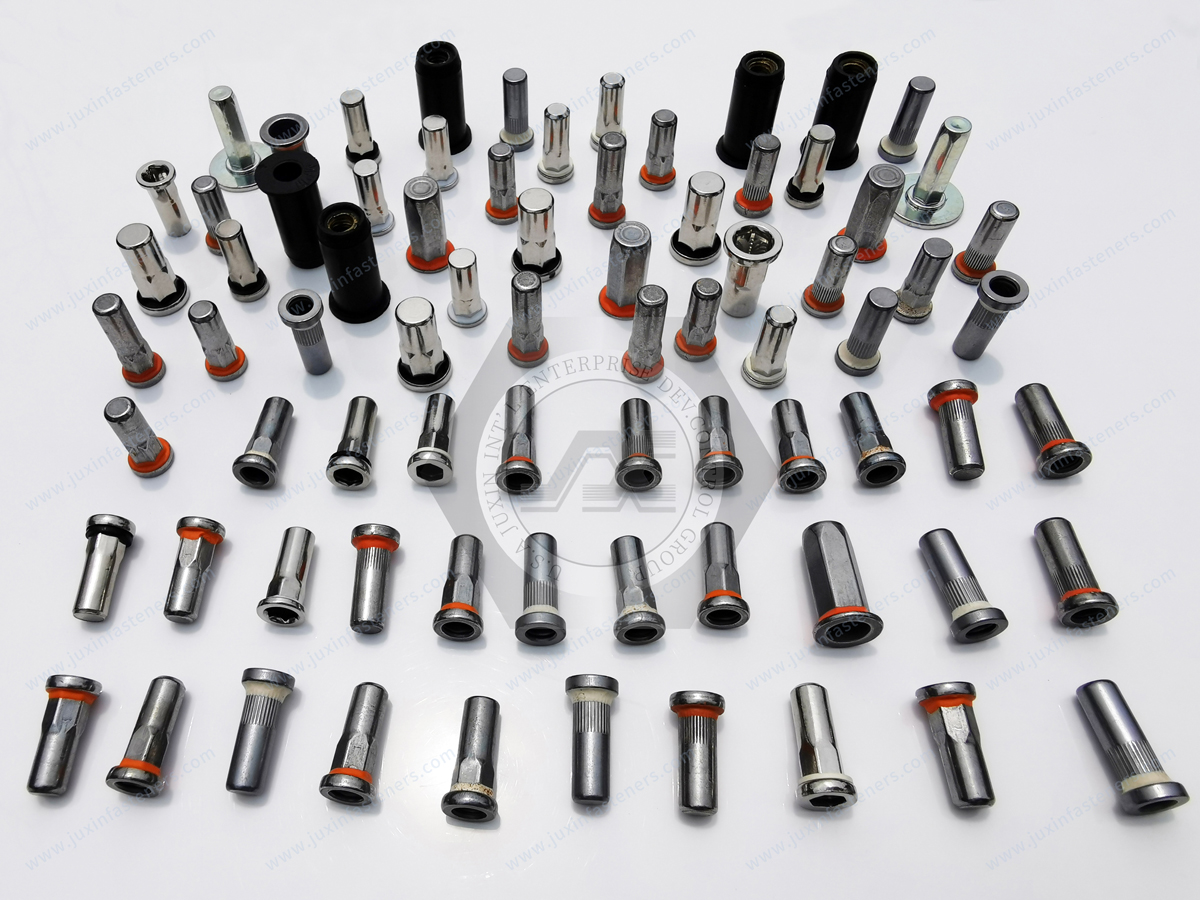
Our product range includes:
Stainless steel rivet nuts (M3–M12)
Hexagonal anti-rotation rivet nuts
Countersunk and flat head rivet nuts
Structural blind rivet nut systems
Custom-designed threaded insert solutions
All products are manufactured under strict quality systems to ensure consistent performance in demanding industrial environments.
Conclusion
Rivet nut fasteners and blind rivet nut systems provide a highly efficient, weld-free, and vibration-resistant fastening solution for automotive, appliance, and rail transit industries. Their ability to create strong, threaded connections in thin materials makes them essential for modern, lightweight, and automated manufacturing.
By adopting advanced rivet nut fastening technology, manufacturers can significantly improve production efficiency, reduce assembly costs, and enhance long-term structural reliability across a wide range of industrial applications.
Product Packaging
Packaging Standard
At Juxin Fasteners, we apply standardized export packaging to ensure product protection, traceability, and compliance with international logistics requirements.
1. Standard Export Packaging
Unless otherwise specified, all products will be packed according to our factory standard export packaging, which includes:
Moisture-resistant inner protection
Poly bag or small box packing as required
Reinforced export cartons
Clear labeling with part number, specification, batch number, and quantity
Palletizing for sea or air shipment when necessary
Our standard packaging is designed to ensure safe transportation, efficient warehousing, and long-distance international shipping.
2. Customized Packaging Options
We also provide customized packaging solutions according to customer requirements, including but not limited to:
Private labeling
Customized barcodes
Specific carton dimensions
Retail packaging
Special pallet configuration
Customer-specific marking and identification
So that you know, customized packaging may involve additional costs and extended lead time depending on the complexity of the requirements.
3. Compliance & Quality Assurance
All packaging processes are controlled under our ISO 9001 quality management system to ensure consistency, traceability, and product integrity throughout the supply chain.
Product Pictures
Contact Us
Tel.:
+86 020 8621 0320
+86 020 3121 6067
E-mail:
Technical Support:
Navigation
SEND INQUIREY