Call Us
+86 136 6007 9809
Call Us
+86 136 6007 9809

Rivet Nuts and Fastener Solutions for New Energy Vehicle (NEV) Manufacturing Industry
Lightweight, High-Strength, Corrosion-Resistant Fastening Systems for EV Battery, Chassis & E-Drive Applications
The new energy vehicle (NEV) manufacturing industry is rapidly shifting from scale-driven expansion to high-quality, safety-oriented, and technology-intensive development. With increasing requirements for vehicle lightweighting, battery safety, and reliability of the “Three Electric Systems” (battery, motor, and electronic control), traditional fastening methods are no longer sufficient for modern EV engineering demands.
In this context, rivet nuts and advanced fastener solutions for NEV manufacturing have become a core enabling technology for body structures, battery trays, motor systems, thermal management modules, and electronic assemblies.
Product Specification
Rivet Nuts and Fastener Solutions for New Energy Vehicle (NEV) Manufacturing Industry
Lightweight, High-Strength, Corrosion-Resistant Fastening Systems for EV Battery, Chassis & E-Drive Applications
The new energy vehicle (NEV) manufacturing industry is rapidly shifting from scale-driven expansion to high-quality, safety-oriented, and technology-intensive development. With increasing requirements for vehicle lightweighting, battery safety, and reliability of the “Three Electric Systems” (battery, motor, and electronic control), traditional fastening methods are no longer sufficient for modern EV engineering demands.
In this context, rivet nuts and advanced fastener solutions for NEV manufacturing have become a core enabling technology for body structures, battery trays, motor systems, thermal management modules, and electronic assemblies.
1. Industry Background and Engineering Challenges in NEV Fastening Systems
Modern electric vehicles operate under complex conditions, including:
High-frequency vibration from electric drivetrains
Shock loads during acceleration and braking
Battery thermal cycling and temperature extremes
Exposure to humidity, water ingress, and electrolyte corrosion
Lightweight structural design requirements
Traditional welding and threaded fasteners often suffer from:
Preload loss and loosening under vibration
Thermal deformation in aluminum structures
High maintenance complexity
Poor compatibility with thin-wall materials
These limitations create a strong demand for high-performance rivet nut fastening systems for new energy vehicles.
2. System Solutions: Rivet Nuts for NEV Lightweight Engineering
To meet the structural and performance requirements of electric vehicle platforms, we provide modular NEV rivet nut and fastener solutions designed for multi-material, high-integration architectures.
2.1 Lightweight Structural Rivet Nut Design for EV Platforms
Lightweight rivet nut systems for NEV manufacturing are developed using:
Aluminum alloy rivet nuts
High-strength stainless steel rivet nuts
Titanium alloy fasteners (advanced applications)
Hollow weight-reduction structural design
Topology-optimized geometry
Engineering Benefits:
5%–8% weight reduction in BIW and battery pack structures
High strength-to-weight ratio
Compatibility with aluminum and composite EV platforms
Improved energy efficiency through lightweight design
2.2 Anti-Loosening and High-Vibration Resistance Systems
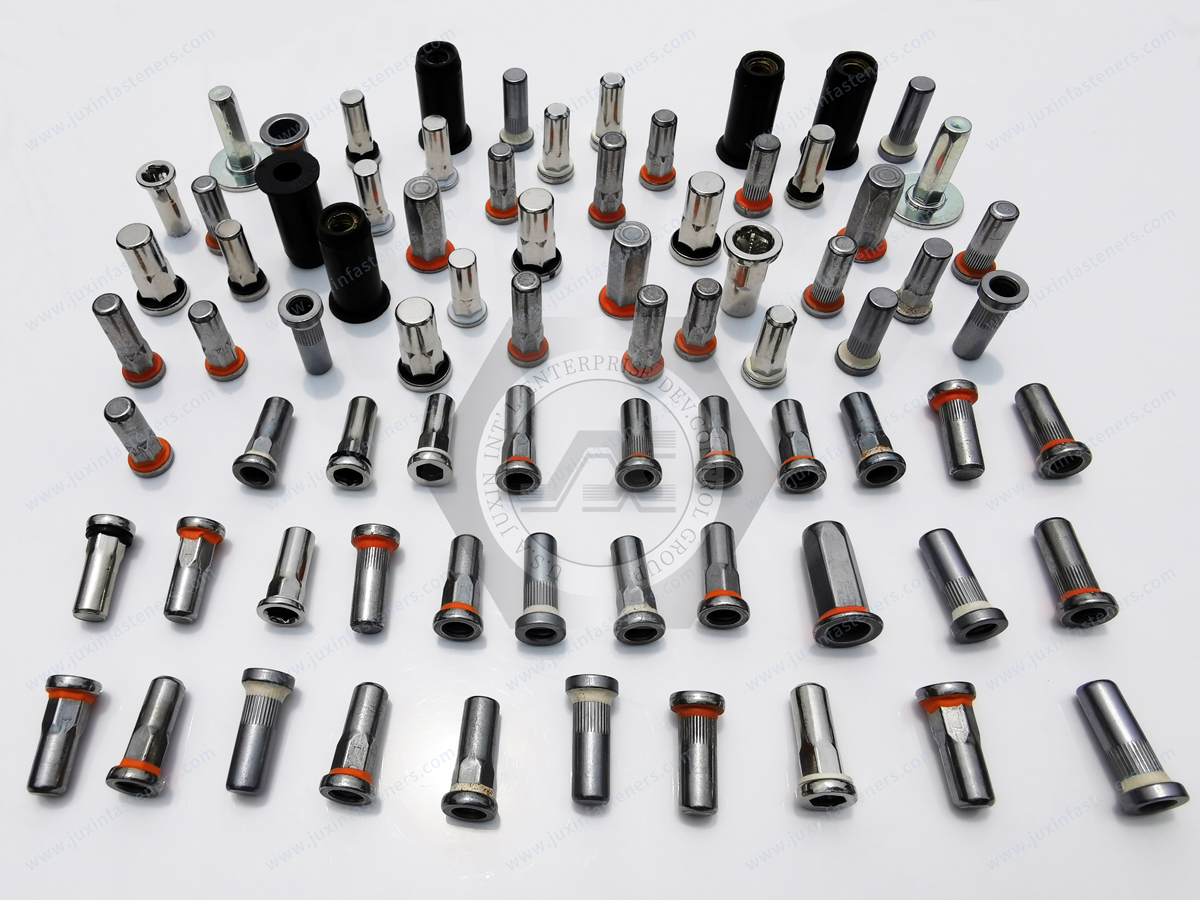
Electric vehicles generate continuous vibration from motor systems and road conditions. To ensure reliability, we integrate advanced anti-loosening rivet nut fastener systems for EV applications:
Nylon insert locking structures
Metal deformation locking systems
Wedge-locking mechanisms
Performance Advantages:
Prevents loosening under high-frequency vibration
Ensures stability in battery packs and e-drive systems
Maintains preload consistency throughout vehicle lifecycle
Enhances chassis and structural reliability
2.3 Corrosion Resistance and Sealing Protection for Battery Systems
NEV battery environments require exceptional resistance to:
Electrolyte leakage
Humidity and water ingress
Salt spray corrosion
We provide corrosion-resistant rivet nuts for EV battery systems with:
Dacromet coating
Zinc-nickel alloy plating
PTFE composite surface treatment
Key Benefits:
Over 1,000-hour salt spray resistance
Improved electrical insulation performance
Enhanced sealing protection for battery enclosures
Long-term durability in harsh environments
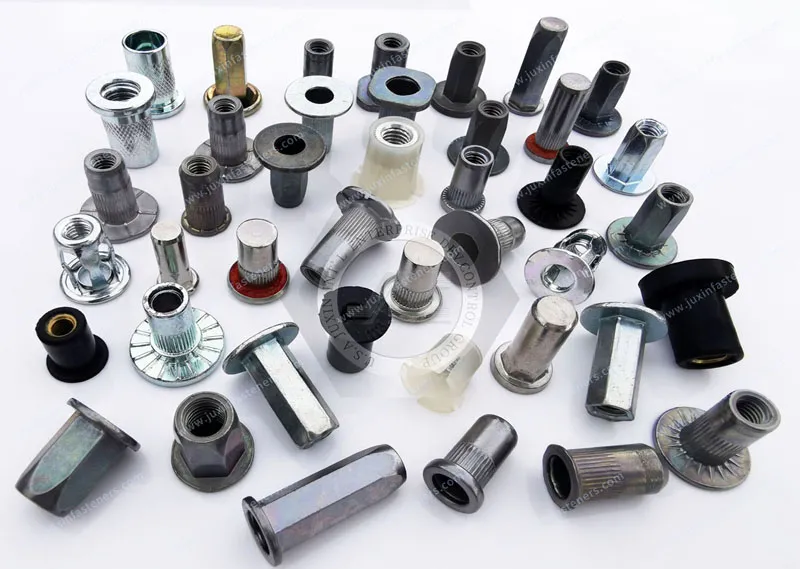
2.4 Standardized Rivet Nut Product Matrix for EV Platforms
To support multi-platform EV production, we offer a standardized system:
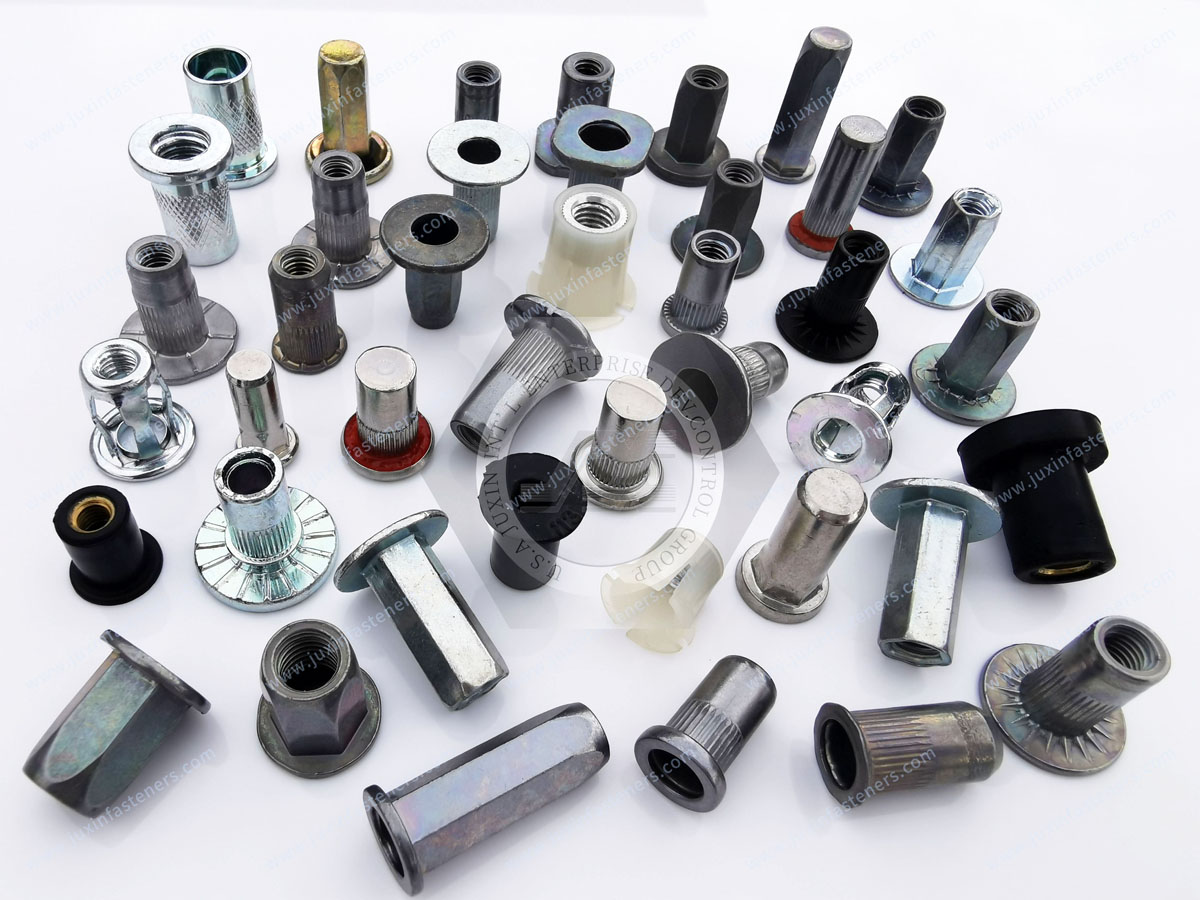
Rivet nut sizes: M3–M12
Blind-hole and through-hole configurations
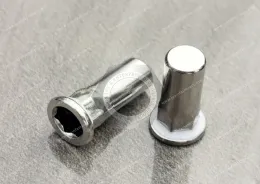
Hexagonal anti-rotation designs
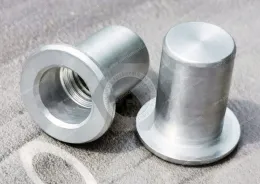
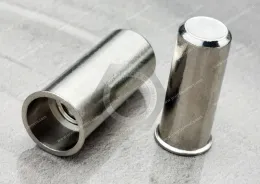
Cylindrical general-purpose designs
Engineering Advantages:
Compatible with mixed-model EV production
Supports rapid R&D and validation cycles
Reduces platform integration complexity
Enables scalable OEM manufacturing
3. Key Materials and Advanced Manufacturing Technologies
3.1 Material Engineering for NEV Fasteners
We provide optimized material systems for different EV applications:
Grade 10.9 high-strength alloy steel rivet nuts → structural load-bearing components
304 / 316L stainless steel fasteners → corrosion-critical environments
Duplex stainless steel → extreme corrosion and durability applications
Aerospace-grade aluminum alloys → lightweight non-structural parts
3.2 Precision Forming and Quality Control
Advanced manufacturing processes ensure high consistency:
Multi-station cold heading
Precision thread rolling technology
CCD optical full inspection systems
Inline dimensional monitoring
Result:
Stable torque performance
Reduced assembly variation
Zero-defect quality control before shipment
3.3 Eco-Friendly Surface Treatment Technologies
Aligned with EV sustainability requirements:
Chrome-free passivation
Micro-arc oxidation
Nano-ceramic coatings
Compliance Benefits:
RoHS / REACH compliance
Reduced carbon footprint
Environmentally friendly manufacturing
Improved long-term corrosion resistance
4. EV Assembly Process and Automation Integration
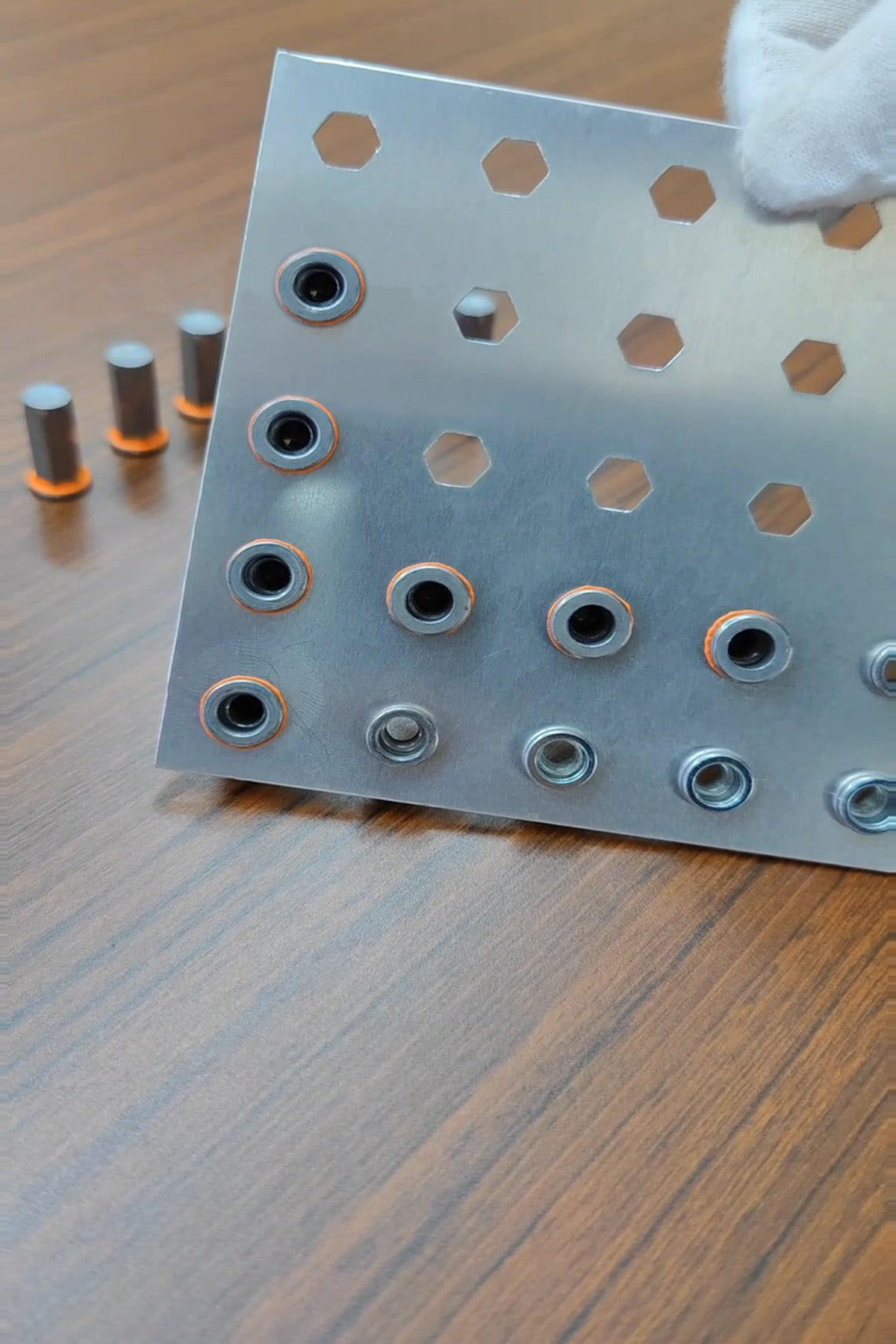
4.1 Single-Sided Installation for Battery & BIW Production
Rivet nut fasteners for NEV assembly systems enable:
Blind-hole single-sided installation
No welding required
No rear-side access needed
Faster BIW and battery pack assembly
When integrated with servo-electric riveting tools:
Real-time torque control
Digital process traceability
Higher production efficiency
4.2 Smart Manufacturing and MES Integration
Advanced production systems support:
RFID-based fastener tracking
MES system integration
Batch-level traceability
Station-level quality monitoring
Benefits:
Closed-loop quality control
Reduced assembly errors
Improved production transparency
4.3 Process Validation and Engineering Testing
All EV rivet nut fastening systems undergo:
Tensile strength testing
Shear load testing
Vibration fatigue testing
Thermal cycling validation
CAE simulation optimization
This ensures stable performance across the full vehicle lifecycle.
5. Supply Chain Collaboration and Quality Assurance
5.1 Vertically Integrated Manufacturing System
We maintain full control over:
Raw material processing
Cold heading production
Heat treatment systems
Surface finishing processes
Advantages:
Stable supply chain
Reduced external dependency
Consistent product quality
Reliable delivery performance
5.2 Digital Quality Traceability System
Using IoT and data integration technologies:
Full production lifecycle tracking
One-click batch traceability
IATF 16949 compliance support
OEM audit readiness
5.3 OEM & Tier 1 Co-Development Platform
We support joint development with:
EV OEM manufacturers
Battery system suppliers
Tier 1 automotive suppliers
Applications:
CTB (Cell-to-Body) battery structures
CTC (Cell-to-Chassis) platforms
Integrated die-cast EV bodies
This significantly reduces time-to-market for new EV platforms.
6. Future Trends in EV Fastener Technology
The next generation of rivet nut solutions for NEV manufacturing will evolve toward:
Lightweight composite fasteners
Self-sensing smart fasteners (stress & temperature monitoring)
Fully digital fastening systems
Zero-carbon manufacturing processes
AI-driven quality prediction systems
These innovations will redefine fastening systems in electric mobility.
Conclusion
Rivet nuts and fastener solutions for new energy vehicle manufacturing play a critical role in enabling lightweight structures, battery safety, vibration resistance, and long-term reliability.
Through advanced materials, anti-loosening engineering, corrosion-resistant coatings, and integration with digital manufacturing, modern NEV rivet nut fastening systems provide a complete solution for EV body structures, battery systems, and electric drivetrains.
As the NEV industry continues to evolve toward smarter, lighter, and more integrated architectures, high-performance rivet nut systems will remain a foundational technology driving the future of electric mobility.
Product Packaging
Packaging Standard
At Juxin Fasteners, we apply standardized export packaging to ensure product protection, traceability, and compliance with international logistics requirements.
1. Standard Export Packaging
Unless otherwise specified, all products will be packed according to our factory standard export packaging, which includes:
Moisture-resistant inner protection
Poly bag or small box packing as required
Reinforced export cartons
Clear labeling with part number, specification, batch number, and quantity
Palletizing for sea or air shipment when necessary
Our standard packaging is designed to ensure safe transportation, efficient warehousing, and long-distance international shipping.
2. Customized Packaging Options
We also provide customized packaging solutions according to customer requirements, including but not limited to:
Private labeling
Customized barcodes
Specific carton dimensions
Retail packaging
Special pallet configuration
Customer-specific marking and identification
So that you know, customized packaging may involve additional costs and extended lead time depending on the complexity of the requirements.
3. Compliance & Quality Assurance
All packaging processes are controlled under our ISO 9001 quality management system to ensure consistency, traceability, and product integrity throughout the supply chain.
Product Pictures
Contact Us
Tel.:
+86 020 8621 0320
+86 020 3121 6067
E-mail:
Technical Support:
Navigation
SEND INQUIREY