Call Us
+86 136 6007 9809
Call Us
+86 136 6007 9809

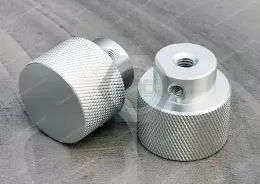
Juxin Fasteners manufactures custom aluminum hex flange nuts with side-drilled M3 threaded holes for radial set screws.
Originally developed for an automotive manufacturing customer, these lightweight precision nuts combine an integral bearing flange, central machine thread and secondary locking-screw provision.
Metric M2–M8 sizes and custom UNC/UNF configurations can be evaluated according to OEM drawings.
Aluminum alloy selection, CNC machining, anodized or PVD finishes, dimensional inspection and batch production are supported subject to engineering review.
Product Specification
Custom Aluminum Hex Flange Nuts with M3 Radial Set Screw – Automotive OEM Manufacturing
Juxin Fasteners manufactures custom aluminum hex flange nuts with a secondary M3 radial threaded hole for automotive OEM applications.
Originally developed for an automotive manufacturing customer, this specialized fastener combines a lightweight aluminum alloy body,
an integral circular flange, a central machine thread and a transverse threaded hole designed to accommodate an M3 set screw.
Unlike conventional aluminum hex flange nuts, this design incorporates a secondary radial fastening feature that can be used to create a controlled locking or positioning interface when correctly engineered.
Also described as custom aluminum flange nuts with side set screws, radial set screw flange nuts and precision-machined automotive flange nuts,
these components are manufactured according to customer-specific drawings rather than a single universal dimensional standard.
Juxin Fasteners supports OEM and ODM manufacturing, CNC machining, cold forming where suitable, custom surface finishes and repeat-order batch production.
Product Design – Aluminum Hex Flange Nut with Radial M3 Threaded Hole
The product features three principal structural elements.
Integral Hexagonal Nut Body
The hexagonal body provides wrench engagement for installation and removal.
Across-flats dimensions, overall height and chamfer geometry can be defined according to the approved engineering drawing.
Circular Bearing Flange
The integral flange increases the contact area against the mating component compared with a conventional hex nut without a flange.
This can help distribute compressive loading over a larger surface.
The flange geometry must be selected according to the supporting material, joint loading and required installation clearance.
M3 Radial Set Screw Hole
A secondary threaded hole is machined radially through the side of the nut body.
This hole is designed to accept an M3 set screw.
Depending on the mating component geometry, the set screw may contact a threaded stud, shaft, specially prepared flat or other designated locking surface.
The radial hole location, thread depth and set screw engagement must be specified on the OEM drawing.
The actual locking performance depends on the set screw design, contact geometry, tightening torque and application conditions.
Key Product Features
Lightweight aluminum alloy construction.
Integral hexagonal body and circular flange.
Central internal machine thread.
Secondary M3 radial threaded hole.
Provision for a separately installed set screw.
Drawing-based custom dimensions.
CNC-machined secondary features.
Corrosion-resistant finish options.
Polished, anodized or PVD surface finish evaluation.
Metric and custom Unified inch thread configurations.
OEM batch manufacturing for automotive applications.
Technical Specifications – Custom Aluminum Flange Nuts
| Specification | Product Details |
|---|---|
| Product Type | Custom Aluminum Hex Flange Nut |
| Primary Application | Automotive OEM Manufacturing |
| Material | Aluminum Alloy |
| Main Body | Hexagonal |
| Flange | Integral Circular Flange |
| Main Internal Thread | Metric / Drawing-Based Inch Thread |
| Secondary Thread | M3 Radial Threaded Hole |
| Radial Thread Reference | M3 × 0.5 |
| Metric Product Range | M2–M8, Configuration Subject to Confirmation |
| Inch Options | UNC / UNF by Engineering Review |
| Surface Finishes | Polishing, Anodizing, PVD as Specified |
| Manufacturing | CNC Machining / Suitable Forming Processes |
| Customization | Main Thread, Flange, Hex Body, Radial Hole and Finish |
| Inspection | Drawing-Based Dimensional and Thread Inspection |
| Supply Model | OEM / ODM Batch Manufacturing |
The final material grade, dimensions, thread tolerances, surface treatment and mechanical requirements must be confirmed against the approved customer drawing.
Metric Thread Specifications – M2 to M8
The following metric thread sizes are relevant to the aluminum flange nut product family.
| Metric Thread | Nominal Diameter | Coarse Pitch | Inch Diameter Reference |
|---|---|---|---|
| M2 × 0.4 | 2 mm | 0.4 mm | 0.0787 in |
| M2.5 × 0.45 | 2.5 mm | 0.45 mm | 0.0984 in |
| M3 × 0.5 | 3 mm | 0.5 mm | 0.1181 in |
| M4 × 0.7 | 4 mm | 0.7 mm | 0.1575 in |
| M5 × 0.8 | 5 mm | 0.8 mm | 0.1969 in |
| M6 × 1.0 | 6 mm | 1.0 mm | 0.2362 in |
| M8 × 1.25 | 8 mm | 1.25 mm | 0.3150 in |
These sizes describe the broader product family. The available size combinations for this particular M3 radial-hole design must be confirmed against manufacturing drawings.
The inch measurements are nominal diameter references only and do not indicate equivalent Unified thread sizes.
M3 Radial Thread – Secondary Locking Feature
The radial threaded hole is a distinguishing feature of this custom automotive fastener.
For a standard coarse M3 thread, the nominal thread designation is M3 × 0.5.
Important engineering parameters include:
Radial hole position.
Thread depth.
Distance from the main internal thread.
Remaining wall thickness.
Set screw length.
Set screw tip configuration.
Set screw material.
Installation torque.
Contact surface geometry.
Resistance to loosening.
Reusability requirements.
The radial threaded hole should not be assumed suitable for every nut size.
For smaller main-thread configurations, the available wall thickness may be insufficient for an M3 radial hole without substantial changes to the nut body.
Each size requires separate geometric and mechanical verification.
How the Radial Set Screw Works
A compatible set screw is installed through the side of the nut body.
When tightened, its tip applies localized contact force to the designated mating surface.
Depending on the design, this may help restrict relative movement between the nut and the mating component.
Possible functions include:
Supplementary rotational restraint.
Component positioning.
Controlled adjustment retention.
Secondary mechanical locking.
Retention of a specified mating component.
The radial set screw does not automatically make the nut a certified prevailing-torque locknut.
Locking performance must be verified through appropriate testing.
Set Screw Contact Geometry
The type of set screw tip influences the contact behavior.
Potential configurations include:
Flat-point set screws.
Cup-point set screws.
Cone-point set screws.
Nylon-tip set screws.
Custom contact-tip designs.
The appropriate design depends on the mating material, allowable surface damage and required retention.
Direct contact with a threaded fastener can damage its threads or affect future removal.
Where repeatability or surface protection is important, a prepared contact flat, protective tip or alternative locking arrangement may be required.
Aluminum Alloy Selection for Automotive Fasteners
Aluminum alloys offer lower density than steel and can provide useful corrosion resistance when selected and finished appropriately.
For custom automotive flange nuts, material selection should consider:
Mechanical strength.
Thread stripping resistance.
Fatigue behavior.
Corrosion exposure.
Machinability.
Surface treatment compatibility.
Thermal expansion.
Galvanic corrosion risk.
Production cost.
Aluminum 6061 and other machinable aluminum alloys may be evaluated for drawing-based manufacturing.
The exact alloy and temper must be specified by the customer or approved during engineering review.
No universal strength rating should be assumed for an unspecified aluminum alloy.
Lightweight Design for Automotive OEM Applications
Weight reduction is an important consideration in automotive component design.
Aluminum has substantially lower density than conventional carbon steel.
Replacing a steel fastener with an aluminum design may reduce component mass, but the complete connection must still satisfy the required strength, durability and service conditions.
The aluminum nut should not be treated as a direct mechanical replacement for a steel nut without engineering validation.
Surface Finish Options – Polishing, Anodizing and PVD
Juxin Fasteners can evaluate different surface finishes according to the customer drawing.
Polished Aluminum
Polishing can improve surface appearance and reduce visible machining marks.
A polished surface alone does not establish a specified corrosion-resistance rating.
Silver Anodized Aluminum
Anodizing creates a controlled oxide layer on suitable aluminum alloys.
The coating may improve corrosion resistance and surface durability when correctly specified.
Silver or natural anodized finishes are relevant to applications requiring a metallic appearance.
Colored Anodized Aluminum
The broader aluminum flange nut product family may be manufactured in various decorative colors.
Potential color specifications include:
Green.
Titanium Grey.
Silver.
Gold.
Fuchsia.
Sky Blue.
Royal Blue.
Orange.
Black.
Purple.
Wine Red.
Color availability depends on the selected alloy, anodizing process and approved appearance requirements.
Color consistency should be evaluated using approved samples where necessary.
PVD Surface Coating
Physical Vapor Deposition may be considered for selected custom designs requiring particular surface properties or appearance.
PVD coating compatibility, adhesion and dimensional effects must be evaluated for the specified aluminum alloy.
Polishing, anodizing and PVD are separate processes and should not be described as one interchangeable surface treatment.
Corrosion Resistance and Galvanic Compatibility
Aluminum alloys can provide useful corrosion resistance, particularly when combined with suitable surface protection.
However, corrosion performance depends on alloy composition, finish, exposure conditions and contact with other metals.
In automotive assemblies, galvanic corrosion may occur when aluminum contacts dissimilar metals in the presence of an electrolyte.
Engineering evaluation should consider:
Aluminum alloy selection.
Mating bolt material.
Set screw material.
Surface treatment.
Moisture exposure.
Road salt exposure.
Electrical contact between dissimilar metals.
Protective coatings and isolation methods.
Corrosion resistance must be verified against the actual service environment.
Automotive OEM Applications
This custom aluminum flange nut was developed for an automotive manufacturing application.
Its radial M3 set screw feature makes it relevant to specialized mechanical connections where a conventional flange nut may not provide the required positioning or retention function.
Potential applications include:
Automotive Mechanical Assemblies
Custom threaded connections in automotive mechanisms requiring controlled positioning or secondary retention.
Lightweight Mounting Components
Weight-sensitive assemblies where an aluminum fastener can meet the required mechanical performance.
Adjustment and Positioning Mechanisms
Components requiring a secondary screw to retain an adjusted position.
Automotive Interior Mechanisms
Selected interior equipment assemblies where compact dimensions and low component mass are important.
Electric Vehicle Auxiliary Components
Noncritical brackets, housings and equipment interfaces where a custom aluminum fastening design has been approved.
Motorsport and Performance Vehicle Components
Custom assemblies where lightweight materials, precision machining and application-specific geometry are required.
These are potential engineering applications rather than claims that this exact part has been qualified for every listed use.
Safety-critical automotive applications require specific design approval, validation and production controls.
Engineering Considerations for Automotive Design Engineers
Main Thread Engagement
The primary internal thread must provide sufficient engagement with the mating bolt or stud.
Aluminum thread strength depends on alloy, temper, thread dimensions and effective engagement length.
Radial Hole Position
The radial hole location influences the remaining wall thickness and interaction with the main thread.
The design must avoid unacceptable weakening of the nut body.
Flange Diameter
The flange diameter influences the available bearing area and clearance around the joint.
Hex Across-Flats Dimension
The hex dimensions must be compatible with the installation tool and available assembly space.
Set Screw Tightening Torque
The radial set screw torque must be defined to provide the required contact force without damaging the aluminum threads or mating component.
Main Nut Tightening Torque
Main nut tightening torque should be established through joint testing, considering material strength, friction conditions and the effect of the secondary radial hole.
Vibration Resistance
Any claimed anti-loosening performance must be demonstrated through testing appropriate to the actual joint configuration.
Fatigue Performance
The radial hole may create a local stress concentration. Cyclic loading should be evaluated where relevant.
Thermal Expansion
Aluminum and steel have different thermal expansion characteristics.
Temperature variation may influence joint preload and radial screw contact conditions.
Aluminum Flange Nuts vs. Nylon-Insert Flange Lock Nuts
These two product types use different locking principles.
| Feature | Custom Radial Set Screw Nut | Nylon-Insert Flange Lock Nut |
|---|---|---|
| Main Body | Aluminum Hex Flange | Hex Flange |
| Locking Feature | Radial Set Screw | Nonmetallic Insert |
| Secondary Hole | Yes, M3 in This Design | Not Normally Required |
| Locking Mechanism | Contact-Based, Design-Dependent | Prevailing Torque from Insert |
| Standardization | Custom Drawing | Defined Standard Designs Available |
| Engineering Validation | Application-Specific | According to Relevant Standard and Application |
The radial set screw design should not be described as equivalent to a nylon-insert prevailing-torque nut.
Applicable Standards and Drawing Requirements
This product is a customer-specific engineered fastener.
Standards such as ISO 7043 and ISO 12125 address particular prevailing-torque flange nut designs with nonmetallic inserts and do not directly define this radial set screw configuration.
DIN EN 1666 and other flange nut standards may provide dimensional references for certain conventional flange nut geometries, but conformity cannot be assumed for this custom part.
Relevant engineering references may include:
ISO metric thread specifications.
ASME B1.1 for Unified inch threads.
ISO 3506 where applicable to stainless steel mating fasteners.
ASTM B117 for specified salt spray testing.
Customer-specific automotive drawings and inspection requirements.
The actual acceptance criteria must be defined by the approved OEM drawing and purchasing specification.
UNC and UNF Inch Thread Options for North American OEMs
Juxin Fasteners can evaluate custom inch-thread versions of aluminum flange nuts according to customer drawings.
Common Unified thread reference sizes include:
| Inch Thread | Series | Nominal Diameter | Threads per Inch |
|---|---|---|---|
| #6-32 | UNC | 0.1380 in | 32 |
| #8-32 | UNC | 0.1640 in | 32 |
| #10-24 | UNC | 0.1900 in | 24 |
| #10-32 | UNF | 0.1900 in | 32 |
| 1/4-20 | UNC | 0.2500 in | 20 |
| 1/4-28 | UNF | 0.2500 in | 28 |
| 5/16-18 | UNC | 0.3125 in | 18 |
| 5/16-24 | UNF | 0.3125 in | 24 |
These are reference thread designations, not a confirmed inventory list for this radial set screw design.
The feasibility of combining a particular inch main thread with an M3 radial hole must be evaluated separately.
Metric and Inch Thread Compatibility
Metric, UNC and UNF threads are not directly interchangeable.
For example:
M4 × 0.7 is not interchangeable with #8-32 UNC.
M5 × 0.8 is not interchangeable with #10-24 UNC.
M6 × 1.0 is not interchangeable with 1/4-20 UNC.
M8 × 1.25 is not interchangeable with 5/16-18 UNC.
Similar nominal diameters do not establish thread compatibility.
All custom drawings must identify the correct thread designation, pitch and tolerance.
Custom Manufacturing – Juxin Fasteners
Juxin Fasteners is an industrial fastener manufacturer supporting drawing-based OEM and ODM production.
Our manufacturing capabilities combine cold heading, cold forming, CNC machining and secondary metalworking operations.
For custom aluminum flange nuts with radial threaded holes, the manufacturing route is selected according to the approved geometry, alloy, production quantity and required tolerances.
CNC machining may be used to produce or finish:
Hexagonal body dimensions.
Circular flange geometry.
Main internal threads.
Radial M3 threaded holes.
Chamfers and edge features.
Custom recesses.
Precision locating surfaces.
Where technically and economically appropriate, suitable forming processes may be combined with secondary machining.
Drawing-Based Customization Options
Juxin Fasteners can evaluate:
Custom aluminum alloy grades.
Metric internal threads.
UNC and UNF internal threads.
M3 radial threaded holes.
Alternative radial thread sizes.
Special flange diameters.
Customized hex dimensions.
Special nut heights.
Custom chamfers.
Polished surfaces.
Anodized finishes.
PVD coating requirements.
Customer-specific dimensional tolerances.
Batch inspection and packaging requirements.
Custom configurations are subject to engineering and manufacturing feasibility review.
Quality Control and Inspection
Inspection requirements may include:
Main internal thread GO/NO-GO gauge inspection.
Radial M3 thread gauge inspection.
Radial hole position.
Radial hole depth.
Remaining wall thickness.
Hex across-flats dimensions.
Overall nut height.
Flange diameter and thickness.
Main thread concentricity.
Surface finish inspection.
Coating thickness where specified.
Material verification.
Drawing-based dimensional inspection.
Batch identification.
Automotive Application Validation
Depending on the OEM requirements, testing may include:
Main thread stripping resistance.
Radial thread stripping resistance.
Set screw tightening torque.
Set screw retention.
Main joint tightening performance.
Vibration resistance.
Fatigue performance.
Thermal cycling.
Corrosion testing.
Repeated installation and removal.
No fixed vibration rating, temperature range or locking torque should be claimed without test evidence for the approved design.
Production Engineering and Batch Manufacturing
For production managers and manufacturing engineers, important considerations include:
Repeatable radial hole positioning.
Consistent main thread quality.
Controlled machining tolerances.
Surface finish consistency.
Efficient inspection methods.
Compatible installation tools.
Controlled set screw installation.
Stable repeat-order dimensions.
Traceable drawing revisions.
Production quantity planning.
Juxin Fasteners supports manufacturing review to align custom fastener geometry with OEM assembly requirements.
International OEM Procurement and Supply
Juxin Fasteners supports international B2B customers requiring custom aluminum fasteners and precision metal components.
Our technical and commercial support is intended for:
Automotive design engineers.
Mechanical and structural engineers.
Manufacturing engineers.
Production managers.
Procurement development specialists.
Purchasing specialists.
Purchasing managers.
Supply chain managers.
For purchasing programs, important requirements include material grade, approved drawings, surface finish, dimensional tolerances, inspection criteria, production quantities and repeat-order consistency.
We support international OEM and Tier-1/Tier-2 manufacturing programs in North America, South America, Europe and other markets.
Frequently Asked Questions
What is a custom aluminum flange nut with a radial set screw?
It is an aluminum flange nut incorporating a secondary threaded hole through the side of its body for installation of a set screw.
What is the purpose of the M3 radial hole?
The M3 radial hole allows a compatible set screw to contact a designated mating component, providing a potential secondary locking or positioning function.
Does the M3 set screw make the nut vibration-proof?
No. Vibration resistance depends on the complete joint design, set screw contact geometry and validated installation conditions.
Is this the same as a nylon-insert flange lock nut?
No. A nylon-insert locknut uses a nonmetallic insert to generate prevailing torque. This product uses a separate radial set screw interface.
Can the M3 hole be used with every main thread size?
Not necessarily. Smaller nut sizes may lack sufficient wall thickness for the radial hole. Each configuration requires engineering verification.
Can aluminum flange nuts be anodized?
Yes, suitable aluminum alloys can be anodized. The coating requirements and color must be confirmed for the selected material.
Can Juxin Fasteners manufacture custom colors?
Juxin Fasteners can evaluate custom anodized colors and other surface finishes according to customer requirements and approved samples.
Are these aluminum flange nuts suitable for automotive applications?
This design originated from an automotive manufacturing requirement. Each new application must be evaluated against its specific mechanical, environmental and safety requirements.
Can Juxin Fasteners manufacture UNC and UNF versions?
Custom Unified inch-thread configurations can be evaluated according to the customer drawing and production requirements.
Are metric and inch threads interchangeable?
No. Metric, UNC and UNF threads have different dimensions and pitches and must not be directly substituted.
What information is required for an OEM quotation?
Please provide the 2D/3D drawing, aluminum alloy grade, main thread size, M3 radial hole location, flange dimensions, finish, inspection requirements and estimated production quantity.
Request an OEM Manufacturing Quote – Custom Aluminum Flange Nuts
Juxin Fasteners manufactures custom aluminum hex flange nuts with radial set screw holes for automotive OEM applications and other precision mechanical assemblies.
We support drawing-based manufacturing, custom material selection, precision CNC machining, secondary threaded features, surface finishing and repeat-order batch production.
For technical evaluation and quotation, please provide your approved drawings, material requirements, surface finish specifications and estimated annual purchasing quantity.
Manufacturer: Juxin Fasteners
Product: Custom Aluminum Hex Flange Nuts with M3 Radial Set Screw
Material: Aluminum Alloy, Grade According to Drawing
Main Thread: Metric / Custom UNC and UNF Options
Secondary Thread: M3 Radial Threaded Hole
Finish: Polishing, Anodizing or PVD According to Specification
Application: Automotive OEM and Custom Mechanical Assemblies
Manufacturing: OEM / ODM, CNC Machining and Drawing-Based Batch Production
Email: info@juxinfasteners.com
Website: www.juxinfasteners.com
Send your 2D/3D engineering drawings, technical specifications and estimated annual demand to request a custom aluminum flange nut manufacturing quotation from Juxin Fasteners.
Product Packaging
Packaging Standard
At Juxin Fasteners, we apply standardized export packaging to ensure product protection, traceability, and compliance with international logistics requirements.
1. Standard Export Packaging
Unless otherwise specified, all products will be packed according to our factory standard export packaging, which includes:
Moisture-resistant inner protection
Poly bag or small box packing as required
Reinforced export cartons
Clear labeling with part number, specification, batch number, and quantity
Palletizing for sea or air shipment when necessary
Our standard packaging is designed to ensure safe transportation, efficient warehousing, and long-distance international shipping.
2. Customized Packaging Options
We also provide customized packaging solutions according to customer requirements, including but not limited to:
Private labeling
Customized barcodes
Specific carton dimensions
Retail packaging
Special pallet configuration
Customer-specific marking and identification
So that you know, customized packaging may involve additional costs and extended lead time depending on the complexity of the requirements.
3. Compliance & Quality Assurance
All packaging processes are controlled under our ISO 9001 quality management system to ensure consistency, traceability, and product integrity throughout the supply chain.
Product Pictures


Contact Us
Tel.:
+86 020 8621 0320
+86 020 3121 6067
E-mail:
Technical Support:
Navigation
SEND INQUIREY