Call Us
+86 136 6007 9809
Call Us
+86 136 6007 9809

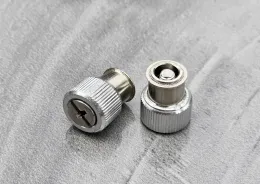
Captive panel screws solve a deceptively simple but important equipment-design problem: how can a removable panel be repeatedly opened and closed without turning its screws into loose parts?
Product Specification
Captive panel screws solve a deceptively simple but important equipment-design problem: how can a removable panel be repeatedly opened and closed without turning its screws into loose parts?
In AI server chassis, network equipment, electrical cabinets, semiconductor equipment, industrial machinery,
HVAC systems, medical equipment and other serviceable enclosures, a conventional machine screw becomes a separate component as soon as it is removed.
It can be dropped, misplaced, mixed with another screw size or left inside the equipment after maintenance.
A captive panel screw changes that service architecture. The screw remains mechanically retained by the removable panel even after its thread has disengaged from the mating member.
However, captivation alone does not determine whether a captive screw is correct for an assembly.
Engineers still need to evaluate the mounting method, host-panel material and thickness, mating thread, available travel, thread disengagement,
head and drive style, access clearance, alignment, surface finish, environment and maintenance sequence.
For procurement and supplier-development teams, the same product also creates another challenge: two captive panel fasteners that look similar may not be functionally interchangeable.
This guide explains how to move from the application problem to the correct captive panel screw architecture and then to a technically complete OEM RFQ.
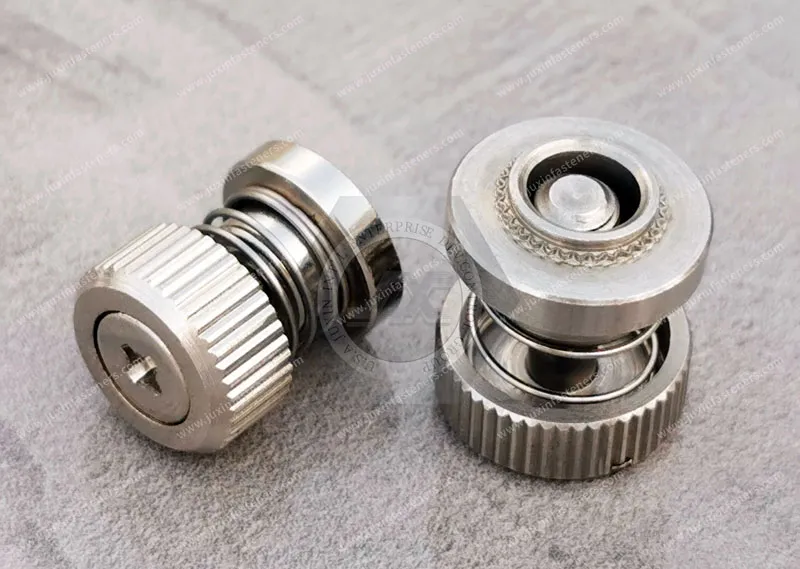
A captive panel screw is a threaded panel fastener designed to remain attached to a panel, cover, door or other removable component when its thread is disengaged from the mating structure.
A typical assembly combines several functional elements:
a screw or threaded member;
a retainer, sleeve or mounting body;
a mechanism that keeps the assembly attached to the host panel;
sufficient axial movement for engagement and disengagement;
a head, knob or drive interface;
and, in some designs, a spring or floating mechanism.
When the equipment is closed, the screw engages a mating thread and contributes to clamping the panel.
When the equipment is opened, the screw can disengage from the mating thread while remaining retained by the removable panel.
That distinction is fundamental:
Captive describes retention of the fastener to the panel. It does not automatically describe locking, sealing, grounding, vibration resistance or environmental protection.
Those functions must be evaluated separately.
A standard machine screw can be entirely appropriate for an assembly that is rarely opened and where loose hardware does not create a meaningful service problem.
Captive panel hardware becomes more valuable as maintenance frequency, equipment density, access difficulty or loose-part consequences increase.
Typical reasons for specifying captive panel screws include:
preventing screws from being lost during maintenance;
reducing the number of loose components handled by service personnel;
keeping the correct screw associated with the correct panel;
supporting repeated removal and reinstallation of covers;
reducing the possibility of hardware being left inside equipment;
simplifying service procedures;
supporting tool-operated or hand-operated access strategies;
and improving hardware management on modular equipment.
The engineering question should therefore not be simply:
“Do we need a captive screw?”
A better question is:
“What must happen to this fastener when the panel is opened, serviced, aligned and reinstalled?”
That question determines the architecture.
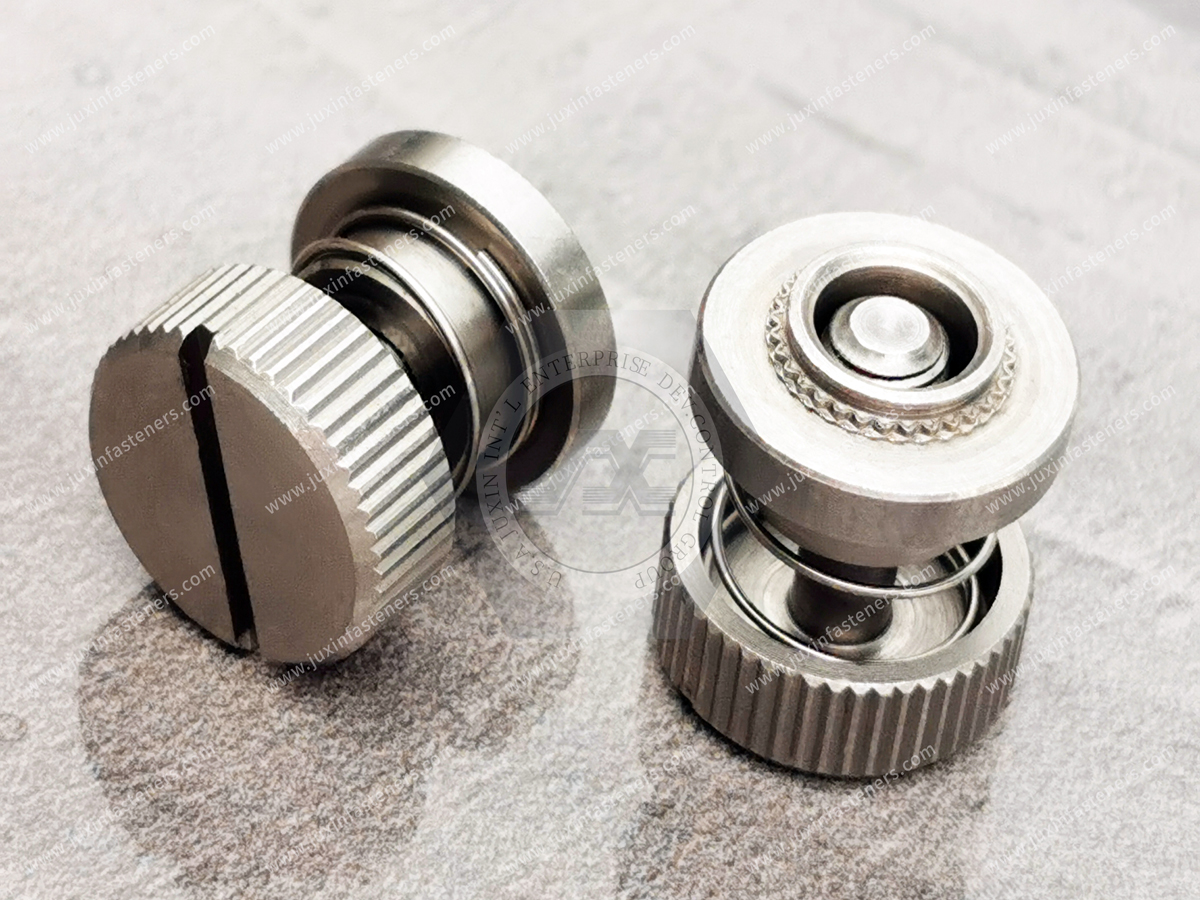
This distinction is particularly important when evaluating captive hardware.
The retainer-to-panel interface keeps the screw assembly attached to the removable panel.
The screw-to-mating-thread interface generates the threaded connection used to secure the panel.
These interfaces perform different jobs.
A captive screw can therefore remain successfully retained in its panel while the threaded joint itself is unsuitable for the intended clamp requirement.
Conversely, a suitable screw thread does not automatically mean the captivation method is compatible with the host panel.
Engineering review should consider both interfaces independently:
Panel → Retainer → Captivation
and
Screw → Mating Thread → Panel Clamping
This two-interface model is useful when troubleshooting installation problems, designing new equipment or qualifying a second-source captive fastener.
Captive panel hardware can use different methods to retain the assembly in the host panel. Three important architectures are self-clinching, flare-mounted and floating designs.
They should not be treated as interchangeable simply because the exposed screw head looks similar.
A self-clinching captive screw assembly is installed into a prepared panel opening using a press operation.
The retaining feature is designed so that compatible sheet material flows into the fastener's retention geometry during installation.
This architecture can be useful where the panel material, thickness, hardness, mounting-hole geometry and installation process are suitable for self-clinching attachment.
Key engineering checks include:
host-panel material;
sheet thickness;
sheet hardness;
mounting-hole size and quality;
distance from the mounting hole to nearby bends or edges;
installation tooling;
panel flatness;
surface finish condition;
and access for the installation operation.
The important procurement lesson is that thread size alone cannot define a self-clinching captive screw.
An M4 captive screw for one sheet configuration is not automatically interchangeable with another M4 captive screw if the retainer geometry, mounting hole, panel thickness or installed position differs.
A flare-mounted captive fastener uses a retainer geometry that is mechanically formed during installation to secure the assembly to the panel.
This architecture can be useful when the application is not suitable for conventional self-clinching attachment or when panel geometry, material,
hardness, edge distance or fabrication sequence favors a flared mounting approach.
Selection should consider:
panel material;
panel thickness;
required hole geometry;
forming access;
installation tooling;
backside condition after installation;
surrounding features;
finish condition;
and the required installed envelope.
Flare mounting should not automatically be described as “better for thin sheet” or “better for hard sheet” without reference to the specific fastener design.
The allowable panel conditions depend on the actual mounting geometry and supplier specification.
Floating captive fasteners introduce controlled lateral movement between the screw and its mounting structure.
Their purpose is generally not to make a poorly designed assembly acceptable.
Their value is to provide alignment accommodation where the mating hole or thread position can vary within the intended assembly tolerance.
This may be useful in:
large access panels;
multi-fastener covers;
long sheet-metal enclosures;
fabricated chassis;
service panels with multiple attachment points;
and assemblies where tolerance accumulation can make simultaneous thread engagement difficult.
The required float must be evaluated from the actual tolerance stack.
There is no universal float value that should be applied to every captive panel design.
Too little accommodation may fail to resolve misalignment.
Too much uncontrolled movement may create undesirable positioning behavior.
The correct amount therefore depends on the panel geometry, hole pattern, mating structure, fabrication tolerances and assembly sequence.
One of the most useful design questions is whether the captive screw needs to locate the panel or merely fasten it.
If separate features already establish panel position—such as locating pins, formed tabs, shoulders, guide rails or datum surfaces—the captive screw may primarily provide clamping.
In that situation, controlled float can help the screw find its mating thread without forcing the screw itself to correct panel-position error.
If the designer expects the screw to perform alignment, locating and clamping simultaneously, thread-start problems and cross-threading can become more likely when tolerances accumulate.
A useful design sequence is:
identify what features locate the panel;
identify what features carry service or structural loads;
determine what positional variation remains at the threaded attachment;
then decide whether fixed or floating captive hardware is appropriate.
This is more reliable than selecting a floating fastener simply because assembly is currently difficult.
Captivation and spring retraction are also different functions.
A basic captive screw can remain attached to the panel without automatically retracting when unthreaded.
A spring-loaded captive screw adds a spring mechanism that can move or hold the threaded member away from the mating interface after disengagement.
Manual captive screws may be appropriate where:
the panel can be easily pulled away after unthreading;
thread drag is not a significant concern;
the screw does not need to retract automatically;
internal clearance is sufficient;
and a simpler retained-screw architecture satisfies the service procedure.
Spring-loaded captive panel screws can be useful where automatic or assisted retraction improves panel removal.
Possible reasons include:
preventing the disengaged thread from dragging across a mating frame;
clearing the screw from a sliding panel path;
making disengagement visually or physically apparent;
supporting repeated equipment servicing;
or improving access where the technician cannot easily retract each screw manually.
However, spring-loaded does not automatically mean vibration-resistant.
The spring's function, travel, compressed condition, available clearance and interaction with the panel should be evaluated for the specific assembly.
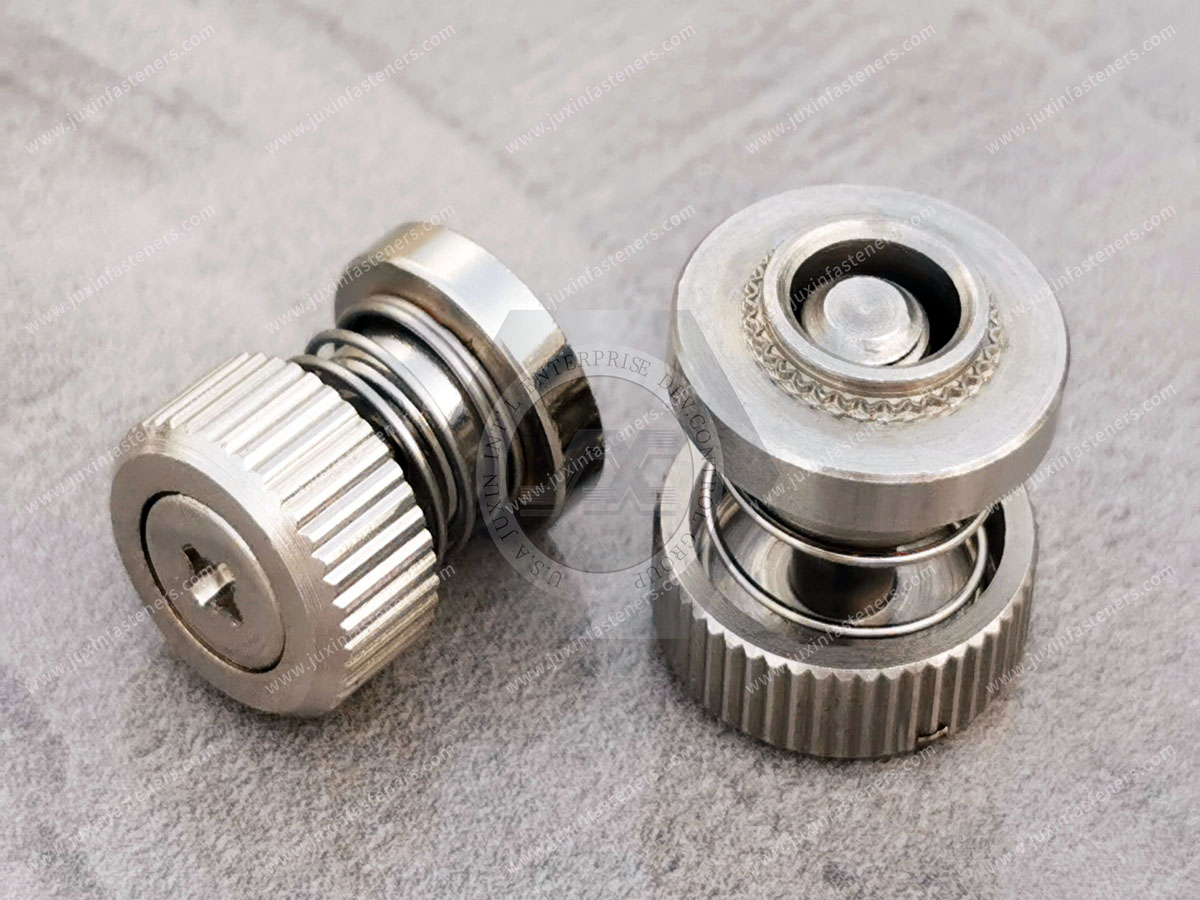
A common design mistake is to look only at how far the screw can move.
The more useful engineering question is:
Does the threaded end fully clear the mating thread or obstruction when the panel needs to move?
A captive screw can have visible axial movement and still fail to provide enough usable disengagement.
Engineers should distinguish between:
total axial movement;
usable retraction;
thread engagement length;
thread disengagement;
panel separation distance;
and clearance required for panel removal.
For sliding covers, drawers, server modules and service panels, the disengaged screw position should be checked against the complete removal path.
This is particularly important where a screw could remain partially engaged or drag across a painted, plated or finished frame.
Panel thickness affects more than whether a fastener physically fits through the sheet.
Depending on the captive screw architecture, it can influence:
retainer engagement;
installed height;
available screw travel;
mounting stability;
backside clearance;
panel deformation during installation;
and the relationship between the screw and mating thread.
For fabricated enclosures, the engineering team should also consider whether the nominal sheet thickness changes after:
coating;
painting;
plating;
local forming;
countersinking;
embossing;
or other panel operations.
The RFQ should therefore identify the actual panel construction rather than supplying only the screw thread.
A captive panel screw still depends on a compatible mating thread.
The mating member may be:
a tapped frame;
a threaded insert;
a self-clinching nut;
another engineered panel fastener;
or another suitable threaded component.
Engineers should confirm:
metric or Unified inch thread system;
nominal diameter;
pitch or threads per inch;
mating thread geometry;
available engagement;
screw length;
rear clearance;
and the risk of bottoming.
For standard Unified inch screw threads, ASME B1.1 is one relevant thread reference where applicable.
Metric thread requirements should likewise be defined using the applicable international thread specification and drawing requirements.
But the existence of a standard thread does not make the entire captive assembly standardized.
The retainer, travel, head, mounting interface and panel conditions can still be application-specific.
The head style should be selected according to how the equipment is actually serviced.
Knurled knobs and other hand-operable head styles may suit panels that require regular authorized access without a driver.
Possible applications include:
frequently serviced electronics;
instrumentation;
test equipment;
machinery adjustment covers;
and some modular equipment panels.
Phillips, hex, Torx or other tool-actuated drives can be appropriate where the intended service procedure requires a tool.
This can be useful for:
electrical cabinets;
power electronics;
industrial machinery;
controlled equipment compartments;
and panels that should not be casually opened by hand.
However, a tool-actuated screw by itself does not establish regulatory access control or electrical safety compliance.
The equipment manufacturer must evaluate the complete access strategy against the applicable equipment requirements and target-market standards.
Head protrusion becomes important when the outer surface of the panel has limited clearance.
Typical examples include:
dense server chassis;
rack-mounted electronics;
adjacent sliding modules;
cabinet doors;
instrumentation housings;
embedded electronic equipment;
and compact machinery enclosures.
A low-profile captive screw can reduce interference, but head height should not be considered in isolation.
Reducing the available head envelope can affect:
drive depth;
hand grip;
driver access;
actuation ergonomics;
head strength;
and the space available for an internal spring or retainer architecture.
The engineering objective is therefore not simply “use the lowest head.”
It is to establish the maximum allowable protrusion and then select an actuation method that still works reliably within that envelope.
The strongest captive-panel applications share one characteristic: the panel must be removed or opened during the equipment's useful life.
Different industries create different reasons for that access.
AI servers, GPU computing systems, network switches and rack-mounted equipment contain dense mechanical and electronic assemblies that may require installation, replacement, inspection or maintenance.
Captive panel screws can be relevant to:
server chassis covers;
removable service panels;
network switch enclosures;
rack-mounted equipment faceplates;
drive or module access covers;
power equipment panels;
and rear access panels.
In these assemblies, the value is not simply “a screw that cannot be lost.”
The design may need to balance:
repeated service access;
limited head clearance;
high equipment density;
thread disengagement before module extraction;
hardware retention;
tool or hand actuation;
and alignment between removable and fixed chassis members.
For sliding modules in particular, usable thread retraction may matter more than the nominal screw length.
Modern data-center infrastructure extends beyond server chassis.
Captive hardware can also be relevant to serviceable mechanical enclosures such as:
PDU covers;
UPS equipment;
power distribution cabinets;
cooling equipment;
liquid-cooling cabinets;
CDU service panels;
control compartments;
and removable equipment covers.
Cooling or power equipment may require routine inspection and service, making retained panel hardware useful for managing fasteners during repeated access.
The captive screw itself, however, does not establish leak containment, water resistance or enclosure IP performance.
Where a panel interfaces with a gasket, sealing performance depends on the complete enclosure design.
Electrical cabinets often contain control electronics, power-conversion equipment, distribution components or other serviceable assemblies.
Possible captive screw locations include:
cabinet access panels;
inverter covers;
variable-frequency-drive enclosures;
UPS covers;
power-distribution equipment;
control cabinet doors;
and internal service covers.
Tool-actuated captive hardware may fit service procedures that require tools for access.
But the fastener should not independently be described as making an enclosure electrically safe, grounded or compliant.
Those are system-level functions.
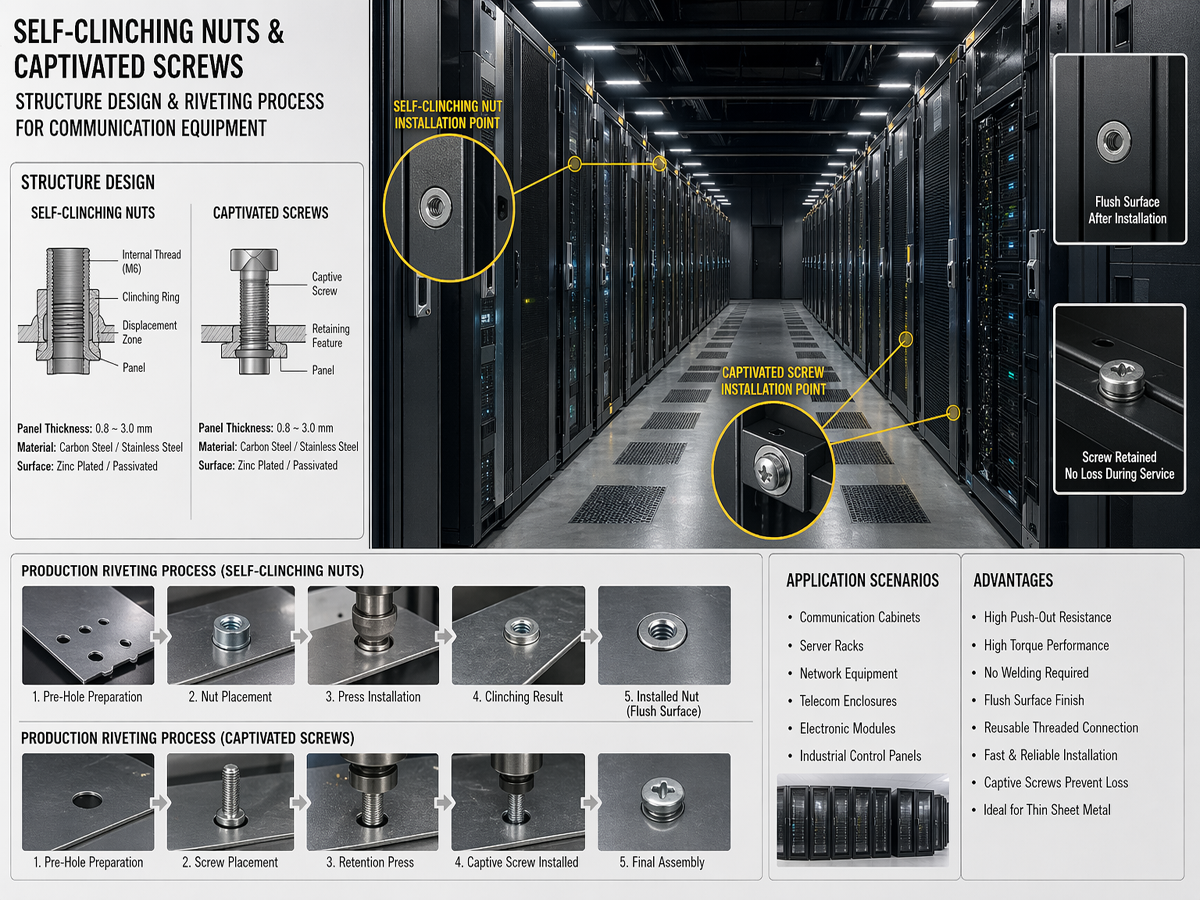
Telecommunications and network infrastructure frequently use serviceable outdoor or indoor enclosures.
Applications may include:
communication equipment cabinets;
network equipment chassis;
rack-mounted communication modules;
base station equipment enclosures;
antenna-associated electronics housings;
and field-service access panels.
Captive hardware can reduce the need to manage loose screws during field servicing.
Where outdoor exposure is involved, material and finish selection should be evaluated against the actual environment, mating materials and maintenance requirements.
“Stainless” or “zinc plated” alone is not a complete corrosion specification.
Semiconductor manufacturing and supporting equipment can contain complex mechanical, electrical and automation subsystems.
Captive panel screws may be considered for suitable:
equipment enclosures;
electronics cabinets;
service covers;
control modules;
automation panels;
and removable machine panels.
Selection should focus on the actual mechanical and maintenance requirement.
A captive screw should not be represented as vacuum-compatible, cleanroom-qualified or suitable for semiconductor process environments unless those requirements have been specifically evaluated and verified.
Machinery and robotic systems frequently use removable guards, control covers and maintenance panels.
Potential applications include:
machine access covers;
automation cell panels;
control enclosures;
inspection covers;
robotic equipment housings;
conveyor service panels;
and removable guards.
Captive screws can simplify repeated maintenance because the hardware remains associated with the removed panel.
Where the panel is a machinery guard, however, fastener selection is only one element of the complete guarding and safety design.
Automotive and electric-vehicle systems contain many different fastening environments, so captive panel screws should be applied selectively rather than described as a universal automotive fastener.
Potential uses may include suitable:
electronics enclosures;
power-electronics covers;
charging equipment;
service-access panels;
diagnostic or test equipment;
battery-related service enclosures;
and manufacturing or assembly equipment.
For EV battery systems, a captive screw should not automatically be treated as a sealing fastener or structural battery-joint fastener.
Where sealing, crash loads, electrical isolation or high-voltage access requirements exist, those functions must be evaluated at the assembly level.
Rail and transportation equipment can include serviceable electrical, communication and control enclosures.
Captive panel hardware may be useful where covers must be removed during inspection or maintenance.
Operating vibration, shock, access procedures and service life should be included in the design review.
Captive does not mean vibration-proof, and no vibration certification should be assumed from the product architecture alone.
Captive panel hardware can be relevant to suitable aerospace equipment, ground-support equipment, tooling, electronics enclosures and other applications where the specific qualification requirements permit its use.
For flight-critical or regulated applications, material, traceability, testing, documentation and qualification requirements must be defined by the customer and applicable program.
A generic industrial captive panel screw should never be represented as aerospace-qualified merely because the product architecture is used somewhere in the aerospace sector.
HVAC systems contain filters, controls, electrical compartments, fans and other serviceable areas.
Suitable captive hardware applications may include:
control-panel covers;
equipment access doors;
filter service panels;
electronics compartments;
and maintenance covers.
If the panel also contributes to air or water sealing, the captive screw is only one part of the closure system.
Gasket design, panel stiffness, fastener spacing and compression still determine sealing performance.
Suitable applications may include:
diagnostic-equipment housings;
laboratory-equipment covers;
medical carts;
electronics compartments;
and service panels.
Captive hardware can support serviceability and hardware retention, but it does not establish medical-device certification, biocompatibility, sterilization compatibility or cleanroom suitability.
Those requirements must be separately defined and validated.
Instrumentation and electronic appliances may use captive screws where covers need periodic calibration, inspection, repair or component replacement.
Relevant design priorities can include:
compact head size;
appearance;
repeated access;
correct screw retention;
mating-thread protection;
and controlled service procedures.
Commercial food-service equipment often requires maintenance access to electrical, mechanical or control compartments.
Captive panel hardware can be useful on suitable service covers because it keeps the fastener with the panel during maintenance.
Material and finish selection should reflect the actual environment and cleaning exposure.
Do not assume that a captive fastener is food-contact approved or compatible with every cleaning or sanitation process.
Construction and off-highway machinery can contain electrical boxes, control enclosures, engine access panels and service covers.
Captive panel screws may support repeated maintenance access where retained hardware is desirable.
For vibration-intensive applications, the complete threaded joint, locking strategy and equipment-level validation should be reviewed rather than relying on captivation alone.
For sheet-metal fabricators, captive panel hardware introduces manufacturing questions before the final equipment even reaches assembly.
The fabricator may need to coordinate:
hole creation;
panel thickness;
bends and formed features;
edge distance;
coating sequence;
hardware installation;
installation tooling;
inspection;
and protection of installed hardware during downstream operations.
This means captive screw selection should ideally occur before the enclosure drawing and fabrication process are frozen.
A captive screw is fundamentally a retained access fastener.
It should not automatically be described as waterproof, sealed, IP65, IP67 or IP68.
Where a removable panel forms part of an environmental enclosure, sealing can depend on:
gasket material;
gasket geometry;
compression;
panel stiffness;
fastener spacing;
enclosure geometry;
surface condition;
panel flatness;
installation;
and validation of the complete assembly.
The captive screw contributes to the closure system by applying clamp through the threaded joint.
It does not independently determine the enclosure rating.
Metal captive hardware may be part of an electrically conductive assembly, but this does not automatically create a validated grounding or bonding path.
Electrical continuity can be affected by:
paint;
powder coating;
anodizing;
plating;
oxide layers;
mating materials;
contact geometry;
assembly pressure;
corrosion;
and surface contamination.
If electrical bonding is required, engineers should deliberately define the conductive interface and verify continuity at the assembly level.
Do not rely on the words “metal captive screw” as an electrical specification.
Captivation prevents the screw assembly from becoming a completely loose component after disengagement.
It does not necessarily prevent the engaged screw thread from loosening under vibration.
For equipment exposed to vibration or shock, engineering review may include:
joint preload requirements;
mating thread;
locking features where appropriate;
prevailing-torque elements;
pre-applied locking patches where appropriate;
spring effects;
panel movement;
material and finish;
maintenance requirements;
and assembly-level validation.
The correct strategy depends on the equipment.
No generic captive screw should be called “vibration-proof” without appropriate evidence.
Surface finish should be specified according to the material, environment, moving interfaces and mating components.
Depending on the product design and application, possible options may include:
trivalent zinc systems;
zinc-nickel;
nickel;
black zinc;
black nickel where validated;
passivated stainless steel;
or other engineered finishes where applicable.
JUXIN FASTENERS does not recommend defining a finish only by color.
For example, “black” is an appearance requirement, not a complete coating specification.
The RFQ should identify the required finish or environmental requirement wherever possible.
Where moving clearances exist inside the captive assembly, coating buildup and post-finishing movement should also be considered.
Material selection should begin with the complete service requirement rather than a simple assumption that one material is universally superior.
Possible factors include:
required mechanical properties;
host-panel material;
corrosion environment;
mating material;
galvanic compatibility;
magnetic requirements where relevant;
surface finish;
wear;
manufacturing process;
availability;
and cost.
Carbon steel and stainless steel are both useful in captive hardware when appropriately specified.
Stainless steel may reduce dependence on sacrificial plating for certain environments, but it is not corrosion-proof.
Plated carbon steel may be appropriate for many industrial applications, but the finish must match the environment and functional interfaces.
Several recurring mistakes can turn a simple retained fastener into an assembly problem.
“M4 captive screw” or “#8-32 captive screw” is not enough.
The retainer, mounting method, panel thickness, screw length, retraction, head, drive and mating geometry still need definition.
A screw can be captive without automatic spring retraction.
Specify the required disengaged behavior.
The panel is part of the fastening system.
Material, thickness, hardness, hole geometry, edge distance and forming operations can affect installation.
A correct panel installation does not guarantee correct thread engagement.
Check the mating thread and rear clearance.
Floating hardware can accommodate intended positional variation, but it should not substitute for uncontrolled fabrication or assembly errors.
These are separate functions.
These are also separate functions.
Two captive screws can look nearly identical above the panel while having different retainers, travel, mounting requirements or installed geometry underneath.
This is especially important during second-source qualification.
Procurement teams frequently need an alternative supplier because of lead time, cost, supplier consolidation, localization, discontinued hardware or supply-chain risk.
The safest approach is not to ask:
“Can you copy this captive screw?”
Instead ask:
“Which characteristics must remain identical for this assembly to function correctly, and which characteristics may change?”
That leads to four different sourcing paths:
Critical dimensions and interfaces are reproduced according to the approved specification.
Some non-critical geometry may differ, but form, fit, function and assembly requirements remain acceptable after engineering review and customer validation.
The replacement intentionally changes one or more features to address a new requirement such as head clearance, drive type, material, finish or installation method.
A new captive fastener is developed around the actual equipment requirement rather than copying the existing component.
These categories should not be treated as interchangeable.
When evaluating an alternative captive panel fastener, review at least the relevant items below:
mounting method;
mounting-hole geometry;
host-panel material;
panel thickness range;
installed retainer geometry;
screw thread;
pitch or threads per inch;
mating thread;
engagement length;
screw length;
retracted position;
head height;
head diameter;
drive type;
hand or tool actuation;
spring-loaded or manual behavior;
floating requirement;
material;
finish;
environmental requirements;
surrounding clearance;
assembly sequence;
serviceability;
and packaging or line-side identification requirements.
A similar appearance is not sufficient evidence of interchangeability.
When an existing drawing is unavailable, a physical sample can support development of replacement or custom hardware.
A realistic workflow is:
Physical Sample → Dimensional Review → Functional Review → Critical Feature Identification → Material and Finish Information Review
→ Drawing Confirmation → Manufacturing Feasibility → Prototype / Sample Development → Customer Validation → Production
A physical sample alone may not reveal exact alloy chemistry, heat treatment, hardness profile or coating chemistry.
Where those properties are critical, the customer should provide the original specification where available or define appropriate verification requirements.
A high-quality RFQ should tell the supplier what the captive fastener must do, not just what it looks like.
Provide:
panel material;
nominal panel thickness and tolerance where critical;
mounting-hole dimensions;
nearby bends or formed features;
edge-distance constraints;
coating or paint condition;
and access available for installation.
Provide:
metric or Unified inch thread;
thread size;
pitch or threads per inch;
mating component;
required engagement conditions;
and available rear clearance.
Specify:
required mounting architecture;
fixed or floating;
manual or spring-loaded;
required disengaged behavior;
required retraction or hold-out;
panel removal direction;
and any critical clearance.
Define:
knob or tool-actuated head;
drive style;
maximum head protrusion;
hand-access requirements;
tool-clearance restrictions;
and any visual identification requirements.
Identify:
material requirement;
finish;
corrosion environment;
appearance requirement;
mating material;
and any restricted-substance or customer-specific specification.
Include:
prototype or sample quantity;
initial production quantity;
estimated annual usage where known;
packaging requirements;
target schedule;
existing approved drawing where available;
and whether the project is a new design, replacement, second source or cost-reduction program.
Before sending an RFQ, procurement and engineering teams can use the following checklist:
2D engineering drawing
3D model where available
Physical sample where applicable
Application and equipment type
Panel material
Panel thickness
Mounting-hole information
Mounting method
Thread system
Thread size and pitch
Mating component
Screw length
Required disengagement/retraction
Fixed or floating architecture
Head style
Drive style
Hand-operated or tool-actuated requirement
Spring-loaded requirement where applicable
Material
Surface finish
Operating environment
Critical dimensions and tolerances
Sample quantity
Production quantity
Estimated annual usage
Packaging requirements
Existing supplier part or drawing reference where legally and commercially appropriate
The more complete the functional information, the easier it is to evaluate manufacturability and quotation accuracy.
Large OEM procurement teams should evaluate more than unit price.
A supplier review may include:
ability to review engineering drawings;
understanding of the captive mechanism;
manufacturing feasibility review;
material control;
surface-finish control;
dimensional inspection;
prototype and sample-development support;
production scalability;
inspection planning;
packaging control;
traceability requirements where specified;
change communication;
lead-time management;
and support for repeat production.
For custom captive panel screws, supplier qualification should also examine whether the manufacturer understands the difference between critical functional dimensions and cosmetic or non-critical geometry.
That distinction can materially affect second-source development.
JUXIN FASTENERS supports standard, modified and custom engineered fasteners for OEM equipment manufacturers and industrial supply chains.
For captive panel hardware projects, development can be based on:
customer 2D engineering drawings;
3D models;
existing physical samples;
required application geometry;
custom dimensions;
specified materials;
specified surface finishes;
and customer-defined functional requirements.
Manufacturing route and tooling requirements depend on the captive fastener architecture, geometry, material, tolerances, finish and production quantity.
JUXIN does not apply a universal production-volume rule to every custom fastener. The appropriate manufacturing process should be evaluated from the actual part and program requirements.
Prototype or sample evaluation can be used before volume production, and automatic optical sorting may be applied to
suitable high-volume fastener programs where the geometry and inspection requirement are compatible with the process.
For engineers and procurement teams, a captive panel screw project can be reduced to a practical decision path:
What panel must be removed?
→ Why must the screw remain captive?
→ How will the retainer attach to the panel?
→ Does the assembly require fixed or floating alignment?
→ Must the screw retract automatically?
→ What thread and mating component are used?
→ What clearance exists in the engaged and disengaged positions?
→ How will a technician operate the fastener?
→ What material and finish suit the environment?
→ Which dimensions are functionally critical?
→ How will samples be validated in the real assembly?
→ What production quantity and supply requirements apply?
This sequence helps prevent a common sourcing mistake: selecting captive hardware from a photograph or thread size before understanding the assembly.
For new captive panel screw designs, replacement parts, functional equivalents, second-source projects or custom OEM hardware,
send the available 2D drawing, 3D model, physical sample and application requirements to:
JUXIN FASTENERS can review the available information and evaluate a suitable manufacturing and sample-development path for your captive panel hardware project.
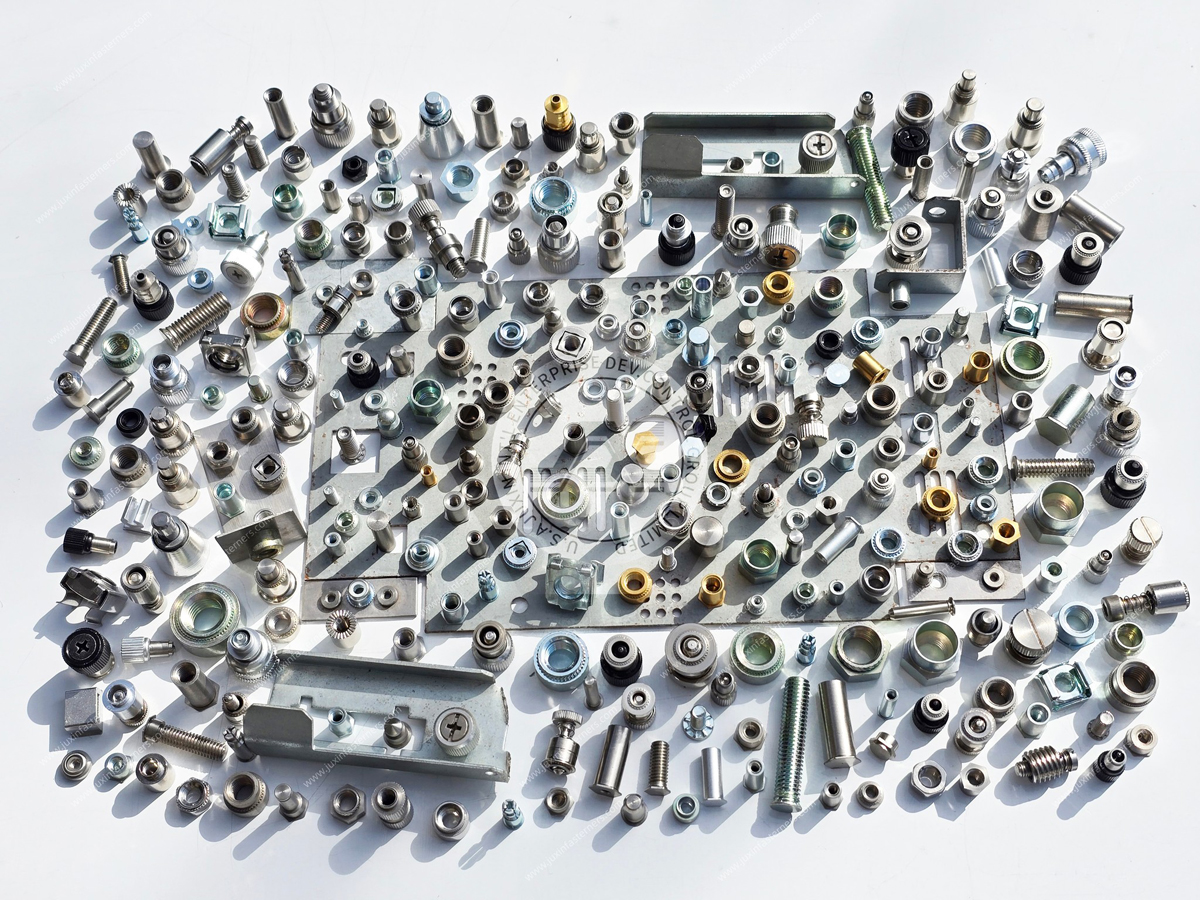
Product Packaging
Packaging Standard
At Juxin Fasteners, we apply standardized export packaging to ensure product protection, traceability, and compliance with international logistics requirements.
1. Standard Export Packaging
Unless otherwise specified, all products will be packed according to our factory standard export packaging, which includes:
Moisture-resistant inner protection
Poly bag or small box packing as required
Reinforced export cartons
Clear labeling with part number, specification, batch number, and quantity
Palletizing for sea or air shipment when necessary
Our standard packaging is designed to ensure safe transportation, efficient warehousing, and long-distance international shipping.
2. Customized Packaging Options
We also provide customized packaging solutions according to customer requirements, including but not limited to:
Private labeling
Customized barcodes
Specific carton dimensions
Retail packaging
Special pallet configuration
Customer-specific marking and identification
So that you know, customized packaging may involve additional costs and extended lead time depending on the complexity of the requirements.
3. Compliance & Quality Assurance
All packaging processes are controlled under our ISO 9001 quality management system to ensure consistency, traceability, and product integrity throughout the supply chain.
Product Pictures
Contact Us
Tel.:
+86 020 8621 0320
+86 020 3121 6067
E-mail:
Technical Support:
Navigation
SEND INQUIREY