Call Us
+86 136 6007 9809
Call Us
+86 136 6007 9809

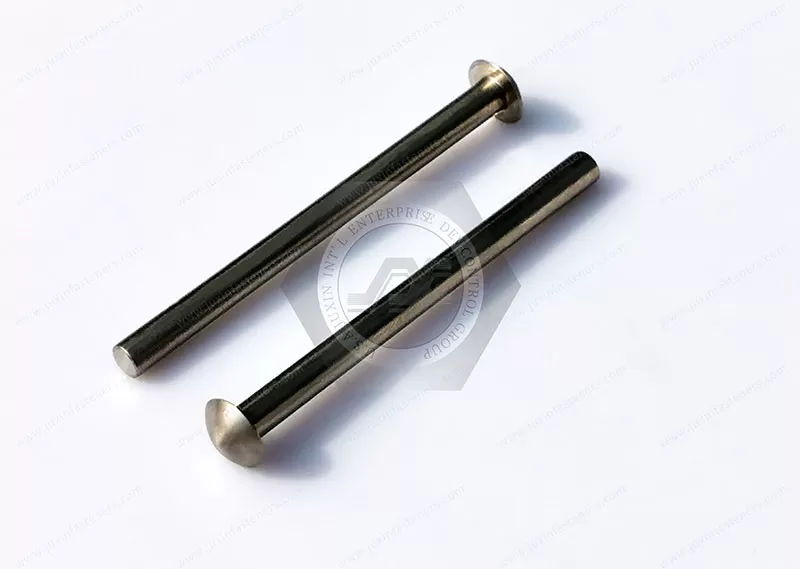
JUXIN FASTENERS supplies custom long-shank stainless steel solid rivets for commercial foodservice equipment, fabricated metal assemblies and industrial OEM applications.
These solid-shank fasteners are designed for permanent joining where access to both sides of the workpiece is available.
Original listed inch sizes include 1/8", 5/32", 3/16", 1/4", 5/16", 3/8" and 1/2"; their dimensional meaning must be verified against the relevant drawing.
Explore long-shank selection, joint grip thickness, rivet tail allowance, stainless steel grades, head geometry, installation tooling, corrosion compatibility and OEM quality requirements.
Custom production inquiries are evaluated from customer engineering drawings.
Product Specification
Custom Long-Shank Stainless Steel Solid Rivets for Foodservice Equipment and Industrial OEM Assemblies
JUXIN FASTENERS supplies custom long-shank stainless steel solid rivets for commercial foodservice equipment, industrial metal fabrication and customer-specific OEM assemblies.
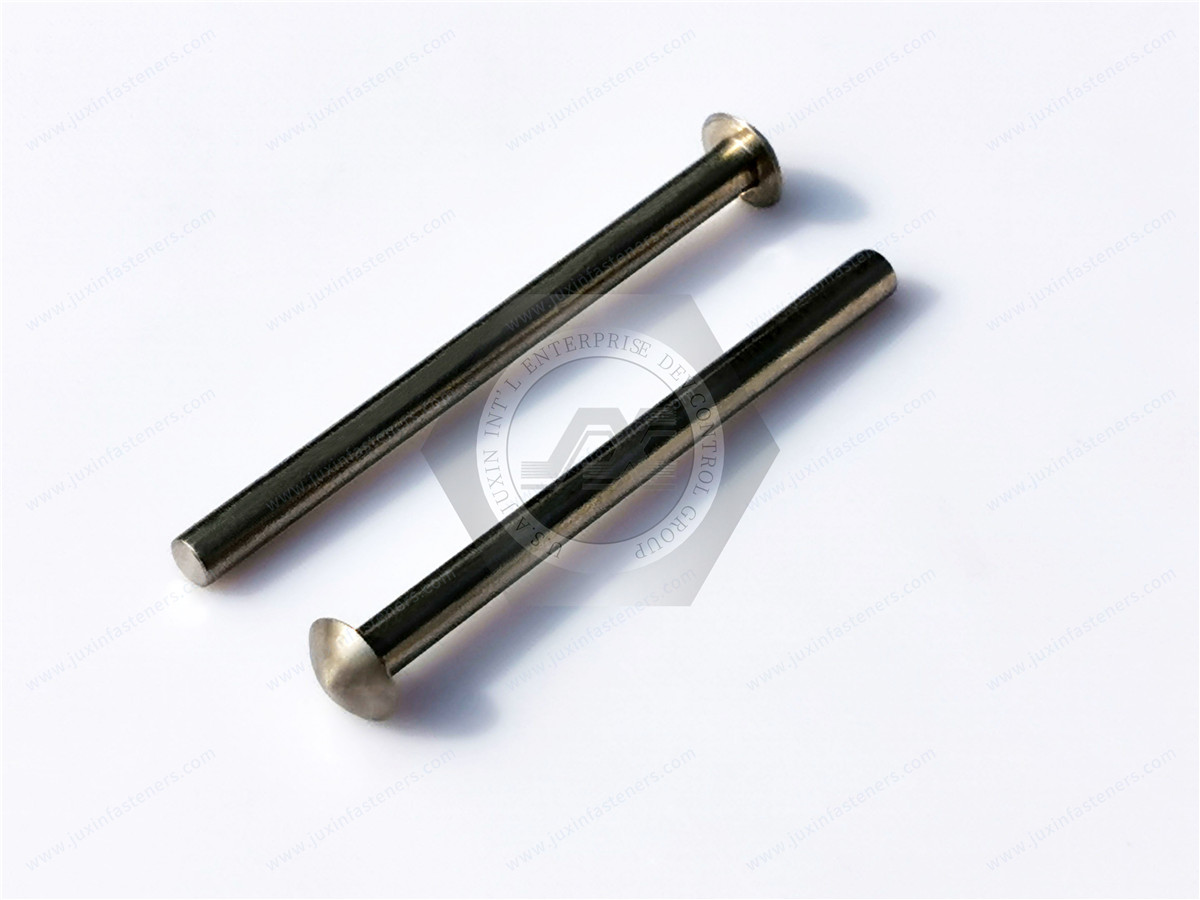
These fasteners combine a manufactured head with a solid cylindrical shank intended for permanent mechanical joining.
Compared with a shorter rivet of similar construction, a long-shank solid rivet can accommodate a different assembly stack thickness or a specialized joint geometry,
provided that its dimensions and forming allowance are correctly engineered.
The featured product has been associated with a customer-specific commercial foodservice equipment application.
For OEM manufacturers, mechanical design engineers, production managers and sourcing professionals, selecting the correct long-shank solid rivet requires more than choosing a nominal diameter.
Important factors include joint thickness, head geometry, material grade, receiving-hole dimensions, tail allowance, installation equipment and finished joint performance.
JUXIN FASTENERS supports drawing-based inquiries for custom stainless steel solid rivets used in industrial production.
Product Overview and Technical Specifications
Product Name: Custom Long-Shank Stainless Steel Solid Rivets
Original Product Name: Longth Solid Stainless Steel Rivets
Alternative Industry Names: Long Solid Rivets, Extended-Length Solid Rivets, Stainless Steel Solid-Shank Rivets
Material: Stainless Steel
Construction: Solid Shank
Fastening Method: Permanent Mechanical Riveting
Installation Access: Generally Requires Access to Both Sides of the Assembly
Original Listed Inch Sizes:
1/8"
5/32"
3/16"
1/4"
5/16"
3/8"
1/2"
The original product information does not identify whether these values refer to shank diameters, nominal lengths or another dimension.
The exact dimensions and available combinations must be confirmed from the approved engineering drawing or specification sheet.
Stainless Steel Material Options Referenced in the Original Product Family:
18-8 Stainless Steel
316 Stainless Steel
These materials are identified in the original product description, but the exact grade used for the pictured customer-specific rivets has not been independently established.
Other engineering characteristics, including head dimensions, shank tolerances, finished head requirements and installation loads, are subject to customer specification.
What Are Long-Shank Stainless Steel Solid Rivets?
Long-shank solid rivets are permanent mechanical fasteners featuring a manufactured head and a solid cylindrical shank with an extended length appropriate to the intended assembly.
During conventional installation, the rivet is inserted through aligned holes in the components being joined.
The protruding end of the shank is then mechanically deformed to form a second retaining head, commonly called the shop head or upset head.
This operation secures the joined components between the manufactured head and the formed head.
The fastener is generally not intended for routine disassembly.
The required rivet length depends on the assembly thickness and the material needed to form the finished head.
A long rivet should not be selected solely because it appears to provide additional strength.
Long-Shank Solid Rivets vs. Standard-Length Solid Rivets
Both designs use the same basic solid-rivet fastening principle.
The main difference is the available shank length.
Standard-Length Solid Rivets
These may be appropriate for assemblies with relatively small or conventional stack thicknesses.
Long-Shank Solid Rivets
These may be appropriate for assemblies with greater stack thickness or specialized joining geometry.
However, longer shanks can introduce additional installation considerations.
Potential concerns include:
Shank bending during installation.
Incorrect tail allowance.
Excessive forming force.
Poor workpiece support.
Incomplete hole filling.
Distorted shop heads.
Assembly misalignment.
Correct length selection and tooling are essential.
Long-Shank Solid Rivets vs. Blind Rivets
A conventional solid rivet and a blind rivet use different installation mechanisms.
Solid Rivets
Solid rivets generally require access to both sides of the assembly.
The installer forms the protruding tail into a second retaining head.
Blind Rivets
Blind rivets are designed for installation from one accessible side using a suitable setting mechanism.
Engineering Implication
A long-shank solid rivet should not be described as suitable for blind installation merely because its shank is long.
When backside access is unavailable, a suitable blind fastening system may need to be evaluated instead.
Long-Shank Solid Rivets vs. Semi-Tubular Rivets
A solid rivet has a fully solid shank before installation.
A semi-tubular rivet has a hollow section at the tail that is intended to be formed.
These fasteners can require different forming forces and tooling.
The correct type must be selected according to the approved assembly design.
Stainless Steel Material Selection
Stainless steel is commonly selected for industrial equipment where appropriate corrosion resistance and mechanical performance are required.
However, material selection must account for both service conditions and riveting behavior.
18-8 Stainless Steel
The term 18-8 commonly refers to a family of chromium-nickel austenitic stainless steels.
It is used in many industrial fastener applications.
The exact material grade and condition should be identified in the engineering specification.
316 Stainless Steel
316 stainless steel may be considered for environments involving particular corrosion challenges.
Its suitability depends on the service conditions, mechanical requirements and manufacturing process.
Material Condition and Formability
A solid rivet must be capable of forming the required shop head without unacceptable cracking or damage.
The selected stainless steel grade and condition influence:
Forming force.
Ductility.
Hardness.
Head formation.
Work hardening.
Installation repeatability.
Mechanical performance.
The material should be validated for the intended riveting process.
Corrosion Resistance and Cleaning Environments
Commercial foodservice equipment may be exposed to:
Moisture.
Cleaning chemicals.
Food residues.
Temperature changes.
Condensation.
Repeated cleaning cycles.
Contact with dissimilar metals.
Stainless steel can offer useful corrosion resistance, but the actual performance depends on the grade, surface condition and environment.
No stainless steel grade should be described as universally corrosion-proof.
Galvanic Compatibility
Stainless steel rivets may contact aluminum, carbon steel or other metals in fabricated equipment.
In the presence of moisture, galvanic interaction may need to be considered.
Material selection should evaluate the complete joint rather than the rivet alone.
Critical Engineering Dimensions for Long Solid Rivets
1. Shank Diameter
Shank diameter influences receiving-hole fit, joint geometry and mechanical loading.
The correct diameter must be established from the engineering drawing.
2. Shank Length
Shank length must accommodate the assembly thickness and provide the required tail allowance for forming.
3. Manufactured Head Diameter
Head diameter influences bearing area and component retention.
4. Manufactured Head Height
Head height affects equipment clearance and the finished assembly profile.
5. Head Style
Potential solid-rivet head styles include round, universal, flat and countersunk configurations.
The actual featured head style must be verified from the drawing.
6. Receiving-Hole Diameter
The receiving hole must be compatible with the shank diameter and riveting process.
7. Grip Thickness
Grip thickness is the combined thickness of the materials being joined.
8. Tail Allowance
Tail allowance is the portion of the rivet shank protruding beyond the assembly before forming.
9. Finished Shop Head
The finished shop head must meet the required geometry and retention criteria.
10. Dimensional Tolerances
Critical dimensions should follow the approved OEM drawing.
Grip Thickness and Rivet Length Selection
One of the most important aspects of long-shank rivet engineering is selecting the correct length for the intended joint.
The basic relationship is:
Required Rivet Shank Length = Assembly Grip Thickness + Required Tail Allowance
This is a conceptual relationship rather than a universal dimensional specification.
The required tail allowance depends on:
Rivet diameter.
Material grade.
Material condition.
Head-forming process.
Tooling geometry.
Required shop head dimensions.
Assembly support.
Customer-defined acceptance criteria.
A rivet that is too short may not provide sufficient material to form the retaining head.
A rivet that is too long may bend or form an unacceptable head during installation.
The correct dimensions should be established through drawing review and installation validation.
Long-Shank Rivet Stability During Installation
Longer rivet shanks may require additional attention to alignment and support.
Engineering Challenge
An unsupported shank may bend or deform unevenly during the forming operation.
Engineering Solution
The assembly process should provide:
Accurate hole alignment.
Appropriate fixture support.
Correct rivet length.
Suitable forming tools.
Controlled forming force.
Proper workpiece positioning.
Inspection of the finished shop head.
The correct process depends on the rivet material and geometry.
Commercial Foodservice Equipment Applications
The featured custom rivets are associated with a commercial foodservice equipment project.
This experience is relevant to OEM manufacturers requiring permanent fastening components for stainless steel equipment assemblies.
1. Commercial Kitchen Equipment Brackets
Commercial kitchen equipment may incorporate fabricated brackets and mechanical support components.
Engineering Challenge
The joint must maintain the required mechanical connection while remaining compatible with the equipment environment.
Engineering Solution
A custom stainless steel solid rivet may be evaluated where both sides of the assembly are accessible.
Important considerations include:
Bracket thickness.
Hole diameter.
Rivet length.
Head clearance.
Corrosion exposure.
Cleaning accessibility.
Installation tooling.
Mechanical loading.
2. Commercial Cooking Equipment
Commercial cooking equipment may require permanent fastening for selected mechanical hardware.
Potential applications include:
Equipment brackets.
Auxiliary mounting components.
Non-food-contact structural accessories.
Fabricated metal assemblies.
Engineering Challenge
Temperature variation, repeated cleaning and mechanical loading may affect the joint.
Engineering Solution
The rivet material, geometry and assembly process should be evaluated against the actual operating conditions.
No specific temperature rating is established for the featured product.
3. Stainless Steel Foodservice Equipment Fabrication
Foodservice equipment manufacturers frequently use stainless steel sheet-metal components.
Potential applications include:
Equipment frames.
Brackets.
Support assemblies.
Mechanical retaining components.
Fabricated equipment subassemblies.
Engineering Challenge
The joining method must be compatible with material thickness, installation access and equipment design.
Engineering Solution
A custom solid rivet can be evaluated when permanent joining and two-sided access are appropriate.
The final joint should be inspected for fit, retention and surface condition.
4. Commercial Food Preparation Equipment
Food preparation equipment may contain mechanical assemblies requiring permanent fastening.
Engineering Challenge
The equipment design may require cleanable surfaces and suitable corrosion resistance.
Engineering Solution
Fastener selection should consider the complete equipment design, including accessibility for cleaning and potential contamination traps.
A stainless steel rivet does not automatically qualify a joint for direct food contact.
5. Commercial Warewashing Equipment
Commercial dishwashing and warewashing equipment may expose hardware to moisture and cleaning chemicals.
Engineering Challenge
The joint must remain suitable for the actual chemical and environmental exposure.
Engineering Solution
The material grade, surface condition and joint geometry should be evaluated according to the equipment requirements.
No particular cleaning-chemical compatibility is established without testing or supporting material data.
6. Restaurant Equipment Accessories
Commercial restaurant equipment may incorporate custom retaining brackets and accessory mounts.
Engineering Challenge
Standard catalog rivets may not provide the required length, head geometry or material specification.
Engineering Solution
Custom long-shank solid rivets may be evaluated according to the OEM drawing and production requirements.
Industrial Applications Beyond Foodservice Equipment
The same solid-rivet design principles may apply to other industrial sectors.
1. Industrial Machinery
Potential applications include equipment brackets, mechanical support components and fabricated assemblies.
2. Appliance Manufacturing
Potential applications include permanent joining of selected metal components.
3. Electrical Equipment
Potential applications include mechanical brackets, equipment supports and enclosure hardware.
Electrical clearance and conductive material compatibility must be evaluated separately.
4. HVAC Equipment
Potential applications include fabricated metal assemblies and mechanical mounting components.
5. Transportation Equipment
Custom solid rivets may be evaluated for selected transportation hardware.
Safety-critical applications require dedicated engineering approval and testing.
6. General Metal Fabrication
Long-shank rivets may be relevant to fabricated assemblies with specific stack thickness or head requirements.
These examples are potential application categories, not confirmation that the featured custom rivet is qualified for every industry.
Solid Rivet Installation Methods
The correct installation process depends on the material, diameter, shank length and assembly geometry.
1. Pneumatic Riveting
Pneumatic riveting uses an impact tool with a suitable rivet set.
A bucking bar or appropriate support is generally required on the opposite side.
2. Manual Riveting
Manual riveting may be used in certain applications with appropriate tools and access.
The process must provide controlled head formation.
3. Compression Riveting
Compression riveting uses a press or squeezer to form the rivet tail.
It may be suitable where the equipment and joint geometry allow access to both sides.
4. Automated Riveting
Automated riveting equipment may be considered for high-volume OEM production.
Process feasibility depends on feeding, alignment, tooling and forming requirements.
5. Specialized Rivet Forming
Other forming methods may be considered where compatible with the solid rivet design.
The final process must be validated for the specified stainless steel material and dimensions.
Step-by-Step Solid Rivet Installation Considerations
Step 1: Verify the Rivet Specification
Confirm material grade, diameter, length, head geometry and dimensional tolerances.
Step 2: Prepare the Assembly
Ensure the components are positioned correctly.
Step 3: Inspect the Receiving Holes
Check hole dimensions, alignment and burr condition.
Step 4: Insert the Rivet
Position the manufactured head against the appropriate assembly surface.
Step 5: Support the Rivet
Use a suitable bucking bar, rivet set or forming fixture.
Step 6: Form the Tail
Apply the required forming operation to create the retaining head.
Step 7: Inspect the Finished Joint
Verify the formed head, component condition and required joint performance.
The actual installation instructions must follow the approved customer drawing and equipment process.
Common Installation Problems and Engineering Solutions
Problem 1: Bent Rivet Shank
Possible causes include excessive unsupported length, poor alignment or incorrect tooling.
Review rivet length and assembly support.
Problem 2: Incomplete Shop Head
Possible causes include insufficient tail allowance or inadequate forming force.
Review the length calculation and forming process.
Problem 3: Excessive Head Deformation
Possible causes include incorrect tool geometry or excessive impact force.
Review tooling and process controls.
Problem 4: Workpiece Distortion
Possible causes include inadequate support or excessive forming force.
Review fixtures and material thickness.
Problem 5: Loose Riveted Joint
Possible causes include incorrect hole dimensions, insufficient head formation or unsuitable rivet length.
Review the complete joint design.
Problem 6: Cracking During Forming
Possible causes include unsuitable stainless steel condition, excessive deformation or incorrect tooling.
Review material properties and forming requirements.
Problem 7: Surface Corrosion
Possible causes include unsuitable material grade, contamination or environmental exposure.
Review material selection and surface condition.
Quality Inspection for Custom Long-Shank Solid Rivets
OEM quality requirements should follow the approved engineering drawing.
Dimensional Inspection
Potential characteristics include:
Shank diameter.
Shank length.
Head diameter.
Head height.
Head profile.
Straightness.
Concentricity.
Surface condition.
Critical tolerances.
Material Verification
Confirm the specified stainless steel grade and material condition.
Visual Inspection
Check for:
Cracks.
Burrs.
Surface damage.
Shank deformation.
Head defects.
Other imperfections affecting assembly.
Installation Validation
Verify that the rivet can form the required retaining head in the actual assembly.
Mechanical Performance Testing
Depending on the customer application, testing may include:
Joint shear performance.
Axial retention.
Formed head inspection.
Vibration performance.
Fatigue durability.
Corrosion exposure.
Assembly consistency.
These are potential customer-defined tests, not claims that every test is routinely performed for each product.
Foodservice Equipment Hygiene and Compliance Considerations
Commercial foodservice equipment may be subject to sanitation and safety requirements.
Depending on the equipment category, relevant standards may include:
NSF/ANSI 2 for certain food equipment.
NSF/ANSI 4 for certain commercial cooking and hot food holding equipment.
NSF/ANSI 3 for certain commercial warewashing equipment.
These standards address equipment-level requirements.
The use of stainless steel does not automatically establish NSF certification, direct food-contact approval or compliance with a particular equipment standard.
Engineering review should consider:
Material suitability.
Surface condition.
Cleaning accessibility.
Joint geometry.
Crevice formation.
Corrosion resistance.
Environmental exposure.
Applicable customer requirements.
Any certification or compliance claim must be supported by appropriate documentation.
Production Engineering and High-Volume OEM Assembly
For production managers, custom solid rivets affect both component cost and assembly performance.
Important factors include:
Material availability.
Rivet length consistency.
Part feeding.
Fixture design.
Hole alignment.
Forming force.
Tooling wear.
Cycle time.
Shop head consistency.
Inspection time.
Scrap and rework.
Production scheduling.
Repeat-order stability.
A well-defined engineering drawing supports repeatable manufacturing and assembly.
Custom Long-Shank Solid Rivets to Engineering Drawings
JUXIN FASTENERS supports inquiries for custom stainless steel solid rivets and related permanent fastening components.
Custom requirements may include:
Non-standard shank lengths.
Special shank diameters.
Custom head dimensions.
Customer-defined head profiles.
Stainless steel material grades.
Surface finish requirements.
Dimensional tolerances.
Special assembly thicknesses.
Installation process requirements.
Customer-defined mechanical performance.
Manufacturing feasibility and quotation depend on the actual engineering drawing and production requirements.
Inch Sizes and Metric Reference
The original product information lists the following inch values:
1/8" ≈ 3.175 mm
5/32" ≈ 3.969 mm
3/16" ≈ 4.763 mm
1/4" = 6.350 mm
5/16" ≈ 7.938 mm
3/8" = 9.525 mm
1/2" = 12.700 mm
These are dimensional conversions only.
The original information does not confirm whether each value represents a diameter, length or another characteristic.
The conversions do not establish availability of corresponding metric product specifications or dimensional interchangeability.
Frequently Asked Engineering Questions
What are long-shank stainless steel solid rivets?
They are solid-shank permanent fasteners with extended lengths selected according to the intended assembly thickness and forming requirements.
How are solid rivets installed?
Conventional solid rivets are inserted through prepared holes and mechanically formed at the tail to create a second retaining head.
Do solid rivets require access to both sides?
Yes, conventional solid riveting generally requires access to both sides for forming and support.
Are long-shank solid rivets stronger than shorter rivets?
Not necessarily. Joint strength depends on diameter, material, geometry, loading and installation quality.
How is the correct rivet length selected?
The required length depends on the combined material thickness and the tail allowance needed for the intended forming process.
What stainless steel grades are available?
The original product-family description identifies 18-8 and 316 stainless steel. Availability for a specific custom part must be confirmed.
Can these rivets be used in commercial kitchen equipment?
They may be suitable for selected equipment assemblies when material, geometry, installation and environmental requirements are satisfied.
Are stainless steel solid rivets automatically NSF certified?
No. Material selection alone does not establish NSF certification or equipment-level compliance.
Can long solid rivets be installed using a pneumatic rivet gun?
Yes, where the rivet design, tooling and assembly access are suitable.
Can these rivets replace blind rivets?
Not automatically. Solid rivets generally require access to both sides, while blind rivets use a different installation mechanism.
Can custom lengths and head styles be manufactured?
Custom requirements can be evaluated according to the engineering drawing and production specifications.
What information is required for an OEM quotation?
A dimensioned drawing, material grade, head style, shank dimensions, assembly thickness, installation method and estimated production volume provide a useful basis for technical review.
Request a Custom Long-Shank Stainless Steel Solid Rivet RFQ
JUXIN FASTENERS supports engineering inquiries for long-shank stainless steel solid rivets used in commercial foodservice equipment and industrial OEM manufacturing.
For a new project or an existing production component, please provide:
2D engineering drawing or 3D CAD file.
Required stainless steel grade.
Shank diameter.
Shank length.
Head style and dimensions.
Critical dimensional tolerances.
Surface finish requirements.
Assembly material and stack thickness.
Receiving-hole dimensions.
Required tail allowance.
Installation method.
Finished shop head requirements.
Mechanical performance requirements.
Environmental and cleaning conditions.
Quality and inspection requirements.
Prototype or initial production quantity.
Estimated annual production demand.
Target project schedule.
Our team can review the supplied technical requirements and discuss the next steps for engineering clarification and quotation.
JUXIN FASTENERS
Website: https://www.juxinfasteners.com/
Email: info@juxinfasteners.com
Submit Your Engineering Drawings for a Custom Long-Shank Solid Rivet RFQ.
Product Packaging
Packaging Standard
At Juxin Fasteners, we apply standardized export packaging to ensure product protection, traceability, and compliance with international logistics requirements.
1. Standard Export Packaging
Unless otherwise specified, all products will be packed according to our factory standard export packaging, which includes:
Moisture-resistant inner protection
Poly bag or small box packing as required
Reinforced export cartons
Clear labeling with part number, specification, batch number, and quantity
Palletizing for sea or air shipment when necessary
Our standard packaging is designed to ensure safe transportation, efficient warehousing, and long-distance international shipping.
2. Customized Packaging Options
We also provide customized packaging solutions according to customer requirements, including but not limited to:
Private labeling
Customized barcodes
Specific carton dimensions
Retail packaging
Special pallet configuration
Customer-specific marking and identification
So that you know, customized packaging may involve additional costs and extended lead time depending on the complexity of the requirements.
3. Compliance & Quality Assurance
All packaging processes are controlled under our ISO 9001 quality management system to ensure consistency, traceability, and product integrity throughout the supply chain.
Product Pictures
Contact Us
Tel.:
+86 020 8621 0320
+86 020 3121 6067
E-mail:
Technical Support:
Navigation
SEND INQUIREY