Call Us
+86 136 6007 9809
Call Us
+86 136 6007 9809

Automotive body structures, chassis brackets, seat structures, reinforcement panels,
equipment frames and industrial sheet-metal assemblies frequently require a permanent threaded attachment point before final assembly.
When the parent sheet is too thin for sufficient tapped-thread engagement,
manufacturers have several options: self-clinching fasteners, rivet nuts, cage nuts, welded studs or weld nuts.
Product Specification
Automotive body structures, chassis brackets, seat structures, reinforcement panels,
equipment frames and industrial sheet-metal assemblies frequently require a permanent threaded attachment point before final assembly.
When the parent sheet is too thin for sufficient tapped-thread engagement,
manufacturers have several options: self-clinching fasteners, rivet nuts, cage nuts, welded studs or weld nuts.
For high-volume welded sheet-metal production, resistance projection weld nuts remain an important fastening technology.
JUXIN FASTENERS supplies multiple weld nut families for automotive and industrial sheet-metal applications, including:
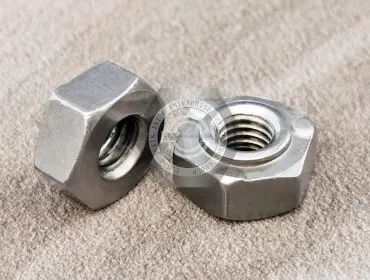
DIN 929 hex weld nuts
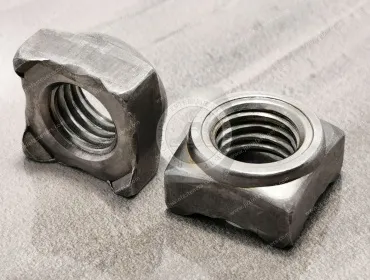
DIN 928 square weld nuts
Square projection weld nuts
Hexagonal projection weld nuts
Flange projection weld nuts
Multi-projection weld nuts
Round piloted projection weld nuts
Floating cage weld nuts
Custom drawing-based weld nuts
The engineering challenge is not simply selecting an M6, M8 or M10 weld nut.
A successful projection-welded threaded joint depends on the interaction between the weld nut geometry, projection design, parent sheet,
material condition, coating, electrode arrangement, welding parameters and assembly fixture.
For automotive OEMs, Tier suppliers, sheet-metal fabricators and procurement teams, this distinction is critical.
Projection weld nuts are used where manufacturers need a permanent threaded feature integrated into a welded sheet-metal structure.
Potential applications include:
Body reinforcement structures
Cross-members
Floor assemblies
Structural brackets
Inner body panels
Mounting brackets
Equipment attachment points
Interior structural mounting locations
Depending on vehicle architecture and engineering requirements, weld nuts may be used in:
Chassis brackets
Underbody structures
Suspension-related brackets
Shield mounting locations
Structural support components
Equipment mounting points
The final nut geometry, material and weld process must be validated for the actual parent sheet and load condition.
Weld nuts can also appear in:
Seat structures
Dashboard support structures
Lighting mounting systems
Interior brackets
Exterior component mounting
Equipment supports
Accessory attachment points
Projection weld nuts are also relevant to:
Truck structures
Bus assemblies
Rail-related fabricated structures
Agricultural machinery
Construction equipment
Material-handling equipment
Outside automotive manufacturing, weld nuts are widely applicable to:
HVAC equipment
Electrical cabinets
Commercial food-service equipment
Industrial enclosures
Machinery guards
Equipment frames
Appliance assemblies
Fabricated metal structures
The common requirement is a durable machine thread integrated into a welded metal assembly.
Projection welding is a form of resistance welding.
Instead of relying on a broad contact surface between the nut and sheet,
specially formed projections concentrate electrical current and mechanical force at defined contact points.
During the welding cycle, resistance heating develops at these interfaces.
The projections collapse as the joint forms under controlled force.
The final result depends on several interacting variables:
Projection geometry
Projection height
Projection consistency
Nut material
Parent sheet material
Sheet thickness
Surface coating
Electrode geometry
Welding force
Welding current
Weld time
Part positioning
Fixture condition
This is why the weld nut itself cannot independently guarantee weld performance.
Projection welding is a process system, not simply a fastener property.
The projections on a weld nut are functional welding features.
They are not merely locating bumps.
Their purpose is to help concentrate current and heat at controlled locations during resistance welding.
If projection geometry varies significantly, the welding process can become less consistent.
Potential problems may include:
Uneven current concentration
Unequal projection collapse
Weld expulsion
Incomplete weld formation
Nut tilting
Variation in final nut position
For this reason, projection dimensions should be treated as functional characteristics during weld nut manufacturing.
This becomes especially important in automated automotive production where the same weld process must be repeated across large quantities of parts.
A common misconception is that a weld nut with more projections must automatically provide greater strength.
That is not necessarily true.
Three, four or multiple projection configurations distribute welding current differently and interact differently with the parent sheet.
The appropriate configuration depends on factors such as:
Nut geometry
Thread size
Parent sheet thickness
Sheet material
Available flange area
Welding equipment
Electrode configuration
Required joint performance
A properly designed three-projection nut can be more appropriate for one assembly than a larger four-projection design.
The number of projections should therefore be treated as part of the welding system rather than as a simple strength ranking.
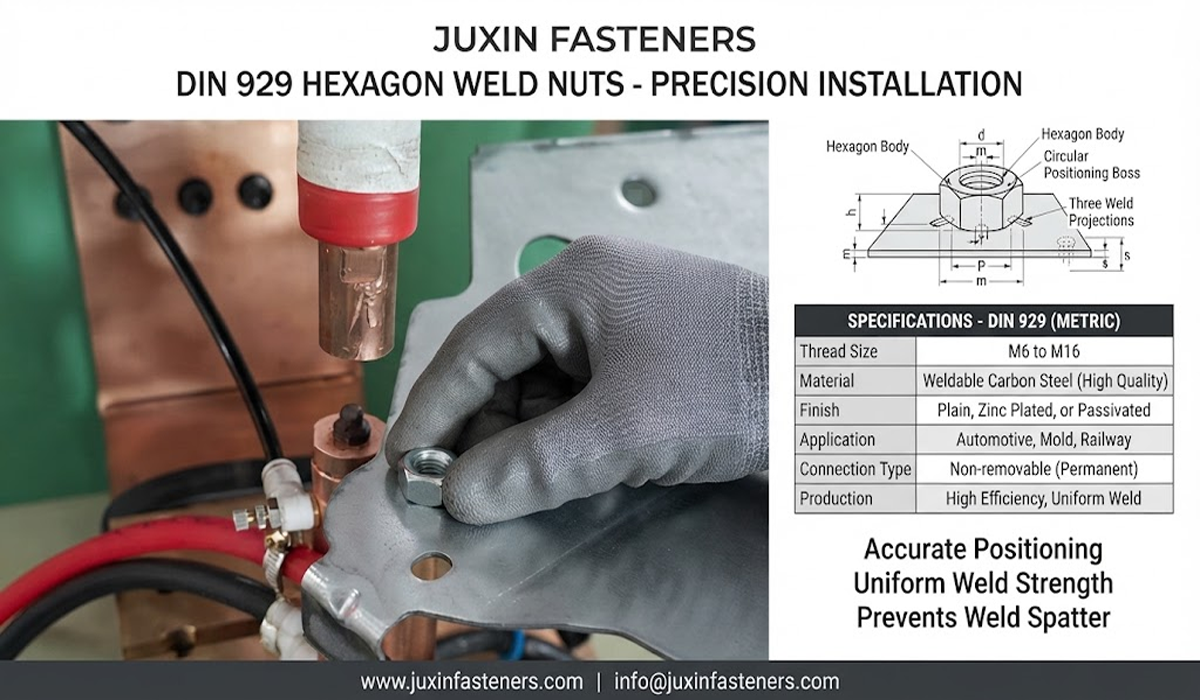
DIN 929 hex weld nuts are among the most recognizable resistance weld nut designs.
Their compact hexagonal body makes them suitable for many sheet-metal structures where space around the threaded location is limited.
Typical applications can include:
Automotive brackets
Sheet-metal frames
Machinery assemblies
HVAC components
Electrical equipment
Industrial fabricated structures
When selecting a DIN 929 weld nut, engineers should consider more than the nominal thread.
Important variables include:
Thread size
Nut dimensions
Projection geometry
Parent sheet
Welding access
Required joint performance
DIN 929 provides a useful standardized product direction, but the final welded joint still needs to be compatible with the actual production process.
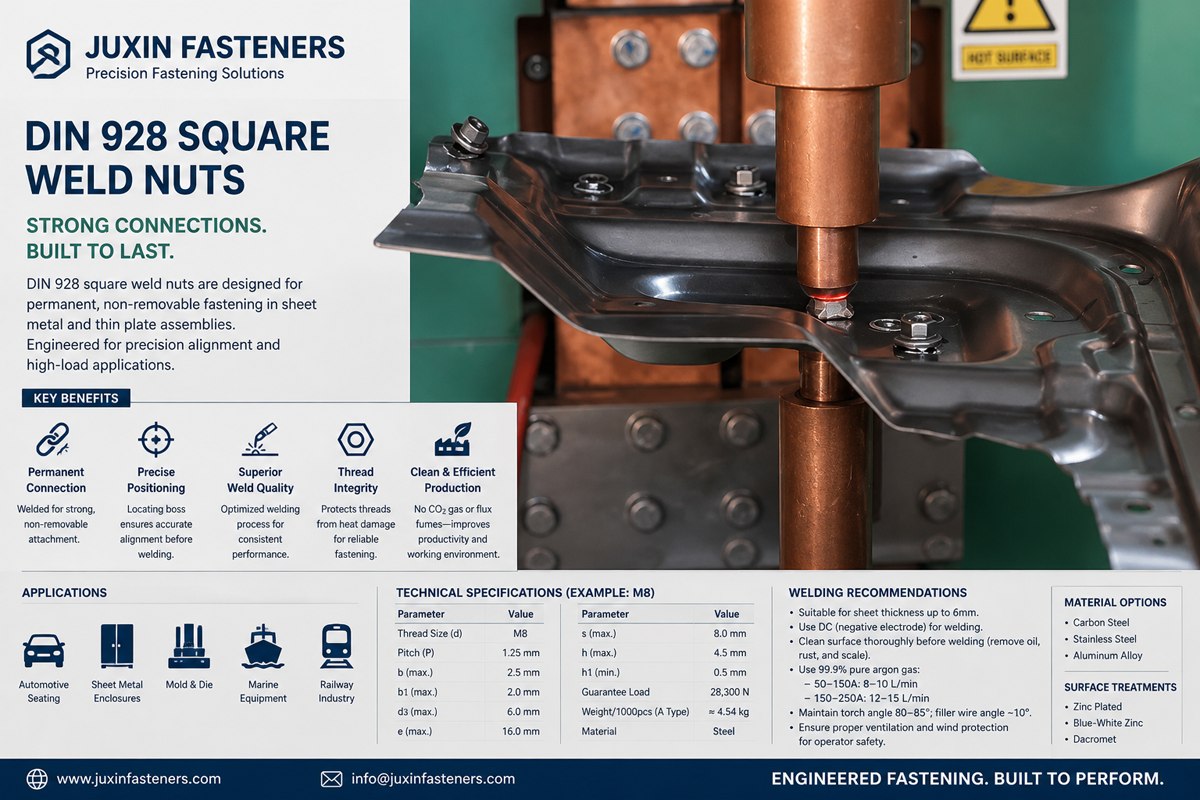
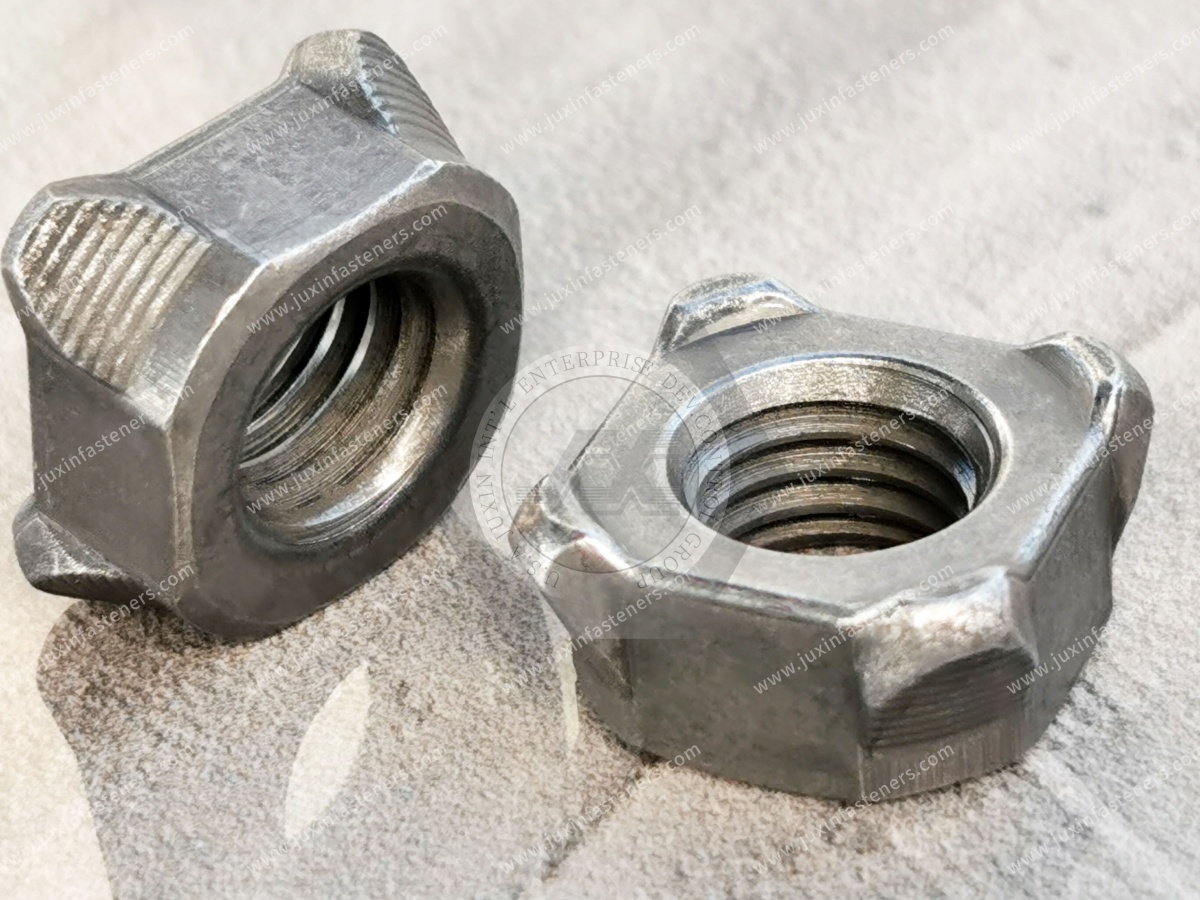
DIN 928 square weld nuts use a square body and are commonly selected for welded sheet-metal structures.
The larger footprint and projection arrangement provide a different interface from a compact hex weld nut.
Applications can include:
Automotive sheet-metal assemblies
Structural brackets
Equipment frames
Industrial enclosures
Machinery components
Fabricated metal assemblies
The choice between DIN 928 and DIN 929 should not be based simply on which nut appears larger.
Packaging space, electrode access, parent sheet geometry, projection arrangement and final joint requirements all matter.
This is a useful engineering decision because both products may be available in the same thread size.
Consider a hexagonal weld nut where:
Installation space is restricted
A compact external profile is preferred
The established assembly already uses a DIN 929-type geometry
Electrode and fixture design suit the nut
Consider a square weld nut where:
The sheet-metal design provides sufficient footprint
The projection arrangement suits the welding process
A DIN 928-type configuration matches the existing assembly
The equipment and fixture are designed for the square geometry
Neither shape is universally superior.
The correct choice is the one that integrates best with the sheet-metal design and welding process.
Flange weld nuts provide a broader base around the threaded body.
Depending on the design, the flange can support:
Projection placement
Part positioning
Load transfer
Welding interface geometry
Flange-style projection weld nuts can be useful in automotive and industrial applications where a different footprint is required from standard DIN 928 or DIN 929 configurations.
JUXIN FASTENERS can evaluate standard and drawing-based flange weld nut designs according to the customer application.
Some weld nut designs incorporate a pilot feature.
The pilot can help locate the nut relative to a hole in the parent sheet.
This can be important in automated welding and assembly because the final threaded axis must remain correctly positioned for downstream bolt installation.
However, the pilot should not be treated simply as a thread-protection feature.
Its function can include:
Locating the nut
Supporting alignment
Interfacing with the sheet hole
Helping control assembly position
Pilot diameter, pilot height and mating-hole geometry therefore need to be evaluated together.
A weld nut can be securely attached and still create an assembly problem if its thread is not positioned correctly relative to the mating component.
Potential downstream problems include:
Bolt insertion difficulty
Cross-threading
Misalignment with mating holes
Assembly-line rework
Increased installation time
This is particularly important where robotic assembly or automated bolt installation is used.
The fastening system should therefore control both:
weld integrity and thread position.
For automated production, part feeding and fixture repeatability can be just as important as the weld nut dimensions themselves.
Weld spatter, deformation and process contamination can interfere with bolt installation after welding.
However, it is misleading to claim that one weld nut geometry can completely eliminate these problems.
Thread condition after welding depends on:
Nut design
Welding parameters
Sheet condition
Electrode condition
Fixture alignment
Spatter generation
Downstream handling
For high-volume production, manufacturers should validate the complete welded assembly using the actual mating bolt or an appropriate thread inspection method.
This is more meaningful than inspecting the unwelded nut alone.
A weld nut can pass incoming dimensional inspection but still create problems after welding.
Why?
Because welding introduces heat, force and localized deformation into the assembly.
For critical production applications, quality planning should therefore distinguish between:
Potential characteristics include:
Thread dimensions
Nut dimensions
Projection geometry
Pilot dimensions
Material
Surface condition
Potential checks can include:
Nut position
Thread usability
Push-out performance
Torque resistance
Visual weld condition
Destructive weld evaluation where specified
This separation is important.
Fastener quality and welding-process quality are related, but they are not the same thing.
Weld nut performance is frequently discussed using push-out and torque testing.
These evaluate different aspects of the joint.
Push-out testing evaluates resistance to a force attempting to separate the nut from the parent sheet in an axial direction.
Torque testing evaluates resistance to rotational loading around the threaded axis.
An application may place greater importance on one failure mode than another.
For example, bolt installation generates rotational loading, while certain service loads may create axial forces.
The required acceptance criteria should therefore come from the OEM drawing, engineering specification or validated production standard.
JUXIN should not substitute generic values for application-specific requirements.
Automotive and industrial sheet-metal structures frequently use zinc-coated or galvanized steel for corrosion protection.
This changes the projection welding condition.
The zinc coating affects:
Electrical contact resistance
Heat generation
Electrode behavior
Surface condition
Process window
The appropriate welding parameters may therefore differ from those used on uncoated cold-rolled steel.
This does not mean galvanized sheet is unsuitable for projection welding.
It means the weld nut, sheet coating and welding process must be validated together.
For sourcing teams, identifying the parent sheet only as “steel” is therefore not enough.
The coating condition should also be communicated.
Projection weld nuts are commonly manufactured from weldable low-carbon steel for applications requiring resistance welding.
JUXIN works with low-carbon steel materials suitable for cold forming and weld nut manufacturing.
For custom projects, material should be selected according to:
Product geometry
Forming process
Thread requirements
Welding process
Mechanical requirements
Customer drawing
Material selection should not be based only on final nut strength.
A material that is unnecessarily hard or poorly matched to the welding process can create additional manufacturing challenges.
Surface treatment on a weld nut must be compatible with the intended welding process.
Depending on the customer specification and manufacturing sequence, weld nuts may be supplied with a surface condition intended for subsequent welding.
The appropriate condition should be agreed according to:
Corrosion requirements
Welding process
Storage conditions
Parent sheet coating
Final assembly treatment
For welded fasteners, the best corrosion solution cannot be selected independently from the welding process.
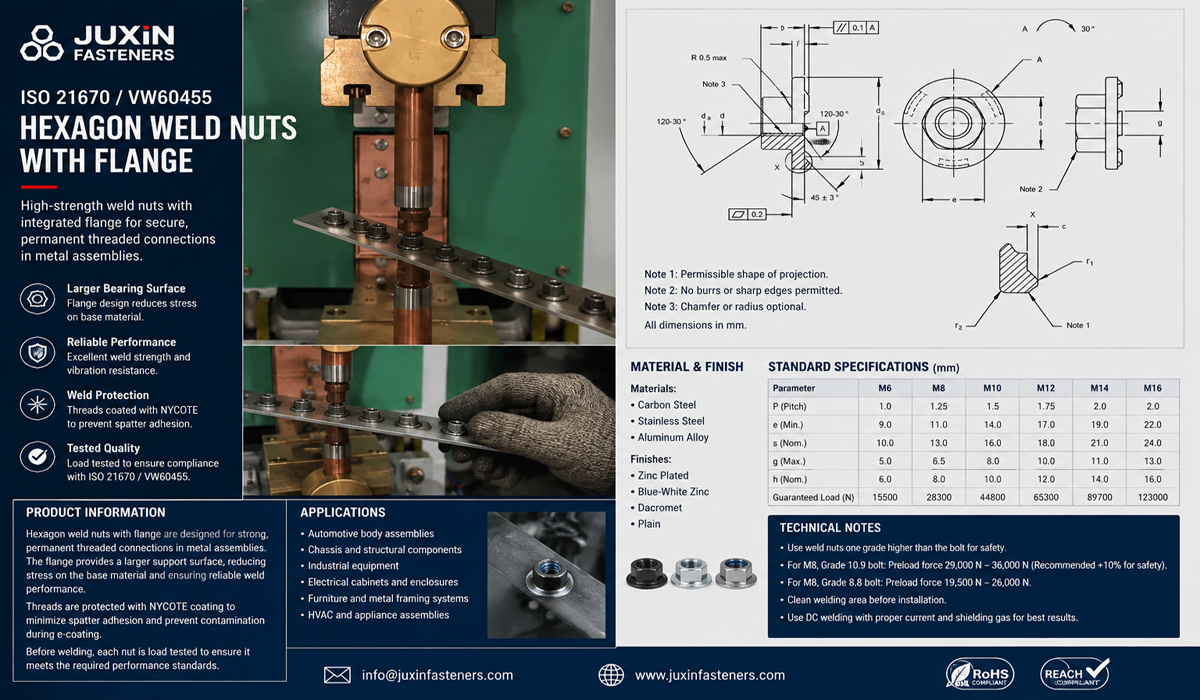
Both technologies create permanent threaded features in sheet metal, but they belong to different manufacturing processes.
| Design Condition | Projection Weld Nut | Self-Clinching Nut |
|---|---|---|
| Primary installation method | Resistance welding | Press installation |
| Heat input | Yes | No welding heat |
| Production environment | Welding cell | Press operation |
| Typical use | Welded sheet-metal structures | Thin-sheet panels and chassis |
| Parent material requirement | Must suit welding process | Must suit clinching process |
| Main retention mechanism | Welded joint | Mechanical interlock |
| Process validation | Welding parameters and joint testing | Hole, sheet and installation validation |
If the manufacturing plant already uses automated resistance welding, weld nuts may integrate naturally into the production flow.
If welding is undesirable and press access is available, self-clinching hardware may be more appropriate.
Rivet nuts are particularly useful when the installer has access from only one side of the component.
Projection weld nuts normally belong to an earlier fabrication stage where the sheet-metal component is accessible to welding equipment.
A rivet nut may be preferable when:
The structure is already assembled
Only one side is accessible
Welding is not available
Retrofit installation is required
A weld nut may be preferable when:
The component is still in fabrication
Resistance welding is part of the production process
The threaded feature should be permanently integrated into the welded structure
High-volume automated production is planned
Again, the correct decision comes from the manufacturing process rather than the thread size.
High-volume automotive manufacturing introduces requirements that may not matter in manual welding.
Automated equipment can be sensitive to:
Part orientation
External geometry
Dimensional consistency
Burrs
Surface condition
Projection consistency
Packaging
Part-to-part variation
A weld nut that works during manual prototype welding may still require additional evaluation before entering an automated feeding system.
For procurement and supplier development teams, this means part approval should consider both:
functional weld performance and manufacturing-line compatibility.
If automatic feeding is planned, this should be communicated during the RFQ stage.
Packaging is often treated purely as a logistics topic.
For high-volume weld nuts, it can influence manufacturing performance.
Poor packaging can contribute to:
Part contamination
Mixed parts
Surface damage
Excessive handling
Feeding interruptions
Where weld nuts are used in automated production, procurement teams should define packaging and identification requirements alongside dimensional requirements.
This is particularly relevant for automotive and other high-volume assembly environments.
Not every application fits DIN 928 or DIN 929.
OEM designs may require:
Special flange diameters
Different projection geometry
Custom pilot dimensions
Non-standard overall height
Special thread sizes
Special locating features
Restricted installation envelopes
Application-specific feeding geometry
JUXIN FASTENERS supports drawing-based development of customized weld nuts where standard products do not match the assembly.
For a custom weld nut project, the most useful information is not simply a sample photograph.
Provide the complete drawing and application conditions.
Design engineers should begin with these questions:
What is the parent sheet material?
Cold-rolled steel, galvanized steel, another coated steel or another weldable substrate?
What is the sheet thickness?
The parent sheet influences the welding process and joint design.
What thread is required?
Define diameter, pitch and thread tolerance.
Is a standard DIN 928 or DIN 929 geometry suitable?
If not, determine which dimension or feature requires customization.
Does the nut need a pilot?
Evaluate the mating hole and required thread position.
How will the nut be welded?
Manual, semi-automatic or automated resistance welding?
How will the nut be fed into the welding station?
If automatic feeding is required, geometry and packaging become additional considerations.
What joint validation is required?
Define push-out, torque resistance, thread condition or other project-specific acceptance criteria.
This provides a much stronger technical basis than searching only for “high-strength weld nut.”
For procurement managers and supplier development teams, an RFQ should ideally include:
DIN 928, DIN 929 or customer drawing
Thread size and pitch
Nut geometry
Projection geometry where drawing-controlled
Pilot dimensions where applicable
Material
Parent sheet material
Parent sheet thickness
Parent sheet coating
Surface treatment requirement
Welding method
Automated feeding requirement
Required mechanical validation
Annual quantity
Prototype quantity
Packaging requirements
Labeling requirements
Inspection requirements
For an existing automotive or industrial project, providing the mating panel drawing can significantly improve technical review.
For repeat production, supplier evaluation should go beyond checking thread dimensions.
Important characteristics may include:
Material consistency
Thread quality
Projection dimensions
Projection consistency
Pilot dimensions
Overall geometry
Burr control
Surface condition
Drawing revision control
Batch identification
Packaging consistency
The exact control plan should reflect the customer drawing and application requirements.
The objective is not to inspect every dimension equally.
It is to identify which characteristics can affect welding, positioning, feeding and final assembly.
For standard and customized weld nut projects, a typical development path can follow:
Application Requirement → Drawing Review → Material & Projection Review → Sample Manufacturing → Welding Evaluation
→ Dimensional & Functional Approval → Golden Sample → Production
For customized components, tooling requirements can be evaluated after the drawing and projected production quantity are reviewed.
JUXIN FASTENERS supplies weld nuts and welded fastening components for OEM manufacturers, Tier suppliers, sheet-metal fabricators and industrial equipment manufacturers.
This page focuses on projection weld nuts for automotive and industrial sheet-metal assemblies.
Related product families include:
DIN 929 Hex Weld Nuts — compact hexagonal weld nuts for resistance welding
DIN 928 Square Weld Nuts — square-body projection weld nuts
Flange Projection Weld Nuts — wider-base configurations for selected sheet-metal assemblies
Round Piloted Projection Weld Nuts — locating designs for drawing-specific applications
Floating Cage Weld Nuts — threaded assemblies where controlled positional movement is required
Weld Studs — male threaded attachment points for welded assemblies
Weld Pins — welded attachment solutions for insulation and other industrial applications
Self-Clinching Fasteners for Telecom Cabinets & AI Data Center Enclosures — non-welded press-installed threads for thin-sheet equipment
Blind Rivet Nuts — one-sided threaded installation for closed or inaccessible structures
As these individual product pages are developed, they should internally link back to this projection weld nut application page,
while this page links into the specific DIN 928, DIN 929 and specialized weld nut product pages.
If you are designing or sourcing weld nuts for:
Automotive body-in-white structures
Automotive chassis assemblies
Automotive brackets
Commercial vehicles
Transportation equipment
HVAC systems
Electrical cabinets
Industrial enclosures
Commercial food-service equipment
Machinery
Fabricated sheet-metal structures
send us your 2D drawing, 3D model where available, thread size, parent sheet material, sheet thickness, coating condition, welding process and estimated production quantity.
For an existing assembly, information about the current weld process and any specific welding or assembly problem can also help the technical review.
JUXIN FASTENERS can evaluate standard DIN 929 hex weld nuts, DIN 928 square weld nuts, flange projection weld nuts,
piloted weld nuts and drawing-based custom weld nut configurations according to the application.
JUXIN FASTENERS
Website: www.juxinfasteners.com
Engineering & RFQ: info@juxinfasteners.com
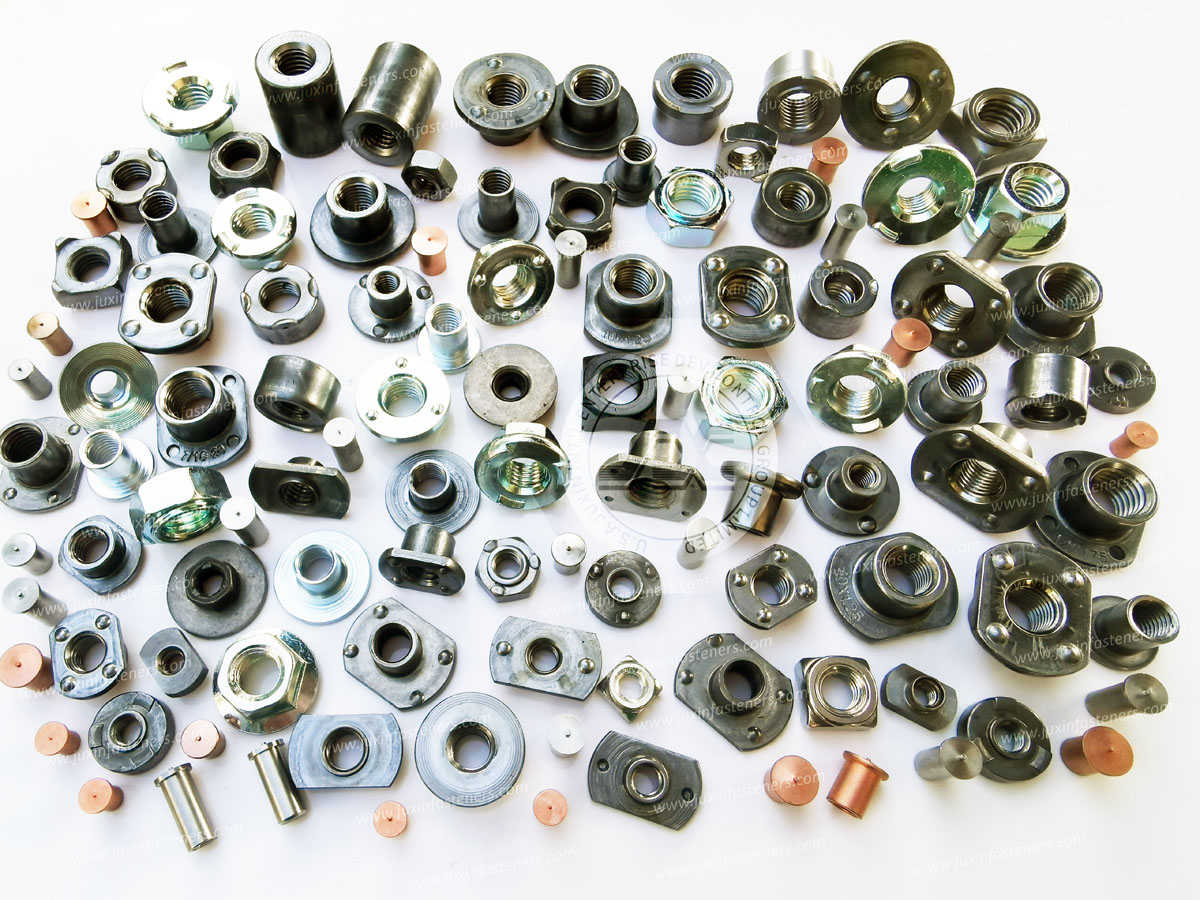
Product Packaging
Packaging Standard
At Juxin Fasteners, we apply standardized export packaging to ensure product protection, traceability, and compliance with international logistics requirements.
1. Standard Export Packaging
Unless otherwise specified, all products will be packed according to our factory standard export packaging, which includes:
Moisture-resistant inner protection
Poly bag or small box packing as required
Reinforced export cartons
Clear labeling with part number, specification, batch number, and quantity
Palletizing for sea or air shipment when necessary
Our standard packaging is designed to ensure safe transportation, efficient warehousing, and long-distance international shipping.
2. Customized Packaging Options
We also provide customized packaging solutions according to customer requirements, including but not limited to:
Private labeling
Customized barcodes
Specific carton dimensions
Retail packaging
Special pallet configuration
Customer-specific marking and identification
So that you know, customized packaging may involve additional costs and extended lead time depending on the complexity of the requirements.
3. Compliance & Quality Assurance
All packaging processes are controlled under our ISO 9001 quality management system to ensure consistency, traceability, and product integrity throughout the supply chain.
Product Pictures
Contact Us
Tel.:
+86 020 8621 0320
+86 020 3121 6067
E-mail:
Technical Support:
Navigation
SEND INQUIREY