Call Us
+86 136 6007 9809
Call Us
+86 136 6007 9809

Juxin Fasteners manufactures carbon steel conical seat lug nuts and closed-end acorn wheel nuts for automotive OEM and wheel assembly applications.
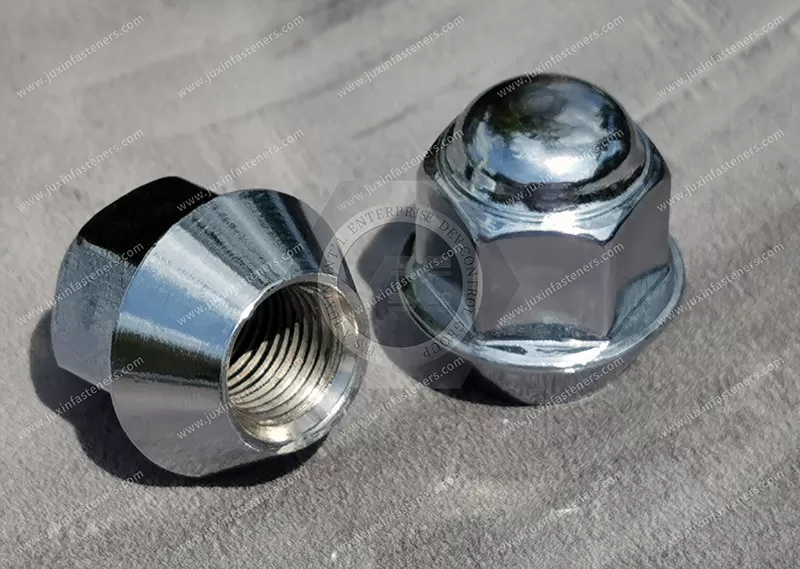
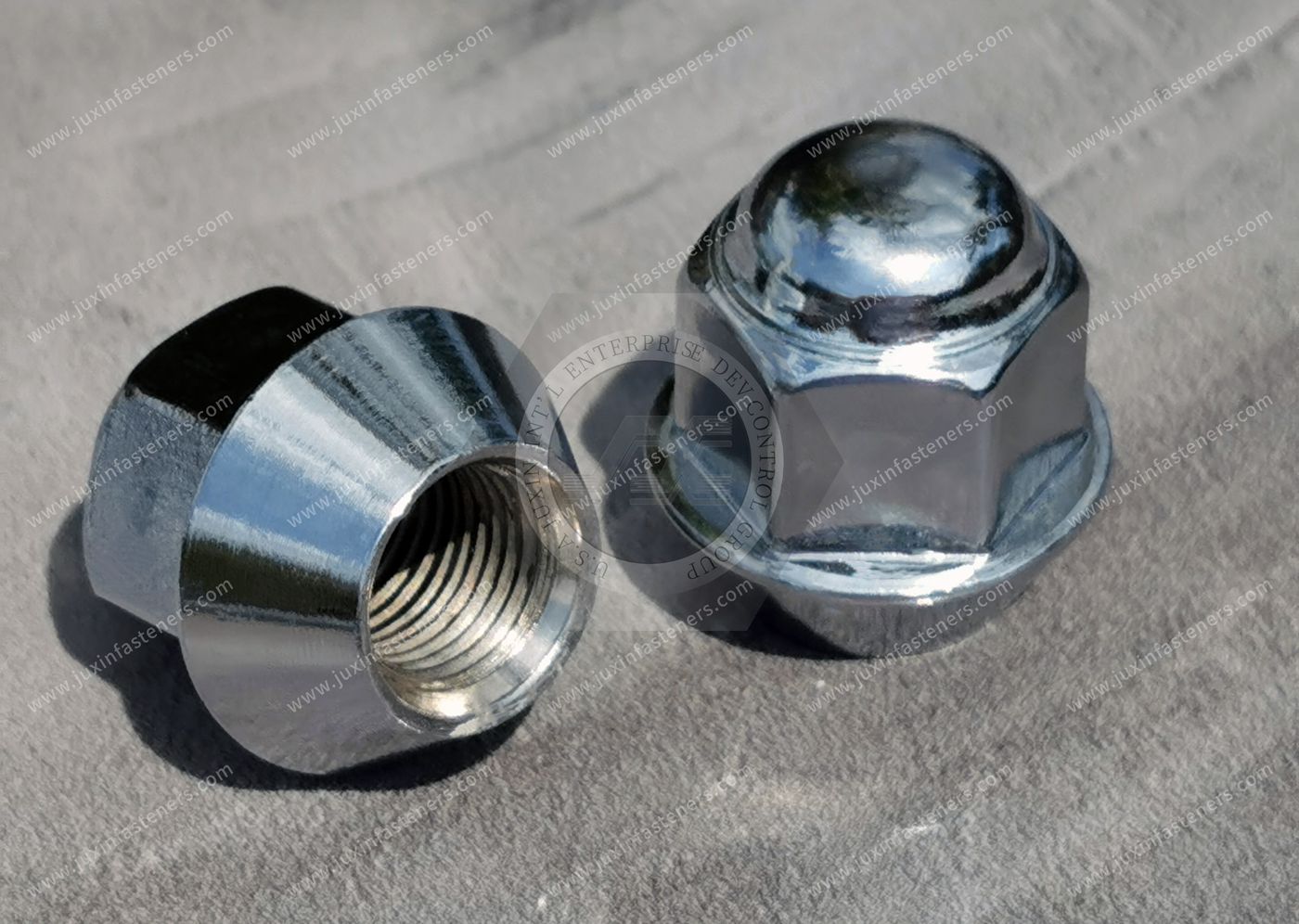
The product family includes external hex designs with tapered seating surfaces and domed closed-end configurations, as illustrated in the product images.
Available thread specifications in the supplied range include M12×1.25, M12×1.5, M12×1.75, M14×1.5, M14×2.0, M16×1.5, 7/16-20 UNF, 1/2-20 UNF and 9/16-18 UNF.
Exact seat angle, hex size, overall height, internal thread depth and mechanical properties are determined by the approved drawing.
Juxin Fasteners supports OEM/ODM made-to-drawing production using cold heading, cold forming, CNC machining and appropriate secondary processes.
Chrome plating, zinc plating, black finishes and other customer-specified coatings can be evaluated according to corrosion, friction and application requirements.
Product Specification
Conical Seat and Acorn Lug Nuts for Automotive Wheel Assemblies
Carbon Steel Wheel Nut Manufacturing | Metric and UNF Threads | OEM/ODM Production
Juxin Fasteners is an industrial fastener manufacturer specializing in standard and custom-engineered fastening components for automotive OEMs,
wheel assembly manufacturers and industrial production programs.
Our conical seat and acorn lug nut product family includes carbon steel hexagonal wheel nuts with tapered seating surfaces and closed-end domed designs.
These configurations are used in wheel attachment systems where the thread, seating geometry, nut dimensions and mechanical requirements match the approved vehicle and wheel specifications.
Juxin Fasteners supports made-to-drawing manufacturing using cold heading, cold forming, CNC machining and product-specific secondary operations.
The manufacturing route is selected according to material, geometry, tolerances, mechanical properties and production volume.
Product Specifications
| Parameter | Specification |
|---|---|
| Product Family | Automotive Wheel Nuts |
| Main Product Types | Conical Seat Lug Nuts; Acorn Lug Nuts |
| Alternative Terms | Tapered Seat Lug Nuts; Closed-End Wheel Nuts |
| Material | Carbon Steel |
| External Drive | Hexagonal |
| Seat Geometry | Drawing-Specified Conical Seat |
| Typical Cone Seat Reference | 60° Included Angle, Where Specified |
| End Configuration | Open-End or Closed-End, Depending on Design |
| Metric Threads | M12×1.25, M12×1.5, M12×1.75, M14×1.5, M14×2.0, M16×1.5 |
| Unified Inch Threads | 7/16-20 UNF, 1/2-20 UNF, 9/16-18 UNF |
| Surface Treatments | Chrome, Zinc, Black and Other Approved Finishes |
| Manufacturing | Cold Heading, Cold Forming, CNC and Secondary Operations as Required |
| Customization | OEM/ODM Made-to-Drawing |
| Production | Industrial Batch Manufacturing |
The listed thread sizes represent the supplied product range.
Specific combinations of thread size, seat profile, overall length and end configuration require confirmation against the applicable drawing.
What Is a Conical Seat Lug Nut?
A conical seat lug nut is an internally threaded wheel fastener with a tapered bearing surface designed to contact a corresponding conical seat in the wheel.
The tapered interface helps locate the wheel nut within the mating seat during installation. Correct seating geometry is essential to the wheel attachment system.
A 60-degree included cone angle is commonly used in automotive wheel fastening applications, but it must not be assumed for every wheel design.
The cone angle, bearing diameter, thread size, hex dimensions and nut height must be specified and verified.
What Is an Acorn Lug Nut?
An acorn lug nut is commonly identified by its closed-end, domed exterior.
The closed end covers the exposed tip of the wheel stud when the stud length and internal nut depth are correctly matched.
Acorn lug nuts are widely recognized in North American automotive terminology.
Important features include:
Closed-end construction.
External hexagonal drive.
Defined internal thread.
Application-specific wheel seating surface.
Customer-specified nut height.
Protective or decorative finish.
An acorn nut is not defined solely by its seating geometry. Closed-end acorn designs may be manufactured with different seat configurations according to the intended wheel assembly.
Conical Seat vs. Acorn Lug Nuts
The terms describe different product characteristics.
| Term | Primary Meaning | Engineering Consideration |
|---|---|---|
| Conical Seat Lug Nut | Tapered Bearing Surface | Cone Angle and Seat Contact |
| Acorn Lug Nut | Domed Closed-End Design | Internal Depth and Stud Clearance |
| Bulge Acorn Lug Nut | Closed-End Nut with Enlarged Conical Seat | Bearing Surface Geometry |
| Open-End Conical Lug Nut | Through-Threaded Nut with Tapered Seat | Stud Engagement and Protrusion |
A single lug nut may be both an acorn nut and a conical seat nut.
For OEM manufacturing, both the end configuration and the seating surface must be specified independently.
Conical Seat Geometry and Wheel Compatibility
The conical seating surface is one of the most important features of the wheel nut.
Engineering requirements may include:
Cone included angle.
Minimum and maximum seat diameters.
Bearing contact geometry.
Surface finish.
Nut body dimensions.
Thread position relative to the seat.
Mating wheel geometry.
A conical seat lug nut must not be substituted for a spherical-seat or flat-seat design solely because the internal thread matches.
60-Degree Cone Seat Lug Nuts
A 60-degree conical seat is a common configuration in automotive wheel fastening.
The 60-degree value refers to the included cone angle, not the angle between the tapered surface and the nut axis.
Where this design is specified, the seating surface must match the approved wheel geometry.
Juxin Fasteners can evaluate custom conical seat dimensions according to customer drawings.
Bulge Seat Acorn Lug Nuts
Bulge seat acorn lug nuts have an enlarged conical seating region compared with certain standard cone seat designs.
They are used where the wheel mounting interface requires the corresponding larger bearing surface.
The term “bulge” does not define a universal seat diameter.
Engineering drawings must specify the required profile and dimensions.
Closed-End Design and Stud Clearance
Closed-end acorn lug nuts require particular attention to internal thread depth.
If the wheel stud contacts the closed end before the seating surface is correctly loaded, the assembly may not achieve the intended clamping condition.
Design review should include:
Overall nut height.
Internal thread depth.
Available internal clearance.
Wheel stud length.
Required thread engagement.
Seating surface contact.
Installation tool clearance.
A decorative dome must not compromise the mechanical function of the wheel attachment system.
Metric Thread Sizes
The supplied product range includes the following metric thread specifications.
| Thread Size | Nominal Diameter | Thread Pitch |
|---|---|---|
| M12×1.25 | 12 mm | 1.25 mm |
| M12×1.5 | 12 mm | 1.50 mm |
| M12×1.75 | 12 mm | 1.75 mm |
| M14×1.5 | 14 mm | 1.50 mm |
| M14×2.0 | 14 mm | 2.00 mm |
| M16×1.5 | 16 mm | 1.50 mm |
These thread designations must be matched to the corresponding wheel studs.
The actual lug nut geometry, mechanical properties and seat design are determined separately.
M12 Conical Seat and Acorn Lug Nuts
M12 wheel nut configurations may use M12×1.25, M12×1.5 or M12×1.75 threads.
These pitches are not interchangeable.
For custom OEM production, the customer should specify:
Exact thread pitch.
Hex size.
Nut height.
Conical seat geometry.
Open-end or closed-end construction.
Material requirements.
Mechanical properties.
Surface treatment.
M14 Automotive Lug Nuts
M14×1.5 and M14×2.0 are different metric thread specifications.
Juxin Fasteners supports engineering review for M14 carbon steel lug nut designs based on customer drawings.
The appropriate configuration depends on the approved wheel attachment system.
M16×1.5 Custom Wheel Nuts
M16×1.5 is included in the supplied thread range.
For larger thread sizes, the available nut wall thickness, seat geometry, wrenching dimensions and mechanical requirements must be evaluated together.
Custom M16 designs are subject to manufacturing feasibility review.
American Unified Inch-Thread Lug Nuts
The product range also includes Unified fine-thread configurations relevant to North American wheel fastening applications.
| Thread Size | Thread Series | Nominal Diameter | Threads per Inch | Pitch Equivalent |
|---|---|---|---|---|
| 7/16-20 | UNF | 0.4375 in | 20 | 1.270 mm |
| 1/2-20 | UNF | 0.5000 in | 20 | 1.270 mm |
| 9/16-18 | UNF | 0.5625 in | 18 | Approximately 1.411 mm |
Pitch equivalents are dimensional references only.
Unified and metric threads must not be directly interchanged.
7/16-20 UNF Acorn Lug Nuts
7/16-20 UNF is an established Unified wheel nut thread designation.
The mating stud, seating surface, hex dimensions and internal depth must be confirmed for the intended application.
1/2-20 UNF Conical Seat Lug Nuts
1/2-20 UNF is commonly used in North American automotive wheel nut product ranges.
Both standard cone seat and bulge seat configurations exist in the market.
Juxin Fasteners can evaluate customer-specified 1/2-20 UNF wheel nut designs according to the approved drawing.
9/16-18 UNF Wheel Nuts
9/16-18 UNF is another recognized Unified fine-thread wheel nut specification.
The nut design must be selected according to the required wheel seat, thread engagement and mechanical properties.
Metric and Unified Threads Are Not Interchangeable
For example:
| Parameter | M12×1.25 | 1/2-20 UNF |
|---|---|---|
| Nominal Diameter | 12.000 mm | 12.700 mm |
| Thread Pitch | 1.250 mm | 1.270 mm |
| Thread System | ISO Metric | Unified Fine |
| Interchangeable | No | No |
Although the pitch values are similar, the thread diameters differ.
The exact mating stud specification must always be confirmed.
Hexagonal Drive Dimensions
Hexagonal lug nuts require appropriate socket engagement.
Relevant dimensions include:
Width across flats.
Hex height.
Overall nut height.
Maximum outside diameter.
Wheel recess clearance.
Tool access.
Coating thickness.
Common automotive socket sizes vary by design and must not be assigned from thread size alone.
Carbon Steel Material Selection
Carbon steel is the specified material family for these wheel nuts.
Material selection should consider:
Required mechanical properties.
Cold forming suitability.
Heat treatment response.
Thread strength.
Seat contact requirements.
Coating compatibility.
Production volume.
The actual steel grade and finished nut properties must be established from the approved specification.
Bolt property class designations such as 10.9 and 12.9 should not be used as finished nut property class designations.
Cold Heading and Cold Forming
Cold heading and cold forming are suitable manufacturing processes for many steel lug nut geometries.
Depending on the design, these processes can support repeatable body formation and efficient industrial batch production.
Forming feasibility depends on the material, geometry, tooling and required production quantity.
CNC Machining and Secondary Operations
CNC machining may be selected for specific seat geometries, dimensional features or customer-defined requirements.
The manufacturing route may combine forming and machining or use another appropriate process sequence.
Not every product requires all available manufacturing processes.
Thread Manufacturing and Inspection
Internal threads must comply with the approved thread designation and tolerance.
Engineering review may include:
Thread diameter.
Thread pitch.
Thread tolerance class.
Thread gauge inspection.
Coating effects.
Mating stud compatibility.
The thread manufacturing method is selected according to the product specification.
Heat Treatment and Mechanical Properties
Heat treatment may be required to achieve specified mechanical properties.
Relevant considerations include:
Material grade.
Hardness.
Proof-load requirements.
Thread strength.
Dimensional stability.
Surface condition.
The actual requirements must be defined by the applicable OEM specification.
Surface Finish Options
Carbon steel conical seat and acorn lug nuts may be specified with different finishes.
| Surface Treatment | Primary Consideration |
|---|---|
| Chrome Plating | Decorative Appearance and Surface Protection |
| Zinc Plating | Corrosion Protection |
| Black Zinc | Black Appearance and Protective Finish |
| Black Oxide | Appearance; Additional Protection May Be Required |
| Electrophoretic Coating | Customer-Specified Coating Performance |
| Vacuum-Deposited Decorative Coating | Appearance and Coating Compatibility |
| Zinc Flake Coating | Protective Finish Subject to Specification |
Each finish must be evaluated for corrosion requirements, adhesion, thickness, thread fit and installation friction.
A decorative appearance does not establish a specific corrosion resistance rating.
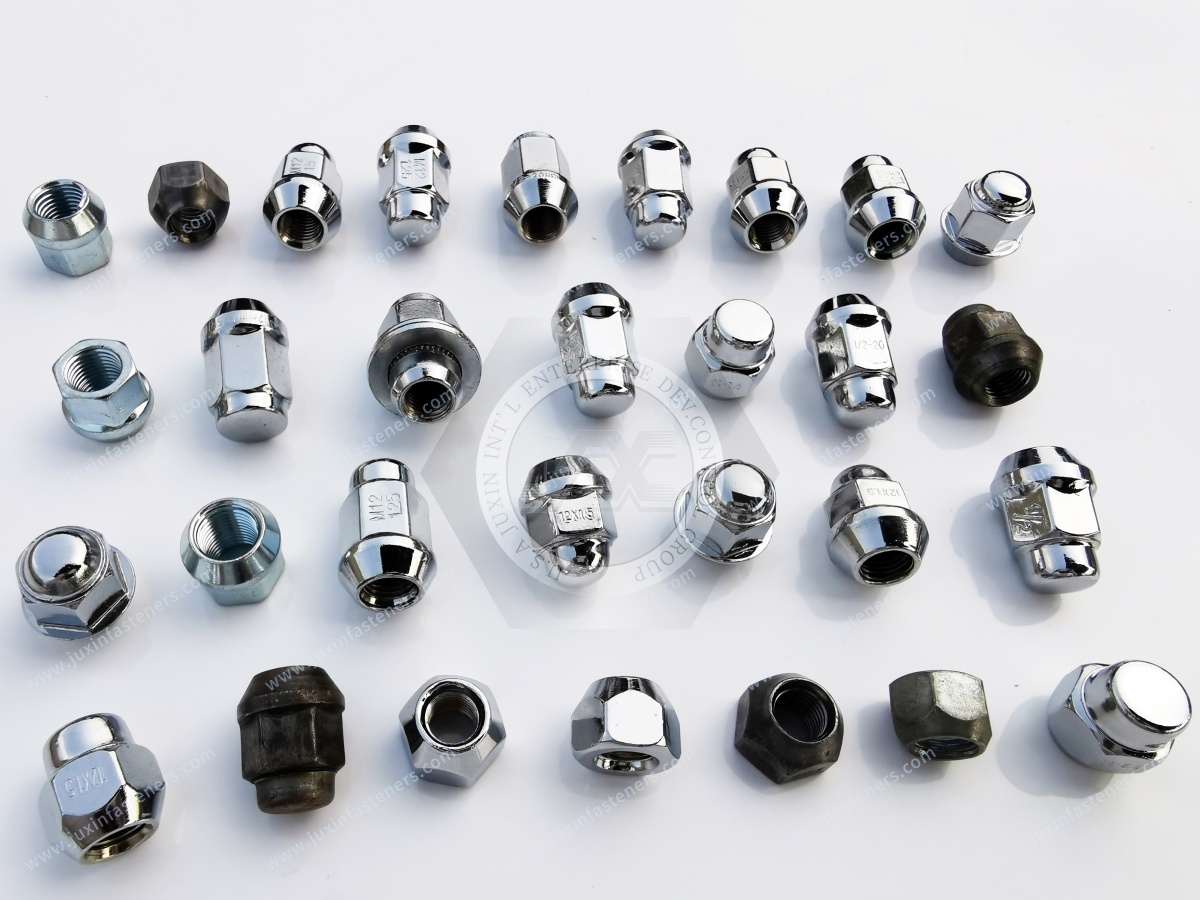
Chrome-Plated Acorn Lug Nuts
Chrome-plated acorn lug nuts are commonly associated with a bright metallic appearance.
For OEM applications, coating evaluation should consider:
Surface preparation.
Coating adhesion.
Corrosion protection.
Dimensional effects.
Thread compatibility.
Seating surface friction.
Appearance requirements.
Chrome plating does not eliminate the need for corrosion and installation validation.
Black-Finish Lug Nuts
Black-finish wheel nuts may be specified for particular vehicle or wheel designs.
Possible finish systems include black zinc, electrophoretic coating and other customer-approved coatings.
The coating specification must define the actual performance requirements rather than relying on color alone.
Wheel Nut Installation and Clamp Load
Wheel nuts are safety-critical fastening components.
Correct installation depends on the complete wheel attachment system.
Important factors include:
Thread compatibility.
Seating geometry.
Stud condition.
Coating friction.
Nut dimensions.
Thread engagement.
Installation torque.
Wheel and hub requirements.
The correct torque must be obtained from the vehicle or wheel manufacturer's approved installation instructions.
A universal torque value cannot be assigned from thread size alone.
Wheel Nut Loosening and Retention
A conical seat does not independently establish a prevailing-torque locking mechanism.
Reliable wheel attachment depends on the specified clamping condition, mating components and installation procedure.
Any special locking feature must be separately specified and validated.
Passenger Car Wheel Assemblies
Passenger vehicle wheel assemblies may use conical seat or acorn lug nut designs where specified by the wheel manufacturer.
Engineering requirements include:
Wheel seat compatibility.
Mating stud thread.
Nut body dimensions.
Internal depth.
Mechanical properties.
Surface finish.
Installation requirements.
SUV and Light Commercial Vehicle Applications
SUVs and light commercial vehicles may require wheel nuts with different thread sizes, seating geometries and mechanical properties.
Juxin Fasteners supports drawing-based evaluation for suitable OEM fastening requirements.
No vehicle fitment is implied without the corresponding approved specification.
Automotive Wheel and Hub Manufacturers
Wheel and hub manufacturers may require custom wheel nuts to match specific mounting designs.
Relevant parameters include:
Wheel seat angle.
Bearing contact diameter.
Stud geometry.
Nut height.
Hex dimensions.
Wheel recess clearance.
Coating requirements.
Engineering drawings should define the complete wheel attachment interface.
Automotive Tier-1 and Tier-2 Suppliers
Automotive suppliers may require wheel fastening components for production assembly programs.
Typical project considerations include:
Drawing revision control.
Material specification.
Manufacturing feasibility.
Dimensional tolerances.
Thread inspection.
Mechanical property requirements.
Surface treatment.
Sample evaluation.
Batch acceptance criteria.
Production planning.
Juxin Fasteners supports OEM/ODM manufacturing assessment for custom automotive fastener programs.
Electric Vehicle Wheel Attachment Systems
Electric vehicle manufacturers and component suppliers require wheel fasteners compatible with their approved wheel and hub assemblies.
Selection depends on vehicle loading, wheel design, thread specification, seating geometry and installation requirements.
Electric vehicle applications do not automatically require a different wheel nut material or thread system.
Aftermarket Wheel Manufacturers
Aftermarket wheel manufacturers may specify conical seat or acorn lug nuts for particular wheel mounting interfaces.
Custom designs may require:
Modified nut height.
Specific hex dimensions.
Alternative conical seat profiles.
Closed-end construction.
Decorative finishes.
Special packaging.
The wheel manufacturer's technical requirements remain controlling.
Common Wheel Nut Engineering Problems
| Problem | Possible Cause | Recommended Review |
|---|---|---|
| Incorrect Thread Fit | Wrong Diameter or Pitch | Verify Stud Thread |
| Improper Seat Contact | Wrong Seat Profile | Check Wheel Geometry |
| Nut Bottoming on Stud | Insufficient Internal Depth | Verify Stud Clearance |
| Insufficient Engagement | Incorrect Nut or Stud Design | Review Thread Engagement |
| Socket Interference | Incorrect Hex or Body Dimensions | Check Tool Clearance |
| Corrosion | Unsuitable Coating | Review Surface Specification |
| Clamp Load Variation | Friction or Installation Variation | Review Assembly Process |
These are potential engineering issues, not a substitute for inspection of the actual assembly.
Custom OEM Conical Seat and Acorn Lug Nut Manufacturing
Juxin Fasteners supports custom wheel nut production based on customer 2D drawings, 3D CAD models and engineering specifications.
Custom requirements may include:
Metric or Unified inch threads.
Conical seat angle.
Seat contact dimensions.
Bulge seat geometry.
Open-end or closed-end configuration.
Domed cap dimensions.
Hex size.
Nut overall height.
Internal thread depth.
Carbon steel grade.
Mechanical properties.
Heat treatment.
Surface coating.
Marking and packaging.
All designs are subject to manufacturing feasibility and technical review.
Engineering and Manufacturing Feasibility
Before production, the engineering review may cover:
Product geometry.
Material suitability.
Cold forming feasibility.
CNC machining requirements.
Thread manufacturing.
Heat treatment.
Surface treatment.
Tooling.
Inspection.
Production quantity.
Cost considerations.
The objective is to establish a manufacturing process suitable for the approved design.
Inspection and Quality Requirements
Project-specific quality requirements may include:
Material verification.
Thread gauge inspection.
Hex dimension measurement.
Overall height inspection.
Internal depth inspection.
Cone angle verification.
Seat geometry inspection.
Hardness evaluation.
Mechanical property testing.
Coating inspection.
Functional assembly assessment.
The actual inspection and testing scope must be agreed for each project.
Production Manager Considerations
Production managers evaluating lug nut manufacturing should consider:
Installation tool compatibility.
Thread consistency.
Nut seating geometry.
Internal stud clearance.
Coating friction.
Assembly efficiency.
Inspection requirements.
Batch consistency.
Packaging.
Delivery planning.
These factors affect both component suitability and production line reliability.
Purchasing and Supplier Development Considerations
Purchasing managers and supplier development engineers should confirm:
Product drawing and revision.
Thread specification.
Seat geometry.
Nut dimensions.
Material grade.
Mechanical properties.
Surface treatment.
Inspection criteria.
Sample requirements.
Initial order quantity.
Annual demand.
Delivery requirements.
Complete specifications support accurate engineering assessment and quotation.
Relevant International Standards
Depending on the approved product design, the following international standards may be relevant:
ISO 261 / ISO 724: ISO metric screw-thread designations and basic dimensions.
ISO 965 Series: ISO metric screw-thread tolerances.
ASME B1.1: Unified inch screw-thread requirements.
ISO 898-2: Mechanical properties of applicable carbon steel and alloy steel nuts within its defined scope.
SAE J995: Mechanical and material requirements for applicable steel nuts.
ASTM B633: Electrodeposited zinc coatings on iron and steel.
ASTM B841: Electrodeposited zinc-nickel alloy coatings.
EN ISO 10683: Non-electrolytically applied zinc flake coatings.
The approved automotive wheel attachment specification remains the controlling technical document.
Mentioning a standard does not constitute a claim of certification or conformity.
Frequently Asked Questions
What is a conical seat lug nut?
A conical seat lug nut has a tapered bearing surface designed to match the corresponding conical seat in a wheel.
What is an acorn lug nut?
An acorn lug nut is commonly identified by its closed-end domed construction.
Can an acorn lug nut also have a conical seat?
Yes. The acorn shape describes the end configuration, while the conical seat describes the bearing surface.
Are all conical seat lug nuts 60 degrees?
No. A 60-degree included cone angle is common, but the actual angle must match the approved wheel specification.
What is a bulge seat acorn lug nut?
It is a closed-end lug nut with an enlarged conical seating surface designed for a corresponding wheel seat.
What metric thread sizes are included?
The supplied range includes M12×1.25, M12×1.5, M12×1.75, M14×1.5, M14×2.0 and M16×1.5.
What American inch-thread sizes are included?
The supplied range includes 7/16-20 UNF, 1/2-20 UNF and 9/16-18 UNF.
Can metric and Unified inch-thread lug nuts be interchanged?
No. The thread diameter, pitch and thread system must match the wheel stud.
Can closed-end acorn lug nuts accommodate any stud length?
No. Internal depth and stud clearance must be verified to prevent bottoming.
Are conical seat lug nuts self-locking?
Not necessarily. A conical seating surface is not itself a prevailing-torque locking mechanism.
Can Juxin Fasteners manufacture custom conical seat lug nuts?
Yes. Juxin Fasteners supports OEM/ODM made-to-drawing manufacturing based on customer specifications and engineering feasibility.
Can custom chrome or black finishes be specified?
Yes. Finish options can be evaluated according to appearance, corrosion protection, friction and dimensional requirements.
What information is required for an OEM quotation?
The customer should provide the engineering drawing, thread designation, seat geometry, dimensions, material requirements, surface finish, mechanical properties and purchasing quantity.
Request a Quote — Custom Conical Seat and Acorn Lug Nuts
Juxin Fasteners is an industrial fastener manufacturer supporting global automotive OEMs, Tier-1 and Tier-2 suppliers, wheel manufacturers, mechanical engineers, manufacturing engineers, production managers, purchasing managers and supplier development teams.
Our manufacturing capabilities include cold heading, cold forming, CNC machining and product-specific secondary operations selected according to the approved product design.
We support OEM/ODM fastener manufacturing, custom-engineered wheel nuts, made-to-drawing production and industrial batch manufacturing.
Recommended RFQ Information
2D engineering drawing or 3D CAD model.
Metric or Unified inch thread size.
Thread pitch and tolerance.
Conical seat angle.
Seat diameter and contact geometry.
Standard or bulge seat configuration.
Open-end or closed-end design.
Internal thread depth.
Nut overall height.
Hex width across flats.
Outside diameter.
Mating wheel stud specification.
Carbon steel grade.
Mechanical property requirements.
Heat treatment specification.
Surface finish and coating requirements.
Inspection and testing requirements.
Initial order quantity.
Estimated annual demand.
Packaging and delivery requirements.
Please send your engineering drawings and technical specifications for manufacturing feasibility review and quotation.
Juxin Fasteners
Industrial Fastener Manufacturer | Custom Automotive Wheel Nuts | OEM/ODM Fastener Manufacturing | Made-to-Drawing Production
Website: https://www.juxinfasteners.com/
Email: info@juxinfasteners.com
Product Packaging
Packaging Standard
At Juxin Fasteners, we apply standardized export packaging to ensure product protection, traceability, and compliance with international logistics requirements.
1. Standard Export Packaging
Unless otherwise specified, all products will be packed according to our factory standard export packaging, which includes:
Moisture-resistant inner protection
Poly bag or small box packing as required
Reinforced export cartons
Clear labeling with part number, specification, batch number, and quantity
Palletizing for sea or air shipment when necessary
Our standard packaging is designed to ensure safe transportation, efficient warehousing, and long-distance international shipping.
2. Customized Packaging Options
We also provide customized packaging solutions according to customer requirements, including but not limited to:
Private labeling
Customized barcodes
Specific carton dimensions
Retail packaging
Special pallet configuration
Customer-specific marking and identification
So that you know, customized packaging may involve additional costs and extended lead time depending on the complexity of the requirements.
3. Compliance & Quality Assurance
All packaging processes are controlled under our ISO 9001 quality management system to ensure consistency, traceability, and product integrity throughout the supply chain.
Product Pictures

Contact Us
Tel.:
+86 020 8621 0320
+86 020 3121 6067
E-mail:
Technical Support:
Navigation
SEND INQUIREY