Call Us
+86 136 6007 9809
Call Us
+86 136 6007 9809

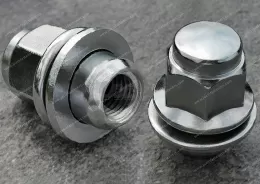
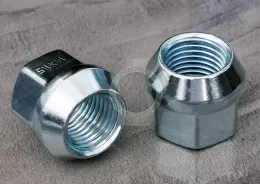
Juxin Fasteners manufactures carbon steel automotive wheel nuts and custom lug nuts for OEM wheel attachment applications.
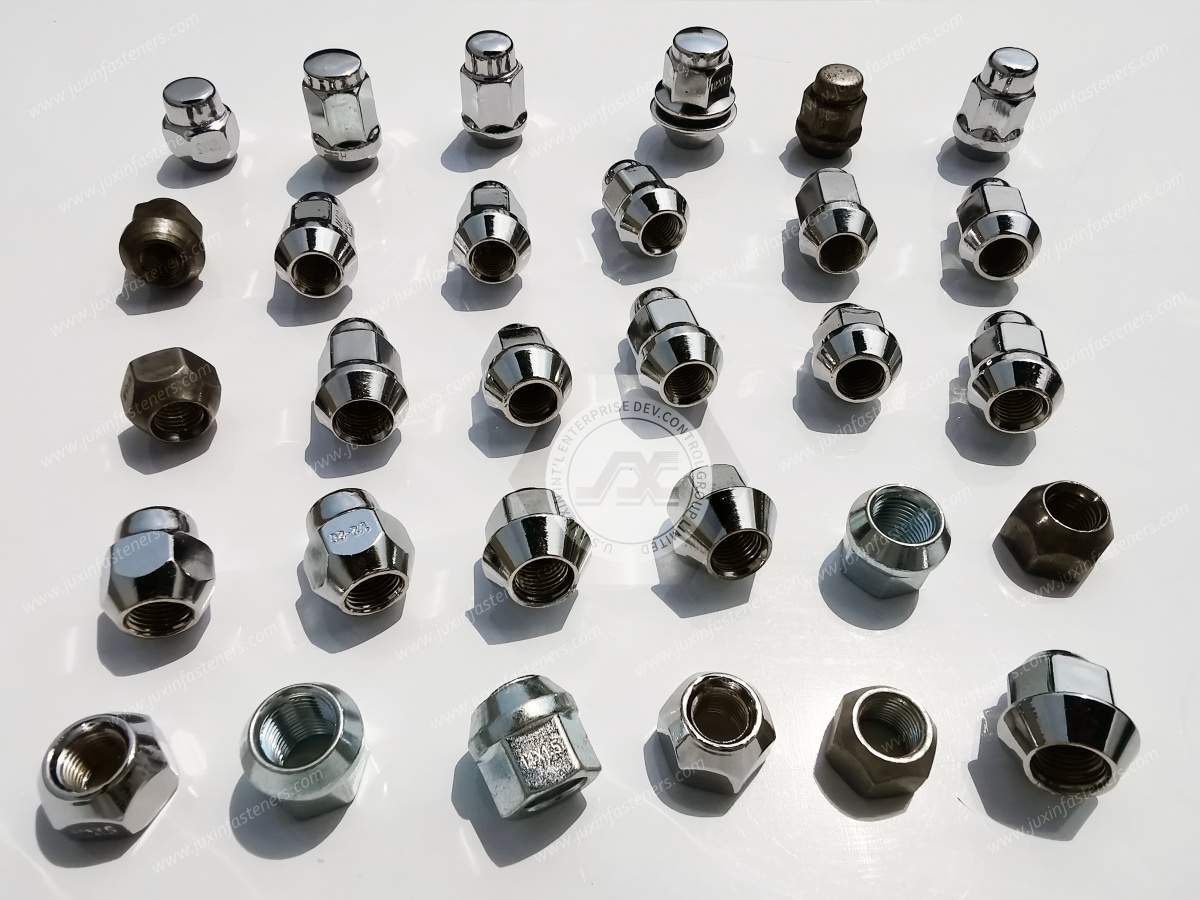
Product designs may include hexagonal wheel nuts, open-end and closed-end configurations, tuner-style nuts and spline-drive nuts, subject to approved engineering drawings.
Metric thread options include M12×1.25, M12×1.5, M12×1.75, M14×1.5, M14×2.0 and M16×1.5.
Unified inch-thread options include 7/16-20 UNF, 1/2-20 UNF and 9/16-18 UNF. Wheel seat geometry, thread compatibility, material properties and installation requirements must be verified for each application.
Juxin Fasteners supports OEM/ODM made-to-drawing manufacturing, cold forming, precision threading, CNC secondary operations and customer-specified surface finishes for industrial production programs.
Product Specification
DIN 74361-2 Form A Spherical Collar Wheel Nuts
Carbon Steel Ball-Seat Wheel Nuts for Commercial Vehicle Wheel Attachment and OEM Manufacturing
Juxin Fasteners manufactures DIN 74361-2 Form A spherical collar wheel nuts for commercial vehicle manufacturers, wheel assembly suppliers and OEM customers requiring engineered wheel fastening components.
These hexagonal wheel nuts feature an integral spherical bearing collar designed to engage a compatible spherical wheel mounting seat.
The spherical collar provides a defined bearing interface within a bolt-centered wheel attachment system.
Unlike conventional tapered-seat lug nuts, flat-seat wheel nuts or short-shank wheel nuts, Form A uses a specific spherical contact geometry.
Juxin Fasteners supports standard and custom carbon steel wheel nut manufacturing, fine-pitch metric threads, customer-engineered inch-thread configurations,
precision spherical seat geometry, mechanical property requirements and industrial batch production.
Product Technical Specifications
| Parameter | Specification |
|---|---|
| Product Name | Spherical Collar Wheel Nut |
| Standard Designation | DIN 74361-2 Form A |
| Alternative Names | Spherical-Seat Wheel Nut, Ball-Seat Wheel Nut |
| Product Category | Commercial Vehicle Wheel Fasteners |
| Material | Carbon Steel |
| Standard Reference Threads | M12×1.5, M14×1.5, M18×1.5, M20×1.5, M22×1.5 |
| Thread System | ISO Metric Fine |
| Wheel Mounting Design | Bolt-Centered Wheel Attachment |
| Bearing Geometry | Integral Spherical Collar |
| Hexagonal Drive | External Hexagon |
| Mechanical Property Class | According to Applicable Standard and Approved Drawing |
| Surface Finish | Customer-Approved |
| Additional Metric Threads | Custom Engineering Review |
| Inch-Thread Options | Customer-Specified Unified Threads |
| Manufacturing | OEM/ODM Made-to-Drawing |
| Production | Industrial Batch Manufacturing |
The actual thread, spherical seat dimensions, mechanical property class and coating must be confirmed against the controlling standard edition and approved wheel attachment drawing.
What Is a DIN 74361-2 Form A Wheel Nut?
A DIN 74361-2 Form A wheel nut is a hexagonal wheel fastening component incorporating an integral spherical collar.
The design is used in specified wheel attachment systems where the wheel is centered by the wheel bolts or studs and associated mounting geometry.
Its main features include:
Hexagonal wrenching body.
Internal fine-pitch thread.
Integral spherical bearing collar.
Defined spherical seat geometry.
Specified nut height.
Carbon steel construction.
Compatibility with an approved wheel mounting arrangement.
The spherical collar must match the corresponding wheel seat.
Correct thread size alone does not establish wheel nut interchangeability.
Spherical Collar Design and Wheel Centering
The spherical collar is the defining feature of Form A.
Its curved bearing surface is intended to contact the corresponding spherical mounting seat in the wheel.
This geometry contributes to the specified seating and centering arrangement during assembly.
Important dimensions include:
Spherical seat radius.
Collar outside diameter.
Spherical contact profile.
Nut height.
Width across flats.
Thread diameter and pitch.
Bearing surface condition.
The spherical collar must be matched to the wheel manufacturer's approved mounting geometry.
A spherical seat with an incorrect radius can produce improper contact, even when the thread fits the stud.
DIN 74361-2 Form A Standard Metric Dimensions
The following nominal dimensional references are associated with DIN 74361 Form A.
| Thread Size | Pitch | Hex Width Across Flats | Nominal Height | Nominal Collar Diameter |
|---|---|---|---|---|
| M12×1.5 | 1.5 mm | 17 mm | 18 mm | 23 mm |
| M14×1.5 | 1.5 mm | 19 mm | 20 mm | 26 mm |
| M18×1.5 | 1.5 mm | 24 mm | 25 mm | 28 mm |
| M20×1.5 | 1.5 mm | 27 mm | 27 mm | 33 mm |
| M22×1.5 | 1.5 mm | 30 mm | 30 mm | 36 mm |
These values are reference dimensions associated with the published Form A dimensional table.
They do not replace the complete standard drawing, spherical seat radius, tolerances or customer-approved engineering specifications.
Spherical Seat Radius Requirements
Spherical-seat wheel nuts must match the actual wheel seat geometry.
The radius is an important dimensional characteristic and should be identified on the approved drawing.
For DIN 74361 Form A, the standard dimensional reference includes different spherical seat radii according to the thread size and product geometry.
A nut with the correct nominal thread but incorrect spherical radius must not be treated as an approved replacement.
DIN 74361-2 Form A vs. DIN 74361-3 Type K
These two wheel nut designs are intended for different mounting arrangements.
| Feature | DIN 74361-2 Form A | DIN 74361-3 Type K |
|---|---|---|
| Main Geometry | Integral Spherical Collar | Short Guide Shank |
| Bearing Arrangement | Spherical Seat | Thrust Plate and Guide Shank |
| Centering Design | Bolt-Centered System | Specified Guided Wheel Mounting |
| Typical Threads | M12–M22 Fine Threads | M18–M22 Fine Threads |
| Wheel Compatibility | Matching Spherical Seat | Matching Guide Hole and Thrust Plate |
| Directly Interchangeable | No | No |
The two designs must remain separate in engineering documentation and purchasing specifications.
Spherical-Seat vs. Conical-Seat Lug Nuts
Spherical-seat and conical-seat wheel nuts are not interchangeable solely because their threads match.
| Feature | Spherical-Seat Nut | Conical-Seat Nut |
|---|---|---|
| Contact Geometry | Curved Spherical Surface | Straight Tapered Surface |
| Seat Identification | Spherical Radius | Cone Angle |
| Wheel Requirement | Matching Spherical Seat | Matching Conical Seat |
| Thread Compatibility | Must Match | Must Match |
| Direct Substitution | Not Recommended | Not Recommended |
A common conical-seat angle in other wheel fastening systems is 60 degrees.
This does not make a 60-degree tapered nut equivalent to DIN 74361-2 Form A.
Spherical-Seat vs. Flat-Seat Wheel Nuts
Flat-seat wheel nuts use a different bearing arrangement from spherical-seat designs.
Flat-seat configurations may incorporate washers or other defined bearing components.
The correct nut must be selected according to the wheel mounting system.
The use of a flat washer beneath a spherical-seat nut does not automatically create a valid substitute.
DIN 74361-2 Form A vs. Tuner and Spline Lug Nuts
Tuner nuts and spline-drive nuts are generally associated with particular wheel designs and installation tool requirements.
They may use narrow bodies, special external drives or other geometry.
DIN 74361-2 Form A is identified primarily by its spherical collar and standardized wheel attachment geometry.
These products should not be combined under a single technical specification.
Additional Custom Metric Thread Options
Juxin Fasteners can evaluate customer-specific spherical-seat wheel nut designs with alternative metric threads.
Potential engineering configurations include:
| Thread | Common Pitch | Configuration |
|---|---|---|
| M12×1.25 | 1.25 mm | Custom Design |
| M12×1.75 | 1.75 mm | Custom Design |
| M14×2.0 | 2.00 mm | Custom Design |
| M16×1.5 | 1.50 mm | Custom Design |
These thread configurations are not presented as standard DIN 74361-2 Form A dimensional combinations.
The spherical seat, hex dimensions, nut height and mechanical requirements must be defined through the approved drawing.
American Unified Inch-Thread Wheel Nuts
North American OEM manufacturers may specify Unified inch-thread wheel fastening components.
The following sizes are relevant to the supplied product information.
| Thread Size | Thread Series | Nominal Diameter | Threads per Inch |
|---|---|---|---|
| 7/16-20 | UNF | 0.4375 in | 20 |
| 1/2-20 | UNF | 0.5000 in | 20 |
| 9/16-18 | UNF | 0.5625 in | 18 |
These are valid Unified fine-thread designations.
However, they are not standard DIN 74361-2 Form A metric thread sizes.
Custom spherical-seat wheel nuts with these threads require engineering drawings defining the complete mounting geometry.
The seat radius, material properties and intended wheel application must be verified before production.
Metric and Inch Threads Are Not Interchangeable
For example:
| Parameter | M12×1.5 | 1/2-20 UNF |
|---|---|---|
| Nominal Diameter | 12.000 mm | 12.700 mm |
| Thread Pitch | 1.500 mm | 1.270 mm |
| Thread System | ISO Metric | Unified Fine |
| Interchangeable | No | No |
A similar nominal diameter does not establish compatibility.
The correct mating stud and wheel seat must be identified.
Commercial Truck Wheel Assemblies
Commercial truck manufacturers require wheel attachment components with controlled dimensions and mechanical properties.
Spherical collar wheel nuts may be used where the approved wheel mounting arrangement specifies this design.
Important requirements include:
Wheel seat geometry.
Thread compatibility.
Nut material properties.
Spherical collar dimensions.
Installation torque.
Surface treatment.
Inspection criteria.
Production consistency.
The complete wheel fastening system must meet the vehicle manufacturer's requirements.
Bus and Coach Manufacturing
Bus and coach manufacturers may require spherical-seat wheel nuts for compatible wheel attachment systems.
Potential applications include:
City buses.
Intercity coaches.
Commercial passenger vehicles.
Specialized transport vehicles.
The wheel nut must be selected according to the actual wheel, hub and stud specifications.
Commercial Trailer Manufacturing
Trailer manufacturers may use DIN 74361-2 Form A wheel nuts in specified bolt-centered wheel assemblies.
Engineering requirements include:
Axle and hub design.
Wheel mounting geometry.
Thread size and pitch.
Spherical seat dimensions.
Material strength.
Surface protection.
Installation procedure.
The nut should not be substituted without approval from the relevant wheel or axle manufacturer.
Wheel Hub and Wheel Assembly Manufacturing
Wheel assembly manufacturers and Tier-1 suppliers require reliable dimensional consistency.
Important manufacturing considerations include:
Spherical collar profile.
Thread tolerance.
Hexagonal dimensions.
Nut height.
Material verification.
Mechanical property requirements.
Surface finish.
Assembly compatibility.
These characteristics must be controlled according to the approved production specification.
Commercial Fleet Replacement Parts
Fleet maintenance teams require accurate replacement wheel nuts.
A replacement must match:
Original wheel attachment type.
Thread designation.
Spherical seat radius.
Nut height.
Hexagonal dimensions.
Material and mechanical properties.
Surface treatment.
Approved installation requirements.
A visually similar spherical-seat nut should not automatically be considered interchangeable.
Carbon Steel Material Selection
Carbon steel is the specified material family for this product.
Material selection depends on:
Required mechanical properties.
Cold forming characteristics.
Heat treatment response.
Thread strength.
Fatigue requirements.
Surface treatment compatibility.
Production volume.
The finished nut's mechanical property class must be established according to the controlling standard and approved customer specification.
A material grade alone does not establish the finished product strength class.
Mechanical Property Requirements
Wheel nuts are safety-relevant fastening components.
Mechanical requirements may include:
Proof load.
Hardness.
Thread strength.
Material condition.
Heat treatment.
Functional compatibility.
Published DIN 74361 Form A product references include steel property classes 8 and 10.
The applicable class must be selected and verified for the specific configuration.
No finished mechanical property class should be claimed without supporting production and inspection records.
Heat Treatment
Heat treatment may be required to achieve specified mechanical properties.
Important considerations include:
Material grade.
Strength.
Hardness.
Dimensional stability.
Thread integrity.
Spherical seat geometry.
Surface condition.
Heat treatment requirements must be controlled according to the approved manufacturing specification.
Surface Finishes for Spherical Collar Wheel Nuts
Wheel nut surface treatment affects corrosion resistance, friction and installation performance.
Potential finishing options include:
Zinc plating.
Zinc-nickel alloy coating.
Zinc flake coating.
Phosphate coating.
Customer-approved specialty coatings.
Chrome plating, black finishes, electrophoretic coatings and other decorative finishes may be evaluated where technically appropriate.
However, a decorative finish should not automatically be considered suitable for a safety-critical wheel fastening application.
Any finish must be approved for the complete wheel attachment system.
Zinc-Plated Wheel Nuts
Zinc plating may provide corrosion protection for suitable carbon steel wheel nuts.
Important requirements include:
Coating thickness.
Passivation.
Thread fit.
Surface consistency.
Corrosion resistance.
Friction behavior.
The coating must be compatible with the wheel manufacturer's installation specification.
Zinc-Nickel Alloy Coatings
Zinc-nickel coatings may be specified for certain OEM wheel fastening projects.
Important considerations include:
Coating composition.
Thickness.
Corrosion testing.
Friction characteristics.
Thread compatibility.
Hydrogen embrittlement precautions where applicable.
The coating system must be evaluated and approved before production.
Zinc Flake Coating Systems
Zinc flake coatings are relevant to industrial and automotive fastener applications.
DIN EN ISO 10683 provides requirements for non-electrolytically applied zinc flake coatings.
The actual coating system and performance criteria must be specified by the OEM.
Wheel Nut Installation and Torque
Correct installation is essential for wheel attachment safety.
The procedure must follow the vehicle, wheel, axle or hub manufacturer's approved requirements.
Important installation factors include:
Correct wheel nut type.
Matching spherical seat.
Correct thread.
Clean mounting surfaces.
Mating stud condition.
Approved lubrication requirements.
Installation sequence.
Specified tightening torque.
Required inspection.
No universal installation torque should be assigned solely from the DIN 74361-2 Form A designation.
Torque, Friction and Clamp Load
The relationship between tightening torque and clamp load depends on friction and joint geometry.
Important factors include:
Thread friction.
Spherical bearing surface friction.
Coating.
Lubrication.
Mating materials.
Wheel mounting surface.
Installation method.
Changes to surface treatment or lubrication can change the resulting clamp load.
Such changes require engineering approval.
Wheel Fastening and Vibration
Commercial vehicle wheel assemblies experience dynamic loads during service.
Wheel retention depends on the complete fastening system, including:
Correct wheel mounting geometry.
Proper stud engagement.
Material strength.
Correct tightening procedure.
Adequate clamp load.
Maintenance and inspection.
The spherical collar itself should not be described as a prevailing-torque self-locking mechanism.
It must not be assumed to contain serrations, nylon inserts or distorted threads.
Common Wheel Nut Selection Errors
| Problem | Possible Cause | Engineering Action |
|---|---|---|
| Incorrect Seat Contact | Wrong Spherical Radius | Verify Wheel Seat |
| Thread Damage | Incorrect Pitch | Confirm Stud Thread |
| Improper Mounting | Wrong Nut Type | Check Wheel Attachment Design |
| Inconsistent Clamp Load | Friction or Torque Variation | Review Installation Procedure |
| Corrosion | Unsuitable Surface Finish | Verify Coating |
| Bearing Surface Damage | Incorrect Seat Geometry | Inspect Contact Profile |
| Insufficient Thread Engagement | Incorrect Nut or Stud | Review Assembly Dimensions |
| Replacement Incompatibility | Similar Appearance, Different Design | Verify Approved Part |
Actual failure causes require engineering investigation.
OEM Manufacturing Capabilities
Juxin Fasteners is an industrial fastener manufacturer supporting custom-engineered wheel fastening components for global OEM manufacturers.
Our manufacturing capabilities include:
Cold heading.
Cold forming.
CNC machining.
Precision internal threading.
Product-specific secondary operations.
Heat treatment according to specification.
Surface finishing according to approved requirements.
Made-to-drawing OEM production.
Industrial batch manufacturing.
The production process depends on material grade, spherical collar geometry, thread requirements, mechanical properties, tolerances and production quantity.
Not every product requires every available manufacturing process.
Custom Spherical Collar Wheel Nut Manufacturing
Customer-specific configurations may include:
Modified spherical seat radius.
Custom collar diameter.
Special nut height.
Alternative hex dimensions.
Metric fine threads.
Unified inch threads.
Customer-specified carbon steel grades.
Mechanical property requirements.
Special surface finishes.
Product marking.
OEM packaging.
Any design modification must be approved for the intended wheel attachment system.
Dimensional Inspection
A project-specific inspection plan may include:
Material verification.
Thread gauge inspection.
Thread pitch verification.
Width across flats.
Overall height.
Collar outside diameter.
Spherical seat profile.
Surface finish.
Hardness.
Mechanical property verification.
Functional assembly evaluation.
Packaging and quantity verification.
Inspection criteria must follow the approved drawing and applicable standards.
Production Manager Considerations
Production managers should evaluate:
Thread dimensional consistency.
Spherical seat inspection.
Assembly tooling.
Surface finish friction.
Installation torque.
Production batch consistency.
Rework prevention.
Material verification.
Inspection efficiency.
Assembly line compatibility.
These factors affect manufacturing reliability and wheel assembly quality.
OEM Procurement and Supplier Development
Purchasing managers and supplier development engineers should confirm:
DIN 74361-2 Form A designation.
Applicable standard edition.
Thread size and pitch.
Wheel manufacturer and mounting design.
Spherical seat radius.
Collar diameter.
Nut height.
Width across flats.
Material grade.
Mechanical property class.
Heat treatment.
Surface finish.
Friction requirements.
Inspection and acceptance criteria.
Sample approval requirements.
Initial order quantity.
Annual purchasing forecast.
Packaging and delivery requirements.
Drawing revision control is important for repeat OEM programs.
Relevant International Engineering Standards
DIN 74361-2
Wheel fastening devices for bolt-centered wheel attachment systems, including Form A spherical collar wheel nuts.
ISO 261 / ISO 724
ISO metric screw-thread designations and basic dimensions.
ISO 965 Series
ISO metric screw-thread tolerances.
ISO 898-2
Mechanical properties of applicable carbon steel and alloy steel nuts within the defined scope of the standard.
ASME B1.1
Unified inch screw-thread requirements for customer-specific inch-thread configurations.
DIN EN ISO 10683
Non-electrolytically applied zinc flake coating systems for fasteners.
ASTM B633
Electrodeposited zinc coatings on iron and steel.
ASTM B841
Electrodeposited zinc-nickel alloy coatings.
Customer-Approved Wheel Attachment Drawings
The controlling requirements for spherical seat geometry, thread specifications, materials, mechanical properties and installation procedures.
References to standards do not independently establish product certification or conformity.
Frequently Asked Questions
What is a DIN 74361-2 Form A wheel nut?
It is a hexagonal wheel nut with an integral spherical collar for specified bolt-centered wheel attachment systems.
Is a spherical collar wheel nut the same as a ball-seat lug nut?
The terms describe related bearing geometry, but dimensional interchangeability must be verified.
What is the difference between Form A and Type K wheel nuts?
Form A uses an integral spherical collar. Type K uses a short guide shank and thrust plate for a different wheel mounting arrangement.
What are the standard metric thread sizes?
Published Form A dimensional references include M12×1.5, M14×1.5, M18×1.5, M20×1.5 and M22×1.5.
Can M12×1.25 or M14×2.0 versions be manufactured?
Custom designs can be evaluated according to the customer's approved wheel attachment drawing.
Are spherical-seat and conical-seat wheel nuts interchangeable?
No. The bearing geometry must match the corresponding wheel seat.
Can Unified inch-thread spherical wheel nuts be manufactured?
Yes. Customer-specific inch-thread designs can be evaluated for manufacturing feasibility.
Are these nuts suitable for commercial trucks and buses?
They may be used where the approved wheel attachment system specifies the corresponding Form A geometry.
Are spherical collar wheel nuts self-locking?
The spherical collar itself is not a prevailing-torque locking mechanism.
Can alternative coatings be specified?
Yes, subject to approval of the coating's corrosion and friction characteristics for the intended wheel attachment system.
Can Juxin Fasteners manufacture custom wheel nuts?
Yes. Juxin Fasteners supports drawing-based OEM manufacturing and industrial batch production.
Request a Quote — DIN 74361-2 Form A Spherical Collar Wheel Nuts
Juxin Fasteners manufactures industrial fastening components for commercial vehicle OEMs, wheel assembly manufacturers,
Tier-1/Tier-2 suppliers, mechanical engineers, production managers, purchasing teams and supply chain professionals.
We support DIN 74361-2 Form A spherical collar wheel nuts and customer-engineered wheel fastening components for approved commercial vehicle wheel attachment systems.
Recommended RFQ Information
2D engineering drawing or 3D CAD model.
DIN 74361-2 Form A designation.
Applicable standard edition.
Metric or Unified thread size.
Thread pitch and tolerance.
Wheel manufacturer and mounting specification.
Spherical seat radius.
Collar outside diameter.
Nut height.
Width across flats.
Material grade.
Mechanical property class.
Heat treatment requirements.
Surface finish.
Friction requirements.
Mating wheel stud specifications.
Installation requirements.
Inspection and acceptance criteria.
Initial order quantity.
Estimated annual purchasing volume.
Packaging and delivery requirements.
Please send your engineering drawings, technical specifications and purchasing requirements for manufacturing feasibility review and quotation.
Juxin Fasteners
Industrial Fastener Manufacturer | DIN 74361-2 Form A Spherical Collar Wheel Nuts | Commercial Vehicle Wheel Fasteners | OEM/ODM Manufacturing
Website: https://www.juxinfasteners.com/
Email: info@juxinfasteners.com
Product Packaging
Packaging Standard
At Juxin Fasteners, we apply standardized export packaging to ensure product protection, traceability, and compliance with international logistics requirements.
1. Standard Export Packaging
Unless otherwise specified, all products will be packed according to our factory standard export packaging, which includes:
Moisture-resistant inner protection
Poly bag or small box packing as required
Reinforced export cartons
Clear labeling with part number, specification, batch number, and quantity
Palletizing for sea or air shipment when necessary
Our standard packaging is designed to ensure safe transportation, efficient warehousing, and long-distance international shipping.
2. Customized Packaging Options
We also provide customized packaging solutions according to customer requirements, including but not limited to:
Private labeling
Customized barcodes
Specific carton dimensions
Retail packaging
Special pallet configuration
Customer-specific marking and identification
So that you know, customized packaging may involve additional costs and extended lead time depending on the complexity of the requirements.
3. Compliance & Quality Assurance
All packaging processes are controlled under our ISO 9001 quality management system to ensure consistency, traceability, and product integrity throughout the supply chain.
Product Pictures


Contact Us
Tel.:
+86 020 8621 0320
+86 020 3121 6067
E-mail:
Technical Support:
Navigation
SEND INQUIREY