
Call Us
+86 136 6007 9809
Call Us
+86 136 6007 9809

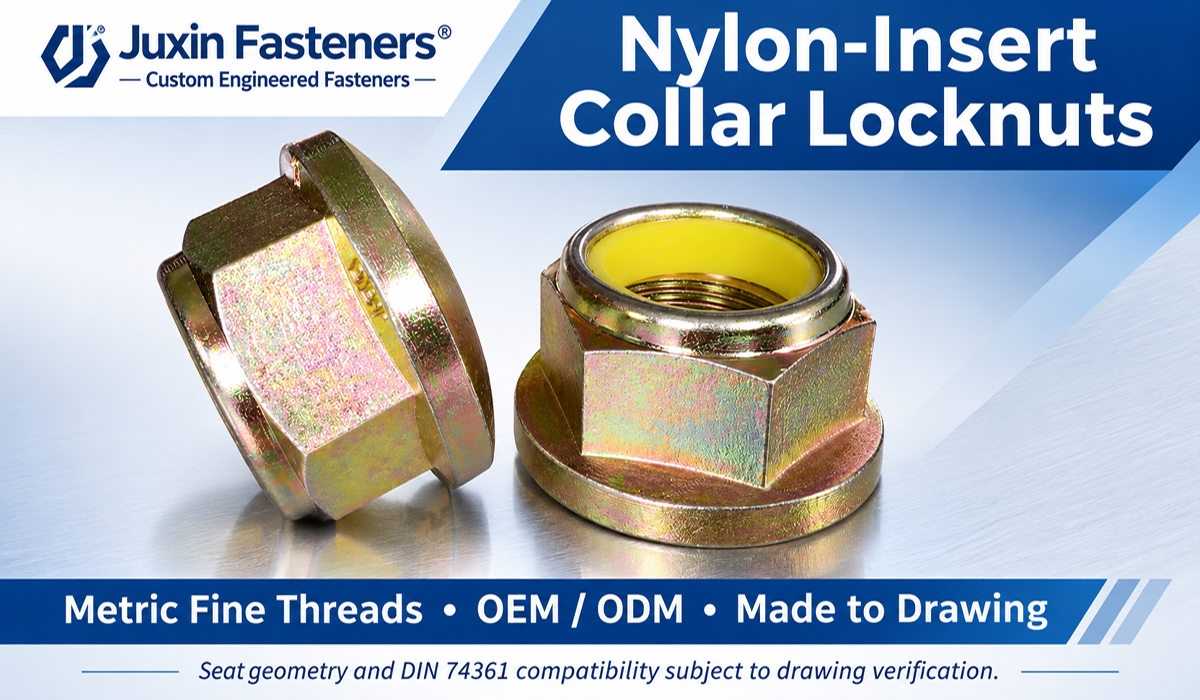
Juxin Fasteners manufactures custom nylon-insert collar locknuts for OEM mechanical assemblies and selected vehicle fastening applications.
These hexagonal locknuts combine a nonmetallic prevailing-torque insert with an enlarged bearing collar.
Spherical-seat configurations can be evaluated using DIN 74361-2 Form A dimensional references, subject to confirmation of the actual seating radius and mating interface.
Reference metric fine-thread sizes include M12×1.5, M14×1.5, M18×1.5, M20×1.5 and M22×1.5.
Carbon steel is the primary material, with Class 10 mechanical-property requirements and stainless steel alternatives subject to engineering review.
Juxin Fasteners supports OEM/ODM made-to-drawing manufacturing, custom seating geometry, CNC machining, suitable cold forming processes and industrial batch production.
Wheel fastening and other safety-critical applications require validated seat geometry, bolt compatibility, installation torque and customer approval.
Product Specification
Nylon Insert Spherical Collar Locknuts for OEM Assemblies
Custom Hex Locknuts with Nylon Inserts, Engineered Collar Geometry and Metric Fine Threads
Juxin Fasteners manufactures custom nylon-insert collar locknuts for industrial equipment, vehicle-related fastening systems and OEM mechanical assemblies.
These fastening components combine a hexagonal metal body, a nonmetallic locking insert and an enlarged bearing collar.
The nylon insert provides prevailing torque against the mating bolt, while the collar geometry determines how the nut contacts the mating component.
For spherical-seat designs, the collar must match the specified mating seat geometry.
Juxin Fasteners supports OEM/ODM manufacturing, cold heading, cold forming, CNC machining and made-to-drawing production according to customer engineering specifications.
Product Specifications
| Parameter | Specification |
|---|---|
| Product Name | Nylon Insert Spherical Collar Locknuts |
| Alternative Names | Nylon Insert Collar Nuts; Spherical Seat Locknuts; Custom Wheel Fastening Nuts |
| Body Type | Hexagonal |
| Locking Mechanism | Nonmetallic Nylon Insert |
| Collar Configuration | Customer-Specified; Spherical Seat Where Confirmed |
| Primary Material | Carbon Steel |
| Alternative Material | Stainless Steel, Subject to Review |
| Mechanical Property Option | Class 10, Subject to Verification |
| Reference Standard | DIN 74361-2 Form A for Applicable Seat Geometry |
| Reference Threads | M12×1.5 to M22×1.5 |
| Surface Finish | Customer-Specified |
| Manufacturing | Product-Specific Forming, Machining and Insert Assembly |
| Customization | OEM/ODM Made-to-Drawing Manufacturing |
The exact seat radius, collar dimensions, thread tolerance, locking torque and mechanical properties must be established by the approved drawing.
What Is a Nylon Insert Spherical Collar Locknut?
A nylon-insert spherical collar locknut combines two distinct functional features.
The first is a nylon locking insert that creates frictional resistance against the mating thread.
The second is a specially shaped bearing collar that transfers load into a compatible mating surface.
When the collar has a spherical seating profile, it must engage a corresponding spherical seat.
A spherical seat is not equivalent to a conical seat or a flat flange.
How the Nylon Locking Insert Works
As the nut is installed, the mating bolt thread engages the nylon insert.
The nylon deforms elastically and generates prevailing torque.
This rotational resistance helps resist unintended loosening under suitable conditions.
Locking performance depends on:
Nylon material.
Insert geometry.
Bolt thread tolerance.
Installation temperature.
Thread condition.
Assembly cycles.
Lubrication.
Vibration and loading.
The locking insert does not replace the need for correct joint preload or seating geometry.
Understanding Spherical Collar Geometry
A spherical collar provides a curved bearing surface.
In a properly engineered assembly, the spherical surface engages a compatible concave seat.
The seating radius and contact geometry affect load transfer and alignment.
Incorrect mating geometry can produce concentrated contact stresses and unreliable fastening.
The collar must not be treated as a universal replacement for a flat flange or conical seat.
DIN 74361-2 Form A
DIN 74361-2 addresses wheel fastening devices for bolt-centered disc wheels.
Form A includes spherical-collar wheel nut geometry.
The standard provides dimensional references for specific nut configurations.
However, adding a nylon insert does not automatically establish conformity with the complete standard.
A custom nylon-insert version must be evaluated separately for dimensional compatibility, mechanical performance and the intended application.
Reference Metric Fine-Thread Sizes
| Nominal Thread | Approximate Diameter in Inches |
|---|---|
| M12×1.5 | 0.472 in |
| M14×1.5 | 0.551 in |
| M18×1.5 | 0.709 in |
| M20×1.5 | 0.787 in |
| M22×1.5 | 0.866 in |
These are nominal thread diameter conversions.
They are not interchangeable inch-thread sizes.
DIN 74361 Form A Dimensional References
Published DIN 74361 Form A dimensional tables include the following nominal references.
| Thread | Nominal Hex Width Across Flats | Nominal Nut Height |
|---|---|---|
| M12×1.5 | 17 mm | 18 mm |
| M14×1.5 | 19 mm | 20 mm |
| M18×1.5 | 24 mm | 25 mm |
| M20×1.5 | 27 mm | 27 mm |
| M22×1.5 | 30 mm | 30 mm |
These dimensions are references for the relevant standard geometry.
They are not confirmed measurements of the photographed nylon-insert product.
Custom Unified Inch Threads
For North American OEM applications, custom collar locknuts may be evaluated with Unified inch threads.
Potential engineering references include:
| Unified Thread | Series |
|---|---|
| 1/2-20 | UNF |
| 9/16-18 | UNF |
| 5/8-18 | UNF |
| 3/4-16 | UNF |
| 7/8-14 | UNF |
These are custom design references only, not confirmed stock products.
Thread diameter, pitch, class and seating geometry must be verified for the intended assembly.
Metric and Unified threads are not directly interchangeable.
Class 10 Carbon Steel Options
Class 10 carbon steel locknuts may be selected where the required mechanical properties and compatible bolt strength have been established.
The specified mechanical property class must be verified through appropriate material and product testing.
A Class 10 nut should not be described as universally stronger than every other locknut design.
The nut and mating bolt must be selected as a compatible system.
Stainless Steel Alternatives
Stainless steel versions may be evaluated where corrosion resistance is important.
However, stainless steel material grades have different mechanical properties from Class 10 carbon steel.
A stainless steel version should not automatically be assigned Class 10 mechanical properties.
Material selection must consider strength, corrosion exposure, thread behavior and manufacturing feasibility.
Surface Treatment
Carbon steel collar locknuts may be manufactured with customer-specified finishes.
Potential finishes include zinc plating, zinc-flake coatings and other suitable protective systems.
Coating selection should account for:
Corrosion exposure.
Thread tolerance.
Surface friction.
Seating surface condition.
Hydrogen embrittlement risk.
Coating compatibility.
Customer requirements.
The exact finish must be confirmed before production.
Nylon Insert Temperature Limitations
The locking performance of nylon inserts depends on polymer grade, operating temperature and exposure duration.
High temperatures may reduce locking effectiveness.
Low temperatures, chemical exposure and aging can also affect performance.
No universal operating range is claimed for every nylon-insert collar nut.
Reuse and Maintenance
Nylon-insert locknuts may retain prevailing torque after removal, but repeated installation can reduce locking resistance.
Reuse limits depend on the approved product specification and application requirements.
For safety-critical assemblies, the equipment manufacturer's replacement instructions take precedence.
Spherical Seat vs. Conical Seat vs. Flat Flange
| Seat Type | Geometry | Engineering Requirement |
|---|---|---|
| Spherical Seat | Curved Radius | Matching Concave Spherical Seat |
| Conical Seat | Tapered Cone | Matching Cone Angle |
| Flat Flange | Flat Bearing Surface | Suitable Flat Mating Surface |
These configurations must not be substituted without engineering approval.
Automotive Wheel Fastening Applications
Spherical-collar wheel nuts are used in certain automotive and commercial vehicle fastening systems.
However, a nylon-insert spherical collar nut is not automatically approved as a replacement wheel nut.
Wheel fastening applications require verification of:
Seat geometry.
Thread dimensions.
Mechanical properties.
Nut height.
Stud engagement.
Installation torque.
Wheel material.
Wheel design.
Temperature exposure.
Locking performance.
OEM approval.
Incorrect wheel nut selection can create serious safety risks.
Commercial Vehicle and Trailer Assemblies
Commercial vehicle and trailer manufacturers may require custom wheel fastening components.
Spherical-seat or other collar nut configurations must be matched to the actual wheel and hub design.
The locking insert must also be evaluated for the intended service conditions.
Industrial Machinery
Custom nylon-insert collar locknuts may be used in suitable industrial equipment assemblies where a specialized bearing surface and prevailing-torque locking feature are required.
Potential applications include:
Mechanical support connections.
Industrial equipment mounts.
Custom threaded assemblies.
Machinery brackets.
Selected vibration-exposed connections.
Application suitability depends on the approved design.
Agricultural and Construction Equipment
Agricultural and construction machinery may require vibration-resistant fastening components.
Custom collar locknuts can be evaluated for suitable equipment connections.
Mechanical loads, corrosion exposure, operating temperature and maintenance requirements must be considered.
Power Transmission Equipment
Certain power transmission assemblies may require special collar geometry to accommodate mating components.
The nut must be evaluated for axial loading, joint preload and locking performance.
Rail and Aerospace Applications
Safety-critical transportation applications require appropriate engineering qualification, traceability, testing and customer approval.
A product's geometry or nylon locking mechanism does not establish compliance with rail or aerospace requirements.
No general qualification for these applications is claimed.
OEM Seat Geometry Customization
Juxin Fasteners supports custom collar designs according to customer engineering drawings.
Potential customization includes:
Spherical seating radius.
Collar outside diameter.
Collar height.
Hexagonal dimensions.
Nut overall height.
Thread size and pitch.
Nylon insert dimensions.
Material grade.
Surface treatment.
Functional torque requirements.
The mating seat geometry should be supplied with the nut drawing.
Manufacturing Considerations
Juxin Fasteners supports cold heading, cold forming and CNC machining for suitable metal fastening components.
The manufacturing route is selected according to material, geometry, dimensional tolerances and production volume.
A custom collar locknut may require:
Nut blank forming.
Thread manufacturing.
Collar machining.
Seat profile finishing.
Surface treatment.
Nylon insert assembly.
Dimensional inspection.
Functional testing.
The actual manufacturing sequence is determined during engineering review.
Prevailing Torque and Joint Preload
Prevailing torque is the resistance generated by the locking insert.
Joint preload is the clamping force developed in the assembled connection.
These are not the same.
A correct installation procedure must account for locking torque, thread friction, seat friction and required preload.
Quality Control and Testing
Depending on the project, quality requirements may include:
Material verification.
Thread gauging.
Hex dimension inspection.
Collar diameter inspection.
Seat radius inspection.
Surface finish verification.
Nylon insert inspection.
Prevailing torque testing.
Proof load testing.
Functional assembly testing.
Batch acceptance criteria.
Safety-critical applications may require additional qualification testing.
Relevant International Standards
Potentially relevant references include:
DIN 74361-2: Wheel fastening devices for bolt-centered disc wheels, where applicable.
ISO 261: ISO metric screw-thread general plan.
ISO 724: Basic dimensions of ISO metric screw threads.
ISO 965 Series: ISO metric screw-thread tolerances.
ISO 898-2: Mechanical properties of carbon steel and alloy steel nuts, where applicable.
ISO 2320: Prevailing-torque steel nuts, where applicable to the specific design.
ASME B1.1: Unified inch screw threads for custom inch-thread versions.
Listing a standard does not constitute a claim of conformity.
The actual product must be evaluated against the scope and requirements of the relevant specification.
Frequently Asked Questions
What is a nylon-insert spherical collar locknut?
It is a hexagonal nut with a nylon locking insert and a specially shaped collar intended to engage a compatible mating surface.
Is it the same as a standard DIN 985 nylon locknut?
No. The collar geometry and application requirements differ.
Does DIN 74361-2 Form A specify spherical wheel nuts?
Yes. Form A includes spherical-collar wheel nut geometry.
Does a nylon-insert version automatically comply with DIN 74361-2?
No. Conformity must be verified for the actual design.
Can spherical and conical wheel nuts be interchanged?
No. The seating geometries must match the mating component.
What metric sizes are commonly referenced?
M12×1.5, M14×1.5, M18×1.5, M20×1.5 and M22×1.5.
Are custom inch threads possible?
Custom Unified inch-thread designs can be evaluated according to engineering feasibility.
Can stainless steel replace Class 10 carbon steel?
Not automatically. Mechanical properties and application requirements must be reviewed.
Can nylon-insert collar nuts be reused?
Reuse depends on the approved specification and retained locking performance.
Are these nuts suitable for wheel installation?
Only when the complete wheel fastening design has been validated and approved by the relevant equipment manufacturer.
Can Juxin Fasteners manufacture custom seat profiles?
Yes. Juxin Fasteners supports OEM/ODM made-to-drawing manufacturing for custom collar geometry and threaded fasteners.
Request a Quote — Nylon Insert Spherical Collar Locknuts
Juxin Fasteners is an industrial fastener manufacturer supporting custom fastening components for international OEM, Tier-1 and Tier-2 manufacturing programs.
Our capabilities include cold heading, cold forming, CNC machining and suitable secondary manufacturing operations.
We support custom collar locknuts, nylon-insert locking components, metric fine-thread designs and made-to-drawing industrial fasteners.
Recommended RFQ Information
2D engineering drawing or 3D CAD model.
Customer part number.
Thread diameter and pitch.
Hexagonal width across flats.
Nut overall height.
Collar outside diameter.
Seat type: spherical, conical or flat.
Spherical radius or cone angle.
Mating seat drawing.
Carbon steel or stainless steel grade.
Mechanical property requirements.
Surface finish.
Nylon insert specification.
Prevailing torque requirements.
Mating bolt or stud specification.
Installation torque.
Operating temperature.
Intended application.
Inspection and testing requirements.
Initial order quantity.
Estimated annual demand.
Packaging requirements.
Required delivery schedule.
Please send your drawings, samples and technical specifications for manufacturing feasibility review and quotation.
Juxin Fasteners
Industrial Fastener Manufacturer | Nylon Insert Collar Locknuts | Custom Spherical Seat Nuts | OEM Fastener Manufacturing
Website: https://www.juxinfasteners.com/
Email: info@juxinfasteners.com
Product Packaging
Packaging Standard
At Juxin Fasteners, we apply standardized export packaging to ensure product protection, traceability, and compliance with international logistics requirements.
1. Standard Export Packaging
Unless otherwise specified, all products will be packed according to our factory standard export packaging, which includes:
Moisture-resistant inner protection
Poly bag or small box packing as required
Reinforced export cartons
Clear labeling with part number, specification, batch number, and quantity
Palletizing for sea or air shipment when necessary
Our standard packaging is designed to ensure safe transportation, efficient warehousing, and long-distance international shipping.
2. Customized Packaging Options
We also provide customized packaging solutions according to customer requirements, including but not limited to:
Private labeling
Customized barcodes
Specific carton dimensions
Retail packaging
Special pallet configuration
Customer-specific marking and identification
So that you know, customized packaging may involve additional costs and extended lead time depending on the complexity of the requirements.
3. Compliance & Quality Assurance
All packaging processes are controlled under our ISO 9001 quality management system to ensure consistency, traceability, and product integrity throughout the supply chain.
Product Pictures

Contact Us
Tel.:
+86 020 8621 0320
+86 020 3121 6067
E-mail:
Technical Support:
Navigation
SEND INQUIREY


