
Call Us
+86 136 6007 9809
Call Us
+86 136 6007 9809

JUXIN FASTENERS manufactures titanium gray anodized 6061 aluminum nylon-insert hex lock nuts for lightweight, appearance-controlled OEM assemblies.
The product combines an aluminum alloy body with a retained nylon locking insert and a metallic gray anodized finish.
Titanium gray describes the appearance only; the body material is aluminum alloy 6061, not titanium.
This product is suitable for engineering evaluation in bicycle and mountain bike accessories, motorcycle instrumentation, motorsport auxiliary equipment,
robotics, precision machinery, electronics enclosures and industrial equipment. Listed metric sizes include M3, M4, M5, M6, M8, M10 and M12.
Custom metric fine and American UNC/UNF thread designs can be evaluated against approved drawings.
JUXIN supports OEM/ODM manufacturing, custom dimensions, approved anodized finishes and industrial batch production.
Product Specification
Titanium Gray Anodized 6061 Aluminum Nylon-Insert Lock Nuts
Custom Metallic Gray Aluminum Locknuts for Precision Equipment, Lightweight Assemblies and Industrial OEM Manufacturing
JUXIN FASTENERS manufactures standard and custom industrial fastening components for international OEM, Tier-1 and Tier-2 manufacturing programs.
Our titanium gray anodized 6061 aluminum nylon-insert hex lock nuts combine a lightweight aluminum alloy body, a retained nylon locking insert and a metallic gray surface finish.
The product is intended for suitable mechanical assemblies requiring controlled dimensions, low component mass, prevailing-torque locking performance and a neutral metallic appearance.
These fasteners may be described as titanium gray aluminum locknuts, gunmetal gray aluminum nylon-insert nuts, gray anodized Nyloc-type nuts or aluminum prevailing-torque hex nuts.
Important Material Identification: Titanium gray is the finish color. The body material is aluminum alloy 6061, not titanium alloy.
Potential applications include precision instrumentation, robotics accessories, mountain bike equipment, bicycle accessories, motorcycle instrumentation,
motorsport electronics, industrial equipment enclosures and selected auxiliary assemblies.
JUXIN FASTENERS supports OEM/ODM custom fastener manufacturing, made-to-drawing production, CNC machining, customer-approved finishes and industrial batch manufacturing.
Product Specifications
| Parameter | Specification |
|---|---|
| Product Name | Titanium Gray Anodized 6061 Aluminum Nylon-Insert Hex Lock Nut |
| Body Material | Aluminum Alloy 6061 |
| Material Temper | Customer-Specified and Verified |
| Locking Mechanism | Retained Non-Metallic Nylon Insert |
| External Shape | Hexagonal |
| Featured Color | Titanium Gray / Titanium Grey |
| Alternative Color Description | Metallic Gray / Gunmetal Gray, Subject to Approved Sample |
| Surface Finish | Colored Anodized Aluminum |
| Surface Preparation | Polishing Where Specified |
| Other Coatings | Customer-Specified PVD or Other Coatings, Subject to Review |
| Listed Metric Sizes | M3, M4, M5, M6, M8, M10, M12 |
| Custom Threads | Metric Coarse, Metric Fine, UNC, UNF |
| Nut Height | According to Approved Drawing |
| Flange Configuration | According to Approved Drawing, If Applicable |
| Product Control | Customer-Approved Engineering Specification |
| Manufacturing | OEM/ODM and Industrial Batch Production |
Individual sizes, material conditions, dimensions and finish requirements must be confirmed for each order.
Titanium Gray Aluminum vs. Real Titanium Alloy: What OEM Buyers Must Know
The words "titanium gray" describe a metallic color.
They do not identify the fastener's base material.
A titanium gray anodized aluminum nut and a titanium alloy nut are different products.
| Engineering Factor | 6061 Aluminum Alloy | Titanium Alloy Grade 5 |
|---|---|---|
| Base Material | Aluminum-Magnesium-Silicon Alloy | Titanium-Aluminum-Vanadium Alloy |
| Approximate Density | 2.70 g/cm³ | 4.43 g/cm³ |
| Material Identification | Aluminum 6061 | Ti-6Al-4V |
| Mechanical Properties | Depend on Temper | Depend on Material Condition |
| Appearance | Can Be Finished in Metallic Gray | May Have a Gray Metallic Appearance |
| Direct Substitution | Requires Engineering Approval | Requires Engineering Approval |
For equal solid metal volume, 6061 aluminum is approximately 39% lighter than Grade 5 titanium alloy.
However, lower weight does not establish equal strength.
A customer requesting titanium alloy fasteners should not receive titanium gray aluminum components as substitutes.
Why This Distinction Matters in OEM Procurement
Incorrect material descriptions can cause:
Inaccurate RFQ comparisons.
Incorrect material selection.
Mechanical design errors.
Incorrect purchasing specifications.
Supplier qualification problems.
Product identification disputes.
The approved drawing and purchase order should separately identify the base material and surface finish.
Recommended material description:
Body Material: Aluminum Alloy 6061
Recommended finish description:
Surface Finish: Titanium Gray Anodized, According to Approved Color Sample
What Is a Nylon-Insert Prevailing-Torque Lock Nut?
A nylon-insert lock nut contains an internally threaded metal body and a retained polymer locking ring.
During installation, the mating bolt engages and locally deforms the nylon insert.
This interference creates additional resistance to rotation, known as prevailing torque.
The locking mechanism can help resist unintended nut rotation in properly engineered joints.
It does not replace correct joint preload, sufficient thread engagement or an approved tightening procedure.
How the Nylon Insert Works
The nylon insert's performance depends on:
Polymer material.
Insert geometry.
Thread dimensions.
Mating bolt surface condition.
Installation speed.
Lubrication.
Temperature.
Reuse history.
Chemical exposure.
The finished component's prevailing-torque performance must be validated against the agreed application requirements.
Nylon-Insert Locknuts vs. All-Metal Locknuts
Nylon-insert locknuts use polymer-to-thread interference.
All-metal prevailing-torque nuts use controlled deformation of metallic features.
The two locking mechanisms are not interchangeable without engineering review.
Temperature, reuse, joint preload and environmental conditions influence product selection.
Titanium Gray Anodized Finish: Appearance and Specification
The featured product uses a metallic gray anodized appearance.
Anodizing creates an aluminum oxide layer through an electrochemical process.
A gray appearance may be produced through a suitable coloring process.
The finished color depends on alloy composition, surface preparation, anodizing conditions, coloring and sealing.
Titanium gray, titanium grey and gunmetal gray are commercial color descriptions rather than universally interchangeable technical specifications.
Color Matching for Industrial OEM Production
Appearance-sensitive manufacturing programs should define:
Approved physical master sample.
Metallic gray color reference.
Surface texture.
Gloss level.
Acceptable color variation.
Anodizing specification.
Cosmetic inspection conditions.
Packaging protection.
Different production batches may show visible color variation.
A product photograph should not be used as the sole acceptance standard.
Anodizing vs. Polishing vs. PVD
These are different surface processes.
Polishing modifies surface texture and reflectivity.
Anodizing creates an aluminum oxide layer.
PVD deposits a coating using a separate physical vapor deposition process.
For each OEM project, the actual required process should be identified in the approved specification.
6061 Aluminum: Material Selection for Lightweight Assemblies
6061 is an aluminum-magnesium-silicon alloy used in machined industrial components.
Its relatively low density makes it relevant to weight-sensitive equipment.
Mechanical properties depend on temper, raw material form and processing.
6061-T6 and annealed 6061 do not have equivalent strength.
The required material temper must be specified and verified.
Density Comparison
| Material | Approximate Density |
|---|---|
| 6061 Aluminum | 2.70 g/cm³ |
| Grade 5 Titanium | 4.43 g/cm³ |
| Carbon Steel | 7.85 g/cm³ |
| Stainless Steel | 7.9–8.0 g/cm³ |
For equal solid metal volume, 6061 aluminum is approximately 66% lighter than carbon steel.
Actual finished nut weight depends on geometry.
Aluminum Thread Strength and Joint Loadability
Internal thread loadability is an important design consideration for aluminum locknuts.
Relevant factors include:
Material temper.
Nut height.
Thread engagement.
Thread tolerance.
Mating bolt strength.
Tightening torque.
Joint preload.
Surface condition.
An aluminum nylon-insert nut must not automatically replace a steel Class 8 or Class 10 locknut.
Mechanical suitability must be verified for the complete joint.
Metric Thread Sizes and Inch Diameter References
The listed metric product family includes M3, M4, M5, M6, M8, M10 and M12.
| Metric Thread | Standard Coarse Pitch | Nominal Diameter in Inches |
|---|---|---|
| M3 | 0.50 mm | 0.1181 in |
| M4 | 0.70 mm | 0.1575 in |
| M5 | 0.80 mm | 0.1969 in |
| M6 | 1.00 mm | 0.2362 in |
| M8 | 1.25 mm | 0.3150 in |
| M10 | 1.50 mm | 0.3937 in |
| M12 | 1.75 mm | 0.4724 in |
The pitches shown are standard coarse-thread references.
Actual product threads must be confirmed against approved drawings.
Inch values are nominal diameter conversions only and do not indicate compatibility with inch-series threads.
Custom Metric Fine-Thread Options
Customer-specific metric fine-thread designs may be evaluated.
Examples include:
M6 × 0.75.
M8 × 1.0.
M10 × 1.25.
M12 × 1.25.
These are engineering references, not confirmed stock items.
American UNC and UNF Thread References
North American OEM buyers may require Unified inch-series threads.
JUXIN FASTENERS can review custom UNC and UNF aluminum locknut designs according to customer drawings.
| Nominal Inch Size | UNC | UNF |
|---|---|---|
| #4 | #4-40 | #4-48 |
| #6 | #6-32 | #6-40 |
| #8 | #8-32 | #8-36 |
| #10 | #10-24 | #10-32 |
| 1/4 in | 1/4-20 | 1/4-28 |
| 5/16 in | 5/16-18 | 5/16-24 |
| 3/8 in | 3/8-16 | 3/8-24 |
| 7/16 in | 7/16-14 | 7/16-20 |
| 1/2 in | 1/2-13 | 1/2-20 |
| 9/16 in | 9/16-12 | 9/16-18 |
| 5/8 in | 5/8-11 | 5/8-18 |
| 3/4 in | 3/4-10 | 3/4-16 |
These are recognized thread designations for engineering reference.
They do not establish stock availability or manufacturing feasibility for every size.
Metric and Inch Threads Are Not Interchangeable
Metric, UNC, UNF, BSW and BSF are separate thread systems.
Examples:
M6 × 1.0 is not interchangeable with 1/4-20 UNC.
M8 × 1.25 is not interchangeable with 5/16-18 UNC.
M10 × 1.5 is not interchangeable with 3/8-16 UNC.
The actual thread designation, pitch and tolerance must match the mating component.
Application: Precision Industrial Equipment
Titanium gray aluminum locknuts may be evaluated for suitable equipment requiring neutral metallic hardware and lightweight components.
Potential applications include:
Instrumentation brackets.
Equipment covers.
Sensor fixtures.
Auxiliary mechanical supports.
Mechanical load, temperature and assembly requirements must be verified.
Application: Mountain Bike and MTB Accessories
Mountain bike manufacturers may evaluate titanium gray aluminum locknuts for suitable low-load accessories.
Potential applications include:
Bicycle computer brackets.
Lighting mounts.
Sensor fixtures.
Approved equipment holders.
Non-critical accessory brackets.
The metallic gray finish may coordinate with dark gray bicycle components.
These nuts must not automatically replace specified fasteners in brakes, steering, suspension or wheel-retention systems.
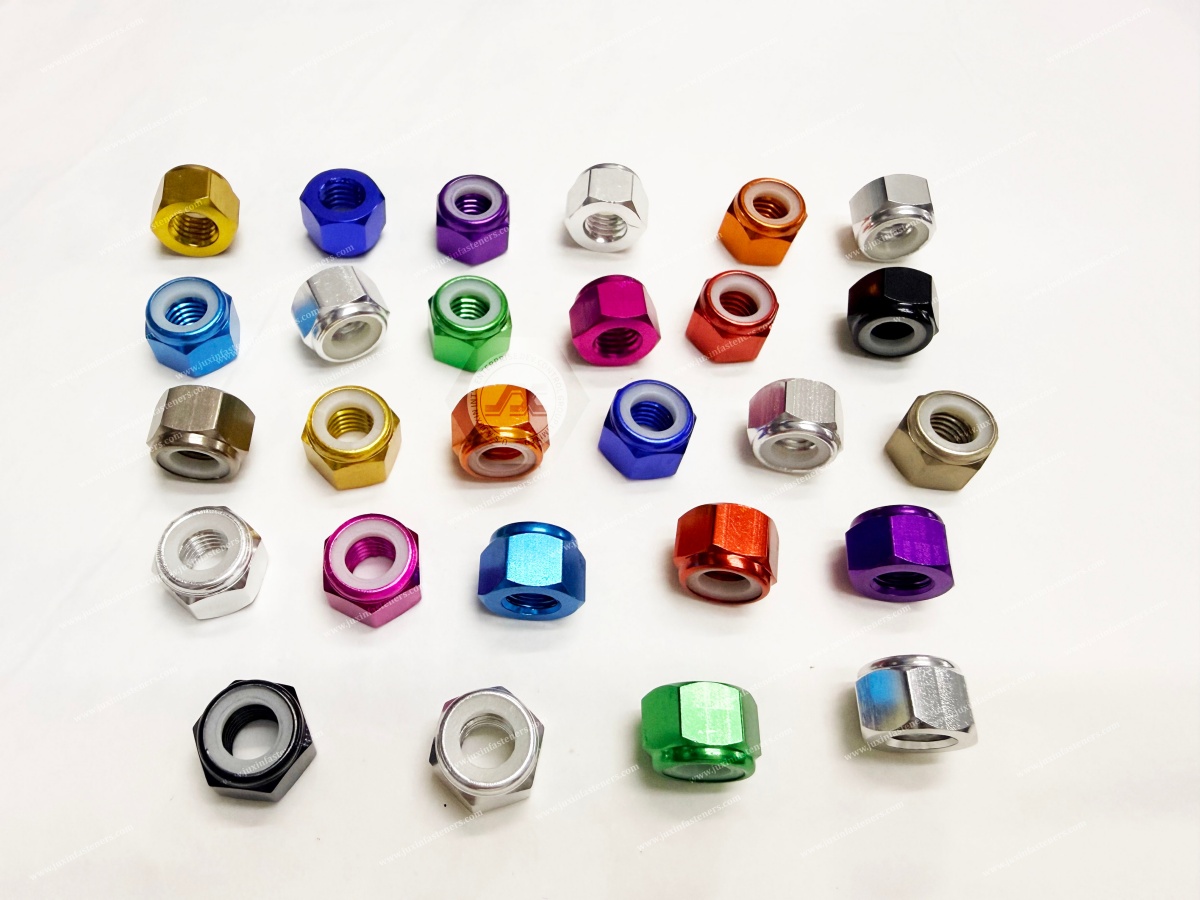
Application: Performance Bicycle Manufacturing
Potential applications include:
Cycling electronics brackets.
Lightweight accessory holders.
Sensor mounts.
Non-critical equipment fixtures.
Designers should evaluate thread strength, fatigue, vibration and prevailing-torque performance.
Application: Motorcycle Manufacturing
Motorcycle accessory manufacturers may consider titanium gray aluminum nylon-insert nuts for approved low-load assemblies.
Potential applications include:
Instrumentation brackets.
Sensor mounts.
Approved fairing accessories.
Camera equipment fixtures.
Non-critical equipment covers.
Motorcycle environments may involve vibration, temperature variation and repeated servicing.
Safety-critical motorcycle joints require separately qualified fasteners.
Application: Motorsport and Racing Equipment
Potential applications include suitable:
Data acquisition brackets.
Racing instrumentation.
Electronics mounting fixtures.
Non-critical auxiliary equipment.
Workshop test equipment.
These nuts should not automatically replace specified high-strength fasteners in suspension, braking, steering or drivetrain systems.
Application: Automotive OEM Manufacturing
Automotive manufacturers may evaluate aluminum nylon-insert nuts for selected auxiliary assemblies.
Potential applications include:
Sensor brackets.
Instrumentation fixtures.
Lightweight equipment covers.
Non-critical accessory mounts.
Joint preload, fatigue, temperature and mating materials must be reviewed.
Application: Robotics and Industrial Automation
Potential applications include:
Sensor mounting brackets.
Instrumentation supports.
Precision mechanical fixtures.
Lightweight equipment covers.
Dynamic loads and locking performance must be evaluated.
Application: Semiconductor Equipment Manufacturing
Semiconductor equipment manufacturers may require controlled dimensions and documented material selection.
Potential applications include non-process:
Instrumentation brackets.
Equipment covers.
External sensor mounts.
Auxiliary mechanical fixtures.
Nylon inserts may be unsuitable for vacuum, high-temperature or contamination-sensitive environments.
Application: Medical Equipment Manufacturing
Potential applications include:
Laboratory equipment brackets.
Non-patient-contact instrument fixtures.
Lightweight equipment covers.
External accessory mounts.
Material traceability, cleaning compatibility and regulatory requirements must be evaluated.
No medical-device certification is claimed.
Application: Food Machinery Manufacturing
Potential applications include suitable external machinery accessories and non-food-contact fixtures.
Cleaning chemicals, temperature, corrosion and contamination risks must be assessed.
No food-contact certification is claimed.
Application: AI Data Center Metal Cabinet Manufacturing
AI data center infrastructure includes server cabinets, cooling systems, power distribution enclosures and auxiliary instrumentation.
Potential applications include:
Cabinet accessory brackets.
Cable-management fixtures.
Sensor mounts.
Non-critical equipment covers.
Lightweight mounting accessories.
Designers should evaluate installation access, sheet metal thickness, mating materials, grounding and joint preload.
For one-sided sheet metal installation, rivet nuts or self-clinching fasteners may be more suitable.
Application: Telecommunications Equipment
Potential applications include:
Telecom cabinet accessories.
Antenna instrumentation brackets.
Cable-management fixtures.
Lightweight equipment supports.
Outdoor installations require corrosion, moisture and temperature evaluation.
Application: Electrical Power Equipment
Potential applications include:
Control cabinet accessories.
Instrumentation brackets.
Electrical enclosure hardware.
Non-critical equipment fixtures.
Electrical grounding, conductivity and insulation requirements must be evaluated independently.
Application: Energy Equipment Manufacturing
Potential applications include:
Energy storage enclosure accessories.
Solar monitoring brackets.
Auxiliary power equipment covers.
Lightweight instrumentation fixtures.
Thermal cycling, corrosion and electrical safety requirements must be reviewed.
Application: Rail Transit Equipment
Potential applications include approved non-critical:
Instrumentation brackets.
Auxiliary equipment fixtures.
Maintenance equipment accessories.
Lightweight enclosure hardware.
Rail applications may require vibration, fatigue, fire, smoke and environmental qualification.
Application: Marine Equipment
Aluminum locknuts may be considered for selected lightweight marine accessories.
Potential applications include non-critical instrumentation mounts and equipment covers.
Galvanic corrosion must be assessed when aluminum contacts dissimilar metals in conductive environments.
Application: Electronics and Electrical Appliances
Potential applications include:
Equipment housings.
Instrumentation brackets.
Lightweight mechanical supports.
Auxiliary enclosure hardware.
Electrical safety, operating temperature and assembly loads must be evaluated.
Application: HVAC Equipment
Potential applications include:
Control cabinet accessories.
Instrumentation fixtures.
Lightweight equipment brackets.
Non-critical enclosure assemblies.
Vibration, humidity and thermal cycling must be considered.
When Titanium Gray Aluminum Locknuts May Not Be Appropriate
Alternative fasteners should be considered when:
High proof-load capacity is required.
The mating bolt exceeds the aluminum nut's verified loadability.
Operating temperature exceeds the nylon insert's validated range.
Severe fatigue loading requires another fastening system.
Galvanic corrosion cannot be controlled.
Repeated reuse reduces prevailing torque below acceptance limits.
Chemical exposure is incompatible with the insert.
The assembly requires a qualified safety-critical fastener.
Steel, stainless steel or suitable all-metal locking nuts may be more appropriate.
Galvanic Corrosion in Aluminum Fastening Assemblies
Aluminum may experience galvanic corrosion when electrically connected to dissimilar metals in the presence of an electrolyte.
Relevant factors include:
Mating bolt material.
Moisture exposure.
Coating integrity.
Electrical contact.
Joint geometry.
Maintenance conditions.
Anodizing does not automatically eliminate galvanic corrosion risk.
Nylon Insert Temperature and Reuse
The operating temperature capability depends on the actual nylon formulation and finished product design.
A universal temperature range must not be assumed.
Repeated installation and removal may change prevailing-torque performance.
Reuse acceptance must follow the approved specification and testing requirements.
Installation and Assembly Considerations
Recommended engineering checks include:
Confirm the exact thread designation.
Inspect mating bolt threads.
Verify nut orientation.
Ensure sufficient thread engagement.
Use approved assembly tools.
Control tightening torque.
Account for prevailing torque.
Validate joint preload.
Protect the anodized finish.
Follow approved reuse criteria.
JUXIN FASTENERS Manufacturing Capabilities
JUXIN FASTENERS is an industrial fastener manufacturer supporting OEM/ODM projects and industrial batch production.
Our broader manufacturing capabilities include:
Cold heading.
Cold forming.
CNC machining.
Threading operations.
Product-specific secondary operations.
Customer-defined surface finishing.
Made-to-drawing production.
Industrial batch manufacturing.
The actual manufacturing route for 6061 aluminum locknuts depends on material temper, geometry, tolerances and production requirements.
Not every aluminum locknut is necessarily cold formed.
CNC Machining for Custom Aluminum Locknuts
CNC machining may support:
Custom hex dimensions.
Special nut heights.
Precision internal threads.
Customer-specific geometry.
Specialized batch quantities.
Appearance-sensitive components.
Nylon Insert Assembly
The nylon insert must be retained according to the approved design.
Relevant controls may include:
Insert dimensions.
Polymer specification.
Retention geometry.
Assembly consistency.
Functional prevailing-torque verification.
OEM/ODM Customization Options
JUXIN FASTENERS can review:
Custom metric threads.
Custom UNC/UNF threads.
Special nut heights.
Customer-defined hex dimensions.
Aluminum 6061 temper requirements.
Titanium gray anodized finish.
Approved physical color matching.
Alternative surface finishes.
Nylon insert specifications.
Prevailing-torque requirements.
Proof-load requirements.
OEM packaging.
Annual production quantities.
All customization is subject to engineering feasibility review.
Engineering Support for OEM Teams
Design and Mechanical Engineers
Important considerations include material selection, thread loadability, joint preload, vibration and locking performance.
Manufacturing Engineers
Relevant factors include installation torque, tooling, prevailing-torque consistency and anodized surface protection.
Production Managers
Key concerns include assembly efficiency, dimensional consistency, finish appearance, inspection criteria and production handling.
Procurement and Supplier Development Managers
Important requirements include approved drawings, material verification, finish approval, sample evaluation and repeat production quality.
Supply Chain Managers
Long-term OEM programs require coordination of engineering revisions, batch quantities, packaging and delivery schedules.
Quality Control and Engineering Verification
Depending on customer requirements, inspection planning may include:
Aluminum alloy verification.
Material temper documentation.
Thread dimensional inspection.
Across-flats measurement.
Nut height inspection.
Nylon insert retention.
First-on prevailing-torque testing.
Removal prevailing-torque testing.
Reuse-cycle testing where required.
Proof-load or thread-stripping evaluation.
Titanium gray anodized finish inspection.
Color consistency.
Packaging and part identification.
Actual testing and acceptance criteria must be agreed for each project.
Common Engineering Failure Modes
| Engineering Concern | Potential Failure | Recommended Action |
|---|---|---|
| Incorrect Material Identification | Aluminum Mistaken for Titanium | Verify Material and Finish Separately |
| Excessive Bolt Preload | Aluminum Thread Stripping | Verify Nut Loadability |
| Incorrect Material Temper | Reduced Mechanical Performance | Specify and Verify Temper |
| Repeated Reuse | Reduced Prevailing Torque | Define Reuse Criteria |
| Elevated Temperature | Nylon Insert Degradation | Validate Operating Temperature |
| Dissimilar Metal Contact | Galvanic Corrosion | Review Material Compatibility |
| Incorrect Thread System | Thread Damage | Confirm Metric or UNC/UNF |
| Color Variation | Cosmetic Rejection | Approve Physical Master Sample |
| Incorrect Assembly Torque | Joint Damage | Validate Tightening Procedure |
Material and Engineering Standards
Aluminum Alloy 6061
The specified body material is aluminum alloy 6061.
The required temper and applicable raw material specification must be defined in the approved manufacturing documents.
ASTM B221/B221M may be relevant to extruded aluminum bar stock where the selected raw material form falls within its scope.
The raw material standard does not independently certify the finished locknut.
ISO Metric Screw Threads
Applicable references include:
ISO 261 — Metric thread selection.
ISO 724 — Metric thread basic dimensions.
ISO 965 series — Metric thread tolerances.
The exact thread designation and tolerance must follow the approved drawing.
ASME B1.1 — Unified Inch Screw Threads
ASME B1.1 provides requirements for Unified inch screw threads, including UNC and UNF.
It is a thread standard rather than a complete aluminum nylon-insert locknut product standard.
DIN 985 and ISO 10511 — Design References
DIN 985 is a historical designation associated with thin nylon-insert hex locknuts.
ISO 10511:2025 specifies thin prevailing-torque hexagon nuts with non-metallic inserts in steel and stainless steel.
These standards may provide relevant dimensional design references but do not automatically establish conformity for a custom 6061 aluminum locknut.
ISO 7040 and ISO 7041 — Different Nut Heights
ISO 7040 addresses regular-height prevailing-torque hexagon nuts with non-metallic inserts.
ISO 7041 addresses high prevailing-torque hexagon nuts with non-metallic inserts.
The applicable nut height must be verified against the engineering drawing.
ASME B18.16.6 — Inch-Series Locknut Reference
ASME B18.16.6 addresses defined inch-series nylon-insert locknut designs.
Its applicability to a custom aluminum component requires review of the actual material, geometry and performance requirements.
Steel property grades must not automatically be assigned to aluminum nuts.
Customer-Approved Engineering Drawings
The finished product should be controlled by an approved drawing defining:
Material and temper.
Thread designation.
Hex dimensions.
Nut height.
Nylon insert design.
Surface finish.
Prevailing-torque requirements.
Mechanical performance.
Inspection methods.
Acceptance criteria.
Frequently Asked Questions
Are titanium gray aluminum locknuts made from titanium?
No. The featured product uses aluminum alloy 6061.
Titanium gray describes the anodized appearance.
What is the difference between aluminum and titanium locknuts?
They use different base materials with different densities and mechanical properties.
They should not be substituted without engineering approval.
What is the locking mechanism?
A retained nylon insert creates prevailing torque as it engages the mating bolt.
What metric sizes are listed?
M3, M4, M5, M6, M8, M10 and M12.
Can JUXIN manufacture UNC or UNF threads?
Customer-specific inch-series designs can be evaluated against approved engineering drawings.
Are metric and UNC threads interchangeable?
No. They are different thread systems.
Can these nuts be used on mountain bikes?
They may be evaluated for suitable accessory assemblies.
Safety-critical bicycle joints require independently qualified fasteners.
Can they be used on motorcycles or racing vehicles?
They may be considered for approved auxiliary equipment, subject to joint validation.
Can the titanium gray color be customized?
Customer-specific metallic gray appearance requirements can be evaluated using approved physical master samples.
Can aluminum locknuts replace steel Class 10 nuts?
Not automatically. Aluminum thread strength and joint loadability must be evaluated.
Can nylon-insert locknuts be reused?
Reuse depends on prevailing-torque performance and the applicable acceptance criteria.
Are these suitable for high-temperature applications?
Only when the nylon insert and complete assembly have been validated for the specified operating conditions.
Are these aerospace or medical-device certified?
No such certification is claimed for this commercial product.
Does JUXIN support OEM/ODM manufacturing?
Yes. JUXIN supports custom fastener manufacturing and industrial batch production.
Request a Quote — Titanium Gray 6061 Aluminum Nylon-Insert Lock Nut Manufacturer
JUXIN FASTENERS manufactures standard and custom-engineered industrial fasteners for international OEM, Tier-1 and Tier-2 manufacturing programs.
We support lightweight aluminum locknut projects requiring custom metric or UNC/UNF threads, customer-approved titanium gray anodized finishes,
specified material temper, specialized dimensions and prevailing-torque requirements.
Our broader manufacturing capabilities include cold heading, cold forming, CNC machining and product-specific secondary operations.
Recommended RFQ Information
Required metric or UNC/UNF thread.
Aluminum 6061 temper.
Customer 2D drawing or 3D CAD model.
Nut height and hex dimensions.
Nylon insert material requirements.
Mating bolt specification.
Required joint preload.
Prevailing-torque acceptance criteria.
Operating temperature and environment.
Titanium gray anodized finish specification.
Approved physical color sample.
Mechanical performance requirements.
Inspection and testing criteria.
Order quantity and annual forecast.
Packaging and delivery requirements.
Please send your drawings and technical specifications for engineering review and quotation.
JUXIN FASTENERS
Industrial Fastener Manufacturer | OEM/ODM Custom Manufacturing | Cold Heading, Cold Forming & CNC Machining
Website: https://www.juxinfasteners.com/
Email: info@juxinfasteners.com
Product Packaging
Packaging Standard
At Juxin Fasteners, we apply standardized export packaging to ensure product protection, traceability, and compliance with international logistics requirements.
1. Standard Export Packaging
Unless otherwise specified, all products will be packed according to our factory standard export packaging, which includes:
Moisture-resistant inner protection
Poly bag or small box packing as required
Reinforced export cartons
Clear labeling with part number, specification, batch number, and quantity
Palletizing for sea or air shipment when necessary
Our standard packaging is designed to ensure safe transportation, efficient warehousing, and long-distance international shipping.
2. Customized Packaging Options
We also provide customized packaging solutions according to customer requirements, including but not limited to:
Private labeling
Customized barcodes
Specific carton dimensions
Retail packaging
Special pallet configuration
Customer-specific marking and identification
So that you know, customized packaging may involve additional costs and extended lead time depending on the complexity of the requirements.
3. Compliance & Quality Assurance
All packaging processes are controlled under our ISO 9001 quality management system to ensure consistency, traceability, and product integrity throughout the supply chain.
Product Pictures


Contact Us
Tel.:
+86 020 8621 0320
+86 020 3121 6067
E-mail:
Technical Support:
Navigation
SEND INQUIREY


