Call Us
+86 136 6007 9809
Call Us
+86 136 6007 9809

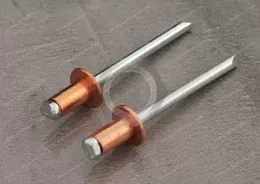
120° Countersunk Aluminum Blind Rivets
JUXIN FASTENERS supplies 5052 aluminum open-end blind rivets with 120° countersunk heads and steel or aluminum mandrels.
Designed for one-sided installation, these rivets seat flush in properly prepared countersunk holes, providing a low-profile fastening solution for sheet-metal and panel assemblies.
Custom dimensions are available for technical review based on OEM drawings and application requirements.
Product Specification
Aluminum Open-End 120° Countersunk Head Blind Rivets
Product Overview
JUXIN FASTENERS supplies aluminum open-end blind rivets with a 120° countersunk head for applications requiring a flush or low-profile fastening surface.
The countersunk head is designed to seat within a properly prepared 120° countersink, reducing head projection above the accessible panel surface.
These break-mandrel rivets are installed from one side of the assembly and are suitable for compatible sheet-metal, equipment panel and enclosure fastening applications.
Material Combinations
| Option | Rivet Body Material | Mandrel Material | Head Style |
|---|---|---|---|
| A | 5052 Aluminum Alloy | Steel | 120° Countersunk |
| B | 5052 Aluminum Alloy | Aluminum | 120° Countersunk |
Both configurations are open-end blind rivets.
The body and mandrel materials must be identified separately because material combinations can affect setting behavior, joint performance and environmental suitability.
Product Specifications
| Parameter | Description |
|---|---|
| Product Type | Open-End Blind Rivet |
| Head Style | 120° Countersunk Head |
| Installation Profile | Flush-Mount, with correctly prepared countersink |
| Rivet Body Material | 5052 Aluminum Alloy |
| Mandrel Material | Steel or Aluminum |
| Installation Method | One-sided blind riveting |
| Rivet Body Diameter | According to selected specification |
| Rivet Body Length | According to selected specification |
| Head Diameter | According to product drawing |
| Countersunk Head Angle | 120° |
| Recommended Hole Diameter | According to selected rivet size |
| Grip Range | According to product specification |
| Shear Strength | According to verified product data |
| Tensile Strength | According to verified product data |
Detailed drawings and dimensions: Refer to the existing product PDF/CAD documentation, pages 93–94.
The original technical drawings, tolerances and dimensional tables govern the available product specifications.
120° Countersunk Head and Flush-Mount Design
The 120° countersunk head is the defining feature of this rivet.
When installed in a correctly dimensioned countersunk hole, the head can sit approximately flush with the surrounding material surface.
This configuration is useful where a projecting rivet head could interfere with an adjacent component or where a relatively smooth visible surface is required.
Important design considerations include:
Countersink angle and diameter
Countersink depth
Remaining material thickness
Rivet head dimensions
Installation-hole diameter
Panel material and stiffness
Required joint strength
A countersunk blind rivet does not automatically produce a flush surface in every material or hole configuration.
Correct seating depends on the compatibility of the rivet head and prepared countersink.
Countersink Geometry and Panel Thickness
For a 120° countersunk blind rivet, the mating countersink must be designed to accommodate the specified head geometry.
The countersink should provide sufficient seating area without unnecessarily reducing the remaining load-bearing material.
For thin sheet-metal applications, countersinking may reduce the effective material thickness around the hole.
This can affect local bearing performance and joint suitability.
The appropriate countersink geometry should therefore be evaluated together with the panel thickness, material and expected loading conditions.
Grip Range and Rivet Length
Grip range refers to the combined thickness of the materials that a particular blind rivet is designed to fasten.
The correct rivet must accommodate the total material stack-up within its specified grip range.
Rivet body length and grip range are different dimensions.
For countersunk applications, the actual installed joint geometry, including the countersunk interface, should be considered when evaluating grip compatibility.
Metric and Inch Diameter Reference
Common nominal blind rivet diameter references include:
| Metric Diameter | Approximate Inch Reference |
|---|---|
| 2.4 mm | 3/32 in |
| 3.2 mm | 1/8 in |
| 4.0 mm | 5/32 in |
| 4.8 mm | 3/16 in |
| 6.4 mm | 1/4 in |
These are general nominal dimensional references and do not represent a confirmed size range for this specific JUXIN product.
Actual available dimensions must be verified against the product PDF/CAD documentation.
Metric and inch-designated rivets should not be treated as directly interchangeable without confirming dimensions, tolerances, hole requirements and functional performance.
Installation Method
These open-end countersunk blind rivets are installed using a compatible blind riveting tool and nosepiece.
The installation process involves:
Preparing the specified mounting hole and 120° countersink.
Aligning the components to be joined.
Inserting the rivet through the prepared hole.
Engaging the mandrel with the compatible installation tool.
Pulling the mandrel to deform the rivet body on the blind side.
Completing the setting operation when the mandrel breaks at its designed break point.
The rivet head must seat correctly within the countersink during installation.
Tool compatibility depends on the rivet diameter, mandrel configuration and material combination.
Typical Industrial Applications
120° countersunk aluminum blind rivets may be considered for:
Flush-mounted sheet-metal panels
Equipment housings and covers
Electrical enclosures
Industrial machinery panels
Metal cabinets and fabricated assemblies
Sheet-metal brackets
Hinges and compatible mounting components
OEM assemblies requiring reduced head projection
Suitability depends on the approved joint design, material thickness, installation geometry and required mechanical performance.
Material and Corrosion Considerations
The rivet body is specified as 5052 aluminum alloy, with either a steel or aluminum mandrel.
The aluminum body provides a lightweight fastening component.
However, the complete rivet's corrosion behavior depends on the mandrel material, surface finish, mating materials and environmental conditions.
For steel mandrel configurations, the actual mandrel coating or surface treatment should be confirmed from the product specification.
No specific corrosion-resistance rating is implied without supporting technical data.
Mechanical Performance and Joint Design
Shear strength and tensile strength are different characteristics of a blind rivet.
Shear loading acts primarily across the rivet body, while tensile loading acts along the joint separation direction.
The applicable performance values depend on the rivet diameter, material combination and product design.
For countersunk blind rivets, joint performance also depends on:
Hole diameter and tolerance
Countersink geometry
Material stack-up
Rivet spacing
Edge distance
Panel stiffness
Installation quality
The use of a countersunk head should not be interpreted as a guarantee of higher strength or vibration resistance.
International Standards and Technical References
International blind rivet standards distinguish products by head style, body material, mandrel material and construction.
The original product description refers to ISO 15978, DIN 7337 and IFI 114.
However, these references must not be treated as universally equivalent.
The applicable standard and edition should be verified against the specific 120° countersunk configuration, material combination, dimensions and customer requirements.
For this product, the approved JUXIN drawing and technical specification remain the controlling references until formal standard conformity has been established.
Inspection and Quality Requirements
Relevant inspection characteristics for 120° countersunk blind rivets may include:
Rivet body diameter
Rivet body length
Head diameter and height
120° head angle
Mandrel dimensions
Material identification
Surface condition
Hole and countersink compatibility
Grip range
Setting characteristics
Shear and tensile performance where specified
Inspection methods and acceptance criteria should follow the approved engineering drawing and agreed customer requirements.
OEM Customization and Bulk Supply
JUXIN FASTENERS supports OEM sourcing projects for countersunk aluminum blind rivets.
Customer-specific requirements may include rivet diameter, body length, head dimensions, mandrel material, grip range, surface finish and packaging.
Technical feasibility and commercial terms are reviewed according to the required specifications and purchasing quantities.
Frequently Asked Questions
What is a 120° countersunk blind rivet?
It is a blind rivet with a 120° countersunk head designed to seat within a matching countersunk mounting hole.
What is the difference between a countersunk and dome head blind rivet?
A countersunk head is designed to sit within a prepared recess, while a dome head normally projects above the accessible material surface.
Can these rivets be installed from one side?
Yes. Open-end blind rivets are designed for one-sided installation using a compatible riveting tool.
Do 120° countersunk rivets always sit flush?
Not necessarily. Flush seating depends on the head dimensions, countersink geometry, panel material and installation conditions.
What mandrel materials are available for this product?
The existing JUXIN product specification identifies steel and aluminum mandrels with a 5052 aluminum body.
Are countersunk blind rivets suitable for thin sheet metal?
They may be suitable when the countersink geometry and remaining material thickness are compatible with the required joint performance.
Can JUXIN supply custom dimensions?
Customer-specific dimensional requirements can be submitted with engineering drawings for technical review and quotation.
Request an OEM Countersunk Blind Rivet Quotation
JUXIN FASTENERS supplies industrial blind rivets for OEM manufacturing and bulk purchasing applications.
Please provide the required rivet diameter, body length, 120° countersunk head dimensions, material combination, grip range,
mounting-hole specifications, engineering drawings, expected purchasing quantities and applicable quality requirements.
Email: info@juxinfasteners.com
Website: https://www.juxinfasteners.com/
JUXIN FASTENERS — Custom Blind Rivets and Industrial Fastening Solutions for Global OEM Applications.
Product Packaging
Packaging Standard
At Juxin Fasteners, we apply standardized export packaging to ensure product protection, traceability, and compliance with international logistics requirements.
1. Standard Export Packaging
Unless otherwise specified, all products will be packed according to our factory standard export packaging, which includes:
Moisture-resistant inner protection
Poly bag or small box packing as required
Reinforced export cartons
Clear labeling with part number, specification, batch number, and quantity
Palletizing for sea or air shipment when necessary
Our standard packaging is designed to ensure safe transportation, efficient warehousing, and long-distance international shipping.
2. Customized Packaging Options
We also provide customized packaging solutions according to customer requirements, including but not limited to:
Private labeling
Customized barcodes
Specific carton dimensions
Retail packaging
Special pallet configuration
Customer-specific marking and identification
So that you know, customized packaging may involve additional costs and extended lead time depending on the complexity of the requirements.
3. Compliance & Quality Assurance
All packaging processes are controlled under our ISO 9001 quality management system to ensure consistency, traceability, and product integrity throughout the supply chain.
Product Pictures


Contact Us
Tel.:
+86 020 8621 0320
+86 020 3121 6067
E-mail:
Technical Support:
Navigation
SEND INQUIREY