Call Us
+86 136 6007 9809
Call Us
+86 136 6007 9809

Industrial original equipment manufacturers (OEMs) designing diagnostic imaging systems, patient monitoring equipment, laboratory automation platforms,
analytical instruments, surgical equipment, and healthcare-related electronic devices often need to consider more than the mechanical function of a fastener.
Product Specification
Industrial original equipment manufacturers (OEMs) designing diagnostic imaging systems, patient monitoring equipment, laboratory automation platforms, analytical instruments,
surgical equipment, and healthcare-related electronic devices often need to consider more than the mechanical function of a fastener.
Internal components may be exposed to cleaning chemicals, humidity, temperature changes, repeated assembly, vibration, electrical requirements, or magnetic environments.
Some assemblies may also require controlled spacing between sensors, circuit boards, optical components, fluid-handling modules, covers, brackets, and equipment housings.
In these applications, plastic hardware can be considered when a non-metallic fastening interface, electrical non-conductivity,
reduced weight, corrosion resistance, controlled spacing, or specific material compatibility is required.
Depending on the design, the plastic hardware family may include plastic machine screws, nylon screws, plastic bolts, nylon bolts, plastic nuts, nylon hex nuts,
nylon washers, insulating washers, shoulder washers, cup washers, plastic spacers, nylon spacers, PCB spacers, threaded standoffs, male-to-female standoffs,
female-to-female standoffs, threaded inserts, compression limiters, and custom polymer fastening components.
However, medical equipment sourcing requires careful separation between material suitability, component suitability, and finished-device compliance.
A polymer fastener should not be described as “medical grade,” “sterilizable,” “MRI safe,” or compliant with a medical-device requirement simply because it is made from nylon,
POM, PVDF, or PEEK. The exact resin grade, component geometry, manufacturing process, application environment, cleaning or sterilization exposure, and finished-equipment requirements must be evaluated together.
JUXIN FASTENERS provides industrial fastening and custom component solutions for OEM applications, supporting drawing review, product selection,
multi-SKU sourcing, and technical RFQ evaluation.
This guide explains how engineers and procurement teams can evaluate plastic hardware for medical equipment and laboratory systems while keeping the fastening decision connected to the actual application.
Medical equipment and laboratory equipment engineers may consider engineered plastic hardware when an assembly requires one or more of the following:
Non-metallic fastening: Plastic screws, nuts, washers, spacers, and standoffs can provide a non-metallic alternative where metallic fastening is undesirable.
Non-conductive interfaces: Polymer hardware can be useful around electronic circuits, sensors, wiring assemblies, and other components where unintended conductive contact should be avoided.
Non-magnetic characteristics: Many common engineering polymers are non-ferromagnetic, which can make selected plastic hardware candidates useful around equipment where magnetic interaction is an engineering concern. The complete component and material composition still need to be verified for the actual application.
Chemical compatibility: Some engineering polymers can offer useful resistance to selected cleaning chemicals, laboratory fluids, or process environments. Compatibility must be evaluated against the actual chemical concentration, exposure time, temperature, and cleaning method.
Controlled spacing: Plastic spacers, PCB spacers, and threaded standoffs can maintain separation between boards, sensors, brackets, housings, and other internal components.
Surface protection: Plastic washers and other polymer interfaces can reduce direct contact between a fastener and sensitive or finished surfaces.
Weight reduction: Plastic hardware may reduce component weight where the joint does not require the mechanical performance of an equivalent metal fastener.
The key engineering principle is that plastic hardware is a component-level design choice, not a substitute for medical-device qualification or finished-equipment compliance.
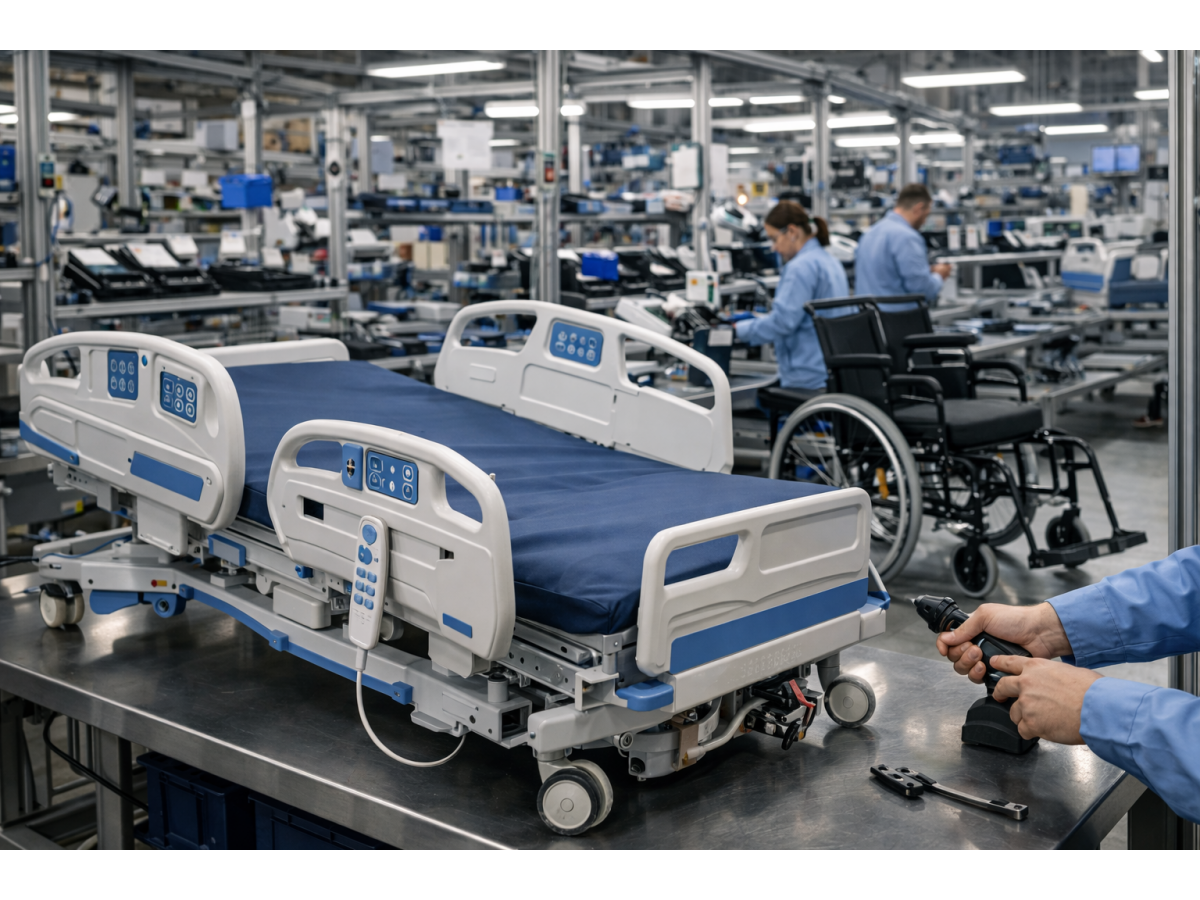
Medical equipment combines mechanical structures, electronics, sensors, optics, fluid systems, user interfaces, and protective housings. Fastening components can therefore influence several parts of the overall assembly.
Diagnostic imaging and analytical equipment may operate in environments where magnetic properties are important.
Plastic hardware made from non-ferromagnetic polymer materials may be considered for selected mounting applications where metallic fasteners could create an unwanted magnetic interaction.
However, engineers should not treat all “plastic” fasteners as automatically suitable for magnetic-sensitive equipment.
The complete component should be reviewed for:
Polymer type
Exact material grade
Fillers or reinforcements
Metallic inserts
Coatings or secondary components
Manufacturing contamination
Assembly environment
Equipment-specific magnetic requirements
This distinction is particularly important when a component is being evaluated for MRI-related equipment or another highly magnetic environment.
A polymer fastener being non-ferromagnetic does not by itself establish that the complete device or assembly is suitable for a particular MRI environment.
Medical and laboratory equipment may be repeatedly exposed to cleaning agents, disinfectants, laboratory chemicals, or other fluids.
Potential exposure may include substances such as:
Isopropyl alcohol
Hydrogen peroxide-based cleaners
Quaternary ammonium compounds
Detergents
Laboratory chemicals
Process fluids
The correct polymer cannot be selected from the chemical name alone.
Engineers should consider:
Chemical concentration
Contact duration
Temperature
Frequency of exposure
Mechanical stress during exposure
Surface finish
Polymer grade
Potential stress cracking
Dimensional change
Long-term mechanical behavior
A material that performs well in one cleaning environment may not provide the same result under a different concentration, temperature, or exposure cycle.
Some medical instruments and equipment components may be exposed to sterilization or high-temperature disinfection processes.
This is an area where material selection requires particular care.
A high-performance polymer such as PEEK may be considered for certain demanding applications, but the presence of PEEK alone does not mean that a finished component is suitable for every sterilization method.
Similarly, standard nylon should not automatically be described as suitable for repeated sterilization.
Engineers should identify the actual process, including:
Sterilization method
Temperature
Exposure duration
Number of cycles
Pressure or humidity conditions
Chemical exposure
Required dimensional stability
Required mechanical retention after cycling
The component and material should then be evaluated against those conditions.
Diagnostic equipment, laboratory automation, optical systems, and instrumentation can contain tightly controlled mechanical interfaces.
Plastic components may provide excellent dimensional performance in some applications, but polymer behavior can be affected by:
Moisture
Temperature
Material grade
Molded or machined geometry
Wall thickness
Internal stress
Long-term loading
Manufacturing tolerances
Nylon deserves particular attention because moisture absorption can influence dimensional behavior and mechanical properties.
For precision applications, engineers should therefore consider environmental conditions during both assembly and service rather than evaluating dimensions only at room-temperature, dry conditions.
Medical and laboratory equipment can have internal assemblies where contamination control matters.
Plastic hardware may reduce the need for metallic components in selected areas, but the material itself does not automatically qualify as “cleanroom” or “medical-grade” hardware.
Where cleanliness is important, the procurement specification should define the required:
Cleaning process
Packaging method
Handling procedure
Particulate requirements
Surface condition
Lubrication restrictions
Packaging environment
Traceability requirements
The supplier should then evaluate whether the requested production and packaging process can meet the defined requirements.
Medical equipment assemblies frequently contain many different fastening interfaces. Rather than sourcing one generic “medical plastic fastener,” OEMs can evaluate the complete plastic hardware architecture.
Plastic screws, nylon screws, plastic machine screws, nylon machine screws, plastic bolts,
and nylon bolts may be considered for selected non-structural or moderate-load applications where polymer fastening is compatible with the design.
Important specification points include:
Thread size
Thread form
Head style
Overall length
Thread engagement
Mating material
Installation method
Required clamping load
Temperature
Chemical exposure
Cleaning or sterilization conditions
Metric and inch-thread configurations can be selected according to the equipment design and target market.
Plastic nuts, nylon nuts, plastic hex nuts, nylon hex nuts, and custom plastic nuts may be used where a polymer nut is appropriate for the mechanical and environmental requirements.
A plastic nut can also be combined with a metallic screw or bolt where the application requires a hybrid fastening arrangement.
The decision should consider thread durability, assembly frequency, loading, temperature, chemical exposure, and the material of the mating fastener.
Nylon washers, plastic flat washers, nylon insulating washers, shoulder washers, cup washers, and insulating cup washers can provide different types of interface control.
For example:
A plastic flat washer can distribute contact pressure or protect a mounting surface.
A shoulder washer can provide separation around a fastener shank.
An insulating cup washer can provide a different interface geometry around a fastener head.
A polymer washer can help create a non-metallic interface between selected components.
These products should not be treated as interchangeable. The geometry should match the actual mounting interface.
Medical electronics often contain circuit boards, sensors, displays, controllers, communication modules, and other electronic assemblies.
The plastic hardware family may include:
Plastic spacers
Nylon spacers
Industrial plastic spacers
PCB spacers
Threaded standoffs
Male-to-female standoffs
Female-to-female standoffs
These components can support board positioning, mounting height, component separation, airflow space, cable routing, and enclosure integration.
Medical and laboratory equipment frequently uses polymer housings, covers, brackets, and molded structural components.
Where a direct plastic thread does not provide the required assembly characteristics, threaded inserts for plastic may be considered.
Potential technologies include:
Heat-set inserts
Ultrasonic inserts
Molded-in inserts
Expansion inserts
Brass thread inserts
Other application-specific threaded insert designs
The appropriate insert technology depends on the plastic housing material, boss geometry, production process, installation method, loading, and required assembly performance.
Where a screw applies concentrated clamping load through a plastic housing, compression limiters may be considered to create a more defined load-bearing path through the joint.
This can be relevant to equipment housings, covers, brackets, and structural polymer assemblies.
The suitability of a compression limiter depends on the housing geometry, material, screw arrangement, axial length, clamping conditions, and complete joint design.
Material selection should begin with the application requirements rather than the assumption that one polymer family is universally suitable.
| Polymer Family | Typical Material References | General Characteristics | Potential Equipment Applications | Engineering Considerations |
|---|---|---|---|---|
| Nylon / Polyamide | PA6, PA66, glass-filled grades where specified | Useful combination of strength, toughness, low weight, and electrical non-conductivity | Internal brackets, spacers, washers, standoffs, selected equipment hardware | Evaluate moisture absorption, dimensional change, creep, stress relaxation, temperature, chemicals, and cleaning exposure |
| POM / Acetal | Homopolymer / copolymer grades | Relatively rigid, low-friction, and dimensionally stable in suitable environments | Precision mechanisms, positioning components, trays, guides, selected instrument hardware | Evaluate chemical exposure, temperature, impact, thread behavior, and long-term loading |
| PVDF | Polyvinylidene fluoride | Useful chemical and environmental resistance in selected applications | Laboratory equipment, chemical-handling assemblies, specialized fluid-contact-adjacent components | Exact chemical exposure, temperature, mechanical requirements, and material grade require evaluation |
| PEEK | Polyether ether ketone | High-performance engineering polymer with high-temperature and wear-resistance characteristics | Specialized high-temperature or demanding instrument components | Premium material; exact grade, geometry, processing, and application requirements require specific evaluation |
The table should be treated as an engineering screening tool rather than a qualification statement.
A material family name alone does not establish:
Medical-device suitability
Biocompatibility
Sterilization suitability
Flame performance
MRI suitability
Chemical compatibility
Regulatory compliance
Cleanroom qualification
Those requirements must be defined and verified according to the actual equipment and application.
Plastic hardware may be a suitable candidate when several of the following conditions apply:
The joint does not require the mechanical performance of a metallic fastener.
A non-metallic or non-conductive fastening interface is useful.
Magnetic interaction is a design consideration and the complete component can be appropriately evaluated.
The selected polymer is compatible with the operating temperature.
The material can tolerate the required cleaning or chemical exposure.
Moisture absorption and dimensional changes are acceptable.
The joint can tolerate polymer creep and stress-relaxation behavior.
The required thread engagement and installation method are appropriate.
The component can be manufactured consistently at the required production volume.
The finished equipment requirements can be satisfied through appropriate component and system evaluation.
Plastic hardware is not automatically appropriate for every medical or laboratory equipment assembly.
Engineers may need to reconsider polymer fastening when the joint requires:
High structural load-bearing capability
High and sustained clamping force
Significant vibration or shock resistance
High-temperature exposure
Extremely tight dimensional stability over changing humidity
Repeated sterilization cycles not validated for the selected material
Specialized grounding or bonding functions
Specific flame, dielectric, chemical, magnetic, or regulatory performance that has not been demonstrated
Metallic mechanical properties required by the joint
Repeated assembly and disassembly beyond the practical capability of the selected polymer thread
A hybrid architecture may be more appropriate in these situations.
For example, a metallic structural fastener may be combined with a nylon insulating washer, shoulder washer, cup washer, or plastic spacer when the mechanical and interface functions need to be separated.
The fastening component should be evaluated together with the surrounding equipment.
For example, a PCB mounting assembly may use:
Equipment enclosure → plastic spacer or insulating interface → threaded standoff → PCB → standoff → plastic screw
A sensor mounting assembly may use:
Bracket → insulating washer → sensor → spacer → plastic machine screw → plastic nut
A polymer housing may use:
Plastic housing → threaded insert or compression limiter → screw → internal bracket
These are examples of fastening architectures rather than universal designs.
The important point is that screw, nut, washer, spacer, standoff, insert, and housing should be evaluated as one assembly.
This system-level approach also creates an opportunity for OEMs to consolidate multiple plastic hardware SKUs.
A medical equipment program may require:
Plastic machine screws + nylon bolts + plastic nuts + nylon hex nuts + nylon washers + shoulder washers + cup washers + plastic spacers + PCB spacers + threaded standoffs + threaded inserts + compression limiters
across multiple product models.
Managing these components as a coordinated BOM can simplify specification review, packaging, production planning, and supplier communication.
The same plastic hardware selection principles can apply to other industrial applications where non-metallic fastening, electrical non-conductivity, material compatibility, controlled spacing, or weight reduction is useful.
Plastic hardware may be considered for selected electrical and electronic modules, battery-related assemblies, BMS mounting, wiring support, thermal-management structures, and enclosure interfaces.
Material selection should account for temperature, vibration, moisture, chemicals, electrical requirements, and long-term mechanical loading.

Plastic screws, nylon nuts, insulating washers, shoulder washers, spacers, and standoffs can be considered for selected electrical cabinet, control-panel, and enclosure assemblies.
Plastic hardware may be used around sensitive electronic assemblies, equipment housings, cable routing, sensor mounts, and selected clean manufacturing environments where the material and process requirements are appropriate.
Plastic spacers, standoffs, insulating washers, screws, nuts, and other polymer hardware may support electronic modules, cable routing, antenna-related assemblies, and equipment enclosures.
Plastic hardware can be considered for control boxes, sensors, wiring systems, equipment housings, and selected internal assemblies where the environmental and mechanical requirements permit.
A complete technical package allows a supplier to evaluate the actual component instead of quoting a generic “medical plastic fastener.”
Identify the required product clearly, such as:
Plastic machine screw
Nylon machine screw
Plastic screw
Nylon screw
Plastic bolt
Nylon bolt
Plastic nut
Nylon hex nut
Nylon insulating washer
Plastic flat washer
Shoulder washer
Cup washer
Insulating cup washer
Plastic spacer
Nylon spacer
PCB spacer
Threaded standoff
Male-to-female standoff
Female-to-female standoff
Threaded insert
Compression limiter
Custom polymer fastening component
Also identify where the component is used within the equipment.
Provide 2D drawings and, where available, 3D CAD files showing:
Critical dimensions
Thread size and thread form
Head geometry
Overall length
Hole dimensions
Wall thickness
Spacer or standoff height
Tolerance requirements
Mating components
Assembly orientation
For precision equipment, identify which dimensions are functionally critical.
Specify the polymer family and grade where already established.
For example:
PA6
PA66
Glass-filled nylon where required
POM
PVDF
PEEK
Other specified engineering polymer
If the material has not yet been finalized, provide the actual operating environment so that material selection can be evaluated.
If the component will be cleaned, disinfected, sterilized, or otherwise chemically processed, specify:
Cleaning agent
Chemical concentration where known
Exposure duration
Exposure frequency
Temperature
Sterilization method
Number of cycles
Humidity or pressure conditions where relevant
This information is more useful than simply requesting “sterilization-resistant plastic.”
Where relevant, specify:
Magnetic-environment requirements
Non-ferromagnetic requirements
Electrical insulation requirements
Voltage environment
Clearance requirements
Grounding or bonding requirements
Customer-specific equipment requirements
If the component is intended for MRI-related or other magnetic-sensitive equipment, the complete component construction should be clearly defined.
If the component enters a controlled assembly environment, specify:
Required cleaning process
Packaging requirements
Particulate expectations
Lubrication restrictions
Handling requirements
Labeling
Traceability
Lot identification
The supplier should evaluate whether the requested production and packaging process can meet these requirements.
Where a project contains multiple plastic hardware items, provide the complete BOM where possible.
For example:
Plastic machine screws + nylon nuts + nylon washers + shoulder washers + plastic spacers + PCB standoffs + threaded inserts
A consolidated BOM allows related components to be reviewed for dimensional compatibility, material requirements, packaging, and production planning.
The RFQ should also identify:
Prototype requirements
Expected production volume
Annual demand
Release schedule
Inspection requirements
Packaging requirements
Labeling requirements
Traceability requirements where applicable
Customer-specific quality documentation
Where a medical-device customer has specific quality-system, validation, regulatory, or documentation requirements, those requirements should be stated explicitly for supplier evaluation.
Before approving a plastic hardware component for production, engineers should review the complete fastening interface.
A practical checklist includes:
Material: Is the exact polymer grade appropriate for the application?
Chemical exposure: Has the actual cleaning, disinfection, laboratory-fluid, or sterilization environment been evaluated?
Magnetic environment: If relevant, has the complete component construction been reviewed?
Geometry: Does the component fit the equipment architecture?
Thread: Is the thread form, size, engagement, tolerance, and mating material appropriate?
Electrical function: Does the component provide the intended non-conductive interface?
Mechanical loading: Is the joint compatible with polymer creep and stress relaxation?
Temperature: Is the material appropriate for the complete operating range?
Moisture: Has moisture absorption been considered, especially for nylon?
Dimensional stability: Could environmental conditions affect critical dimensions?
Assembly: Is the installation process compatible with the component?
Cleanliness: Are cleaning and packaging requirements defined?
Quality: Can critical dimensions and characteristics be controlled consistently?
BOM: Can related plastic hardware items be coordinated across the equipment program?
For medical equipment programs, supplier qualification should extend beyond the ability to supply a catalog screw.
Engineering and procurement teams can evaluate whether the supplier can:
Review technical drawings before quotation
Identify ambiguous or conflicting specifications
Review material requirements against application conditions
Control critical dimensions and thread characteristics
Coordinate multiple plastic hardware SKUs
Support prototype and production stages
Review screws, nuts, washers, spacers, standoffs, inserts, and related components as an assembly
Provide appropriate inspection information where required
Support defined packaging and labeling requirements
Maintain lot or production traceability where specified
Handle recurring production releases
Maintain clear communication between engineering, purchasing, quality, and production teams
For OEM medical equipment, the ability to manage a multi-SKU plastic hardware program can be important because one equipment platform may contain dozens of small fastening and spacing components.
Plastic hardware may be used where non-metallic fastening, electrical non-conductivity, controlled spacing, surface protection, weight reduction, or specific chemical compatibility is useful.
The suitability of the selected component depends on the complete equipment design and application requirements.
Some polymer fasteners may be candidates for selected MRI-related applications because many engineering polymers are non-ferromagnetic.
However, “plastic” alone does not establish MRI suitability.
The exact material, fillers, inserts, coatings, component construction, and equipment requirements should be reviewed for the intended magnetic environment.
No.
Nylon is a polymer family, not a universal medical-device qualification.
The specific resin grade, manufacturing process, component application, cleaning or sterilization exposure, documentation,
and finished-device requirements determine whether a component is appropriate for a particular medical application.
It depends on the polymer, grade, component geometry, sterilization method, temperature, cycle count, exposure duration, and mechanical requirements.
High-performance polymers such as PEEK may be considered for demanding applications, while standard polyamide components require application-specific evaluation.
Yes, selected plastic screws, nuts, washers, spacers, standoffs, and custom polymer components can be considered for laboratory equipment.
Chemical exposure, temperature, dimensional stability, mechanical loading, cleaning procedures, and the exact laboratory application should be evaluated.
A plastic spacer generally provides controlled physical separation between components and may be unthreaded.
A threaded standoff incorporates an internal or external thread and can participate directly in the fastening architecture.
The correct choice depends on the required mounting method and assembly geometry.
Yes.
A hybrid fastening architecture can separate mechanical and electrical functions.
For example, a metallic screw can be combined with a nylon insulating washer, shoulder washer, cup washer, or plastic spacer where the assembly requires a non-metallic interface.
OEM sourcing can be structured around a multi-SKU BOM covering related plastic hardware components.
The exact products, materials, dimensions, tolerances, production requirements, and documentation should be defined from the customer's drawings and specifications.
The most useful information includes 2D drawings, 3D CAD files, material requirements, resin grades, thread specifications, critical dimensions, tolerances,
cleaning or sterilization conditions, magnetic or electrical requirements where applicable, annual volumes, packaging requirements, inspection requirements, and the complete multi-SKU BOM.
Selecting plastic hardware for medical equipment and laboratory systems requires more than choosing a polymer because it is lightweight or non-metallic.
The polymer grade, component geometry, mating materials, mechanical loading, chemical exposure, cleaning or sterilization process, magnetic environment,
electrical requirements, dimensional stability, production process, and documentation requirements should be evaluated as part of the complete application.
JUXIN FASTENERS can review OEM requirements for plastic and nylon fastening components used in medical equipment, diagnostic systems, laboratory instruments, electronic assemblies,
equipment housings, and related industrial applications.
For a technical review, provide your 2D drawings, 3D CAD files, material and resin requirements, critical dimensions, environmental conditions,
cleaning or sterilization requirements, magnetic or electrical requirements where applicable, BOM information, annual volume, and quality requirements.
Contact JUXIN FASTENERS at info@juxinfasteners.com for product selection, drawing review, multi-SKU sourcing, and OEM quotation support.
Product Packaging
Packaging Standard
At Juxin Fasteners, we apply standardized export packaging to ensure product protection, traceability, and compliance with international logistics requirements.
1. Standard Export Packaging
Unless otherwise specified, all products will be packed according to our factory standard export packaging, which includes:
Moisture-resistant inner protection
Poly bag or small box packing as required
Reinforced export cartons
Clear labeling with part number, specification, batch number, and quantity
Palletizing for sea or air shipment when necessary
Our standard packaging is designed to ensure safe transportation, efficient warehousing, and long-distance international shipping.
2. Customized Packaging Options
We also provide customized packaging solutions according to customer requirements, including but not limited to:
Private labeling
Customized barcodes
Specific carton dimensions
Retail packaging
Special pallet configuration
Customer-specific marking and identification
So that you know, customized packaging may involve additional costs and extended lead time depending on the complexity of the requirements.
3. Compliance & Quality Assurance
All packaging processes are controlled under our ISO 9001 quality management system to ensure consistency, traceability, and product integrity throughout the supply chain.
Product Pictures
Contact Us
Tel.:
+86 020 8621 0320
+86 020 3121 6067
E-mail:
Technical Support:
Navigation
SEND INQUIREY