Call Us
+86 136 6007 9809
Call Us
+86 136 6007 9809

Semiconductor manufacturing equipment places unusual demands on small mechanical components.
A fastener that performs adequately in a general industrial machine may require a completely different evaluation when it is exposed to process chemicals,
ultra-pure water, controlled environments, vacuum conditions, elevated temperatures, or sensitive electronic assemblies.
Product Specification
Semiconductor manufacturing equipment places unusual demands on small mechanical components.
A fastener that performs adequately in a general industrial machine may require a completely different evaluation when it is exposed to process chemicals, ultra-pure water,
controlled environments, vacuum conditions, elevated temperatures, or sensitive electronic assemblies.
For equipment manufacturers, the decision to use plastic hardware is therefore not simply a question of replacing a metal screw with a plastic screw.
Engineers may need to evaluate chemical compatibility, contamination considerations, dimensional stability, mechanical loading,
electrical insulation, thermal exposure, installation method, and the interaction between the fastener and the surrounding assembly.
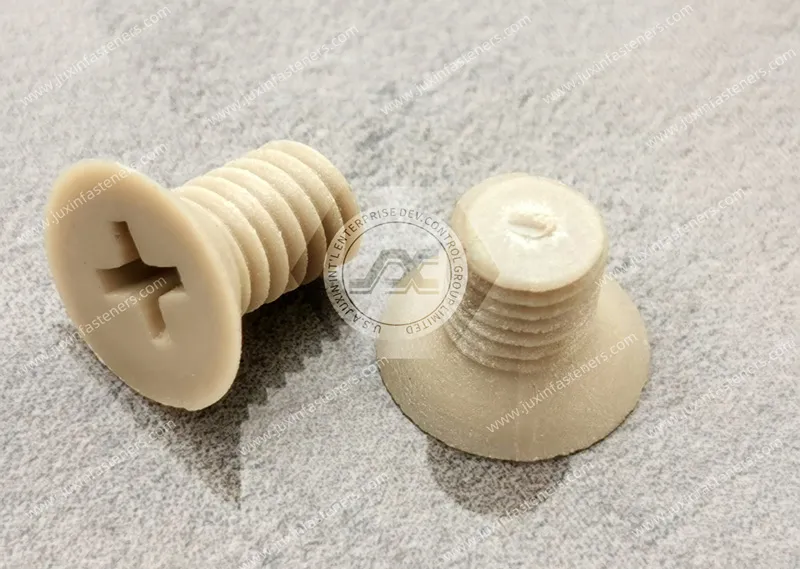
Depending on the application, the plastic hardware family may include plastic screws, nylon screws, plastic machine screws, nylon machine screws, plastic bolts,
nylon bolts, plastic nuts, nylon hex nuts, plastic flat washers, nylon insulating washers, shoulder washers, plastic spacers, nylon spacers, PCB spacers,
threaded standoffs, male-to-female standoffs, female-to-female standoffs, threaded inserts for plastic, compression limiters, and custom polymer fastening components.
For more chemically demanding applications, engineering teams may also evaluate materials such as PVDF, PTFE, PEEK, POM/Acetal, PA6 and PA66, depending on the actual environment and mechanical requirements.
JUXIN FASTENERS provides industrial fastening and custom component solutions for OEM applications. The appropriate plastic material, product geometry,
tolerance, thread configuration and environmental requirements should be evaluated against the actual equipment design rather than selected from material name alone.
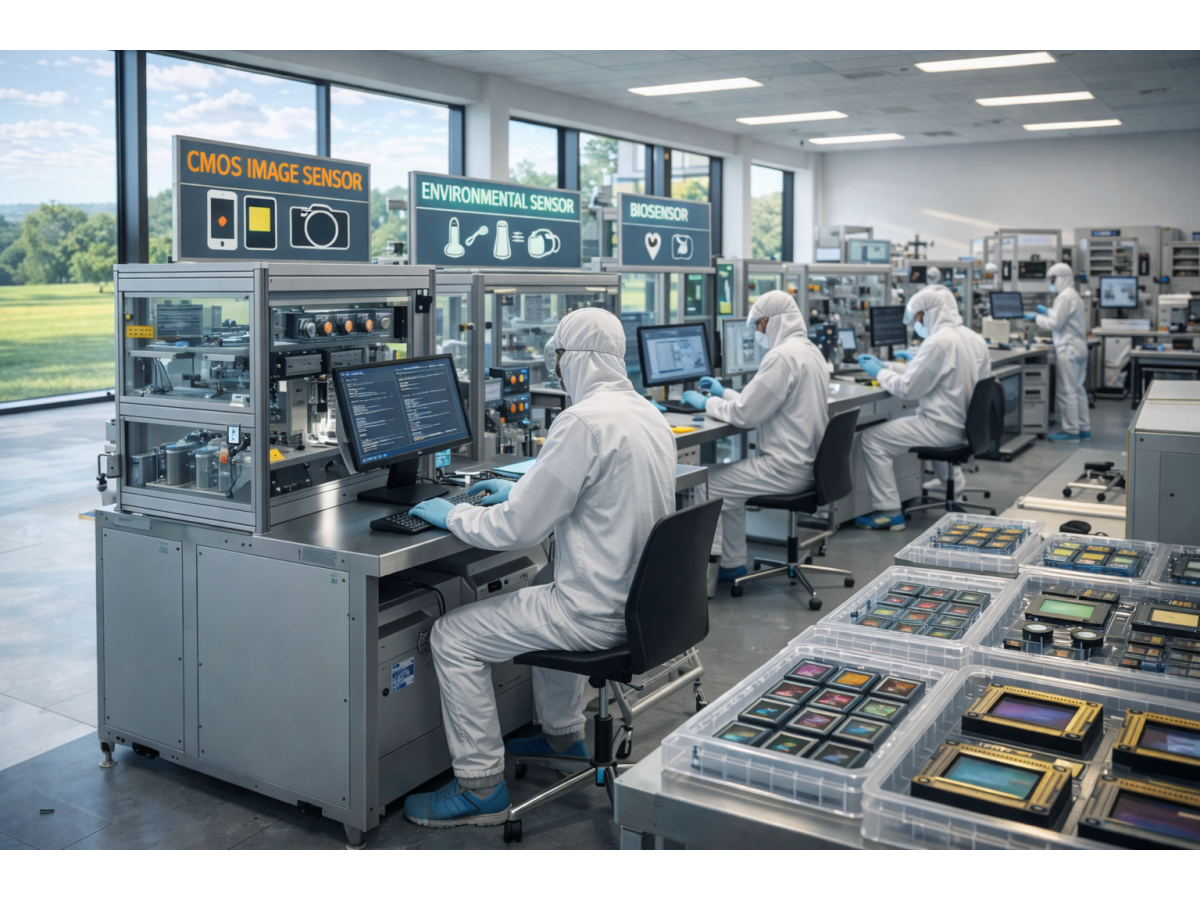
Semiconductor and cleanroom equipment designers may consider plastic hardware when a fastening interface requires one or more of the following characteristics:
Reduced use of metallic components in a controlled assembly environment
Electrical non-conductivity at selected fastening interfaces
Resistance to specific chemicals or process fluids
Lower density than conventional metallic hardware
Separation between dissimilar conductive components
Controlled spacing around electrical or electronic assemblies
Reduced risk of metal-to-metal contact at selected interfaces
Compatibility with plastic housings, covers, liners, brackets or process components
Material characteristics appropriate for a controlled-temperature or controlled-environment application
However, plastic does not automatically mean high-purity, cleanroom-compatible, chemically inert, vacuum-compatible or semiconductor-qualified.
The actual resin grade, additives, pigments, fillers, manufacturing process, surface condition, cleaning method, packaging, installation environment and application-specific requirements must be evaluated.
For critical semiconductor equipment, the correct question is therefore not:
“Which plastic fastener is strongest?”
It is:
“Which plastic hardware material and configuration provides an acceptable combination of chemical compatibility, mechanical performance, dimensional stability, cleanliness and assembly requirements for this specific equipment environment?”
Wet benches, chemical delivery systems and wafer-processing equipment can expose components to aggressive chemicals.
Depending on the process, exposure may involve acids, bases, solvents, oxidizing chemicals, cleaning agents or ultra-pure water.
Material selection therefore needs to consider:
Chemical concentration
Exposure temperature
Exposure duration
Continuous versus intermittent contact
Immersion versus splash exposure
Mechanical loading during exposure
Surface condition
Required service life
A polymer that performs well with one chemical may not be the correct choice for another chemical or concentration.
For this reason, PVDF screws, PTFE screws, PEEK fasteners, nylon fasteners and POM components should not be treated as interchangeable simply because they are all non-metallic.
In semiconductor processing equipment, material selection can be influenced by the potential for unwanted contamination from the surrounding hardware.
Using a polymer fastener instead of a metallic fastener may reduce the amount of exposed metal at a selected interface.
However, this does not automatically mean that the finished component is suitable for every high-purity application.
Engineers may need to evaluate:
Base resin
Fillers and additives
Pigments or colorants
Surface condition
Manufacturing residues
Cleaning processes
Packaging requirements
Lot control and traceability requirements
Actual contact with process fluids
This distinction is particularly important for procurement teams. A request for a high-purity polymer component should identify what “high purity” means for the application instead of relying on the material name alone.
Controlled manufacturing environments place additional attention on particulate generation and component cleanliness.
Plastic hardware may be used in cleanroom equipment, but the suitability of a component depends on the complete manufacturing and handling process.
Engineers should consider:
Machining or molding process
Surface finish
Flash or burr control
Particulate generation during installation
Cleaning requirements
Packaging method
Storage and handling
Whether the component is located inside or outside the controlled process area
A plastic screw should therefore not be described as automatically “non-contaminating” merely because it is made from polymer.
Some semiconductor tools operate under vacuum or controlled-pressure conditions.
For these applications, engineers may need to evaluate:
Material composition
Volatile components
Moisture content
Surface condition
Temperature
Vacuum level
Exposure duration
Cleaning and preconditioning
Required outgassing performance
PEEK and fluoropolymer families may be considered for certain demanding applications, but material selection alone does not establish vacuum suitability.
Where vacuum performance is critical, the required outgassing specification and test method should be included in the engineering specification or RFQ.
Some semiconductor processing equipment operates at elevated temperatures or experiences repeated thermal cycles.
Polymer fasteners can respond differently from metal fasteners because polymers may exhibit temperature-dependent changes in:
Strength
Stiffness
Dimensional stability
Creep
Stress relaxation
Thread engagement
Clamping behavior
The relevant question is not simply whether a material can tolerate a certain temperature. Engineers should evaluate the complete joint at the actual operating condition.
This is particularly important for plastic machine screws, nylon bolts, plastic nuts, threaded standoffs and compression-related interfaces.
Plastic hardware should normally be evaluated as part of the complete fastening assembly rather than as isolated components.
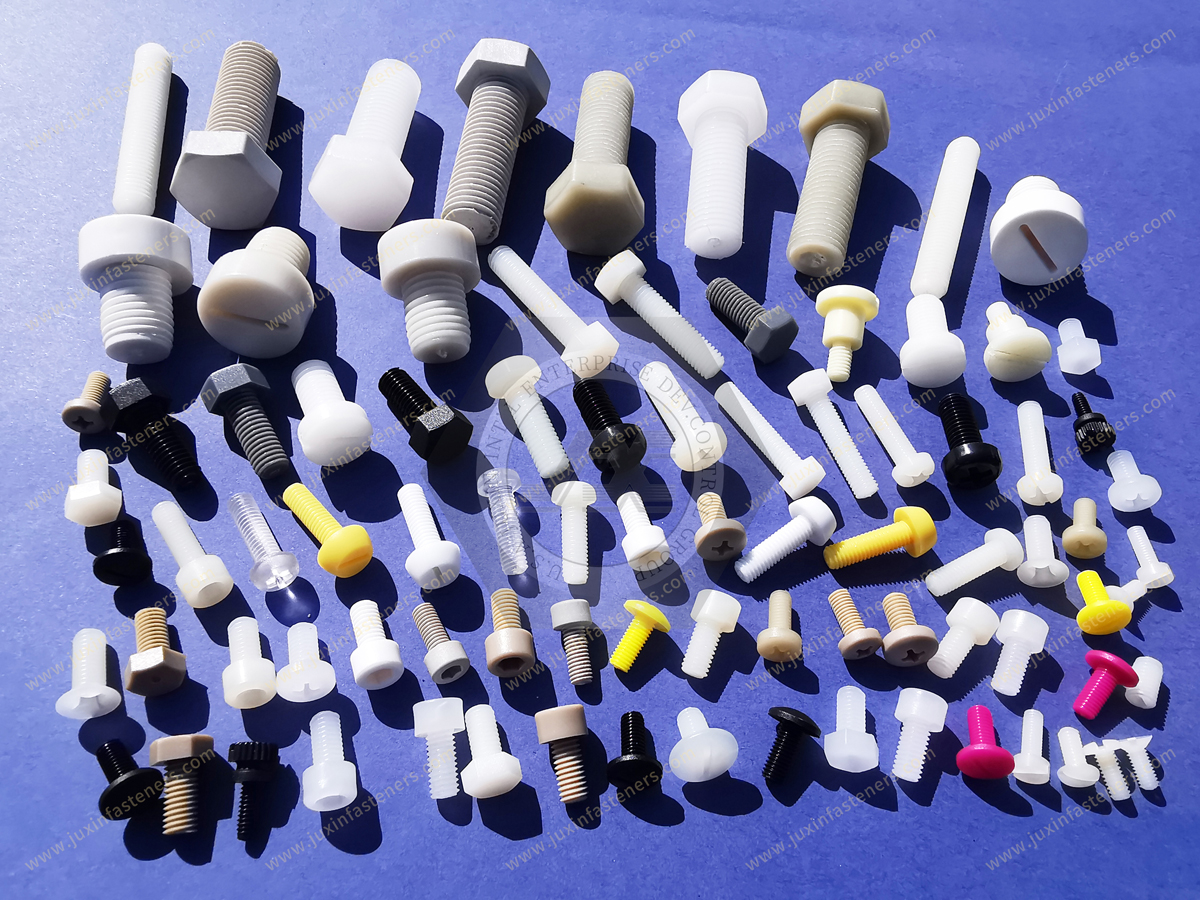
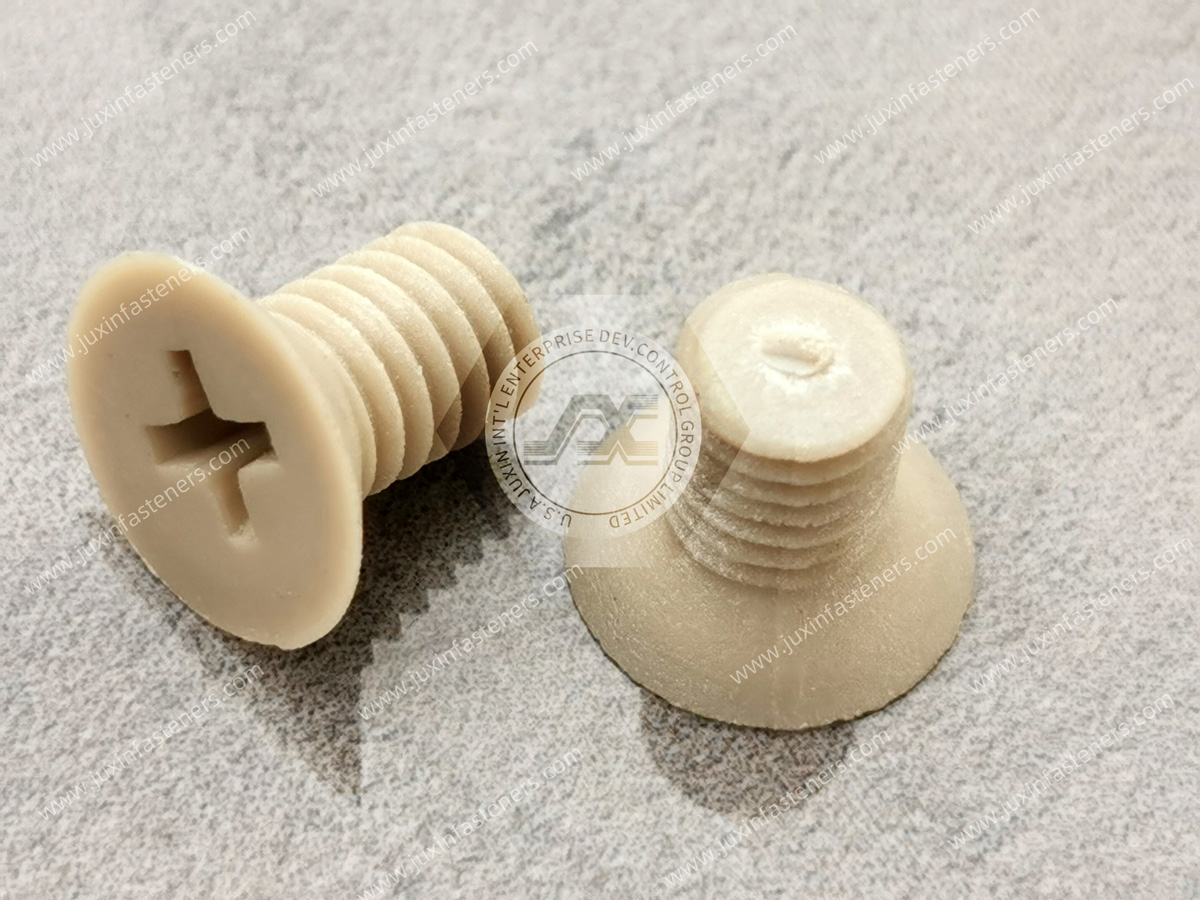
Plastic screws, nylon screws, plastic machine screws and nylon machine screws may be used where electrical insulation, low density, corrosion considerations or polymer compatibility are important.
Depending on the application, engineers may evaluate:
Pan head screws
Flat head screws
Socket head configurations
Machine screw threads
Custom head geometries
Metric threads
Unified threads
For chemically demanding applications, the material must be evaluated against the actual process environment.
Plastic bolts and nylon bolts can be considered for larger fastening interfaces where metallic hardware may be undesirable.
The design should account for:
Joint loading
Thread engagement
Clamp requirements
Temperature
Creep and stress relaxation
Washer configuration
Mating nut material
Installation method
Plastic bolts should not be selected solely on nominal thread size. The complete joint load path matters.
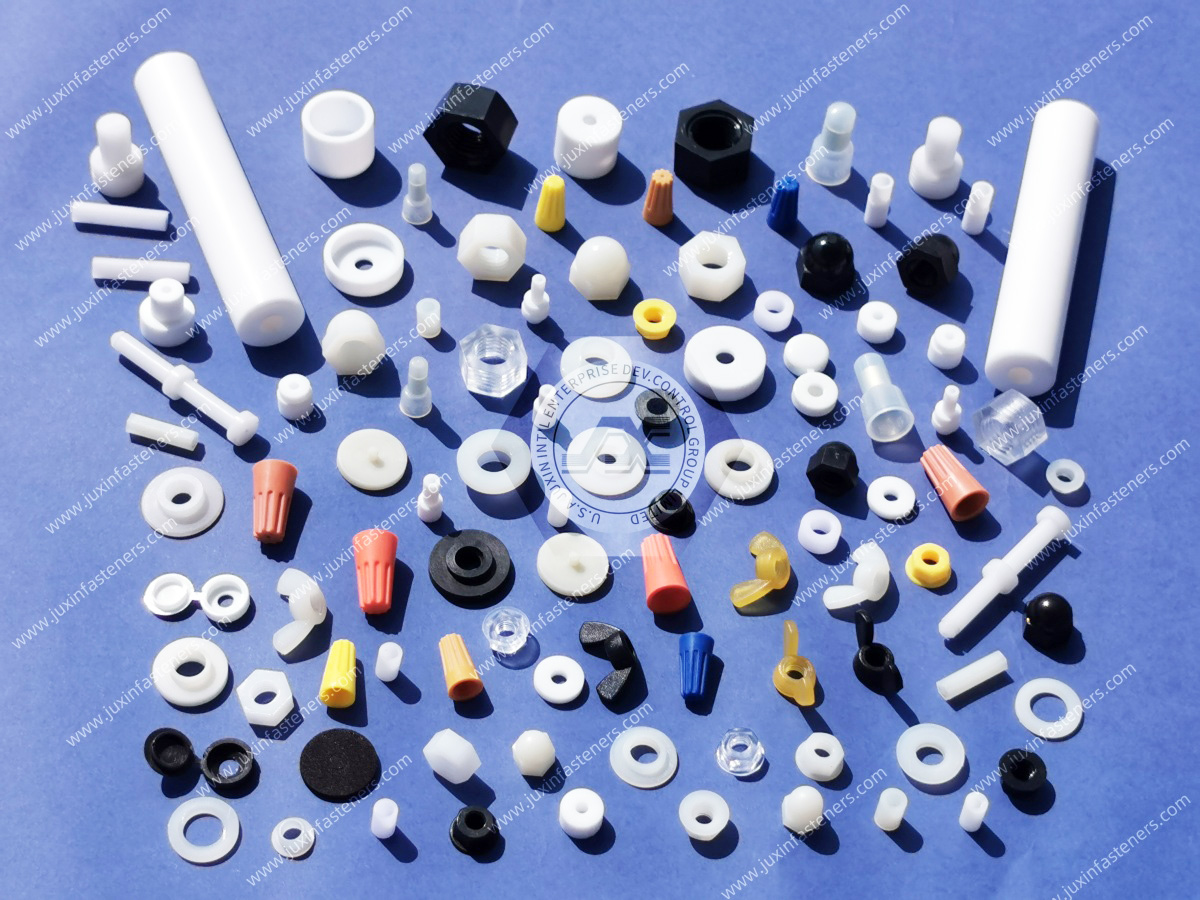
Plastic nuts, nylon nuts, plastic hex nuts and nylon hex nuts provide mating threaded components for polymer or mixed-material assemblies.
They may be used with:
Plastic screws
Nylon screws
Plastic bolts
Nylon bolts
Metallic fasteners where electrical or material-interface requirements permit
Where vibration, repeated assembly or elevated temperature is involved, thread retention and long-term preload behavior should be evaluated.
Plastic flat washers, nylon washers, nylon insulating washers and shoulder washers can provide spacing, load distribution or electrical separation at selected interfaces.
A washer may also help isolate a fastener head from an adjacent surface.
For semiconductor equipment, engineers should distinguish between:
Flat washers
Insulating washers
Shoulder washers
Cup washers
Insulating cup washers
These components can perform different mechanical or interface functions and should not be treated as interchangeable.
Plastic spacers, nylon spacers, industrial plastic spacers, PCB spacers and threaded standoffs can establish controlled spacing between panels, circuit boards, brackets and equipment structures.
Common configurations include:
Unthreaded spacers
Female-to-female standoffs
Male-to-female standoffs
Threaded standoffs
Custom spacing components
These products can be particularly relevant to control electronics, sensor assemblies, automation systems and equipment enclosures.
When a plastic housing requires repeated assembly or a more durable internal thread interface, threaded inserts for plastic may be considered.
Depending on the housing material and production method, engineers may evaluate:
Heat-set inserts
Heat-set brass inserts
Ultrasonic inserts
Molded-in inserts
Expansion inserts
Brass thread inserts
Insert selection should consider the polymer, boss geometry, installation method, required retention and assembly cycle.
Compression limiters can be considered when a plastic housing or bracket must accommodate a clamping load through a more defined structural load path.
This can be useful when the surrounding polymer could otherwise be highly dependent on compressive deformation or long-term stress relaxation.
The appropriate limiter geometry, material, length and interface still require application-specific evaluation.
The following comparison provides a starting point for engineering evaluation. It should not be treated as a universal material qualification table.
| Polymer Family | Potential Engineering Characteristics | Possible Semiconductor Equipment Uses | Key Evaluation Factors |
|---|---|---|---|
| PA6 / Nylon | Good general-purpose engineering characteristics; moisture absorption can affect dimensions and properties | General equipment hardware, spacers, standoffs, electrical/electronic assemblies | Moisture exposure, dimensional stability, temperature, chemical compatibility |
| PA66 / Nylon | Higher-temperature capability than some general-purpose polyamides; moisture sensitivity remains relevant | Fasteners, spacers, standoffs and equipment assemblies where the environment is suitable | Moisture uptake, creep, temperature, chemical exposure |
| POM / Acetal | Rigidity, low friction and dimensional stability can be useful in mechanical assemblies | Cleanroom automation mechanisms, guides, spacers and positioning components | Chemical exposure, temperature, load, friction and wear |
| PVDF | Strong chemical-resistance characteristics in many demanding environments | Wet-process equipment, chemical-handling hardware and selected fluid-contact applications | Specific chemical, concentration, temperature, exposure duration and mechanical load |
| PTFE | Very low friction and broad chemical resistance characteristics | Selected chemical-handling and insulating applications | Mechanical strength, creep, deformation and application-specific purity requirements |
| PEEK | High-performance engineering polymer with strong thermal and mechanical characteristics | Selected high-temperature equipment, precision components and demanding mechanical assemblies | Grade, temperature, chemical exposure, load, machining and cost |
Important: A polymer family does not by itself establish suitability for a semiconductor process. Resin grade, formulation, processing method and application environment must be evaluated together.
PVDF can be an attractive candidate where chemical exposure is a primary design concern.
Potential applications include:
Wet benches
Chemical-handling assemblies
Chemical delivery equipment
Tank and liner-related assemblies
Fluid-handling support hardware
Selected semiconductor process equipment
For a PVDF screw or other PVDF fastening component, engineers should still specify the actual chemical environment.
Useful RFQ information may include:
Chemical name
Concentration
Temperature
Exposure duration
Contact condition
Mechanical loading
Thread size
Required quantity
This provides a much stronger engineering basis than simply requesting “chemical-resistant screws.”
PEEK may be considered where the application requires a combination of mechanical performance, temperature capability and dimensional stability that is beyond the intended range of more general-purpose polymers.
Potential applications can include:
High-temperature equipment
Precision mechanisms
Selected chamber components
Wafer-handling equipment
Automation assemblies
High-performance equipment fixtures
However, PEEK is not automatically the correct choice simply because it is a high-performance polymer.
The higher material cost, machining requirements, thread geometry and actual environmental requirements should be considered together.
PTFE has characteristics that make it attractive for certain chemical, friction and electrical applications.
JUXIN FASTENERS also works with PTFE screws and related plastic fastening components for selected industrial applications.
However, PTFE's relatively soft mechanical behavior and tendency toward creep under load mean that it should not automatically replace a more mechanically rigid polymer.
For a loaded joint, engineers should evaluate:
Clamp load
Thread engagement
Temperature
Long-term deformation
Mating material
Installation torque
Washer configuration
Not every semiconductor equipment assembly requires an advanced polymer such as PVDF or PEEK.
Nylon fasteners, nylon screws, nylon bolts, nylon nuts, nylon washers and nylon spacers can remain practical where:
Chemical exposure is limited
Temperature requirements are moderate
Mechanical loading is appropriate
Moisture can be controlled or tolerated
Electrical insulation is useful
The component is outside the direct process-fluid path
Cost and supply scalability are important
This is an important engineering distinction: the most expensive polymer is not automatically the best engineering solution.
The correct selection depends on the actual requirements of the assembly.
Plastic hardware may be considered for selected:
Chemical-handling brackets
Tank assemblies
Fluid delivery support components
Pipe and tubing support
Equipment covers
Liners and associated fastening interfaces
PVDF, PTFE and other chemically resistant polymers may be evaluated depending on the specific process environment.
Semiconductor automation systems may use plastic hardware for:
Sensor mounting
Guide components
Covers
Brackets
Spacing components
Robotic equipment assemblies
Electronic mounting structures
Here, dimensional stability, wear, friction and mechanical loading may become more important than chemical resistance.
Semiconductor equipment contains extensive electronic control systems.
Plastic hardware may be used for:
PCB mounting
Sensor assemblies
Cable routing
Electrical enclosures
Control panels
Instrumentation
Internal electronic brackets
Relevant products can include PCB spacers, threaded standoffs, male-to-female standoffs, female-to-female standoffs, insulating washers, shoulder washers and plastic screws.
Vacuum applications require a more specialized evaluation.
Depending on location and process conditions, engineers may evaluate PEEK, PTFE, PVDF or other polymers,
but the actual vacuum requirement, temperature, cleaning process and outgassing specification should be identified before selecting the material.

Plasma processing introduces additional environmental considerations.
The polymer must be evaluated against:
Plasma chemistry
Temperature
Exposure duration
Surface degradation
Particle generation
Dimensional stability
Electrical requirements
No single polymer should be assumed to be universally suitable for all plasma environments.
One of the most useful distinctions for equipment engineers is to separate material selection from component selection.
For example:
Chemical exposure → material family → fastener geometry → joint design → environmental validation
rather than:
Chemical exposure → choose PVDF screw
Similarly:
PCB mounting → required spacing → thread configuration → insulation requirement → standoff/washer selection
rather than simply:
PCB → nylon standoff
This approach reduces the risk of selecting a material first and discovering later that the thread, geometry, mechanical loading or installation method does not work with the complete assembly.
A practical engineering sequence is:
Identify where the component is located in the equipment.
Identify whether it contacts process chemicals or only the surrounding equipment structure.
Define mechanical loading and assembly frequency.
Identify temperature and thermal cycling.
Identify electrical requirements.
Define cleanliness or contamination-control requirements.
Evaluate candidate polymer families.
Select the appropriate product geometry.
Verify the complete fastening interface.
Define inspection, packaging and traceability requirements where necessary.
Plastic hardware should not automatically replace metallic hardware in every semiconductor equipment application.
A different fastening solution may be more appropriate when the assembly requires:
High mechanical preload
High structural load
High-temperature performance beyond the selected polymer's range
Tight dimensional stability under changing environmental conditions
Significant resistance to thread deformation
High wear resistance
Repeated high-load assembly
A specific electrical grounding or bonding path
A validated material or process qualification that the selected polymer does not meet
In these situations, engineers may need to evaluate a different polymer, a hybrid fastening architecture, a metallic component with an appropriate interface treatment, or another mechanical design.
For semiconductor equipment programs, a detailed RFQ helps engineering and sourcing teams evaluate the correct component instead of quoting a generic plastic fastener.
Specify the required component:
Plastic machine screws
Nylon machine screws
PVDF screws
PTFE screws
PEEK fasteners
Plastic bolts
Nylon bolts
Plastic nuts
Nylon hex nuts
Plastic flat washers
Insulating washers
Shoulder washers
Cup washers
Plastic spacers
PCB spacers
Threaded standoffs
Male-to-female standoffs
Female-to-female standoffs
Threaded inserts
Compression limiters
Custom polymer fastening components
Provide:
2D technical drawings
3D CAD files where available
Thread size
Thread type
Critical dimensions
Tolerances
Surface requirements
Assembly orientation
Mating component information
Metric designs may reference applicable ISO/DIN thread conventions, while inch-based applications may use ASME/ANSI Unified Thread requirements where appropriate.
Identify:
Polymer family
Resin grade if specified
Filled or unfilled material
Color
Additives or formulation restrictions
Chemical exposure
Temperature range
Mechanical requirements
If the project requires a specific high-purity material, the requirement should be explicitly defined rather than simply stating “high purity.”
Where chemical resistance matters, provide:
Chemical name
Concentration
Temperature
Exposure frequency
Immersion or incidental contact
Expected service duration
This information is especially important for PVDF, PTFE, PEEK and other specialized polymer selections.
If the component is used in a controlled environment, identify:
Cleaning requirements
Packaging requirements
Double-bagging if required by the customer's process
Particulate-control requirements
Handling requirements
Labeling
Lot identification
Traceability requirements
Packaging requirements should be agreed during quotation rather than assumed from the term “cleanroom.”
Procurement teams should also provide:
Prototype quantity
Annual usage
Forecast
Production batch requirements
Required delivery schedule
Inspection requirements
Multi-SKU BOM
Packaging configuration
Quality documentation requirements
A complete BOM can also allow multiple plastic hardware components to be evaluated together rather than managed as isolated purchases.
Semiconductor equipment manufacturers rarely purchase only one fastener.
A single machine may contain:
Plastic screws
Nylon machine screws
Plastic nuts
Nylon nuts
Plastic flat washers
Insulating washers
Shoulder washers
Cup washers
Plastic spacers
Nylon spacers
PCB spacers
Threaded standoffs
Threaded inserts
Compression limiters
Custom polymer components
This creates an opportunity for multi-SKU BOM consolidation.
Instead of evaluating every component independently, an OEM sourcing team can provide the complete fastening BOM for technical review.
This can help identify:
Common material families
Common thread sizes
Standard versus custom components
Potential dimensional standardization
Packaging requirements
Inspection requirements
Prototype versus production items
For strategic sourcing teams, this can be more valuable than sourcing each low-value plastic component separately.
Before production release, engineering teams should verify:
Correct polymer family and grade
Chemical compatibility
Temperature exposure
Moisture sensitivity where applicable
Creep and stress relaxation
Thread geometry
Thread engagement
Installation method
Joint loading
Dimensional tolerances
Surface condition
Electrical requirements
Cleanliness requirements
Packaging requirements
Inspection criteria
Lot traceability requirements
For critical semiconductor equipment, the fastener should be evaluated as part of the complete assembly rather than as an isolated component.
For OEM semiconductor equipment programs, supplier evaluation should go beyond unit price.
Procurement and supply chain teams should evaluate whether the supplier can consistently control:
Can the supplier review:
2D drawings
3D CAD
Thread specifications
Polymer selection
Tolerances
Assembly interfaces
Special environmental requirements?
Can the supplier clearly identify:
Polymer family
Material grade
Material source or documentation requirements
Lot control
Formulation requirements where applicable?
The sourcing team should establish:
Dimensional inspection methods
Thread inspection
Visual inspection
Surface requirements
Batch control
Nonconformance handling
For equipment manufacturers, the ability to coordinate multiple related plastic hardware SKUs can be important.
A supplier relationship may include:
Screws
Bolts
Nuts
Washers
Spacers
Standoffs
Inserts
Compression limiters
Custom polymer components
This can simplify BOM management and supplier communication.
Plastic hardware may be selected where electrical non-conductivity, reduced metallic interfaces, chemical compatibility, lower density or controlled spacing are important.
The actual suitability depends on the material, component design and equipment environment.
PVDF can be considered for many chemically demanding applications, but suitability depends on the specific chemical, concentration, temperature, exposure duration and mechanical requirements.
PEEK may be considered for applications requiring a combination of temperature capability, mechanical performance and dimensional stability.
The actual PEEK grade and application environment should be evaluated before specification.
Yes, nylon fasteners may be appropriate for selected equipment assemblies where the chemical, temperature, moisture and mechanical requirements are compatible with the selected nylon grade.
They should not automatically be used in direct chemical-contact or high-temperature applications without engineering evaluation.
No. Plastic material alone does not establish cleanroom suitability. Manufacturing, surface condition, cleaning, handling, packaging,
contamination requirements and the customer's qualification process may all be relevant.
Some engineering polymers may be considered for vacuum applications, but vacuum suitability depends on the specific material, formulation, manufacturing process, temperature and required outgassing performance.
JUXIN FASTENERS can review custom plastic hardware requirements based on drawings, specifications, material requirements and application conditions.
For specialized semiconductor applications, the appropriate material, processing and qualification requirements should be defined during technical review rather than assumed.
Yes. A complete BOM can be submitted for evaluation so that screws, bolts, nuts, washers, spacers, standoffs, inserts and other polymer fastening components can be considered as a coordinated sourcing program.
Semiconductor equipment applications require more than a generic plastic fastener catalog.
The right component depends on the relationship between material, geometry, chemical exposure, temperature, mechanical loading, cleanliness,
electrical requirements and the complete equipment assembly.
JUXIN FASTENERS provides industrial fastening and custom component solutions for OEM applications, including plastic and nylon fastening hardware,
washers, spacers, standoffs, threaded inserts, compression-related components and other custom polymer fastening components.
For semiconductor equipment, cleanroom systems, wet-process equipment, electronics assemblies or controlled-environment machinery, procurement and engineering teams can provide:
2D technical drawings
3D CAD files
Material requirements
Thread specifications
Chemical exposure information
Temperature requirements
Cleanliness and packaging requirements
Inspection requirements
Multi-SKU BOMs
Prototype and annual volume requirements
Send your technical requirements to info@juxinfasteners.com for engineering review and OEM sourcing discussion.
The more complete the application information, the more accurately the plastic hardware, material and production requirements can be evaluated.
Product Packaging
Packaging Standard
At Juxin Fasteners, we apply standardized export packaging to ensure product protection, traceability, and compliance with international logistics requirements.
1. Standard Export Packaging
Unless otherwise specified, all products will be packed according to our factory standard export packaging, which includes:
Moisture-resistant inner protection
Poly bag or small box packing as required
Reinforced export cartons
Clear labeling with part number, specification, batch number, and quantity
Palletizing for sea or air shipment when necessary
Our standard packaging is designed to ensure safe transportation, efficient warehousing, and long-distance international shipping.
2. Customized Packaging Options
We also provide customized packaging solutions according to customer requirements, including but not limited to:
Private labeling
Customized barcodes
Specific carton dimensions
Retail packaging
Special pallet configuration
Customer-specific marking and identification
So that you know, customized packaging may involve additional costs and extended lead time depending on the complexity of the requirements.
3. Compliance & Quality Assurance
All packaging processes are controlled under our ISO 9001 quality management system to ensure consistency, traceability, and product integrity throughout the supply chain.
Product Pictures
Contact Us
Tel.:
+86 020 8621 0320
+86 020 3121 6067
E-mail:
Technical Support:
Navigation
SEND INQUIREY