Call Us
+86 136 6007 9809
Call Us
+86 136 6007 9809

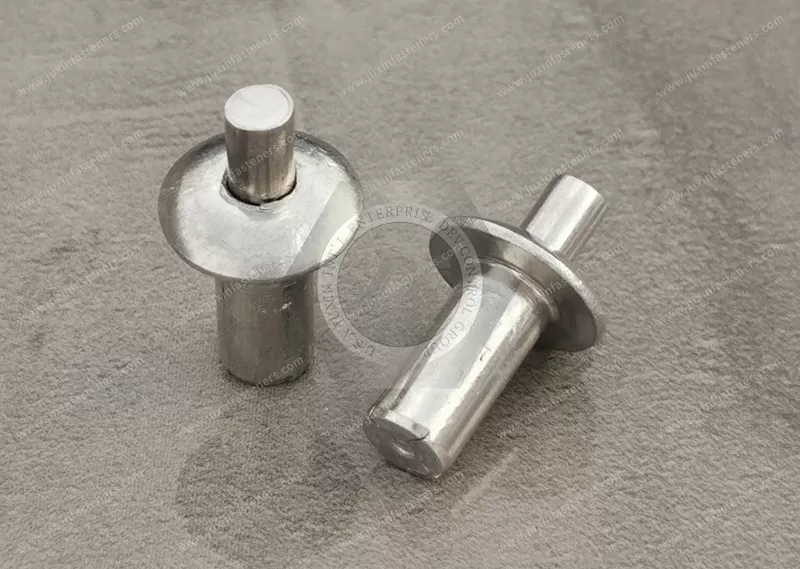
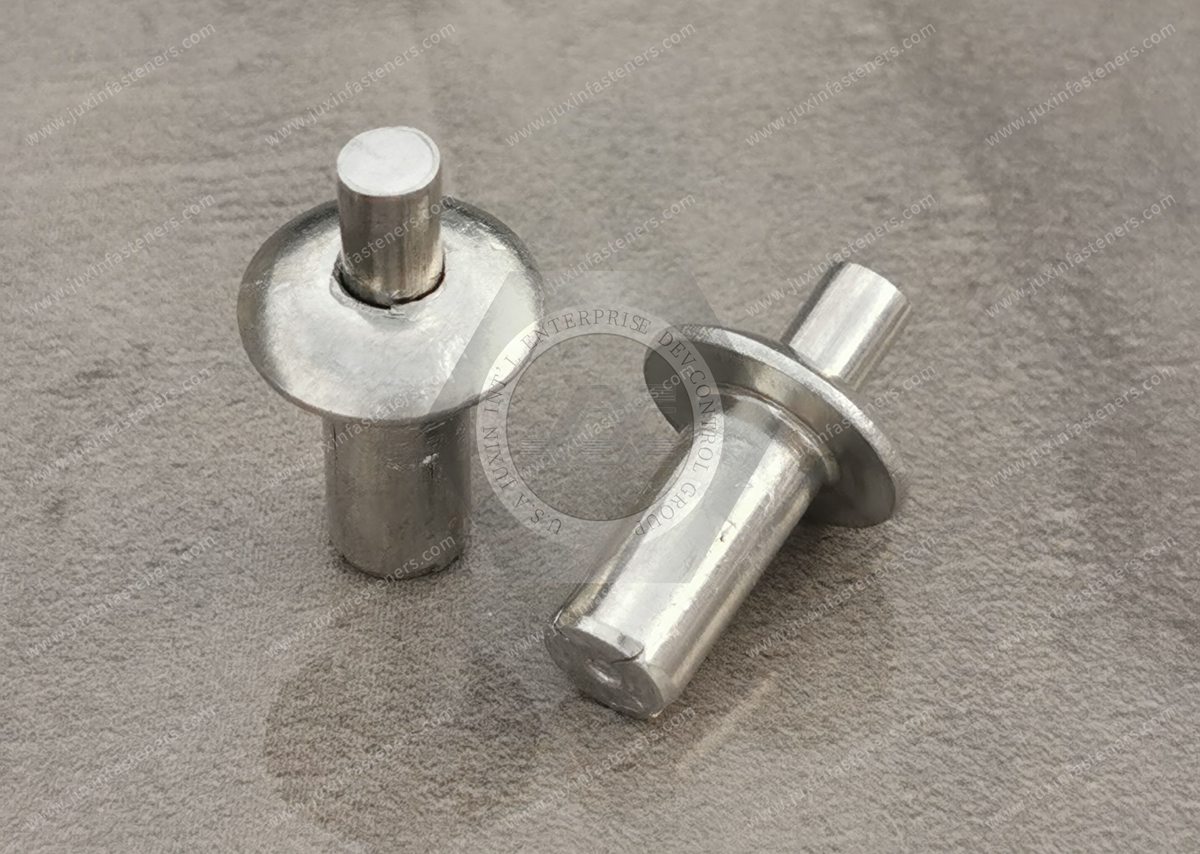
JUXIN FASTENERS supplies aluminum pin-drive rivets with aluminum bodies and aluminum drive pins for one-sided fastening without a conventional pull-riveting tool.
The center pin is driven into the rivet body to expand the fastening end and secure the joint.
Suitable for engineered panel assemblies, sheet metal components, equipment housings, and selected through-hole or blind-hole applications.
Product Specification
Aluminum Pin-Drive Rivets
Hammer-Set Aluminum Drive Rivets for One-Sided Industrial Fastening
JUXIN FASTENERS supplies aluminum pin-drive rivets for OEM manufacturers, sheet metal fabricators, equipment builders, and industrial assembly operations requiring a simple mechanical fastening method with access from one side.
Also known as aluminum drive pin rivets, hammer drive rivets, hammer-set rivets, and blind drive rivets, these fasteners use a central drive pin to expand the rivet body during installation.
Unlike conventional breakstem blind rivets, which are installed by pulling a mandrel with a riveting tool, pin-drive rivets are set by driving the center pin into the rivet body.
This installation principle can be useful for selected panel assemblies, fabricated equipment components, and applications where conventional pulling equipment is impractical.
Product Construction
Rivet Body: Aluminum
Drive Pin: Aluminum
Installation Method: Hammer-driven or compatible impact setting equipment
Fastening Principle: Expansion of the rivet body
Installation Access: One accessible side
Hole Configuration: Suitable through-hole or blind-hole designs, subject to dimensional verification
Exact aluminum grades, rivet dimensions, head geometry, hole requirements, and mechanical performance must be confirmed using the applicable product drawing.
How Aluminum Pin-Drive Rivets Work
A pin-drive rivet consists of a hollow or internally formed rivet body and a central drive pin.
The rivet is first positioned in a prepared installation hole.
During setting, the installer drives the center pin into the rivet body using a hammer or compatible installation equipment.
The advancing pin causes the fastening end of the body to expand or flare outward, creating mechanical retention within or behind the joined materials.
The resulting holding action depends on the rivet design, hole geometry, substrate material, and installation condition.
For a through-hole assembly, expansion may occur beyond the rear surface of the workpiece.
For a suitable closed-end or blind-hole application, the body may expand against the surrounding hole walls.
These two installation arrangements should not be assumed to have identical holding strength or installation requirements.
Key Features and Engineering Benefits
Simple Hammer-Set Installation
Pin-drive rivets can be installed without the conventional pulling mechanism used for breakstem blind rivets.
Depending on the product design and assembly requirements, a hammer or suitable impact tool may be used to drive the center pin.
This can be useful for maintenance operations, field assembly, and selected manufacturing processes.
One-Sided Fastening
The installation process is performed from the accessible side of the assembly.
This is valuable where rear-side access is restricted or where positioning a conventional nut is impractical.
Expanding Rivet Body
Driving the pin causes the body to expand and develop mechanical retention.
The expansion pattern and holding performance depend on the selected rivet construction.
Lightweight Aluminum Construction
An aluminum body and aluminum drive pin provide a lightweight fastening option for suitable industrial applications.
The selected aluminum alloy and environmental conditions determine the actual corrosion performance and mechanical suitability.
Permanent Mechanical Attachment
Pin-drive rivets are generally intended for permanent or nonroutine-removal connections.
Removal may require drilling or destructive methods, depending on the installed construction.
Compatibility with Different Hole Arrangements
Properly designed pin-drive rivets may be used in through-holes or closed-end holes.
The required hole diameter, depth, and supporting material must be verified for each application.
Pin-Drive Rivets Versus Conventional Blind Rivets
Although both fastening methods may provide one-sided installation, their setting mechanisms are different.
Pin-Drive Rivets
The center pin is driven inward to expand the rivet body.
Installation typically uses a hammer or compatible impact-setting method.
The design is relevant to selected panel fastening, equipment assembly, and applications where simple setting equipment is desirable.
Conventional Breakstem Blind Rivets
A pulling tool draws the mandrel through the rivet body.
The blind-side portion of the rivet expands or deforms before the mandrel breaks at its designed location.
These products require a compatible pulling tool and nosepiece.
Engineering Selection
The two fastening types should not be substituted solely because their nominal diameters are similar.
Engineers must verify installation hole requirements, material thickness, joint loading, access conditions, and the required setting process.
Aluminum Body and Aluminum Drive Pin
This JUXIN product series is described with an aluminum body and aluminum center pin.
The body provides the expanding fastening structure, while the drive pin activates the expansion during installation.
Material selection should consider:
Aluminum alloy and temper
Rivet body dimensions
Drive pin geometry
Joint material and thickness
Installation hole diameter
Hole depth for blind-hole applications
Mechanical loading
Corrosion exposure
Installation consistency
Aluminum fasteners may be appropriate for selected lightweight equipment and fabricated assemblies.
However, the aluminum material combination should not automatically be considered suitable for heavy structural joints or high-load applications without verified performance data.
Through-Hole Installation
A through-hole passes completely through the material or assembly.
In a suitable pin-drive rivet design, the fastener body expands after the center pin is driven, forming a retaining structure at the fastening end.
Engineers should verify that the workpiece geometry provides adequate support for the expanded body.
Important considerations include the combined material thickness, installation hole diameter, rivet body length, and clearance behind the assembly.
Where the rear side is accessible for inspection, the formed retaining structure can be checked against the approved installation criteria.
Blind-Hole and Closed-End Hole Installation
A blind hole does not pass completely through the workpiece.
Certain pin-drive rivets are designed to expand within the hole and develop retention against the surrounding material.
This installation method may be relevant to selected equipment components and assemblies where a through-hole is undesirable.
Engineering requirements include:
Correct hole diameter
Adequate hole depth
Suitable substrate material
Sufficient surrounding wall thickness
Compatible expansion geometry
Verified pull-out performance where required
Not every pin-drive rivet is suitable for every blind-hole application.
The specific product design must be confirmed before installation.
Installation Hole Preparation and Fit
Hole quality is important because the expansion mechanism depends on the relationship between the rivet body and the surrounding material.
An oversized hole may reduce retention.
An undersized hole may prevent correct insertion or damage the fastener.
Poorly aligned holes may interfere with seating and produce inconsistent expansion.
For reliable installation, engineers should specify the correct hole diameter and tolerance, verify the material thickness, and control burrs or deformation around the opening.
Blind-hole applications additionally require verification of hole depth and bottom clearance.
Head Design and Surface Appearance
Pin-drive rivets are manufactured in different head configurations across the industrial market.
The head shape affects the bearing surface, finished appearance, and clearance requirements.
For the selected JUXIN product, the exact head diameter, head height, and geometry must be confirmed from the corresponding drawing.
A conventional raised head remains above the accessible surface.
A countersunk design requires a properly prepared matching recess if a flush finish is specified.
Head styles should not be assumed interchangeable without checking the installation geometry.
Installation Procedure
A controlled installation process helps ensure consistent body expansion and joint retention.
Prepare the Workpieces
Produce the specified installation hole and remove burrs or debris that could interfere with seating.
Verify the Rivet
Check the rivet body diameter, body length, material combination, and drive pin condition.
Confirm the Hole Configuration
For through-holes, verify the assembled material thickness and available expansion clearance.
For blind holes, confirm the specified diameter, depth, and surrounding substrate support.
Insert the Rivet
Place the rivet body into the prepared hole and seat the head against the accessible surface.
Drive the Center Pin
Use a hammer or compatible impact-setting equipment to advance the center pin according to the approved installation instructions.
Inspect the Installed Joint
Verify head seating, drive pin position, and any required expansion characteristics.
Where appropriate, conduct representative pull-out or shear testing to establish installation quality.
The final pin position should be based on the specific product design rather than a universal assumption that every drive pin must finish at the same height.
Common Installation Problems and Prevention
Insufficient Body Expansion
Incomplete pin driving may prevent the rivet from developing the intended retention.
Recommended control: Use a defined setting method and verify the final drive pin position.
Oversized Installation Hole
An oversized hole may reduce contact between the expanded body and the surrounding material.
Recommended control: Maintain the approved hole diameter and tolerance.
Incorrect Hole Depth
In a blind-hole application, insufficient depth may prevent proper insertion or setting.
Recommended control: Verify the minimum required hole depth before installation.
Excessive Impact Force
Uncontrolled hammering may damage the rivet head, drive pin, or surrounding material.
Recommended control: Use an appropriate setting method and establish installation acceptance criteria.
Unsuitable Substrate Material
Some materials may crack, deform, or provide inadequate support during rivet expansion.
Recommended control: Evaluate substrate strength, thickness, and hole geometry before approving the application.
Incorrect Rivet Length
An unsuitable body length may prevent the desired expansion or interfere with the assembly.
Recommended control: Select the rivet using the applicable dimensional specification.
Industrial Applications and Engineering Solutions
Sheet Metal Fabrication
Aluminum pin-drive rivets may be considered for selected fabricated panels, covers, and light-duty sheet metal components requiring one-sided fastening.
The installation hole and material thickness must be compatible with the rivet design.
Industrial Equipment Housings
Potential applications include equipment covers, access panels, and fabricated enclosures where a permanent mechanical attachment is appropriate.
The design should account for service access and the possibility of destructive removal.
Commercial Vehicle and Trailer Components
Drive rivets may be evaluated for selected noncritical panels, liners, trim components, and equipment attachments.
The specific application must be checked for vibration, corrosion, and mechanical loading.
Safety-critical or load-bearing vehicle joints require appropriate engineering qualification.
HVAC and Ventilation Equipment
Potential applications include selected sheet metal covers, equipment panels, and fabricated ventilation components.
Engineers should consider material compatibility, vibration, and maintenance requirements.
Electrical and Electronic Equipment
Aluminum drive rivets may be evaluated for suitable covers, housings, and mechanical panel attachments.
They should not be assumed to provide electrical grounding continuity, insulation, or sealing without separate verification.
Telecommunications and Data Center Equipment
Potential applications include selected enclosure panels and lightweight fabricated components where one-sided installation is useful.
Assembly clearance, maintenance access, and mechanical loading should be evaluated.
Outdoor Equipment and Enclosures
Aluminum construction may be useful in selected outdoor assemblies.
Corrosion resistance depends on the actual alloy, contact materials, surface conditions, and operating environment.
Production Management and Installation Efficiency
For production managers, the choice of a pin-drive rivet affects the installation process, equipment requirements, operator training, and inspection workload.
Potential operational considerations include:
One-sided assembly access
Hammer or impact-setting equipment
Hole preparation time
Consistency of pin driving
Operator ergonomics
Workpiece support
Rivet identification
Inspection procedures
Rework and removal requirements
Total installed cost
For repeated OEM production, controlled setting equipment may provide more consistent installation than uncontrolled manual hammering.
The most appropriate process depends on the required production volume and joint quality criteria.
Engineering Selection and Mechanical Performance
Pin-drive rivets should be selected according to the complete joint requirements rather than nominal diameter alone.
Important factors include:
Pull-Out Resistance
The resistance to withdrawal depends on body expansion, substrate properties, hole geometry, and installed condition.
Shear Resistance
Shear performance depends on the fastener construction, material, and joint configuration.
Substrate Strength
Soft or thin materials may deform or fail before the rivet reaches its own mechanical limit.
Vibration and Fatigue
Repeated service loading can affect the joint and should be considered where relevant.
Corrosion Compatibility
Aluminum fasteners installed against dissimilar metals may require evaluation for galvanic corrosion.
Mechanical performance values should only be published when supported by verified test results for the selected product.
OEM Purchasing and Supply Chain Requirements
OEM sourcing engineers, purchasing managers, and supply chain teams should confirm the following information before ordering:
Rivet body diameter
Body length
Head geometry
Aluminum body grade
Aluminum drive pin grade
Installation hole diameter
Minimum hole depth, where applicable
Material thickness or grip requirements
Surface finish
Mechanical performance requirements
Installation method
Packaging specifications
Production quantities
Quality inspection requirements
A clear technical specification helps reduce the risk of incorrect product selection and improves quotation accuracy.
Custom Aluminum Pin-Drive Rivets
JUXIN FASTENERS welcomes drawing-based inquiries for aluminum pin-drive rivets and related industrial fastening components.
Depending on engineering feasibility, project requirements may include custom body dimensions, head configurations, pin geometry, material specifications, surface treatments, packaging, and inspection criteria.
Customer-specific dimensions should be reviewed against the intended installation method and joint requirements.
Custom manufacturing availability is subject to technical evaluation and production confirmation.
Metric and Inch Dimension References
Pin-drive rivets may be specified using metric or inch-based dimensions.
Common dimensional references used in the industrial fastener market include 1/8 inch, 5/32 inch, and 3/16 inch.
These are general market references and do not establish confirmed JUXIN stock sizes.
Metric and inch-designated rivets should not be substituted without verifying the actual body diameter, hole tolerance, length, head geometry, and installation requirements.
Only confirmed product dimensions should be presented as available sizes.
Technical Drawings and Product Specifications
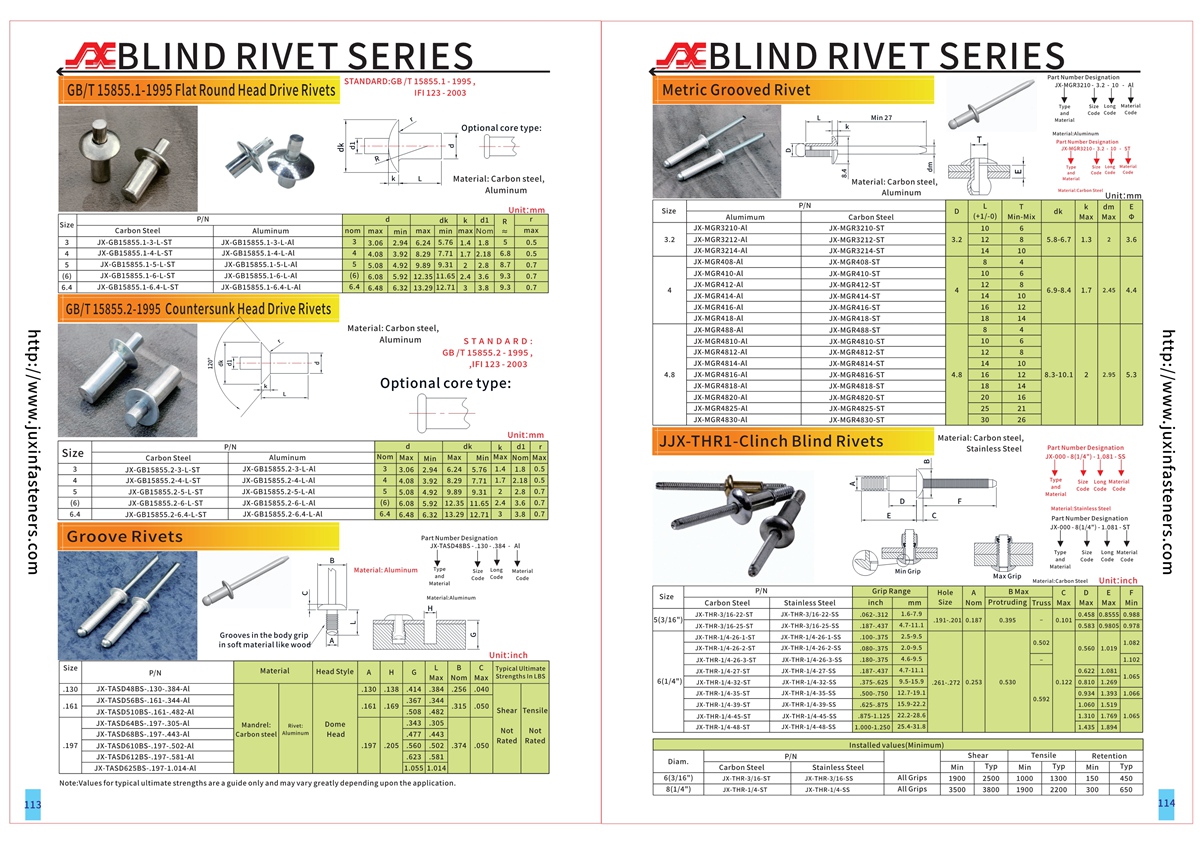
Please refer to the applicable JUXIN product drawings and specification documents for detailed dimensions and installation requirements.
Catalog Reference: Pages 113–114
The product documentation should be used to verify:
Rivet body diameter
Rivet body length
Drive pin dimensions
Head diameter and height
Aluminum material grades
Installation hole diameter
Required hole depth
Material thickness range
Dimensional tolerances
Mechanical ratings, where available
Installation and inspection requirements
Final product selection should be based on the approved drawing and the intended application.
Frequently Asked Questions
What are aluminum pin-drive rivets?
Aluminum pin-drive rivets are mechanical fasteners that use a center pin driven into the rivet body to create expansion and secure the assembly.
Are pin-drive rivets the same as conventional blind rivets?
No. Pin-drive rivets use an inward-driven pin, while conventional breakstem blind rivets use a mandrel pulled by a riveting tool.
Can pin-drive rivets be installed from one side?
Yes. Suitable pin-drive rivet designs can be installed from one accessible side.
Can they be used in blind holes?
Certain designs are suitable for closed-end holes, provided the hole dimensions and substrate material meet the product requirements.
Do aluminum pin-drive rivets require a rivet gun?
They generally use a hammer or compatible impact-setting equipment rather than a conventional pull-riveting tool.
Are aluminum pin-drive rivets suitable for structural joints?
Suitability depends on verified mechanical performance and the complete joint design. They should not be assumed appropriate for critical structural connections without engineering validation.
Are these rivets removable?
They are generally intended for permanent attachment. Removal may require drilling or another destructive method.
What materials are specified for this JUXIN product?
The specified configuration uses an aluminum body and aluminum drive pin.
Can JUXIN manufacture custom sizes?
JUXIN welcomes OEM inquiries based on technical drawings and specifications, subject to engineering review and manufacturing feasibility.
Request a Quotation — Aluminum Pin-Drive Rivets
JUXIN FASTENERS supports OEM manufacturers, design engineers, production managers, sourcing specialists, purchasing managers, and supply chain teams seeking reliable industrial fastening solutions.
For an accurate quotation, please provide the rivet diameter, body length, head dimensions, aluminum material specifications, installation hole requirements, joint material, application details, and estimated order quantity.
Please include 2D engineering drawings or 3D CAD models where available.
Our team can review your project requirements and coordinate technical and commercial clarification.
Email: info@juxinfasteners.com
Website: www.juxinfasteners.com
JUXIN FASTENERS — Industrial Fasteners and Custom OEM Fastening Solutions
Product Packaging
Packaging Standard
At Juxin Fasteners, we apply standardized export packaging to ensure product protection, traceability, and compliance with international logistics requirements.
1. Standard Export Packaging
Unless otherwise specified, all products will be packed according to our factory standard export packaging, which includes:
Moisture-resistant inner protection
Poly bag or small box packing as required
Reinforced export cartons
Clear labeling with part number, specification, batch number, and quantity
Palletizing for sea or air shipment when necessary
Our standard packaging is designed to ensure safe transportation, efficient warehousing, and long-distance international shipping.
2. Customized Packaging Options
We also provide customized packaging solutions according to customer requirements, including but not limited to:
Private labeling
Customized barcodes
Specific carton dimensions
Retail packaging
Special pallet configuration
Customer-specific marking and identification
So that you know, customized packaging may involve additional costs and extended lead time depending on the complexity of the requirements.
3. Compliance & Quality Assurance
All packaging processes are controlled under our ISO 9001 quality management system to ensure consistency, traceability, and product integrity throughout the supply chain.
Product Pictures
Contact Us
Tel.:
+86 020 8621 0320
+86 020 3121 6067
E-mail:
Technical Support:
Navigation
SEND INQUIREY