Call Us
+86 136 6007 9809
Call Us
+86 136 6007 9809

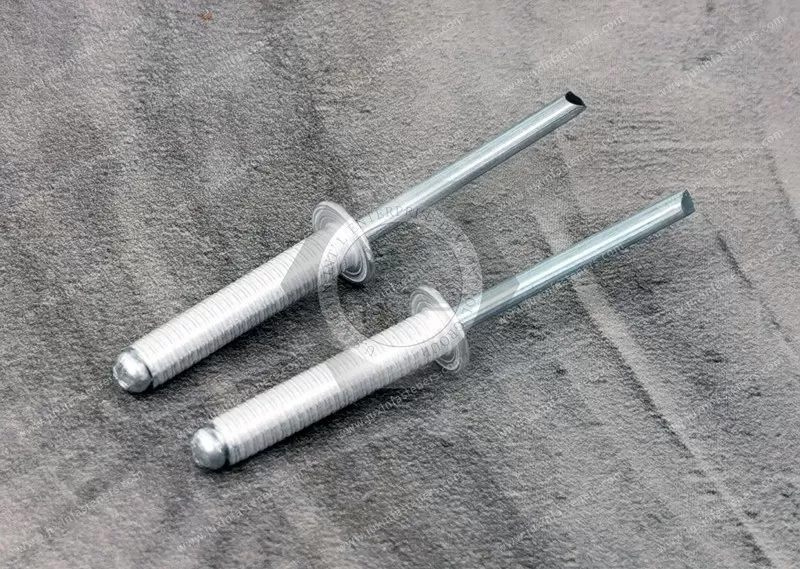
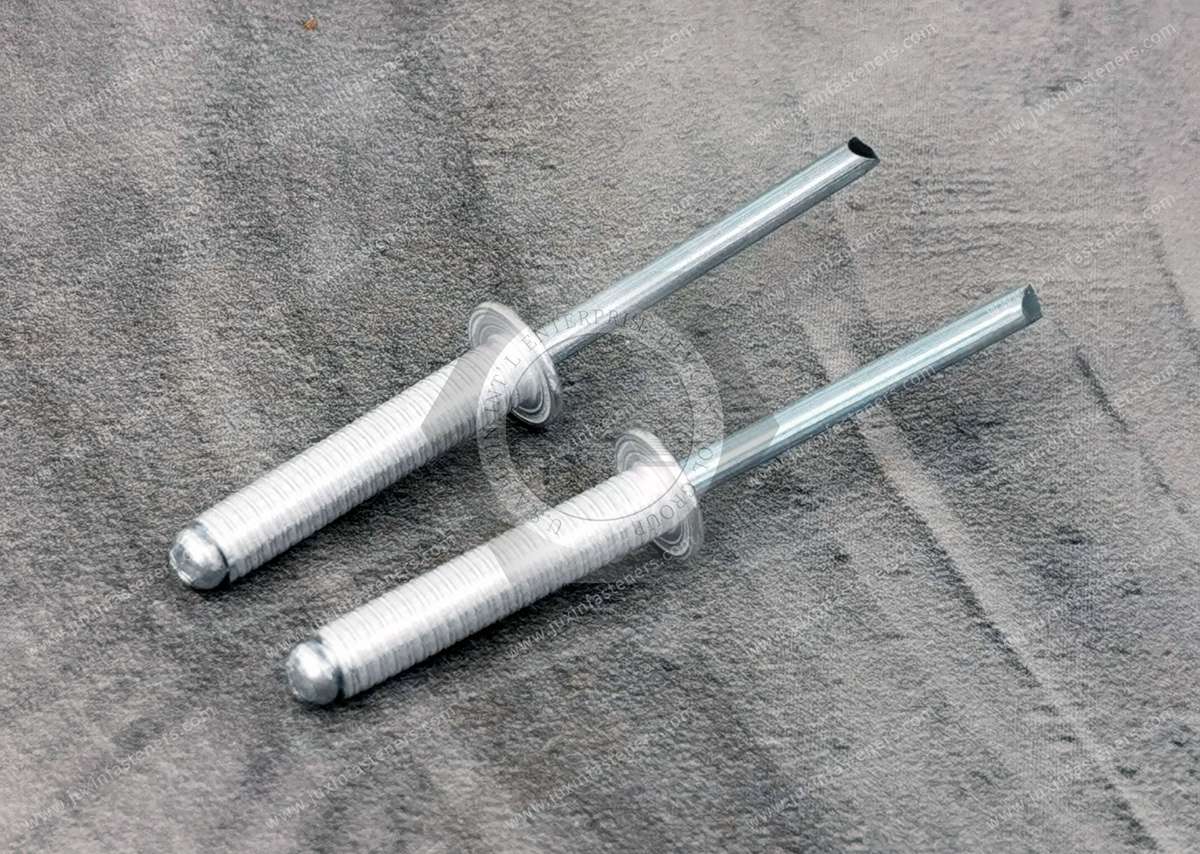
JUXIN FASTENERS supplies aluminum-body, carbon steel mandrel grooved blind rivets for OEM metal-to-wood fastening and compatible soft substrates.
Their annular grooves expand into prepared blind-hole walls, developing mechanical retention in suitable wood, plywood, and plastic materials.
Designed for one-sided installation, these rivets support equipment case fabrication, furniture hardware, industrial panels, and engineered assemblies requiring controlled hole preparation.
Product Specification
Grooved Blind Rivets for Metal-to-Wood OEM Assembly
Engineering Selection, Blind-Hole Design and Industrial Procurement
Fastening a metal component to wood, plywood, or a relatively soft plastic substrate presents different engineering challenges from joining two metal sheets.
The joint may need to be installed from one side, the receiving material may not permit a through-hole, and conventional blind-side expansion may not provide the desired retention.
JUXIN FASTENERS supplies grooved blind rivets with aluminum bodies and carbon steel mandrels for suitable OEM applications involving soft or fibrous substrates.
These specialized blind rivets use circumferential grooves along the body to develop mechanical engagement within a prepared hole.
This guide focuses on how engineers and purchasing teams should evaluate grooved blind rivets for metal-to-wood assemblies,
blind-hole installation, substrate compatibility, production repeatability, and drawing-based procurement.
The Engineering Challenge: Fastening Metal to a Soft Substrate
When a metal bracket, edge profile, or fitting is attached to plywood or another soft material, the joint must transfer load into a substrate with different mechanical properties.
The receiving material may be sensitive to:
Local crushing
Fiber splitting
Hole enlargement
Moisture-related dimensional changes
Withdrawal loading
Repeated vibration
Long-term deformation
The fastener must therefore be selected according to the complete joint rather than the metallic rivet alone.
Grooved blind rivets provide a fastening option in which the rivet body expands within the hole and engages the surrounding substrate.
Product Configuration
The JUXIN product configuration described here includes:
Fastener Type: Grooved Blind Rivet
Rivet Body Material: Aluminum
Mandrel Material: Carbon Steel
Body Geometry: Annular / Circumferential Grooves
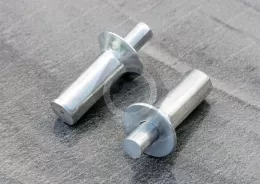
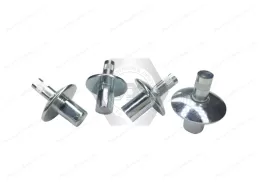
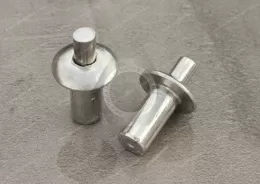
Head Configuration: Domed Head, Subject to Drawing Confirmation
Installation Method: Pull-Type Blind Riveting
Access Requirement: One Accessible Side
Retention Method: Radial Expansion and Hole-Wall Engagement
Exact alloy grades, mandrel finish, dimensions, tolerances, and mechanical performance must be confirmed from the approved technical drawing.
Why the Grooved Body Matters
A conventional blind rivet commonly forms an enlarged closing head behind the workpiece.
That mechanism requires appropriate blind-side space and support.
A grooved blind rivet uses a different retention principle.
During setting, the mandrel causes the grooved aluminum body to expand radially.
The external annular grooves press into the material surrounding the hole.
In a compatible substrate, this creates localized mechanical engagement and resistance to withdrawal.
The effectiveness of the connection depends on the interaction between the rivet body and the substrate.
This makes hole geometry and substrate characteristics critical selection factors.
Blind-Hole Design: The Most Important Selection Decision
A blind hole, also called a closed-end or non-through hole, terminates inside the receiving material.
The fastener must develop sufficient retention without relying on an opening through the rear surface.
For grooved blind rivets, engineers should evaluate the hole as part of the fastening system.
Hole Diameter
The hole diameter determines the available radial engagement between the rivet body and substrate.
If the hole is too large, the grooves may not develop adequate contact.
If the hole is too small, insertion or expansion may damage the surrounding material.
Hole Depth
The hole must provide sufficient space for the rivet body and setting deformation.
The minimum required depth depends on the selected rivet geometry and the thickness of the attached component.
Remaining Substrate Thickness
The material beneath the blind hole must be sufficient to avoid breakthrough, cracking, or local failure.
Edge Distance
The hole location must provide adequate surrounding material to resist splitting and withdrawal.
Hole Quality
Drilling damage, debris, and inconsistent hole geometry may affect installation repeatability.
Engineering Recommendation
For production approval, hole diameter and minimum depth should be established through installation trials using the actual substrate.
Generic dimensions from unrelated rivet products should not be treated as approved JUXIN installation specifications.
Metal-to-Wood Joint Design
A typical application involves a metal component positioned against a wood-based substrate.
The metal component may be a bracket, corner fitting, edge profile, protective strip, or fabricated mounting plate.
The grooved rivet passes through the metal component and expands within the wood.
The head retains the metal component while the grooved body engages the receiving material.
Engineers should evaluate the following conditions.
Metal Component Thickness
The thickness of the attached component affects the available rivet engagement length.
Wood Density
Dense and low-density woods may respond differently to radial expansion.
Wood Grain Orientation
Fiber direction can influence local splitting and withdrawal behavior.
Moisture Content
Changes in moisture content can affect wood dimensions and mechanical performance.
Loading Direction
Withdrawal, shear, and combined loading produce different joint stresses.
Assembly Environment
Humidity, temperature, and vibration may influence long-term retention.
A fastener that performs satisfactorily in one wood species or plywood grade should not automatically be approved for another.
Plywood and Engineered Wood Selection
Plywood is widely used in equipment cases, transport enclosures, furniture, and fabricated panel assemblies.
However, plywood grades differ in:
Number of layers
Veneer thickness
Adhesive system
Density
Surface quality
Internal bonding
Moisture resistance
The annular grooves must develop adequate engagement without causing unacceptable damage.
For an OEM application, testing should use the actual plywood grade and thickness specified for production.
Substituting a different board material may require requalification of the joint.
Plastic Substrate Compatibility
Grooved blind rivets may also be considered for suitable plastic materials.
However, plastic behavior differs from wood.
Ductility
A plastic must tolerate the required local expansion without cracking.
Hardness
The substrate must provide sufficient resistance for the grooves to develop retention.
Creep
Certain plastics can deform under sustained loading, potentially reducing joint holding performance.
Temperature
Temperature changes may affect substrate dimensions and mechanical properties.
Wall Thickness
Thin plastic sections may not provide enough material around the hole.
Engineers should evaluate the actual polymer grade, wall thickness, and operating conditions.
Not all plastics are suitable for grooved blind rivets.
Composite and Fiberglass Considerations
Some OEM assemblies use fiber-reinforced plastics or other composite substrates.
These materials may have relatively high stiffness but limited tolerance for localized radial expansion.
Possible concerns include:
Delamination
Matrix cracking
Hole-wall damage
Fiber fracture
Insufficient groove engagement
Grooved blind rivets should only be selected for composite applications after appropriate testing confirms compatibility.
Application Engineering: Equipment Cases and Transport Enclosures
Equipment transport cases are a relevant example of metal-to-plywood fastening.
These assemblies may include aluminum edge profiles, corner fittings, handles, protective hardware, and other fabricated components attached to plywood panels.
Grooved blind rivets can provide a one-sided fastening option where the receiving material is suitable and blind-hole retention is required.
Engineering considerations include:
Panel thickness
Edge profile geometry
Hardware positioning
Repeated handling loads
Impact exposure
Fastener spacing
Local plywood strength
Repair requirements
The fastener should be selected according to the expected service conditions rather than appearance alone.
Application Engineering: Furniture and Interior Equipment
Furniture manufacturers may use grooved blind rivets to attach selected metal fittings to wood-based components.
Potential applications include:
Metal brackets
Reinforcement plates
Decorative metal profiles
Equipment mounting fittings
Cabinet hardware
Fabricated support components
The required retention depends on the loading and substrate.
Applications involving occupant safety, significant structural loads, or repeated high-force movement require appropriate engineering qualification.
Application Engineering: Industrial Panels and Fabricated Assemblies
Grooved blind rivets may be evaluated for selected fabricated assemblies involving metal components and compatible soft substrates.
Examples include:
Industrial equipment cases
Protective panel assemblies
Engineered wood enclosures
Plastic equipment components
Lightweight interior fittings
Transport packaging hardware
These applications should be assessed individually for load requirements, installation geometry, and substrate behavior.
Grooved Blind Rivets Versus Alternative Fastening Methods
Choosing the correct fastener requires understanding how the joint will be assembled and serviced.
Conventional Blind Rivets
Standard blind rivets generally rely on blind-side deformation to create a closing head.
They may be suitable when the joint provides adequate rear-side space and material support.
Grooved Blind Rivets
Grooved blind rivets develop retention through expansion and engagement within the hole wall.
They may be particularly useful where a suitable blind hole is available in wood or another compatible substrate.
Screws
Screws can offer removable fastening, but their performance depends on thread engagement and substrate characteristics.
Threaded Inserts
Threaded inserts may be appropriate where repeated assembly and disassembly are required.
Engineering Selection
The correct method depends on load, substrate, access, serviceability, production process, and total installed cost.
Grooved blind rivets should not be assumed interchangeable with screws, threaded inserts, or conventional blind rivets.
Installation Process Development
For OEM manufacturing, the installation method should be validated before production release.
Hole Preparation
Prepare the specified hole in the receiving substrate.
Confirm the hole diameter, depth, and location.
Component Positioning
Position the metal or other attached component against the substrate.
Align the holes without forcing the assembly.
Rivet Insertion
Insert the grooved rivet body through the attached component and into the prepared hole.
Tool Setting
Use a compatible blind riveting tool and nosepiece to pull the carbon steel mandrel.
Radial Expansion
The aluminum body expands and its grooves engage the surrounding substrate.
Setting Completion
Complete the approved installation cycle and verify that the mandrel separates as intended.
Inspection
Check head seating, visible substrate damage, and the specified installation acceptance criteria.
Validation
Perform representative joint testing where required.
Production Quality Control
Production managers should focus on the consistency of the entire installation process.
Important control points include:
Substrate Identification
Verify that the production material matches the approved substrate grade.
Hole Diameter
Monitor drilling or machining consistency.
Hole Depth
Prevent insufficient depth and unintended breakthrough.
Tool Compatibility
Use suitable riveting equipment and maintain it according to the approved process.
Mandrel Setting
Monitor incomplete setting and abnormal mandrel behavior.
Head Seating
Check that the rivet head seats correctly against the attached component.
Joint Retention
Use sampling and mechanical testing when required by the application.
Traceability
Maintain appropriate material and production records for OEM projects.
Failure Modes Engineers Should Evaluate
The most important failure mode may occur in the substrate rather than the rivet.
Rivet Pull-Out
The expanded grooves may disengage from the surrounding material under withdrawal loading.
Substrate Splitting
Radial expansion may cause cracking or splitting if the material is unsuitable.
Hole Enlargement
Repeated loading can enlarge the hole and reduce retention.
Local Crushing
Soft materials may deform beneath the rivet head or around the expanded body.
Component Pull-Through
An attached component with insufficient head support may fail locally.
Mandrel or Body Failure
The metallic components may deform or fracture under excessive loading.
Environmental Degradation
Moisture, temperature, and corrosion can affect long-term joint behavior.
These risks should be addressed through appropriate design margins and representative testing.
Mechanical Performance and Test Requirements
Grooved blind rivet performance should be evaluated at two levels.
Fastener-Level Performance
The rivet body and mandrel have material and geometric properties that influence mechanical behavior.
Joint-Level Performance
The installed connection also depends on the receiving substrate, hole geometry, component thickness, and installation process.
For metal-to-wood or metal-to-plastic applications, joint-level performance is particularly important.
Relevant tests may include:
Static pull-out resistance
Shear loading
Cyclic loading
Substrate damage inspection
Environmental conditioning
Installation repeatability
Published fastener strength figures from unrelated products should not be used as guaranteed joint ratings.
Procurement Considerations for OEM Buyers
For sourcing teams, grooved blind rivets should be purchased according to the intended application rather than a generic product name.
A complete technical inquiry should identify:
Required rivet diameter
Rivet body length
Head dimensions
Aluminum body material
Carbon steel mandrel specification
Surface finish
Attached component thickness
Receiving substrate type
Hole diameter
Minimum hole depth
Mechanical performance requirements
Installation equipment
Packaging requirements
Order quantity
Estimated annual consumption
When possible, include both the fastener drawing and the assembly drawing.
This information helps engineering and purchasing teams evaluate product compatibility before production.
Supplier Evaluation and OEM Qualification
OEM buyers should evaluate more than the unit price.
Important supplier qualification considerations include:
Dimensional Consistency
The rivet body, grooves, head, and mandrel must meet the approved drawing.
Material Verification
The aluminum body and carbon steel mandrel must meet the agreed specifications.
Installation Compatibility
The fastener must work with the selected setting equipment and substrate.
Quality Documentation
Inspection reports and material documentation should be agreed according to the project requirements.
Production Capacity
The supplier should be able to support the required order quantities and delivery schedule.
Packaging and Identification
Appropriate labeling and packaging can help prevent material or size mix-ups during production.
Engineering Communication
Drawing revisions and installation requirements should be clearly controlled.
Custom Grooved Blind Rivets for OEM Projects
JUXIN FASTENERS welcomes drawing-based inquiries for custom grooved blind rivets.
Potential custom requirements may include:
Rivet body diameter
Rivet body length
Head geometry
Annular groove profile
Aluminum material specification
Carbon steel mandrel specification
Surface treatment
Packaging configuration
Custom production is subject to technical review and manufacturing feasibility.
For applications involving unusual substrates or installation conditions, representative testing may be necessary before final approval.
Metric and Inch Size References
Grooved blind rivets are specified in both metric and inch-based industrial markets.
Common nominal diameter references include:
1/8 inch, approximately 3.18 mm
5/32 inch, approximately 3.97 mm
3/16 inch, approximately 4.76 mm
These are general market references and do not represent confirmed JUXIN available sizes.
Metric and inch-designated rivets must not be treated as interchangeable without checking actual body diameter, head geometry, hole size, length, and installation requirements.
Technical Documentation
Please refer to the applicable JUXIN product drawing and specification sheet.
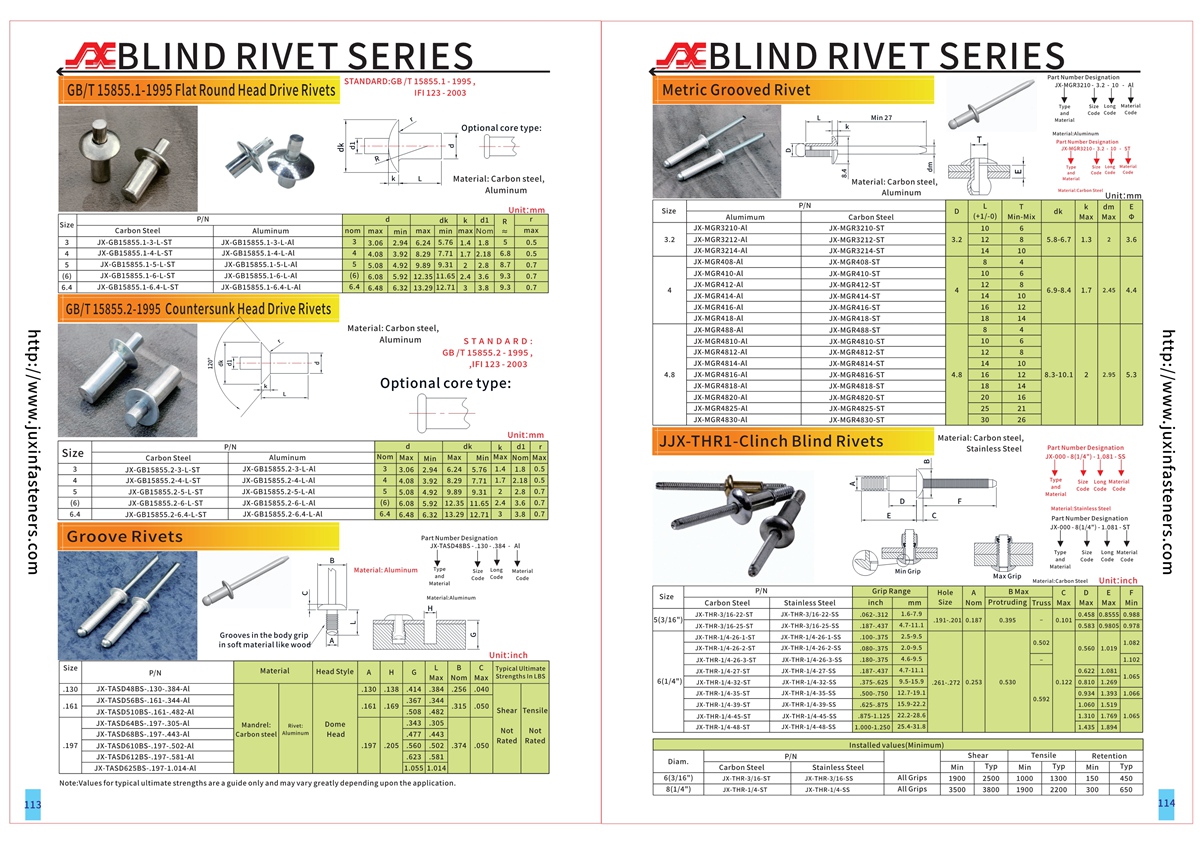
Catalog Reference: Pages 113–114
Technical documentation should be used to confirm:
Body diameter
Body length
Head dimensions
Groove geometry
Mandrel dimensions
Material specifications
Hole diameter
Minimum blind-hole depth
Attached component thickness
Dimensional tolerances
Installation requirements
Mechanical performance, where available
Final approval should be based on the actual product drawing and intended joint application.
Frequently Asked Questions
Why are grooved blind rivets used for metal-to-wood fastening?
Their annular grooves expand into the surrounding wood or compatible substrate, creating mechanical engagement within the prepared hole.
Can grooved blind rivets be installed without drilling through the wood?
Yes. Suitable grooved blind rivets can be installed in blind holes, provided the hole diameter and minimum depth meet the approved requirements.
Do grooved blind rivets require a special installation tool?
They require a compatible blind riveting tool and nosepiece. Tool selection depends on the rivet size and setting requirements.
Are grooved blind rivets suitable for plywood?
They can be suitable for selected plywood grades. Performance should be verified using the actual board material and installation conditions.
Can they be used in plastic materials?
Certain plastics may be suitable, but hardness, creep, wall thickness, and cracking resistance must be evaluated.
Are grooved blind rivets suitable for fiberglass?
Selected applications may be evaluated through testing. Not all fiberglass-reinforced materials are compatible with radial expansion.
How is the correct blind-hole depth determined?
It depends on the rivet body length, attached component thickness, and setting geometry. The required depth should be confirmed from the approved drawing and installation trials.
Are these rivets suitable for high-strength structural joints?
They should not be assumed suitable for safety-critical or heavily loaded structural joints without verified joint performance and engineering approval.
Can JUXIN supply custom grooved blind rivets?
JUXIN welcomes OEM drawing-based inquiries for custom dimensions and specifications, subject to engineering review and manufacturing feasibility.
Request an OEM Quotation — Grooved Blind Rivets
JUXIN FASTENERS supports international OEM manufacturers, product design engineers, production managers, purchasing managers, sourcing specialists, and supply chain teams.
For a quotation, please provide the rivet dimensions, aluminum and carbon steel material requirements,
installation hole diameter and depth, attached component thickness, substrate type, mechanical performance requirements, and estimated production quantity.
Please include 2D drawings, 3D CAD models, or assembly details where available.
Email: info@juxinfasteners.com
Website: www.juxinfasteners.com
JUXIN FASTENERS — Industrial Fasteners and Custom OEM Fastening Solutions
Product Packaging
Packaging Standard
At Juxin Fasteners, we apply standardized export packaging to ensure product protection, traceability, and compliance with international logistics requirements.
1. Standard Export Packaging
Unless otherwise specified, all products will be packed according to our factory standard export packaging, which includes:
Moisture-resistant inner protection
Poly bag or small box packing as required
Reinforced export cartons
Clear labeling with part number, specification, batch number, and quantity
Palletizing for sea or air shipment when necessary
Our standard packaging is designed to ensure safe transportation, efficient warehousing, and long-distance international shipping.
2. Customized Packaging Options
We also provide customized packaging solutions according to customer requirements, including but not limited to:
Private labeling
Customized barcodes
Specific carton dimensions
Retail packaging
Special pallet configuration
Customer-specific marking and identification
So that you know, customized packaging may involve additional costs and extended lead time depending on the complexity of the requirements.
3. Compliance & Quality Assurance
All packaging processes are controlled under our ISO 9001 quality management system to ensure consistency, traceability, and product integrity throughout the supply chain.
Product Pictures
Contact Us
Tel.:
+86 020 8621 0320
+86 020 3121 6067
E-mail:
Technical Support:
Navigation
SEND INQUIREY