Call Us
+86 136 6007 9809
Call Us
+86 136 6007 9809

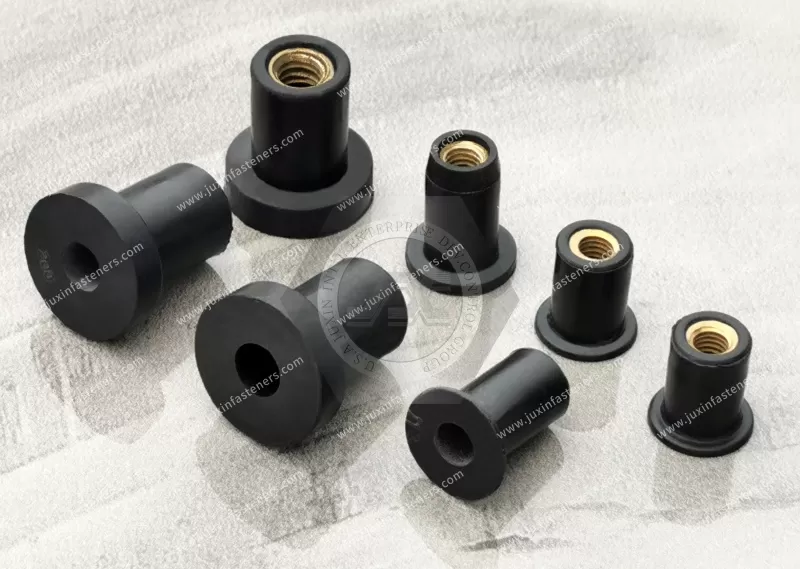
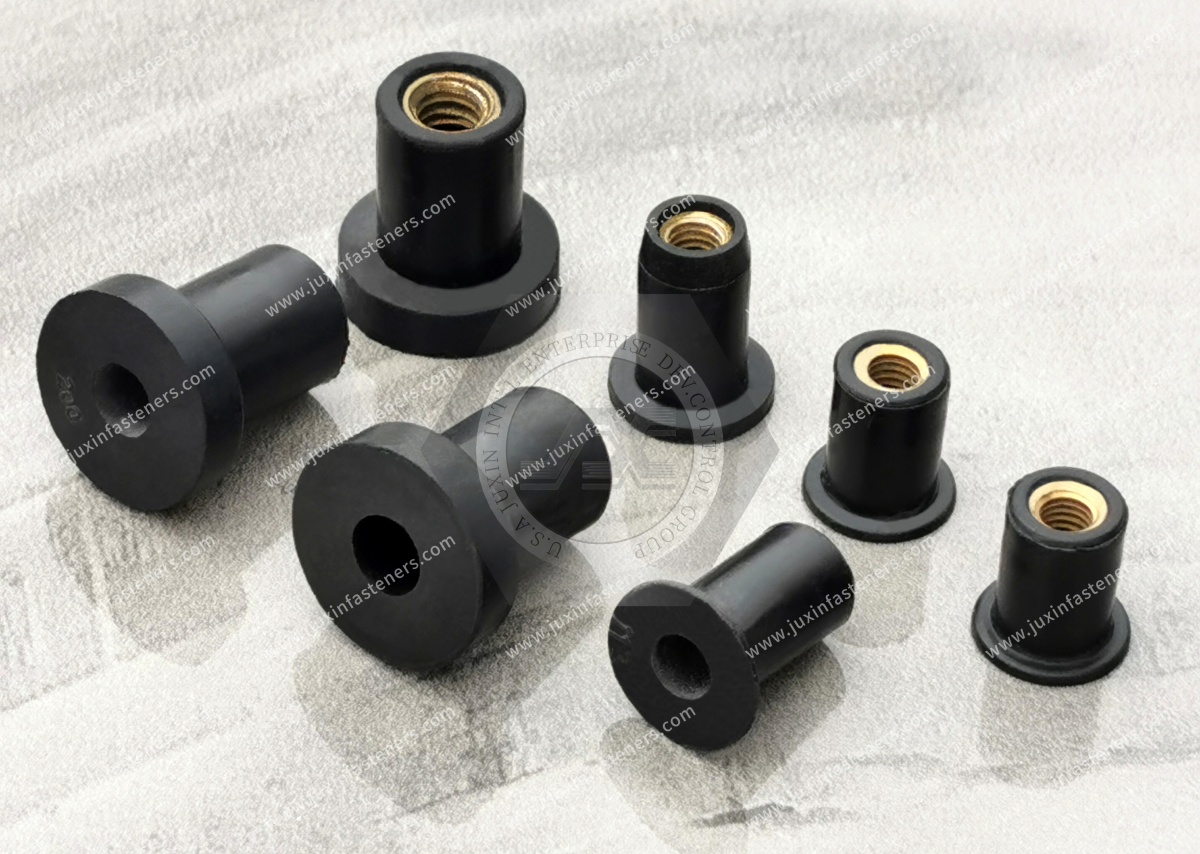
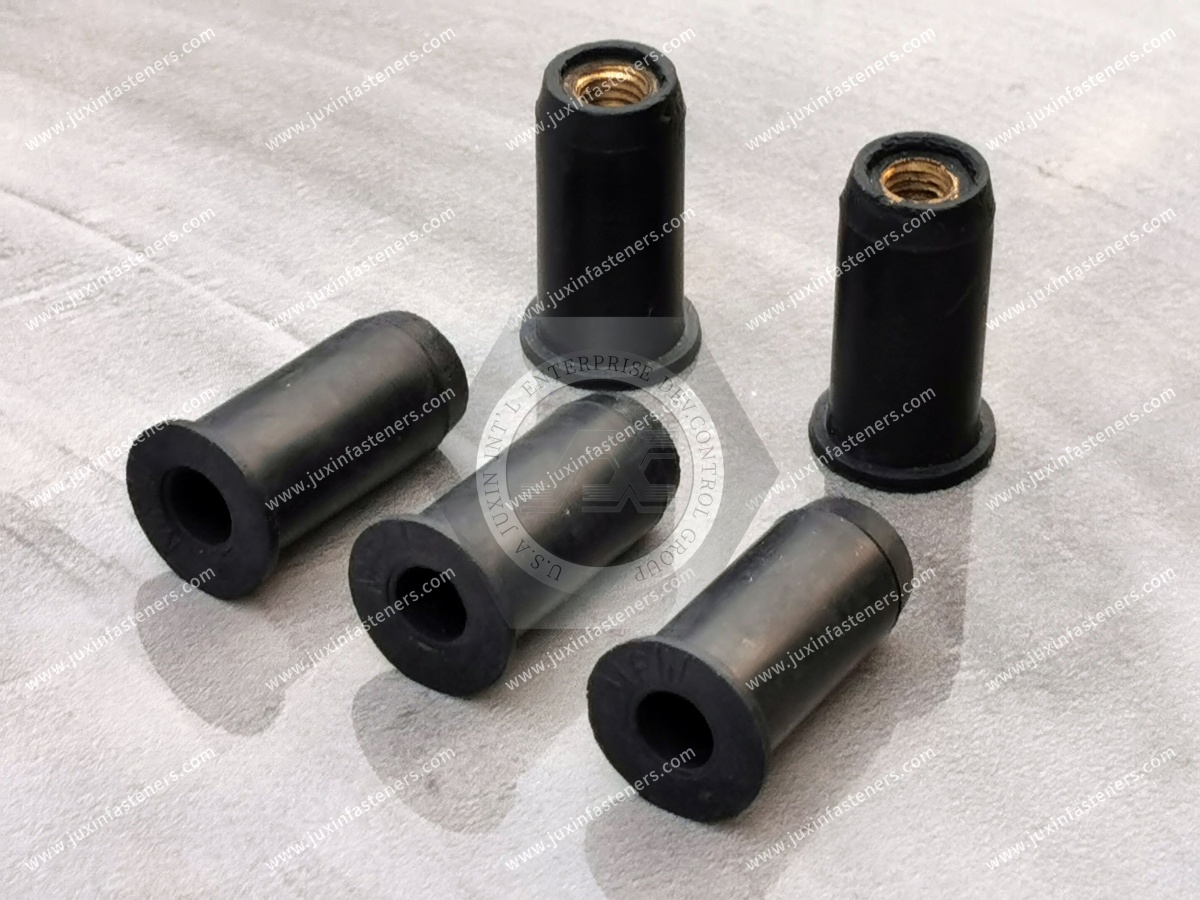
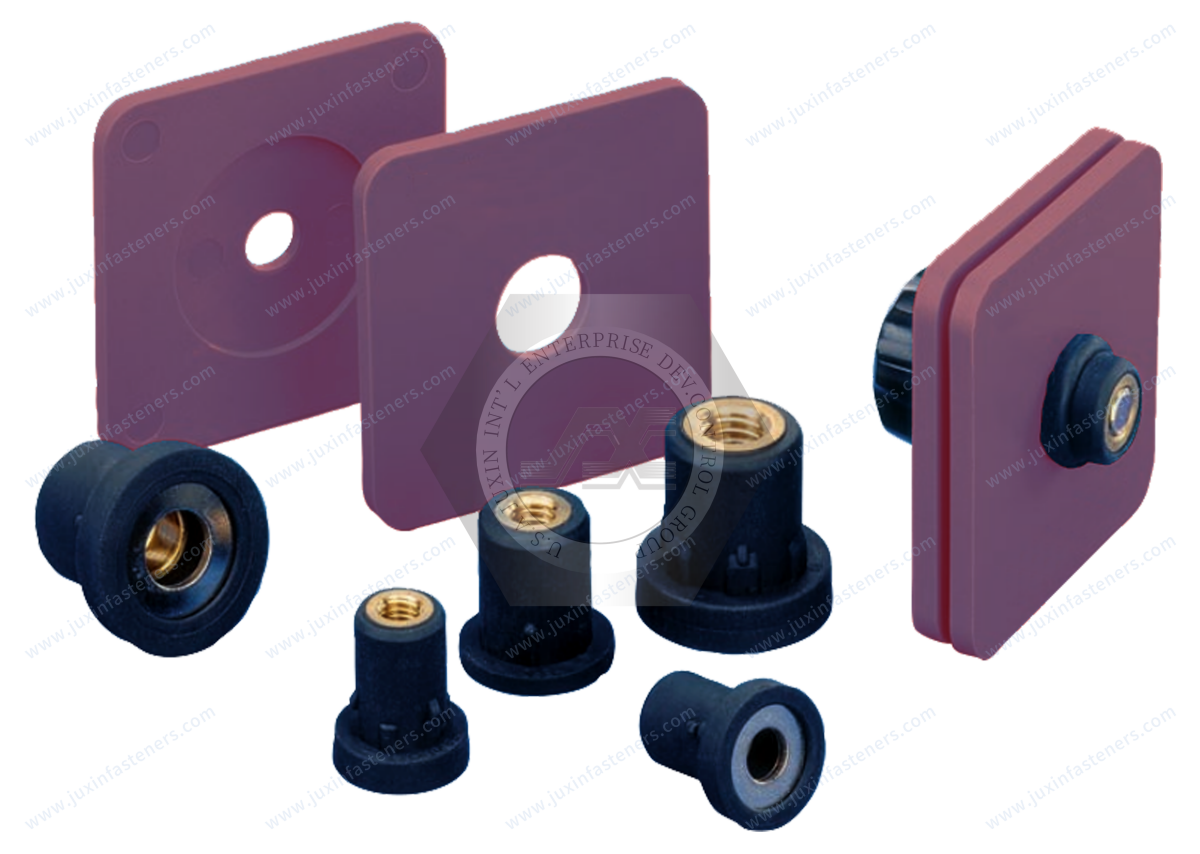
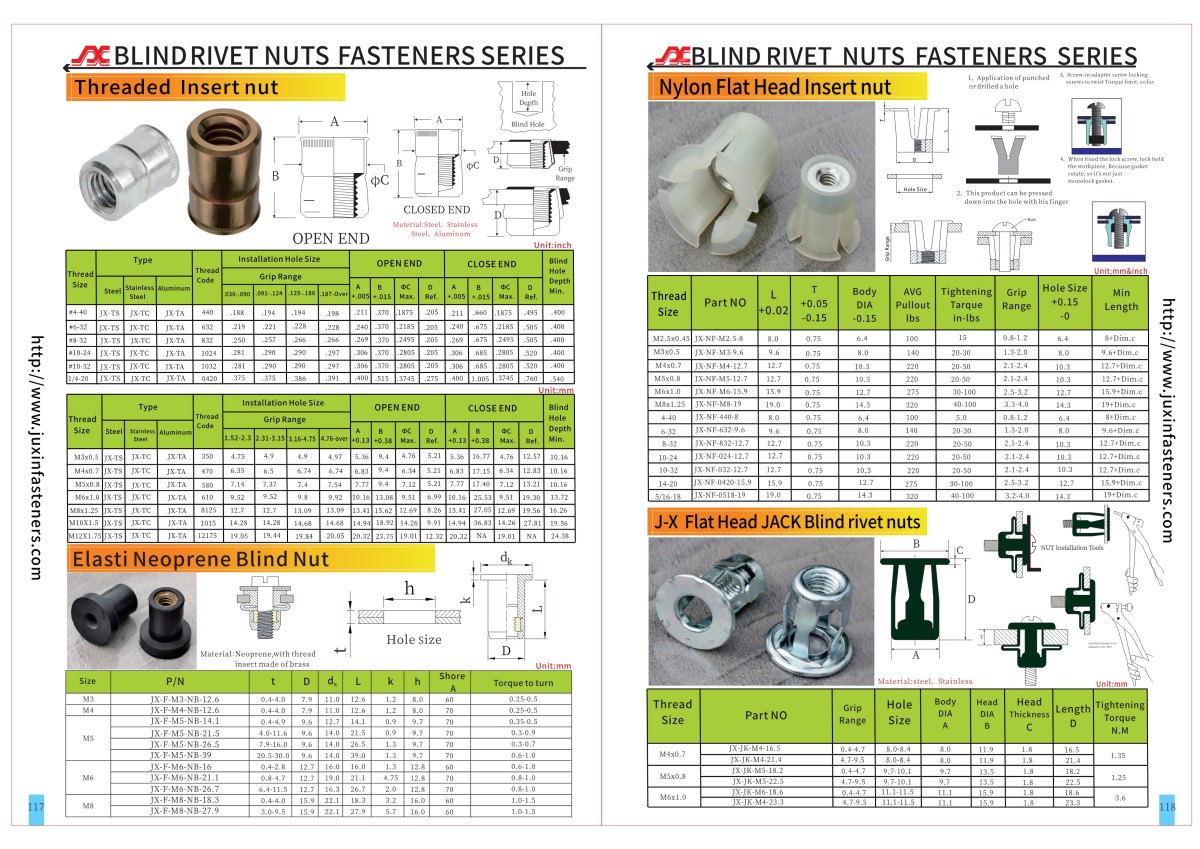
JUXIN FASTENERS supplies rubber-coated rivet nuts, also known as well nuts or elastic blind threaded inserts, for fastening applications requiring vibration damping, noise reduction and one-sided installation. A metal female-threaded insert is retained inside a flexible rubber body that expands behind the panel as the mating screw is tightened. These fasteners can be evaluated for automotive panels, motorcycles, HVAC equipment, electrical enclosures and sensitive equipment mounting. Material combinations and installed performance should be selected according to the application.
Thread Sizes: M3, M4, M5, M6, M8
Metal Insert Options: Steel, Stainless Steel, Copper
Flexible Body: Rubber (specific compound to be confirmed)
Color: Black
Grip Range: 0.4–9.5 mm (product family; verify by part number)
Thread Configuration: Internal Female Metric Thread
Installation: One-Sided Screw-Activated Expansion
Primary Functions: Threaded Retention, Vibration Damping, Noise Decoupling
Electrical and Moisture Protection: Application-dependent; verification required
Product Specification
Product Specifications — Rubber-Coated Rivet Nuts and Vibration-Damping Well Nuts
JUXIN FASTENERS supplies rubber-coated rivet nuts, also known as rubber well nuts, rubber expansion nuts and elastic blind threaded inserts, for OEM applications requiring removable threaded connections, vibration damping and installation from one accessible side.
These fasteners combine a flexible rubber body with an internal female-threaded metal insert. When a compatible mating screw is tightened, the insert draws against the elastomer body, causing it to expand behind the mounting panel and form a retaining feature.
Unlike conventional all-metal blind rivet nuts, which are normally installed by permanently deforming a metal sleeve with a setting tool, rubber well nuts are typically activated by tightening the mating screw.
This construction can help reduce direct vibration transmission between connected components, accommodate limited assembly movement and provide a compliant mounting interface.
Actual sealing, electrical insulation, load capacity and environmental performance depend on the selected material, geometry and installation conditions.
Technical Product Data
Product Type: Rubber-Coated Rivet Nut / Rubber Well Nut
Alternative Names: Rubber Expansion Nut, Elastic Blind Threaded Insert, Vibration-Damping Rivet Nut
Metric Thread Sizes: M3, M4, M5, M6, M8
Metal Insert Material Options: Steel, Stainless Steel, Copper
Elastomer Body: Rubber
Rubber Compound: Subject to approved specification
Color: Black
Grip Range: 0.4–9.5 mm across the product family
Thread Configuration: Internal Female Metric Thread
Head Configuration: According to approved drawing
Body Diameter and Length: According to approved drawing
Installation Method: One-Sided Screw-Activated Expansion
Washer Configuration: According to selected design
Electrical Isolation: Subject to complete assembly verification
Moisture Sealing: Subject to installation and application testing
Vibration-Damping Performance: Subject to application-specific validation
Temperature Range: Not established without confirmed elastomer specification
Mechanical Load Ratings: Subject to part-specific qualification
The supplied grip range applies to the product family. Individual thread sizes, body lengths, mounting-hole requirements and grip ranges must be verified against the selected part drawing.
What Are Rubber-Coated Rivet Nuts?
Rubber-coated rivet nuts are fastening components that combine a metal female-threaded insert with a compliant rubber body.
They are commonly called well nuts in the United States.
The rubber body is inserted into a prepared mounting hole from one side of a panel.
When a mating screw is tightened, the metal insert is drawn toward the accessible side, causing the rubber body to expand behind the panel.
The resulting compression helps retain the fastener and provides a threaded attachment point.
The rubber material can also introduce compliance between the connected components.
This makes rubber well nuts useful in selected applications involving vibration, noise, delicate panels or differential movement.
However, they should not automatically be considered substitutes for structural threaded connections.
Rubber Well Nuts vs. Conventional Metal Rivet Nuts
Rubber Well Nuts
Use an elastomer body with an embedded metal threaded insert.
The rubber body typically expands when the mating screw is tightened.
They may provide vibration damping and a compliant mounting interface.
Conventional Metal Blind Rivet Nuts
Use a deformable metal body.
They are generally installed with a compatible rivet nut setting tool.
Their retention depends on permanent mechanical deformation of the metal body.
The two fastening systems differ in installation behavior, stiffness, load transfer and service characteristics.
A metal blind rivet nut should not be replaced by a rubber well nut without reviewing the required mechanical performance.
Screw-Activated Expansion Principle
A typical rubber well nut operates through controlled compression of its elastomer body.
The process involves:
Preparing a mounting hole according to the approved drawing.
Inserting the rubber body into the hole from the accessible side.
Positioning the mating component and compatible screw.
Engaging the screw with the embedded female-threaded insert.
Tightening the screw using the approved installation procedure.
Drawing the metal insert toward the accessible surface.
Expanding the rubber body behind the panel.
Creating a compressed retaining feature.
The installed geometry depends on the fastener design, rubber properties, panel thickness and applied tightening conditions.
Excessive tightening can damage the rubber body, distort the panel or compromise the connection.
The correct tightening procedure must be determined for the selected part.
Engineering Information Gain — Three Functions, Three Different Acceptance Criteria
Rubber-coated rivet nuts are often described as vibration-damping, insulating and sealing fasteners.
These functions are related but must be evaluated separately.
Mechanical Retention
The installed fastener must retain the mating component under the specified loading conditions.
Vibration and Noise Decoupling
The elastomer must provide the required dynamic behavior over the operating frequency, temperature and load range.
Environmental or Electrical Isolation
The assembled joint must meet the specified moisture protection or electrical requirements.
A fastener that provides satisfactory vibration damping does not automatically provide watertight sealing.
Similarly, a rubber body does not guarantee complete electrical isolation if a screw, washer or other conductive component bridges the insulated interface.
OEM qualification should therefore define separate acceptance criteria for each required function.
Vibration Damping and Noise Decoupling
The elastomer body can reduce direct rigid contact between selected connected components.
Depending on the design, this may help attenuate vibration transmission and associated structure-borne noise.
Potential applications include:
Equipment covers near vibrating machinery
Automotive trim and accessory panels
Motorcycle mounting components
HVAC equipment housings
Sensitive instrument enclosures
Light equipment supports
Actual damping performance depends on:
Elastomer compound
Material hardness
Compression level
Excitation frequency
Temperature
Joint geometry
Static preload
Dynamic loading
Aging and environmental exposure
No specific vibration attenuation percentage or acoustic reduction rating is claimed.
Vibration Isolation Is Not the Same as Thread Locking
The flexible body can contribute to vibration decoupling between components.
However, vibration damping and resistance to screw loosening are different engineering requirements.
Vibration Damping
Concerns the transmission and dissipation of dynamic energy.
Thread Loosening Resistance
Concerns maintaining the intended threaded-joint condition during service.
The selected well nut should be evaluated for the required screw retention and service conditions.
Additional joint design measures may be necessary where vibration-induced loosening is a concern.
Electrical Isolation and Conductive Bypass Paths
Rubber materials can provide electrical insulation when the selected compound and geometry are appropriate.
However, electrical isolation depends on the complete installed assembly.
Potential conductive bypass paths include:
Mating screws
Metal washers
Mounting brackets
Exposed metal inserts
Adjacent conductive components
Grounding hardware
For example, a rubber body may separate the metal insert from the mounting panel, while a mating screw and metal bracket may still create an alternative conductive path.
Electrical isolation must therefore be verified across the intended connection points.
No dielectric strength, insulation resistance or electrical safety rating is claimed.
Moisture Sealing and Environmental Protection
Compression of the rubber body may help reduce moisture entry around a mounting hole.
Actual sealing performance depends on:
Rubber compound
Flange geometry
Panel surface condition
Mounting-hole dimensions
Installed compression
Screw and washer arrangement
Environmental exposure
Material aging
A rubber-coated rivet nut should not automatically be described as waterproof.
No IP rating, immersion capability or marine certification is claimed.
Where environmental sealing is critical, the assembled joint should be tested according to the applicable equipment requirements.
Metal Insert Material Selection
The confirmed material options include steel, stainless steel and copper.
Steel Insert
May be evaluated where the required mechanical characteristics and surface protection are suitable.
Stainless Steel Insert
May be evaluated where the specified stainless steel grade provides suitable corrosion and mechanical characteristics.
Copper Insert
May be evaluated where its properties meet the approved threaded-insert design requirements.
Copper and brass are different material designations.
A copper insert should not automatically be described as brass unless the actual alloy has been confirmed.
For all three options, the exact material grade, mechanical properties and surface treatment must be established through the approved specification.
Rubber Compound Selection
The flexible body is confirmed as rubber, but the exact compound has not been specified.
Different elastomers may offer different combinations of:
Flexibility
Compression behavior
Temperature resistance
Oil resistance
Chemical resistance
Weathering resistance
Electrical properties
Aging characteristics
Vibration damping
Materials such as EPDM, silicone rubber and other elastomers may be considered during engineering selection.
They should not be represented as confirmed available production materials without verification.
Elastomers vs. Thermoplastic Elastomers
Conventional rubber elastomers and thermoplastic elastomers can differ in processing, mechanical behavior and environmental characteristics.
Potential material families for engineering evaluation include:
EPDM
May be considered for selected weathering and water-exposure requirements, subject to compound-specific compatibility.
Silicone Rubber / VMQ
May be considered where temperature behavior and flexibility are important, subject to the actual formulation.
TPE-V
A thermoplastic vulcanizate family that may be considered for certain flexible fastening components.
TPC-EE
A thermoplastic copolyester elastomer family that may be considered where particular mechanical and environmental characteristics are required.
These are material-selection references, not confirmed specifications for this product.
Temperature ranges, chemical resistance and mechanical ratings must be verified for the actual compound and finished fastener.
Temperature and Chemical Resistance
Operating temperature is a critical selection parameter for elastomer fasteners.
A suitable material must maintain the required compression behavior and mechanical function throughout the expected service conditions.
Engineers should consider:
Continuous operating temperature
Short-term temperature excursions
Thermal cycling
Compression set
Oil exposure
Fuel exposure
Cleaning chemicals
UV exposure
Ozone exposure
Moisture
Aging
No universal operating temperature range is assigned to this product family.
The approved rubber formulation and application conditions determine suitability.
Grip Range and Panel Thickness
The supplied product-family grip range is 0.4–9.5 mm.
Approximate inch references:
0.4 mm = 0.016 in
9.5 mm = 0.374 in
Grip range describes the panel thickness accommodated by a particular fastener configuration.
It should not be confused with rubber body length or installed expansion length.
Individual M3, M4, M5, M6 and M8 products may have different grip ranges.
The approved part drawing must be checked before selection.
Metric Thread Sizes and Inch References
Confirmed metric thread sizes:
M3
M4
M5
M6
M8
Approximate nominal diameter references:
M3 = 0.118 in
M4 = 0.157 in
M5 = 0.197 in
M6 = 0.236 in
M8 = 0.315 in
These are dimensional conversions only.
They do not establish equivalent UNC, UNF or BSW threads.
ISO 261 and ISO 965 provide relevant references for ISO metric thread series and tolerances.
The actual internal thread pitch and tolerance must be verified from the approved drawing.
American or British thread configurations may be evaluated as customer-specific requirements, subject to manufacturing feasibility.
No additional inch thread sizes are claimed as standard stock items.
Mounting-Hole Dimensions and Fit
The rubber body must fit the prepared mounting hole correctly.
Important characteristics include:
Hole diameter
Hole tolerance
Panel thickness
Hole edge condition
Flange seating
Rubber body diameter
Body length
Installed expansion geometry
An oversized hole may reduce retention.
An undersized hole may damage the rubber body or prevent proper installation.
The mounting-hole size must come from the approved drawing rather than a general rivet nut diameter chart.
Compression and Installation Torque
The installation torque influences how the elastomer body compresses and expands.
Insufficient tightening may leave the fastener inadequately retained.
Excessive tightening may damage the rubber body, mating screw or parent panel.
Torque selection depends on:
Thread size
Metal insert material
Rubber compound
Body geometry
Panel thickness
Mating component
Washer configuration
Required compression
Intended service loading
No universal tightening torque is claimed.
Installation settings must be established through the approved product and assembly requirements.
Removability and Repeated Assembly
Rubber well nuts can provide a connection that is assembled using a conventional mating screw.
Depending on the design and installed condition, the connection may be loosened and disassembled.
However, the ability to remove the screw does not establish that the rubber insert can be reused indefinitely.
Repeated assembly may change:
Rubber compression
Insert retention
Thread condition
Sealing behavior
Installed preload
Where repeated maintenance is expected, the OEM should define inspection and replacement criteria.
Washer and Non-Washer Configurations
Some elastomer fastening systems incorporate a washer or other bearing component.
A washer may influence load distribution, seating behavior and interaction with the mating component.
For a slotted hole or a softer mating component, a washer may be considered as part of the joint design.
However, washer selection must be based on the actual fastener geometry and engineering requirements.
The supplied product information does not confirm which washer configurations are available for every size.
Washer-equipped and washer-free versions should therefore be treated as drawing-dependent configurations.
Slotted Holes and Tolerance Accommodation
A compliant rubber fastener may help accommodate limited geometric variation in an assembly.
However, a slotted mounting hole introduces additional design considerations.
The engineer should evaluate:
Slot dimensions
Flange support
Washer geometry
Rubber body expansion
Assembly movement
Retention requirements
Edge distance
Service loading
A rubber well nut should not automatically be approved for every slotted-hole application.
The complete joint geometry requires verification.
Axial Pull-Out and Shear Loading
Installed axial retention depends on the expanded rubber body and its interaction with the panel.
Shear loading introduces additional deformation and load-transfer conditions.
Relevant factors include:
Rubber compound
Metal insert geometry
Panel thickness
Hole dimensions
Installed compression
Load direction
Temperature
Dynamic loading
Aging
Rubber-coated rivet nuts should not automatically be assigned the same pull-out or shear ratings as all-metal blind rivet nuts.
No specific load capacity is claimed.
Applications with significant structural or safety-critical loads require separate engineering validation.
Engineering Information Gain — Why a Stronger Metal Insert May Not Produce a Stronger Joint
An OEM buyer may assume that changing a steel insert to stainless steel or another metal will increase the overall fastening capacity.
However, the joint may be limited by the rubber body rather than the internal metal thread.
Possible governing failure mechanisms include:
Rubber tearing
Excessive compression
Pull-through at the mounting hole
Insert movement within the elastomer
Thread damage
Parent-panel deformation
Long-term compression relaxation
The complete assembly must be evaluated to determine which component limits performance.
A stronger metal insert alone does not guarantee a higher installed load rating.
Engineering Information Gain — Dynamic Isolation vs. Positional Stability
An elastomer connection can help reduce transmitted vibration because it permits controlled deformation.
However, the same compliance may allow movement under load.
This creates a design trade-off.
A very stiff connection may provide more precise positioning but transmit more vibration.
A more compliant connection may reduce transmitted vibration but allow greater displacement.
The correct balance depends on:
Equipment mass
Operating frequency
Required alignment
Static load
Dynamic load
Temperature
Allowable movement
Fatigue requirements
For sensitive equipment, both vibration behavior and positional stability should be evaluated.
Automotive Applications
Potential applications include selected:
Trim and accessory panels
Spoiler-related non-structural components
Equipment covers
Air-management components
Light mounting brackets
Vibration-sensitive housings
Automotive applications may involve vibration, thermal cycling, moisture and repeated service access.
The specific material and assembly must be approved for the intended environment.
No safety-critical automotive qualification is implied.
Motorcycle Applications
Rubber well nuts may be evaluated for:
Fairing panels
Selected covers
Accessory housings
Light mounting points
Filter-related components
Relevant requirements include vibration exposure, panel material, rubber durability and maintenance procedures.
Installation torque and rubber compression must be controlled to avoid damaging fragile components.
HVAC and Refrigeration Equipment
Potential applications include:
Equipment covers
Light mounting brackets
Control housings
Service panels
Vibration-sensitive accessory supports
Engineers should consider vibration frequency, temperature, moisture, condensate exposure and cleaning conditions.
The selected elastomer must be compatible with the actual operating environment.
Electrical and Electronics Equipment
Rubber-coated threaded inserts may be considered for selected:
Control cabinets
Electronic enclosures
Instrument housings
Sensitive measurement equipment
Circuit board support arrangements
Switchgear accessory panels
Electrical isolation and mechanical support must be evaluated independently.
A rubber well nut is not automatically an approved insulating support for electrical safety applications.
Agricultural Machinery and Outdoor Equipment
Potential applications include selected non-critical:
Equipment covers
Tractor accessory panels
Agricultural machine housings
Garden equipment panels
Lawn equipment covers
Relevant conditions include vibration, dirt, water, temperature variation, UV exposure and contact with oils or fuels.
The selected rubber compound and metal insert must be suitable for the intended service conditions.
Telecommunications and Industrial Enclosures
Rubber-coated rivet nuts may be evaluated where equipment requires:
One-sided access
Vibration decoupling
Compliant mounting
Reduced direct metal contact
Serviceable threaded connections
For outdoor telecommunications enclosures, sealing and weathering performance require separate verification.
For sensitive electronic equipment, the effect of joint compliance on positioning and grounding should also be considered.
Engineering Example — Vibrating Equipment Cover
Consider an industrial equipment cover attached to a panel near a vibrating motor.
The design requires an M5 threaded attachment point accessible from one side.
A rubber-coated rivet nut may be evaluated to reduce direct vibration transmission.
Before approval, the engineering team should confirm:
Panel material
Panel thickness
Mounting-hole dimensions
Rubber body diameter and length
Metal insert material
Elastomer compound
M5 thread specification
Available blind-side clearance
Mating screw length
Installation torque
Required static retention
Vibration frequency and amplitude
Allowable movement
Operating temperature
Moisture exposure
Maintenance requirements
The presence of rubber alone does not establish satisfactory vibration isolation.
The installed assembly should be evaluated under representative operating conditions.
Engineering Example — Sensitive Electronic Housing
Consider an electronic equipment enclosure where the designer wants to reduce direct mechanical vibration transmission.
An M4 rubber well nut may be considered for a selected housing attachment.
The design review should address:
Static support requirements
Dynamic movement
Panel stiffness
Electrical isolation
Grounding strategy
Tool access
Mating screw engagement
Rubber aging
Environmental exposure
If the housing requires precise rigid alignment, a compliant rubber fastener may not be appropriate without additional positioning features.
OEM Procurement and Supplier Qualification
For purchasing managers and supplier development teams, rubber-coated rivet nuts should be evaluated as multi-material engineered components.
Important sourcing characteristics include:
Metal Insert
Material grade, thread dimensions and insert geometry.
Rubber Body
Compound identification, hardness requirements and relevant environmental properties.
Dimensional Compatibility
Body diameter, body length, flange geometry and mounting-hole requirements.
Installed Performance
Retention, compression, vibration behavior and required environmental performance.
Quality Documentation
Drawing revision, inspection criteria, material requirements and traceability.
Commercial Requirements
Order quantity, forecast demand, delivery schedule and packaging.
Change Control
Approval requirements for changes to the rubber formulation, metal insert, dimensions or manufacturing process.
Changes to the rubber compound may affect performance even when the visible dimensions remain unchanged.
Information Gain — Why Rubber Material Traceability Matters
For an all-metal fastener, dimensional inspection and metal material identification may cover many important purchasing requirements.
For an elastomer fastener, dimensional equivalence alone may not be sufficient.
Two black rubber bodies may have similar appearance but different:
Hardness
Compression set
Chemical resistance
Aging behavior
Temperature performance
Vibration response
Electrical properties
An OEM supplier substitution should therefore evaluate the actual rubber formulation or approved material specification.
Color alone is not a reliable material identification method.
Engineering Standards and Qualification References
Relevant standards should be selected according to the actual application and required test method.
ISO 261 — ISO general-purpose metric screw thread combinations.
ISO 965 — Tolerances for ISO metric screw threads.
ISO 273 — Clearance holes for bolts and screws, where relevant to the mating component design.
ISO 37 — Tensile stress-strain properties of vulcanized or thermoplastic rubber.
ISO 48 Series — Rubber hardness measurement methods.
ISO 815-1 — Compression set determination under specified conditions.
ISO 1817 — Effect of liquids on vulcanized or thermoplastic rubber.
ASTM D2240 — Rubber hardness using a durometer.
ASTM D395 — Compression set of rubber.
ASTM D471 — Effect of liquids on rubber properties.
These standards are potential design and testing references.
They do not establish that the finished JUXIN product has been tested, certified or manufactured to every listed standard.
Actual test methods and acceptance criteria must be defined in the approved customer specification.
Frequently Asked Questions
What are rubber-coated rivet nuts?
They are threaded fasteners combining a metal insert with a rubber body that expands behind a panel when a mating screw is tightened.
Are rubber-coated rivet nuts also called well nuts?
Yes. Well nuts is a common commercial name for this type of rubber-bodied blind threaded insert.
Can rubber well nuts be installed from one side?
Yes. Their construction allows insertion and screw-activated expansion from the accessible side.
Do well nuts require a special rivet nut setting tool?
Many conventional well nut designs are activated by tightening a mating screw rather than using a separate metal rivet nut setting tool. The actual installation procedure must follow the selected product specification.
How do you keep rivnuts from spinning?
For rubber well nuts, resistance to rotation depends on the rubber body's interaction with the mounting hole, compression and joint geometry. Correct hole dimensions and installation conditions are essential. Metal rivet nuts may use different anti-rotation features.
What are the disadvantages of a rivnut?
The disadvantages depend on the type. Rubber well nuts can have limitations involving load capacity, creep, compression relaxation, chemical compatibility and temperature. All-metal rivet nuts have different installation and material considerations.
How much weight will a rivnut hold?
There is no universal value. Capacity depends on the fastener design, parent material, hole geometry, installation and loading direction. Product-specific qualification is required.
What is better than rivnuts?
There is no universally superior alternative. Weld nuts, self-clinching nuts, conventional metal blind rivet nuts and rubber well nuts serve different installation and mechanical requirements.
Are rubber well nuts waterproof?
Not automatically. They may contribute to sealing, but waterproof performance must be verified for the complete assembly.
Are rubber well nuts electrically insulating?
They may provide insulation where the selected compound and joint geometry are appropriate. Conductive bypass paths must be evaluated.
Can well nuts be reused?
Reusability depends on the design and condition after installation or removal. Rubber damage and compression relaxation must be considered.
Are American or British threads available?
The confirmed product sizes are metric M3, M4, M5, M6 and M8. Other thread systems may be reviewed as customer-specific requirements, subject to confirmation.
Related Industrial Fastening Solutions
Engineers and purchasing teams may also consider these related fastening categories.
Thin Head Blind Rivet Nuts — for one-sided internal threaded mounting points with reduced head projection.
Flat Head Blind Rivet Nuts — for conventional mechanical blind threaded insert applications.
Knurled Body Blind Rivet Nuts — for alternative installed rotational resistance characteristics.
Hexagonal Body Blind Rivet Nuts — for polygonal mounting-hole engagement.
Stainless Steel Blind Rivet Nuts — for applications requiring a specified stainless steel material system.
Blind Rivet Studs — for one-sided assemblies requiring external male threaded mounting points.
Self-Clinching Nuts — for suitable press-installed sheet-metal applications.
Weld Nuts — for assemblies designed around an approved welding process.
Custom Industrial Fasteners — for drawing-based OEM fastening requirements.
These product names are intended as contextual internal-link anchor texts. Links should be added only to verified relevant live product pages.
OEM RFQ Checklist
For an accurate quotation and technical review, please provide:
Required metric thread size
Engineering drawing or CAD file
Metal insert material
Rubber compound specification
Rubber hardness requirements
Flange diameter and thickness
Rubber body diameter and length
Parent-panel material
Panel thickness
Required grip range
Mounting-hole dimensions
Mating screw specification
Washer requirements
Installation torque or procedure
Static load requirements
Vibration and noise requirements
Electrical isolation requirements
Moisture sealing requirements
Operating temperature
Chemical exposure
Required qualification testing
Initial order quantity
Estimated annual demand
Packaging and traceability requirements
Where available, submit the existing fastener drawing and application details to support technical equivalence review.
JUXIN FASTENERS — Rubber Well Nut OEM Supply
JUXIN FASTENERS supplies industrial fastening products for international OEM engineers, equipment manufacturers, procurement managers and supplier development teams.
Our rubber-coated rivet nuts provide an alternative fastening approach for applications requiring internal threaded attachment points, one-sided installation and compliant elastomer mounting.
The confirmed product family includes M3, M4, M5, M6 and M8 metric thread sizes with steel, stainless steel or copper insert material options and black rubber bodies.
For automotive equipment, motorcycles, HVAC systems, electrical enclosures, telecommunications equipment and industrial machinery, the correct configuration should be selected according to the approved drawing and operating requirements.
Request an OEM Technical Quotation
Email: info@juxinfasteners.com
Website: www.juxinfasteners.com
Please send your engineering drawing, required thread size, metal insert material, rubber requirements, panel thickness, mounting-hole dimensions and purchasing quantity.
JUXIN FASTENERS — Industrial Fastening Solutions for OEM Engineering and Global Procurement.
Product Packaging
Product Packaging — Rubber-Coated Rivet Nuts and Well Nuts
Packaging for M3, M4, M5, M6 and M8 rubber-coated rivet nuts is subject to the confirmed product configuration, order quantity and customer requirements.
Protective Packaging: Suitable arrangements may be specified to help protect rubber bodies, flange surfaces and internal metal threads during handling and transportation.
Rubber Protection: Packaging requirements should consider deformation, compression, contamination and exposure to conditions that may affect the selected elastomer compound.
Material Segregation: Different metal insert materials, rubber compounds, thread sizes and drawing revisions should be identified and segregated according to the approved order requirements.
Outer Cartons: Carton quantities and arrangements may be reviewed according to shipment weight, product geometry and handling requirements.
Pallet Packaging: Palletized shipments may be considered for bulk OEM orders, subject to confirmation.
Product Identification: Customer-specified labels may identify the part number, thread size, insert material, rubber specification, quantity, lot number and drawing revision.
Lot Traceability: Material and production traceability requirements should be defined in the approved purchasing and quality documentation.
OEM Packaging: Customer-specific packing quantities, labeling, component segregation and logistics instructions are subject to review.
Final packaging details will be confirmed against the approved purchase order.
For OEM quotations and packaging requirements:
Email: info@juxinfasteners.com
Website: www.juxinfasteners.com
Product Pictures
Tags
Contact Us
Tel.:
+86 020 8621 0320
+86 020 3121 6067
E-mail:
Technical Support:
Navigation
SEND INQUIREY